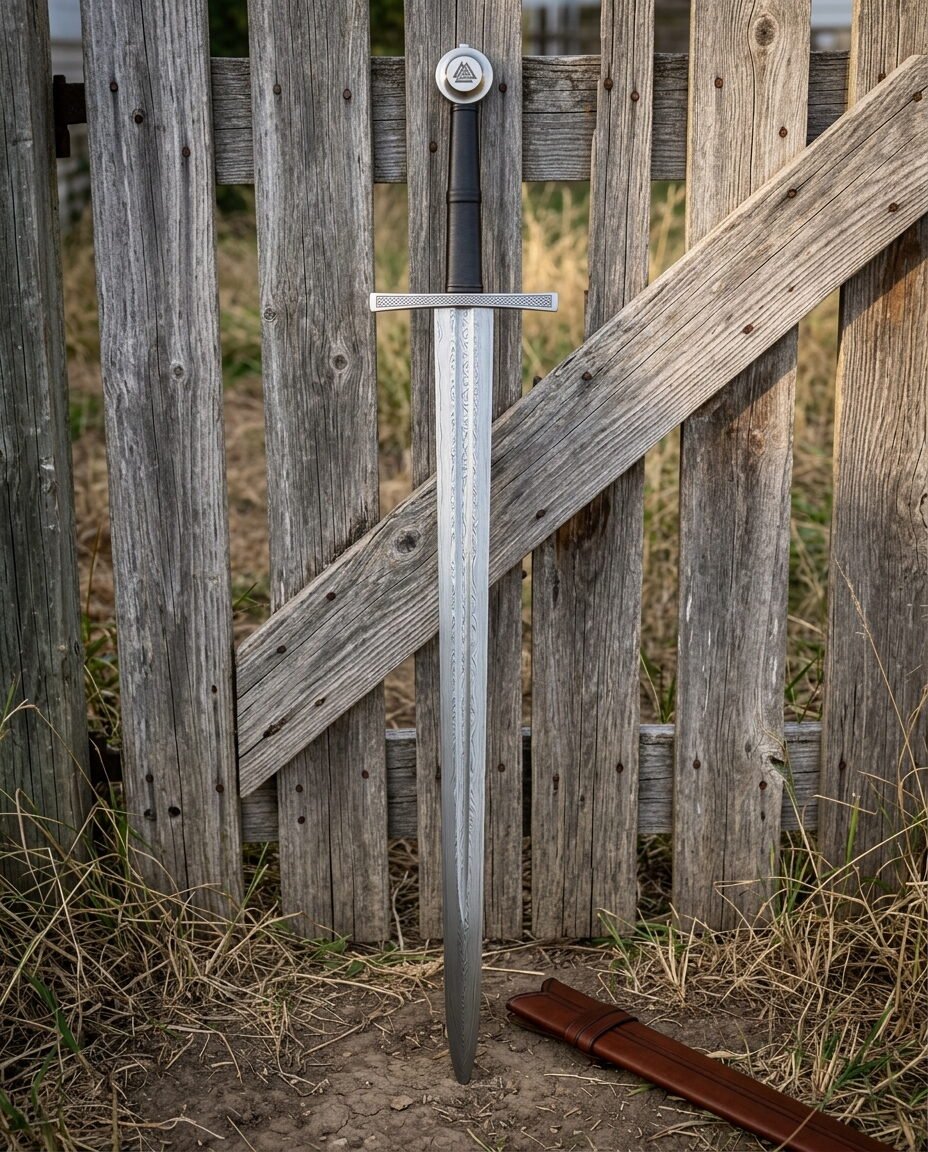
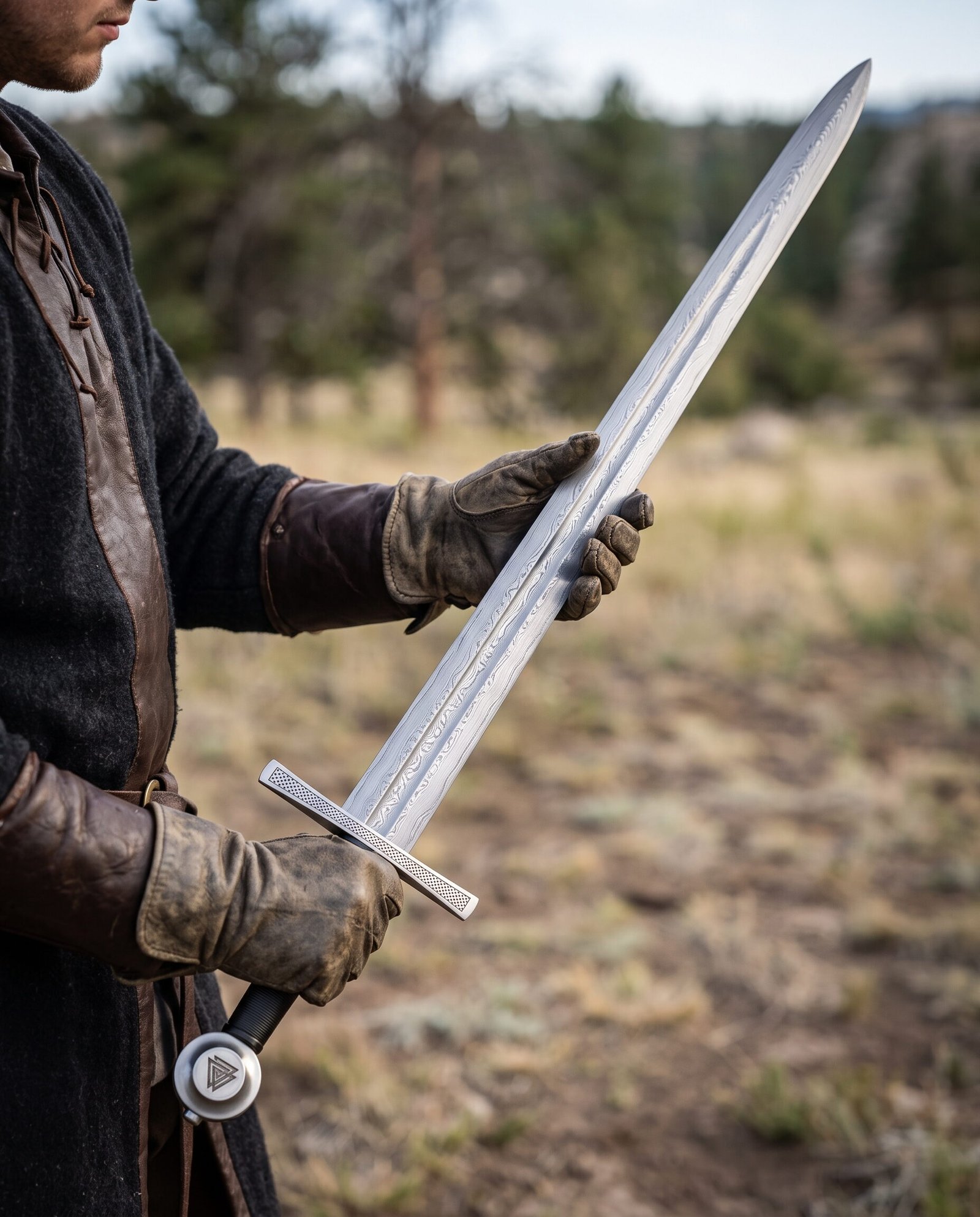
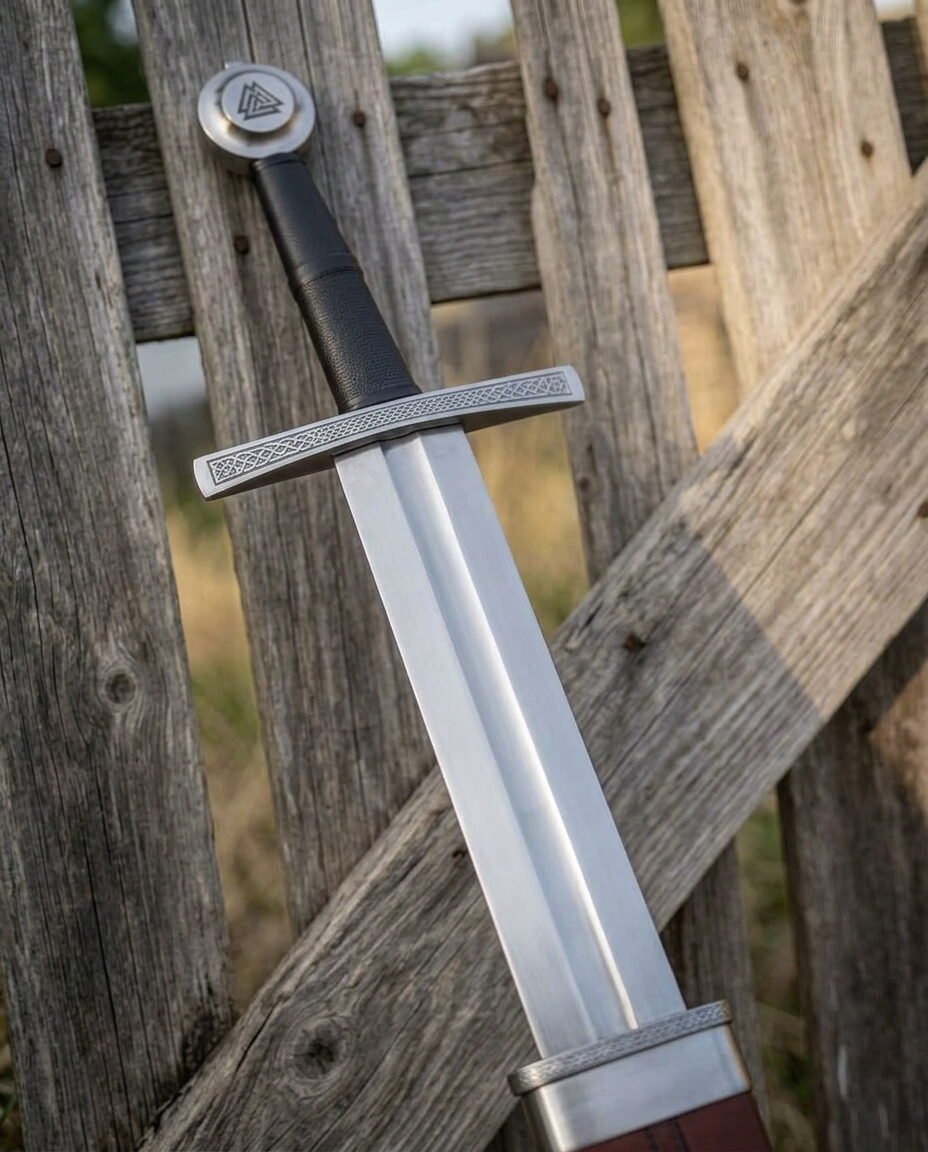
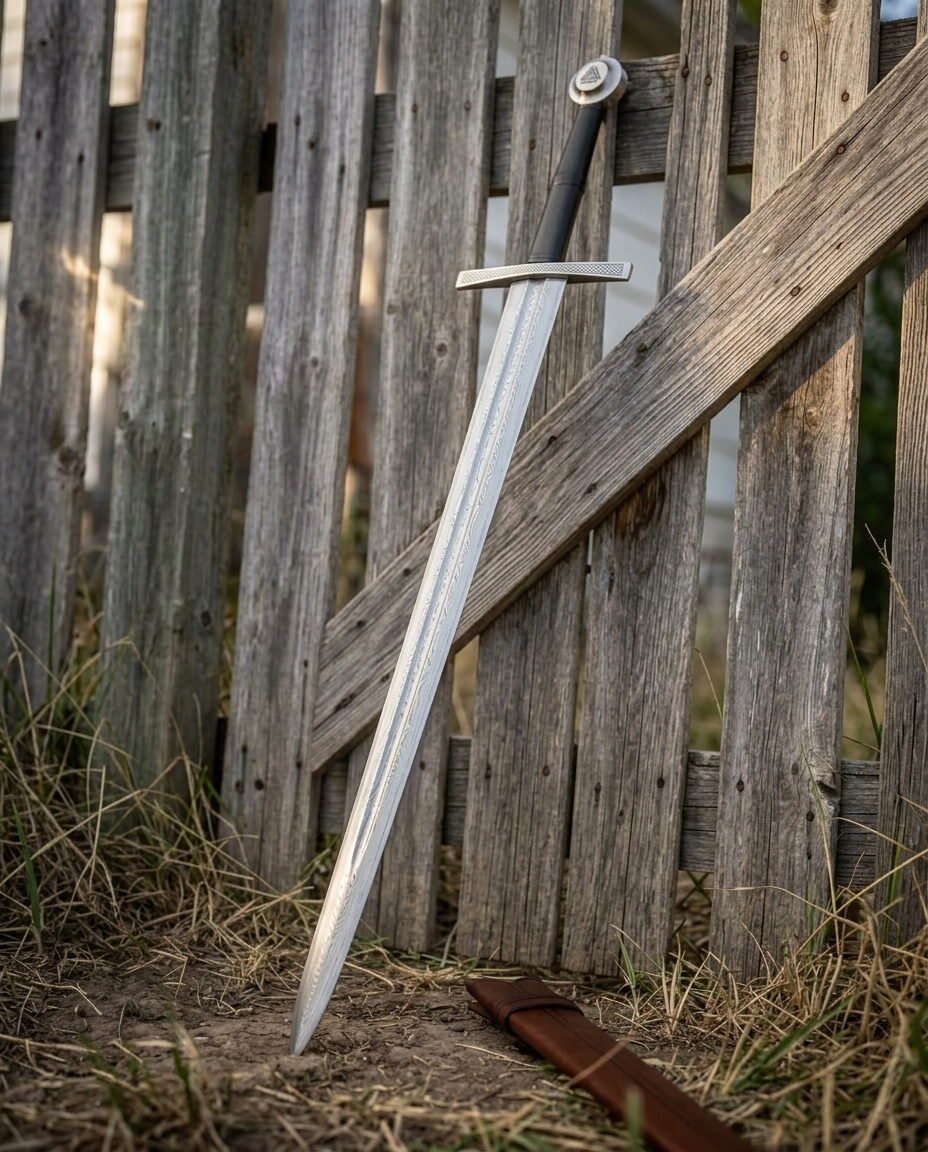
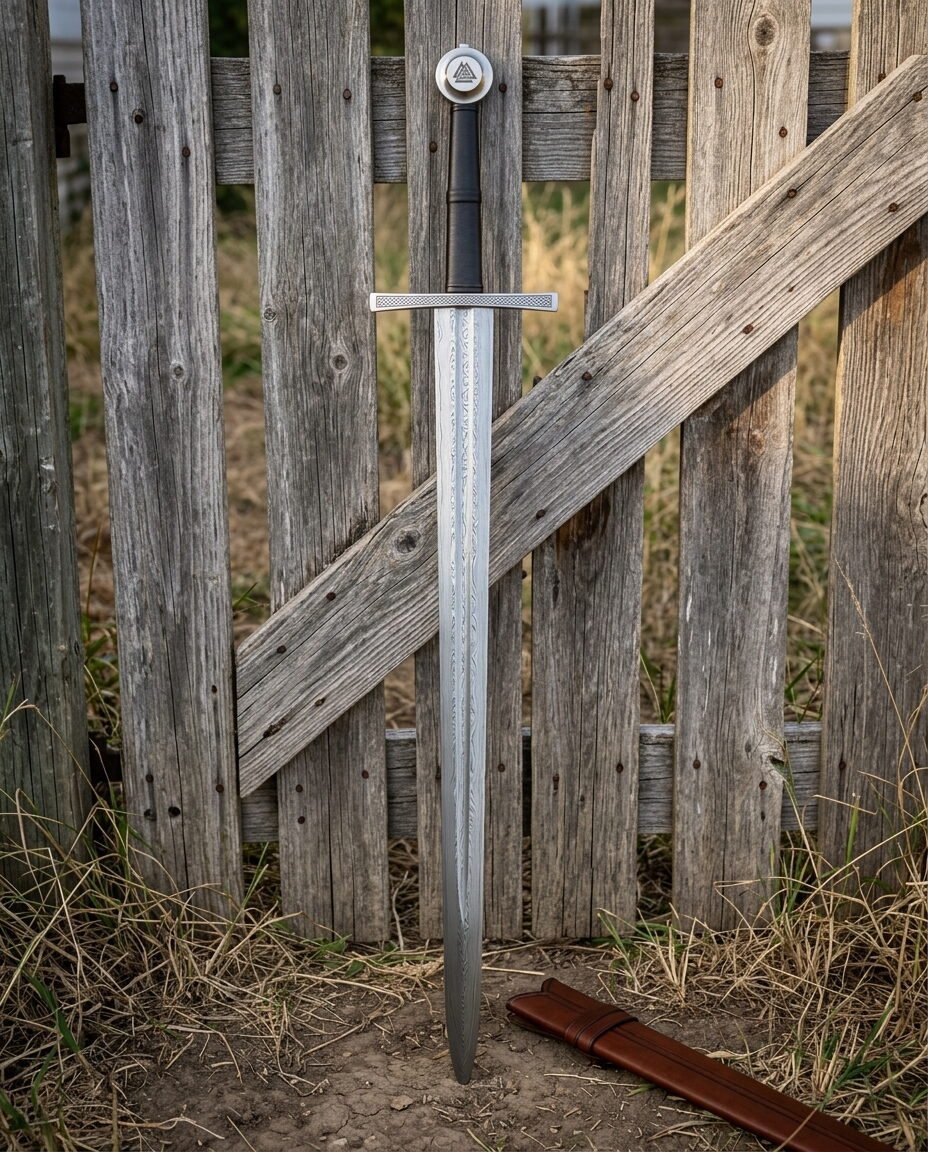
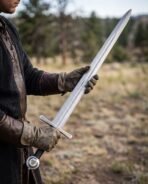
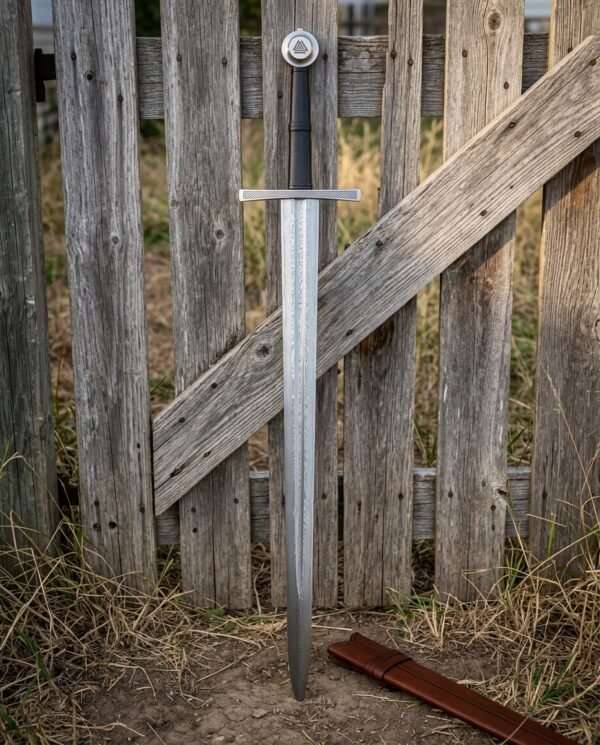
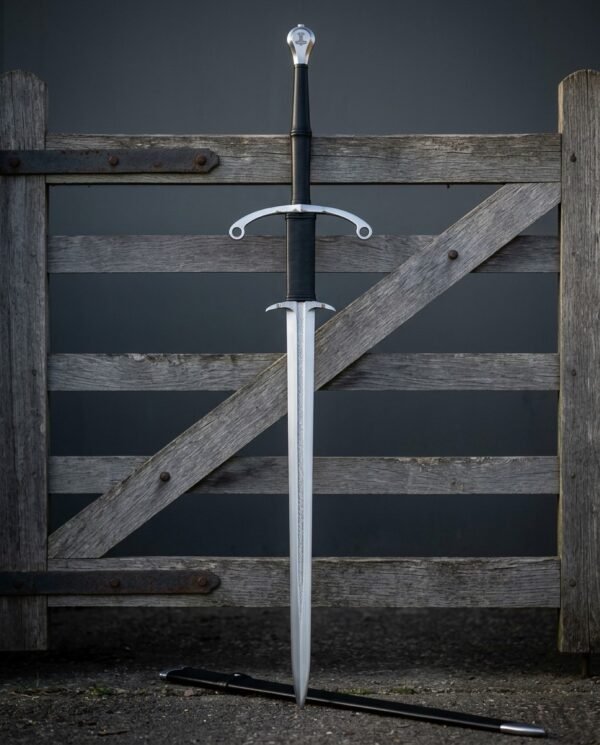
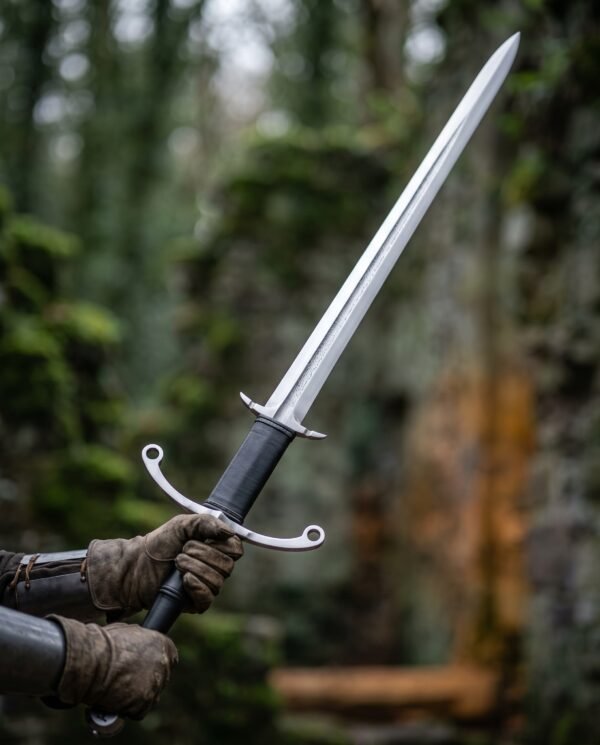
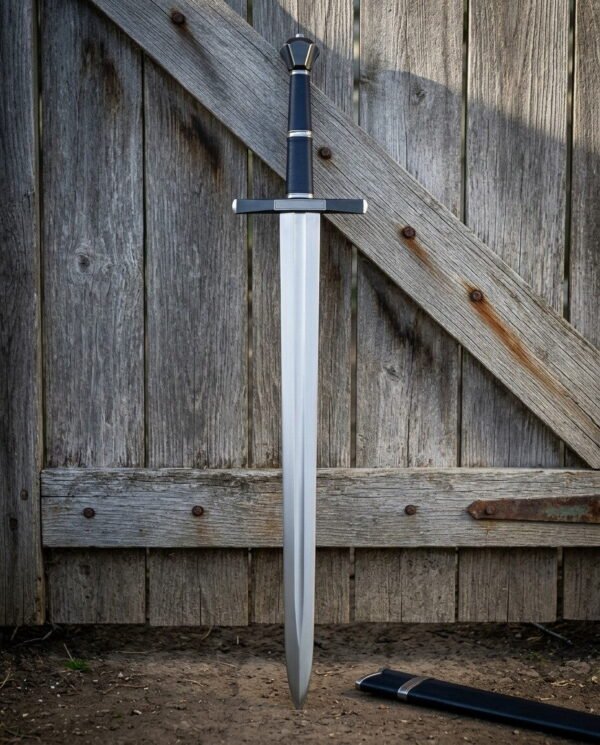
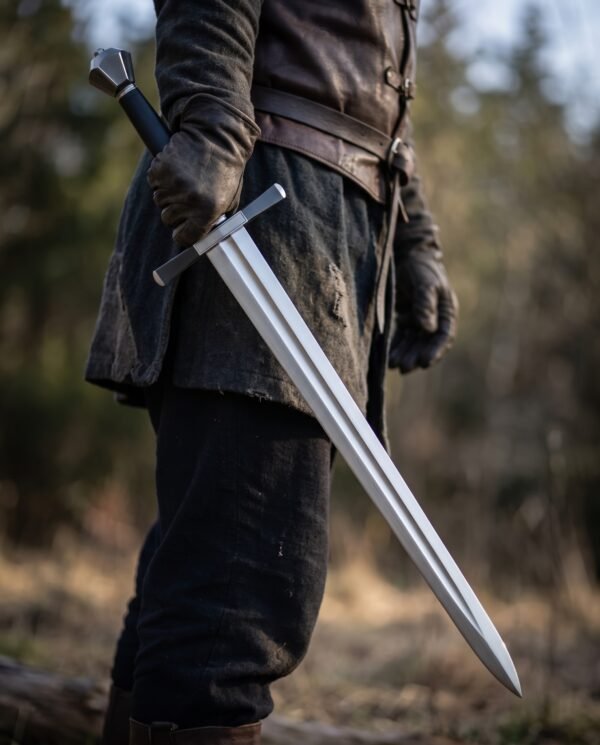
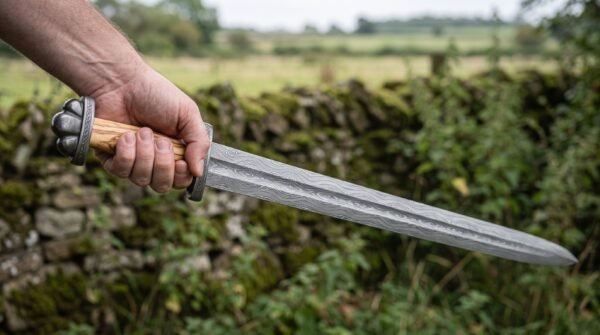
This is a two handed longsword with a blade forge welded from 1095 and 15N20, an engraved steel cross, a long black leather grip and a steel disc pommel carrying a Valknut medallion. The longsword appears in the middle of the fourteenth century and the reason is armour. As plate spread from the limbs to the torso, the shield stopped being worth carrying, because a man in a full harness was already covered. That freed the left hand, and within a couple of generations swordmakers had lengthened both the grip and the blade to use it. What followed is one of the best documented martial traditions in European history. The German fencing books attributed to Johannes Liechtenauer, and the Italian tradition of Fiore dei Liberi, describe a complete system built around four guards, a handful of master strikes and a great deal of attention to what happens after two blades meet. These are not romantic reconstructions. They are surviving manuscripts with pictures.
The billet is stacked, welded, drawn out and etched by hand in the Czech Republic. The blade carries a fine ladder pattern running the full length, the hilt is a long black leather grip over a shaped core, and it ships in a brown leather scabbard. Shipping inside the United States is free.
Specifications
| Steel | 1095 and 15N20 forge welded Damascus, hand etched ladder pattern |
|---|
| Hardness | 58 to 60 HRC |
|---|
| Blade | Double edged, tapering to the point, with a central fuller |
|---|
| Overall length | 46 inches |
|---|
| Blade length | 35 inches |
|---|
| Grip length | 9.5 inches, two handed |
|---|
| Grip | Black leather wrapped over a shaped core, with a raised ring between the two hand positions |
|---|
| Cross | Straight steel cross engraved with a knotwork band |
|---|
| Pommel | Steel disc pommel with a Valknut medallion |
|---|
| Tang | Full length, peened over the pommel |
|---|
| Scabbard | Brown leather |
|---|
| SKU | RK-1344 |
|---|
Why a longsword is longer in the grip than you expect
Look at the proportions on this sword and the grip is nearly ten inches, which is far more than two fists need. That is deliberate and it is the single feature that defines the type. The extra length is not there so you can hold it more comfortably. It is there so the two hands can be far apart, because the distance between them is the lever arm that steers the point.
Work through what that gives you. A short pull with the rear hand at the pommel produces a fast, wide movement at the tip, so a longsword changes line much faster than its length suggests. In a bind, where two blades have met and stopped, the fencer with more leverage wins, so the rear hand becomes the deciding factor rather than raw arm strength. The gap also lets you shift grip mid fight. Slide the rear hand behind the pommel and you gain several inches of reach on a thrust. Take the left hand off the grip entirely and put it on the middle of the blade, what the manuals call half swording, and you convert the sword into a short precise spear for getting a point into the gaps of a plate harness. Reverse it, hold the blade with both hands and strike with the cross and pommel, and you have the murder stroke. All of that is available because the grip is long. None of it is available on an arming sword.
Why Damascus and not stainless
The blade is a forge welded laminate of 1095 and 15N20, folded and rewelded to build the layer count, then ground and etched. The 15N20 carries about two percent nickel, which resists ferric chloride and stays bright, while the 1095 next to it darkens, and that difference is the pattern you see. The ladder figure comes from cutting or pressing straight grooves across the face of the billet before the final flattening, so the layers are pushed down in regular bars and then exposed as rungs when the surface is ground level. It is carbon steel, so it takes a patina and will rust if neglected, and in exchange the folding refines the grain and the finished blade runs at 58 to 60 HRC. Stainless buys corrosion resistance with heavy chromium, which at thirty five inches costs the toughness a sword needs most in the shoulder and tang, and stainless will not etch to a real pattern at all. The full comparison is in Damascus versus stainless.
The grip, the cross and the pommel
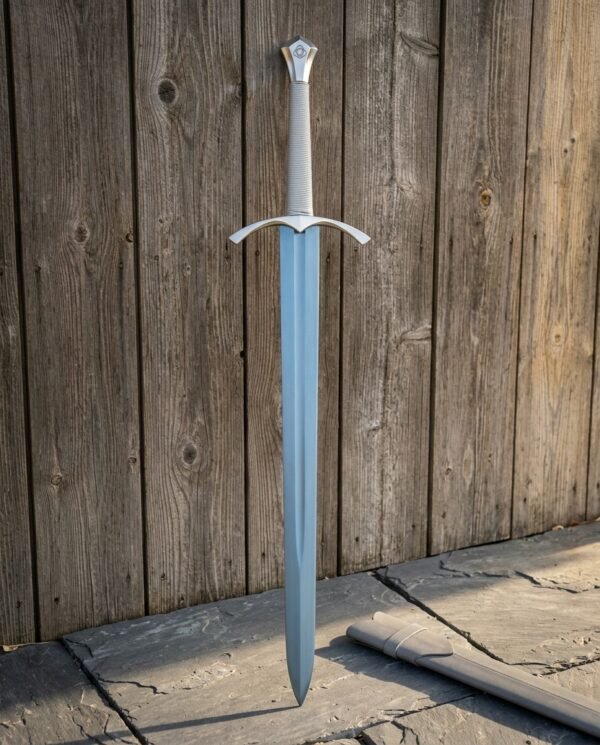
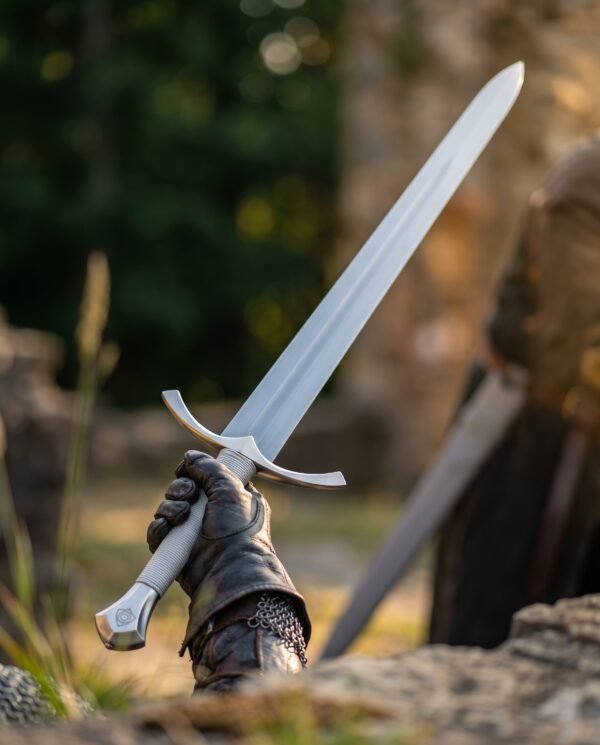
The grip is black leather over a shaped wooden core, split and fitted around the tang and glued closed. On a two handed sword the shaping is doing real work. The section nearest the cross is fuller so the leading hand fills it, and the section behind narrows toward the pommel so the rear hand can rotate freely rather than clamp. That taper is why a well made longsword feels controllable in a way that a straight cylindrical grip never does.
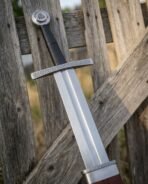
The cross is straight steel with a knotwork band engraved along its face. It is square in section, so it gives the hand a firm edge to hold in the half sword techniques and when the sword is drawn quickly from a scabbard. The disc pommel carries a Valknut medallion and is peened over the tang so the whole hilt sits under compression. Because there is wood in the grip, keep it dry, keep it out of hot cars and away from radiators, and follow our note on wooden handle care. A light leather balm on the wrap once a year keeps it supple.
Engraving, runes and your own design
Use the rune converter on this page to turn a name, a date or a short phrase into Elder Futhark and we will cut it into the steel or the handle. If you would rather have a Viking pattern than a rune line, choose your own design in the engraving option above the add to cart button and tell us whether it goes on the blade or the handle. Where a piece already carries an engraved design, your chosen engraving replaces it rather than sitting alongside it. On this longsword that means your chosen design replaces the Valknut medallion on the pommel. A thirty five inch blade also gives room for a long rune line along the flat if you would rather have it there, and on a ladder pattern we would place it low so it does not fight the rungs. Details are on the engraving page.
Care and sharpening
Etching opens the surface of a Damascus blade slightly, so it wants more care than plain steel. Dry it after handling, wipe it with light machine oil or a hard paste wax and do not leave fingerprints on it overnight in a humid room. Never store the sword sheathed for long stretches, because vegetable tanned leather holds moisture and tanning salts against steel and a thirty five inch blade rusts from the inside out where you will not see it until the damage is done. Hang the sword and keep the scabbard for carrying. A haze lifts with a clean cloth and oil without harming the pattern, which runs through the steel. Read steel care before the first outing, and sharpen with a coarse then a fine stone at a shallow angle as set out in sharpening with a whetstone, then re oil.
Made in the Czech Republic
This piece is made by hand in the Czech Republic, in a workshop that still works the old way. The steel is forged, ground, heat treated and finished by smiths who learned the trade from the people before them, and the wood, horn and leather are cut and fitted by hand rather than pressed out on a line. That is also why no two pieces come out exactly the same.
Ransack Viking is a United States company. We import these pieces ourselves, check every one when it lands and ship from our warehouse in Chicago, Illinois. Engraving is done here in the United States after the piece arrives, so your runes or your own design go on before it leaves for you.
A note on handmade variation
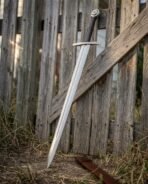
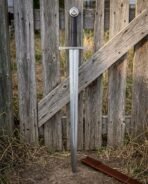
This longsword is hand forged. It is not machine made and it is not bulk produced, so what arrives will not be a pixel for pixel copy of the photograph. The ladder pattern is unique to the billet, the spacing of the rungs varies with how the steel moved under the press and the two faces of the same blade are never identical. The tone of the leather, the depth of the knotwork engraving and the crispness of the Valknut medallion all vary because each piece is worked by hand from natural materials. The dimensions, the steel and the build are the same every time. The character is not, and on a sword this size that is most of the reason to own one.
Frequently asked questions
How heavy is it?
Around three and a half pounds. That surprises people who expect a longsword to be unwieldy. Real medieval longswords sat between two and a half and four pounds, and the weight is carried close enough to the hands that the sword feels much lighter in motion than it does on a scale.
What is the difference between this and a bastard sword?
Length, mostly. A bastard sword has a grip of seven or eight inches and a blade you can still work one handed at need. This has a full two handed grip of nine and a half inches and a thirty five inch blade, and it is meant to be used with both hands almost all the time.
Is it sharp?
Yes, it arrives with a keen working edge. Ask in the order notes for a blunt display or reenactment edge and we will leave a rounded quarter inch instead at no extra cost.
Can I use it for historical fencing?
Not sharp, and not this sword. Sparring needs a purpose built blunt trainer with a flexible tip and a rolled edge. This is a display and collection piece that will also cut soft targets cleanly. Never make edge to edge contact and never throw it.
Will mine look like the photograph?
The size, shape and fittings will. The ladder pattern will not, because no two billets move identically under the press. That is what makes a forge welded blade worth having.
How long does shipping take?
Free inside the United States. Sixteen to twenty working days in the shop for a blade this long, then two to five days in transit, plus about a week if you order engraving.
What is in the box
- One hand forged 1095 and 15N20 Damascus longsword, 46 inches overall
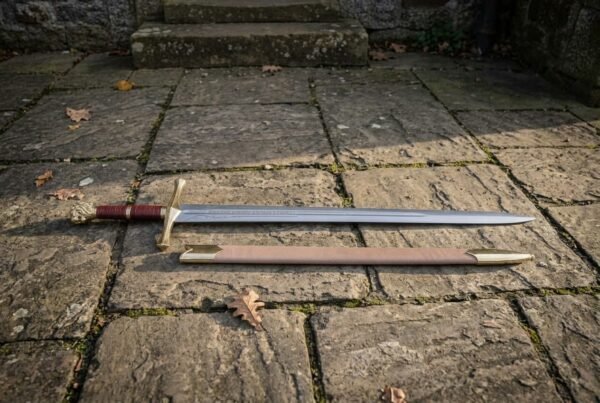
- Brown leather scabbard
- Light protective oil coat on the blade for transit
- Care and sharpening card for pattern welded steel
- Forged and finished in the Czech Republic
Explore the range
Browse the rest of the longswords, the bastard swords, every pattern welded blade in Damascus swords and everything under swords. Background reading is in the guides.
Close to this one
Closest to this in the range is the Crownweave longsword, 45 inches overall. If this one is not quite right, there is the Stormlace longsword, 45 inches overall. Also in this group is the Crownflute longsword, pattern welded Damascus.
If you are putting a set together, the Bonecrest wakizashi sits alongside it. Nothing here exactly right, build one to your own spec on the custom Viking sword page.
If you want to spar rather than display, the Ravnstad feder trainer is the blunt trainer built for it, and our feder range is worth a look.

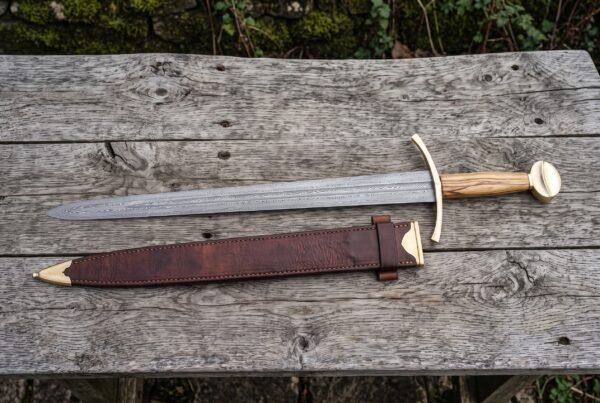
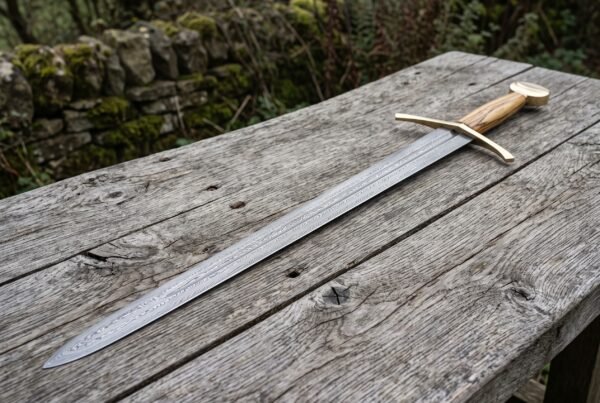
Showed up right on time and looked even better than the photos. Even the small engravings are crisp and clean. The wood handle feels amazing and the balance is perfect. Worth every penny. Made overseas in the Czech Republic yet shipped from a US location so no long customs wait.
Perfect gift. Perfect quality. No complaints. This shop clearly takes pride in their work. Love that this is Czech craftsmanship and shipping from the US meant it showed up in just a few days.
Knew this sword was special the second I opened the box. The wood handle feels amazing and the balance is perfect. So worth it.
No regrets on this purchase at all. This will be a family heirloom for sure. This is my third order from Ransack Viking and they never disappoint.
Happy with this one for the most part. Would buy from this shop again.
Can’t stop showing this off to everyone who comes over. Weight and balance make it feel like a real functional piece not some cheap replica. Love it.
Five stars isn’t even enough honestly. Leather sheath is thick and well stitched. Not the cheap stuff you usually get. The wood handle feels amazing and the balance is perfect. Will definitely order again for another gift. Ransack Viking’s attention to detail is honestly unmatched.
This sword is a genuine work of art. Even the small engravings are crisp and clean. This is going straight into my display case.
Been eyeing this sword for months and it did not disappoint. Fit and finish is museum quality. You can tell real craftsmen made this by hand. Shipping was fast and everything arrived well packaged.
Nice piece for the price. Wood handle looks great though it’s a little smaller than I imagined. Ransack Viking usually delivers solid quality and this was no exception. Sheath is nice. Wish it had more padding but it does the job. Glad I made this purchase.