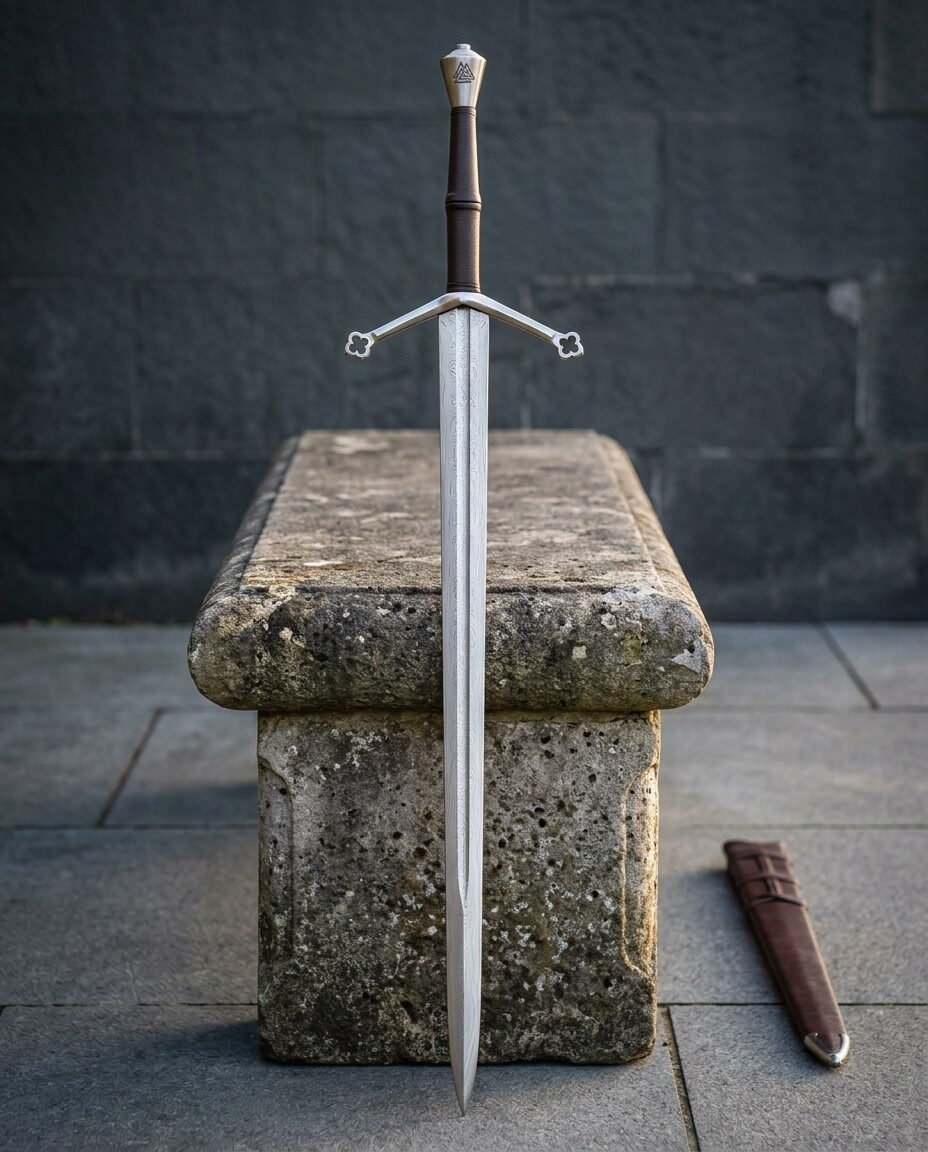
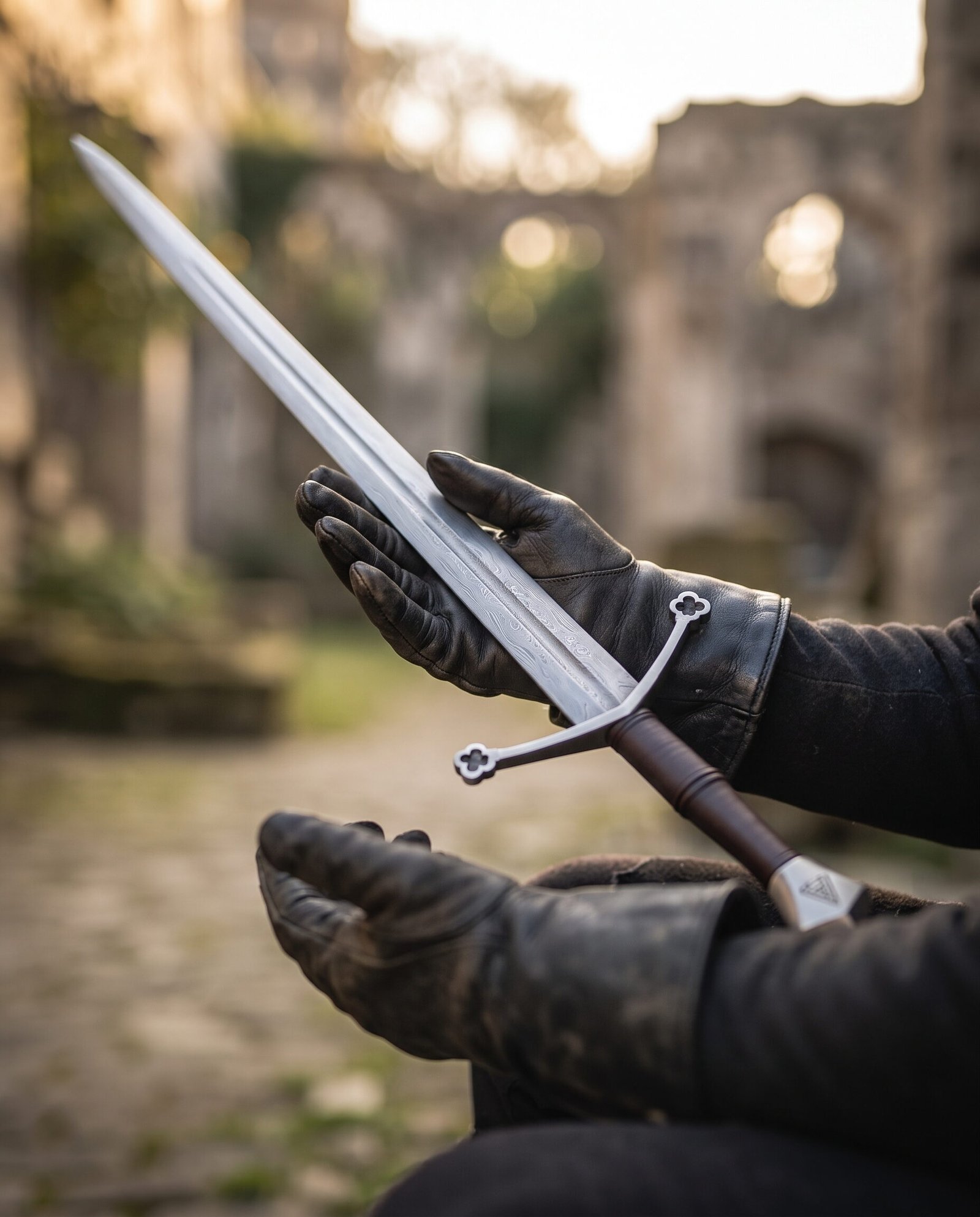
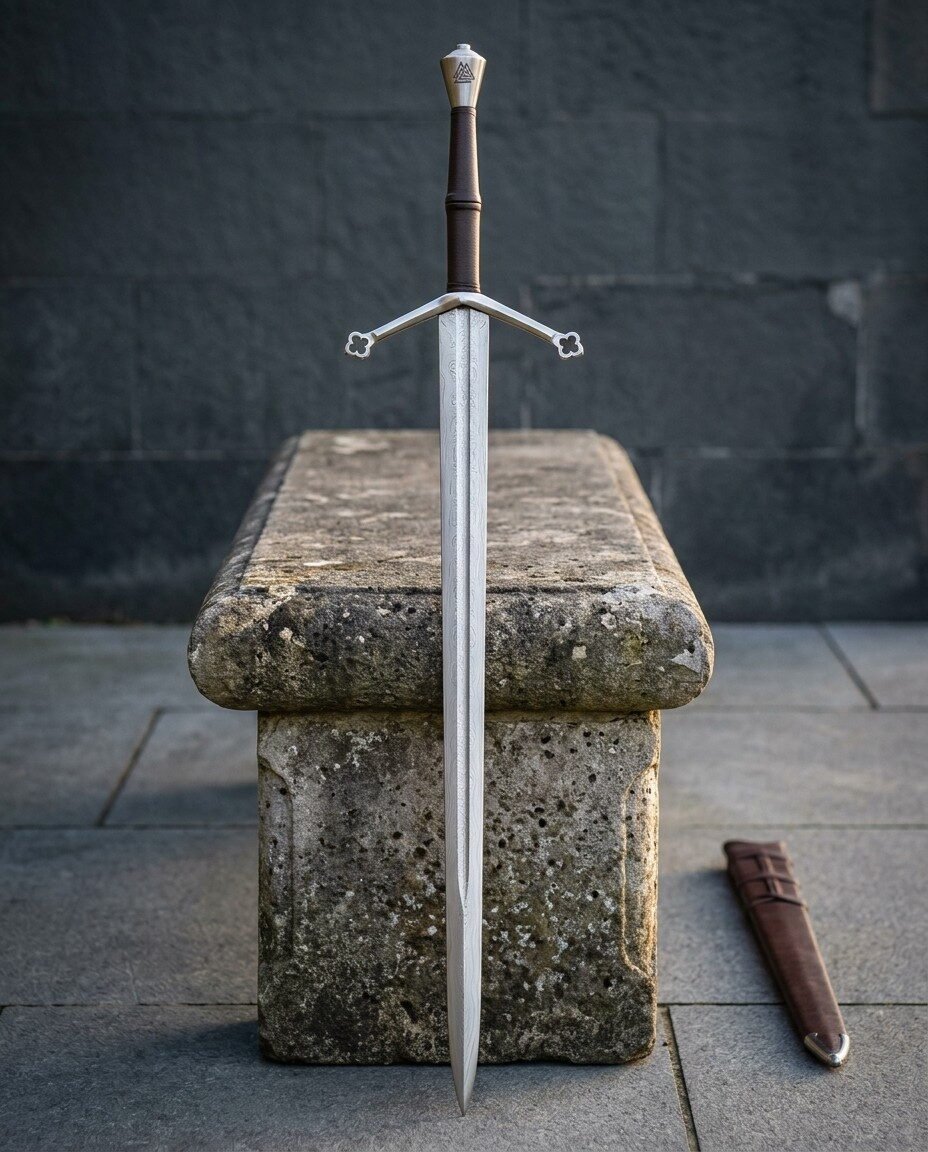
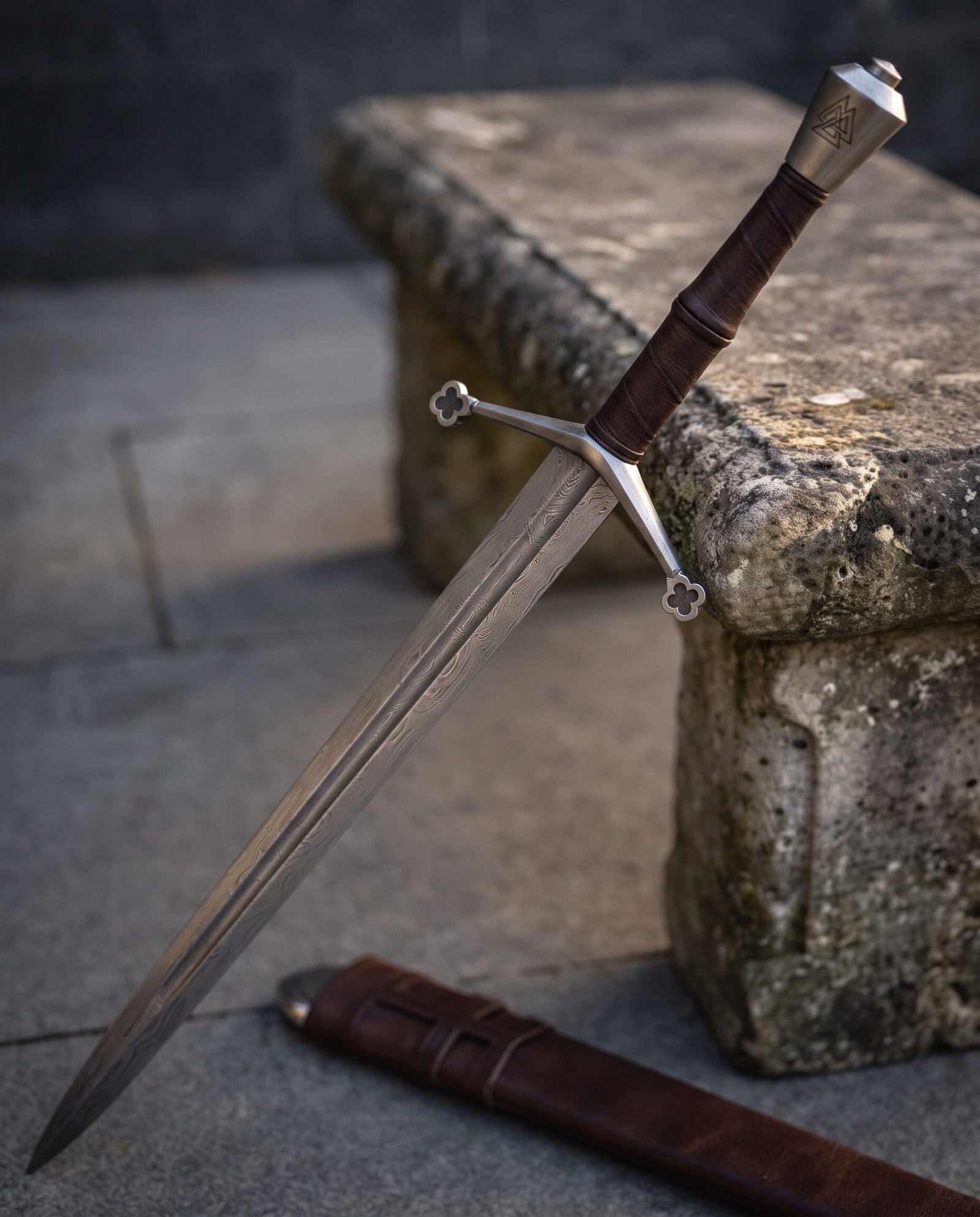
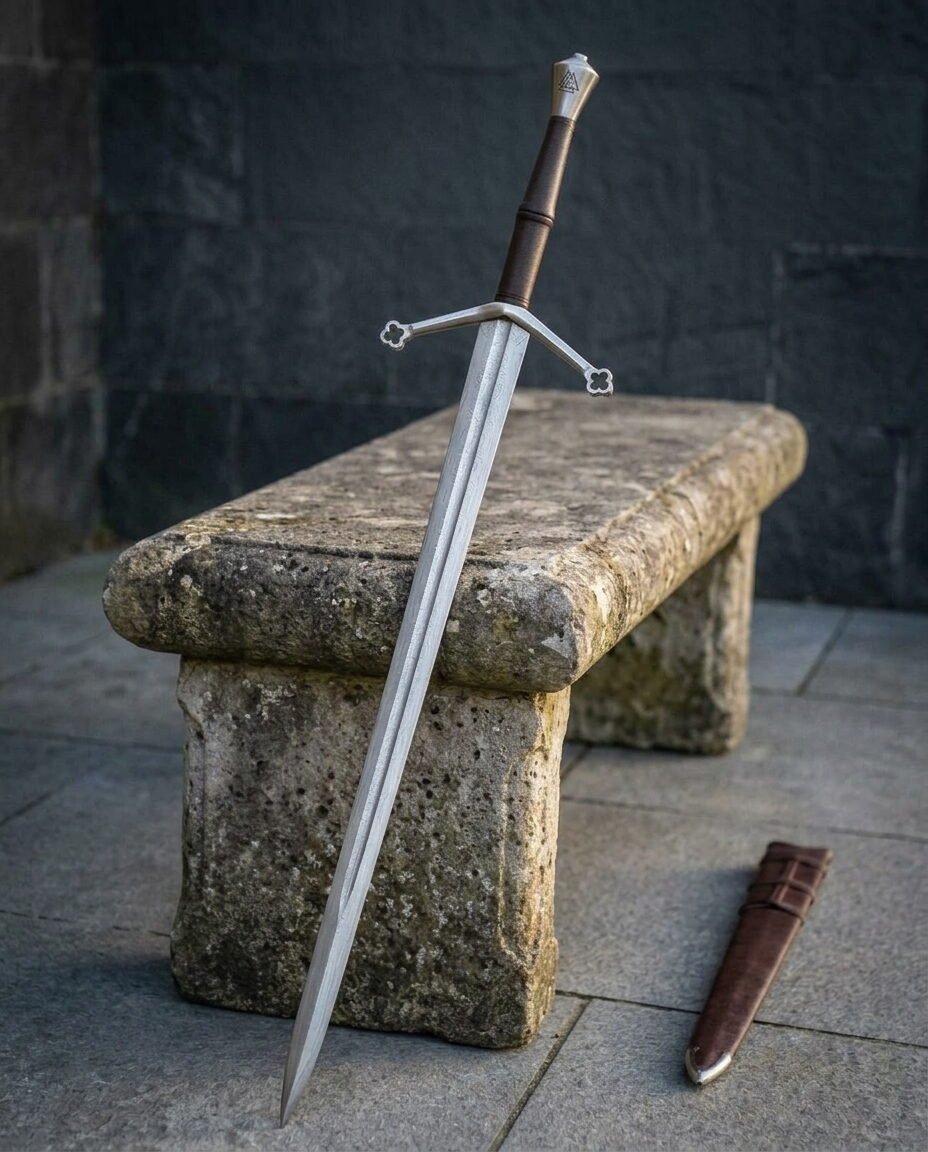
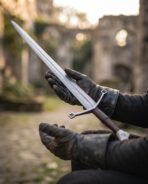
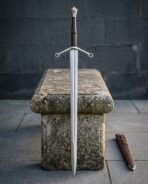
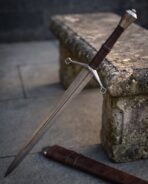
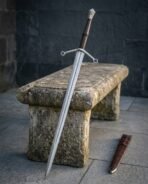
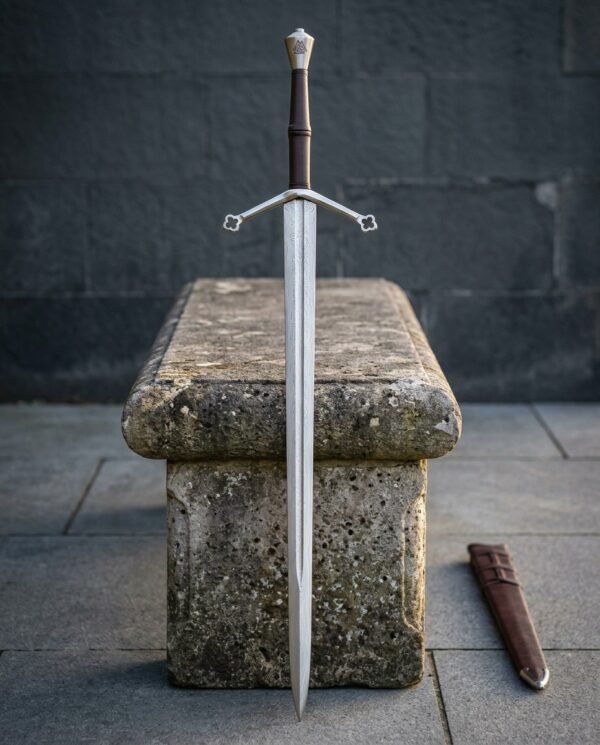
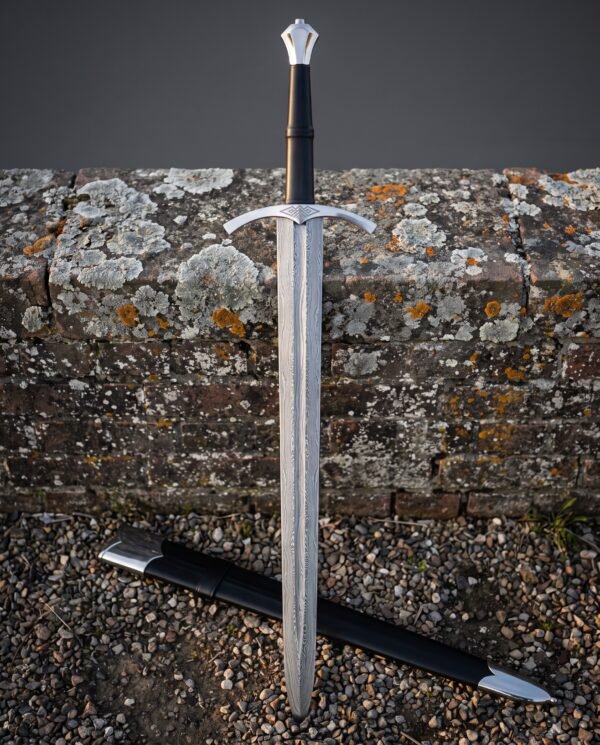
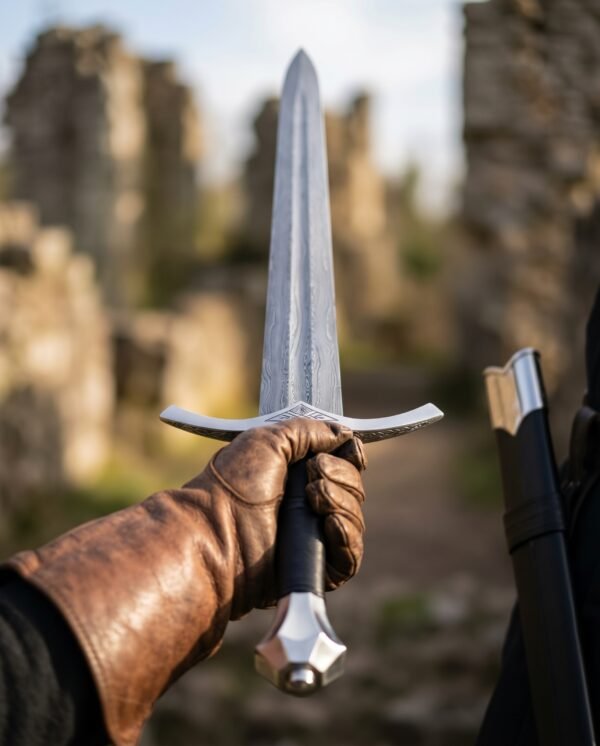
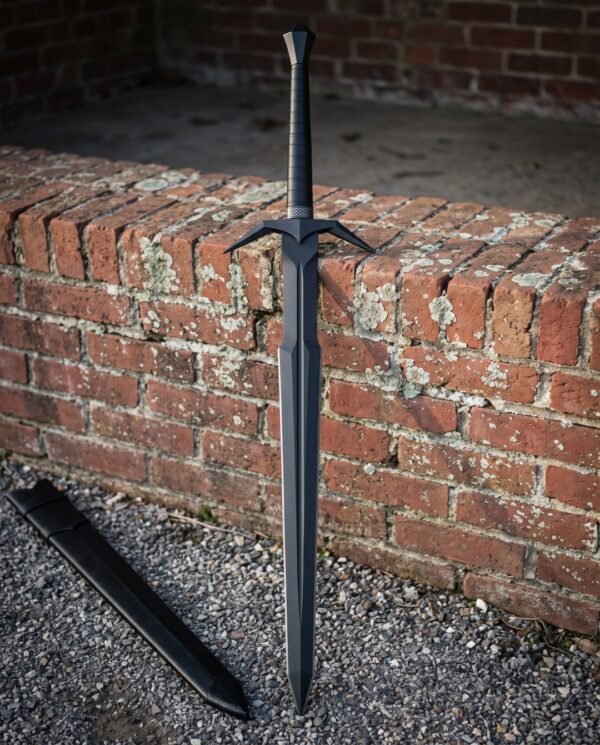
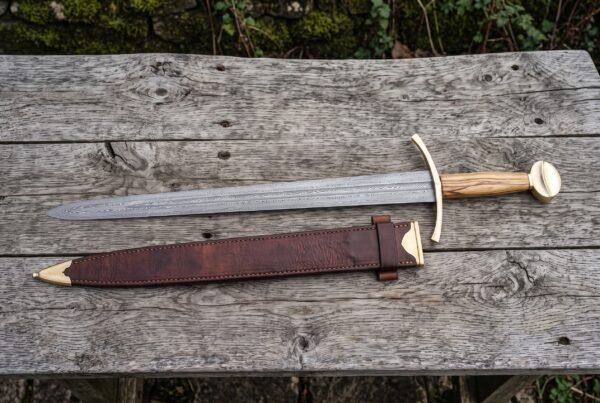
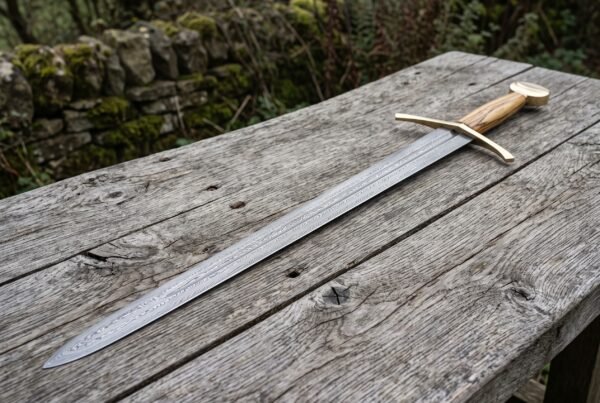
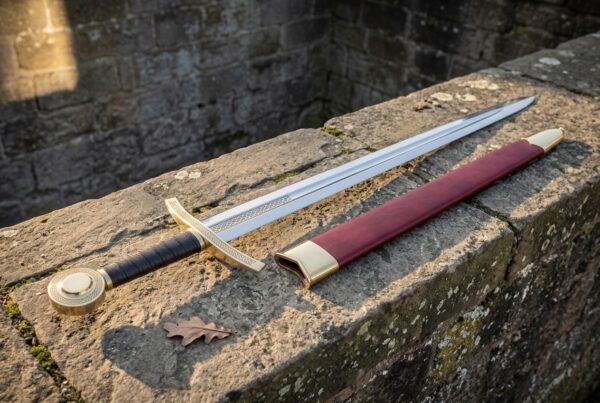
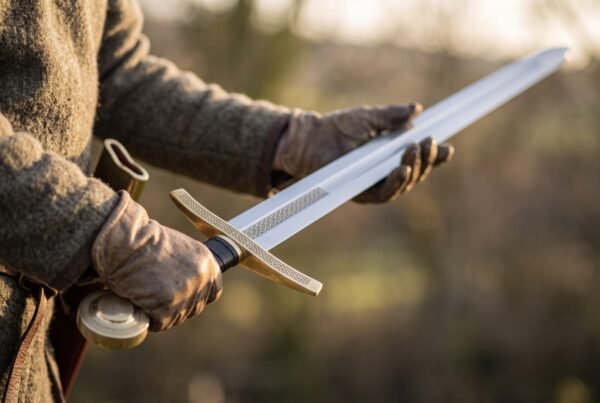
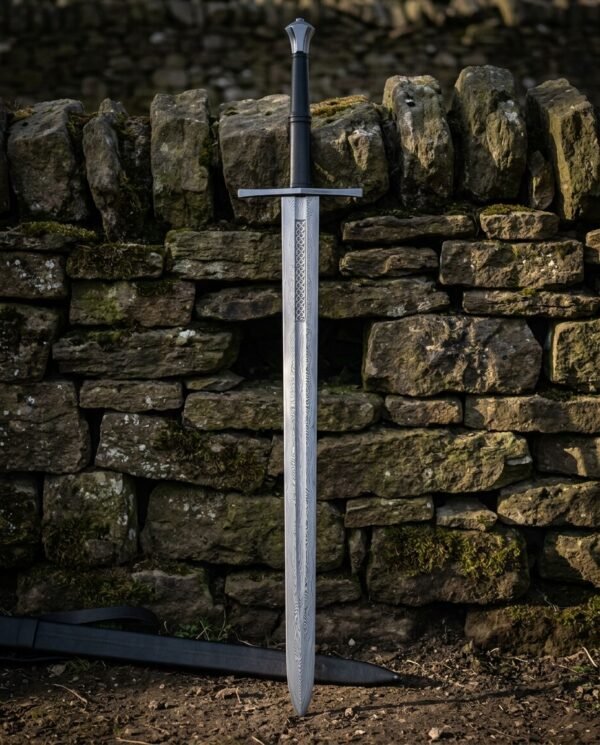
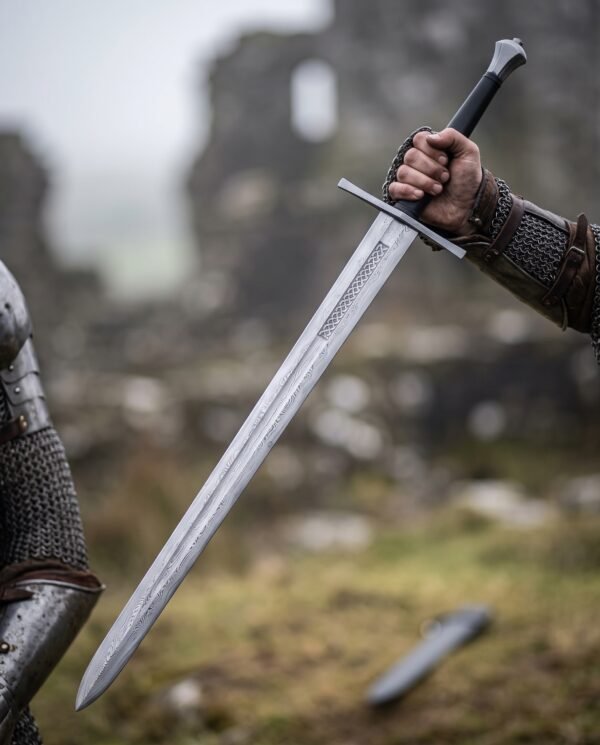
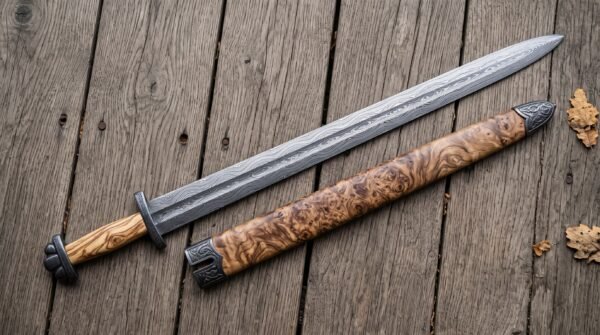
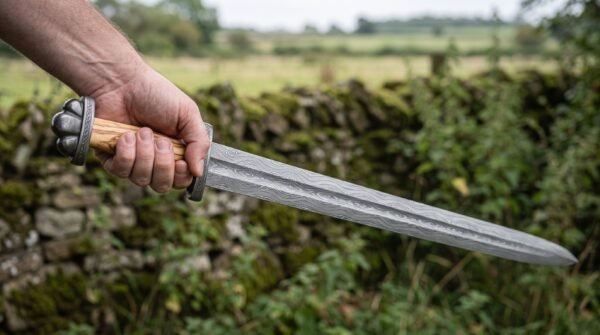
A hand forged longsword in 1095 and 15N20 pattern welded steel, with a down swept cross guard ending in pierced quatrefoil terminals, a leather wrapped hand and a half grip, a faceted pommel marked with a valknut and a cross laced leather scabbard with a steel chape. The pattern runs the length of the blade and dies away into the polished edge bevels, which is what a properly ground pattern welded blade should do.
What actually makes a longsword a longsword is not the blade, it is the grip. A grip long enough for two hands but light enough for one changes everything about how the sword is used, and the fourteenth and fifteenth century fencing manuals are built around that fact. The tradition attributed to Johannes Liechtenauer and the illustrated treatises that followed it spend most of their pages on what the second hand lets you do: the leverage in a bind, the half swording grip with a hand on the blade, the strike delivered with the cross guard. This sword is forged, ground, heat treated, fitted and finished in the Czech Republic, and ships with its leather scabbard. Filed under the longswords, and the Damascus swords are the other half of that shelf.
Specifications
| Blade steel | 1095 and 15N20 pattern welded damascus, hardened to 58 to 60 HRC |
|---|
| Overall length | Approximately 45 inches |
|---|
| Blade length | Approximately 35 inches, double edged with a fuller |
|---|
| Grip | Hand and a half, brown leather wrapped over a shaped wooden core, with a raised ring at the middle |
|---|
| Cross guard | Down swept arms ending in pierced quatrefoil terminals, with a centre langet over the blade |
|---|
| Pommel | Faceted steel pommel marked with a valknut, peened over the tang |
|---|
| Finish | Etched damascus with hand polished edge bevels |
|---|
| Scabbard | Brown leather over a wooden core, cross strapped at the throat, with a steel chape |
|---|
| Edge | Sharpened, sold as a collector and display sword |
|---|
| Included | Sword and scabbard |
|---|
| SKU | RK-1733 |
|---|
What the second hand on the grip is for
Pick up a single hand sword and everything you can do with it happens in an arc around your wrist and elbow. Put a second hand on a longer grip and you gain a lever. The lower hand near the pommel becomes a fulcrum that lets the upper hand change the line of the blade fast, and it lets you push or pull against an opponent blade that has already crossed yours. That is why the old manuals are so full of winding, of turning the point around a bind rather than pulling back and striking again. None of it works with one hand on a short grip.
The quatrefoil terminals on the cross guard are not decoration for their own sake. A plain straight bar can slide out of the hand when a blade runs down it, and thickening or widening the ends gives the guard something to catch on and something to hold on to. On some fifteenth century swords those terminals are pierced rings, on others they are the four lobed clover shape you see here. They also stiffen the bar so it does not bend when it takes a hard strike near the end.
The point of balance sits a few inches ahead of the guard, which is where a cutting oriented longsword wants it. Move it further forward and the sword hits harder but recovers slowly. Move it back and it handles beautifully and does not bite. Ours is set forward of the guard, so it feels alive rather than nose heavy, and the faceted pommel is doing real work as a counterweight rather than sitting there as a lump.
1095 and 15N20 damascus
The pattern in the blade is not applied to the surface. It is the cross section of the steel itself. Two steels are stacked into a billet, forge welded, drawn out, cut, folded back and welded again until the layer count runs into the hundreds, then the billet is forged to a blade. When the finished blade is etched, the two steels react differently to the acid and the layers separate into light and dark.
The bright lines are the 15N20, which carries about two percent nickel. Nickel resists the etchant, so those layers stay proud and shiny while the 1095 around them darkens. That is the entire trick, and it is why nearly every modern damascus blade is built from this pair. It also matters mechanically, because 1095 brings the carbon that lets the blade take a hard temper and 15N20 brings toughness across the weld lines. Heat treated together they come out at 58 to 60 HRC, hard enough to hold an edge and still resilient through the body of the blade.
A pattern welded blade will hold a keen edge and it will cut, and it is sold here as a sharp collector and display sword. It is not for sparring and it should never be taken into full contact drill against another blade or against a hard target.
Engraving, runes and your own design
Use the rune converter on this page to turn a name, a date or a short phrase into Elder Futhark and we will cut it into the steel, the leather or the wood. If you would rather have a Viking pattern than a rune line, choose your own design in the engraving option above the add to cart button and tell us where it goes. Where a piece already carries an engraved design, your chosen engraving replaces it rather than sitting alongside it. On a pattern welded blade the usual place is the ricasso just below the guard, or the scabbard leather, because deep cutting into an etched flat interrupts the pattern. See the engraving page for what works on damascus.
Handling and balance
Hold it with the dominant hand under the cross guard and the other hand loose on or just above the pommel. The lower hand should not grip hard. It steers. Most of the weight of the swing comes from the body turning, not from the arms, and a longsword that is handled with the arms alone feels twice as heavy as it is.
Coming out of the scabbard, draw with the scabbard angled away from your body and your thumb clear of the mouth. The cross laced seam sits on the back of the scabbard so it is out of the way of the edge on the draw. Sheath it slowly with the point found by feel rather than by force, because a sharp point pushed hard into a scabbard mouth will eventually cut through the leather at the throat.
Display it horizontally on a stand rather than point down. Standing a sword on its tip puts the whole weight of the blade onto the smallest part of it and will eventually dull or roll the point.
Care
This is high carbon steel, not stainless, and it will rust if it is left wet or handled and put away. Wipe the blade down with a clean cloth after handling, because fingerprints are slightly acidic and will etch a ghost of themselves into a damascus flat within days. Then wipe a thin film of mineral oil or a dedicated blade oil over the whole blade. There is more detail on steel care.
Do not store the sword long term inside the scabbard. Leather holds moisture and a tight leather scabbard is one of the more reliable ways to rust a blade. Keep the leather fed with a light leather balm two or three times a year, worked in with a cloth and buffed off, and keep the balm off the steel chape. If a light surface rust ever appears, a little oil and 0000 grade steel wool will lift it without touching the pattern.
Made in the Czech Republic
The work behind this piece happens in a Czech Republic workshop that has kept to the old methods. Steel is forged and heat treated by hand, the grind is taken down by eye rather than by machine, and the handle, fittings and sheath are cut and finished one at a time. Because of that, every piece carries small marks of the hand that made it.
Ransack Viking is a United States company. We import direct, check each piece when it reaches us, and ship from our Chicago, Illinois warehouse. Engraving is added here in the United States after arrival, so the piece you receive is finished to your order.
A note on handmade variation
This sword is hand made, not machine made and not bulk produced, so what arrives will not be a pixel for pixel copy of the photograph. Every damascus billet moves differently under the hammer, so the pattern on your blade will be its own: the waves will run at their own spacing and the ladder will break in its own places. The leather on the grip and the scabbard is a natural hide and will take the dye at its own depth, and the lacing will pull its own way. The dimensions, the steel and the build are the same every time. The character is not. There is a longer piece on buying a first sword, and another on how to hang a blade on a wall.
Frequently asked questions
Is it sharp out of the box
Yes. It arrives sharpened. Handle it as you would any sharp blade and keep it away from anyone who is not expecting an edge.
Can I spar with it
No. It is a sharp collector and display sword. Full contact drill needs a blunt purpose built sparring sword, and putting a sharp pattern welded blade edge to edge with another blade will damage both.
Is the pattern etched on or forged in
Forged in. It is the layer structure of the steel showing through the surface, so it goes all the way through the blade and cannot wear off. The etch only reveals it.
Is the scabbard included
Yes. The cross laced leather scabbard with the steel chape comes with the sword.
Will it rust
It can. High carbon steel needs a wipe and a thin coat of oil after handling. Left oiled and out of the scabbard it will stay clean for years.
How long does shipping take
Processing is one to two weeks because each blade is forged to order, then shipping inside the United States is free.
What is in the box
- Stormlace hand forged damascus longsword
- Cross laced leather scabbard with a steel chape
- Blade wiped and oiled for transit
- Lifetime warranty against defects in the forging, the grind, the heat treat and the fittings, with no end date and no receipt needed
- Forged and finished in the Czech Republic
Explore the range
See the rest of the longswords, the damascus swords, the sword stands and displays and the guides.
Compare it with these
For a straight comparison, see the Beakcrown longsword, 44 inches overall. Worth putting side by side with this is the Grimfell longsword, 47 inches overall. In the same category sits the Nightwhorl longsword, 44 inches overall.
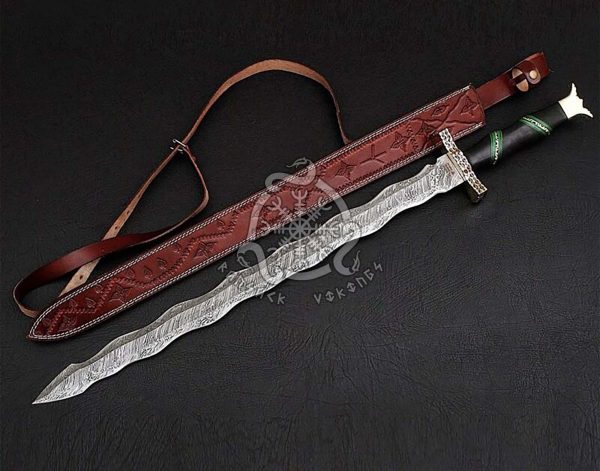
From the same corner of the shop, there is the Wyrmtide flamberge sword. Pick the steel, the length and the fittings yourself on the custom Viking sword page.
If you would rather train with a sword than hang one up, the Vindlaur feder suits club work, and our guide to blade flex covers the choices.

Been eyeing this sword for months and it did not disappoint. Damascus blade holds a razor edge right out of the box. Love that this is Czech craftsmanship and shipping from the US meant it showed up in just a few days. Came in a nice gift box which made it feel even more special. 10/10 would buy again.