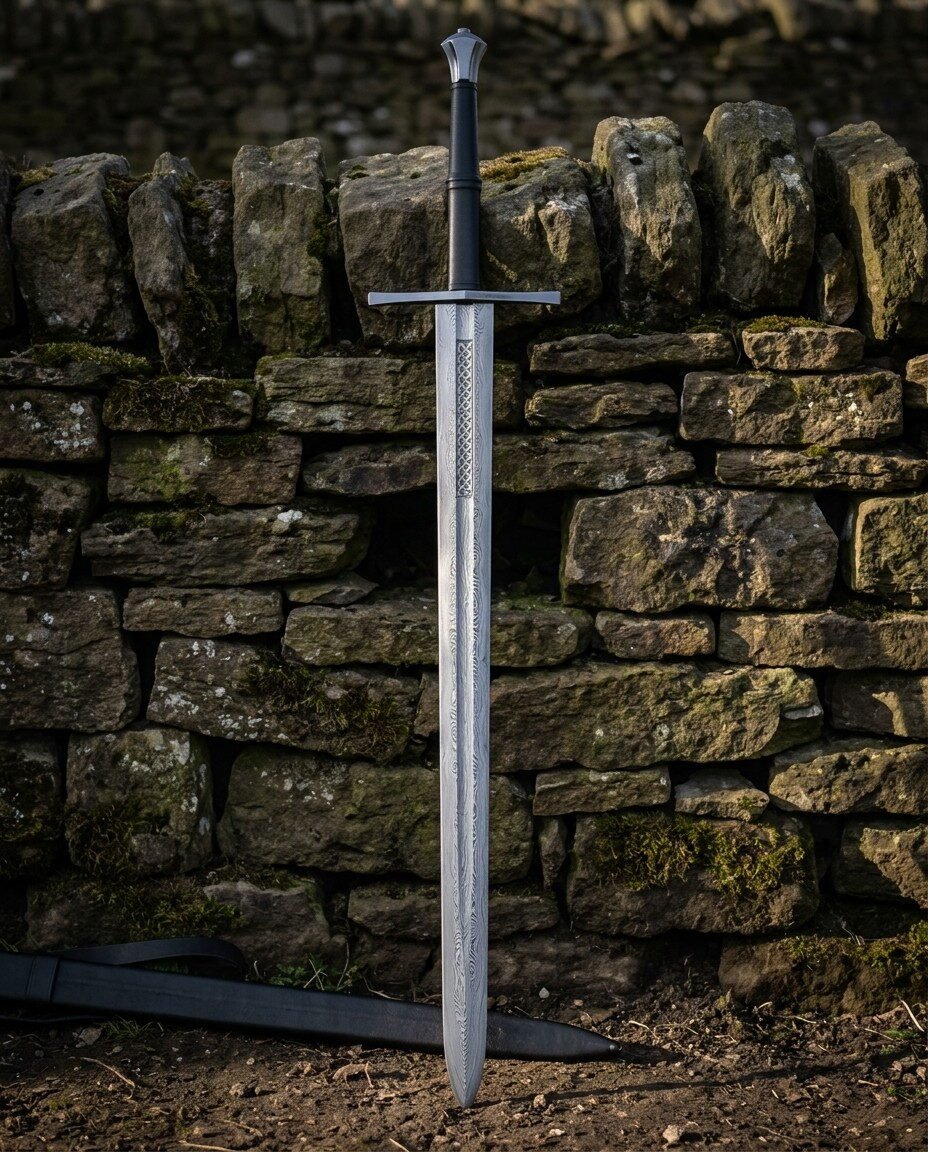
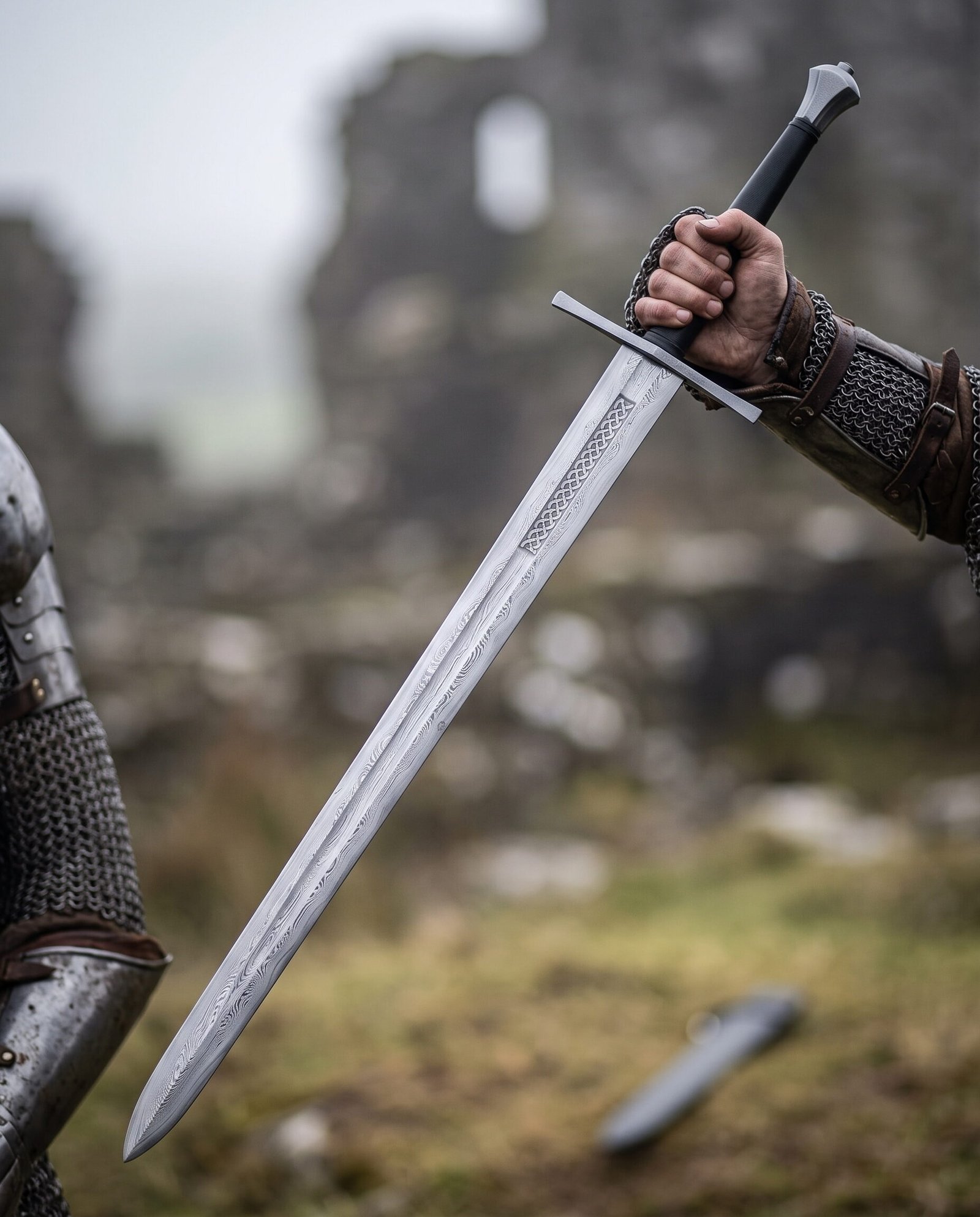
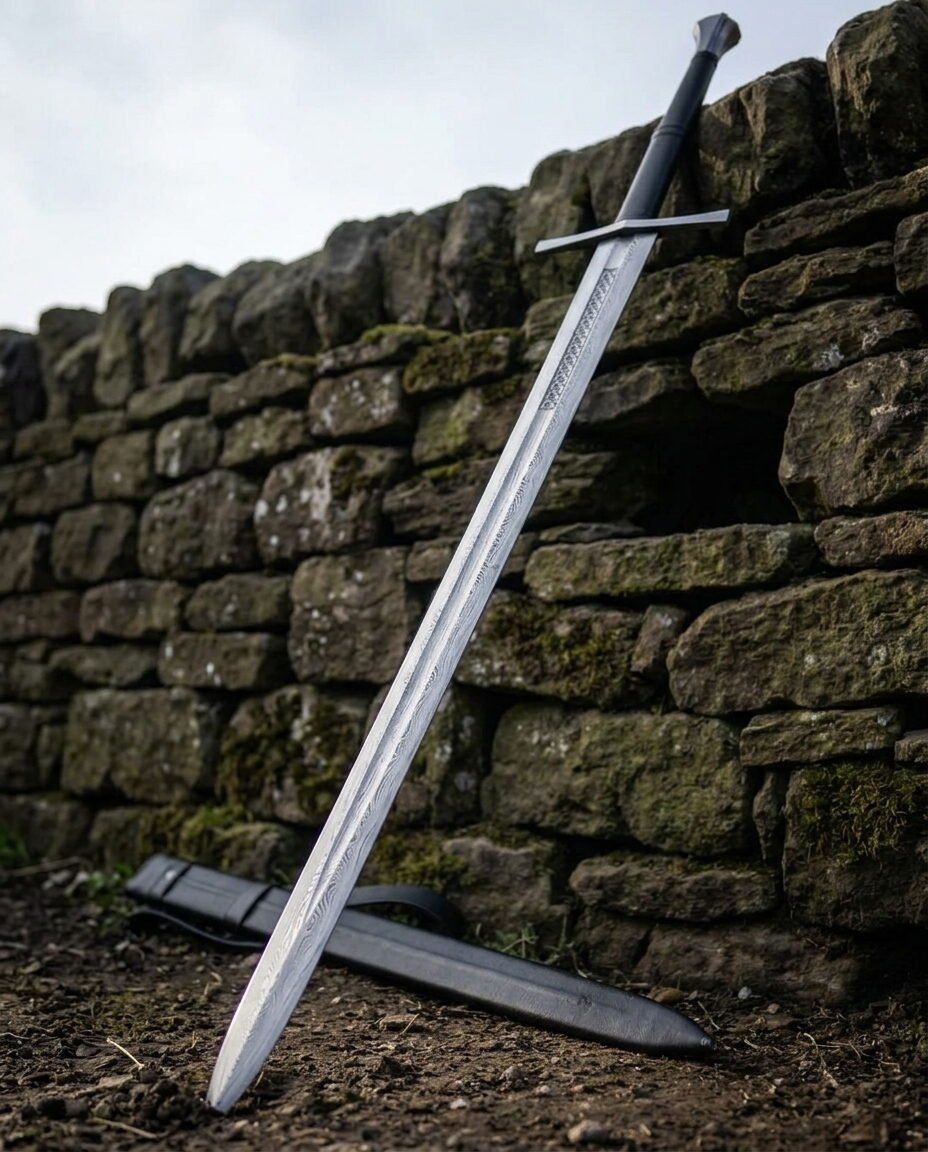
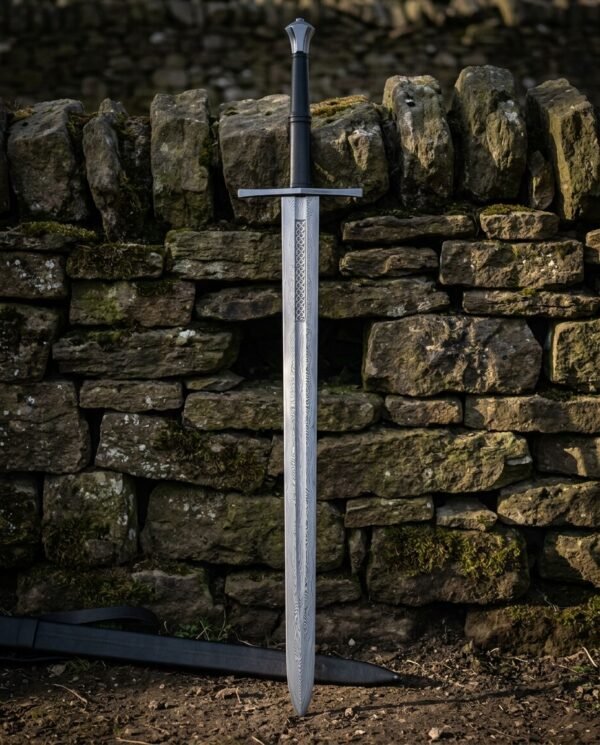
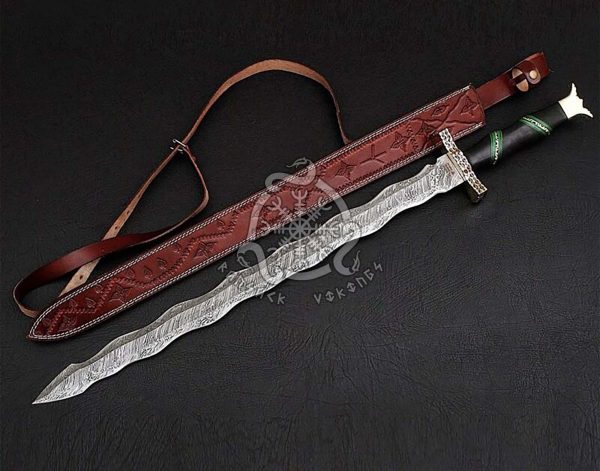
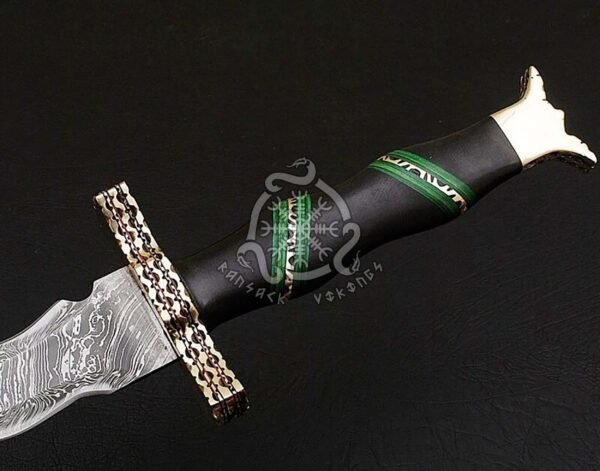
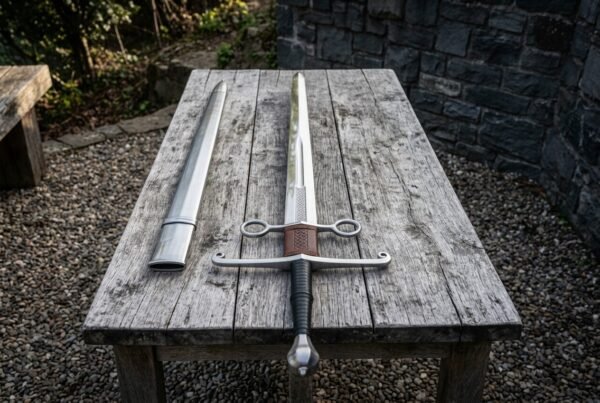
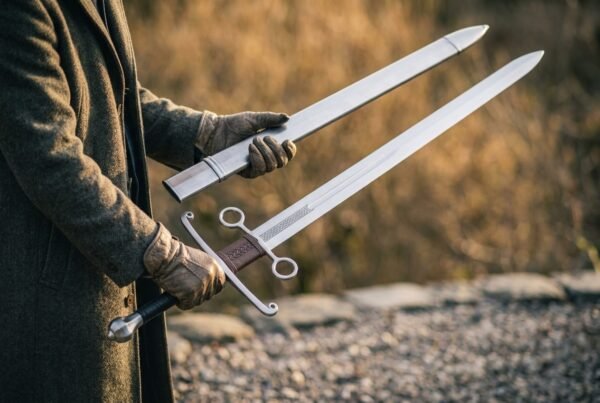
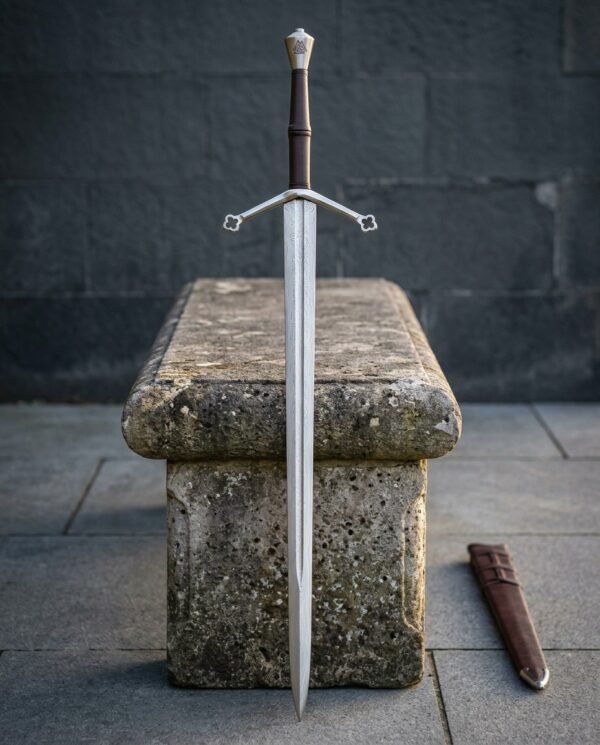
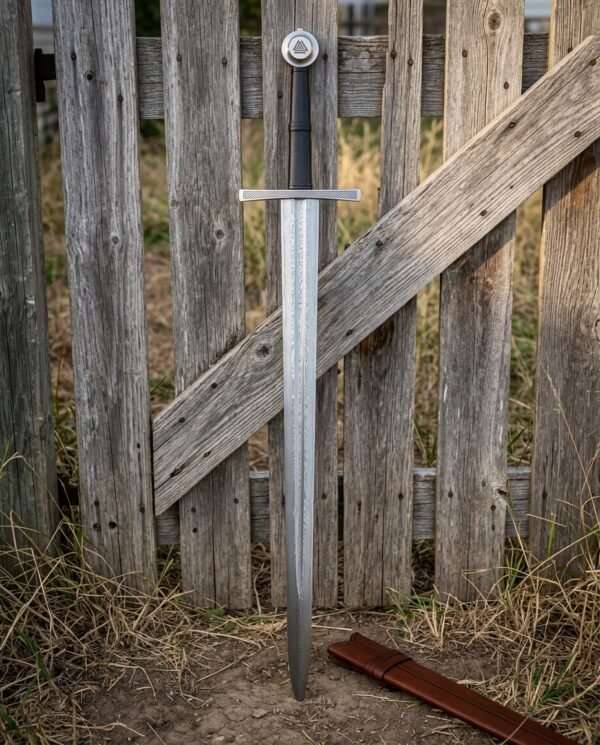
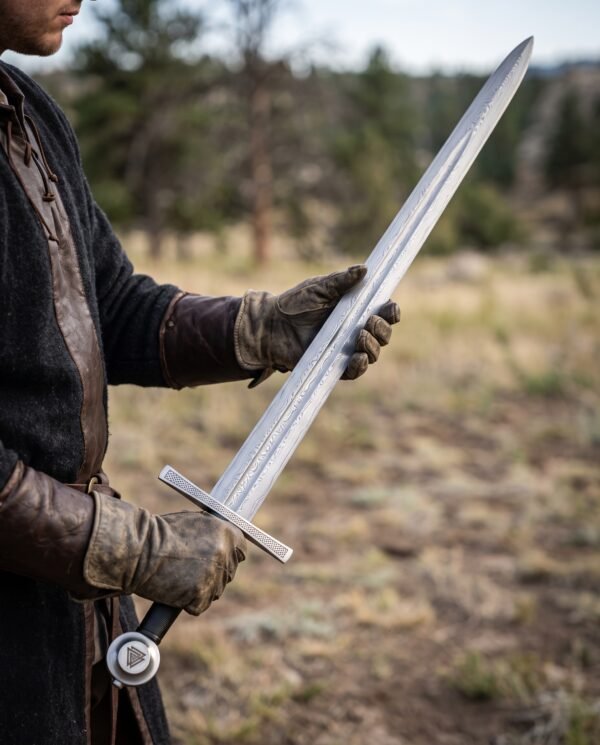
The Nightwhorl is a hand and a half sword, the type the sources call a bastard sword because it belongs properly to neither the single handed nor the two handed family. The blade is pattern welded 1095 and 15N20 with a broad flowing figure running its whole length and a panel of cut interlace set into the flat above the guard. The grip is long black leather over a shaped wooden core, the cross is a plain steel bar, and the pommel is a fluted steel form peened over the tang. A black scabbard is included.
The name is not an insult, or at least it did not start as one. It comes from the French epee batarde, and it described a sword that would not commit to a category. Long enough to take a second hand when you needed leverage, short and light enough to be used in one when you did not. It appears in the fourteenth century as armour got better and cutting alone stopped being enough, and it stayed in fashion for two hundred years because that flexibility turned out to be worth having. This one is welded, forged, ground, etched, hardened and fitted in the Czech Republic. Filed under the longswords, and the two hand swords are the other half of that shelf.
Specifications
| Blade steel | Pattern welded 1095 and 15N20 Damascus, hardened to 58 to 60 HRC |
|---|
| Blade finish | Acid etched flowing pattern with a cut interlace panel down the centre above the guard |
|---|
| Blade | Straight double edged blade tapering to an acute point |
|---|
| Overall length | Approximately 44 inches |
|---|
| Blade length | Approximately 33 inches |
|---|
| Grip | Approximately 9 inches, black leather over a shaped wooden core with a raised riser ring |
|---|
| Guard | Straight steel cross of rectangular section |
|---|
| Pommel | Fluted steel pommel flaring out toward the top, peened over the tang |
|---|
| Scabbard | Black leather over a wooden core with a belt strap and a small steel chape |
|---|
| Included | Sword and scabbard |
|---|
| SKU | RK-1863 |
|---|
What the second hand actually buys you
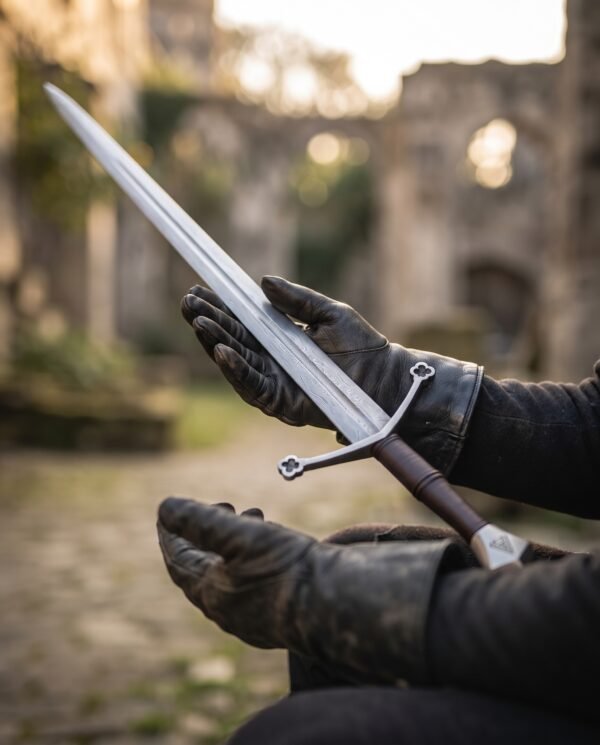
A nine inch grip does not exist so you can hold the sword with two fists side by side. It exists so the second hand can sit low, on or just below the pommel, and work as the far end of a lever. The forward hand becomes a pivot and the rear hand pushes and pulls. That arrangement does two things a single hand cannot. It lets you change the direction of a heavy blade far faster than raw arm strength would allow, and it gives you real control at the point, which is what you need the moment you are trying to find a gap in armour instead of cutting at cloth.
The trade is that you give up a shield. That is the whole story of the fourteenth and fifteenth centuries in one sentence. As plate armour improved, the shield stopped earning its place on the arm and the second hand went onto the sword instead.
The fluted pommel is shaped for that rear hand. The flutes give the fingers something to key against so the hand does not slide off under a pull, and the mass in it balances thirty three inches of blade. Peening rather than threading is what keeps the whole assembly tight, because a peened pommel actually clamps the grip and guard against the shoulders of the tang.
The pattern welded blade
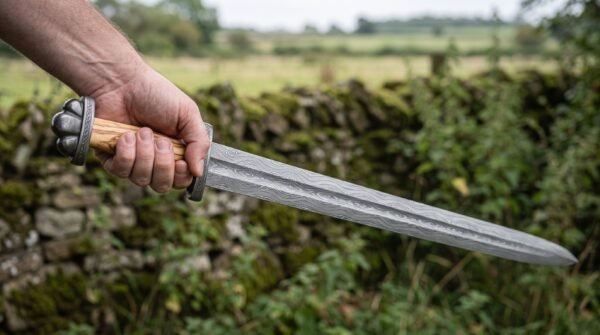
The billet is 1095 and 15N20 stacked, welded, drawn and folded until the layer count is high, then manipulated so the layers run in long flowing bands rather than a repeating geometric figure. Acid does the rest, biting the plain carbon layers dark and leaving the nickel bearing layers bright.
Making a billet long enough for a thirty three inch blade is the real difficulty. Every weld has to hold along the entire length, and a single cold shut or trapped scale inclusion anywhere in that run means the billet goes in the scrap bin rather than becoming a sword. That is the practical reason long Damascus blades cost what they do, and it is worth knowing that the cost is in the failures rather than in the finished piece.
Both steels harden together and the finished blade sits at 58 to 60 HRC, tempered back so it flexes and returns rather than taking a set. The pattern has no effect on how it cuts. It is not sharper because it is Damascus. It is stronger than the uneven iron the technique was invented to work around, and better looking than anything else you can do with a bar of steel.
Engraving, runes and your own design
Use the rune converter on this page to turn a name, a date or a short phrase into Elder Futhark and we will cut it into the steel or the leather. If you would rather have a Viking pattern than a rune line, choose your own design in the engraving option above the add to cart button and tell us where it goes. Where a piece already carries an engraved design, your chosen engraving replaces it rather than sitting alongside it. On this sword the interlace panel above the guard is that design, and your inscription is cut there in its place. A long grip also leaves room to tool a short line into the leather if you would rather leave the steel alone. See the engraving page.
Handling and balance
The sword weighs a little over three pounds with the balance around five inches ahead of the cross. That sounds heavy on paper and does not feel it in the hand, because the long grip means the rear hand has leverage over the whole length. Held in one hand it is usable but deliberate. Held in two it comes alive and changes line almost instantly, which is exactly the behaviour the type was built for.
This is a hand finished collector and display sword. It is not sold as full contact sparring equipment and should never be struck against another blade.
Care
Keep a light film of mineral oil on the blade and wipe it after handling, because etched Damascus takes fingerprints readily and neither steel in the billet is stainless. Work a little oil into the cut interlace with a soft brush. Do not store the sword in the scabbard for long periods, since leather holds damp against steel. Feed the grip and scabbard with a leather balm once or twice a year. Our steel care page covers oiling, early spotting and how to bring a dulled etch back up.
Made in the Czech Republic
Every piece we sell is made by hand in the Czech Republic. The smiths there work the way the trade has been worked for a long time, heating and hammering the steel, taking the bevels down by eye, and fitting the handle and the leather one at a time. There is no automated line anywhere in it, so small differences from one piece to the next are normal and expected.
Ransack Viking is a United States company based in Chicago, Illinois. We bring the pieces in ourselves, inspect them on arrival and ship them from our own warehouse. If you add engraving, that is carried out here in the United States before your order goes out.
A note on handmade variation
This sword is hand made rather than machine made or bulk produced, so what arrives will not be a pixel for pixel copy of the photograph. No two long billets draw out the same way, so the bands in your blade will be your own and the figure will run differently from the one shown. Hammer texture, the depth of the cut panel, the tone of the black leather and the exact flutes on the pommel all vary. The dimensions, the steels and the build are the same every time. The character is not. There is a longer piece on why a full tang matters, and another on the Tolkien swords.
Frequently asked questions
Is a bastard sword the same as a longsword?
Near enough in modern usage. Both describe a hand and a half hilt on a blade that can be used in one hand or two. Bastard sword is the older term.
Is the pattern real Damascus?
Yes. The layers run through the steel. It is forge welded 1095 and 15N20, not a printed or etched surface effect.
Does it arrive sharp?
It comes with a clean cutting edge. Ask in your order notes and we will finish it blunt for display.
Can two hands really fit on the grip?
Yes, with the rear hand low on or over the pommel, which is how the type is meant to be held.
Is it suitable for sparring?
No. It is a hand finished collector and display sword and must not be struck against another blade.
How long is the lead time?
One to two weeks of processing, then free shipping inside the United States.
What is in the box
- One Nightwhorl Damascus bastard sword in 1095 and 15N20
- One black leather over wood scabbard
- A light protective oil film on the blade
- Forged and finished in the Czech Republic
Explore the range
More in longswords, Damascus swords and swords, with pattern welding notes in the guides.
Near neighbours in the shop
Worth putting side by side with this is the Crownflute longsword, pattern welded Damascus. In the same category sits the Beakcrown longsword, 44 inches overall. A near match for this one is the Prowcrown longsword, 44 inches overall.
For a different piece from the same family, look at the Valkhilt bastard sword. You can have this made your way instead on the custom Viking sword page.
Training at a HEMA club? Look at the Tevrand nylon waster for drills and free play, and check our HEMA longsword range as well.

Got this as a gift and now I want one for myself too. The wood handle feels amazing and the balance is perfect. Already planning my next purchase from this shop.