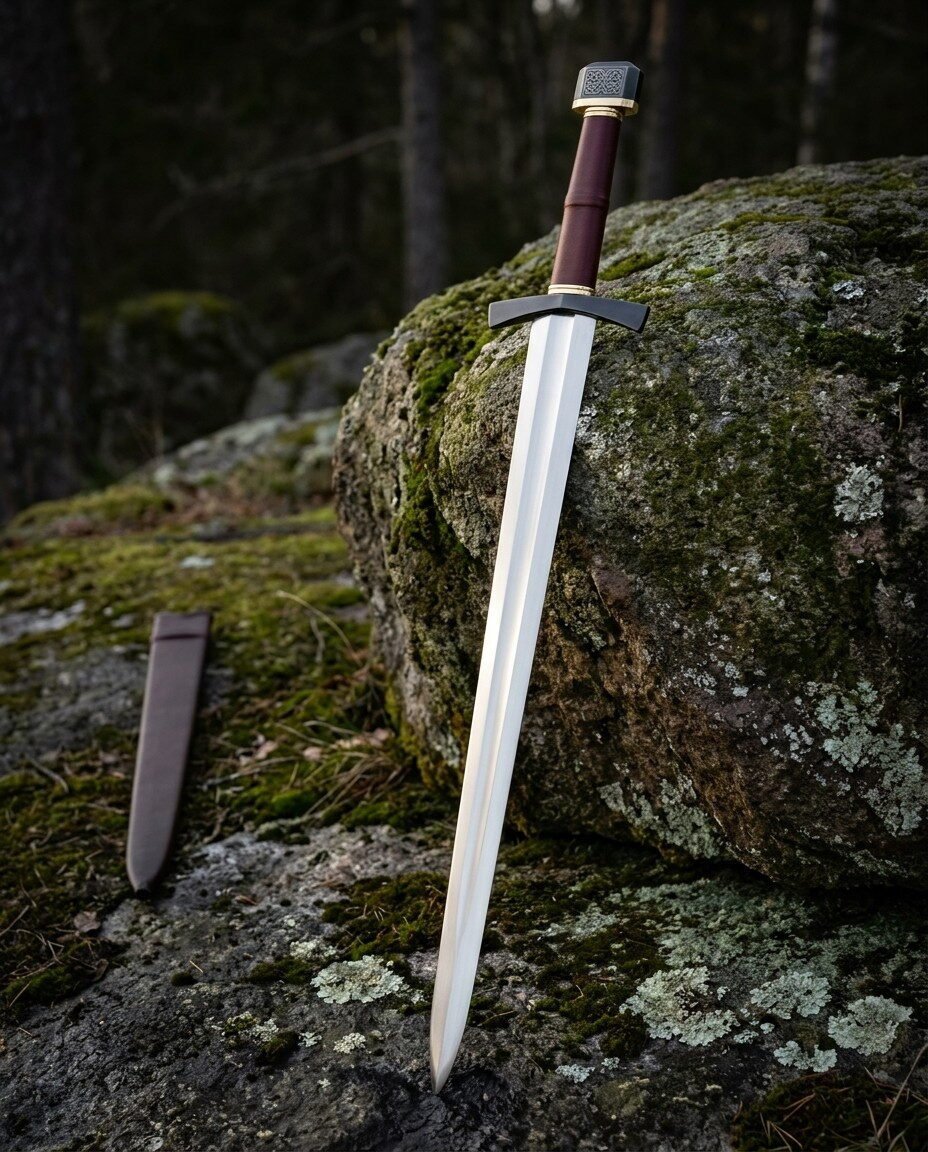
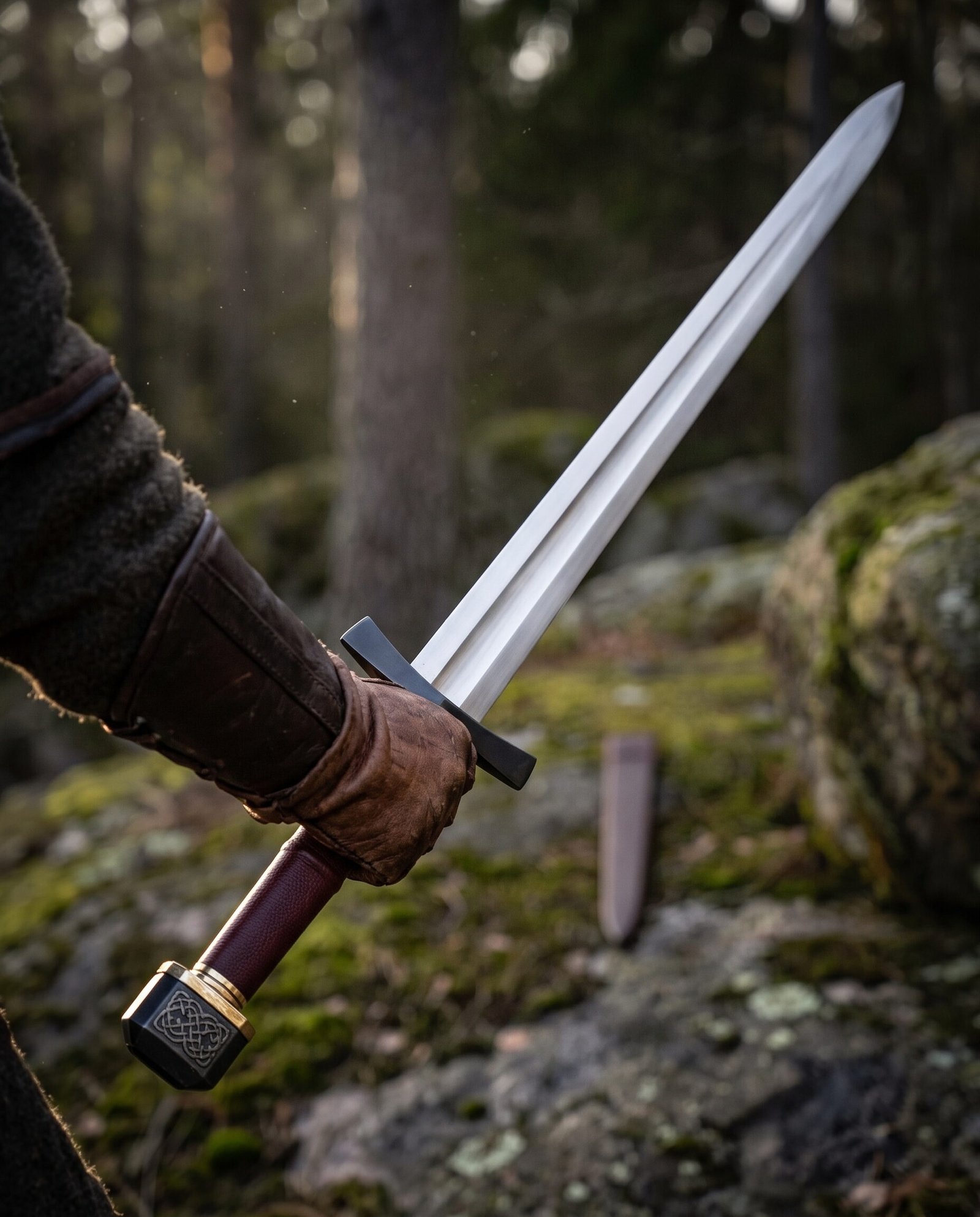
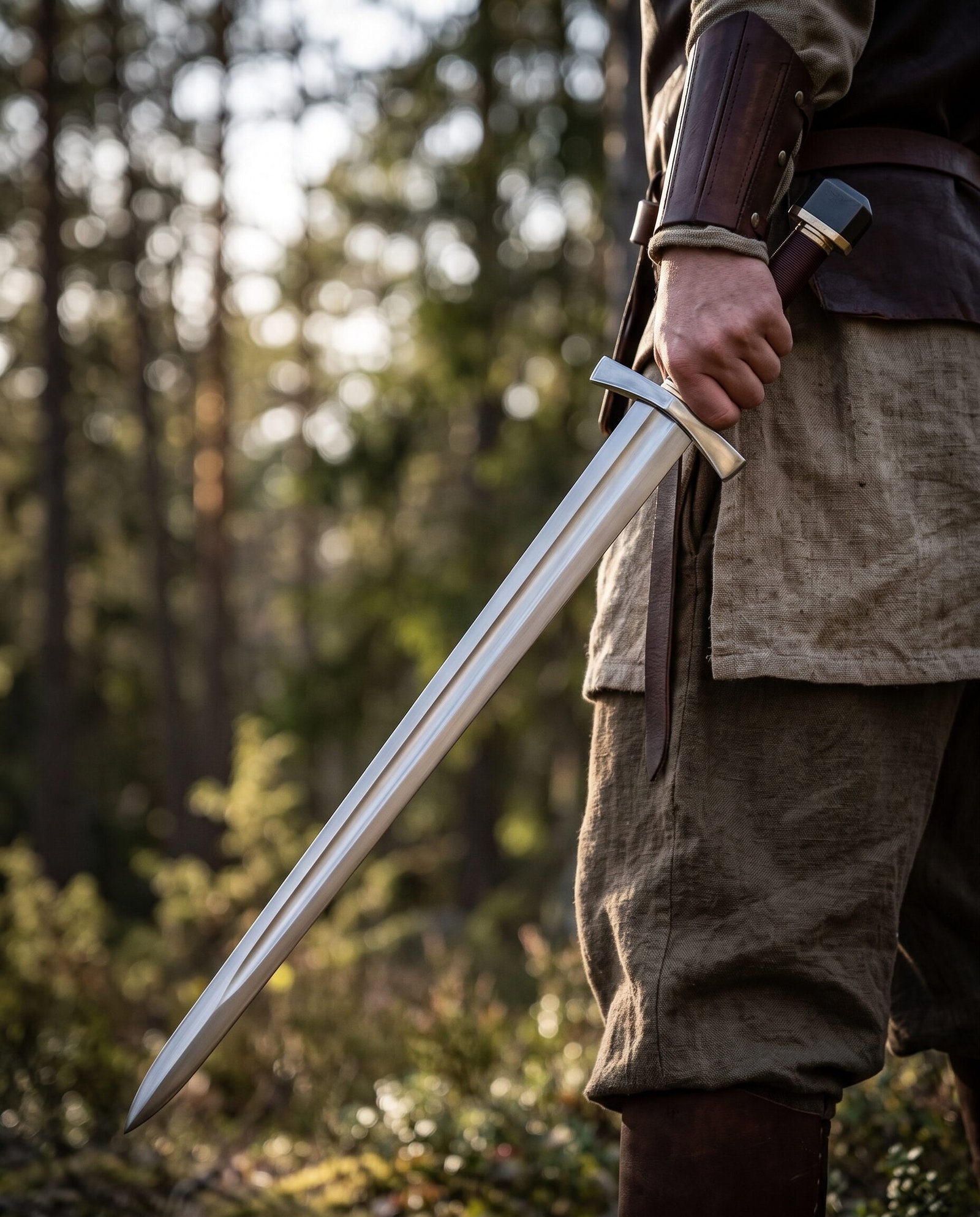
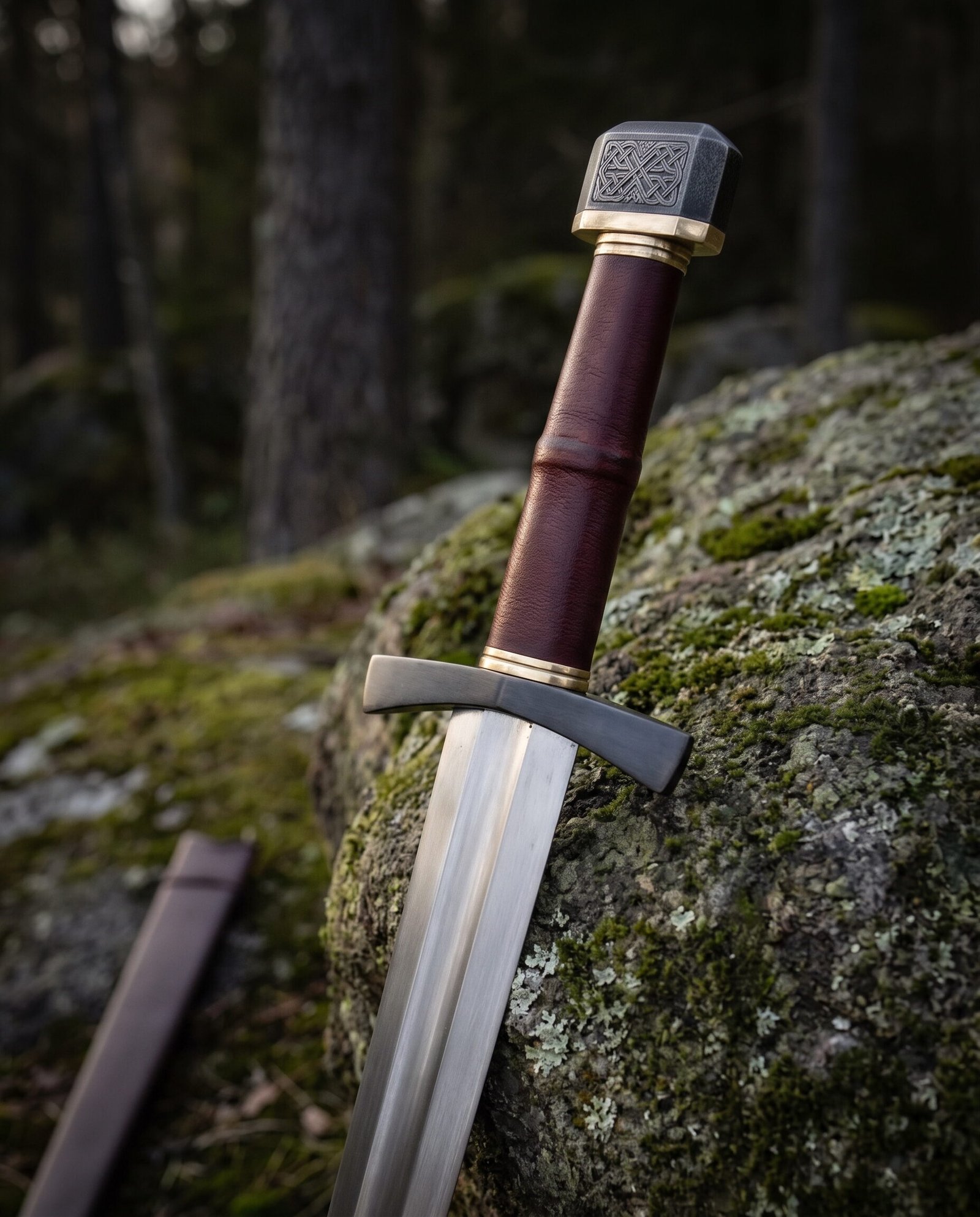
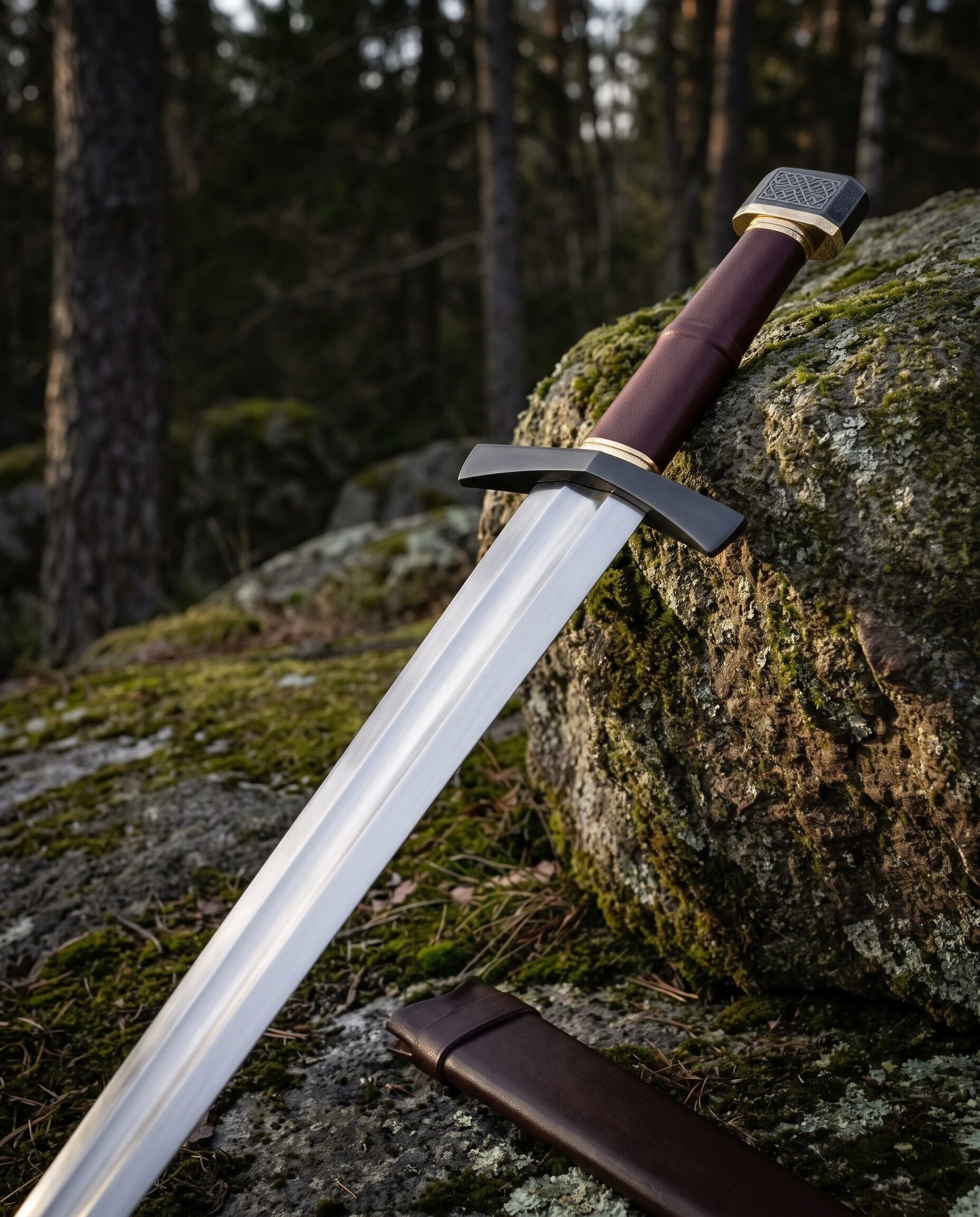
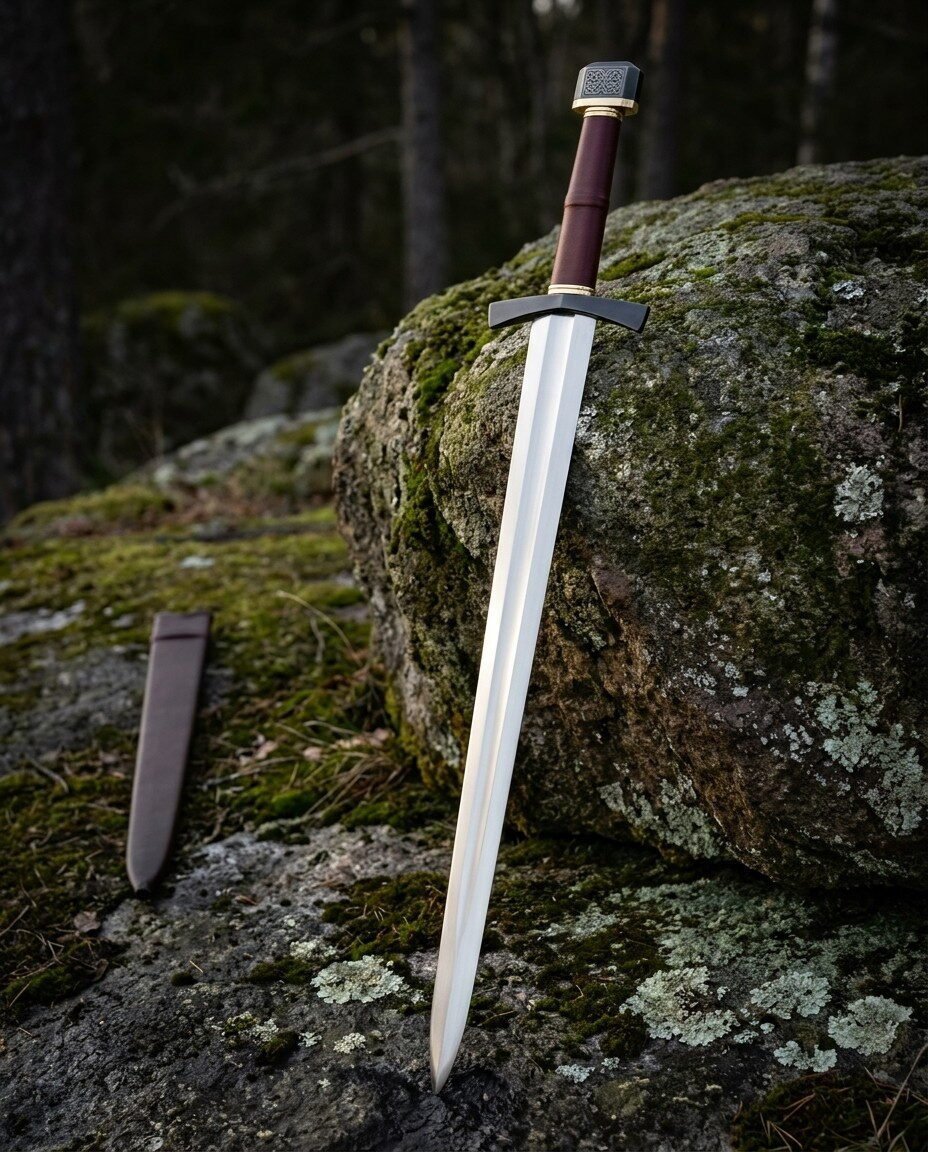
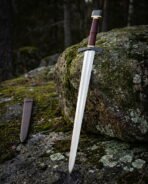
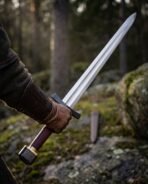
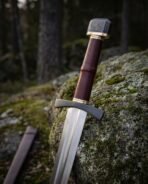
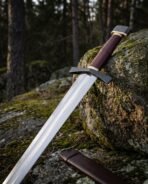
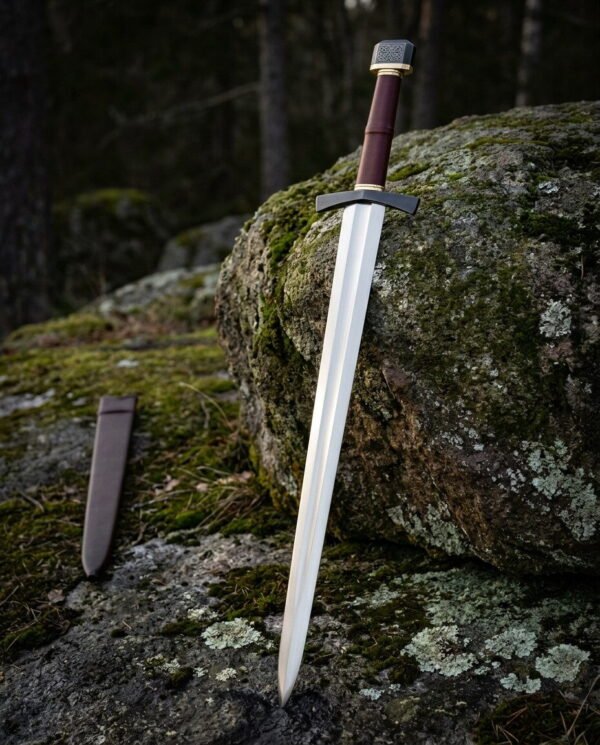
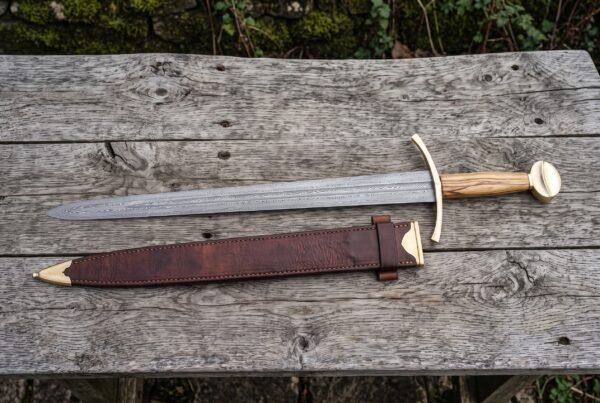
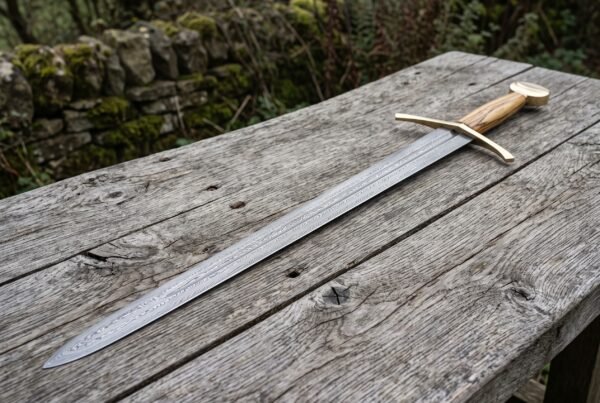
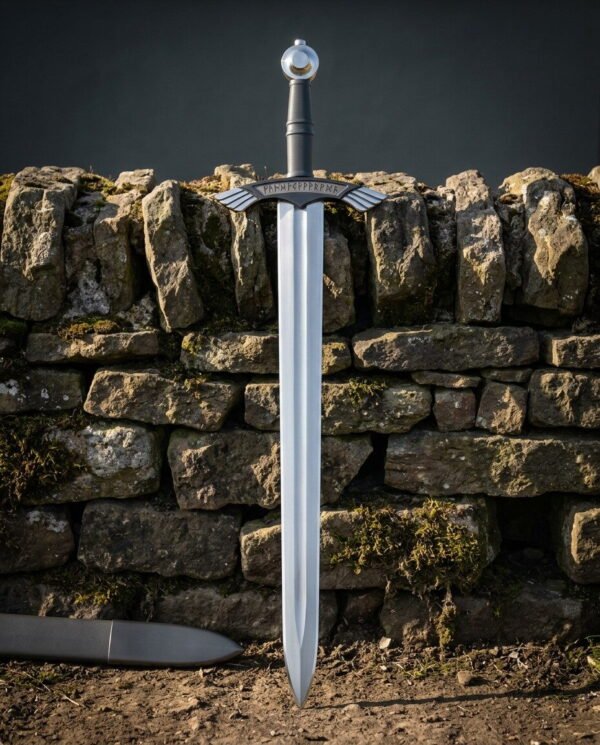
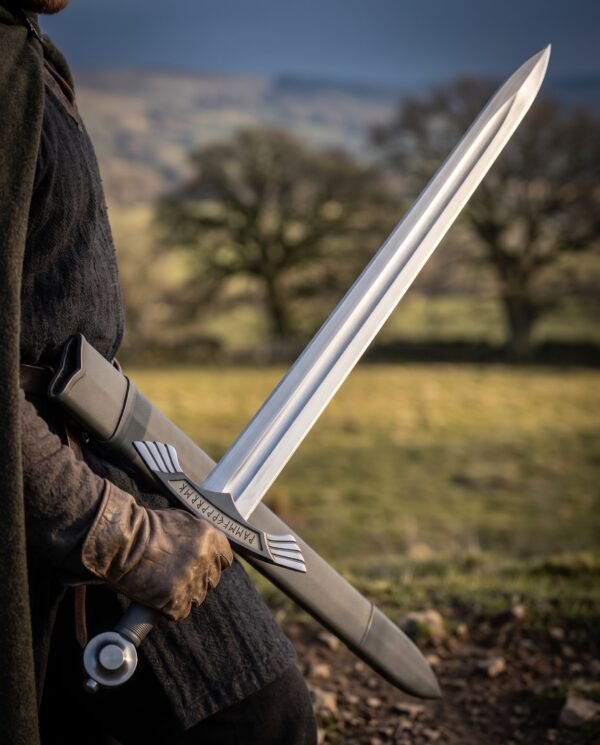
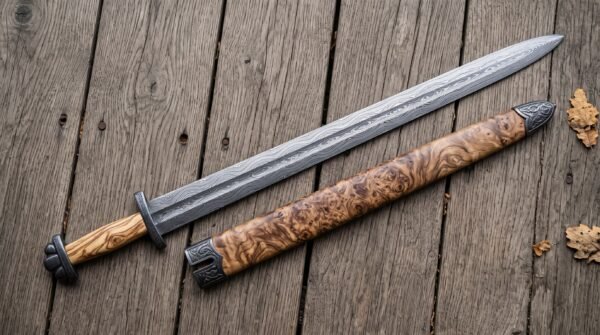
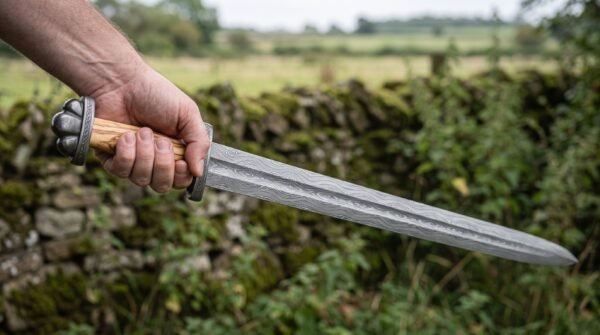
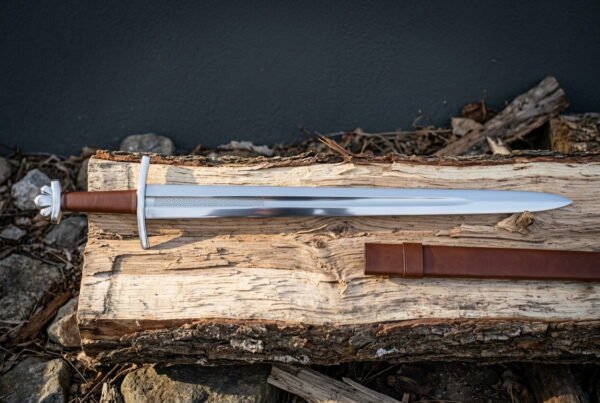
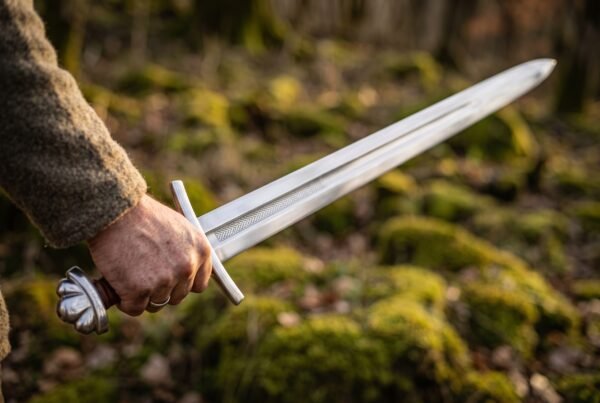
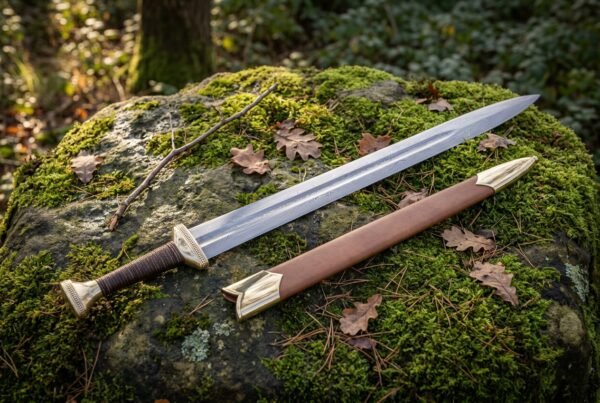
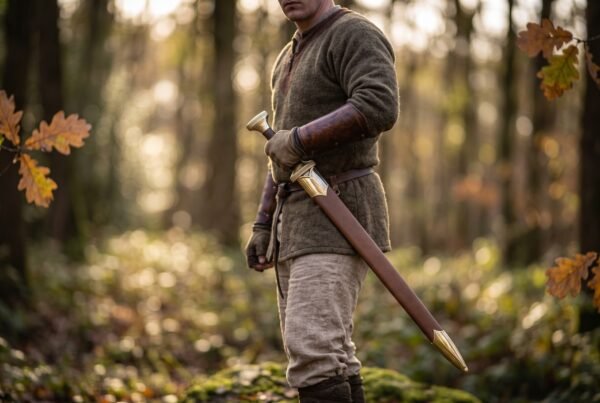
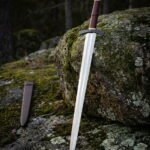
A single hand Viking arming sword with a hilt that reads as Norse from across a room. The blade is hand forged 1095 high carbon steel, double edged, with a flat diamond section that runs to a fine point rather than the broad fullered profile you see on earlier swords. Above it sits a blackened steel crossguard with a slight downward flare, a brass spacer ring, a deep oxblood leather grip with a raised centre ridge and a second brass ring at the top, and a heavy blackened pommel cap whose face is cut with a panel of Norse interlace knotwork. A brown leather scabbard ships with it.
The pommel is the part worth looking at twice. Viking age pommels were not solid lumps. They were usually built in two parts, an upper guard bar and a separate cap riveted or peened onto it, which let a smith combine different metals and different decoration in one hilt without having to carve the whole thing from a single billet. Ours follows that construction logic and carries the interlace on the cap face where it catches raking light. The sword is forged, ground, heat treated and assembled by hand in the Czech Republic. It belongs with the Viking swords. If the shape is not quite right, the Norse arms run close to it.
Specifications
| Blade steel | 1095 high carbon steel, hardened to 54 to 58 HRC |
|---|
| Blade profile | Double edged, flat diamond section, hand polished satin finish |
|---|
| Guard | Blackened steel crossguard with downturned ends |
|---|
| Grip | Oxblood leather over a shaped core with a raised centre ridge |
|---|
| Spacers | Brass rings at the guard and under the pommel |
|---|
| Pommel | Blackened steel cap engraved with a Norse interlace knotwork panel, on a brass base plate |
|---|
| Scabbard | Dark brown leather, stitched and edge finished by hand |
|---|
| Finish | Satin polished blade, blackened fittings, polished brass rings |
|---|
| Included | Sword, leather scabbard, care card |
|---|
| SKU | RK-1794 |
|---|
Reading Norse interlace, and why it never ends
The knotwork on the pommel is not decoration chosen at random. Norse and Insular interlace follows a rule that a carver would have taken as read. The band must be continuous. It weaves over and under itself, it turns, it splits and rejoins, but a properly cut interlace has no loose end anywhere in the panel. Follow any strand with a fingernail and you come back to where you started. That constraint is why the patterns look so dense. A carver is not filling space, they are solving a puzzle inside a fixed border.
Later Scandinavian work took the same rule and hung animals on it, so what looks like abstract ribbon at first glance turns out to be a beast whose body is the band and whose jaw grips its own tail. If you look at the eleventh century Urnes stave church carvings you can see the whole idea at its most extreme. On a sword pommel the panel is small enough that the plain ribbon version reads better, which is what we cut here.
1095 high carbon steel and a flat diamond blade
The blade is 1095, a plain high carbon steel with about one percent carbon and nothing much else, hardened to 54 to 58 HRC. What is different about this one is the cross section. Instead of a fuller it has a flat diamond grind, meaning the blade tapers to a central ridge and then out to both edges with no groove taken from the middle. That makes for a stiffer blade with more mass concentrated in the spine line, which suits a sword with a fine point. It is the later Viking age and early medieval direction of travel, as swords started being asked to find gaps in mail rather than just to cut.
The blackening on the guard and pommel is a controlled oxide finish, not paint and not powder coat. It will wear at the high points over years of handling and go a warm grey there, which is exactly what old iron fittings do.
Engraving, runes and your own design
Use the rune converter on this page to turn a name, a date or a short phrase into Elder Futhark and we will cut it into the steel, the leather or the wood. If you would rather have a Viking pattern than a rune line, choose your own design in the engraving option above the add to cart button and tell us where it goes. Where a piece already carries an engraved design, your chosen engraving replaces it rather than sitting alongside it, so a custom pommel engraving will take the place of the interlace panel. The blade flat and the scabbard face are both good alternatives if you want to keep the knotwork. Detail is on the engraving page.
Handling and balance
This is a one hand sword and it is meant to be held as one. The grip is short, the pommel is heavy and the balance sits close to the guard, so the blade turns around the wrist and can be stopped and redirected rather than committed. The flat diamond section makes it feel stiffer and slightly more point forward than a broad fullered blade of the same length, which is the trade you get for the thrusting geometry.
It is a sharpened collector and display sword. It is not sold for battle ready sparring and should not be used for contact drills against another blade or against a person. Reenactment contact needs a purpose built blunt with rolled edges.
Care
Wipe the blade every time you handle it. Carbon steel takes a permanent grey etch from a fingerprint left overnight in a humid room, and a satin polish shows it clearly. Keep a thin film of mineral oil on the steel. Do not store the sword sheathed for long periods, because vegetable tanned leather holds moisture against the blade. Feed the scabbard and the grip with a leather conditioner once or twice a year, working it in with your fingers and letting it sit overnight. The brass banding will dull to a soft gold, which most owners prefer to a bright shine. The blackened fittings need nothing beyond a dry cloth. Our method is set out under steel care.
Made in the Czech Republic
This is a handmade piece from the Czech Republic, made in a workshop that still forges, grinds and finishes by hand instead of stamping parts out. The smiths there have kept the older way of working, and the wood, horn and leather are shaped and fitted by hand as well. Two pieces of the same design will never be identical, and that is part of what you are buying.
Ransack Viking is a United States company. We handle the import ourselves, look over every piece when it lands and ship from our warehouse in Chicago, Illinois. Engraving is done in the United States after the piece arrives, so your design goes on before we send it out.
A note on handmade variation
Hand made, not machine made or bulk produced, so what arrives will not be a pixel for pixel copy of the photograph. The oxblood dye sits differently on every hide and can read closer to burgundy or closer to brown. The blackened oxide finish varies in depth. The interlace is cut by hand so the line weight will not be identical panel to panel, and the satin polish carries its own direction. The steel, the heat treat, the dimensions and the build are the same every time. The character is not. If that is the part you care about, carry on with the Viking swords collectors go for, then the arms in Vikings and The Last Kingdom.
Frequently asked questions
Does it come sharp
Yes. It arrives with a hand put working edge on both sides. Treat it as a sharp tool from the moment you open the box.
Is this suitable for reenactment fighting
No. It is a sharpened display and collector sword. Contact reenactment requires a blunt trainer with rolled edges built specifically for that use.
Is the pommel really engraved or is it a stamped pattern
It is cut into the pommel face by hand and then blackened, so the pattern sits below the surface and catches light rather than sitting on top of it.
Will the blackened finish rub off
It will wear at the high points with handling and go a warm grey there over years. That is normal for an oxide finish on iron fittings and most people like how it ages.
Is the scabbard included in the price
Yes. The brown leather scabbard shown is part of the listing and ships with the sword.
How long does shipping take
Processing is one to two weeks because each sword is built to order. Shipping within the United States is free once it leaves us.
What is in the box
- Hand forged 1095 high carbon steel Viking arming sword
- Blackened steel pommel cut with a Norse interlace knotwork panel
- Oxblood leather grip with brass rings at each end
- Brown leather scabbard, hand stitched and edge finished
- Care card covering oiling, storage and leather feeding
- Lifetime warranty against defects in forging, grind, heat treat and fittings
- Forged and finished in the Czech Republic
Explore the range
Browse the Viking swords, the arming swords, the full sword range and the guides.
Also in this part of the catalogue
Sitting beside it in the catalogue is the Stonewake Viking sword, forged from 1095. Another in the same line is the Emberhilt Viking sword, forged from 1095. Next along the rack is the Valkwarden Viking sword, 37 inches overall.
Fitting out further, the Palecrest arming sword belongs with it. Or start from a blank sheet on the custom Viking sword page.


Been eyeing this sword for months and it did not disappoint. Fit and finish is museum quality. You can tell real craftsmen made this by hand. Came in a nice gift box which made it feel even more special. Shipping was fast and everything arrived well packaged.
My whole family was impressed when I unboxed it. Even the small engravings are crisp and clean. Love that this is Czech craftsmanship and shipping from the US meant it showed up in just a few days. If you’re on the fence just get it. You won’t regret it.
Incredible craftsmanship on this one. 1095 Steel blade holds a razor edge right out of the box. Made overseas in the Czech Republic yet shipped from a US location so no long customs wait. So worth it.