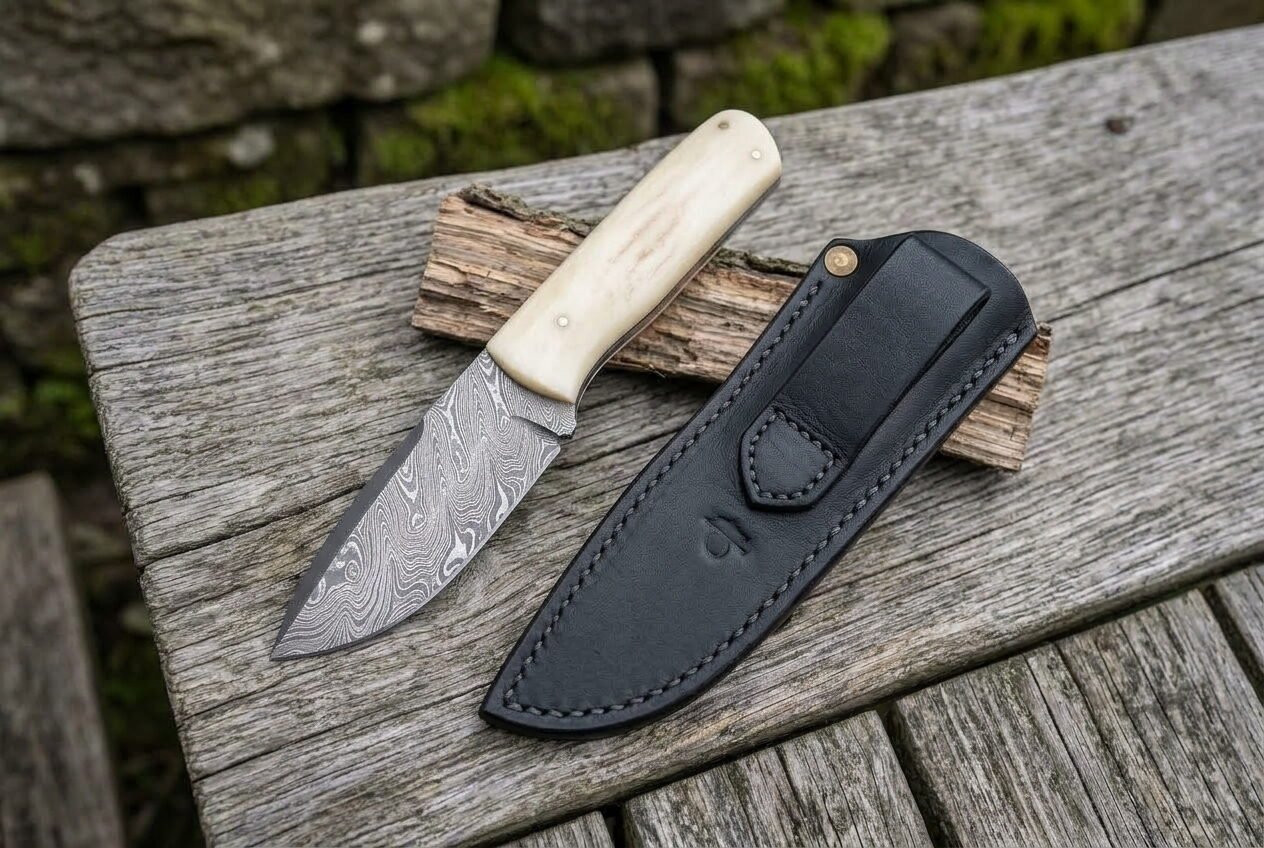
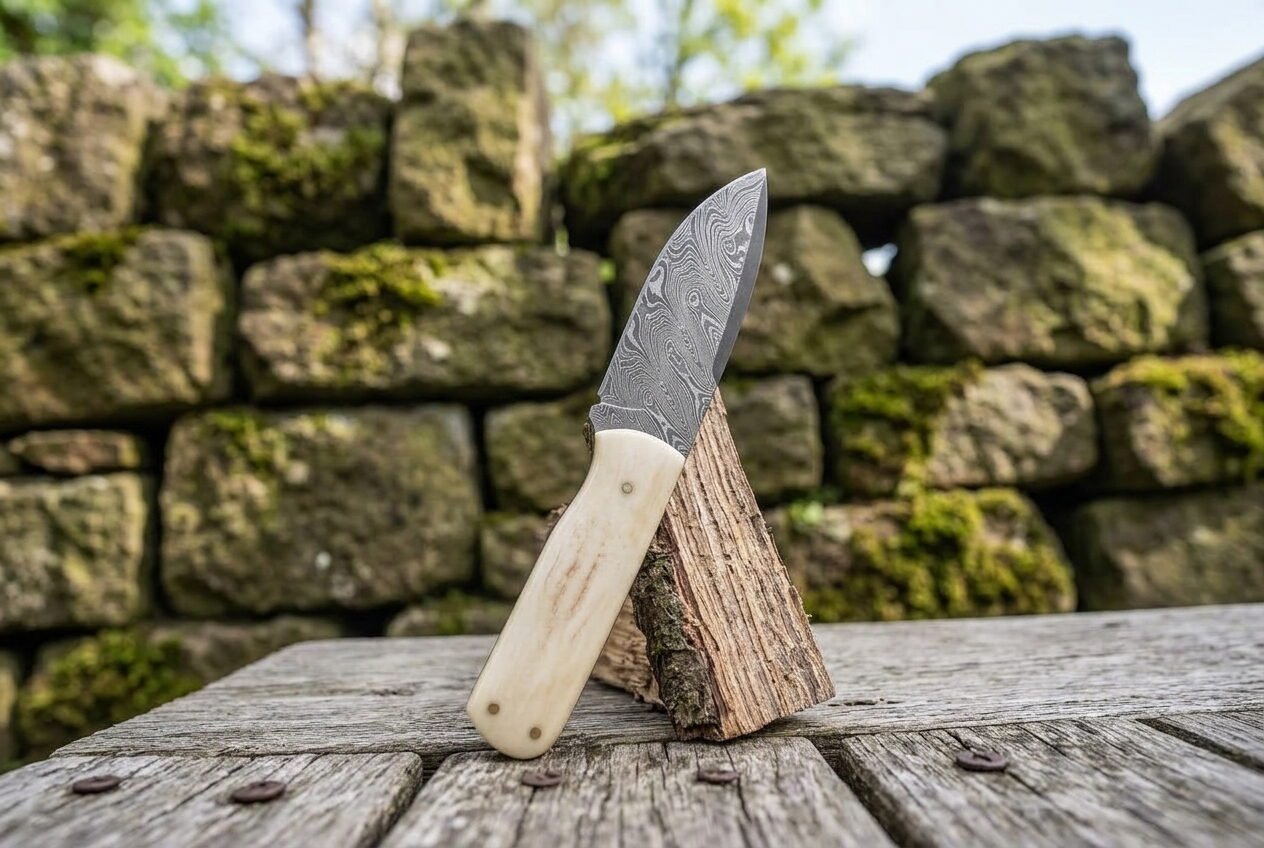
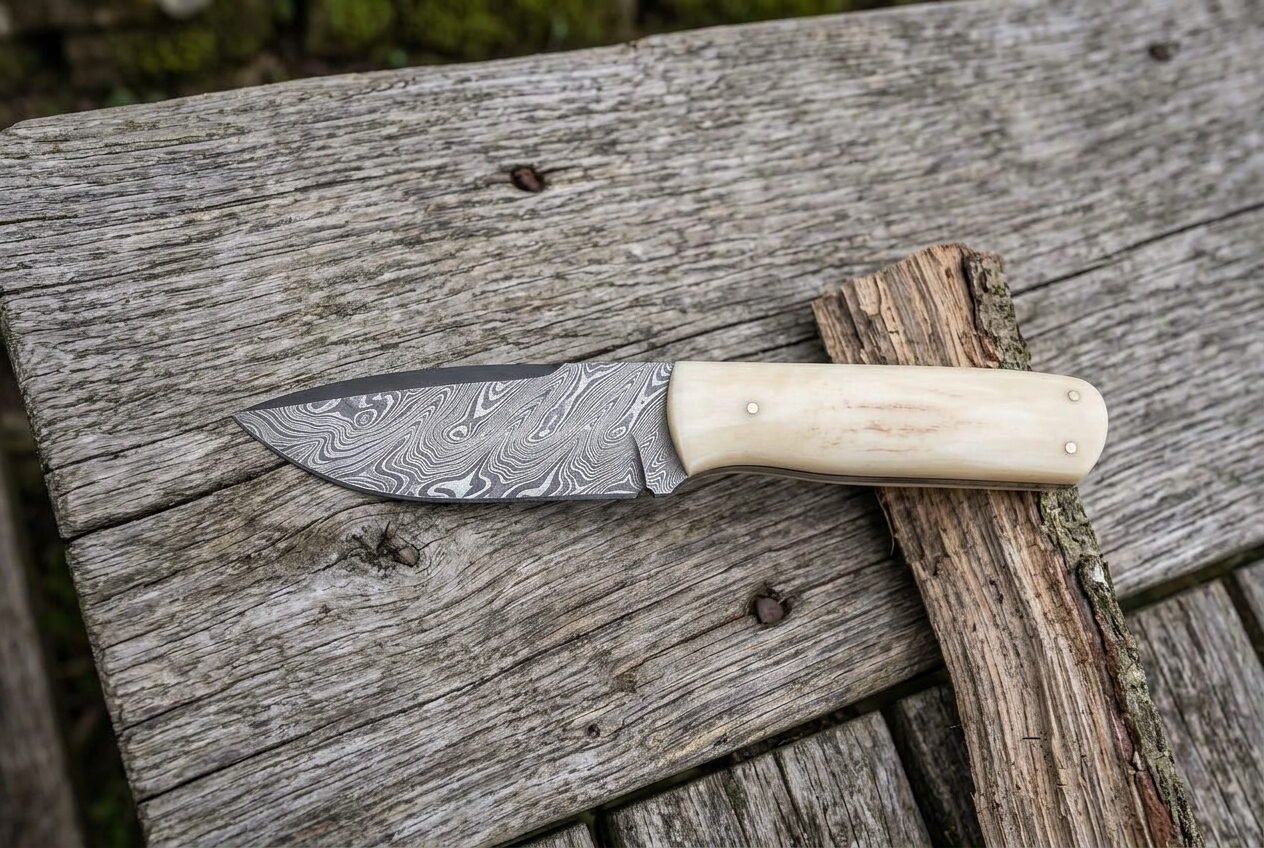
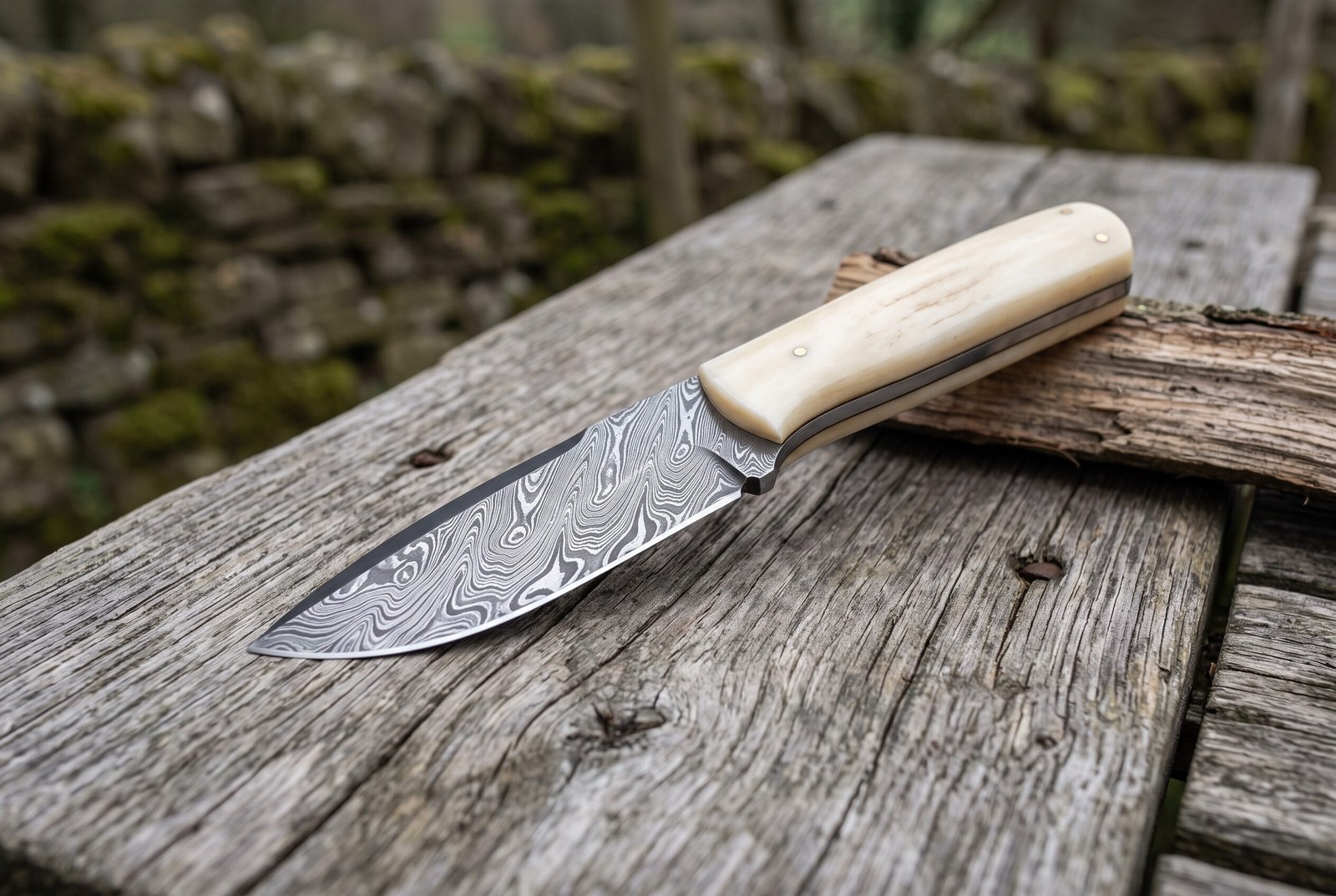
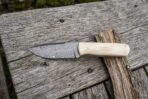
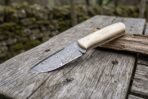
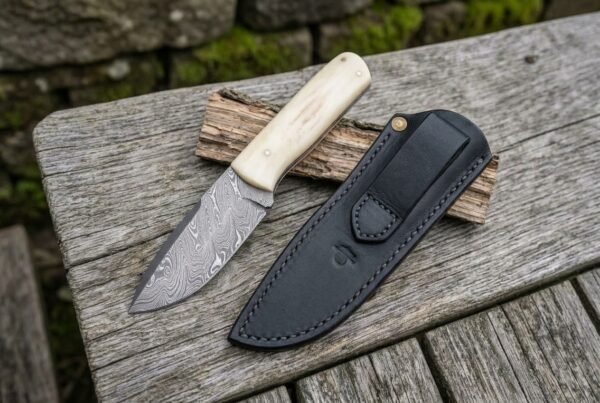
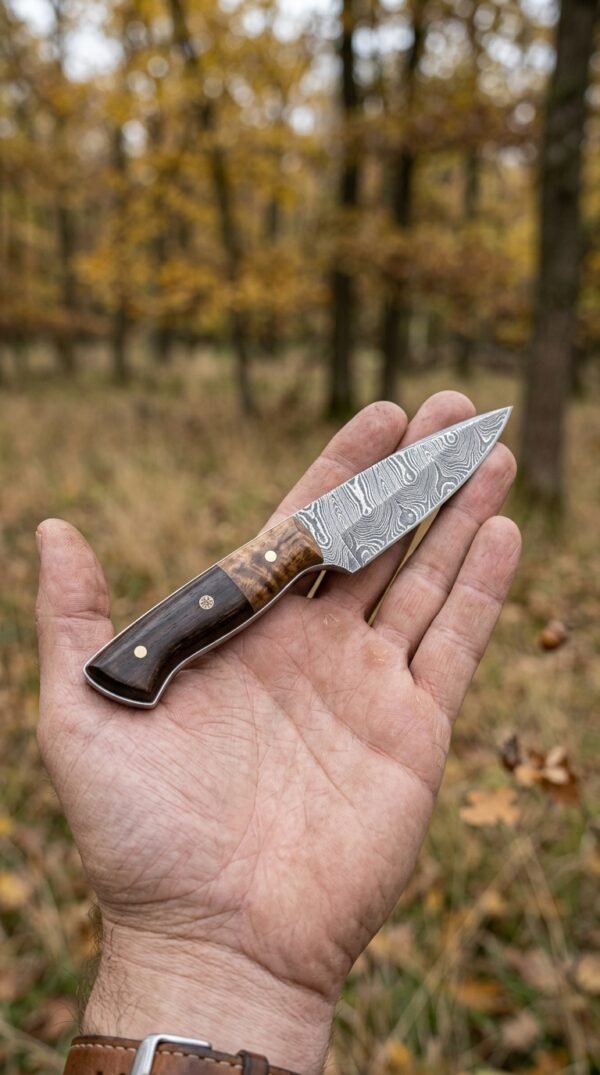
Short, broad and heavier in the hand than the photograph suggests, the Cowhand is a bull cutter built the way the pattern was meant to be built. The Damascus blade is drawn out under the hammer to 3.5 inches, the camel bone handle is fitted to the finished tang rather than to a template, and the whole knife closes out at 6.5 inches overall. Where this shape sits among the rest is covered in the blade shape notes.
The bull cutter earned its name honestly. It is a cattle working pattern from the American stock trade, and the shape follows the job: a wide blade with a deep belly for a long slicing stroke, a short overall length so the knife stays controllable at arm’s reach under an animal, and a blunt or heavily rounded tip so the point cannot dig where it is not wanted. Ranch hands carried them because a knife that will not accidentally puncture is worth more in a working pen than a knife with a needle point. The same geometry turned out to be excellent for camp cooking and general utility, which is why the pattern outlived the specific job it was named for.
This one is forged, heat treated, ground and finished in the Czech Republic, and it ships with a fitted leather sheath, sharpened and boxed, free of shipping charges inside the United States.
Specifications
| Steel | Hand forged Damascus, 1095 and 15N20 forge welded |
|---|
| Hardness | 58 to 60 HRC |
|---|
| Damascus layers | 393 layers |
|---|
| Pattern | Wind and mix twist fire pattern with brass file work |
|---|
| Overall length | 6.5 inches |
|---|
| Blade length | 3.5 inches |
|---|
| Handle length | 3.0 inches |
|---|
| Handle | Camel bone |
|---|
| Sheath | Leather sheath |
|---|
| SKU | RK-433 |
|---|
Why a bull cutter is shaped the way it is
Look at the profile and you are looking at a set of deliberate compromises. The blade is wide relative to its length, which puts a long curved cutting edge into a very short knife. That curve is the working part. A deep belly lets you draw the whole edge through a cut in one pass instead of sawing, and it keeps the contact point moving so the edge does not dull in one spot.
The length is the other half of the design. At 3.5 inches of blade against a 3.0 inch handle, the knife is almost all edge and almost no lever. You hold it in a closed fist with your thumb on the spine and the blade barely projects past your grip, which is what gives you control when you cannot see what you are cutting. A longer knife would give you reach you do not want in that situation.
Bring it into a kitchen or a camp and the same shape becomes a fast little slicer. It breaks down a chicken, it trims fat, it cuts twine, it peels and portions, and the deep belly means it rocks on a board far better than a straight edged knife of the same length. This is a pattern that works far outside the pen it was named after.
Why Damascus and not stainless
The blade is 393 layers of 1095 and 15N20 forge welded into a single billet, then folded, drawn down and etched. The pattern is two steels lying against each other through the full thickness of the blade, not a print on the surface, and no amount of sharpening will take it off.
The practical argument is the 1095. High carbon steel at 58 to 60 HRC takes a finer edge than a soft stainless kitchen blade and holds it through far more cutting before it needs attention. The 15N20 brings nickel, which adds toughness so the blade is not brittle, and which stays bright under the etch to give the pattern its contrast. What you give up is corrosion resistance. Leave it wet and it will spot. Wipe it dry and oil it and it will outlive you. The full comparison sits in Damascus versus stainless.
Camel bone in the hand
Camel bone has been a knife handle material for as long as there have been camels and knives in the same place. It is dense, hard and close grained, it takes a deep polish, and unlike a synthetic scale it warms to skin temperature quickly rather than staying cold and slick.
Because it is a natural material it is not uniform. Bone carries its own faint mottling and its own tone, and the marks that come with the material are the proof that it is the material. Treat it the way you would treat a wooden handle. Keep it out of long soaks, keep it away from dry heat, and give it a wipe of light oil once or twice a year. The routine is written up in wooden handle care and applies to bone, horn and antler in exactly the same way.
Engraving, runes and your own design
Use the rune converter on this page to turn a name, a date or a short phrase into Elder Futhark and we will cut it into the steel or the handle. If you would rather have a Viking pattern than a rune line, choose your own design in the engraving option above the add to cart button and tell us whether it goes on the blade or the handle. Where a piece already carries an engraved design, your chosen engraving replaces it rather than sitting alongside it.
Engraving is cut in house before the knife is packed. On a bull cutter the wide blade flat is the natural canvas and takes a longer line than most knives this size, while a brand, a set of initials or a date sits well on the bone. Options and lead times are on the engraving page.
Care and sharpening
The rules are short. Dry it after use, oil it before storage, and do not leave it sheathed and damp, because leather holds moisture against steel. If it does pick up a spot of surface rust, a little oil and a green scouring pad will take it back without touching the pattern.
Sharpening a deep bellied blade is easier than it looks once you stop trying to keep the knife flat. Lead with the heel, sweep the blade across the stone as you draw it, and let the tip come off the end of the stroke so the whole curve gets the same number of passes. A 1000 grit stone will reset it. Detail in steel care and sharpening with a whetstone.
Made in the Czech Republic
The work behind this piece happens in a Czech Republic workshop that has kept to the old methods. Steel is forged and heat treated by hand, the grind is taken down by eye rather than by machine, and the handle, fittings and sheath are cut and finished one at a time. Because of that, every piece carries small marks of the hand that made it.
Ransack Viking is a United States company. We import direct, check each piece when it reaches us, and ship from our Chicago, Illinois warehouse. Engraving is added here in the United States after arrival, so the piece you receive is finished to your order.
A note on handmade variation
This bull cutter is hand forged. It is not machine made and it is not bulk produced, so the piece that arrives will not be a pixel for pixel copy of the photograph. The Damascus pattern comes out of the billet differently every time, the camel bone came from a different piece of bone, and the exact profile of the grind carries the hand that made it.
The dimensions, the steel, the layer count and the build are the same every time. The grain, the tone, the pattern and the character are not, because every one of these is worked by hand from natural materials. If you want two identical objects, buy something stamped. If you want an object that is yours, this is what that looks like.
Frequently asked questions
What is a bull cutter actually used for today
Most of them never see a pen. They are bought as compact working knives for ranch and farm chores, camp cooking, hunting camp butchery and general utility, and as collector pieces for people who like American working patterns. The shape happens to be very good at all of that.
Is the tip sharp enough to pierce
The pattern is deliberately not a piercing knife. The tip is present but rounded off compared to a clip point or a dagger, because the original job called for a blade that could not accidentally puncture. If you want a fine point for detail work, a drop point or a Bowie is the better buy.
Is the handle full tang
Yes. The tang runs the full length and full profile of the handle with the camel bone fitted to either side of it, which is why the knife feels heavier than its 6.5 inch length suggests and why it will take hard use without loosening at the grip.
Will the camel bone crack over time
Not under normal use. Bone is stable, but like wood and horn it does not like extremes, so avoid leaving it on a dashboard in summer or next to a heat source through winter. An occasional wipe of light oil keeps it from drying out.
Can I get this engraved as a gift for a rancher or a groomsman
Yes, and it is one of the more popular pieces for exactly that. A name and a date on the blade flat, or a brand or monogram on the bone, and it stops being a product. Engraving is cut here before the piece ships.
How long will delivery take
Allow one to two weeks of processing while the piece is made and finished, plus transit. Engraved orders sit at the longer end of that. Shipping inside the United States is free and returns are open for seven days after delivery.
What is in the box
- One Cowhand Damascus bull cutter knife
- Leather sheath
- Protective packaging
- Forged and finished in the Czech Republic
Explore the range
Sitting beside it in the catalogue: Cowboy Bull Cutter, Hunting Knives and Viking Knives. Background on the steel, the bone and the leather is in the guides.
Compare it with these
For a straight comparison, see the Bonewarden Damascus skinner knife, pattern welded Damascus. Worth putting side by side with this is the Camelbone Damascus skinner knife, pattern welded Damascus. In the same category sits the Sandbone bowie knife, pattern welded Damascus.
From the same corner of the shop, there is the Steelpommel dagger knife. Pick the steel, the length and the fittings yourself on the custom Damascus knife page.

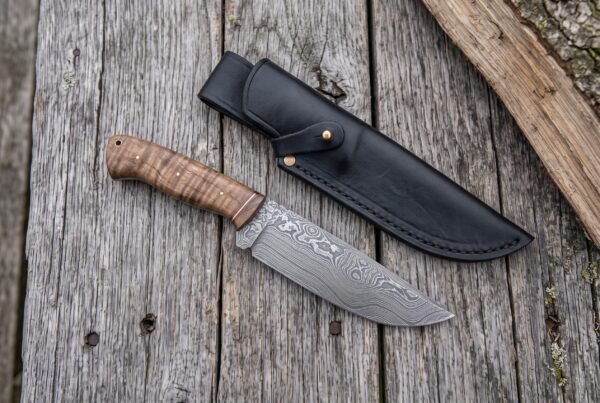
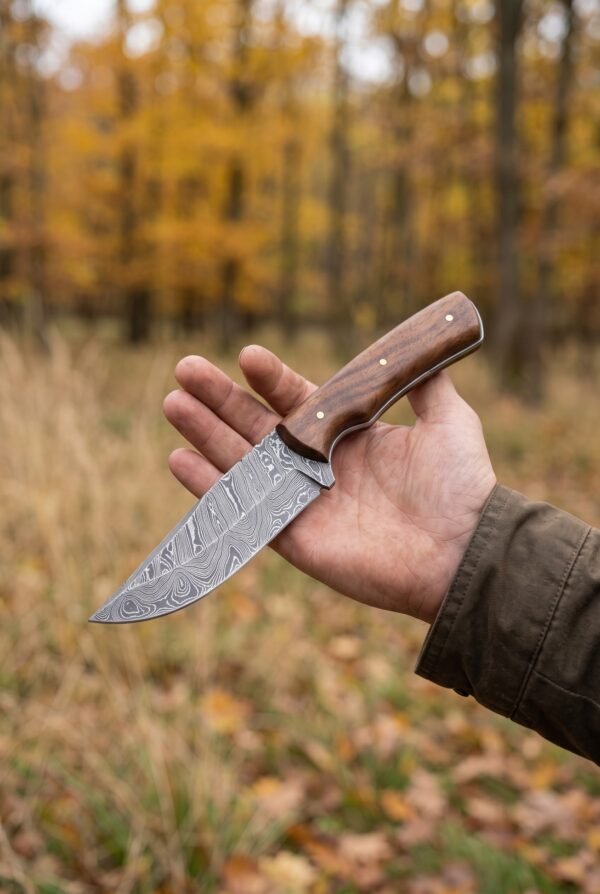



Been eyeing this knife for months and it did not disappoint.
Was nervous ordering something like this online but so glad I did. Love that this is Czech craftsmanship and shipping from the US meant it showed up in just a few days.
Best knife I’ve ever owned. Weight and balance make it feel like a real functional piece not some cheap replica. This is my third order from Ransack Viking and they never disappoint. The bone handle feels amazing and the balance is perfect. Worth every penny.