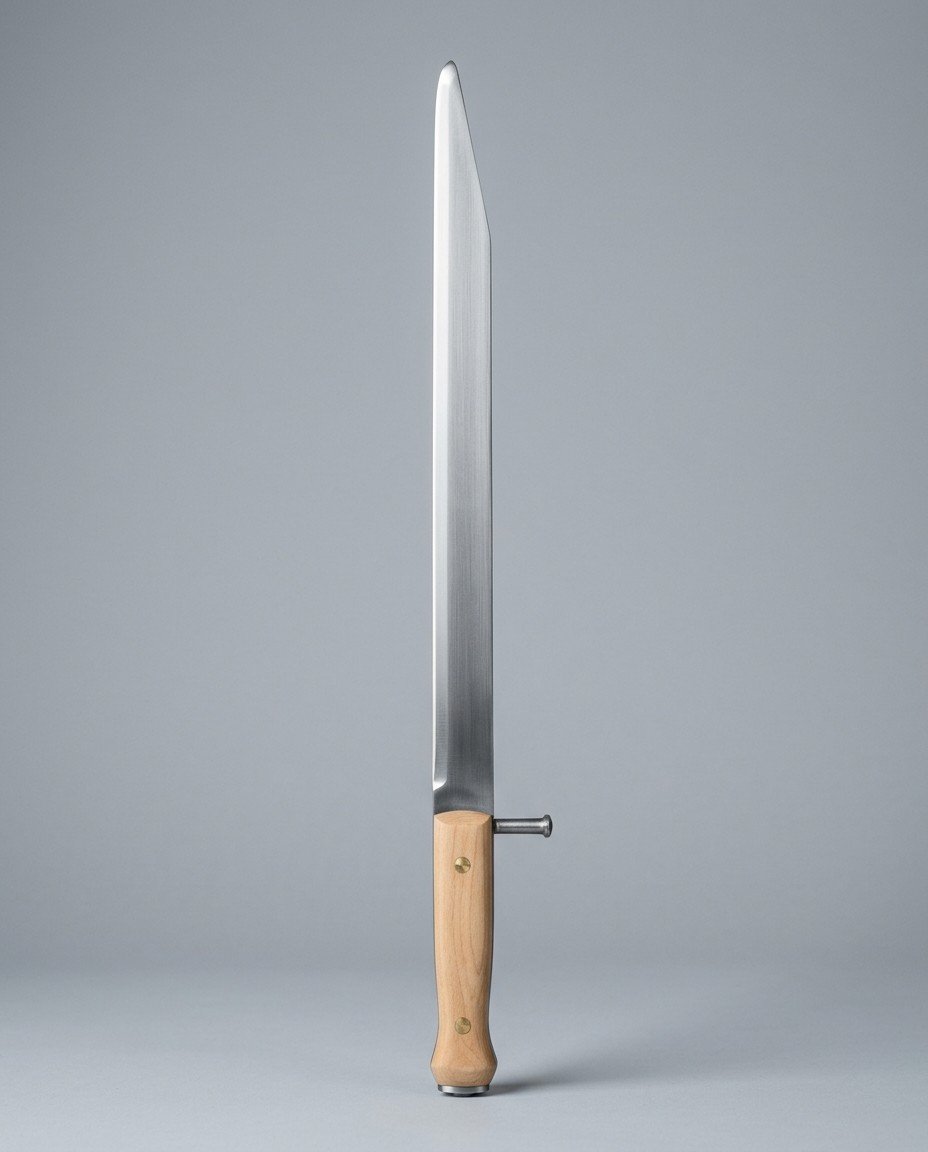
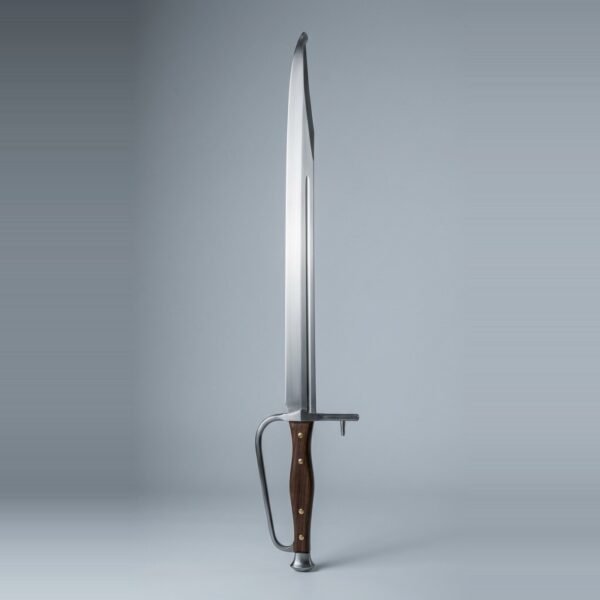
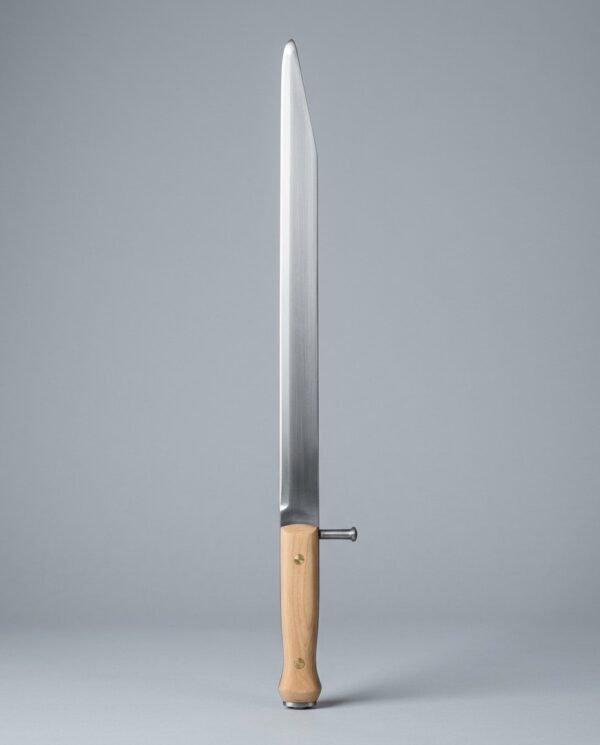
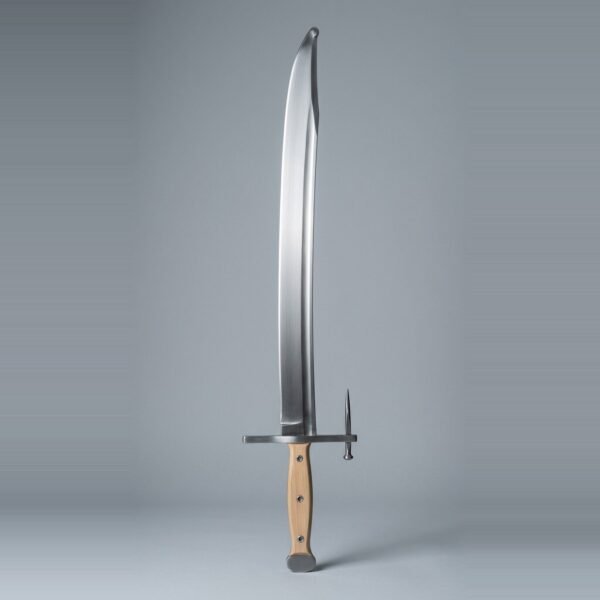
The Hallvarn is a bauernwehr, the belt knife that working people in the German speaking lands carried through the fifteenth and sixteenth centuries. It has one edge, a flat spine, a long clipped point and a nagel standing out of the right side of the grip. There is no cross on it at all. A careful reader may look at this piece and call it a bauernwehr or simply a long knife rather than a full messer, and that reading is fair. It is built on the same logic as a langes messer, only shorter and without the cross bar.
This one is sharp. The edge is ground and finished and it will cut. It is not a blunt trainer and it is not a sparring tool, so it does not belong on a club night and it should never be bound against another blade. It is made for tatami, rolled paper and the kind of controlled test cutting that shows what a short single edged blade does to a target.
If you are working out where a sharp sits next to a blunt in your kit, read blunt versus sharp training swords first, then the messer guide for how the family is put together and what the nagel is doing. The rest of the family lives in HEMA messers.
Specifications
Every figure below is taken from the piece as it is made. It is hand work, so read the lengths as close rather than exact.
| Material | 1095 high carbon steel, hardened to 54 to 58 HRC |
|---|
| Overall length | About 24 inches, hand made so it varies a little piece to piece |
|---|
| Blade length | About 18 inches |
|---|
| Blade type | Single edged, flat spine, long acute clipped point |
|---|
| Edge | Sharp, ground and finished, this is a cutting blade |
|---|
| Tip | Acute clipped point, sharp |
|---|
| Guard | None, there is no cross bar on this form |
|---|
| Nagel | Steel stud set through the right side of the tang |
|---|
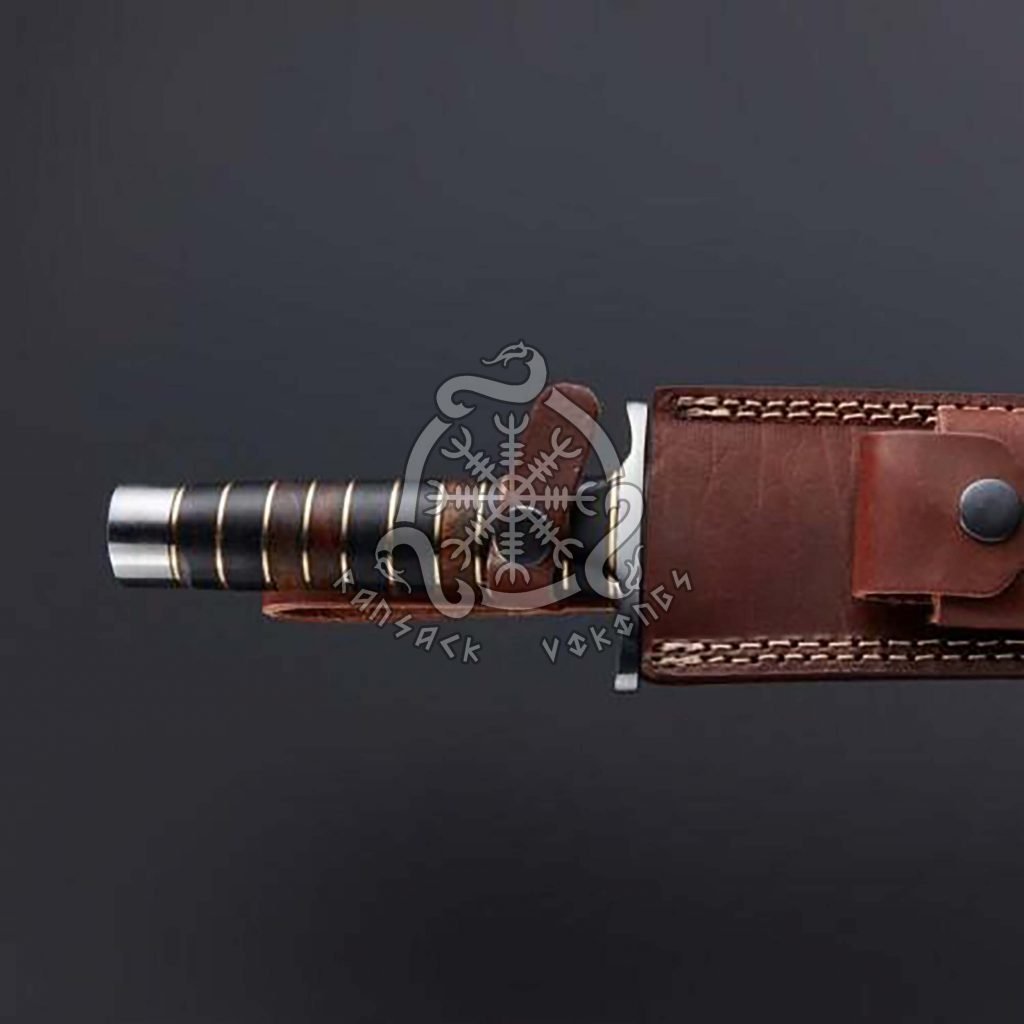
| Grip | Pale wood scales over a full tang, two brass rivets, steel butt ferrule |
|---|
| Flex | Stiff, not a sparring tool |
|---|
| Included | Cloth wrap and a care card, no scabbard |
|---|
| SKU | RK-3036 |
|---|
The bauernwehr and where it sits between knife and messer
Bauernwehr means something close to a countryman’s arm, and that is roughly what it was: the everyday cutting knife of a farmer, a carter or a townsman, worn on the belt and used for work first and defence second. The form runs from a large utility knife up to something near the length of a short sword, and this one sits in the upper half of that range.
The thing that separates it from a langes messer is the hilt. A messer carries a cross bar through the tang as well as a nagel. This piece has the nagel and nothing else. The nagel is the steel stud standing proud of the right side of the grip, and it does the job a cross would do, turning a blade that slides down the outside of the hand and keeping the fingers away from the opposing edge.
The scales are pale wood held by two brass rivets through a full tang, and the butt is closed with a steel ferrule rather than a pommel. That is the honest construction of the type. Nothing is hidden inside a hollow grip and nothing is glued on. Johannes Leckuchner wrote a long and serious fencing treatise on the messer in 1482, which tells you the family was never a poor relation of the longsword. The short forms like this one share that vocabulary of hangings, winding and short edge cuts.
1095 high carbon, the grind and the clipped point
The blunt trainers in this line are 51CrV4 spring steel, because a sparring blade has to bend hard in a bind and come back straight. A cutting blade is a different problem. This one is 1095 high carbon hardened to 54 to 58 HRC, which is the range where an edge holds through a stack of mats without chipping and still takes a stone without a fight.
The section is a flat wedge running from a thick spine down to the edge. That is what a single edged cutter wants. Mass sits behind the edge, the blade parts the target instead of wedging into it, and the flat spine gives you somewhere to lay a thumb or a second hand when you want more control at the end of a cut.
The point is a clipped point and on this piece it is acute. The last stretch of spine is ground away in a long shallow sweep so the tip sits closer to the centre line and comes to a real thrusting shape rather than a blunted nose. Clipped points are the standard on the messer family for exactly that reason. They let a blade built to cut also thrust without moving the balance forward.
Because the steel is hard and the edge is finished, the blade is stiff. It is not meant to flex and it should not be tested that way. Treat it the way you would treat any sharp cutting sword: keep the edge aligned through the cut, stop before you are tired, and keep it away from other steel.
Engraving, runes and your own design
Use the rune converter on this page to turn a name, a date or a short phrase into Elder Futhark and we will cut it into the steel or the grip. On this piece the natural places for a line of runes are the flat of the blade near the spine or the pale wood of the scales, and you can tell us which you want in the order notes.
If you would rather have your own design than a rune line, choose your own design in the engraving option above the add to cart button and tell us where it goes. Where a piece already carries an engraved design, your chosen engraving replaces it rather than sitting alongside it. More on the engraving page.
Handling and balance
Do not expect a sword in the hand. This is short, and the mass sits close to the grip because most of the steel is in the first two thirds of the blade. That makes it quick to bring on line and easy to recover after a cut, which is exactly what a belt knife wants to do.
The nagel changes the grip. Your thumb wants to sit behind it on the flat of the scale, and once it does the blade tracks the back of the hand rather than the palm. Work that grip before you cut anything. A bauernwehr held like a kitchen knife will roll at the moment of impact and you get a slap instead of a cut.
We do not publish a weight or a point of balance for this piece. The photographs carry no scale and every one is finished by hand, so any number we printed would be wrong for most of them. What we will say is that it handles like a tool rather than a display item.
Care
1095 is plain high carbon steel. It will rust if you let it, and it will do that faster than any stainless kitchen knife you own. Wipe the blade down after handling, because skin oil and salt are what start the pitting, and keep a thin film of oil on the steel between uses. Mineral oil, camellia oil or a light gun oil all work.
After cutting mats, clean the blade properly. Wet tatami leaves salts and plant acid on the steel and both will mark it overnight. Dry it, then oil it, then put it away.
The wood scales want almost nothing. A little furniture wax once or twice a year stops them drying out and lifting at the rivets. Do not soak them, do not scrub them and do not store the piece anywhere warm and damp such as a garage or a loft. Store it out of its wrap, flat or point down, somewhere with moving air. The full method is in the knife care guide.
Made in the Czech Republic
Made by hand in the Czech Republic and imported by Ransack Viking. Nothing here is drop shipped out of an importer catalogue straight to a customer. Every one is checked for hilt tightness, pommel seating and blade straightness at our North Babylon, New York warehouse, and ships from there. Shipping in the United States is free, returns run for seven days, and the lifetime warranty against defects in the forging, the grind, the heat treat and the fittings has no end date and needs no receipt.
A note on handmade variation
This is hand forged. It is not machine made, not cast and not bulk produced, so what arrives will not be a pixel for pixel copy of the photograph on this page. Grain in the wood is different on every set of scales. The nagel sits where the smith set it. The clip is ground by eye, so the exact line where it leaves the spine moves a few millimetres from one piece to the next, and the polish on the flats carries the marks of the hand that put it there. None of that is a fault. It is the difference between a hand made blade and a stamping.
Frequently asked questions
Whether this bauernwehr arrives sharp
Yes. The edge is ground and finished and it will cut. This is a sharp blade for test cutting, not a blunt trainer, and it is sold to adults aged 18 and over.
Whether it can be used for sparring
No. Do not spar with it, do not bind it against another blade and do not take it to club night. Use a blunt trainer for paired work and keep this one for cutting.
Why there is no cross on it
Because the type does not have one. A bauernwehr carries a nagel and nothing else. A langes messer adds a cross bar through the tang, and that is the main thing that separates the two forms.
What the nagel actually does
It is the steel stud on the right side of the grip. It covers the hand in place of a cross and gives you something to set a thumb against, which is what keeps the edge aligned when the cut lands.
Whether a scabbard is included
No. Nothing in this line ships with a scabbard and we will not promise one. It arrives wrapped for transit with a care card in the box.
Whether it can be engraved
Yes. Elder Futhark runes, your own text or your own design, cut in the United States after the piece lands at our warehouse. Text and runes are $19, a symbol is $39 and a family crest is $49.
What is in the box
- One Hallvarn bauernwehr, hand made in the Czech Republic.
- A cloth wrap for transit.
- A care and storage card.
- Your warranty and returns information.
Explore the range
Look through HEMA messers for the rest of the family, HEMA swords for the whole training line, messers for the wider catalogue and dagger knives for the shorter pieces. Every guide we have written sits in the guides hub.
Other pieces in this group
In this part of the line you will also find Aurnvik langes messer, about 35 inches overall, Torvhaug sharp langes messer, about 37 inches overall, Jarnfeld sharp langes messer, about 38 inches overall, Ostrevak steel dussack, about 31 inches overall and Skarnvik arming sword, about 36 inches overall.
Everything else sits in the HEMA messer category and in the HEMA sword hub, and the custom sword builder builds to your own numbers.








Reviews
There are no reviews yet