The cavalry sabre is the sword that outlasted almost every other sword in regular military service. Long after foot soldiers had given up the blade for the musket and then the rifle, mounted troops kept a curved single edged sword on the saddle, and they kept it for a reason that has nothing to do with tradition. At the speed of a horse a straight blade buries itself and either breaks the wrist or is torn out of the hand. A curved blade meets the target at an angle, draws along it, and releases. The rider keeps the sword and keeps moving. Everything about the shape of this piece follows from that single problem, from the sweep of the spine to the way the balance sits forward of the guard. A curve needs a different stroke on the stone, and sharpening a curved blade shows it.
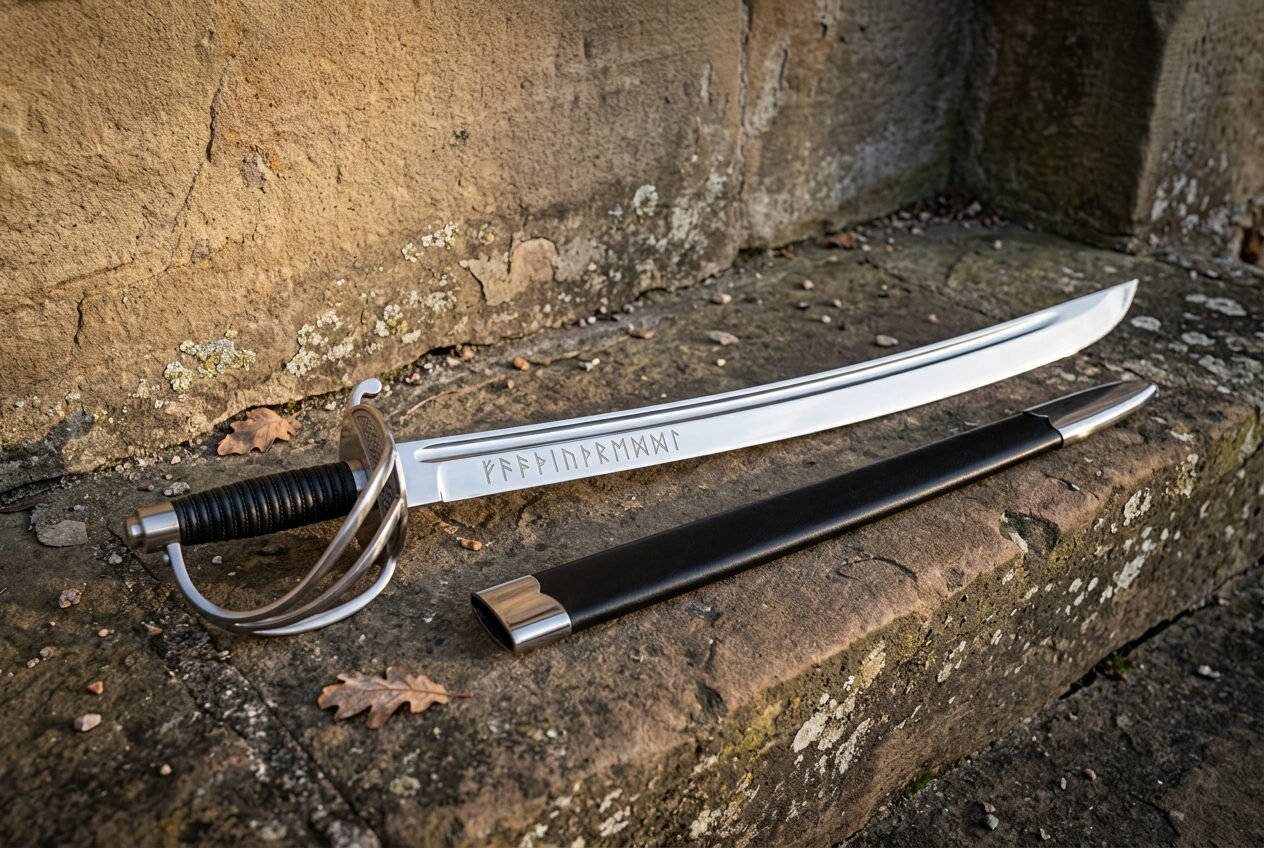
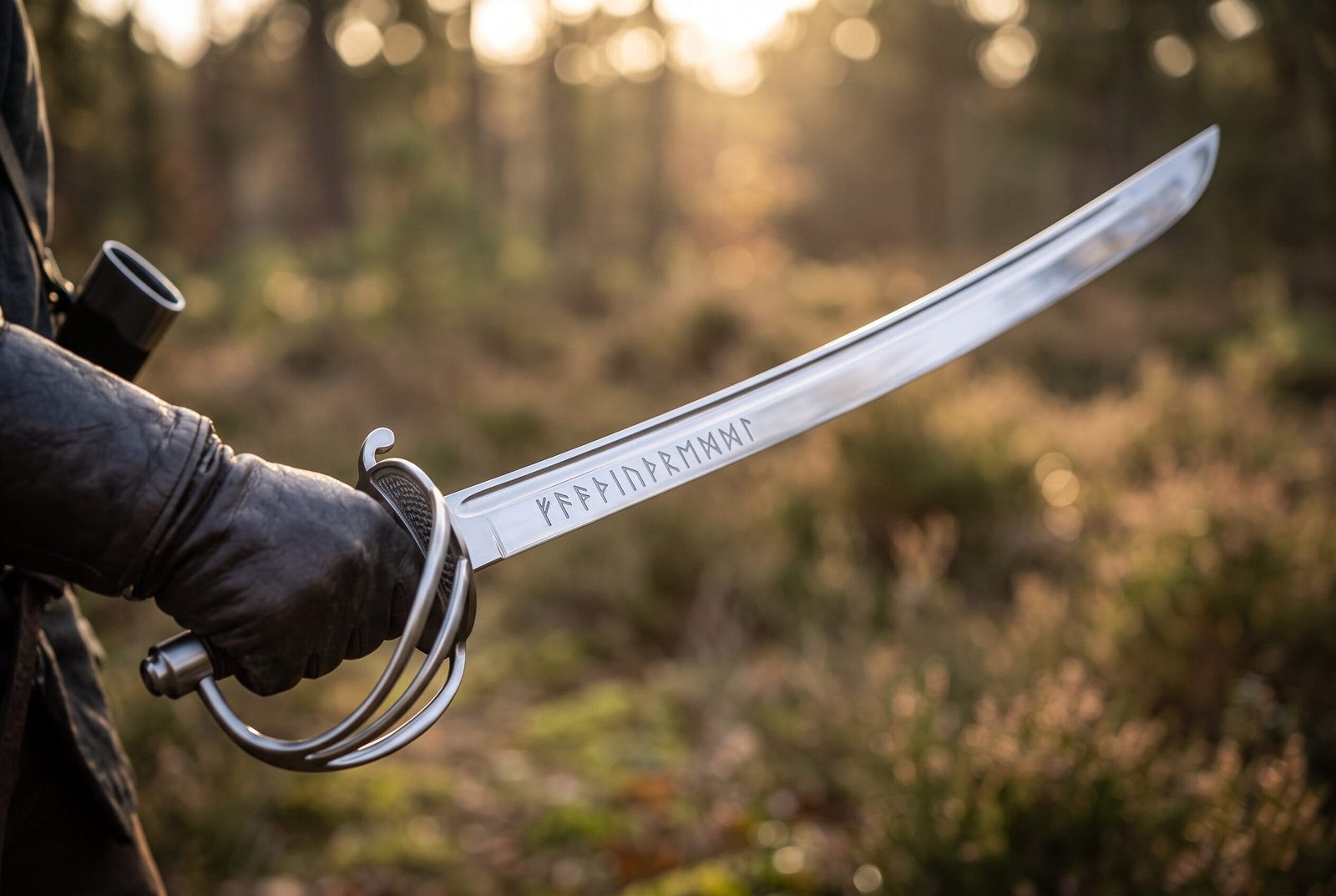
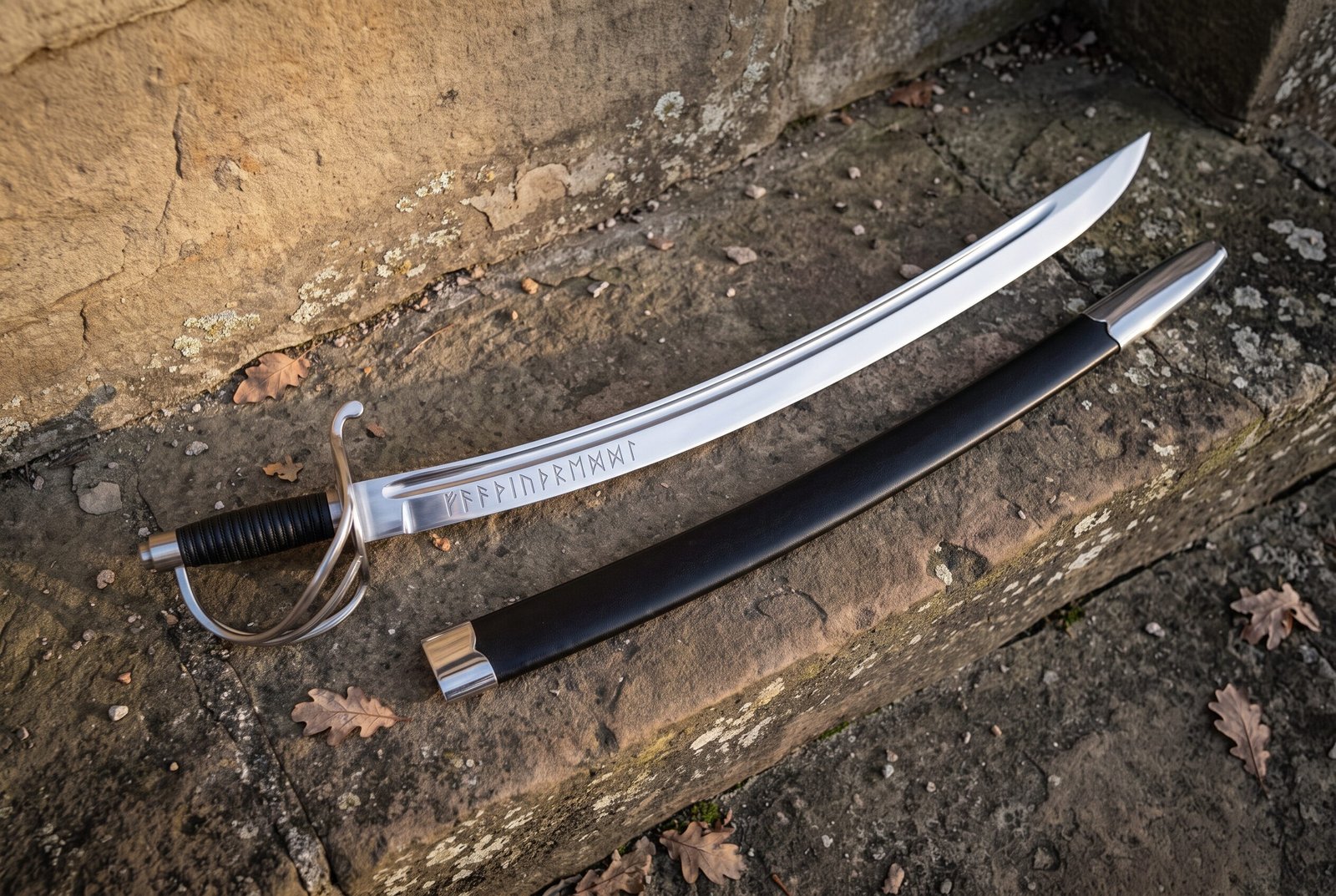
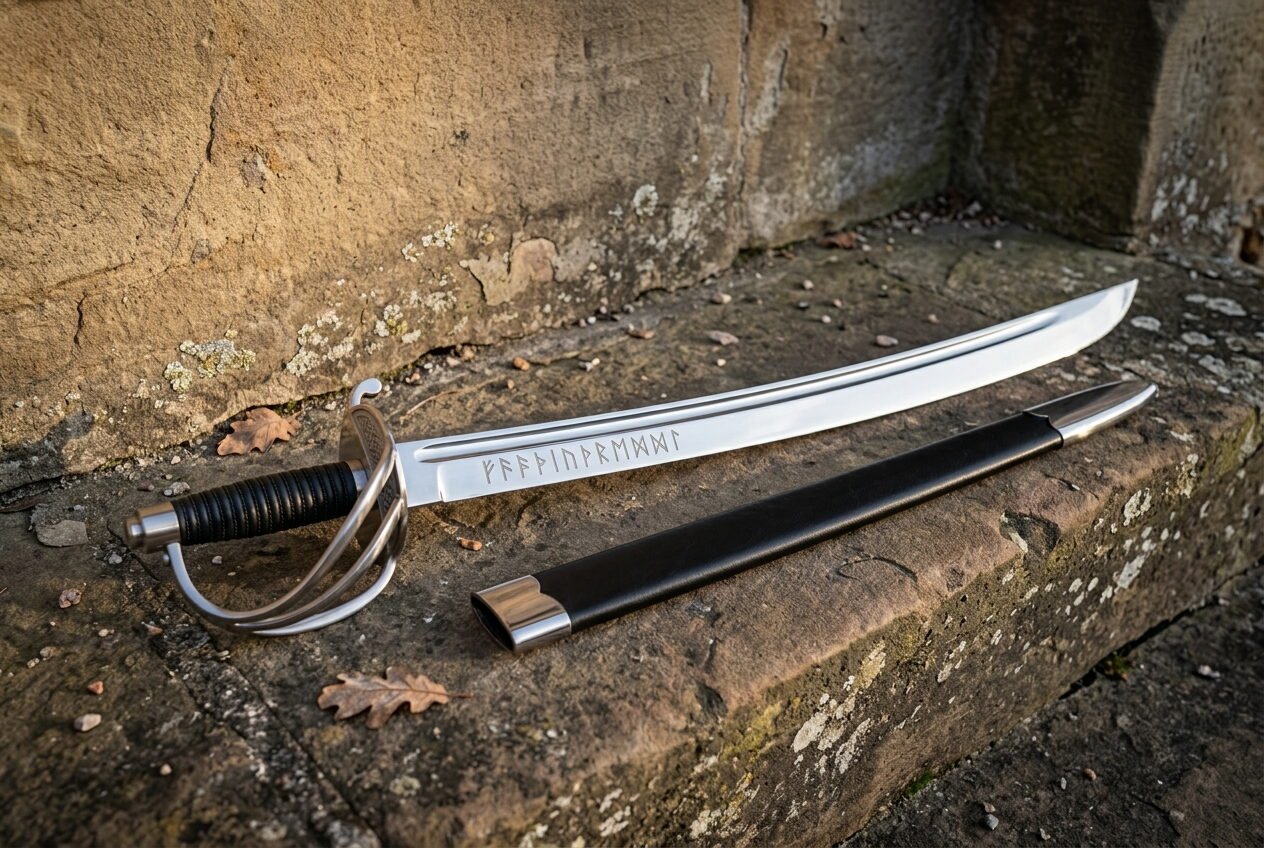
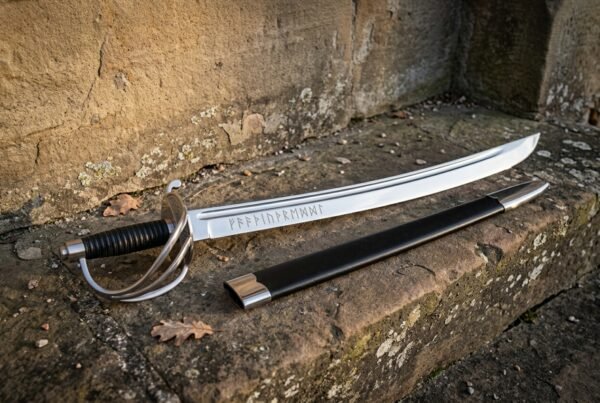
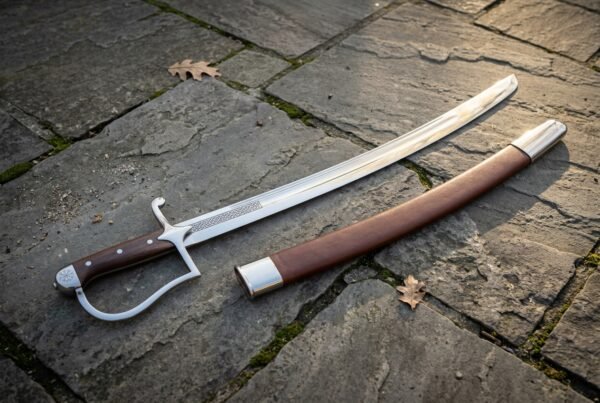
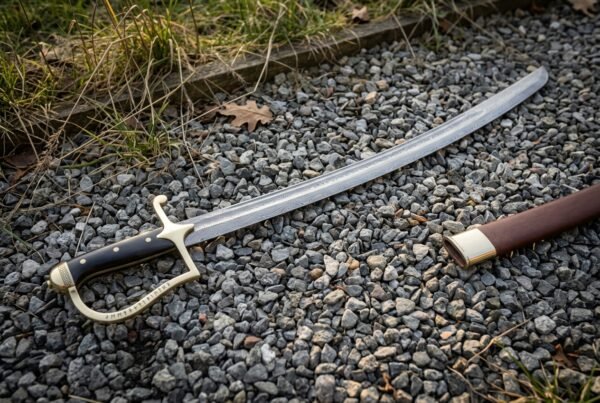
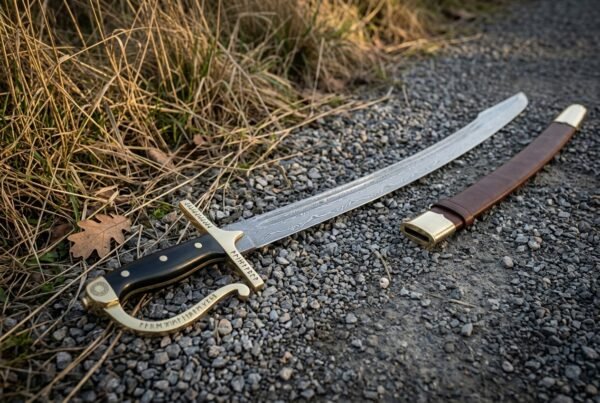
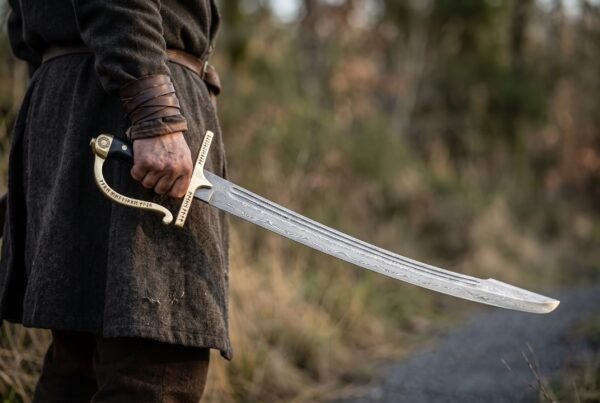
This Ironmarch sabre is hand forged and finished in the Czech Republic. The blade is 1095 high carbon steel, hammered to a curve at the anvil rather than ground into a straight bar afterwards, then hardened, tempered to a working spring, and polished bright. A line of Elder Futhark runes is cut into the flat above the ricasso. It ships with a black leather scabbard fitted with a steel throat and chape, and shipping inside the United States is free.
Specifications
| Steel | 1095 high carbon steel, hand forged |
|---|
| Hardness | 54 to 58 HRC |
|---|
| Overall length | 33 inches |
|---|
| Blade length | 27 inches |
|---|
| Blade profile | Single edged with a moderate curve and a fuller running along the spine |
|---|
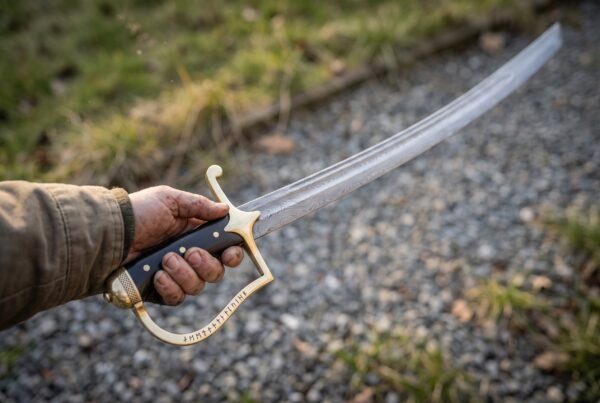
| Blade finish | Bright polished with an engraved Elder Futhark rune line above the ricasso |
|---|
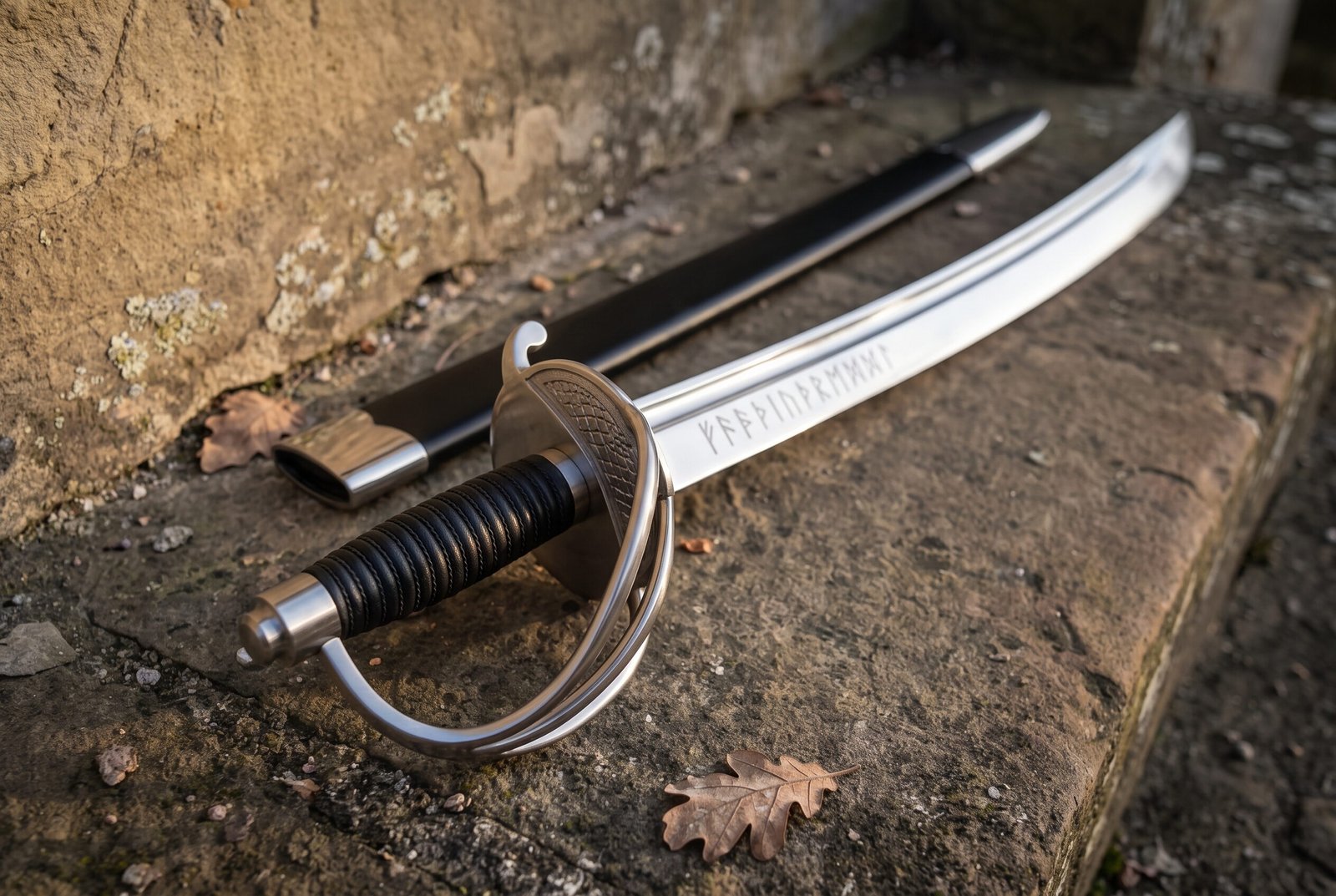
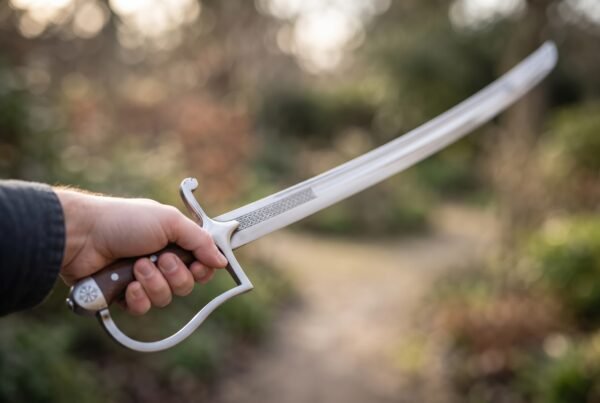
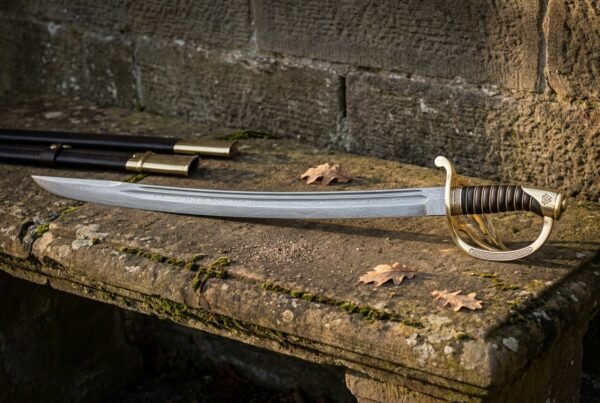
| Guard | Three bar steel knuckle guard with an engraved knotwork plate at the blade and a curled rear quillon |
|---|
| Grip | Ribbed black leather over a shaped core |
|---|
| Pommel | Steel pommel cap with a steel ferrule at the guard |
|---|
| Scabbard | Black leather scabbard with a steel throat and chape |
|---|
| Edge | Shipped with a working edge, sharpened on request at no charge |
|---|
| SKU | RK-1310 |
|---|
What the three bar guard actually does
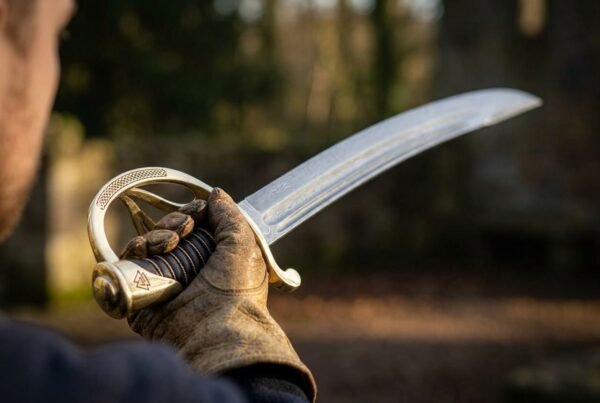
Look at the hilt and you will see three steel bars sweeping from the langet down to the pommel: the knuckle bow itself and two branches that fall away from it toward the outside of the hand. This is not decoration and it is not a half finished basket. A rider holds the sword with the back of the hand facing forward into the wind and toward the opposing line, and that is the surface that gets hit. The three bars cover the back of the hand and the knuckles without enclosing them, which matters because a fully enclosed basket traps the hand and makes it slow to change grip or to hand the sword off. The gaps between the bars also let rain and grit fall straight through instead of collecting against the leather.
The langet, the small engraved plate where the guard meets the blade, does two quiet jobs. It stops the blade from being driven back into the hand under a hard parry, and it seats firmly against the scabbard throat so the sabre does not rattle in the mouth of the scabbard when it is carried. On this piece the langet carries a cut knotwork band, which is our own addition rather than a period detail.
The blade profile is a moderate single curve with a fuller running along the spine and no false edge. That is deliberate. A shallow curve gives you a sword that still thrusts usefully, where a deep curve gives you a sword that cuts beautifully and thrusts badly. This one sits in the middle of that argument, which is where most of the surviving European cavalry patterns ended up as well.
Why 1095 high carbon steel and not stainless
1095 is a simple steel. Roughly one percent carbon, manganese, and very little else. That simplicity is the point. It moves predictably under the hammer, it takes a clean quench, and at 54 to 58 HRC it holds a hard edge while keeping enough spring in the spine that a long blade can flex and come back straight rather than snapping. Stainless steel gets its corrosion resistance from a large chromium addition, and in the thicknesses and lengths a sword needs, that chromium tends to make the steel brittle. A long stainless blade is a decorative object that is quietly waiting to break. For a sword you want toughness first, and you accept that the steel will need oiling. If you want the longer version of that argument, we set it out on our page comparing Damascus versus stainless.
The ribbed leather grip
The grip is leather laid over a shaped core and bound down into raised ribs. Ribs are not a texture effect. They give the fingers something to register against, so the hand finds the same position every time without looking, and they keep the palm from sliding forward under a heavy cut. Leather also swells slightly when damp, which is the opposite of what a smooth wooden or metal grip does, so the hold gets more secure in wet weather rather than less. The steel ferrule and pommel cap are peened over the tang, which means the hilt is held together mechanically and not by adhesive.
Wipe the leather down with a dry cloth if it gets wet and let it dry away from direct heat. A little neutral leather conditioner once or twice a year is all it wants.
Engraving, runes and your own design
Use the rune converter on this page to turn a name, a date or a short phrase into Elder Futhark and we will cut it into the steel or the handle. If you would rather have a Viking pattern than a rune line, choose your own design in the engraving option above the add to cart button and tell us whether it goes on the blade or the handle. Where a piece already carries an engraved design, your chosen engraving replaces it rather than sitting alongside it. This sabre already carries a rune line above the ricasso, so anything you order there will take its place. Full details of what we can and cannot cut are on the engraving page.
Care and sharpening
High carbon steel rusts. That is the trade you make for a blade that behaves properly. After handling, wipe the blade down to remove fingerprints, because skin acid is what starts most of the spotting people see on carbon steel, and put a thin film of oil on it. Store the sabre out of the scabbard if it is going to sit for months, since leather holds moisture against steel over time. Our full routine is on the steel care page.
Sharpening a curved blade is not harder than sharpening a straight one, it just requires you to move the sword rather than your hands. Keep the angle constant and draw the blade across the stone so the contact point travels along the curve. We walk through the whole process on our guide to sharpening with a whetstone.
Made in the Czech Republic
This piece is made by hand in the Czech Republic, in a workshop that still works the old way. The steel is forged, ground, heat treated and finished by smiths who learned the trade from the people before them, and the wood, horn and leather are cut and fitted by hand rather than pressed out on a line. That is also why no two pieces come out exactly the same.
Ransack Viking is a United States company. We import these pieces ourselves, check every one when it lands and ship from our warehouse in Chicago, Illinois. Engraving is done here in the United States after the piece arrives, so your runes or your own design go on before it leaves for you.
A note on handmade variation
This sabre is hand forged. It is not machine made and it is not bulk produced, so what arrives will not be a pixel for pixel copy of the photograph on this page. The polish will catch the light differently, the leather will take the dye a shade lighter or darker, the grain of the steel will run its own way, and the exact profile of the curve will carry the hand of the smith who drew it out. Length, steel, hardness and build are the same every time. The character is not, and that is the nature of work that comes off an anvil rather than out of a mould.
Frequently asked questions
Does it arrive sharp?
It arrives with a working edge that will cut paper and will cut you if you are careless, but it is not shaving sharp out of the box. Ask for a full sharpening in the order notes and we will take it up before it ships at no extra cost.
Can this sabre actually be used, or is it a display piece?
It is a functional sword. The tang runs the length of the grip and the pommel is peened, the steel is properly hardened and tempered, and it will handle cutting practice on tatami, pool noodles and water bottles. It is not a sparring sword. Do not use a sharp sabre against another blade or against a person under any circumstances.
Can I have runes engraved on it?
Yes. Use the rune converter on this page for Elder Futhark, or pick your own design in the engraving option. Bear in mind that your engraving replaces the rune line already on the blade rather than being added next to it.
Will mine look exactly like the photographs?
No, and it is not meant to. Dimensions and materials are consistent, but polish, leather tone and the fine profile of the curve vary from piece to piece because each one is worked by hand.
What is the difference between this and a naval cutlass?
Length and intent. A cutlass is short, broad and heavy in the last third, built for close quarters where there is no room to swing. A cavalry sabre is longer, lighter in the hand and more curved, built to reach down from a horse and draw a cut at speed. Handling them side by side, the cutlass feels like a chopper and the sabre feels like a scythe.
How long does shipping take?
Shipping inside the United States is free. Finished stock leaves us in two to four business days and usually arrives within a week. Engraved pieces take two to three weeks before they ship.
What is in the box
- One Ironmarch hand forged 1095 high carbon steel cavalry sabre, 33 inches overall
- Black leather scabbard with a steel throat and chape
- Care card covering oiling, storage and edge maintenance
- Certificate of hand forging with the SKU recorded
- Forged and finished in the Czech Republic
Explore the range
See the rest of the sabres, the wider swords collection, the short and heavy cutlasses, and everything under Norse arms. Background reading on steel, edges and care lives in the guides.
Close to this one
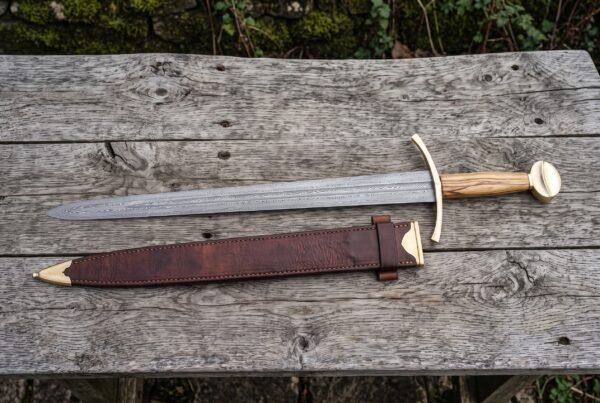
For a straight comparison, see the Wheelcrown arming sword, 37 inches overall. Worth putting side by side with this is the Duskwend sabre, 32 inches overall. In the same category sits the Wolfmark Viking sword, 36 inches overall.
From the same corner of the shop, there is the Valkhilt bastard sword. Nothing here exactly right, build one to your own spec on the design your own page.
If you would rather train with a sword than hang one up, the Reifholm leather dussack suits club work, and our dussack guide covers the choices.

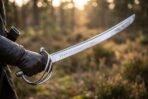
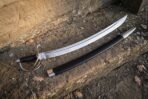
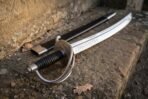
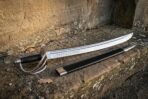
This thing is a beast in the best way. Feels way more premium in person than the listing photos. The craftsmanship really shows in the small details. Exactly as described and clearly made with care. So worth it.
Knew this piece was special the second I opened the box. Feels way more premium in person than the listing photos. The craftsmanship really shows in the small details. Packaging was excellent and it arrived in perfect condition. Shipping was fast and everything arrived well packaged.
Solid piece. Glad I ordered it. Solid piece. Packaging could’ve been a bit sturdier. Good overall quality. Just a couple very minor details off. Glad I made this purchase.