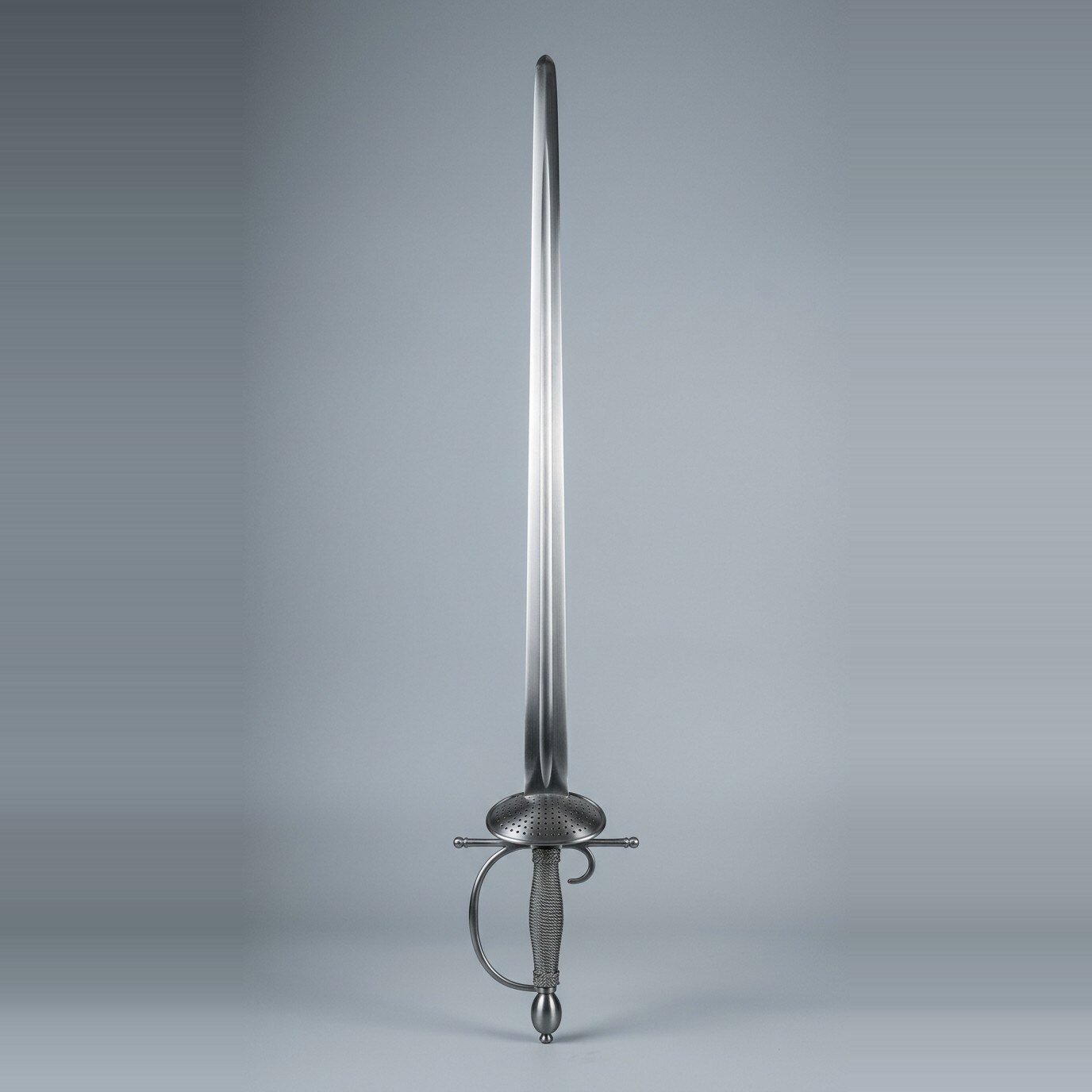
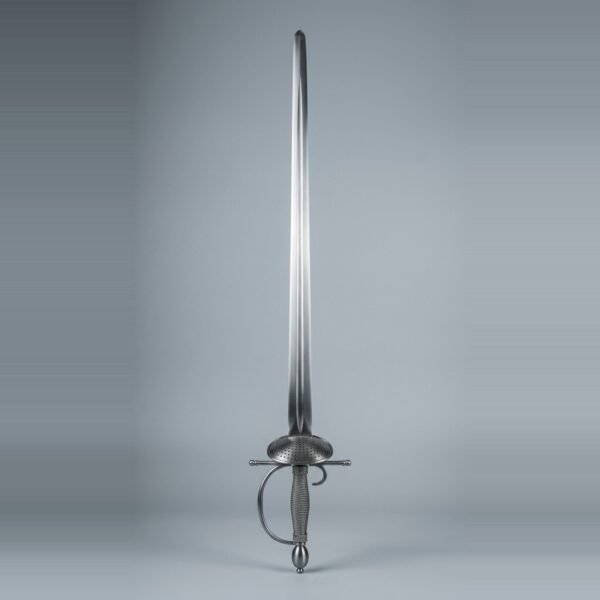
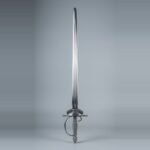
The smallsword is the last civilian sword of the European tradition and the direct ancestor of the modern fencing foil. It is short, light and built around one idea: put the point in first. This one is blackened from shell to pommel, which kills the glare off the hilt and reads far better across a hall than bright steel does.
The blade is hollow ground, so each face is dished out between raised corners and the section ends up very stiff for its weight. It carries no cutting edge, because the original never did. The guard is a pierced oval shell, the pommel is a blackened olive peened over the tang, and the grip is bound in dark wire that gives the fingers something to grip when the hand is damp.
If the eighteenth century is new ground for you, start with the smallsword and spadroon guide, then read how to choose your first HEMA sword. The rest of the light hilts are gathered in smallswords and spadroons.
Specifications
| Material | 51CrV4 spring steel, hardened to 49 to 52 HRC |
|---|
| Overall length | About 39 inches, hand made so it varies a little piece to piece |
|---|
| Blade length | About 32 inches |
|---|
| Blade type | Hollow ground section, stiff through the forte, tapering hard to the foible |
|---|
| Edge | No cutting edge by design, the faces are ground hollow between raised corners |
|---|
| Tip | Rolled and flared button, about 15 mm across |
|---|
| Guard | Pierced oval shell, blackened |
|---|
| Pommel | Blackened olive, peened over the tang |
|---|
| Grip | Dark wire binding over a shaped core |
|---|
| Flex | Light to medium tier, the range a thrusting blade lives in |
|---|
| Included | Sword only. No scabbard. |
|---|
| SKU | RK-3010 |
|---|
The smallsword and the school of the thrust
By the early eighteenth century the cutting sword had left civilian dress and what remained was this. The French masters, and the Italians and the English writers who answered them, built a whole method on a blade that only threatens with the point. Engagement, disengage, the beat, the feint that draws a parry and the thrust that arrives where the parry has just left. Angelo and the writers around him are still the clearest way in.
The vocabulary you will meet is mostly about the line. Tierce and quarte name where the hand sits and which side of the blade is closed. The pas d’ane and the arms of the hilt, the small rings and bars that sit below the shell on a classic smallsword hilt, exist so a finger can be hooked over the ricasso for point control. Everything is measured from the forte, the strong third near the hand that does the parrying, to the foible, the weak third out at the point that does the threatening.
What this piece gives a modern fencer is the real thing rather than a sport foil. The mass is different, the hand position is different and the parries are made with a blade that has a hilt in the way. Work it with a fencing mask, a jacket and gloves. The tip is rolled and flared, and nothing about a blunted point removes the need for kit when two people are thrusting at each other.
A hollow ground blade with no cutting edge, and what that does to the flex
A hollow ground section is the clever part of the smallsword. Each face is dished out so the metal that remains sits at the corners, far from the centre line, which is where it does the most to resist bending. You get a blade that is stiff along its length and very light in the hand, and you get it without any cutting edge at all. The corners are just corners.
Because there is no edge, a trainer like this is blunted at one place only, the point, and that is where every gear list looks. The tip is rolled and flared to about 15 mm across, which matches the spatulated or rolled tip of at least 1.5 cm diameter that the Berlin HEMA Cup gear requirements describe. Rounded tips are not accepted on rapier and sabre under those rules, and a flared button is the shape that is.
The steel is 51CrV4 at 49 to 52 HRC rather than the 1095 at 54 to 58 HRC we use on cutting swords. Spring steel at this hardness bends and returns instead of taking a set or snapping under a hard bind, and on a thin thrusting blade that matters more than on anything else in the range. Flex sits in the light to medium band, roughly where the market puts 15 to 29 lb, which is what lets the blade bow safely on a thrust that lands. We give the tier and not a figure, because we do not put every blade on a jig.
Engraving, runes and your own design
Use the rune converter on this page to turn a name, a date or a short phrase into Elder Futhark and we will cut it into the steel or the grip. On this one a rune line looks best cut through the blackening on the shell, where the bright steel shows underneath, or on the olive of the pommel.
Text and runes are $19, a symbol is $39 and a family crest is $49, and the work is done in the United States after the piece has landed and passed inspection. If you would rather have your own design than a rune line, choose your own design in the engraving option above the add to cart button and tell us where it goes. Where a piece already carries an engraved design, your chosen engraving replaces it rather than sitting alongside it. More on the engraving page.
Handling and balance
Pick it up and the first thing you notice is how little there is of it. The olive pommel sits close behind the hand and the blade tapers away fast, so the point comes online with a movement of the fingers rather than the arm. That is the whole design brief of a smallsword and it is why the method built around it is so precise.
The wire binding is not decoration. It gives the thumb and forefinger a texture to hold when the hand has been sweating for an hour, and it keeps the grip from turning under a hard parry. We do not publish a weight or a point of balance. The photograph has no scale in it, every piece leaves the hammer a little different, and a number printed here would be a guess.
Care
Blackening is a surface treatment and it will wear at the contact points, which on a fencing blade means the forte where the blades meet. That is honest wear rather than a fault. Oil the blade after every session and the bright patches will stay stable.
Check the tang nut and the seat of the pommel regularly, because a light hilt loosens faster than a heavy one and a loose smallsword hilt rattles badly. Never store it point down in a bag where the button takes the weight. The full routine for oiling, rust and storage is written out in our care guide.
Made in the Czech Republic
Made by hand in the Czech Republic and imported by Ransack Viking. Nothing here is drop shipped out of an importer catalogue straight to a customer. Every one is checked for hilt tightness, pommel seating and blade straightness at our North Babylon, New York warehouse, and ships from there. Shipping in the United States is free, returns run for seven days, and the lifetime warranty against defects in the forging, the grind, the heat treat and the fittings has no end date and needs no receipt.
A blackened hilt hides very little, so the shell piercing, the fit of the shell against the blade and the tightness of the pommel are all checked under a lamp when the crate is opened.
A note on handmade variation
This is hand forged. It is not machine made, not cast and not bulk produced, so what arrives will not be a pixel for pixel copy of the photograph on this page. The piercing in the shell is cut by hand, so the pattern of the holes will not repeat exactly from one piece to the next, and blackening takes differently across a batch, coming out warmer on some hilts and colder on others.
The standard behind it does not move. Every one leaves the workshop straight, tight and finished at the point, and anything that fails the check at the warehouse never gets boxed.
Frequently asked questions
Why the blade has no cutting edge
Because the original had none. A smallsword blade is ground hollow on three faces and threatens only with the point, so there is nothing to blunt along the length. The safety work all happens at the tip.
Whether this can be used with modern fencing kit
A fencing mask, a jacket and gloves are the sensible minimum and most club kit will do. The blade is heavier and stiffer than a sport foil, so fence it with people who know that before they take a hit.
How it differs from a spadroon
A spadroon has a straight single edged cutting blade and is used for both cut and thrust, usually with a five ball or shell hilt. A smallsword thrusts only. They share a century and a social class and very little else in the hand.
Whether the blackening will wear off
At the contact points on the forte, yes, over time. It is a finish and not a plating. Keep the blade oiled and the worn areas stay bright rather than turning to rust.
Whether a scabbard is included
No. This ships as the sword alone and we do not sell a scabbard for it. Carry it in a padded bag rather than anything that closes tight around the blade.
Whether it suits a beginner
It suits someone starting smallsword in a club with an instructor. As a first sword bought without any teaching behind it, a broader trainer is easier to learn measure and control with.
What is in the box
- The Hrafnstede blackened smallsword trainer with a rolled and flared button tip.
- A protective film of oil on the steel, which comes off with a rag.
- A printed card covering oiling, the blackened finish and storage.
- The lifetime warranty against defects in the forging, the grind and the fittings.
Explore the range
There are more light hilts in smallswords and spadroons, longer thrusting blades in HEMA rapiers, cut and thrust hilts in HEMA sideswords, and everything we build for the art under HEMA swords. The written side sits in the guides.
Others in the same line
From the same run, look at Skaldrun spadroon, about 37 inches overall, Lindmoor smallsword, about 39 inches overall, Orlunde spadroon, about 38 inches overall, Velstrand cup hilt rapier, about 47 inches overall and Reifholm leather dussack, about 26 inches overall before you decide.
The whole smallsword and spadroon category and the HEMA sword hub carry everything else in this range, and the custom sword builder will take a spec of your own.








Reviews
There are no reviews yet