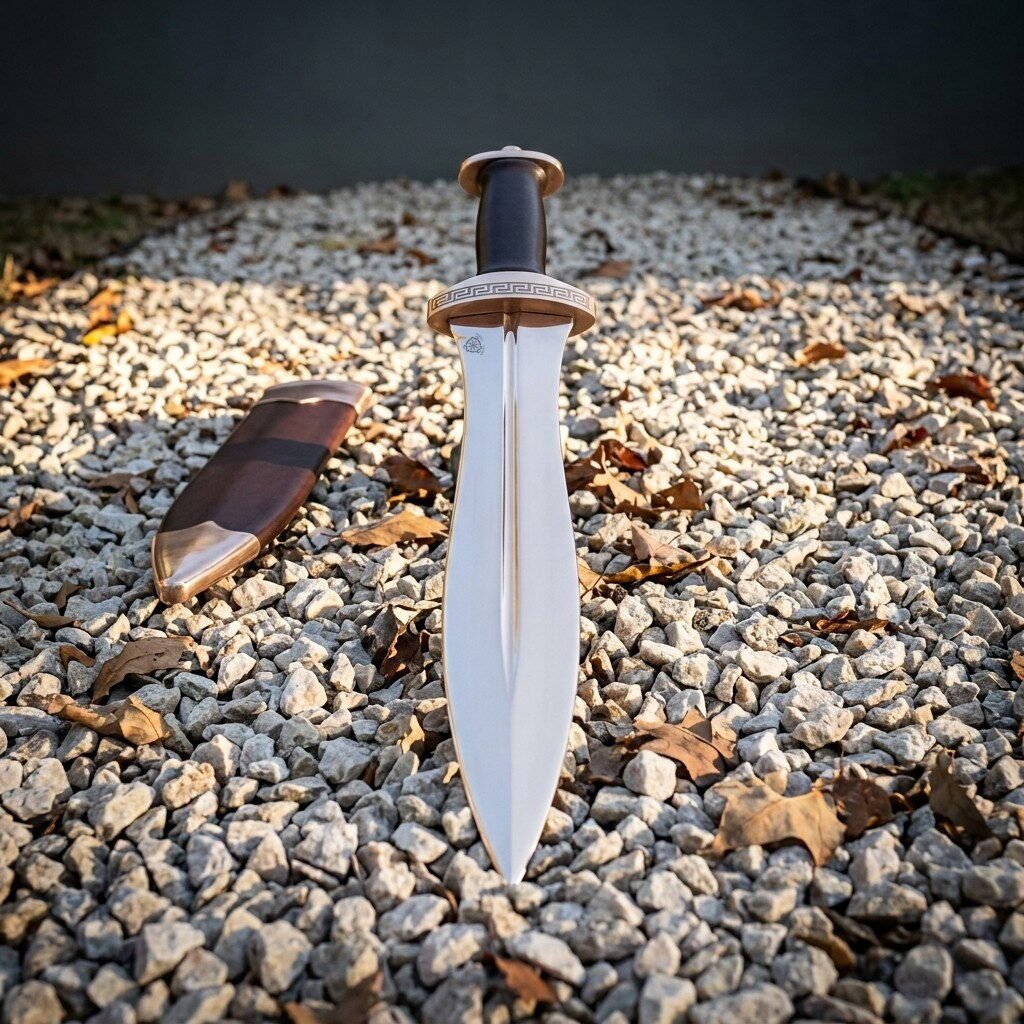
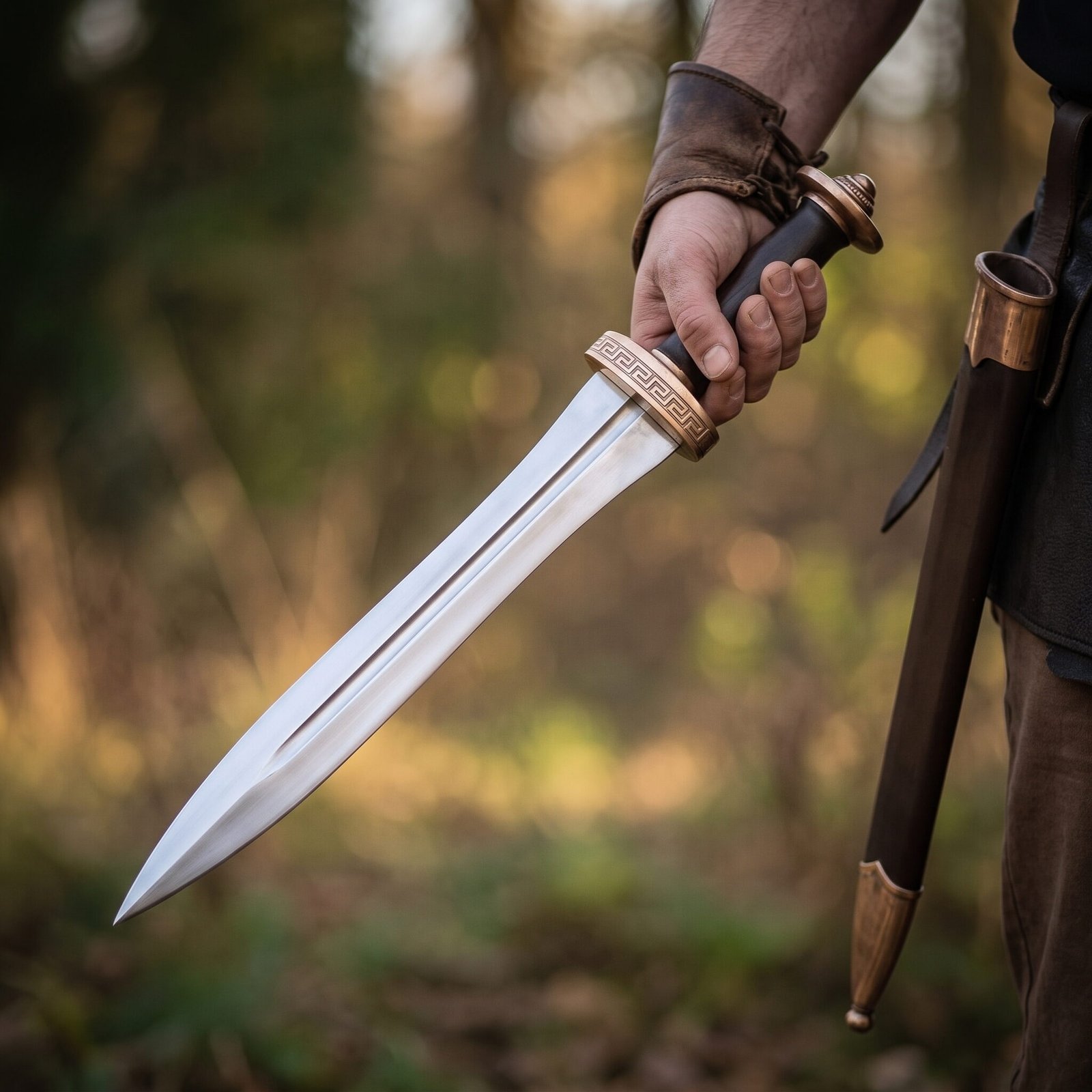
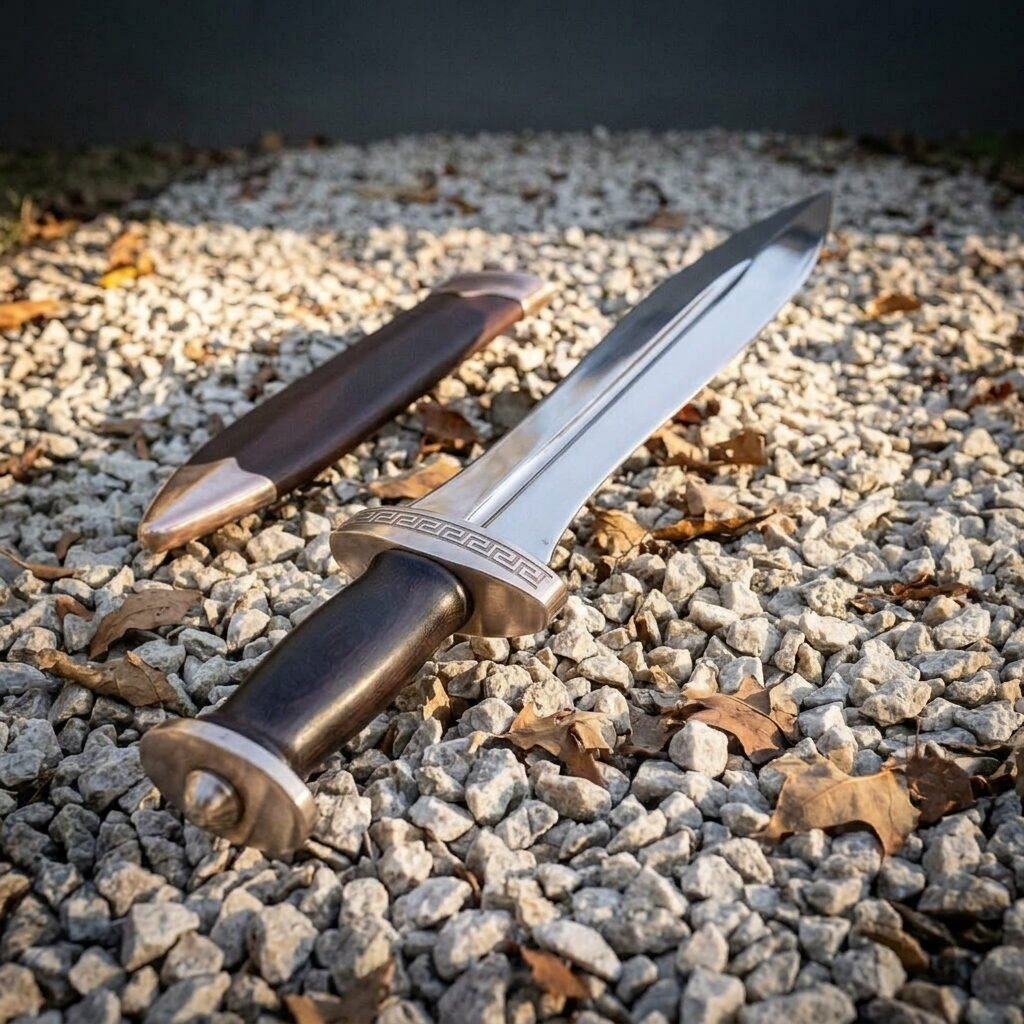
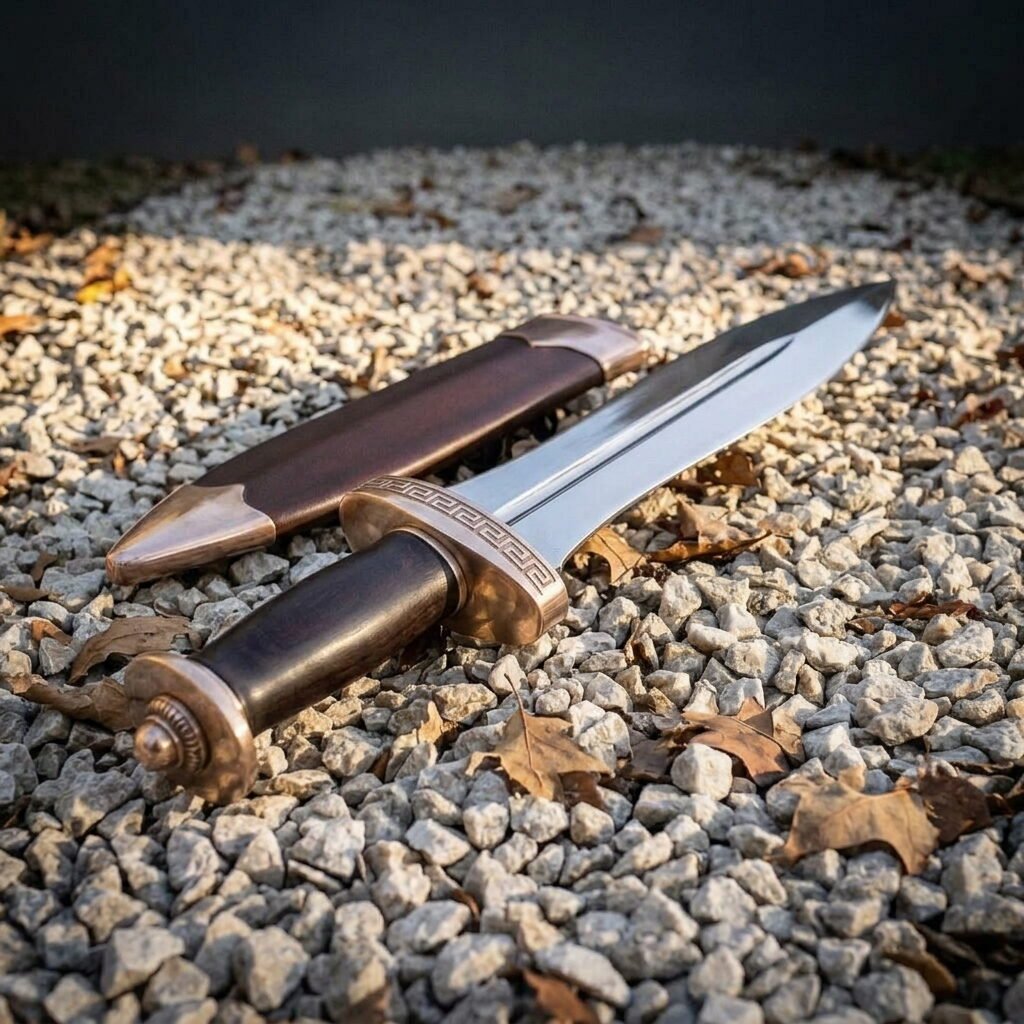
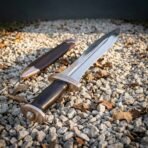
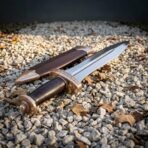
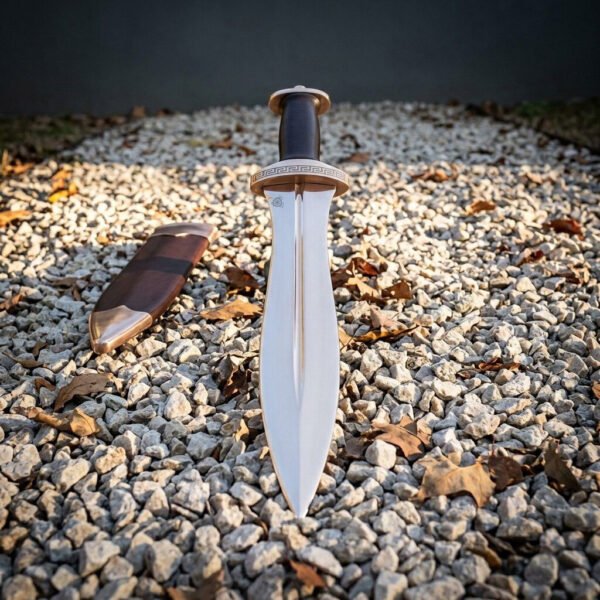
This is a hand forged dagger in the Roman pugio pattern, with the wide waisted blade, the pronounced central midrib and the deep flanking fullers that make the type instantly recognisable. The guard is bronze, cut with a running Greek key meander, and the grip is dark horn coloured with a bronze ferrule and a domed bronze pommel above a wide oval plate. It comes with a leather sheath finished with a bronze locket and a bronze chape.
The pugio is one of the odder pieces of Roman military kit, because it was not really for fighting and everybody knew it. It hung on the left of the belt opposite the gladius, it appears on hundreds of tombstones, and it was decorated far out of proportion to its usefulness, with silver inlay, brass plating and enamel on surviving examples from the Rhine frontier. What it actually was is a badge. A legionary who lost his pugio was in trouble in a way that a legionary who lost a shovel was not. The blade shape, wide at the shoulders, waisted at the middle, swelling again before the point, gives a thick strong section with a stiff midrib in a very short blade, which is what you want for punching rather than slashing.
Each dagger is forged, ground, heat treated, polished and fitted in a Czech Republic workshop. The bronze is cut and the meander is engraved by hand. It ships in its sheath with a care card and blade oil. It belongs with the daggers. If the shape is not quite right, the throwing knives run close to it.
Specifications
| Blade material | 1095 high carbon steel, hardened and tempered to 54 to 58 HRC |
|---|
| Overall length | Approximately 15 inches |
|---|
| Blade length | Approximately 10 inches, double edged with a raised midrib and flanking hollows |
|---|
| Handle | Approximately 5 inches, dark horn coloured grip |
|---|
| Guard | Bronze oval guard engraved with a running Greek key meander |
|---|
| Pommel | Domed bronze pommel over a wide oval bronze plate, peened tang |
|---|
| Finish | Mirror polished blade, polished bronze fittings |
|---|
| Sheath | Brown leather sheath with a bronze locket and a bronze chape |
|---|
| Included | Dagger, sheath, blade oil, care card |
|---|
| SKU | RK-1698 |
|---|
What the midrib does and why the blade is waisted
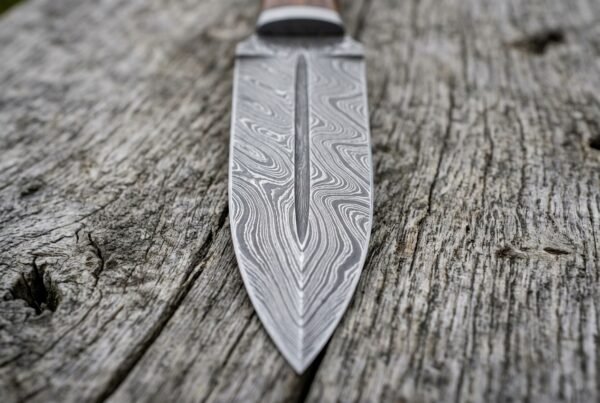
Hold the blade edge on and you can see it is not a flat plate with bevels. There is a raised spine running down the centre of both faces with a hollow either side of it. That midrib is a structural rib, and it is why a pugio blade a little over two inches wide and only a quarter of an inch thick at the spine does not fold when it meets resistance. All the stiffness of a much thicker blade with a fraction of the weight, exactly the same trick as a corrugated sheet or a steel joist.
The waist is the second half of the answer. A blade that is widest at the shoulders and narrowest at the middle puts material where the bending moment is greatest, near the hilt, and takes it away where the blade needs to be quick. It also produces a point section that is short and extremely stiff. What the shape does not do is cut well on a draw. This was never a slashing blade, and Roman writers describing the legions are explicit that the thrust is what they trained.
The Greek key on the guard, called a meander after the winding Maeander river in Anatolia, is one of the oldest continuous decorative motifs in the Mediterranean, running from Greek pottery through Roman mosaic and architecture. It is cut here with hand gravers rather than cast, which is why the corners are square and the strokes catch the light.
The steel and the polish
The blade is 1095, a simple high carbon steel of just under one percent carbon, hardened and tempered to 54 to 58 HRC. On a short stiff blade like this the heat treat matters mostly at the point, because a pugio concentrates everything into a very small area and a soft point will roll while an over hard one will snap. This range holds a point and takes an edge without going brittle.
The blade is taken to a bright polish so the midrib and the flanking hollows read as three distinct surfaces. That is harder than it sounds. Polishing a flat is straightforward, polishing a curved hollow beside a raised rib without rounding over the crest of the rib is a slow job done in stages by hand, and it is the part of this piece that takes the longest.
The fittings are bronze, a copper and tin alloy, which is period correct for the type and which develops a warm brown patina if left alone. 1095 is carbon steel and not stainless, so it rusts if neglected. That is why oil ships with it.
Engraving, runes and your own design
Use the rune converter on this page to turn a name, a date or a short phrase into Elder Futhark and we will cut it into the steel, the leather or the wood. If you would rather have a Viking pattern than a rune line, choose your own design in the engraving option above the add to cart button and tell us where it goes. Where a piece already carries an engraved design, your chosen engraving replaces it rather than sitting alongside it.
On this dagger the placements that work are the flat beside the midrib, which takes a short line cleanly, and the bronze guard plate, where a chosen design replaces the meander rather than sitting alongside it. Roman owners inscribed their own names on kit constantly, so a name on the blade is more authentic than most people assume. Details are on the engraving page.
Handling and balance
The balance sits almost exactly at the guard, which is what you would expect from a short wide blade with a heavy bronze pommel behind it. It feels neutral in the hand and it points naturally, which is the whole design intent of the type. The grip is short and the wide pommel plate stops the hand sliding back, so it can be held firmly without being gripped hard.
This is a hand forged display, collection and reenactment piece. We do not sell it for sparring or combat and it should not be used in contact against another person. The point is genuinely stiff and genuinely sharp. Treat it with the respect a short stabbing blade deserves and keep it sheathed when it is not being looked at.
Care
Wipe the blade and oil it after handling, every time. A mirror polish shows every fingerprint and bare 1095 will etch a print into itself within days in a humid room. Mineral oil, gun oil or blade oil on a soft cloth is enough. If a spot of rust appears, lift it with a rust eraser worked along the length of the blade, never across it, and re oil. There is more in steel care.
Feed the leather sheath with a neutral balm once or twice a year. Do not store the dagger in the sheath for years at a time, because leather holds moisture against steel and a polished blade left in a closed sheath is the classic way a good piece is spoiled. Polish the bronze if you want it bright, or let it patinate, which is what Roman bronze does and what most collectors prefer.
Made in the Czech Republic
Every piece we sell is made by hand in the Czech Republic. The smiths there work the way the trade has been worked for a long time, heating and hammering the steel, taking the bevels down by eye, and fitting the handle and the leather one at a time. There is no automated line anywhere in it, so small differences from one piece to the next are normal and expected.
Ransack Viking is a United States company based in Chicago, Illinois. We bring the pieces in ourselves, inspect them on arrival and ship them from our own warehouse. If you add engraving, that is carried out here in the United States before your order goes out.
A note on handmade variation
Every dagger is hand made rather than machine made or bulk produced, so what arrives will not be a pixel for pixel copy of the photograph. The exact line of the waist, the height of the midrib and the depth of the flanking hollows are ground by eye and by hand, so the profile carries a maker’s fingerprint. Bronze varies in warmth depending on the batch and on how it is filed and polished. The horn coloured grip material carries its own tone and faint banding. The leather sheath is cut from natural hide. The length, the steel, the heat treat and the build are the same every time. The character is not. If that is the part you care about, carry on with why a full tang matters, then the types of daggers.
Frequently asked questions
Is it sharp out of the box?
Yes. It arrives with a finished cutting edge and a stiff sharpened point. Open the parcel carefully and keep it sheathed when it is not in your hand.
Is this a gladius?
No. A gladius is a short sword with a blade roughly twice this length. This is a pugio, the belt dagger that a legionary wore on the opposite hip.
Are the fittings solid bronze or plated?
Solid bronze, cut and engraved by hand. You can see the graver strokes in the meander and the metal will patinate naturally rather than flaking the way a plated finish does.
Is the sheath included?
Yes. The leather sheath with its bronze locket ships with the dagger and is formed to that specific blade.
Can I have a name cut into it?
Yes. Use the rune converter for an Elder Futhark line, or ask for plain Roman lettering in the order notes, which suits this piece particularly well.
How long does shipping take?
Making time is one to two weeks and United States shipping is free. Custom engraving adds a few days because it is cut after polishing.
What is in the box
- One hand forged 1095 carbon steel pugio dagger with engraved bronze guard and pommel
- Leather sheath with bronze locket and chape
- Bottle of blade oil
- Care card covering oiling, rust removal and leather feeding
- Lifetime warranty against defects in forging, grind, heat treat and fittings
- Forged and finished in the Czech Republic
Explore the range
Browse the rest of the daggers, the gladius short swords and the wider Norse arms range, or read the guides for more on blade section, midribs and heat treatment.
Near neighbours in the shop
A near match for this one is the Ringspike dagger knife, pattern welded Damascus. Closest to this in the range is the Duskthorn dagger knife, 20 inches overall. If this one is not quite right, there is the Grimleaf dagger knife, 17 inches overall.
The Shadowreed tanto knife covers the other half of the same kit. You can have this made your way instead on the custom hunting knife page.

Feels way more premium than the price suggests. Weight and balance make it feel like a real functional piece not some cheap replica. Already telling my friends to check this out.