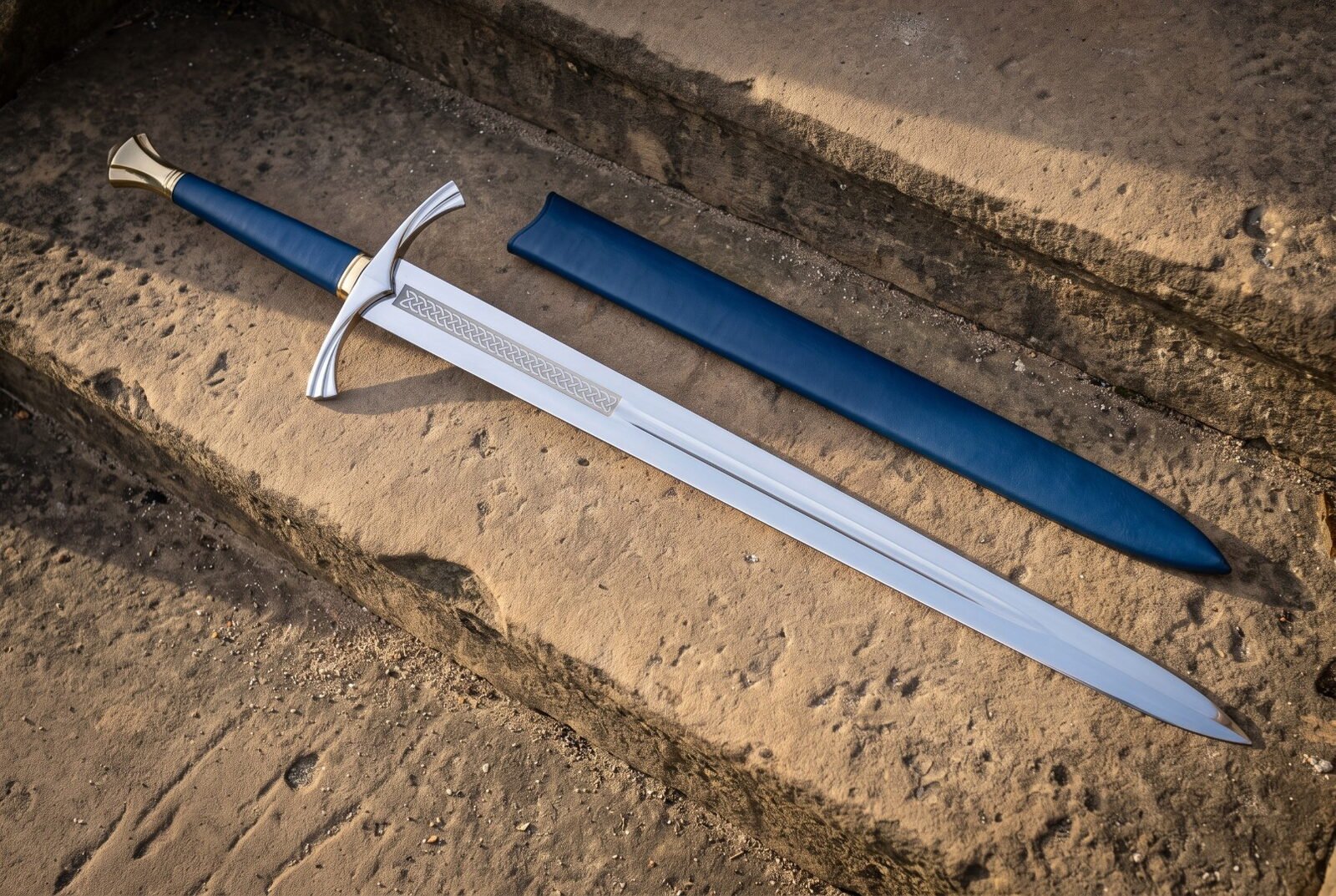
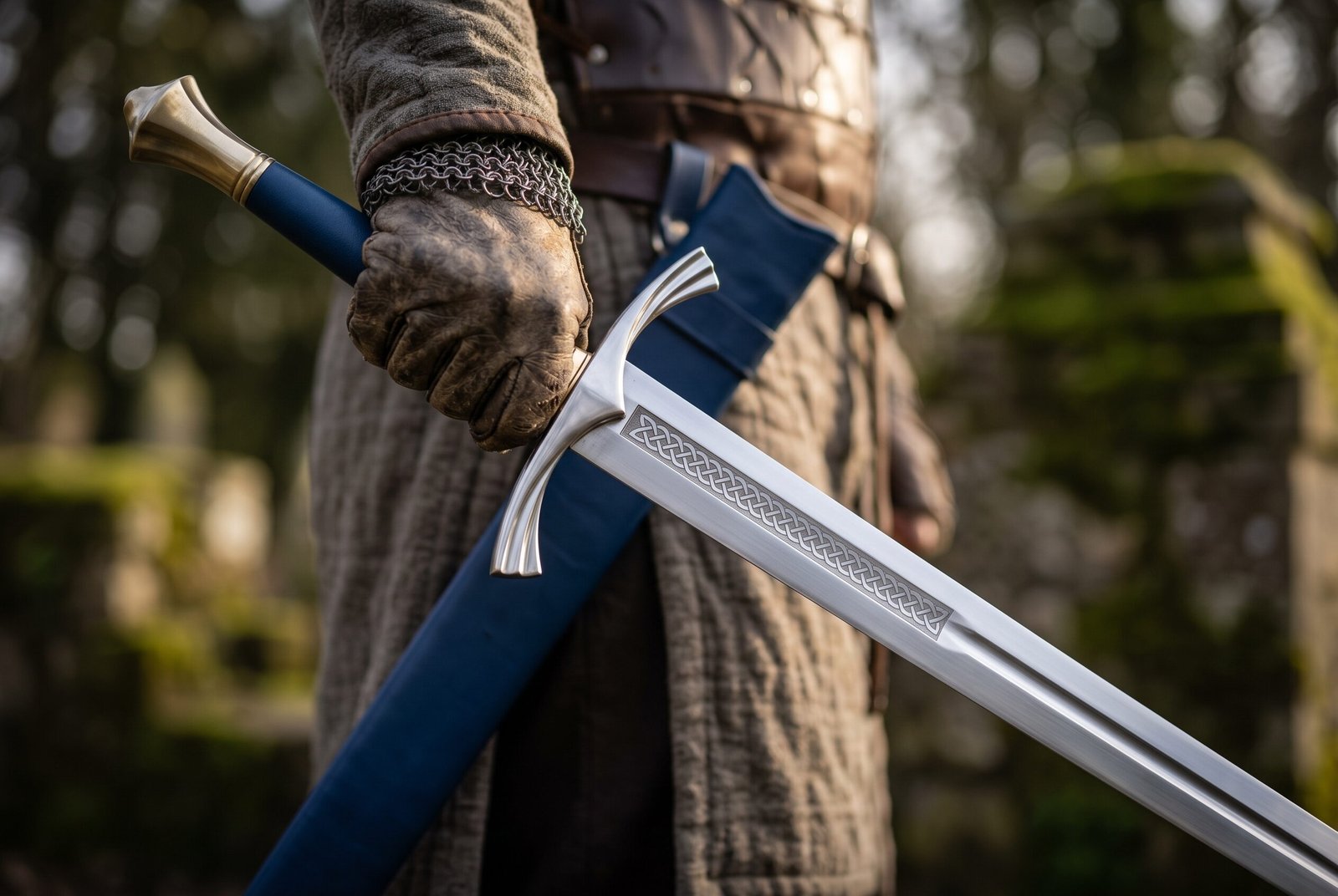
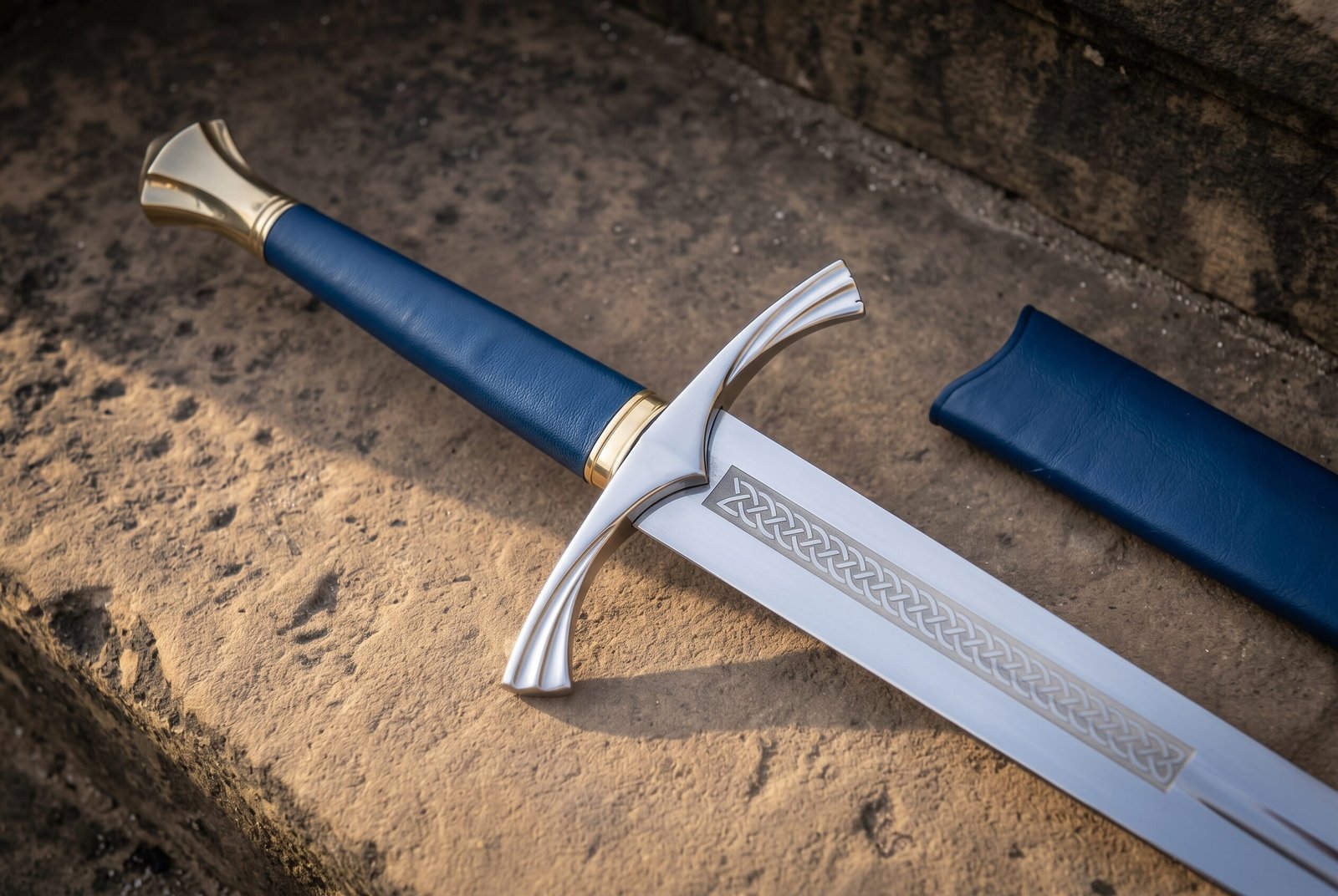
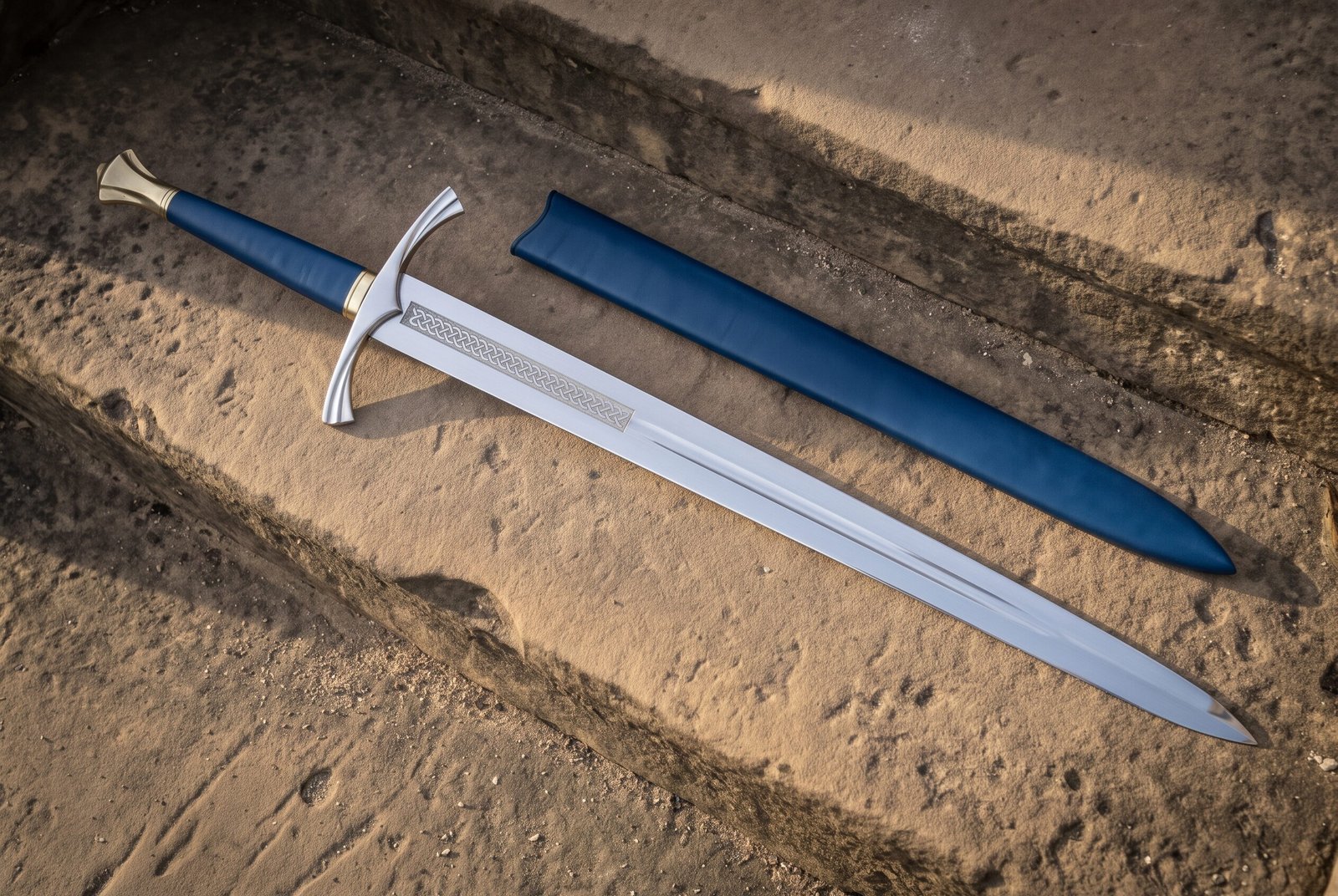
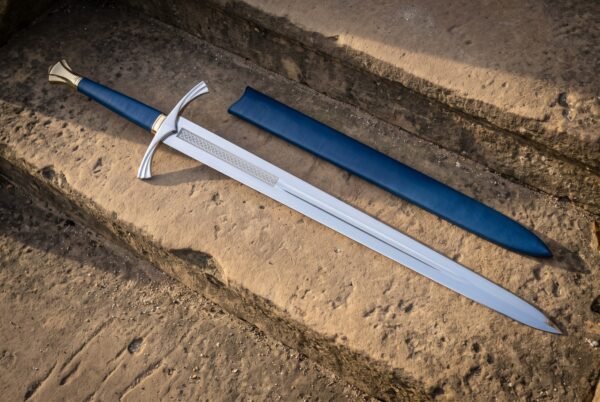
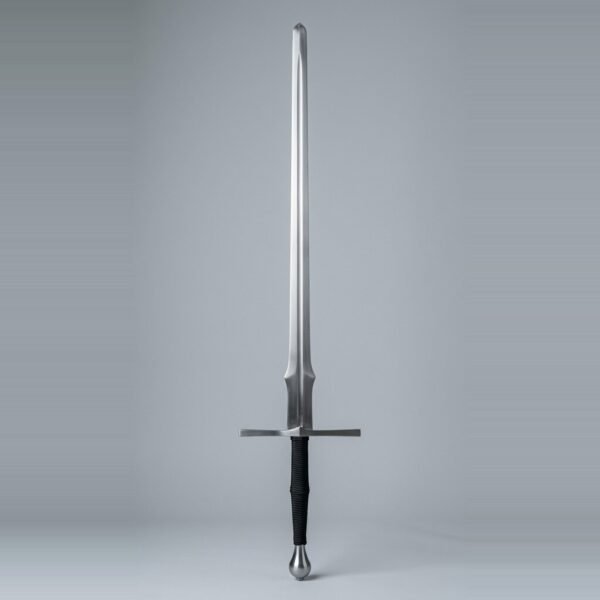
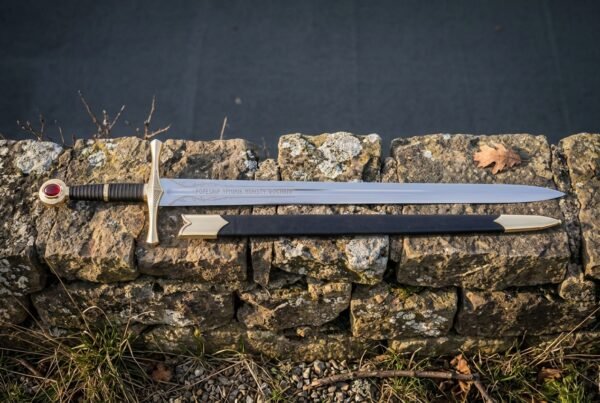
The Indigohilt is a medieval longsword with a two hand grip wrapped in deep blue leather, a slender steel crossguard whose arms both curve toward the blade and end in flared tips, a brass collar at the foot of the grip and a faceted brass pommel. The blade is polished satin steel, double edged, with a Celtic knotwork panel etched into the flat just below the guard and a fuller running on from it. A blue leather scabbard is made to the individual blade and comes with the sword.
The word longsword causes more arguments than it deserves. It does not mean a very long sword. It means a sword with a grip built for two hands that a strong person can still swing with one, which is why the older English term was a hand and a half sword and the German term was simply the long sword. What defines it is the handle, not the blade. Once a grip is long enough to take a second hand behind the first, the whole mechanics of the sword change, and every fencing treatise written between the fourteenth and sixteenth centuries is built on that fact. Each one is forged, ground, heat treated, fitted and finished by hand in the Czech Republic. Each sword ships with the fitted blue scabbard shown and our lifetime warranty against defects in forging, grind, heat treat and fittings.
Before you buy any long blade, display or battle ready explains what those two phrases actually mean. 1095 is the plain carbon steel we work in, and the steel glossary explains what the number means and why it takes an edge. For a grip that takes one hand or two, look at the bastard swords.
Specifications
| Material | 1095 high carbon steel, hardened to 54 to 58 HRC |
|---|
| Overall length | About 40 inches |
|---|
| Blade length | About 31 inches |
|---|
| Blade type | Double edged with a central fuller, tapering to a cut and thrust point |
|---|
| Handle | Blue leather wrap over a shaped core, two hand grip, brass collars at both ends |
|---|
| Guard | Slender steel crossguard with both arms arched toward the blade and flared tips |
|---|
| Pommel | Faceted brass pommel flaring toward the crown, peened over the tang |
|---|
| Etching | Celtic knotwork panel on the blade flat below the guard |
|---|
| Finish | Hand rubbed satin blade with polished brass furniture |
|---|
| Scabbard | Blue leather scabbard fitted to the blade, no metal fittings |
|---|
| Included | Sword and scabbard |
|---|
| SKU | RK-1956 |
|---|
What the second hand is actually doing
Most people assume the second hand on a longsword is there to add power. It is not, or at least that is the smallest part of it. The second hand goes at the bottom of the grip, often right up against or over the pommel, and it works as a fulcrum. The front hand pushes, the back hand pulls, and the sword pivots between them. That is why a longsword can change the line of its point far faster than a single handed sword of the same weight, and it is why the fencing books spend so much time on winding the blade around a bind rather than on hitting harder.
It also gives you control at the moment of contact. When two blades meet, whoever can keep their point on line while displacing the other wins the exchange. Two hands on a long lever make that a matter of small movements rather than raw strength. The consequence for anyone handling one of these for the first time is that you should stop trying to swing it like an axe. Loosen the back hand, let the sword rotate, and it starts to feel like the tool it is.
The crossguard on this sword arches both arms toward the point and flares them at the tips. In a bind the curve steers an opposing blade outward, away from the hand, and the flared ends keep it from sliding off the guard.
Steel, leather and brass
The blade is 1095 high carbon steel taken to 54 to 58 HRC. On a blade over thirty inches, toughness beats hardness. A blade this long will flex under a bad cut, and it needs to come back straight rather than take a set or crack. That is exactly what this hardness band is chosen for.
The blue on the grip and the scabbard is a dyed vegetable tanned leather rather than a painted coating, which means the colour goes through the thickness of the hide rather than sitting on the surface. Vegetable tanned hide is the traditional choice for scabbards because it moulds to the blade and holds its shape once it has dried around it. Dyed leather can transfer a little colour when it is new, especially onto pale cloth or damp hands, so wipe the grip down with a dry cloth before you handle it in a white shirt. The brass pommel is faceted and flares out toward the crown, with a brass collar below it to match the one at the guard. The facets catch light along their edges and give a wet hand something to bite on.
Engraving, runes and your own design
Use the rune converter on this page to turn a name, a date or a short phrase into Elder Futhark and we will cut it into the steel, the leather or the wood. If you would rather have a Viking pattern than a rune line, choose your own design in the engraving option above the add to cart button and tell us where it goes. Where a piece already carries an engraved design, your chosen engraving replaces it rather than sitting alongside it. On the Indigohilt the diamond lattice panel is the existing design, so a rune line would take that place. Blue leather also takes a stamped rune line beautifully, so the scabbard is a good alternative if you want to keep the lattice. Details are on the engraving page.
Handling and balance
This sword handles lighter than its length suggests. The heavy brass pommel sits behind both hands and pulls the balance point back to somewhere around three to four inches ahead of the guard. Hold it with the hands apart, one under the guard and one at the pommel, and it turns on almost nothing.
The blade is a cut and thrust profile rather than a pure cutter, so it will do both without excelling at either, which is what a longsword was for. It is a sharp forged sword and not for sparring or reenactment. Do not use it in contact work against a person or against another blade. Cutting practice against soft targets is the right use for it.
Care
Wipe the blade after handling and keep a light film of mineral or camellia oil across it. Carbon steel and a satin polish will show a rust freckle within days in a humid room, so make the wipe a habit rather than a chore. The brass will dull to a soft yellow with time, which most owners prefer, and comes back with a brass polish and a soft cloth if you want it bright. Detailed instructions are in our steel care guide.
Feed the blue leather once or twice a year with a leather balm and keep it out of direct sun, because strong sunlight will fade a dyed hide unevenly. Never store the sword sheathed for months at a time. Leather holds moisture against the blade and the sword will come out marked.
If it is going on a wall, hanging swords and axes safely covers mounts, fixings and what not to do.
Made in the Czech Republic
The work behind this piece happens in a Czech Republic workshop that has kept to the old methods. Steel is forged and heat treated by hand, the grind is taken down by eye rather than by machine, and the handle, fittings and sheath are cut and finished one at a time. Because of that, every piece carries small marks of the hand that made it.
Ransack Viking is a United States company. We import direct, check each piece when it reaches us, and ship from our Chicago, Illinois warehouse. Engraving is added here in the United States after arrival, so the piece you receive is finished to your order.
A note on handmade variation
Every one of these is made by hand and not machine made or bulk produced, so what arrives will not be a pixel for pixel copy of the photograph. Leather is a natural material and dyed hide takes colour unevenly, so the exact shade of blue will differ from one sword to the next and will differ again between the grip and the scabbard. The knotwork etch, the crispness of the facets on the pommel and the tone of the satin all vary. The length, the steel, the heat treat and the build are constant. The character is not.
Frequently asked questions
Is this a one handed or two handed sword
Two handed, though a strong person can use it one handed at need. That is what hand and a half means and it is exactly what the grip length is designed for.
Will the blue leather bleed onto my hands
It can transfer very slightly when new, especially with damp hands. Wipe the grip with a dry cloth a few times and it settles down quickly.
Is the scabbard made for this exact sword
Yes. Each scabbard is built around its own blade, so it is not interchangeable with another sword of the same model.
Is it sharpened
Yes, it ships with a working edge along both sides. It is not a blunt trainer and cannot be used as one.
Can the brass be polished bright again after it dulls
Yes. A little brass polish on a soft cloth brings it straight back. Keep the polish off the blade and off the leather.
When will it arrive
One to two weeks of processing plus transit time, free within the United States. Engraved orders take slightly longer.
What is in the box
- Indigohilt medieval longsword in 1095 high carbon steel
- Fitted blue leather scabbard made to the blade
- Protective oil film on the blade for transit
- Care card and lifetime warranty against defects in forging, grind, heat treat and fittings
- Forged and finished in the Czech Republic
Explore the range
More in longswords, arming swords and scabbards and sheaths, or read the guides on balance, blade profile and scabbard making.
Compare it with these
In the same category sits the Palecourt longsword, 41 inches overall. A near match for this one is the Beakcrown longsword, 44 inches overall. Closest to this in the range is the Nightwhorl longsword, 44 inches overall.
Fitting out further, the Tidebrand short sword belongs with it. Pick the steel, the length and the fittings yourself on the custom Viking sword page.
If sparring is on your mind, the Vernholt blunt sword is made for that job, and our first HEMA sword guide is a useful next stop.

No regrets on this purchase at all. Even the small engravings are crisp and clean. Great buy overall.
Perfect gift. Perfect quality. No complaints. Fit and finish is museum quality. You can tell real craftsmen made this by hand. This shop clearly takes pride in their work.
Was nervous ordering something like this online but so glad I did. Ransack Viking is quickly becoming my go to shop for anything Norse themed. It’s handmade in the Czech Republic but ships from a US warehouse so it arrived quicker than I expected. 1095 Steel blade holds a razor edge right out of the box. 10/10 would buy again.