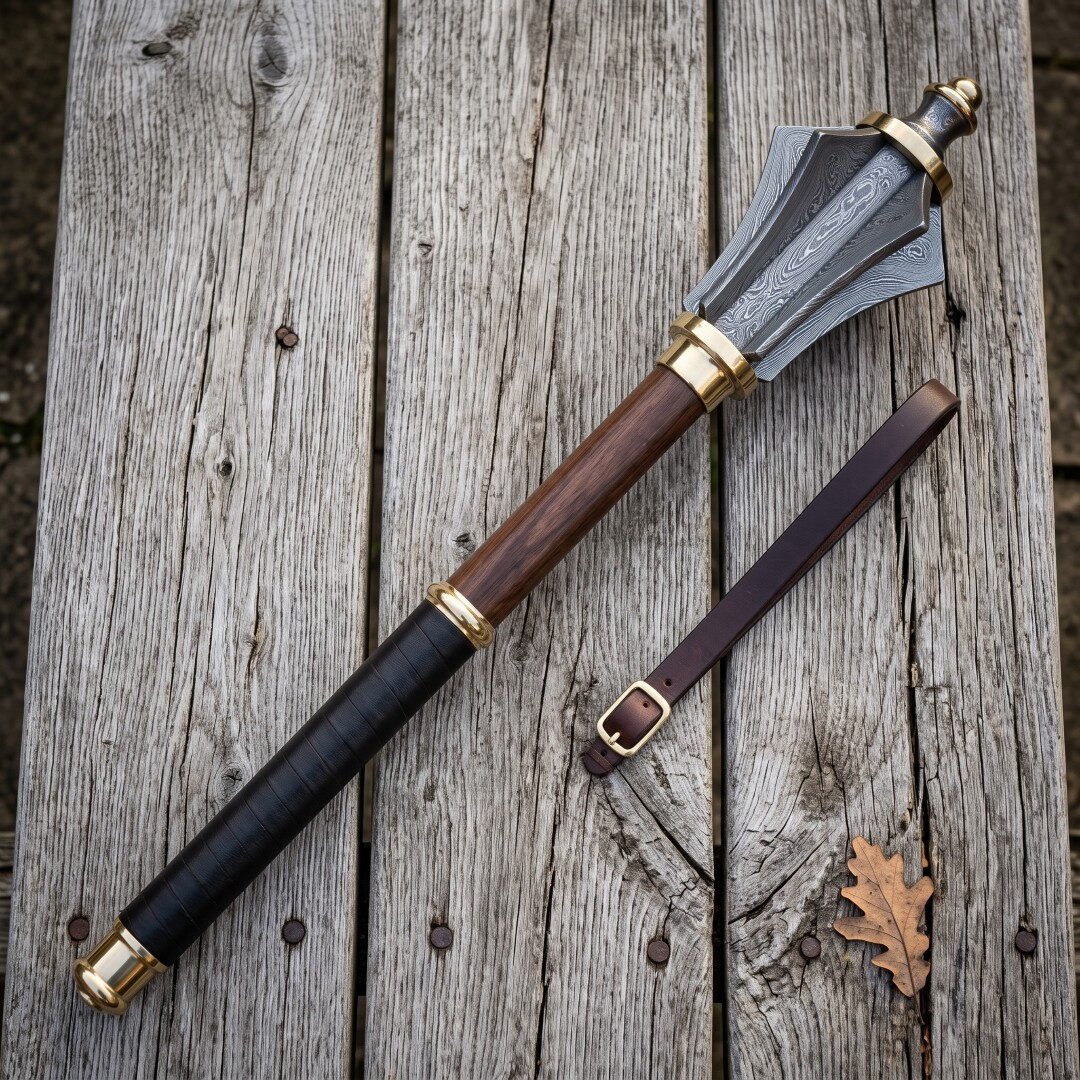
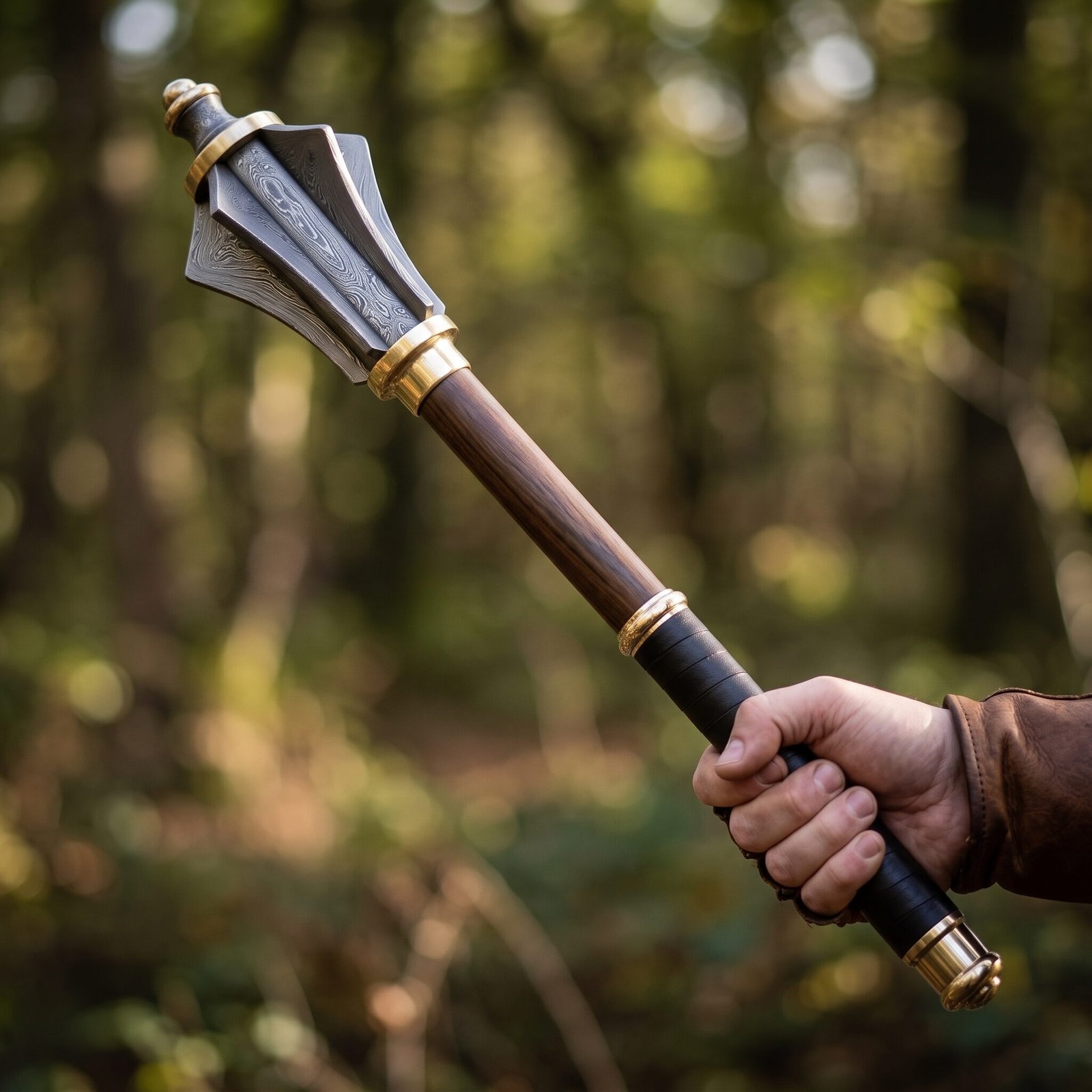
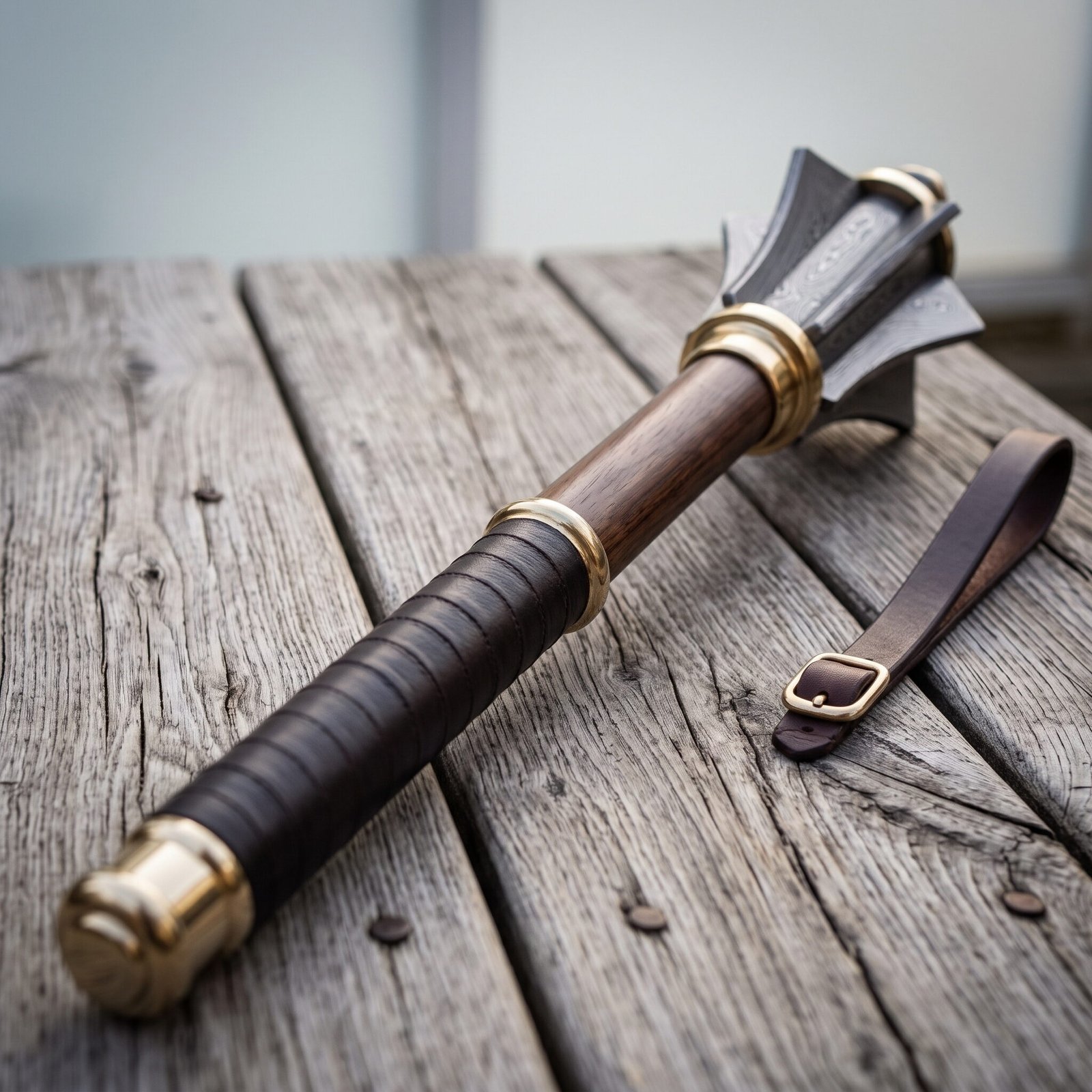
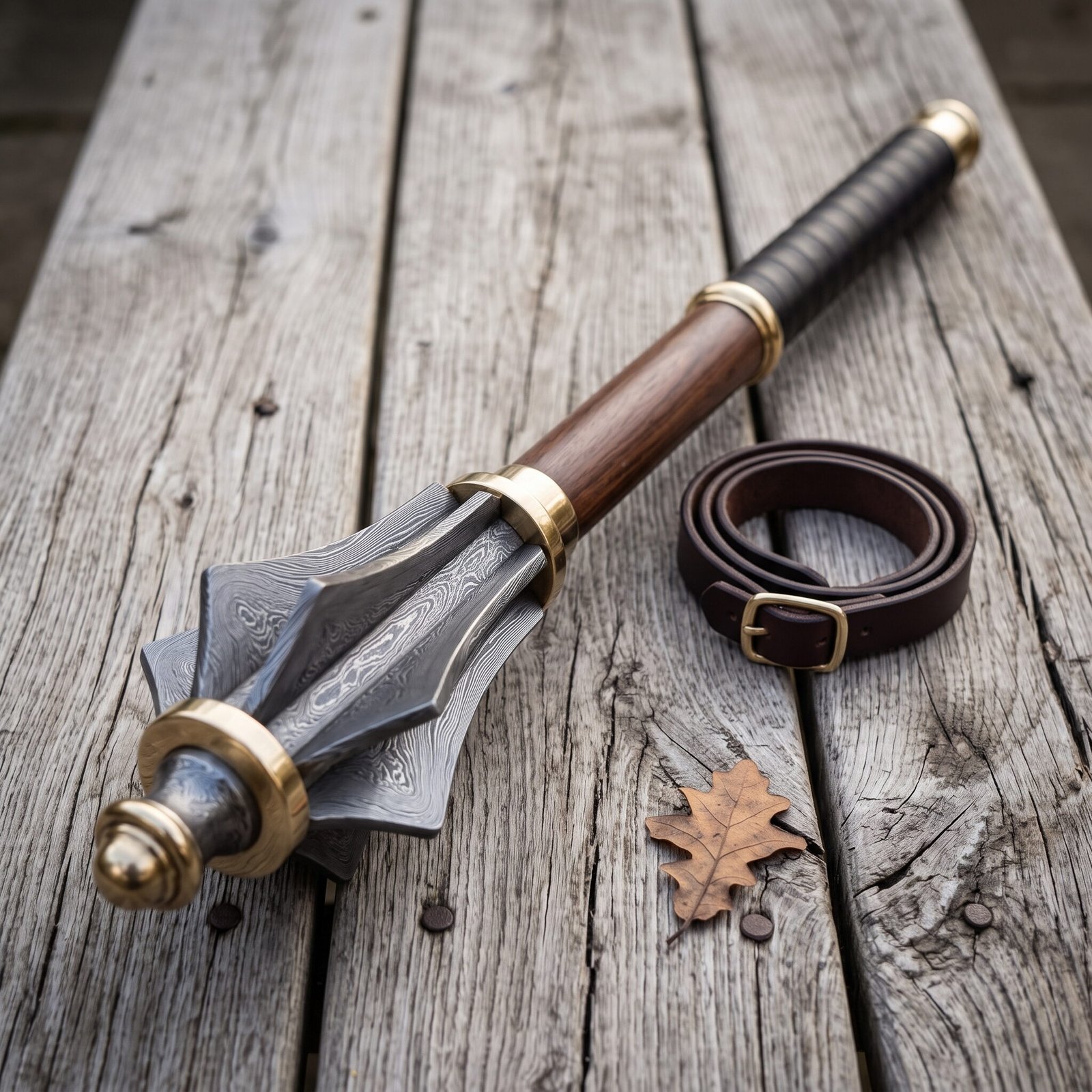
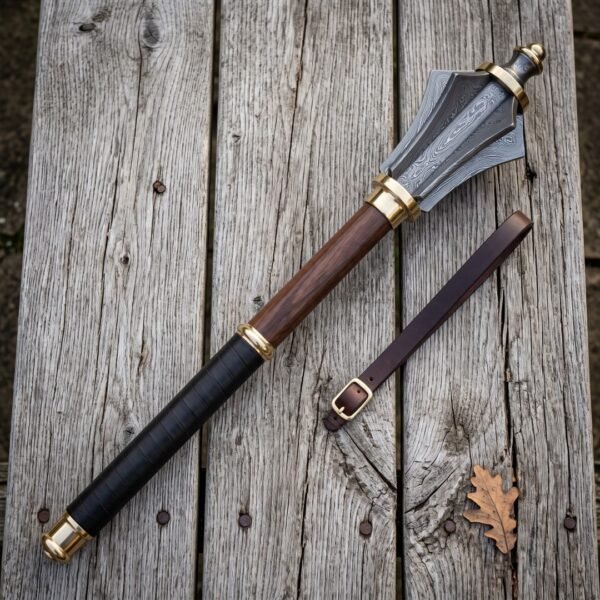
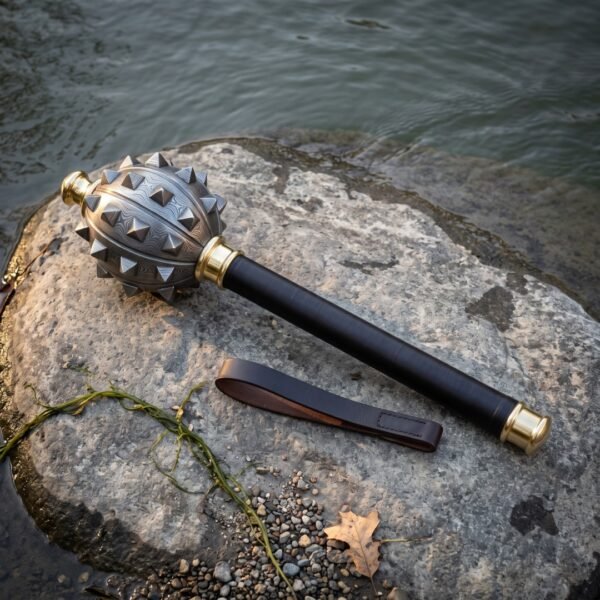
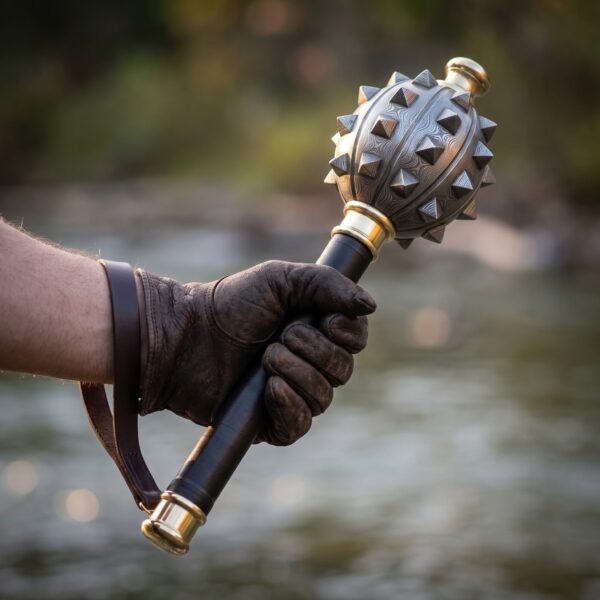
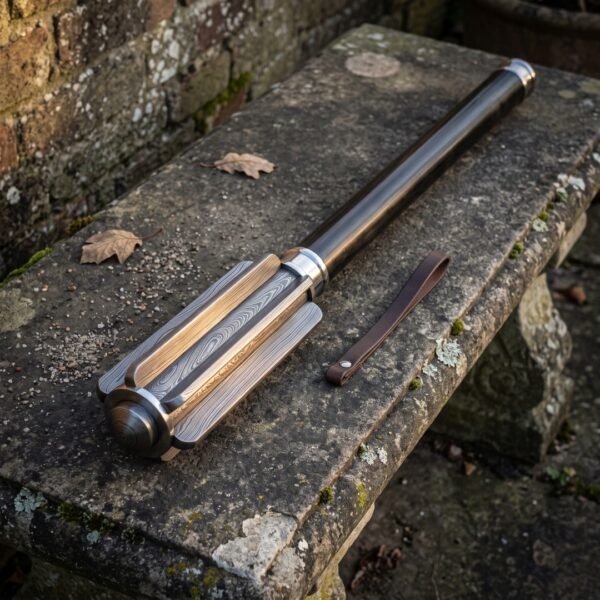
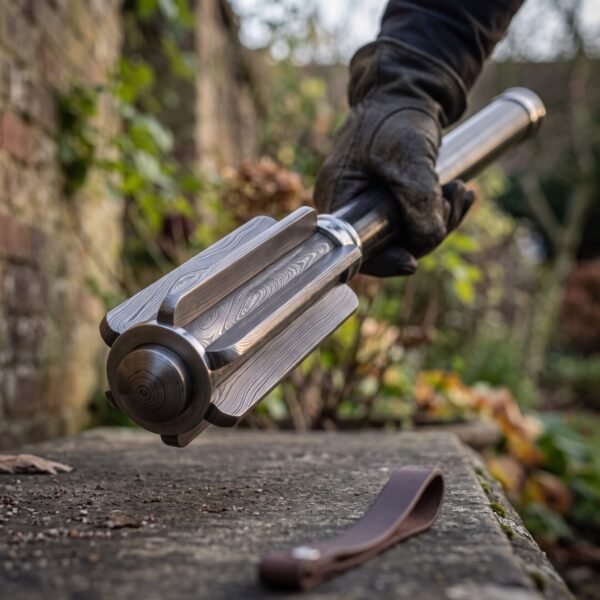
This is a flanged mace with a head forge welded from 1095 and 15N20, six deep flanges standing off a tapering body, finished with brass collars and a turned finial at the crown. Pattern welded mace heads are older than most people assume. Spearheads and sword blades of piled and twisted iron were being made in northern Europe well before the Viking age, and the reason was practical rather than decorative: piling let a smith combine bars of uneven quality into a blade that behaved better than any one of them. What began as a workaround became the most recognisable surface in edged steel.
Forged, welded, etched and finished by hand in the Czech Republic, hardened and drawn to 58 to 60 HRC. It ships with the buckled leather wrist strap shown, free anywhere in the United States, and can be engraved with Elder Futhark runes or a Viking pattern before it leaves the bench.
Specifications
| Steel | 1095 and 15N20 forge welded Damascus, hand etched |
|---|
| Hardness | 58 to 60 HRC |
|---|
| Head | Six drawn Damascus flanges on a tapering body, steel finial with a brass ring at the crown |
|---|
| Overall length | 27 inches |
|---|
| Head length | 6 inches including the finial |
|---|
| Head width | 3.25 inches across the flanges |
|---|
| Haft | Rosewood, with a double brass collar under the head |
|---|
| Grip | Dark leather wrap on the lower haft, brass ring at the top of the wrap |
|---|
| Butt cap | Brass |
|---|
| Weight | approximately 2.9 lb |
|---|
| Sheath | none, buckled dark brown leather wrist strap included |
|---|
| SKU | RK-1351 |
|---|
Reading the pattern on a flanged head
A flat blade is the easy place to show Damascus. A flanged mace head is not, and that is what makes this one worth looking at closely. The head is forged from a solid billet and the flanges are drawn out of it rather than welded on afterwards, so the layers have to travel from the core out along each flange and back down into the body. Where the steel has been moved hard the layers stretch and thin, and where it has been upset they compress and stack. You can read the whole forging sequence in the pattern once you know what to look for.
The long lines running up the flats between the flanges are the original layer stack, barely disturbed. The tight nested rings near the collar are where the body was upset to thicken it for the socket. The chevrons that show at the flange edges are layers cut through at an angle by the dressing file after the shape was set. None of that can be printed on, and none of it repeats from one head to the next.
Why Damascus steel and not stainless
The Damascus here is not an etch or a print. It is 1095 and 15N20 forge welded in alternating layers, drawn out, folded, and welded again until the billet carries the layer count you can see on the finished piece. The two steels are close cousins in carbon content, which is what lets them weld cleanly and harden together, but 15N20 carries about two percent nickel. Nickel resists the acid etch. That is the whole trick. When the finished piece is polished and dipped, the 1095 darkens and the 15N20 stays bright, and the layers you cannot otherwise see come up as pattern.
Because both steels are high carbon, the finished piece hardens properly. This one is quenched and drawn to 58 to 60 HRC, hard enough to hold a working edge and still tough enough for impact work. Stainless cannot do this. High chromium alloys will not forge weld reliably at these temperatures and the chromium carbides that give stainless its corrosion resistance also blunt the contrast an etch depends on, so stainless Damascus is usually a faint grey ghost of a pattern. The trade is care. Read more in Damascus versus stainless.
The hardwood haft
The haft is close grained hardwood, turned to a slight taper so the hand finds the same place on it every time and sanded through the grits before it takes its oil finish. Dense hardwood is chosen over a softwood for a reason that has nothing to do with looks. A dense stave carries the shock of a heavy head into the wood rather than letting it stop at your palm, and it holds a ferrule or a langet tight for years instead of shrinking away from the fitting after one dry winter.
The finish is oil, not lacquer, which is a deliberate choice. Lacquer looks perfect until it chips, then water gets under it and you cannot fix it without stripping the whole handle. Oil wears gradually and is repaired by wiping more oil on. Once or twice a year, a thin coat of boiled linseed or a proprietary handle oil, twenty minutes to soak, then wipe off what has not gone in. See wooden handle care.
Engraving, runes and your own design
Use the rune converter on this page to turn a name, a date or a short phrase into Elder Futhark and we will cut it into the steel or the handle. If you would rather have a Viking pattern than a rune line, choose your own design in the engraving option above the add to cart button and tell us whether it goes on the blade or the handle. Where a piece already carries an engraved design, your chosen engraving replaces it rather than sitting alongside it.
Engraving is cut by hand after the piece is finished and before final oiling, so keep the line short and let it sit where the eye already goes. Names, dates, a line of a poem, a maker mark, a unit or a crew number all work. If you are unsure where a line should sit, send us the text and we will suggest a placement before we cut. Full details and examples are on the engraving page.
Care and sharpening
Damascus needs the same care as any high carbon steel, with one extra thought. The etched pattern lives in a few thousandths of an inch of surface relief. Aggressive polishing, a wire wheel or a scouring pad will flatten that relief and take the pattern with it, and the only way back is to re etch the piece. Clean it with a soft cloth, nothing abrasive, and keep a thin film of mineral oil or paste wax on the steel. Wipe fingerprints off the same day. Rust will start in a fingerprint before it starts anywhere else.
Sharpening does not damage the pattern, because you are only working the bevel and the layers run right through the steel rather than sitting on top of it. Use a whetstone, keep it wet, hold the angle the bevel already carries and work both sides evenly. If the fresh bevel looks paler than the rest of the piece, that is expected, and a light etch will bring it back. See steel care and sharpening with a whetstone.
Made in the Czech Republic
This is a handmade piece from the Czech Republic, made in a workshop that still forges, grinds and finishes by hand instead of stamping parts out. The smiths there have kept the older way of working, and the wood, horn and leather are shaped and fitted by hand as well. Two pieces of the same design will never be identical, and that is part of what you are buying.
Ransack Viking is a United States company. We handle the import ourselves, look over every piece when it lands and ship from our warehouse in Chicago, Illinois. Engraving is done in the United States after the piece arrives, so your design goes on before we send it out.
A note on handmade variation
This is hand forged. It is not machine made, not cast and not bulk produced, so what arrives will not be a pixel for pixel copy of the photograph on this page. The grain of the wood, the tone the steel takes from the fire and the oil, the exact run of a pattern, the precise curve of a profile, all of it shifts a little from one piece to the next because each one is worked by hand from natural materials. Two hafts cut from the same board will not read the same. Two etched blades from the same billet will not carry the same swirl.
What does not change is the specification. Dimensions, steel, hardness, fittings and build are the same every time. The character is the part that is yours alone, and it is the reason to buy something forged rather than something stamped.
Frequently asked questions
Is the Damascus real or an etched print?
Real. It is 1095 and 15N20 forge welded in the shop, drawn and folded, then etched in acid so the nickel bearing layers stand bright against the darker carbon steel. Sand a corner and the pattern is still there underneath.
Are the flanges sharp?
No. They are dressed to a blunt working edge of roughly a sixteenth of an inch, which is what a mace flange should be. Sharpening them would only invite chipping on impact and would not make the piece work any better.
Can I have runes engraved on it?
Yes. The rune converter on this page turns any name or short phrase into Elder Futhark. On this piece engraving usually sits on a flange flat or on the brass collar, and it replaces rather than joins any pattern already there.
Will the brass tarnish?
Yes, slowly, and most owners let it. Brass darkens to a warm amber over a year or two and looks better for it. If you prefer it bright, a soft cloth and a little metal polish on the brass alone will bring it straight back.
What is the difference between this and the plain steel flanged mace?
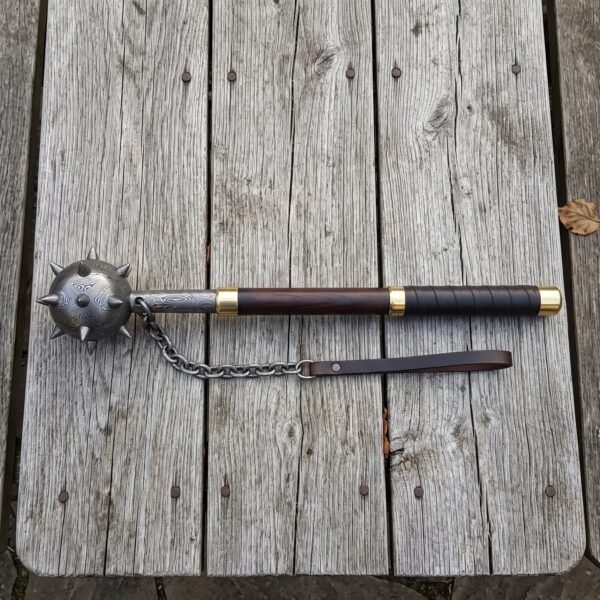
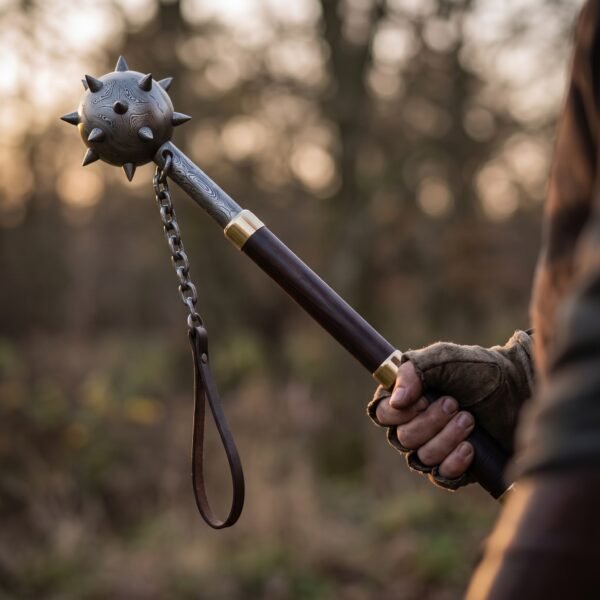
Shape and size are the same idea. This one is pattern welded rather than single steel, runs harder at 58 to 60 HRC, carries brass fittings and a leather wrapped grip, and is a display and collector piece first.
How long does shipping take?
Two to three business days if it is in stock, two to three weeks if it is being forged or engraved. United States shipping is free with tracking.
What is in the box
- One hand forged Damascus flanged mace, 1095 and 15N20
- Rosewood haft with leather wrapped grip and brass fittings
- Buckled leather wrist strap
- Care and oiling notes for etched Damascus
- Forged and finished in the Czech Republic
Explore the range
More in maces, damascus steel, flails and Norse arms, and read the guides.
Worth a look beside this
If this one is not quite right, there is the Stormflute mace, 28 inches overall. Also in this group is the Nightthorn mace, 26 inches overall. Sitting beside it in the catalogue is the Stormlink mace, 29 inches overall.
From the same corner of the shop, there is the Ashmaul poleaxe. Or start from a blank sheet on the custom Norse arms page.


Been eyeing this piece for months and it did not disappoint. Packaging was excellent and it arrived in perfect condition. This shop clearly takes pride in their work.
This is exactly what I wanted and then some. Feels way more premium in person than the listing photos. Will definitely order again for another gift. Nice touch that it ships from within the US even though it’s crafted in the Czech Republic.
Incredible craftsmanship on this one. Feels way more premium in person than the listing photos. Will definitely order again for another gift.
This piece beat every expectation I had. Already telling my friends to check this out.
My husband was speechless when he opened this. Packaging was excellent and it arrived in perfect condition. Already telling my friends to check this out.