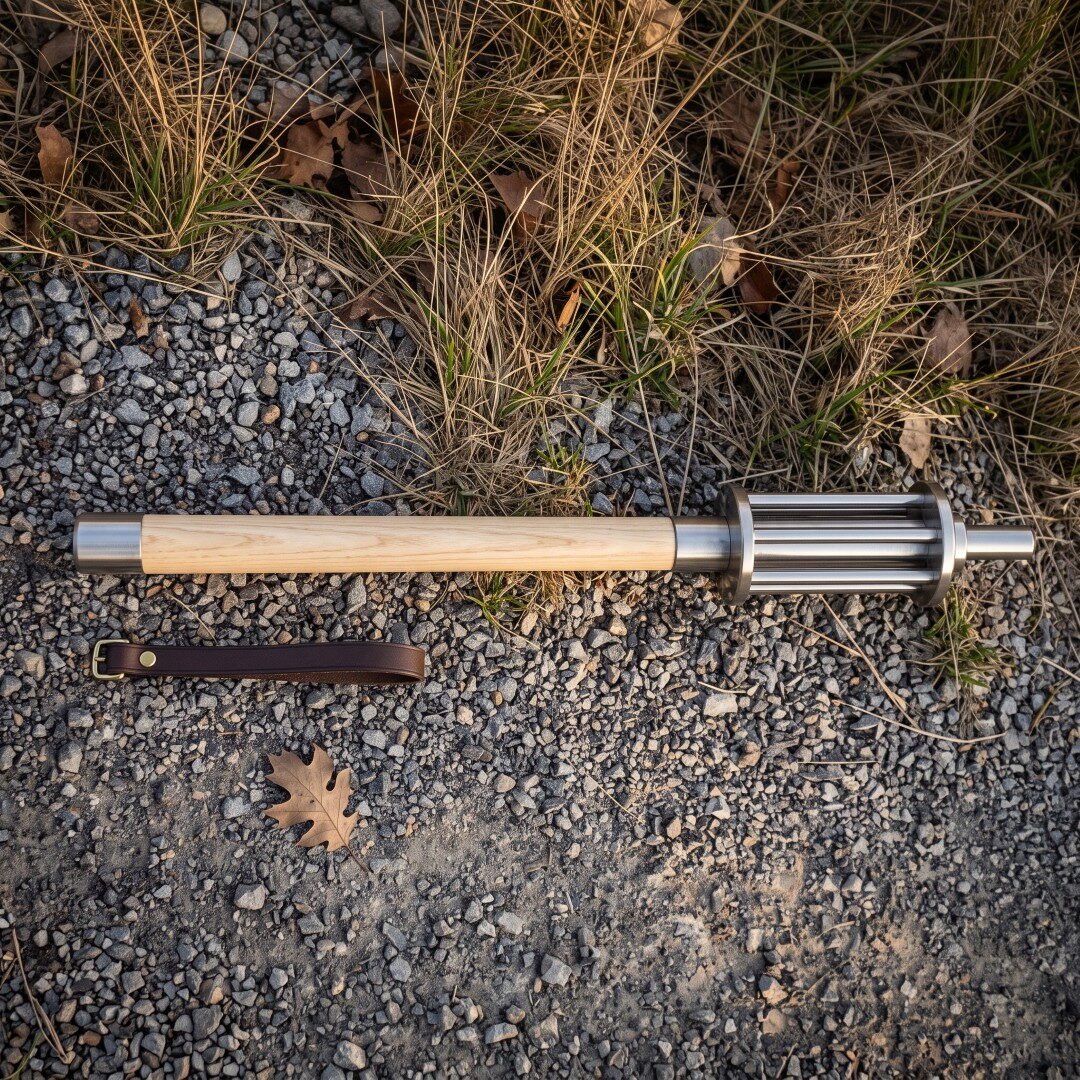
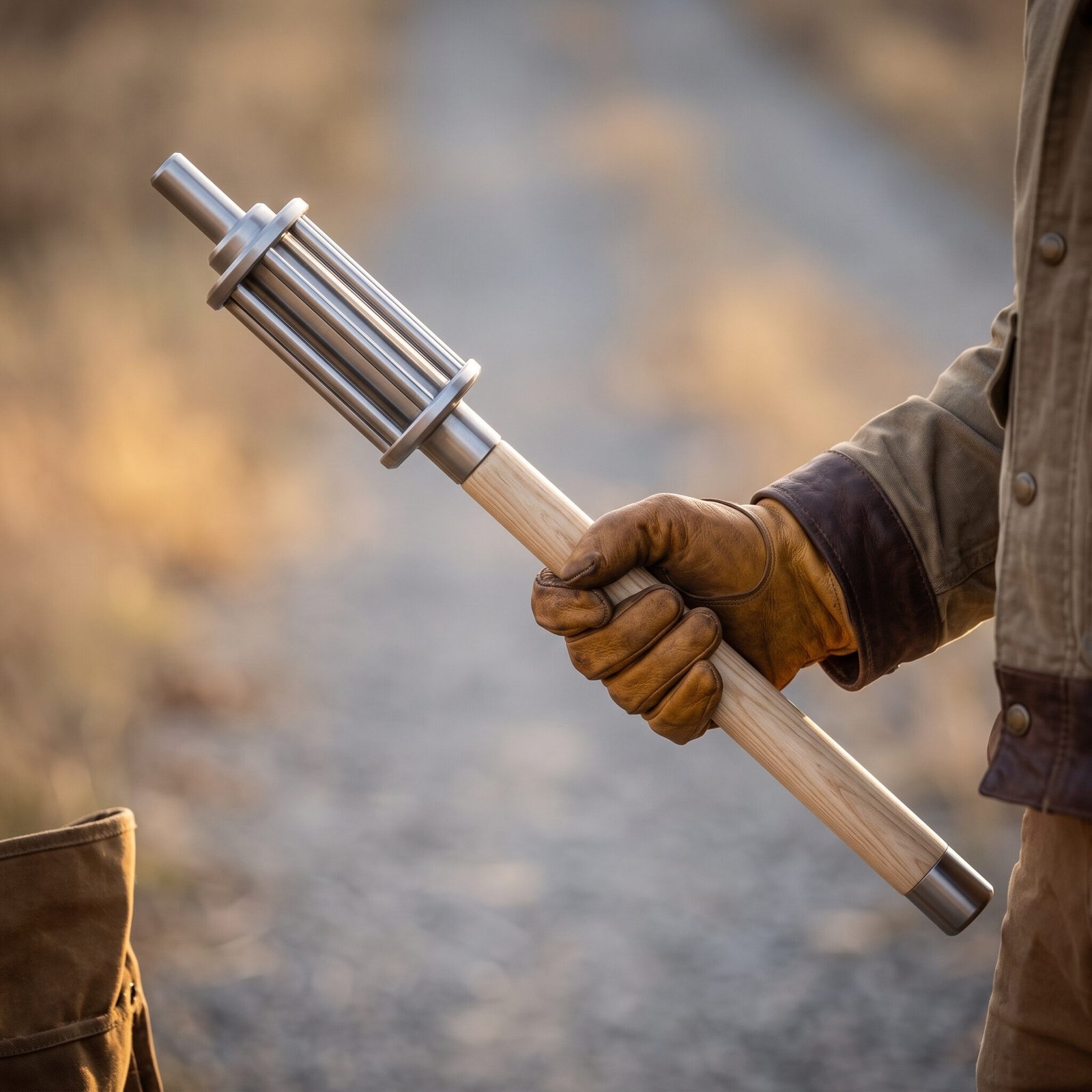
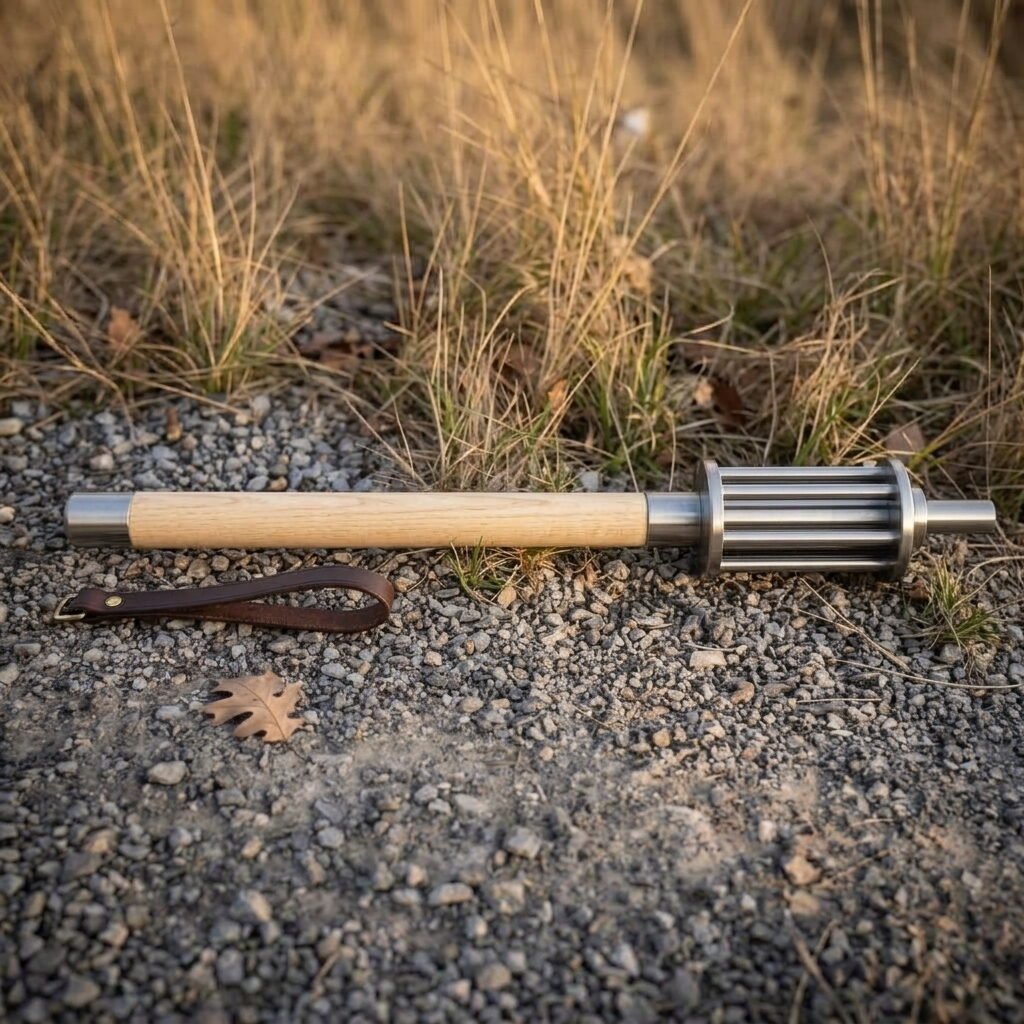
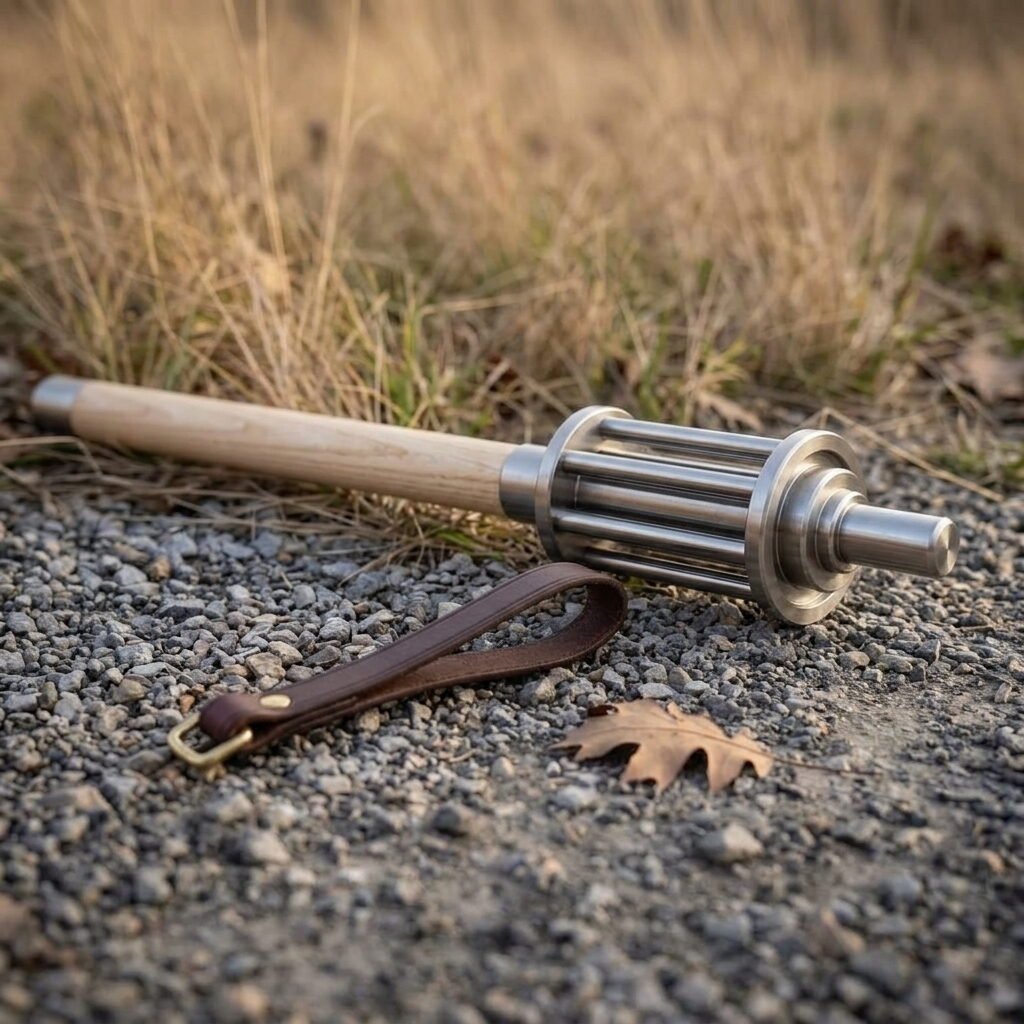
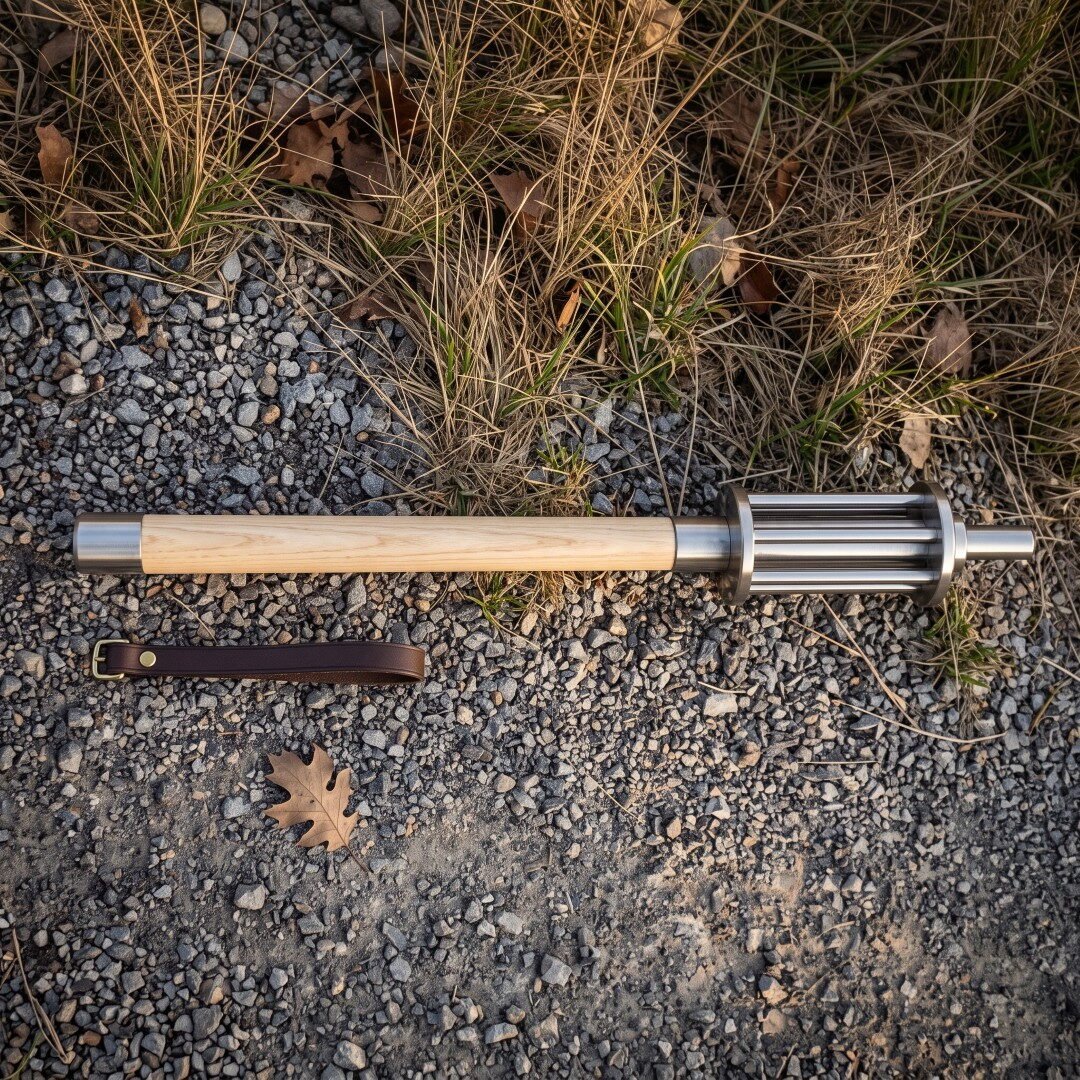
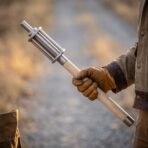
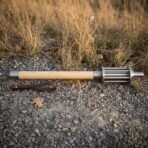
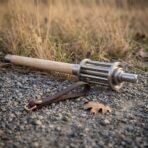
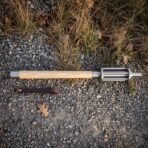
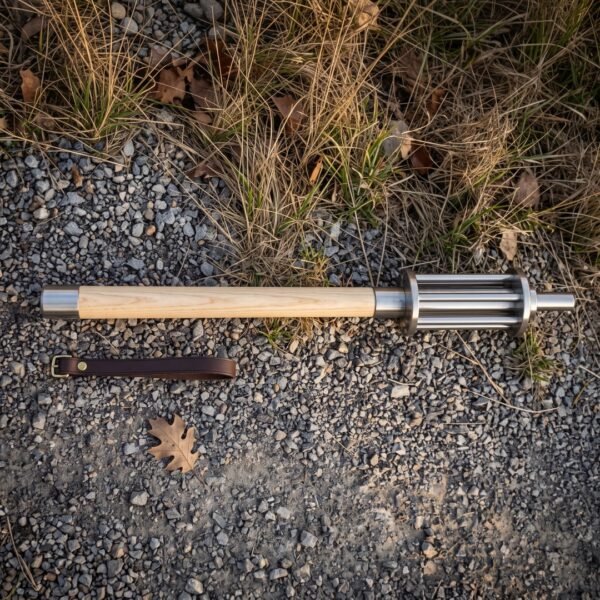
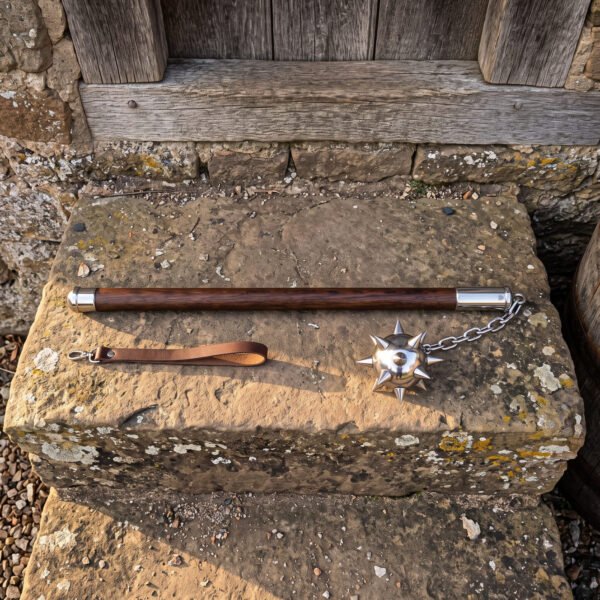
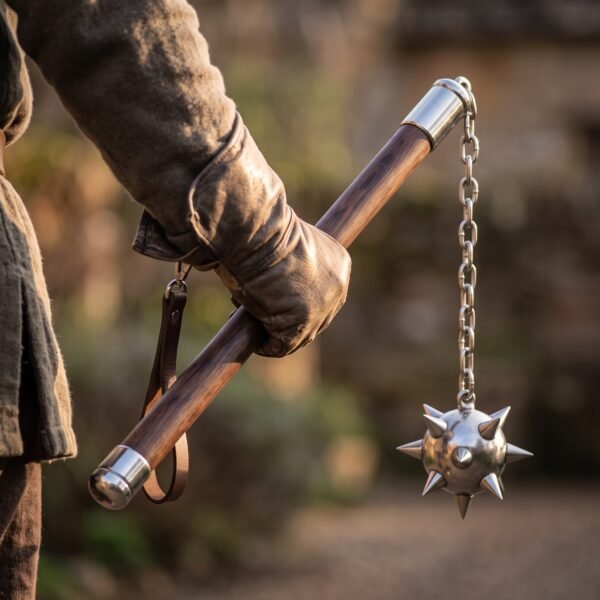
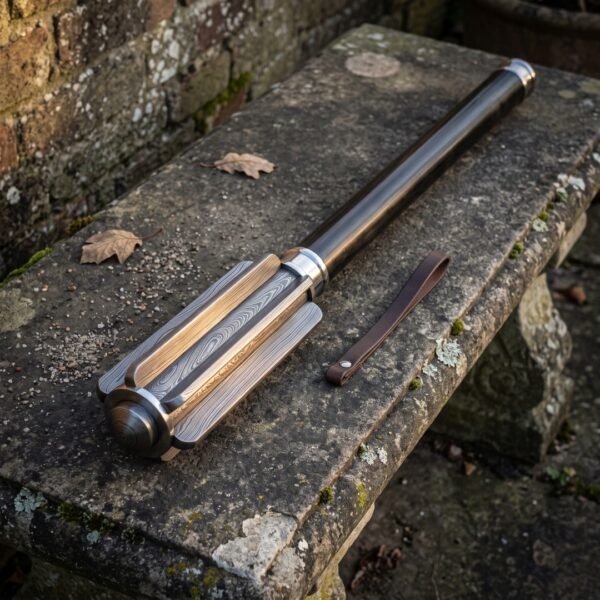
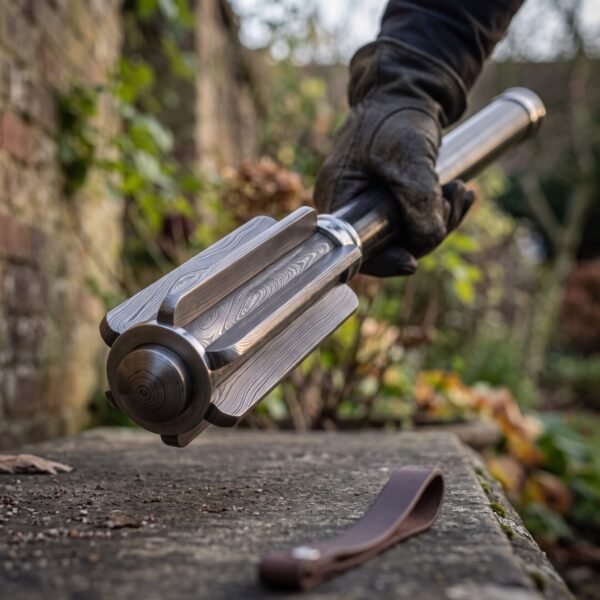
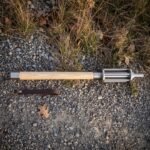
A bar mace trades the star shaped head of a flanged mace for a cylinder of parallel steel bars running the length of the head. This one carries eight polished 1095 round bars set in an open cage about six inches long, held between two round end plates under a stepped steel cap, on a pale American ash haft. The form is older and plainer than the flanged mace and it never really went away. The same principle turns up in the Persian gorz, in the ribbed bronze heads of the eastern Mediterranean, and in the fluted iron mace heads dug out of eleventh century sites across northern and eastern Europe.
Forged, heat treated and finished by hand in the Czech Republic, hardened and drawn to 54 to 58 HRC and polished bright. It ships with the leather wrist strap shown, free anywhere in the United States, and it can be engraved with Elder Futhark runes or a Viking pattern before it leaves the bench.
Specifications
| Steel | 1095 high carbon steel, polished |
|---|
| Hardness | 54 to 58 HRC |
|---|
| Overall length | 27 inches |
|---|
| Head | Open cage of eight round steel bars between two round steel end plates |
|---|
| Head length | 6 inches |
|---|
| Head diameter | 2.5 inches |
|---|
| Top cap | Stepped round steel cap above the head |
|---|
| Haft | Pale American ash |
|---|
| Fittings | Polished steel collar below the head and steel butt ferrule |
|---|
| Weight | approximately 2.8 lb |
|---|
| Strap | Dark brown leather wrist strap with brass buckle included, no sheath |
|---|
| SKU | RK-1352 |
|---|
Why a bar head instead of flanges
A flanged mace puts everything into a handful of deep edges near the crown. A bar mace spreads the same idea along a cylinder, so instead of one narrow line making contact you get several, anywhere along six inches of head. In practice that means it is far less fussy about the angle you land it at. A flanged head rewards precision. A bar head forgives a glancing swing, because whichever part of the barrel arrives first there is still a ridge there.
The second difference is mass and where it sits. The bars run the full length of the head, so the weight is distributed along the axis rather than balled up at the crown. That makes the piece feel longer in the hand and slower to start, but it also means it does not want to twist in the wrist on impact the way a top heavy head does. Historically this is the pattern that stayed in use as an infantry sidearm and as a horseman’s mace long after the fashion for elaborate flanged heads had passed, and its plainness is exactly why.
Why 1095 high carbon steel and not stainless
Every plain steel piece in this group is forged from 1095, a simple high carbon steel with roughly one percent carbon and very little else in it. That plainness is the point. A steel with nothing but iron and carbon to argue about moves predictably under the hammer, takes a clean quench, and comes back to a hardness a smith can actually hold to. These are hardened and drawn to 54 to 58 HRC, which is deliberately a touch softer than a kitchen knife. A head that has to survive impact wants to bend and rebound rather than chip, and 1095 in that range absorbs a bad hit instead of losing a piece of itself.
Stainless alloys buy their rust resistance with chromium, and above about thirteen percent that chromium ties up carbon in carbides that make the steel harder to forge and more brittle at the edge. On a small folding knife that trade is fine. On a head that lands with the weight of a haft behind it, it is not. The cost of choosing 1095 is that it will rust if you leave it wet. Wipe it, oil it, and it will outlast you. There is more on that trade in our guide to Damascus versus stainless.
The ash haft
The haft is American ash, the same timber that goes into tool handles and baseball bats, and it is here for one reason. Ash has long straight fibres that run the length of the stave, which means it flexes under a shock load and returns instead of snapping across the grain. That flex is what keeps a heavy head from beating your hands. It is turned, sanded and finished with oil rather than lacquer, so the grain stays open and the surface grips a dry hand instead of sliding.
Oil finishes want feeding. Once or twice a year, wipe on a thin coat of boiled linseed or a hardwood handle oil, let it soak for twenty minutes and wipe the surplus off. Do not leave it standing in a damp corner or propped against a masonry wall, because wood pulls moisture out of stone and the fit at the head will loosen. Our guide to wooden handle care covers the routine.
Engraving, runes and your own design
Use the rune converter on this page to turn a name, a date or a short phrase into Elder Futhark and we will cut it into the steel or the handle. If you would rather have a Viking pattern than a rune line, choose your own design in the engraving option above the add to cart button and tell us whether it goes on the blade or the handle. Where a piece already carries an engraved design, your chosen engraving replaces it rather than sitting alongside it.
Engraving is cut by hand after the piece is finished and before final oiling, so keep the line short and let it sit where the eye already goes. Names, dates, a line of a poem, a maker mark, a unit or a crew number all work. If you are unsure where a line should sit, send us the text and we will suggest a placement before we cut. Full details and examples are on the engraving page.
Care and sharpening
Carbon steel rusts. That is the only demanding thing about owning it. Wipe the steel down after handling, because fingerprints are salt and moisture and they will etch a bright surface in a week if you let them sit. A thin film of mineral oil, gun oil or paste wax on the metal is enough to keep it stable indoors. If the piece lives on a wall in a room that swings between damp and dry, check it every few months and re oil. Left alone in a garage or a basement it will spot, and once it spots the mark is permanent even after the rust is removed.
There is no edge to keep. The bars are left blunt, so if one picks up a burr from a knock, a few light passes with a fine stone will dress it back. Our guides cover steel care and sharpening with a whetstone in more detail.
Made in the Czech Republic
This piece is made by hand in the Czech Republic, in a workshop that still works the old way. The steel is forged, ground, heat treated and finished by smiths who learned the trade from the people before them, and the wood, horn and leather are cut and fitted by hand rather than pressed out on a line. That is also why no two pieces come out exactly the same.
Ransack Viking is a United States company. We import these pieces ourselves, check every one when it lands and ship from our warehouse in Chicago, Illinois. Engraving is done here in the United States after the piece arrives, so your runes or your own design go on before it leaves for you.
A note on handmade variation
This is hand forged. It is not machine made, not cast and not bulk produced, so what arrives will not be a pixel for pixel copy of the photograph on this page. The grain of the wood, the tone the steel takes from the fire and the oil, the exact run of a pattern, the precise curve of a profile, all of it shifts a little from one piece to the next because each one is worked by hand from natural materials. Two hafts cut from the same board will not read the same.
What does not change is the specification. Dimensions, steel, hardness, fittings and build are the same every time. The character is the part that is yours alone, and it is the reason to buy something forged rather than something stamped.
Frequently asked questions
Are the bars sharp?
No, and they should not be. The ridges are dressed to a blunt working profile. A mace works by concentrating force, not by cutting, and a keen edge on a bar head would simply roll or chip the first time it met anything hard.
Can I spar or fight with it?
No. This is live steel with real weight behind it and it will do serious injury through padding. Buy it for display, for a collection, or for stage and film work where nothing is being struck.
Can I have runes engraved on it?
Yes. Use the rune converter on this page for Elder Futhark, or choose a Viking pattern in the engraving option. On this mace the cleanest placement is around one of the round end plates or on the steel collar of the haft.
Will mine look like the photograph?
The steel, the dimensions and the bar cage will match. The ash grain will not, because every haft is turned from a different stave, and the polish carries small hand finished differences from head to head.
What is the difference between this and a morning star?
A morning star has a spiked ball head meant to punch through and hold. A bar mace has no spikes at all and crushes along a ridge. The bar mace is the older and more practical of the two.
How long does shipping take?
Two to three business days to leave the shop if it is in stock, two to three weeks if it is being made or engraved. Shipping within the United States is free and tracking goes out with it.
What is in the box
- One hand forged bar mace in 1095 high carbon steel
- American ash haft with polished steel ferrules
- Leather wrist strap
- Care and oiling notes
- Forged and finished in the Czech Republic
Explore the range
More in maces, flails, halberds and Norse arms, and read the guides.
Other pieces in this group
In the same category sits the Ironpetal mace, 26 inches overall. A near match for this one is the Emberflange mace, 27 inches overall. Closest to this in the range is the Chainmaw mace, 27 inches overall.
Fitting out further, the Rookbeak poleaxe belongs with it. Nothing here exactly right, build one to your own spec on the custom Norse arms page.

Absolutely blown away by this piece. Great buy overall.