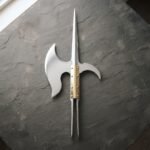
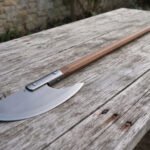
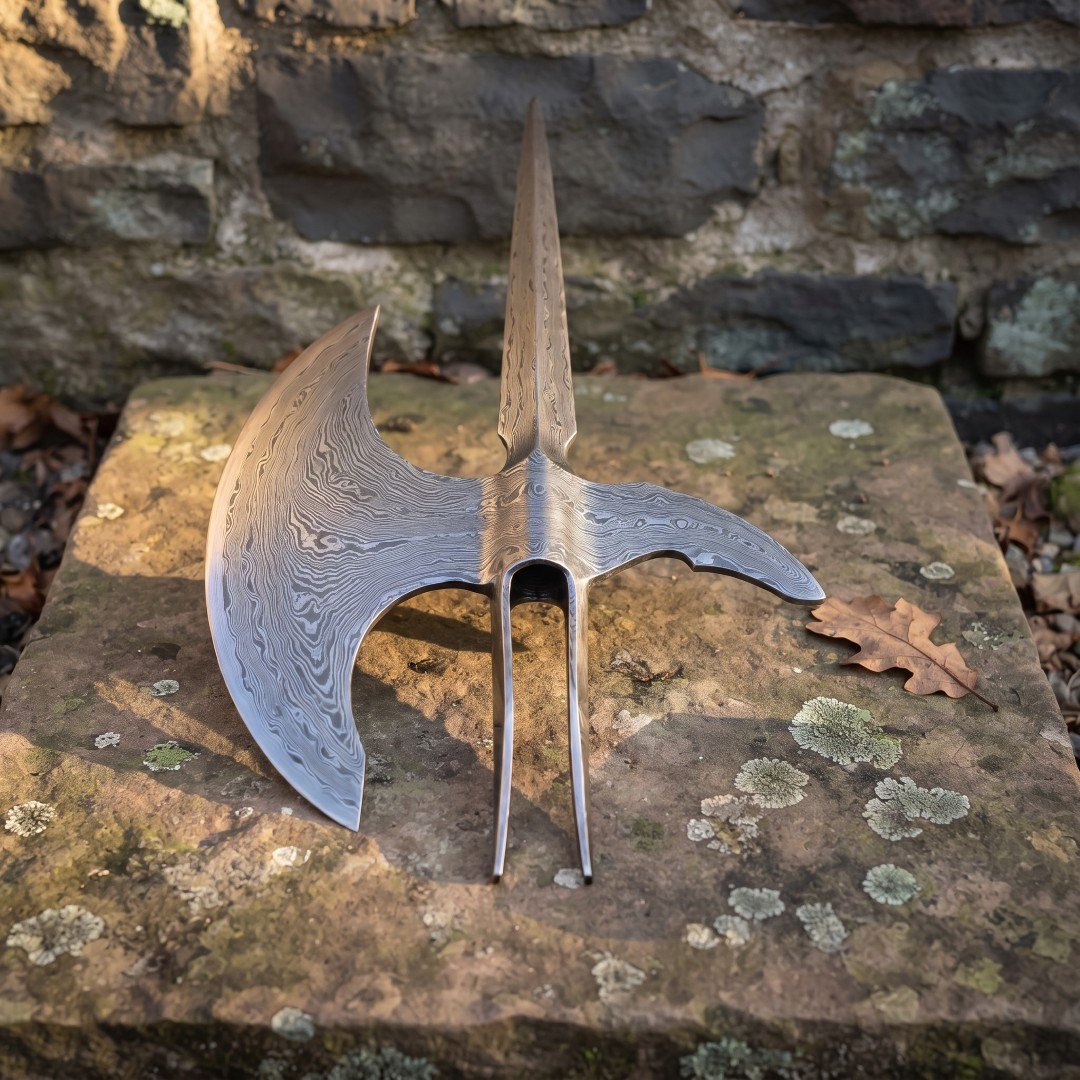
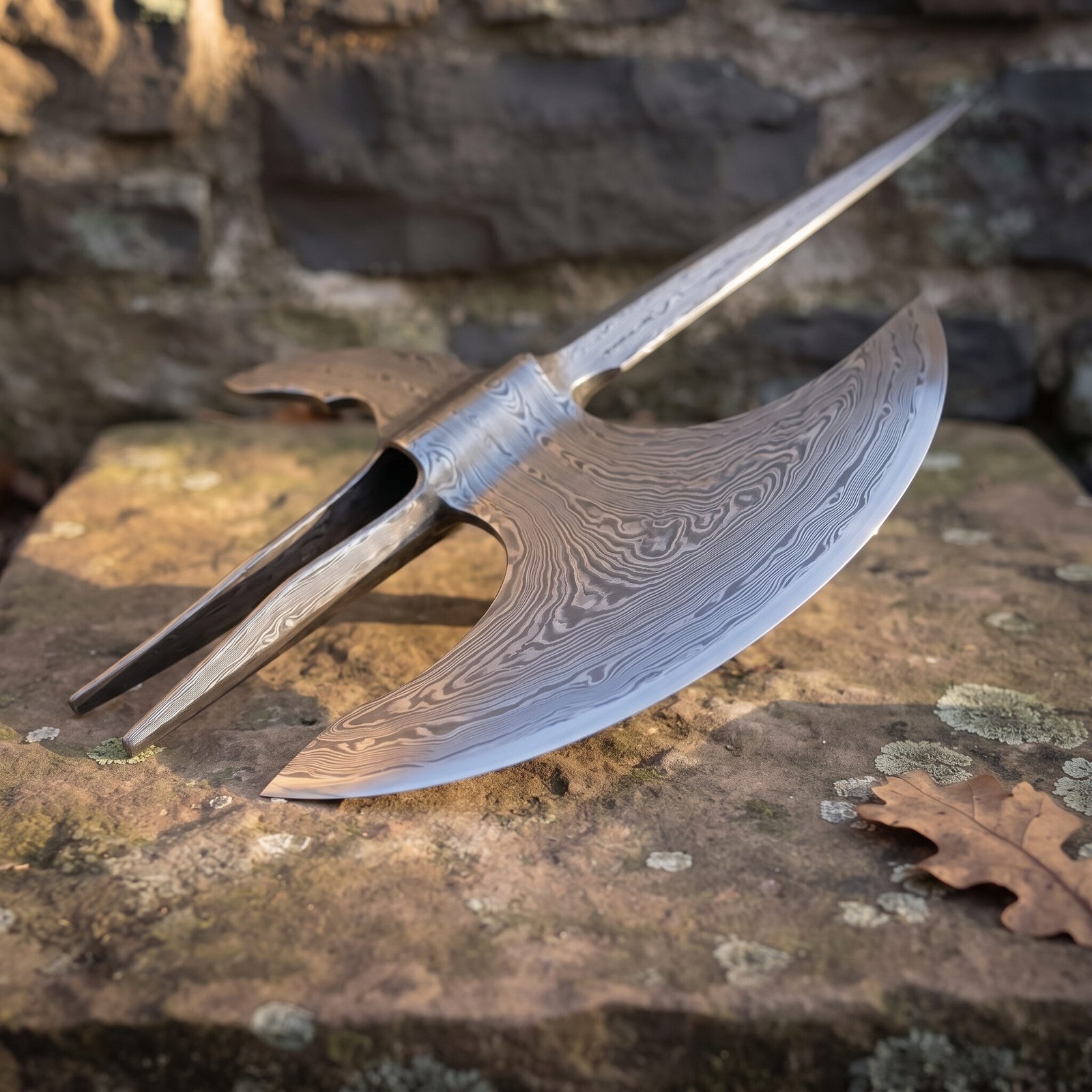
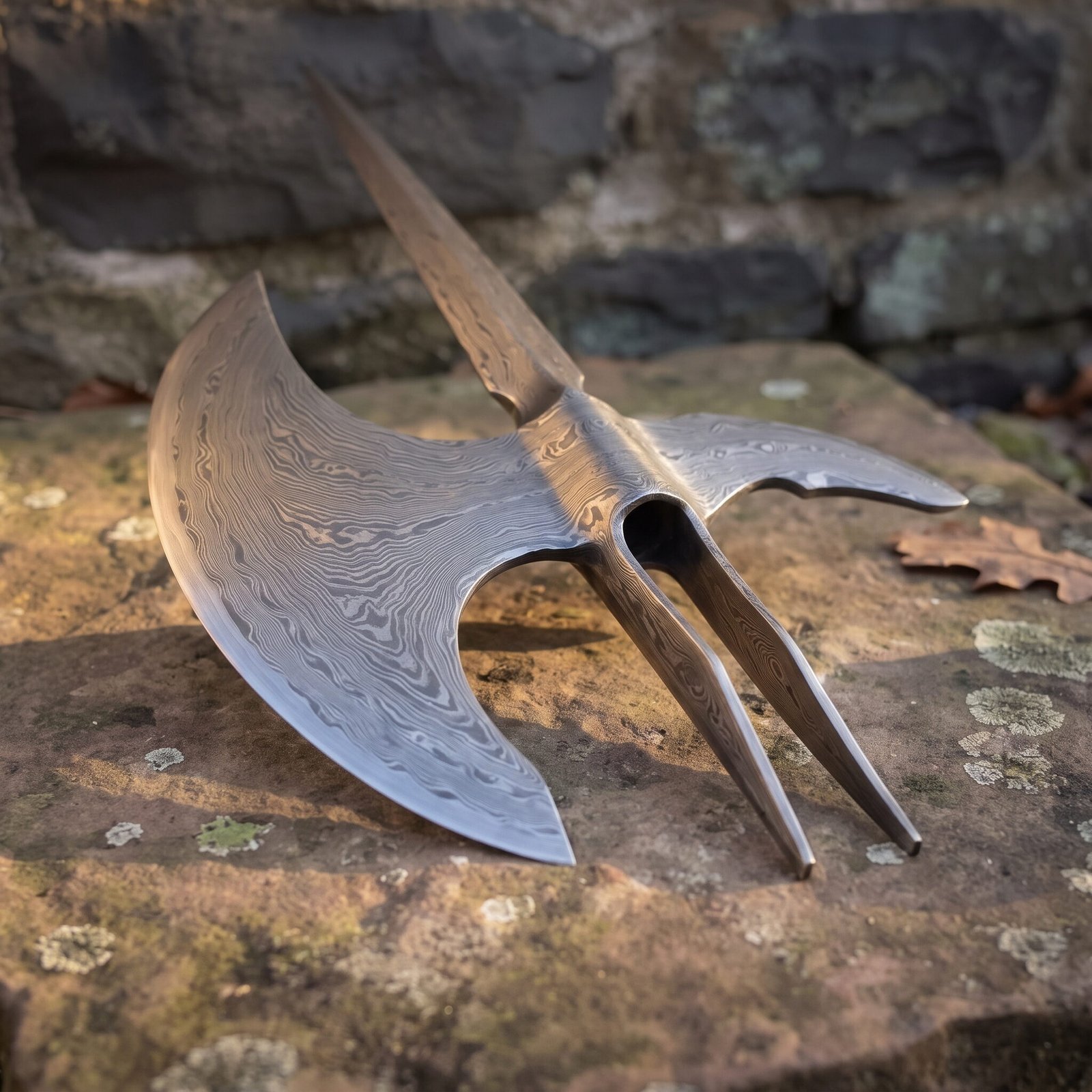
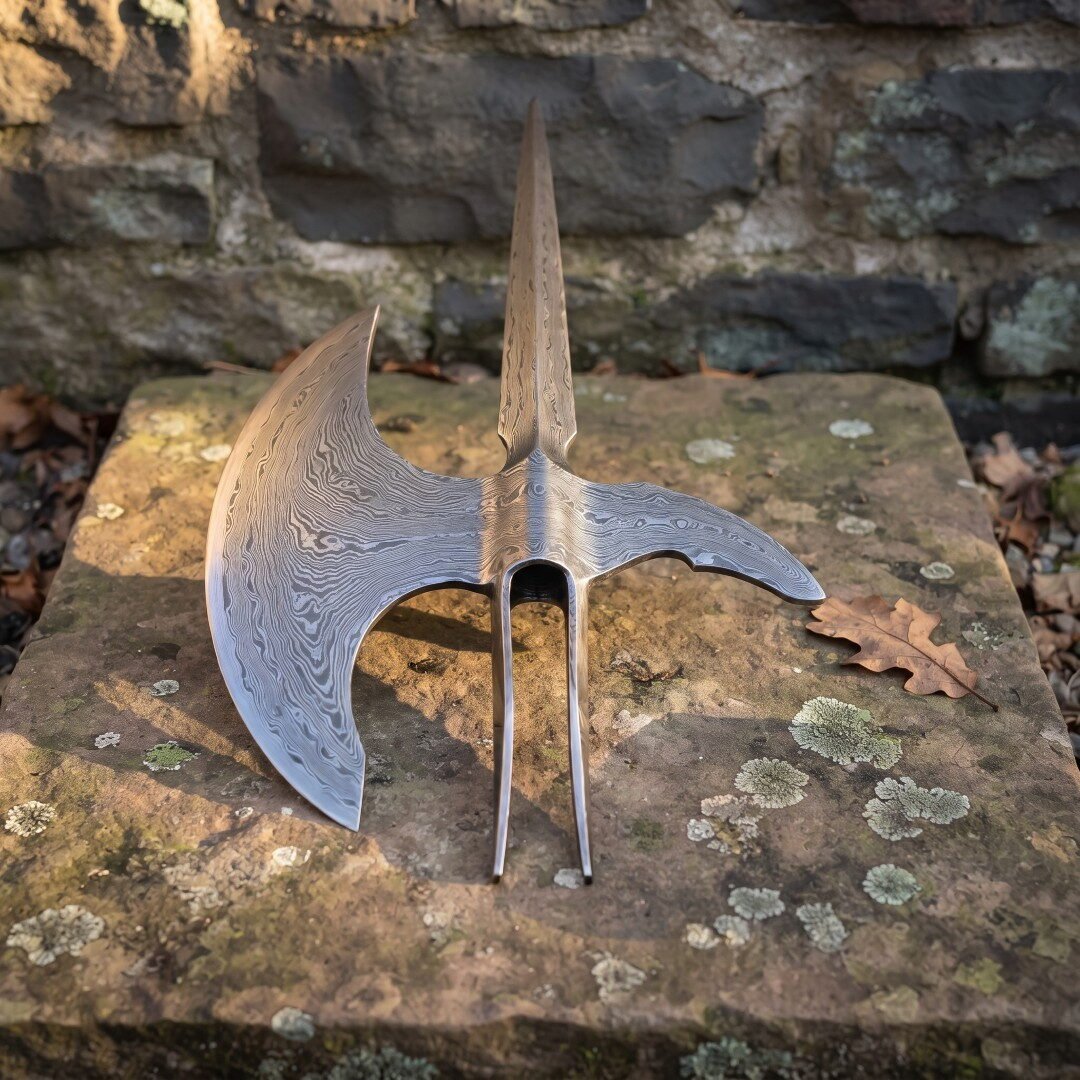
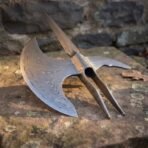
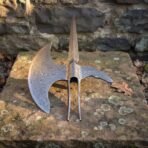
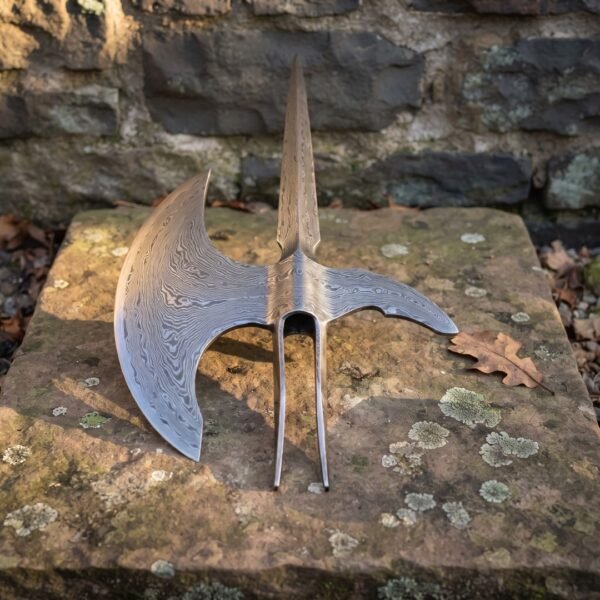
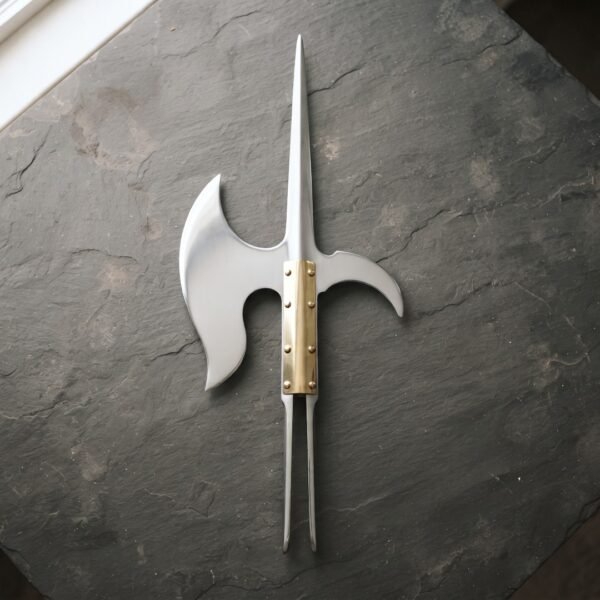
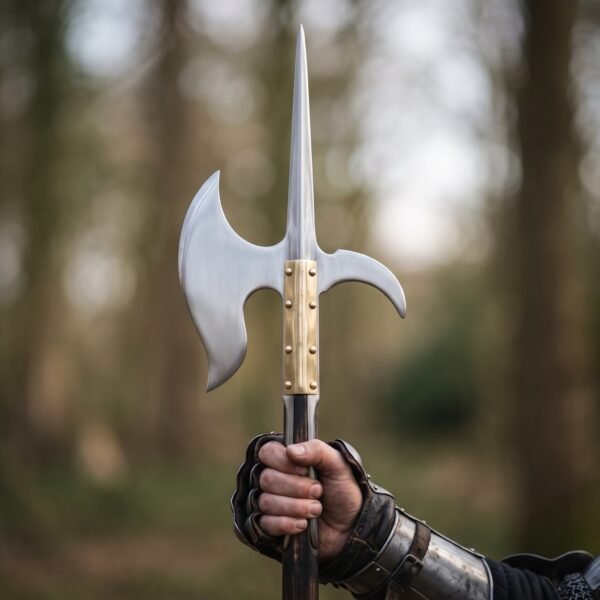
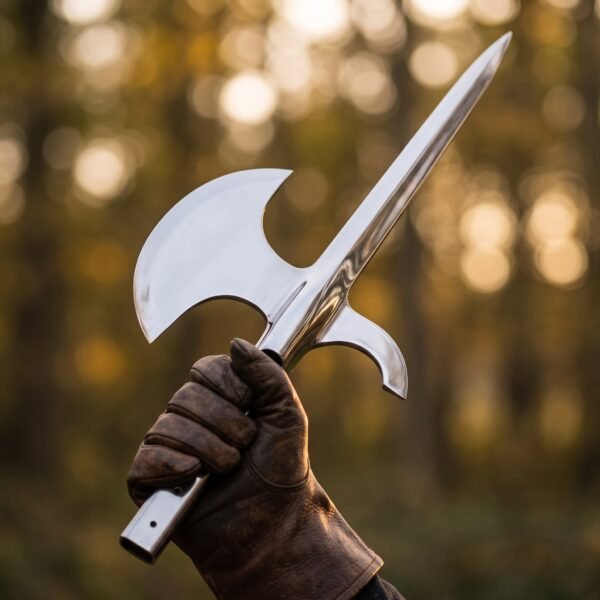
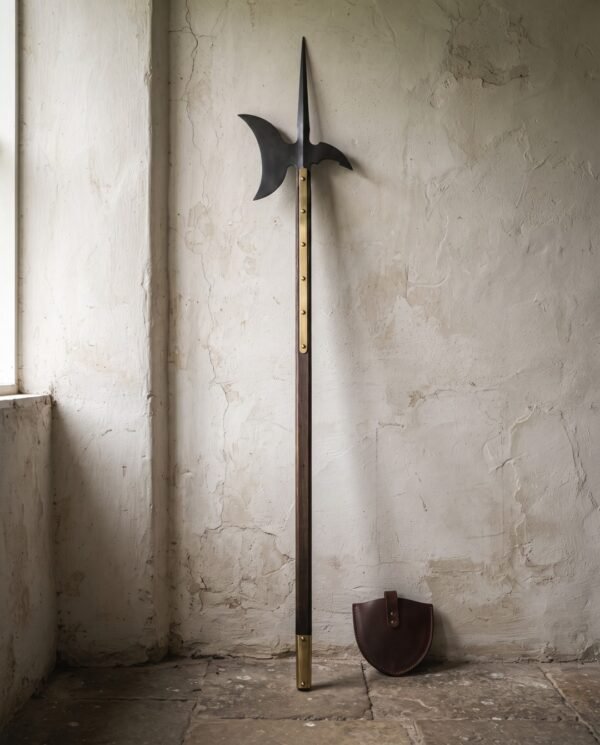
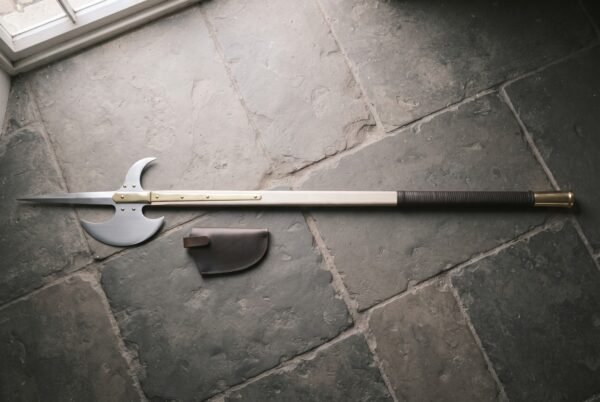
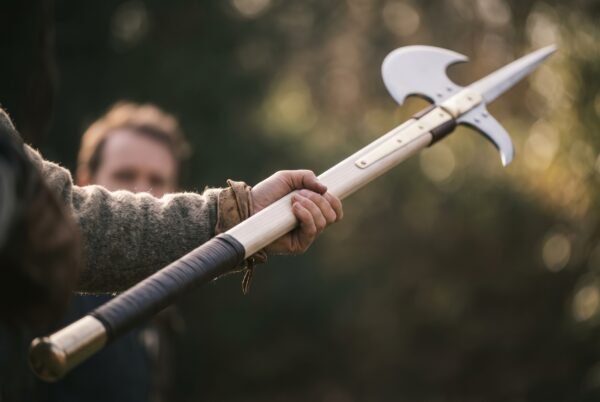
A halberd head in forge welded Damascus, sold without a haft. Spike, crescent blade and hooked rear fluke are all drawn from one billet of 1095 and 15N20, etched to raise the pattern, and finished with twin langet straps drilled for through rivets. Buying a head loose is how collectors have always bought polearms, and with a pattern welded piece there is a further reason for it. Nothing about a Damascus head is hidden when there is no stave in the way, so you can inspect the welds at the eye, which is the one place a bad forging cannot lie.
Forged, welded, etched and finished by hand in the Czech Republic, hardened and drawn to 58 to 60 HRC. It ships free anywhere in the United States and it can be engraved with Elder Futhark runes or a Viking pattern of your choosing before it leaves the bench.
Specifications
| Steel | 1095 and 15N20 forge welded Damascus, hand etched |
|---|
| Hardness | 58 to 60 HRC |
|---|
| Overall length | 18 inches including the langet straps, no haft supplied |
|---|
| Spike | Long tapered top spike |
|---|
| Cutting edge | 6.5 inch crescent blade |
|---|
| Rear fluke | Hooked fluke with small notches along its upper edge |
|---|
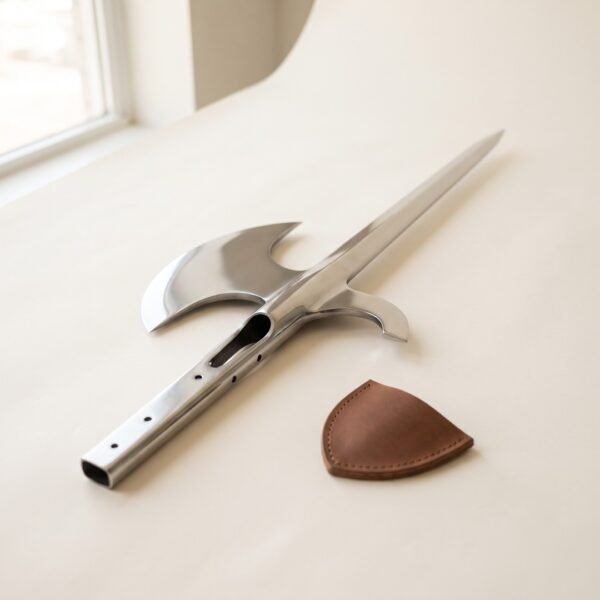
| Fittings | Open socket with twin forged langet straps, drilled for through rivets |
|---|
| Haft | Not included |
|---|
| Weight | Approximately 2.8 lb |
|---|
| Sheath | None |
|---|
| SKU | RK-1370 |
|---|
What the etch is doing
A finished Damascus piece comes off the grinder looking like ordinary grey steel. The pattern is in there but you cannot see it, because 1095 and 15N20 polish to almost the same colour. What brings it up is a dilute acid, usually ferric chloride, and what it exploits is the nickel in the 15N20. The acid eats the plain carbon steel noticeably faster than it eats the nickel bearing layers, so after a few minutes in the bath the 1095 has been etched down and the 15N20 stands slightly proud and stays bright.
That difference in height is only a few thousandths of an inch, and it is what you are feeling if you run a thumb across a good Damascus surface. After etching the piece is neutralised in a baking soda solution to stop the acid, dried hard, and oiled, because freshly etched steel is chemically clean and will flash rust in an hour if it is left alone. The depth of the etch is a judgement call. Too shallow and the pattern is faint, too deep and the surface becomes rough and starts trapping dirt. On a large head like this the etch is done in stages and stopped when the figure reads clearly at arm length.
Why Damascus steel and not stainless
The Damascus here is not an etch or a print. It is 1095 and 15N20 forge welded in alternating layers, drawn out, folded, and welded again until the billet carries the layer count you can see on the finished piece. The two steels are close cousins in carbon content, which is what lets them weld cleanly and harden together, but 15N20 carries about two percent nickel. Nickel resists the acid etch. That is the whole trick. When the finished piece is polished and dipped, the 1095 darkens and the 15N20 stays bright, and the layers you cannot otherwise see come up as pattern.
Because both steels are high carbon, the finished piece hardens properly. This one is quenched and drawn to 58 to 60 HRC, hard enough to hold a working edge and still tough enough for impact work. Stainless cannot do this. High chromium alloys will not forge weld reliably at these temperatures and the chromium carbides that give stainless its corrosion resistance also blunt the contrast an etch depends on, so stainless Damascus is usually a faint grey ghost of a pattern. The trade is care. Read more in Damascus versus stainless.
Hafting the head yourself
This is sold as a head, without a haft, which is how most surviving museum pieces come down to us and how most serious reproductions are bought. It gives you the choice of length, timber and finish, and it keeps the shipping sane, because a finished polearm is a six foot parcel. The socket and langets are drilled and dimensioned for a standard haft section, and any hardwood dowel stock or a turned ash stave will take it.
If you are hafting it yourself, use ash or hickory rather than pine, cut the seat a fraction proud and pare it back until the head drives on hard, and pin through the langet holes with soft steel or copper rivets rather than screws. Oil the wood before you fit it, not after. If you would rather we hafted it for you, contact the shop before you order and we will quote the length you want. Wood care is covered in wooden handle care.
Engraving, runes and your own design
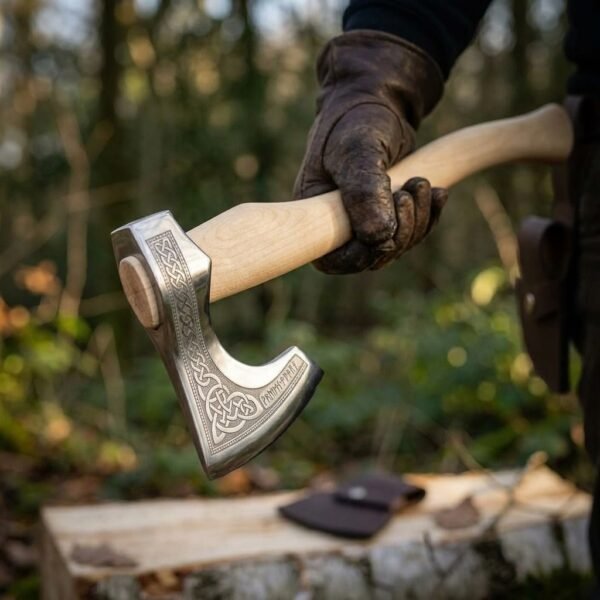
Use the rune converter on this page to turn a name, a date or a short phrase into Elder Futhark and we will cut it into the steel or the handle. If you would rather have a Viking pattern than a rune line, choose your own design in the engraving option above the add to cart button and tell us whether it goes on the blade or the handle. Where a piece already carries an engraved design, your chosen engraving replaces it rather than sitting alongside it.
Engraving is cut by hand after the piece is finished and before final oiling, so keep the line short and let it sit where the eye already goes. Names, dates, a line of a poem, a maker mark, a unit or a crew number all work. If you are unsure where a line should sit, send us the text and we will suggest a placement before we cut. Full details and examples are on the engraving page.
Care and sharpening
Damascus needs the same care as any high carbon steel, with one extra thought. The etched pattern lives in a few thousandths of an inch of surface relief. Aggressive polishing, a wire wheel or a scouring pad will flatten that relief and take the pattern with it, and the only way back is to re etch the piece. Clean it with a soft cloth, nothing abrasive, and keep a thin film of mineral oil or paste wax on the steel. Wipe fingerprints off the same day. Rust will start in a fingerprint before it starts anywhere else.
Sharpening does not damage the pattern, because you are only working the bevel and the layers run right through the steel rather than sitting on top of it. Use a whetstone, keep it wet, hold the angle the bevel already carries and work both sides evenly. If the fresh bevel looks paler than the rest of the piece, that is expected, and a light etch will bring it back. See steel care and sharpening with a whetstone.
Made in the Czech Republic
The work behind this piece happens in a Czech Republic workshop that has kept to the old methods. Steel is forged and heat treated by hand, the grind is taken down by eye rather than by machine, and the handle, fittings and sheath are cut and finished one at a time. Because of that, every piece carries small marks of the hand that made it.
Ransack Viking is a United States company. We import direct, check each piece when it reaches us, and ship from our Chicago, Illinois warehouse. Engraving is added here in the United States after arrival, so the piece you receive is finished to your order.
A note on handmade variation
This is hand forged. It is not machine made, not cast and not bulk produced, so what arrives will not be a pixel for pixel copy of the photograph on this page. The grain of the wood, the tone the steel takes from the fire and the oil, the exact run of a pattern, the precise curve of a profile, all of it shifts a little from one piece to the next because each one is worked by hand from natural materials. Two hafts cut from the same board will not read the same. Two etched blades from the same billet will not carry the same swirl.
What does not change is the specification. Dimensions, steel, hardness, fittings and build are the same every time. The character is the part that is yours alone, and it is the reason to buy something forged rather than something stamped.
Frequently asked questions
Is a haft included?
No, this is the head only with its twin langet straps fitted and drilled. You supply the stave, which lets you choose length and timber and means it arrives in a small parcel rather than a six foot carton.
Can I see the welds?
Yes, and you should look. Check the eye where the socket meets the body and the junction where the crescent leaves the eye. Sound welds show the layers turning the corner continuously. A dark straight line across the pattern would be a cold shut, and there are none on this head.
Is it sharp?
The crescent edge is ground and honed to a working sharpness. The spike is pointed and the inner curve of the hook is left blunt, which is correct, because a hook catches and drags rather than cutting.
Can I have runes engraved on it?
Yes. Use the rune converter on this page for Elder Futhark or choose your own Viking pattern. On etched Damascus we cut the line and then re etch, so the runes sit into the pattern rather than scratching across it.
Will mine look like the photograph?
The dimensions and geometry will match exactly. The pattern will not. Every billet folds and moves differently, and the etch on a large head varies in depth across the surface, which is what gives each one its own light.
How long does shipping take?
Two to three business days if it is in stock, two to three weeks if it is being forged or engraved. Shipping inside the United States is free with tracking.
What is in the box
- One hand forged Damascus halberd head, 1095 and 15N20
- Twin forged langet straps drilled for through rivets, no haft supplied
- Care, oiling and hafting notes for etched Damascus
- Forged and finished in the Czech Republic
Explore the range
More in halberds, damascus steel, poleaxes and glaives and polearms, and read the guides.
Compare it with these
Another in the same line is the Frostward halberd, 66 inches overall. Next along the rack is the Cleftcrown halberd, high carbon steel. For a straight comparison, see the Brasscrest halberd, high carbon steel.
The Stormlink mace covers the other half of the same kit. Pick the steel, the length and the fittings yourself on the custom Norse arms page.

Reviews
There are no reviews yet