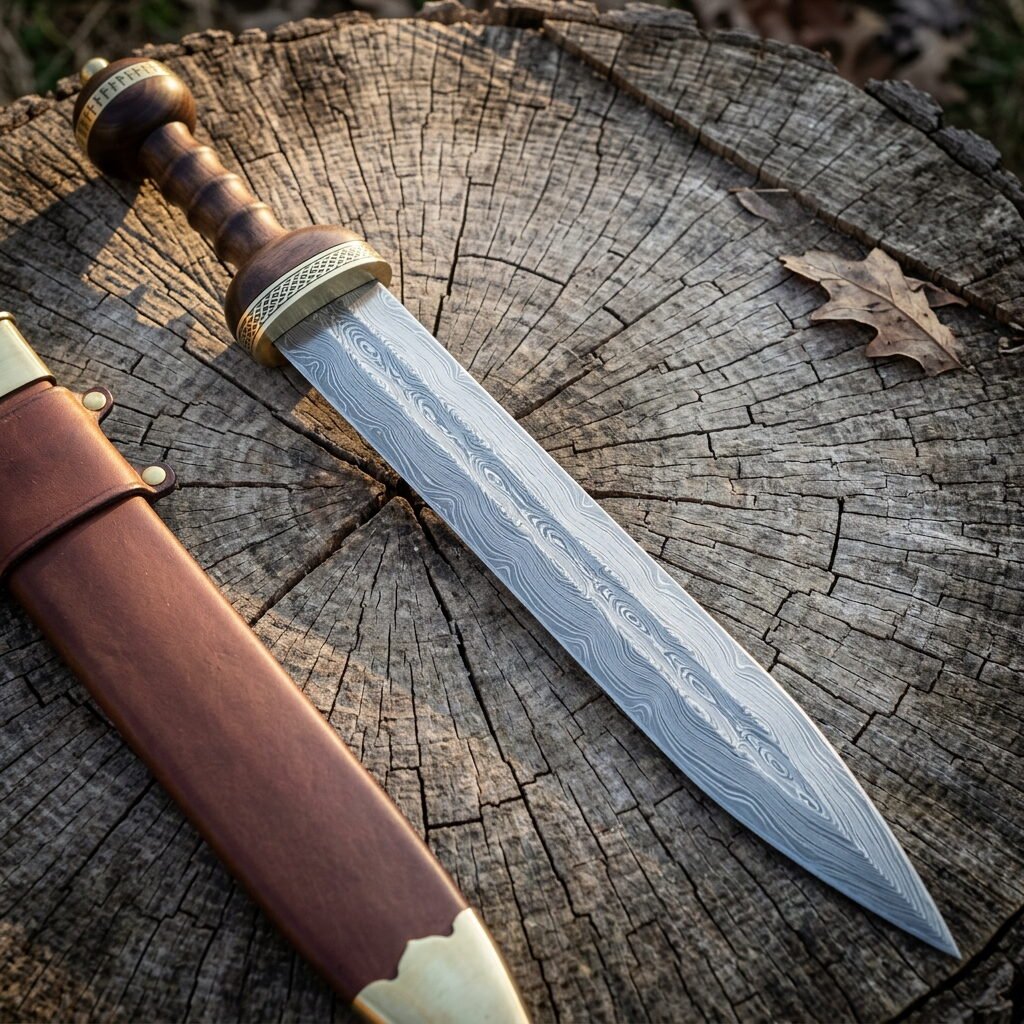
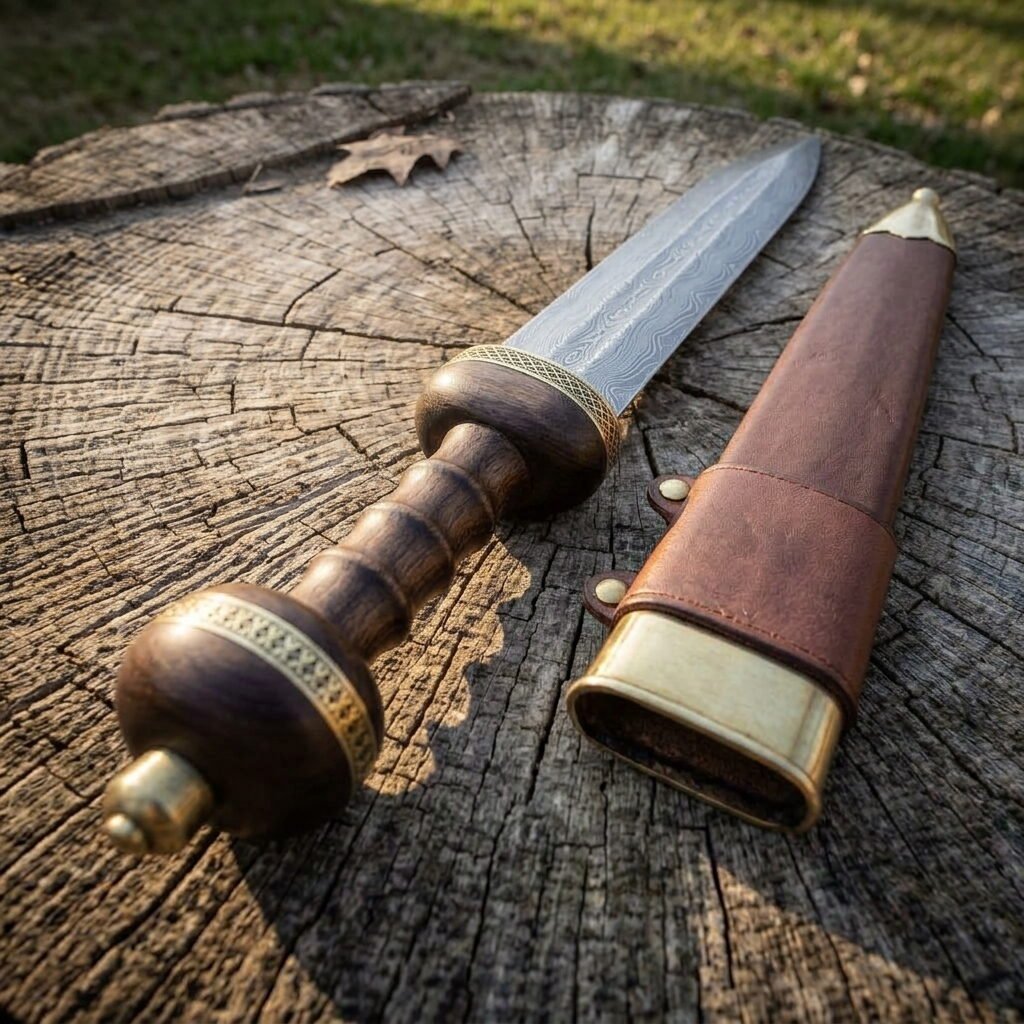
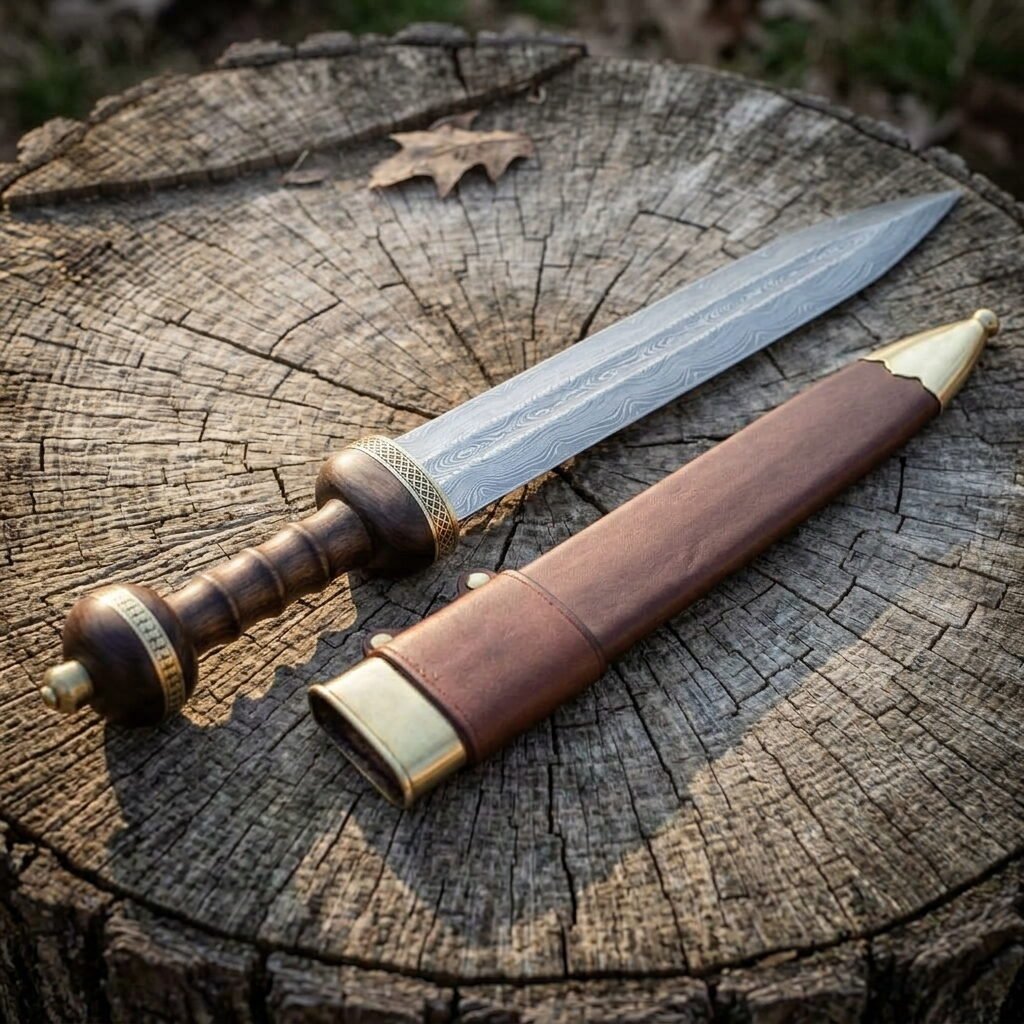
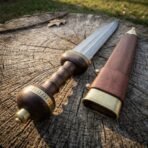
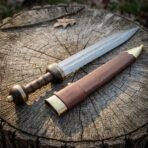
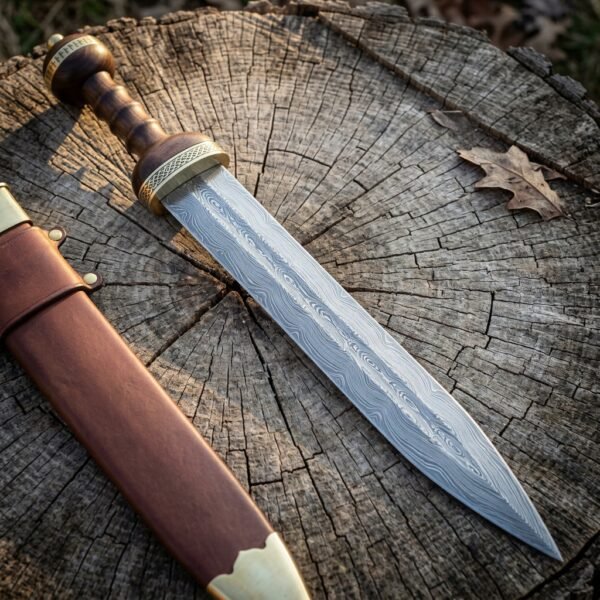
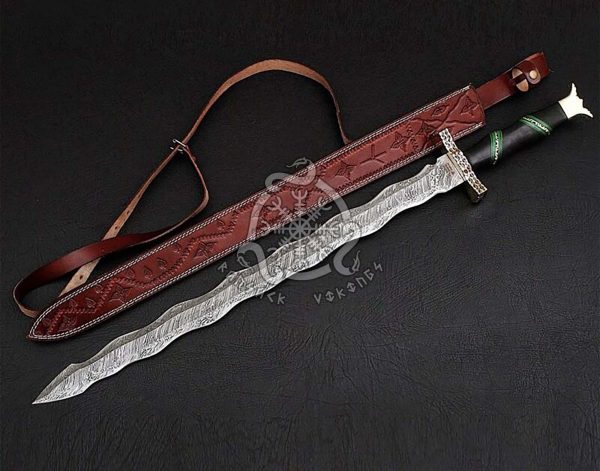
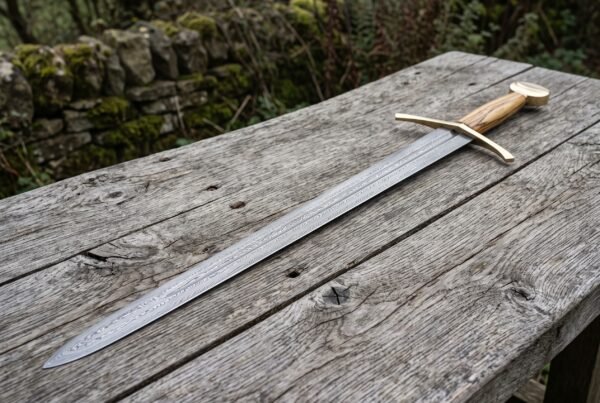
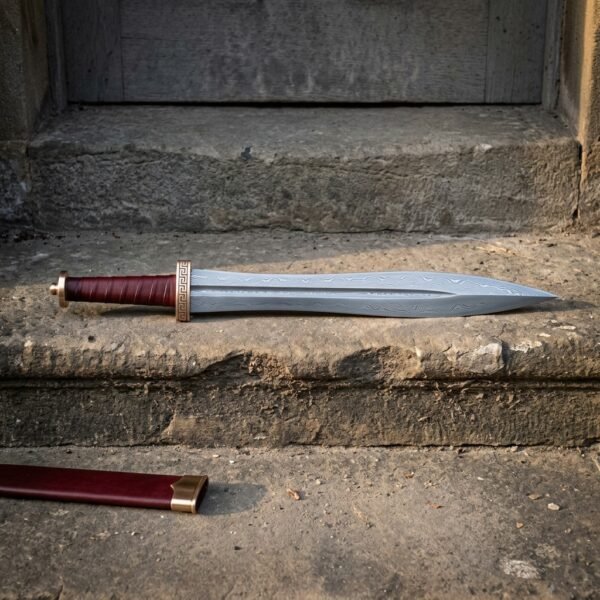
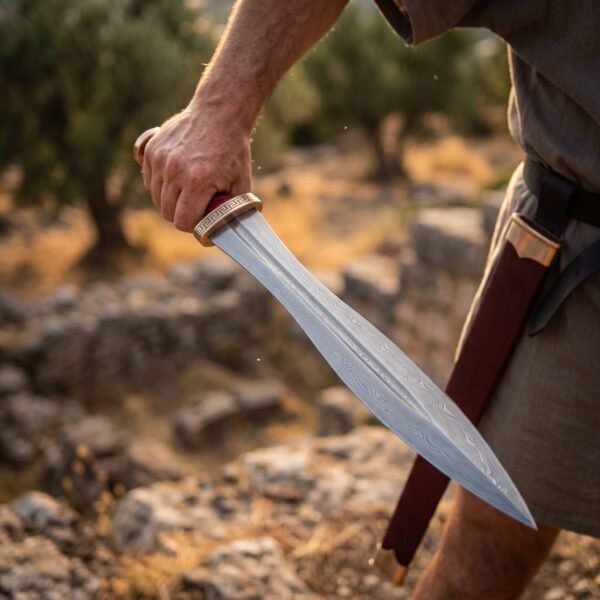
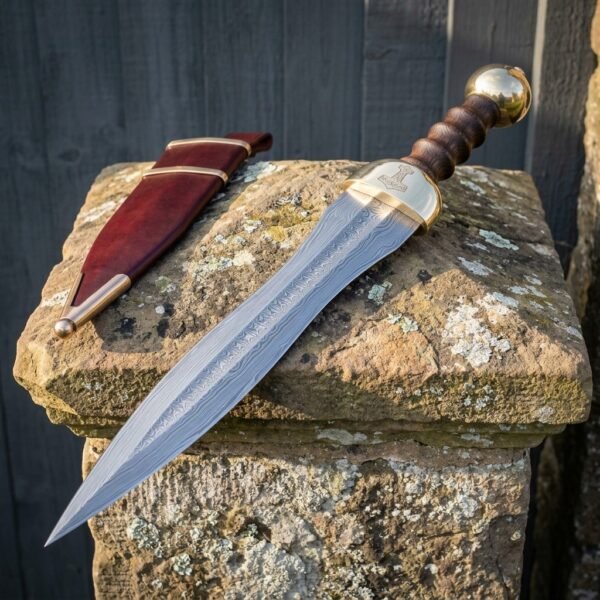
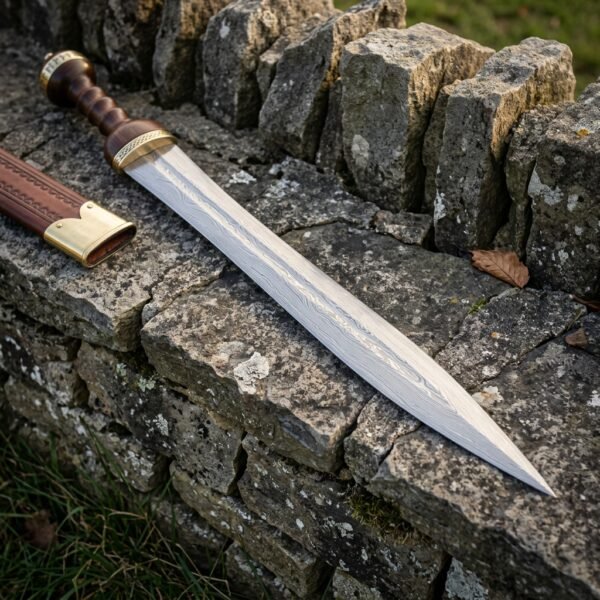
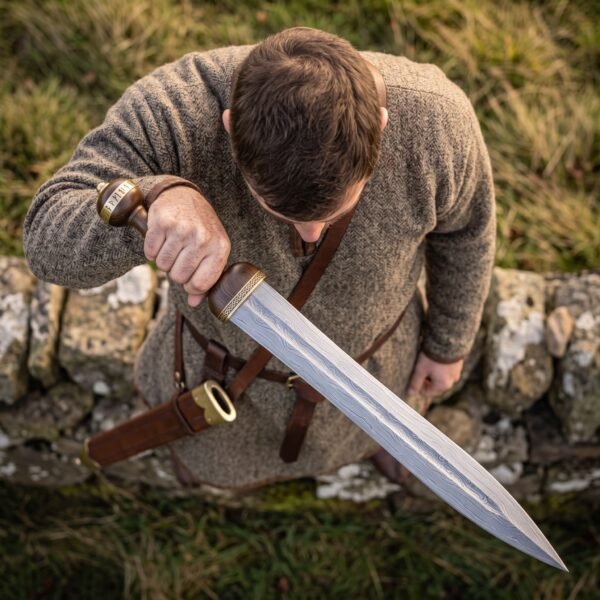
This is a Roman gladius on the Mainz pattern with a blade forge welded from 1095 and 15N20, so the gently tapering edges and long point of the early legionary sword carry a flowing Damascus figure from guard to tip. There is a real historical thread behind that combination. Roman smiths did practise pattern welding, and by the later empire the technique had spread through the Rhine workshops into the migration period blades that the Norse world inherited. Roman writers admired the Spanish sword the army copied in the Punic Wars, and Polybius describes the gladius hispaniensis as good for both cut and thrust. The Mainz pattern kept much of that Spanish shape, with a blade that narrows all the way to a long point made for the thrust. Putting a pattern welded blade in that austere outline is a deliberate contrast between a soldier’s geometry and a smith’s showpiece.
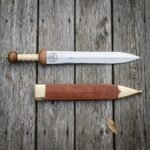
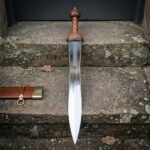
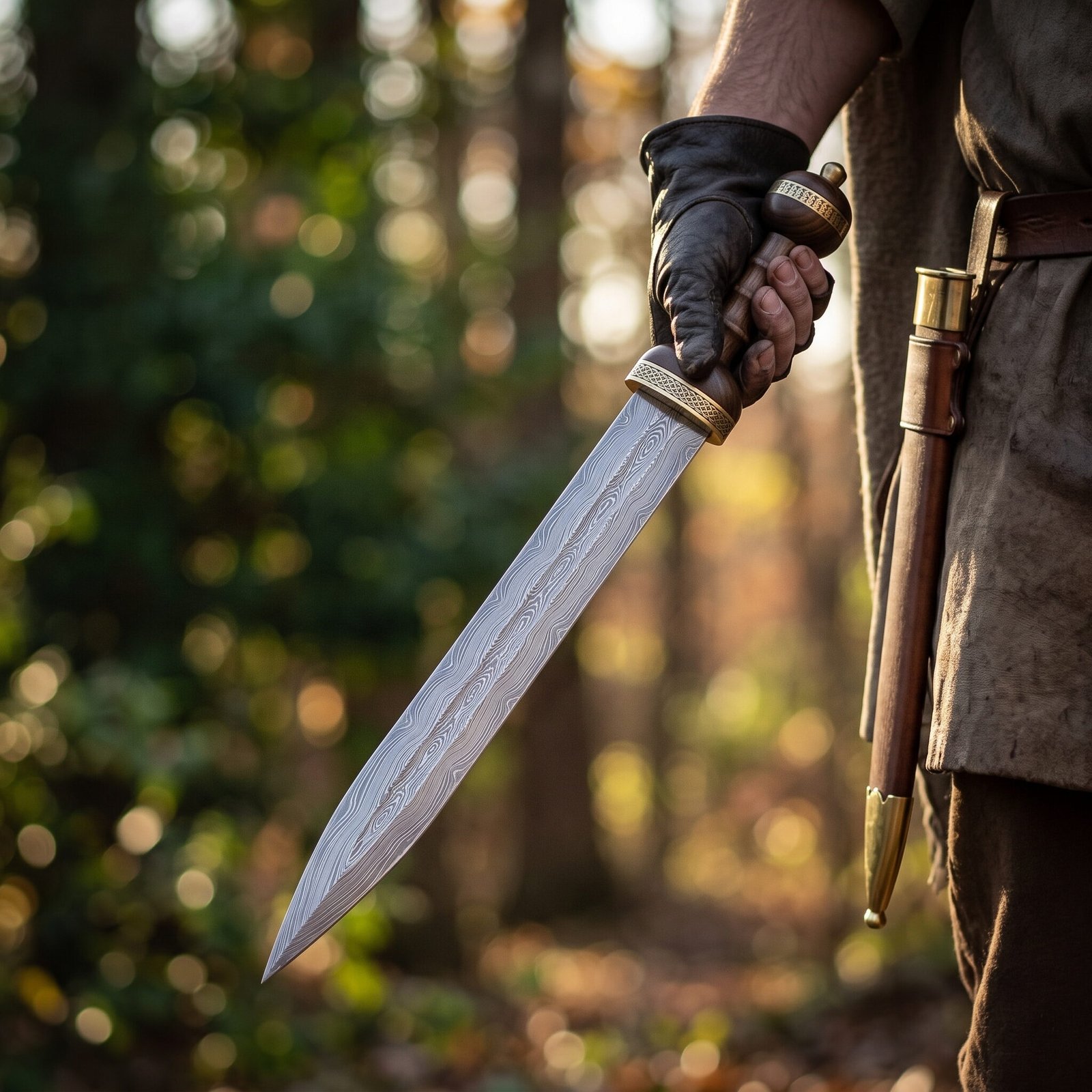
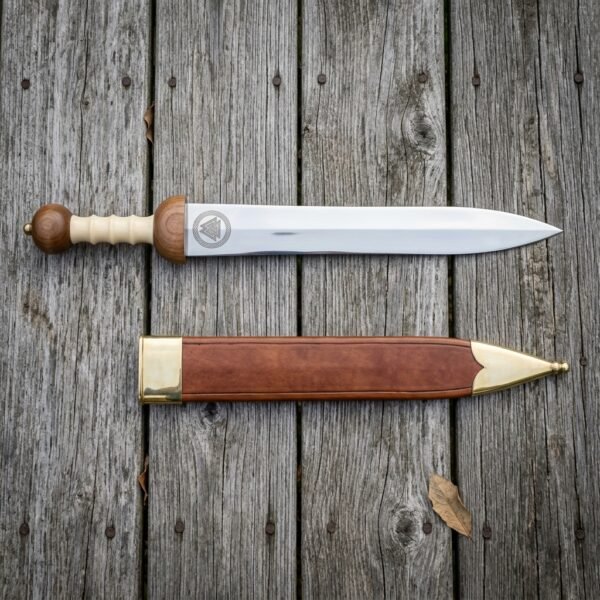
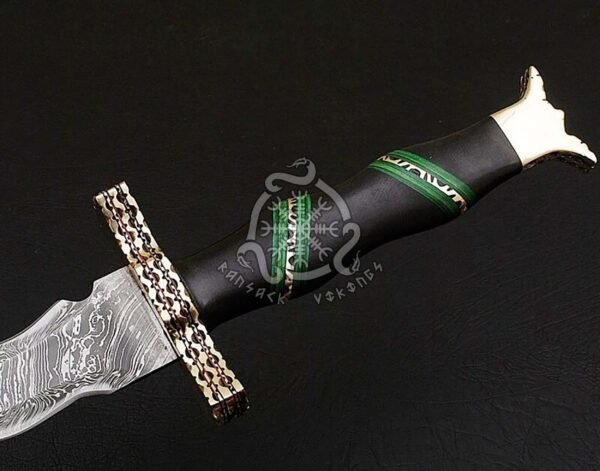
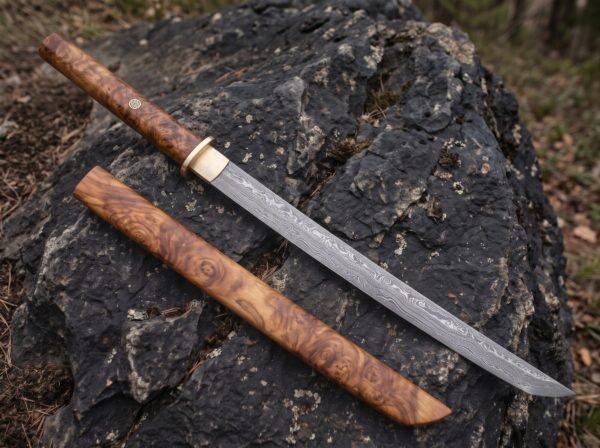
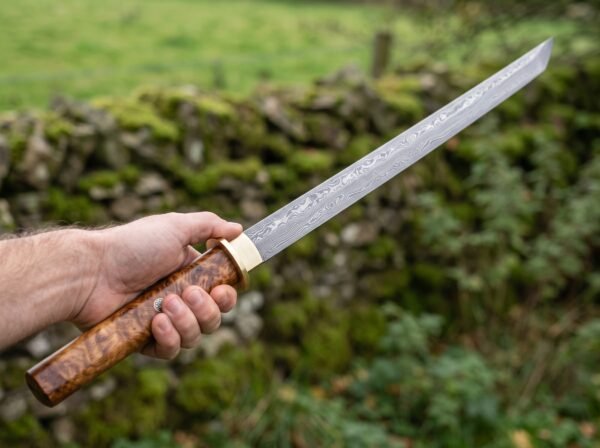
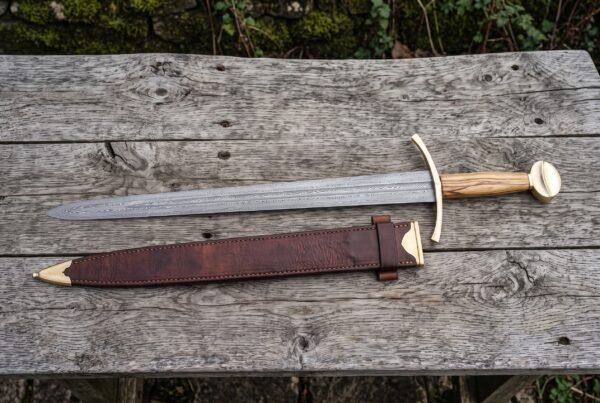
The billet is drawn, folded, welded and etched by hand in the Czech Republic, then ground, hardened and fitted with a walnut handguard banded in engraved brass, a ribbed walnut grip and a turned walnut globular pommel with a brass band and button. It ships in a brown leather scabbard with a brass throat, a brass chape and brass rivets at the mouth. Shipping inside the United States is free.
Specifications
| Steel | 1095 and 15N20 forge welded Damascus, hand etched flowing wave pattern |
|---|
| Hardness | 58 to 60 HRC |
|---|
| Overall length | 27 inches |
|---|
| Blade length | 20 inches |
|---|
| Blade width | 2 inches at the guard, tapering Mainz profile |
|---|
| Blade | Mainz pattern, double edged with a raised centre ridge and a long tapering point |
|---|
| Guard | Turned walnut handguard with an engraved brass band on the blade side |
|---|
| Grip | Ribbed walnut grip with finger ridges |
|---|
| Pommel | Turned walnut globular pommel with an engraved brass band and a brass peen button |
|---|
| Scabbard | Brown leather with brass throat, brass chape and brass rivets |
|---|
| Tang | Full length, peened at the pommel |
|---|
| SKU | RK-1331 |
|---|
How the pattern is made
Damascus here means pattern welding, not a lost Wootz recipe. The smith stacks alternating layers of 1095 and 15N20, brings the stack to welding heat and sets the layers together under the hammer, then draws it out, cuts it, folds it and welds it again until the layer count is right. The two steels are close enough in behaviour to work as one blade and different enough to show. 15N20 carries about two percent nickel, and nickel resists the ferric chloride etch, so it stays bright while the 1095 beside it darkens. That contrast is the pattern.
On this blade the figure runs in long flowing waves along the flats, with small eyes where the bands swirl together. It follows the centre ridge for the full twenty inches, and it is worth turning the sword under a lamp to watch it shift as the light moves.
Why Damascus and not stainless
Forge welded Damascus is a carbon steel laminate. It rusts, it takes a patina and it needs oiling, and in exchange it gives you a blade with a fine grain refined by every fold and a hardness of 58 to 60 HRC that holds a keen edge far longer than a plain blade at the same weight. Stainless steel relies on a heavy chromium content for its corrosion resistance, and in a blade this long that chromium costs toughness at exactly the point where a sword needs it most, in the shoulder and the tang. Stainless also will not etch to a visible pattern, so a stainless Damascus sword is a printed or acid stencilled imitation rather than a forge welded billet. Our full explanation is in Damascus versus stainless.
The walnut grip and brass fittings
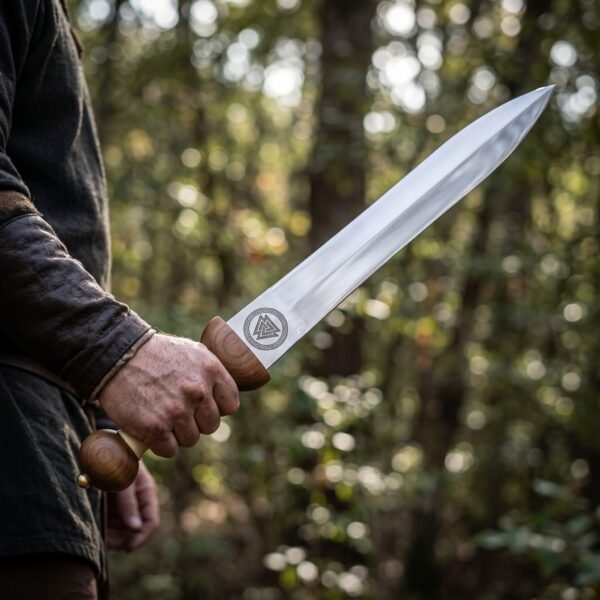
A Roman hilt is four parts on a tang, and this one keeps that logic. A walnut handguard banded in engraved brass seats against the shoulder of the blade, the ribbed walnut grip sits above it, the turned walnut pommel with its own engraved brass band goes on last and the tang is peened over a brass button. The ribs on the grip are finger swells rather than ornament, and they matter on a sword that is used mostly with a thrust, because they stop the hand sliding forward under load. Walnut is dense enough to take the turning without tearing and stable enough not to shrink away from the brass bands in a dry winter.
Give the walnut a wipe with a dry cloth after handling and a thin coat of oil once or twice a year. Do not wash it, do not leave it in a hot car and keep it off a radiator shelf, because it is dimensional change in the wood that loosens a hilt over time. Our short note on wooden handle care sets out the routine. The brass will dull to a soft gold on its own, which most people prefer, and comes back to a shine with a light metal polish if you want it bright.
Engraving, runes and your own design
Use the rune converter on this page to turn a name, a date or a short phrase into Elder Futhark and we will cut it into the steel or the handle. If you would rather have a Viking pattern than a rune line, choose your own design in the engraving option above the add to cart button and tell us whether it goes on the blade or the handle. Where a piece already carries an engraved design, your chosen engraving replaces it rather than sitting alongside it. On a Damascus blade we normally recommend putting engraving on the walnut handguard or the pommel rather than the steel, because a cut line across a Damascus pattern interrupts the figure. We will advise either way. Full detail is on the engraving page.
Care and sharpening
Damascus wants a little more attention than plain steel because the etch has opened the surface very slightly. Dry the blade after handling, wipe it with a light machine oil or a hard paste wax, and do not leave fingerprints on it overnight in a humid room. Store the sword out of the scabbard, because tanned leather holds moisture and salts against a blade. If a dull haze does appear, a clean cloth and oil will lift it without touching the pattern, and the pattern itself goes right through the steel rather than sitting on top of it. Read steel care before the first outing. When the edge needs work, use a coarse then a fine stone at a low angle and follow sharpening with a whetstone, then re oil, because stones strip the protective film.
Made in the Czech Republic
The work behind this piece happens in a Czech Republic workshop that has kept to the old methods. Steel is forged and heat treated by hand, the grind is taken down by eye rather than by machine, and the handle, fittings and sheath are cut and finished one at a time. Because of that, every piece carries small marks of the hand that made it.
Ransack Viking is a United States company. We import direct, check each piece when it reaches us, and ship from our Chicago, Illinois warehouse. Engraving is added here in the United States after arrival, so the piece you receive is finished to your order.
A note on handmade variation
This gladius is hand forged. It is not machine made and it is not bulk produced, so what arrives will not be a pixel for pixel copy of the photograph. The Damascus figure is different on every billet, and it is different from one side of the same blade to the other, because no two stacks fold the same way. The grain and tone of the walnut, the colour the brass has settled to and the exact profile of the ground edge all vary because each piece is worked by hand from natural materials. The dimensions, the steel and the build are the same every time. The character is not.
Frequently asked questions
Is the pattern real or is it etched on?
It is real. The blade is a forge welded stack of 1095 and 15N20 and the pattern runs all the way through the steel. Grinding into the blade would reveal the same layers underneath. Acid only develops the contrast that is already there.
Is it sharp?
Yes. It arrives with a working edge that will shave paper. Ask in the order notes for a blunt reenactment edge and we will leave a rounded quarter inch instead, at no extra charge.
Can I cut with it?
On soft targets, yes. Bottles, mats and pool noodles are fine. Do not strike steel, hardwood or bone with it, do not spar with it against another sharp blade and never throw it. Damascus at 58 to 60 HRC holds a superb edge and will chip if you abuse it.
What is the difference between this and the plain steel gladius?
Geometry, weight and handling are the same. The Damascus blade is harder, holds an edge longer, carries a visible forge welded pattern and costs more because it takes several times the forge work. The plain 1095 sword is the better choice if you intend to use it hard and do not want to fuss over the finish.
Will mine look like the photograph?
The shape, size and fittings will. The pattern will not, because it cannot. Every billet folds differently and that is the point of a forge welded blade.
How long does shipping take?
Free inside the United States. Ten to fourteen working days in the shop, then two to five days in transit. Add about a week for custom engraving.
What is in the box
- One hand forged 1095 and 15N20 Damascus Mainz pattern gladius, 27 inches overall
- Brown leather scabbard with brass throat, brass chape and brass rivets
- Light protective oil coat on the blade for transit
- Care and sharpening card for pattern welded steel
- Forged and finished in the Czech Republic
Explore the range
Browse the full gladius range, every pattern welded blade in Damascus swords, the short swords and everything under swords. Background reading is in the guides.
If this one is not it
Also in this group is the Stormleaf gladius, 28 inches overall. Sitting beside it in the catalogue is the Legionfold gladius, 26 inches overall. Another in the same line is the Bonelegion gladius, 27 inches overall.
For a different piece from the same family, look at the Mosscrown Viking sword. Pick the steel, the length and the fittings yourself on the custom Viking sword page.

I collect stuff like this and this sword is on another level. Edge retention has been great even after regular use. Came in a nice gift box which made it feel even more special. Weight and balance make it feel like a real functional piece not some cheap replica. Great buy overall.