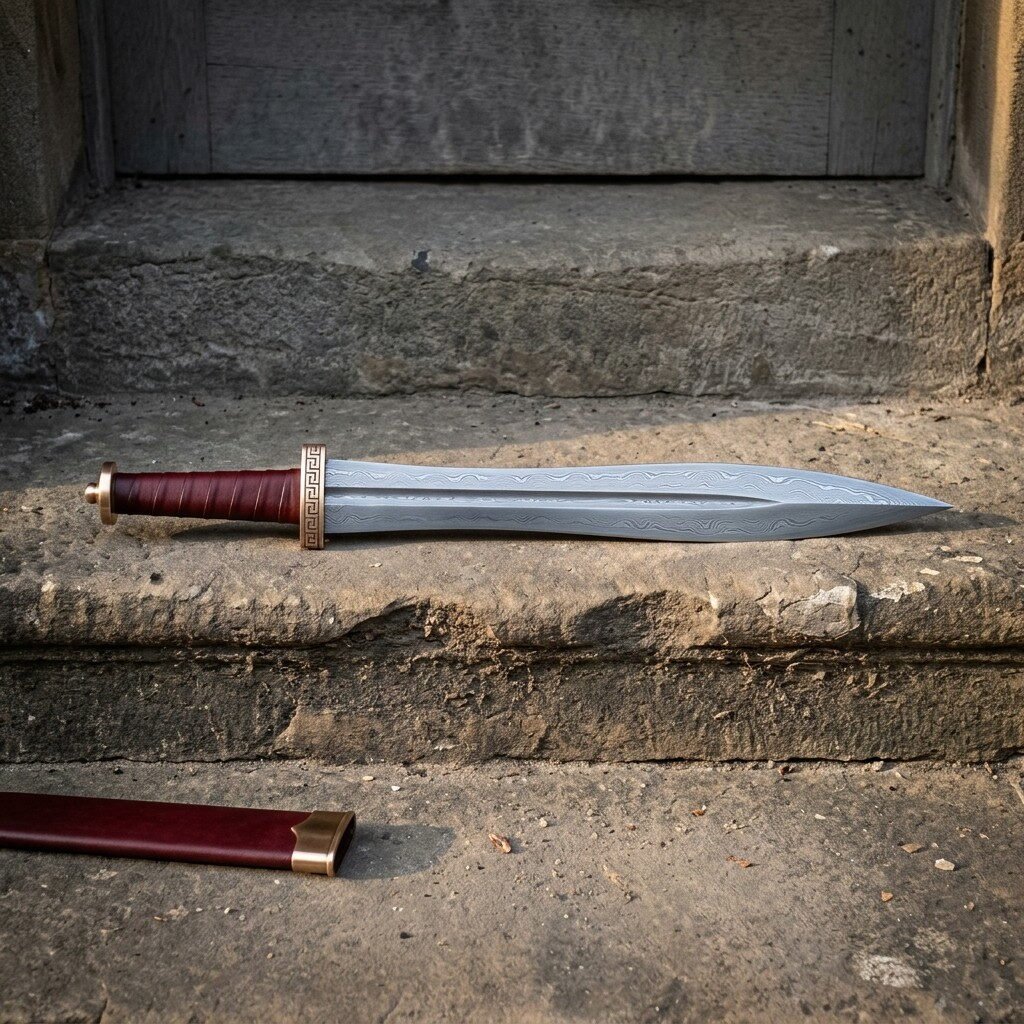
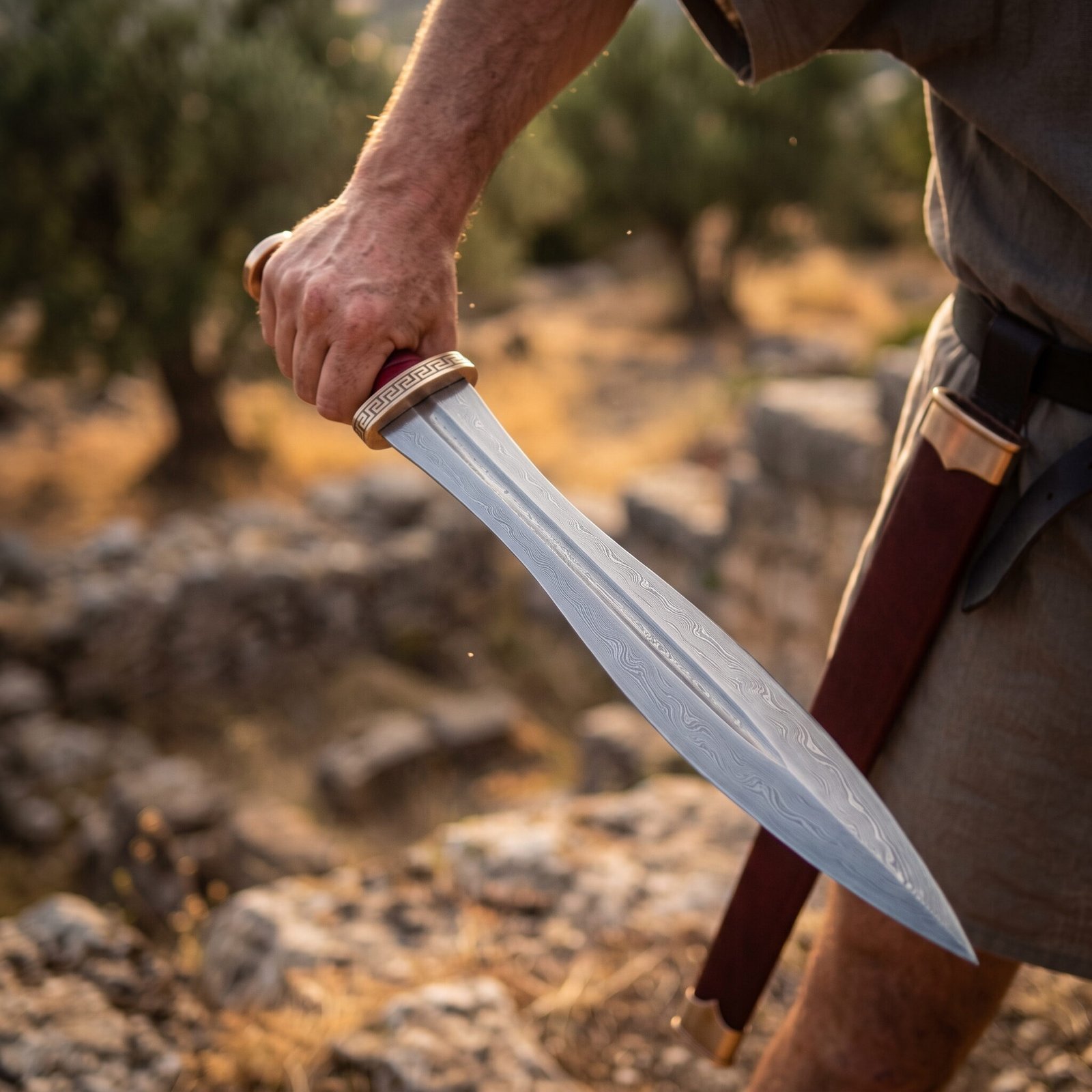
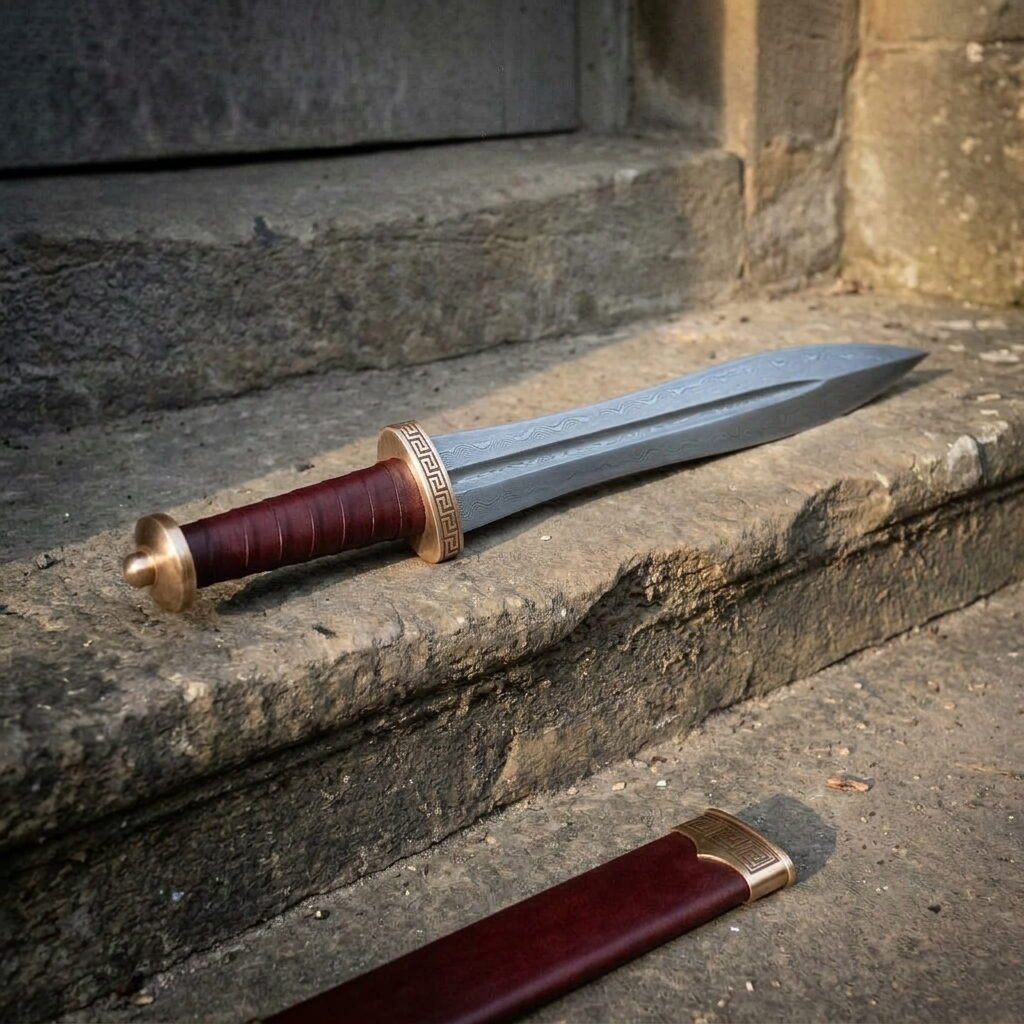
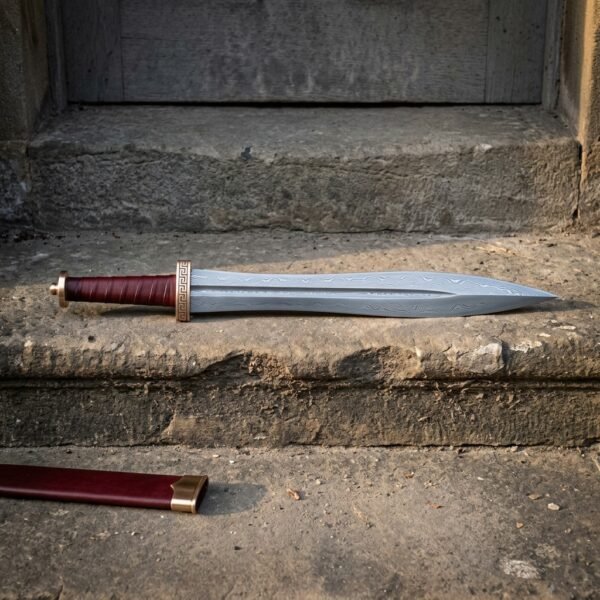
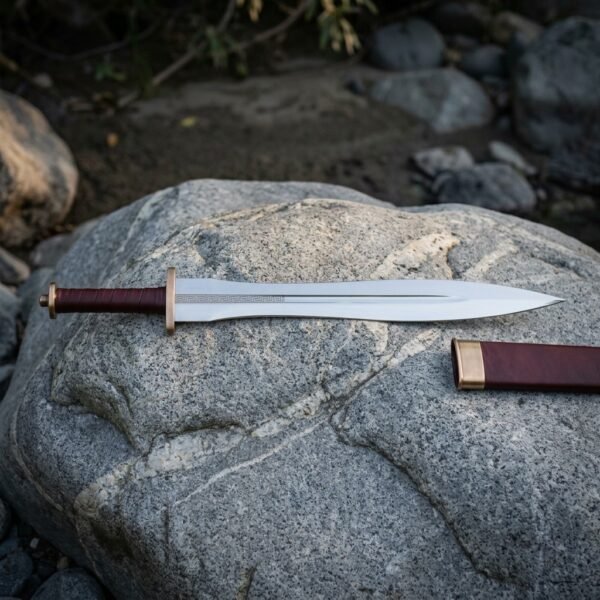
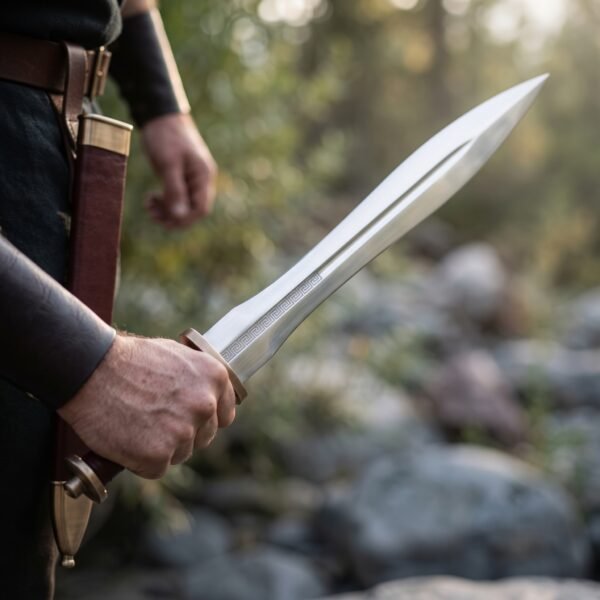
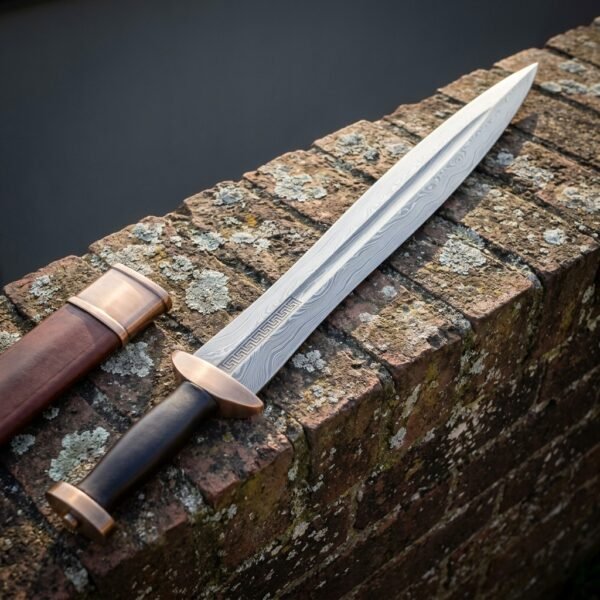
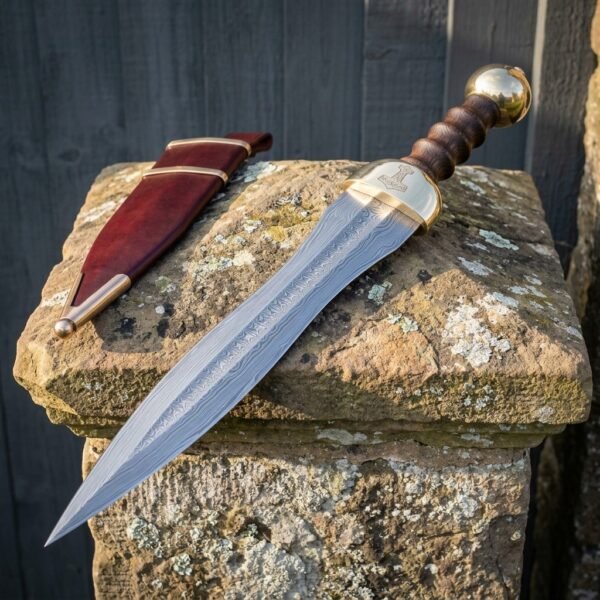
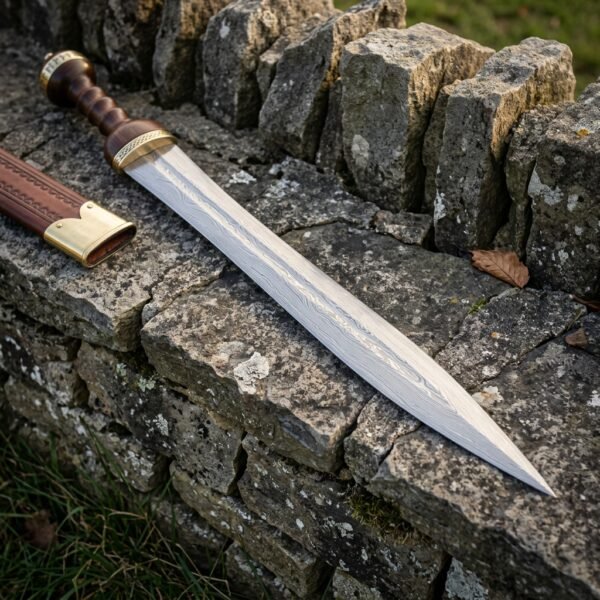
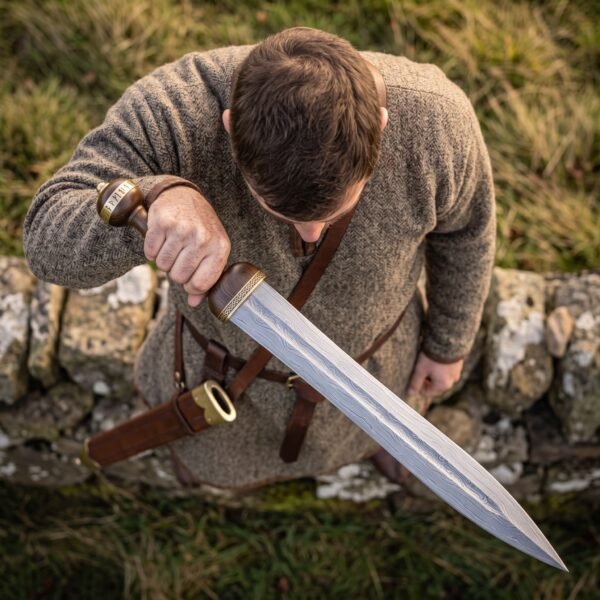
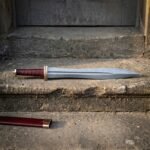
The Legionfold is a short sword in the Roman gladius pattern, forged from 1095 and 15N20 damascus and finished with a bronze guard cut with a running meander, an oxblood leather grip and a matching oxblood scabbard with a bronze mounted throat and chape. The blade is a true leaf, waisted behind the shoulders and swelling again before it runs to a long triangular point.
The gladius that Rome carried through the Republic was not a Roman invention. Polybius and later Roman writers describe it as the gladius Hispaniensis, the Spanish sword, adopted after Rome met Iberian troops carrying it in the Punic Wars. What Rome recognised was that a short waisted blade solves two problems at once. The waist keeps the sword quick in the hand and behind a shield, and the swelling forward of it puts mass exactly where a cut needs it, while the long point still runs a thrust through mail.
Forged, folded, ground, heat treated, etched and hilted in the Czech Republic. It ships with the fitted oxblood scabbard and a care card. Filed under the gladius blades, and the daggers are the other half of that shelf.
Specifications
| Blade material | 1095 and 15N20 damascus, hardened and tempered to 58 to 60 HRC |
|---|
| Blade length | Roughly 19 inches |
|---|
| Overall length | Roughly 26 inches including grip and pommel |
|---|
| Blade | Double edged leaf profile with a raised centre ridge and a long triangular point |
|---|
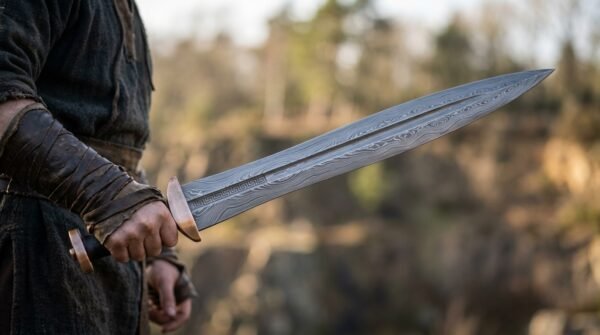
| Pattern | Wavy damascus, hand etched to bring up the layers |
|---|
| Guard | Solid bronze disc guard cut with a running meander band |
|---|
| Grip | Oxblood leather spiral wrap over a shaped core |
|---|
| Pommel | Small bronze pommel cap, peened over the tang |
|---|
| Scabbard | Oxblood leather over a wooden core with a bronze throat cut with a meander and a bronze chape |
|---|
| SKU | RK-1716 |
|---|
What the leaf shape of a gladius is doing
Put a straight parallel sided blade next to this one and the difference is obvious once you know what to look for. A parallel blade has its mass spread evenly, so its centre of percussion, the point along the blade where a cut lands without shocking your hand, sits wherever the length puts it. A leaf blade lets the smith move that point deliberately. Narrowing the blade behind the shoulders takes weight out of the section nearest your hand, where it does nothing for a cut. Widening it again in the forward third puts that weight where the edge actually meets the target.
The result is a sword that is quick to bring up in the tight space behind a shield and still hits far harder than its length suggests. The long triangular point is the other half of the design. Roman drill emphasised the thrust because a thrust needs less room, exposes less of you, and pushes through armour that a cut skates off. This is a genuinely dual purpose blade shape, and it is the reason the pattern outlived the empire that made it famous, reappearing in Migration period and later short swords across Europe.
The damascus and the bronze
The blade is pattern welded from 1095 and 15N20. Both are simple steels and both harden well, but 15N20 carries around two percent nickel, and nickel resists the ferric chloride etch that eats 1095. Weld them in alternating layers, forge them out, fold and redraw the billet, then etch the finished blade, and the 1095 goes dark while the 15N20 stays bright. What you see is a cross section through the folded stack, which is why the pattern is in the steel rather than on it. Grind the blade again tomorrow and a new pattern appears.
Heat treated to 58 to 60 HRC, which is where a damascus blade of this length wants to sit. The bronze guard is cast, filed and hand cut with the meander band, the Greek key that Rome inherited and used everywhere from mosaic borders to military fittings. Bronze was the correct alloy for Roman hilt furniture and it behaves well here: it works cold, takes a crisp cut line and ages to a warm brown rather than corroding. The scabbard is oxblood leather over a carved wooden core with a bronze mounted throat and chape.
Engraving, runes and your own design
Use the rune converter on this page to turn a name, a date or a short phrase into Elder Futhark and we will cut it into the steel or the leather. If you would rather have a Viking pattern than a rune line, choose your own design in the engraving option above the add to cart button and tell us where it goes. Where a piece already carries an engraved design, your chosen engraving replaces it rather than sitting alongside it.
On a damascus blade an engraved line reads a little differently, because it cuts through the etched pattern rather than sitting on a plain flat. That contrast usually looks very good, but it does mean a long line will interrupt the figure of the steel. Most owners of this piece put a short name or date on the ricasso, or have it stamped into the oxblood scabbard instead. See the engraving page.
Handling and balance
Point of balance sits around three inches ahead of the guard, which is close in for a sword and is exactly what the leaf profile is meant to achieve. In the hand it feels less like a small sword and more like a very fast large one. Bring it up and the point is already where you want it, which is the whole argument for a short blade in a crowd.
The grip is a single hand wrap with the bronze collar and pommel trapping the hand, so it should feel close and secure rather than roomy. Be clear about what it is. This is a sharpened collector and display sword, hand forged and hand balanced. It is not sold for sparring, it is not built for blade on blade contact and it should not be used on hard targets. Damascus at 58 to 60 HRC is hard and hard steel chips when it is abused.
Care
An etched damascus blade needs more attention than a plain one, because the etch leaves the surface very slightly textured and that texture holds moisture. Wipe it with an oiled cloth after every handling and before it goes away. Camellia oil, light machine oil or a purpose made blade oil are all fine. Never use an abrasive polish or a scouring pad on the pattern, because you will grind the contrast out of it. Full guidance is on steel care.
Do not store the sword in the scabbard for long periods, since leather holds damp against steel. Keep the blade oiled and stored out of the scabbard, and feed the leather twice a year with a neutral balm. The bronze will darken to a warm patina, which suits the piece. If you want it bright again, a metal polish on a cloth does it, kept well away from the etched blade.
Made in the Czech Republic
The work behind this piece happens in a Czech Republic workshop that has kept to the old methods. Steel is forged and heat treated by hand, the grind is taken down by eye rather than by machine, and the handle, fittings and sheath are cut and finished one at a time. Because of that, every piece carries small marks of the hand that made it.
Ransack Viking is a United States company. We import direct, check each piece when it reaches us, and ship from our Chicago, Illinois warehouse. Engraving is added here in the United States after arrival, so the piece you receive is finished to your order.
A note on handmade variation
This is hand made, not machine made and not bulk produced, so what arrives will not be a pixel for pixel copy of the photograph. Damascus varies more than any other steel we work, because the pattern is a cross section through a stack that was folded and drawn by hand. Two blades from the same billet will not match. Wave spacing, ladder alignment and how boldly the figure runs into the edge bevel all change.
The bronze will vary in tone and the oxblood leather takes dye at its own rate, so it can land anywhere from a bright red brown to a deep burgundy. Blade length, overall length, steel, hardness and construction are the same on every one. The figure in the steel is what makes yours yours. There is a longer piece on how Damascus compares with plain high carbon, and another on buying a first sword.
Frequently asked questions
Is the damascus pattern real or is it printed on
It is real. The blade is forge welded from alternating layers of 1095 and 15N20 and the pattern is a cross section through that stack, brought up with a ferric chloride etch. It goes all the way through the steel.
Is it sharp when it arrives
Yes, fully sharpened along the edges and to the point. Handle it as sharp from the moment you open the box and keep it in the scabbard when it is not in your hand.
Can I use it for cutting practice or sparring
No. It is a sharpened collector and display sword. Damascus at 58 to 60 HRC is hard, and hard steel chips against another blade or a hard target. It is not sold for contact work of any kind.
Is the scabbard included
Yes. The oxblood leather scabbard over a wooden core with its bronze mounted chape ships with the sword and is fitted to that blade.
Will the pattern wear off over time
No, but it can be dulled. The contrast lives in the steel, so normal handling and oiling will not remove it. Abrasive polish, a wire wheel or a scouring pad will flatten it, so never use those.
How long does shipping take
One to two weeks, because the billet is forged and folded after you order. US shipping is free.
What is in the box
- One hand forged 1095 and 15N20 damascus gladius with a bronze meander guard
- One fitted oxblood leather scabbard with a bronze mounted chape
- Care card covering oiling, storage and etched steel
- Lifetime warranty against defects in forging, grind, heat treat and fittings
- Forged and finished in the Czech Republic
Explore the range
See the rest of the gladius range, the damascus swords, the short swords, and the guides for more on pattern welding.
If this one is not it
In the same category sits the Leafwarden gladius, 28 inches overall. A near match for this one is the Bronzeleaf gladius, 27 inches overall. Closest to this in the range is the Wolfgleam gladius, 16 inches overall.
Fitting out further, the Runecrest sabre belongs with it. Pick the steel, the length and the fittings yourself on the custom Viking sword page.

I collect stuff like this and this sword is on another level. Even the small engravings are crisp and clean. Damascus blade holds a razor edge right out of the box. Fit and finish is museum quality. You can tell real craftsmen made this by hand. Will definitely order again for another gift.
Got this as a birthday gift and the reaction was priceless. Edge retention has been great even after regular use. This is going straight into my display case.
It’s okay. Not great not bad. Handle material felt a bit different than pictured. Might work for casual use or display.
Knew this sword was special the second I opened the box. The wood handle feels amazing and the balance is perfect. Love it.
No regrets on this purchase at all. Fit and finish is museum quality. You can tell real craftsmen made this by hand. If you’re on the fence just get it. You won’t regret it.
Feels way more premium than the price suggests. Even the small engravings are crisp and clean. Leather sheath is thick and well stitched. Not the cheap stuff you usually get. The wood handle feels amazing and the balance is perfect. Worth every penny.
This is exactly what I wanted and then some. Fit and finish is museum quality. You can tell real craftsmen made this by hand. This will be a family heirloom for sure.
So happy I finally pulled the trigger on this one. Weight and balance make it feel like a real functional piece not some cheap replica. Beyond happy with how this turned out.
This is exactly what I wanted and then some. Edge retention has been great even after regular use. Will definitely order again for another gift.
This is exactly what I wanted and then some. It’s handmade in the Czech Republic but ships from a US warehouse so it arrived quicker than I expected.