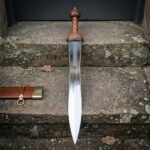
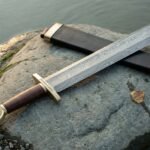
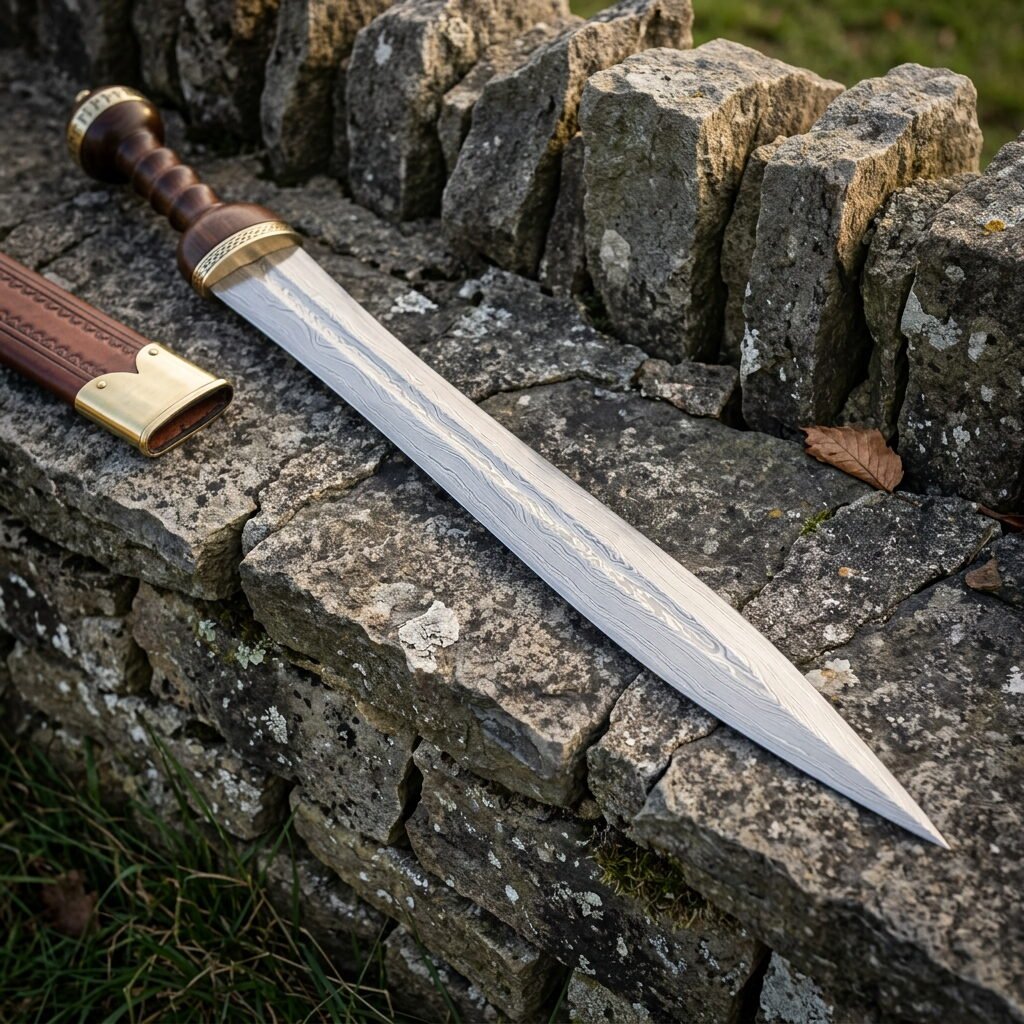
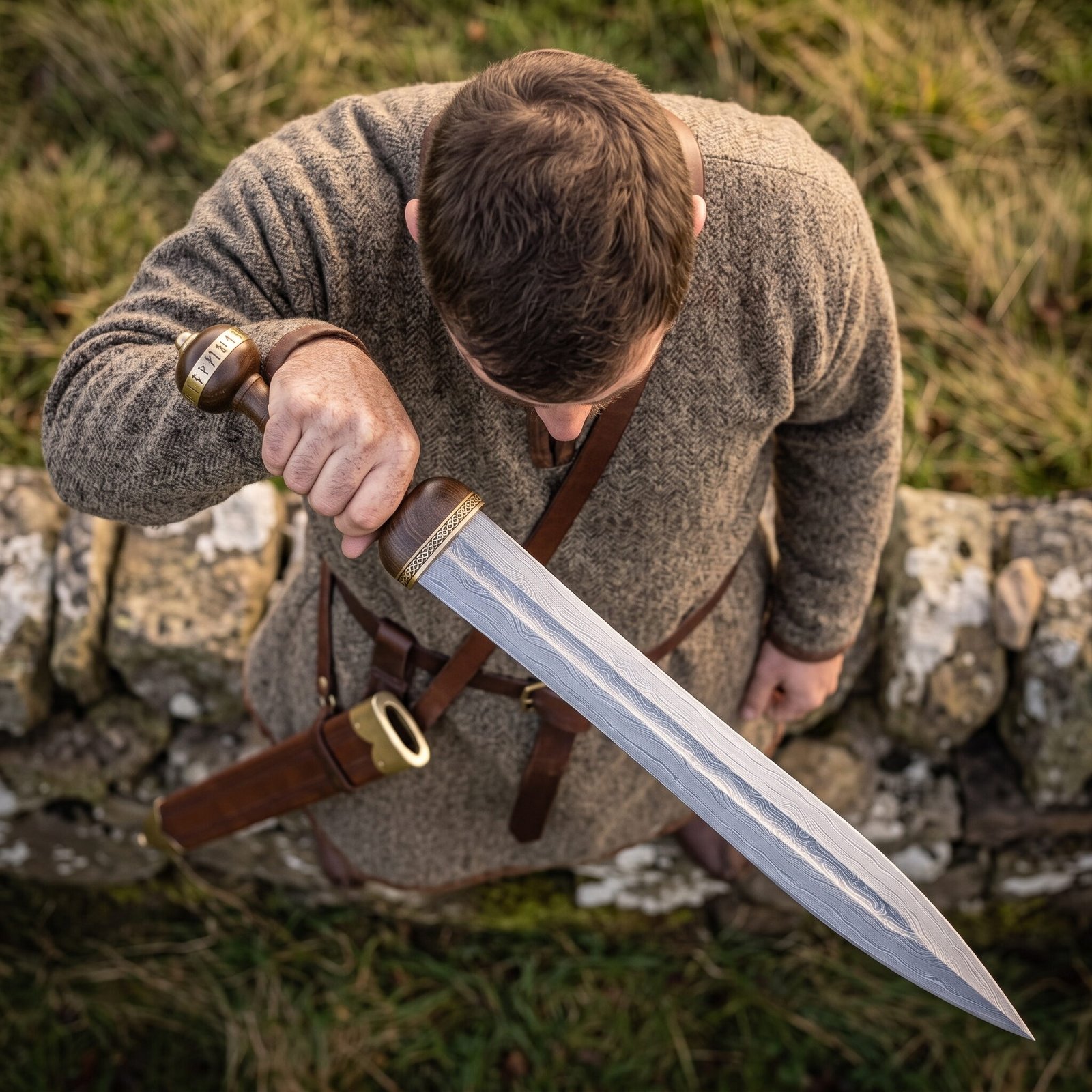
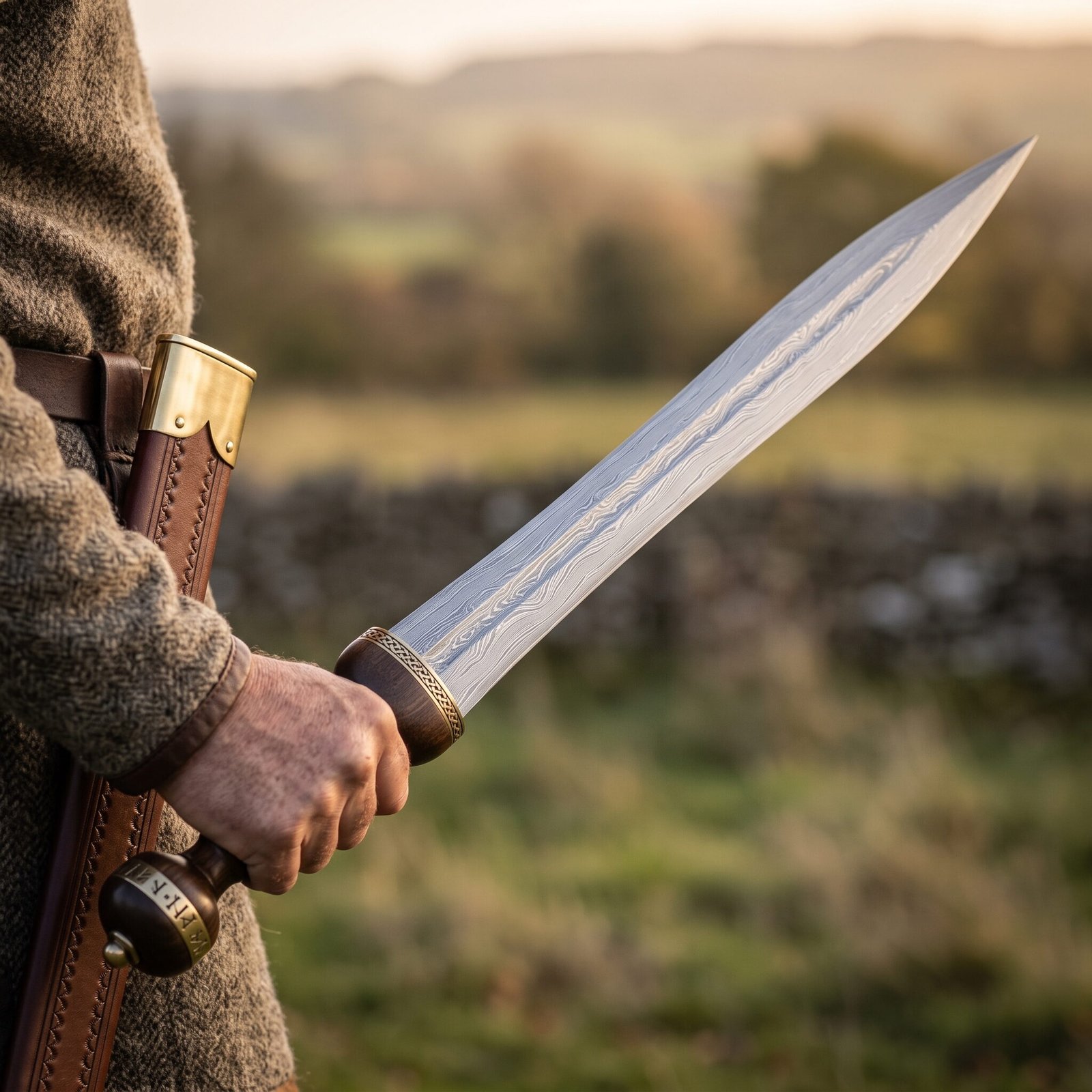
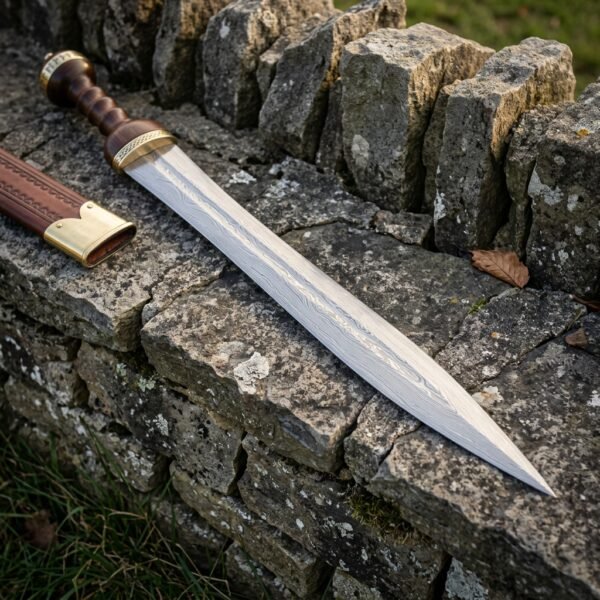
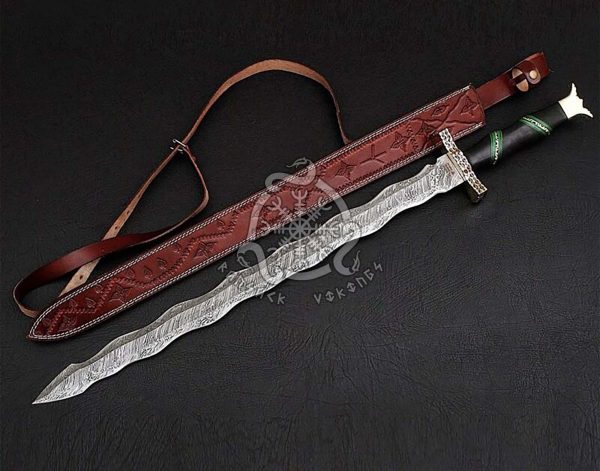
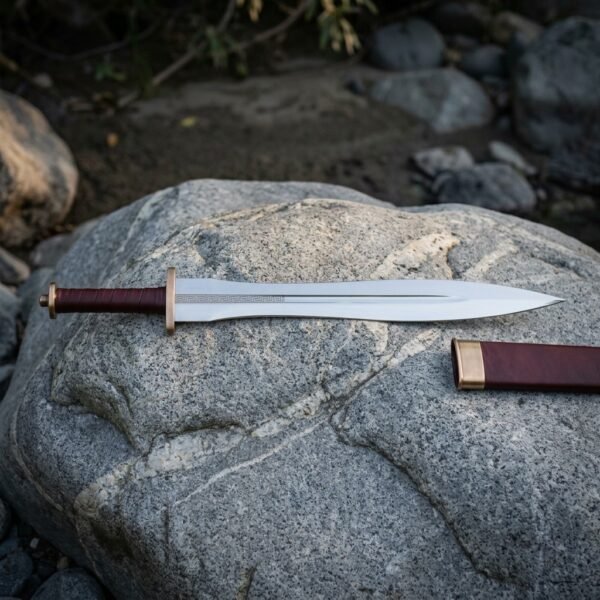
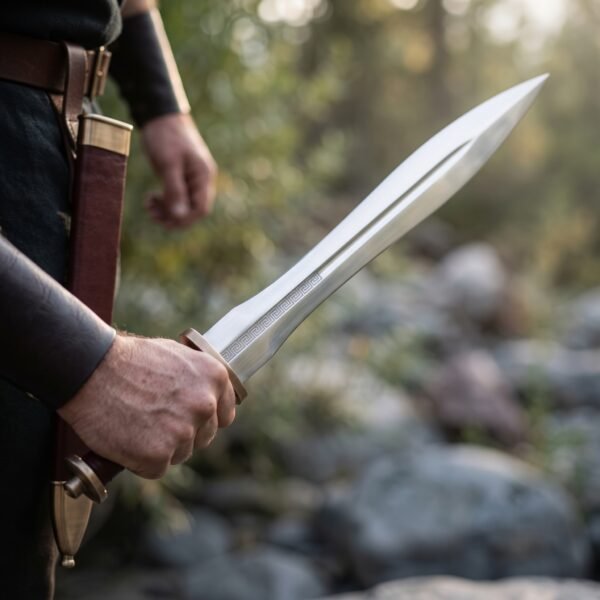
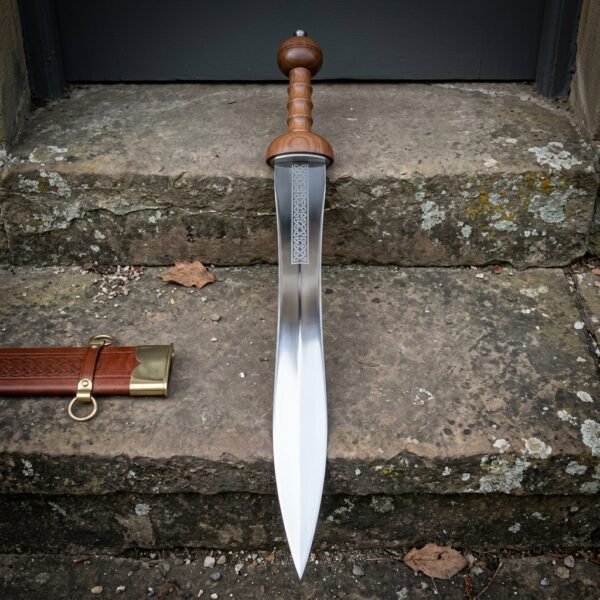
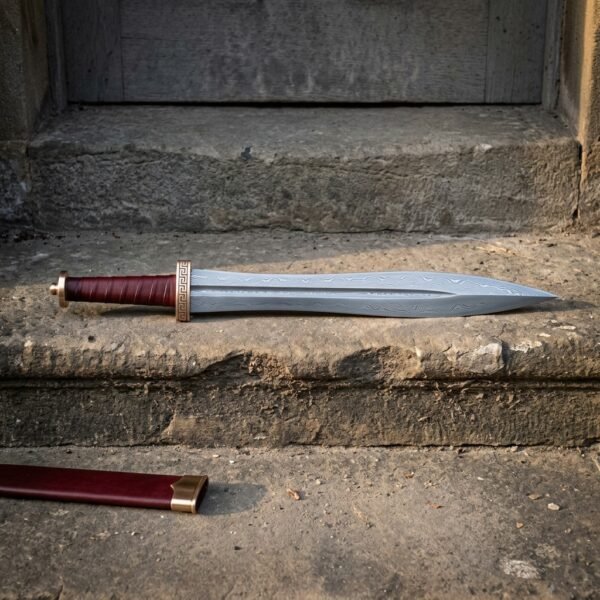
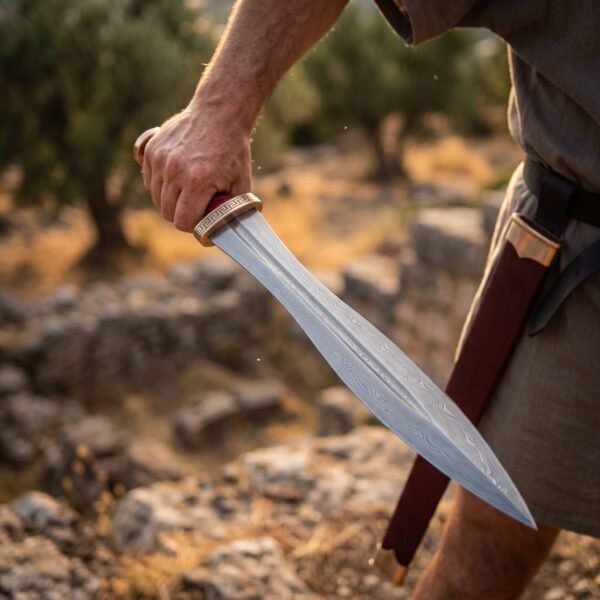
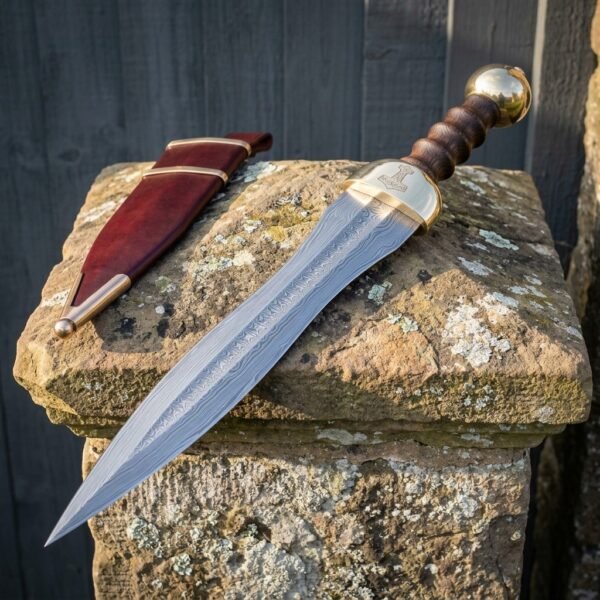
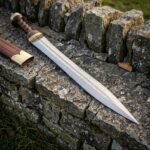
This is a Mainz pattern Roman gladius with a blade forge welded from 1095 and 15N20, so the waisted leaf outline of the early legionary sword carries a flowing wood grain Damascus figure that follows the curve of the edges. The Mainz shape is the older of the two great gladius patterns, named for the swords pulled out of the Rhine at the legionary fortress that grew into the modern city, and in use from roughly the last decades of the republic into the middle of the first century AD. It leaves the guard broad, pinches to a waist, swells again and finishes in a long slender point. Almost every one of those transitions is a place where the layers of a pattern welded billet get bent as the smith moves metal, which is why the figure on a Mainz blade never runs in straight bands. It pools at the shoulder, stretches through the waist and gathers again into the point.
The billet is stacked, welded, drawn and etched by hand in the Czech Republic, then ground, heat treated and fitted with a ribbed walnut grip, an engraved brass collar and a turned walnut globular pommel. It ships in a tooled brown leather scabbard with a heavy flared brass throat. Shipping inside the United States is free.
Specifications
| Steel | 1095 and 15N20 forge welded Damascus, hand etched flowing pattern |
|---|
| Hardness | 58 to 60 HRC |
|---|
| Overall length | 28 inches |
|---|
| Blade length | 21 inches |
|---|
| Blade profile | Waisted Mainz leaf with a central ridge and a long triangular point |
|---|
| Guard | Rounded walnut handguard with an engraved knotwork brass collar at the blade |
|---|
| Handle | Ribbed walnut grip |
|---|
| Pommel | Turned walnut globular pommel with a rune banded brass cap |
|---|
| Scabbard | Tooled brown leather with flared brass throat |
|---|
| Tang | Full length, peened at the pommel |
|---|
| SKU | RK-1333 |
|---|
Why a waisted blade is harder to forge in Damascus
A parallel edged blade can be drawn straight out of a billet and ground true with very little distortion of the layers. A Mainz blade cannot. To get the waist you either grind it out of a wider bar, which cuts through the layers and leaves a flat lifeless figure, or you move the steel with the hammer and let the layers follow the shape. We do the second. Every time the hammer narrows the waist it also compresses the layers there, and every time it spreads the swell below the waist it stretches them, so the pattern tightens and opens along the length of the blade in a way that maps the forging directly.
That is also why the point is the most interesting part. Drawing out a long triangular tip pulls the layers into fine parallel lines that converge on the apex. Hold the sword up and follow the pattern from the shoulder to the tip and you can read, more or less, the order in which the blade was made. None of this makes it a better gladius than the plain steel Mainz. It makes it a piece where the historical outline and the metallurgy are doing the same work.
Why Damascus and not stainless
Our Damascus is a forge welded laminate of 1095 and 15N20. The 15N20 carries about two percent nickel, which resists the ferric chloride etch and stays bright, while the 1095 beside it darkens, and that difference is the whole pattern. It is a carbon steel laminate, so it will take a patina and it will rust if it is neglected. In exchange the repeated folding refines the grain and the blade runs at 58 to 60 HRC with excellent edge retention. Stainless buys corrosion resistance with heavy chromium, which in a sword length blade costs the toughness you need at the shoulder and tang, and stainless will not etch into a visible pattern at all, so any stainless Damascus is a printed or stencilled surface rather than a welded billet. The comparison is set out fully in Damascus versus stainless.
The walnut grip and brass collar
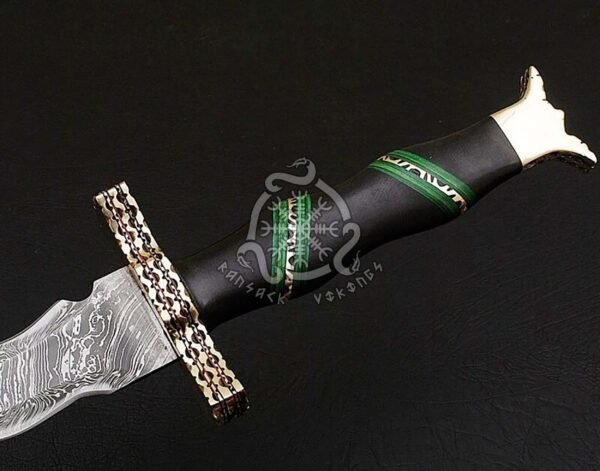
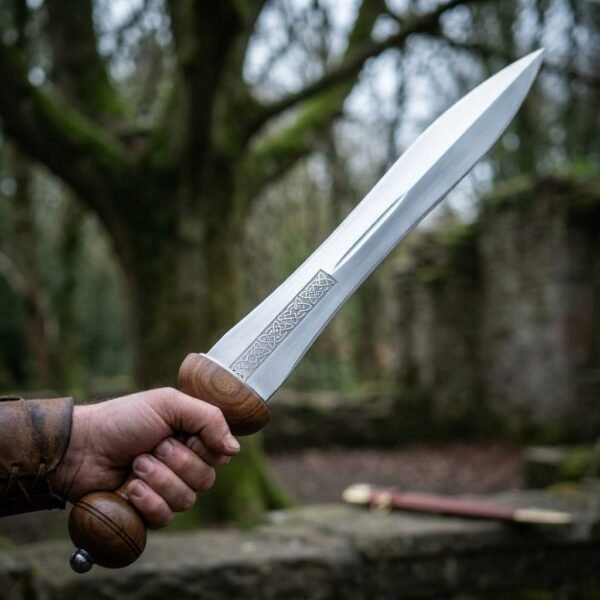
The hilt is built the Roman way, four parts stacked on the tang and locked by a peened nut. An engraved brass collar seats against the blade shoulder, a rounded walnut handguard and a ribbed walnut grip sit above it, and a turned walnut globular pommel with a banded cap closes the assembly. Walnut is used because it turns cleanly, keeps a crisp rib and is stable enough not to shrink away from a brass collar when the weather changes. The ribs are finger swells that stop the hand sliding forward on a thrust and give you edge alignment by feel.
Keep the wood dry, wipe it after handling and oil it lightly once or twice a year. Do not wash it and do not store it against a heat source, because the movement that follows is what loosens a peened hilt. Our short guide to wooden handle care has the routine. The brass will settle to a soft antique gold on its own, and a light metal polish brings it back to bright whenever you want it.
Engraving, runes and your own design
Use the rune converter on this page to turn a name, a date or a short phrase into Elder Futhark and we will cut it into the steel or the handle. If you would rather have a Viking pattern than a rune line, choose your own design in the engraving option above the add to cart button and tell us whether it goes on the blade or the handle. Where a piece already carries an engraved design, your chosen engraving replaces it rather than sitting alongside it. On this sword the rune band on the pommel cap and the engraved brass collar are the natural sites, and we would normally steer you away from cutting across the Damascus figure on the blade. Details are on the engraving page.
Care and sharpening
Etching opens the surface of a Damascus blade very slightly, so it wants more attention than plain steel. Dry it after handling, wipe it with light machine oil or a hard paste wax, and never leave a fingerprint on it overnight in a humid room. Store the sword out of its scabbard, because tanned leather traps moisture and salts against steel. A haze can be lifted with a clean cloth and oil without touching the pattern, which runs through the blade rather than sitting on the surface. Read steel care before you put it away for the first time. Sharpen with a coarse then fine stone at a low angle as described in sharpening with a whetstone, then re oil, because stones strip the protective film.
Made in the Czech Republic
Every piece we sell is made by hand in the Czech Republic. The smiths there work the way the trade has been worked for a long time, heating and hammering the steel, taking the bevels down by eye, and fitting the handle and the leather one at a time. There is no automated line anywhere in it, so small differences from one piece to the next are normal and expected.
Ransack Viking is a United States company based in Chicago, Illinois. We bring the pieces in ourselves, inspect them on arrival and ship them from our own warehouse. If you add engraving, that is carried out here in the United States before your order goes out.
A note on handmade variation
This gladius is hand forged. It is not machine made and it is not bulk produced, so what arrives will not be a pixel for pixel copy of the photograph. The Damascus figure is unique to the billet and differs even between the two faces of one blade. The grain of the walnut, the tone the brass has taken, the depth of the etch and the exact sweep of the waist all vary because each piece is worked by hand from natural materials. The dimensions, the steel and the build are the same every time. The character is not.
Frequently asked questions
Is the Damascus pattern genuine?
Yes. The blade is a forge welded stack of 1095 and 15N20 and the layers go right through the steel. If you ground into the blade you would find the same pattern underneath. Acid only develops the contrast that is already in the metal.
Is it sharp?
It arrives with a keen working edge. Ask for a blunt reenactment edge in the order notes and we will leave a rounded quarter inch instead, at no extra charge.
Can I cut with it?
Soft targets only. Bottles, tatami and pool noodles are fine. Do not strike steel, hardwood or bone, do not spar and never throw it. At 58 to 60 HRC the edge is hard and will chip against something harder than itself.
How does this compare with the plain steel Mainz gladius?
Same geometry, same handling, same length. The Damascus blade is harder, holds an edge longer and carries a visible forge welded pattern, and it costs more because the waist has to be hammered rather than ground. The plain 1095 version is the better buy if you plan to cut with it regularly.
Will mine look exactly like the photograph?
The shape, size and fittings will match. The pattern will not, because no two billets fold alike. That is the nature of pattern welded steel and it is the reason people buy it.
How long does shipping take?
Free inside the United States. Ten to fourteen working days in the shop, then two to five days in transit, plus about a week if you order engraving.
What is in the box
- One hand forged 1095 and 15N20 Damascus Mainz pattern gladius, 28 inches overall
- Tooled brown leather scabbard with flared brass throat
- Light protective oil coat on the blade for transit
- Care and sharpening card for pattern welded steel
- Forged and finished in the Czech Republic
Explore the range
Browse the full gladius range, every pattern welded blade in Damascus swords, the short swords and everything under swords. Background reading is in the guides.
Near neighbours in the shop
Sitting beside it in the catalogue is the Bronzeleaf gladius, 27 inches overall. Another in the same line is the Wolfgleam gladius, 16 inches overall. Next along the rack is the Emberlegion gladius, 27 inches overall.
Fitting out further, the Rosehilt arming sword belongs with it. You can have this made your way instead on the custom Viking sword page.

Kind of regret ordering this if I’m honest.