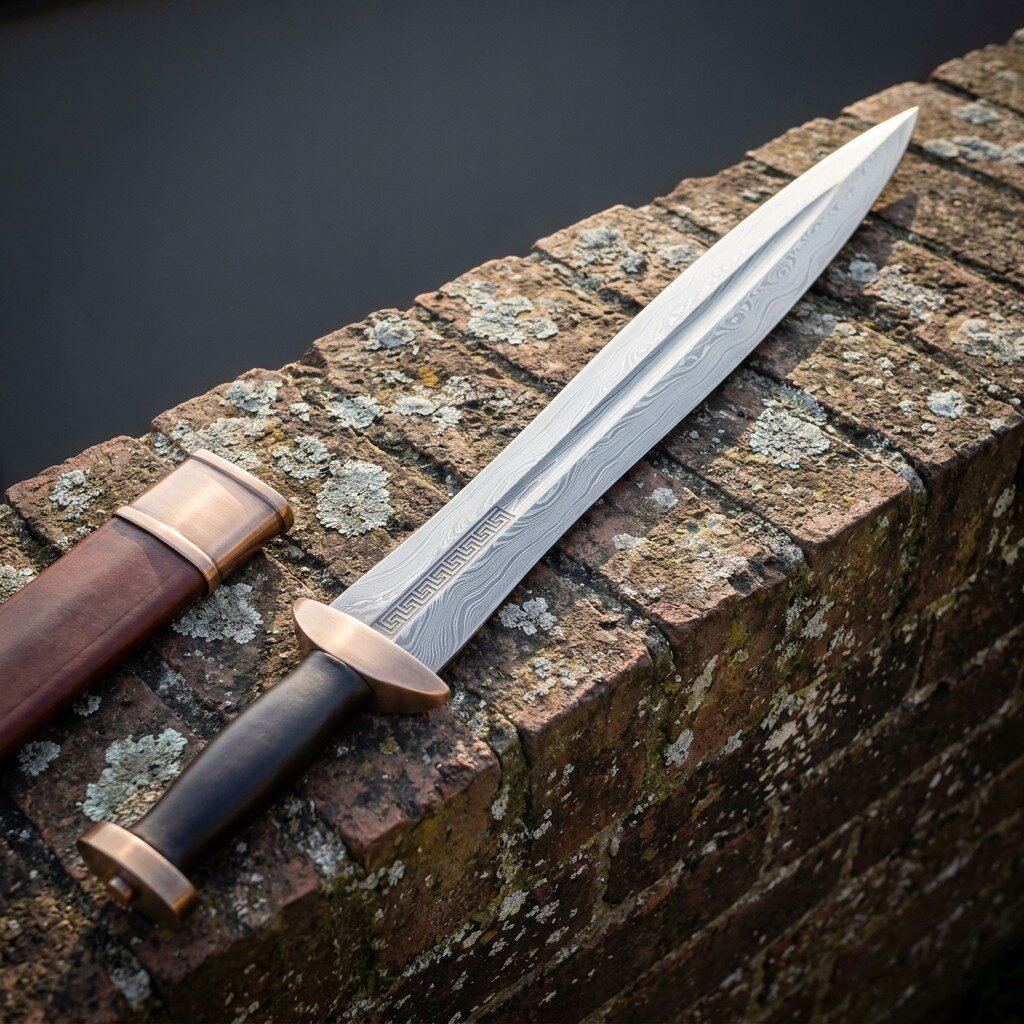
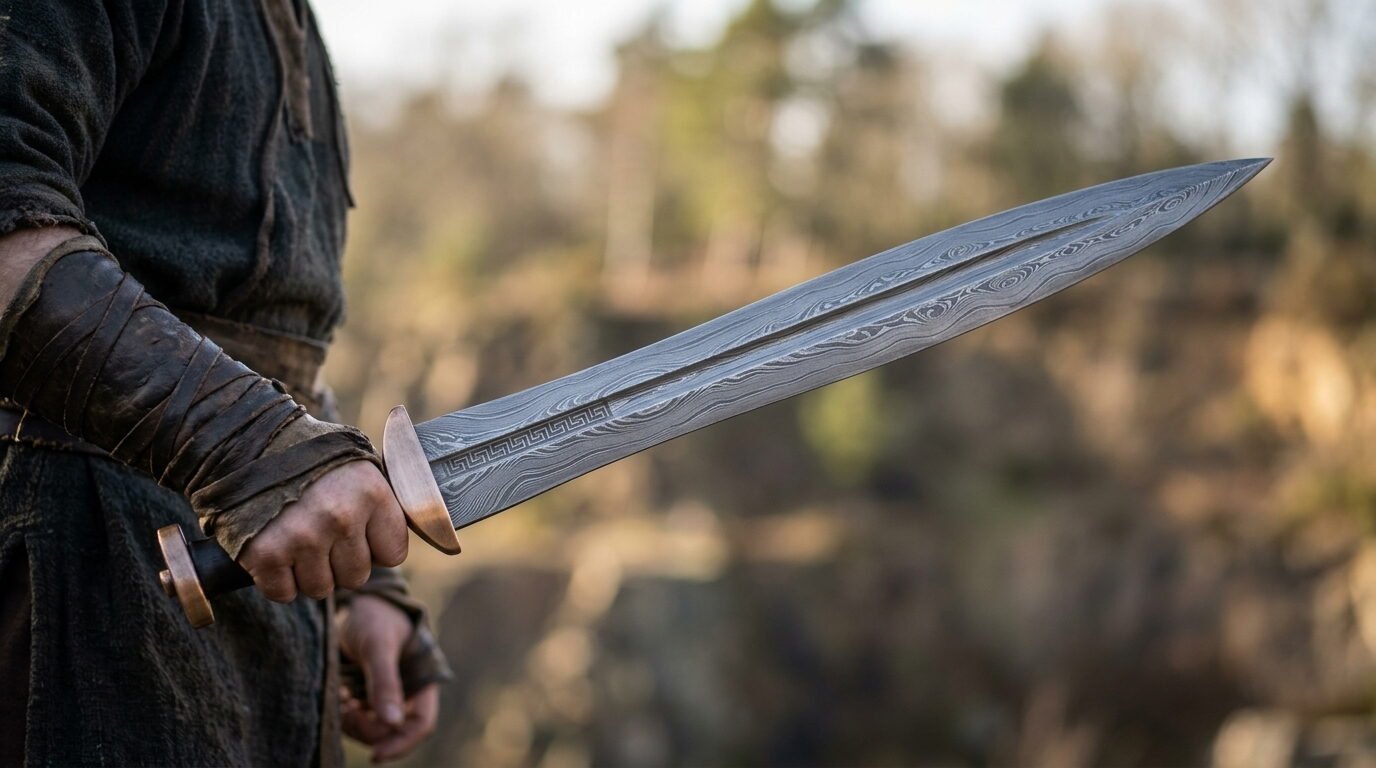
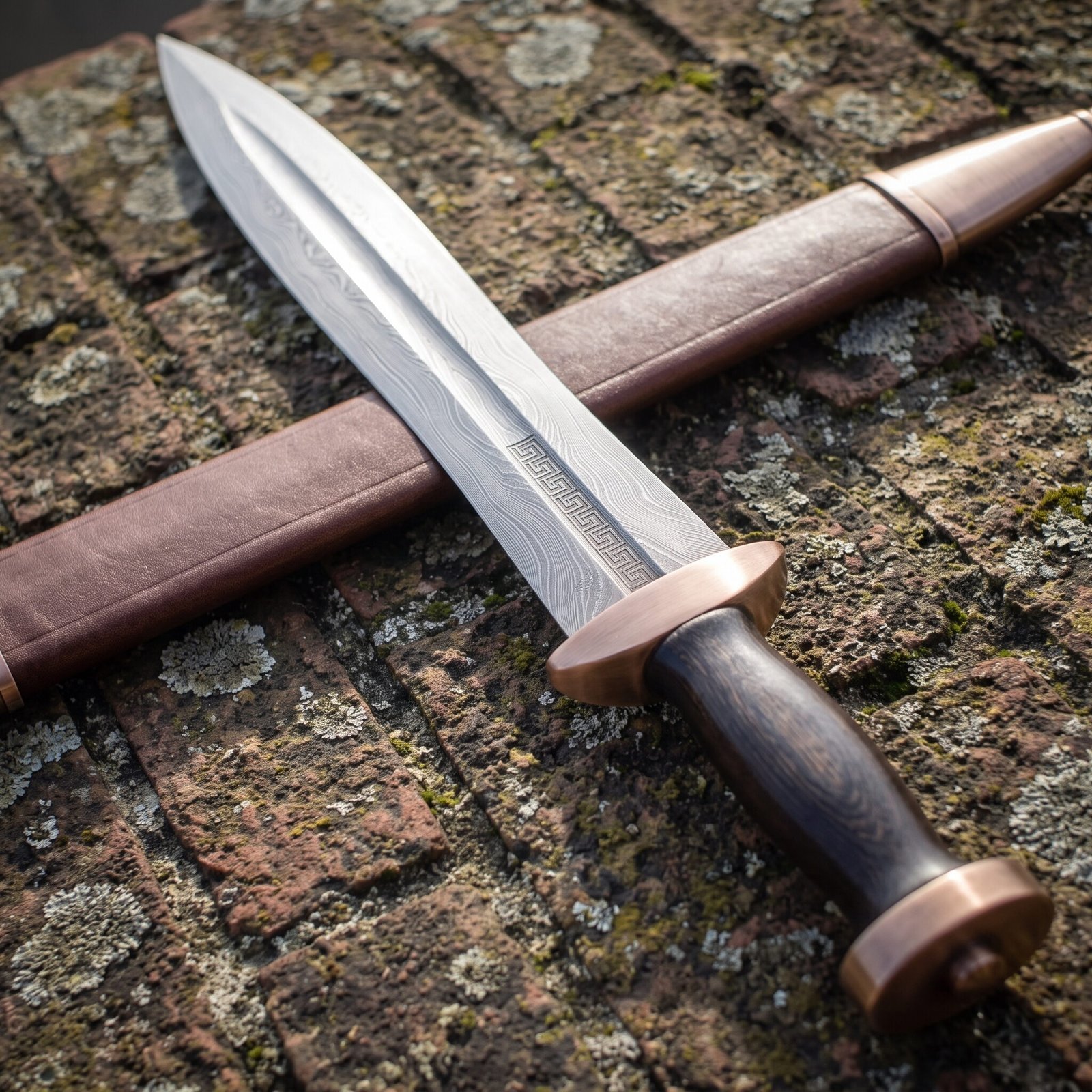
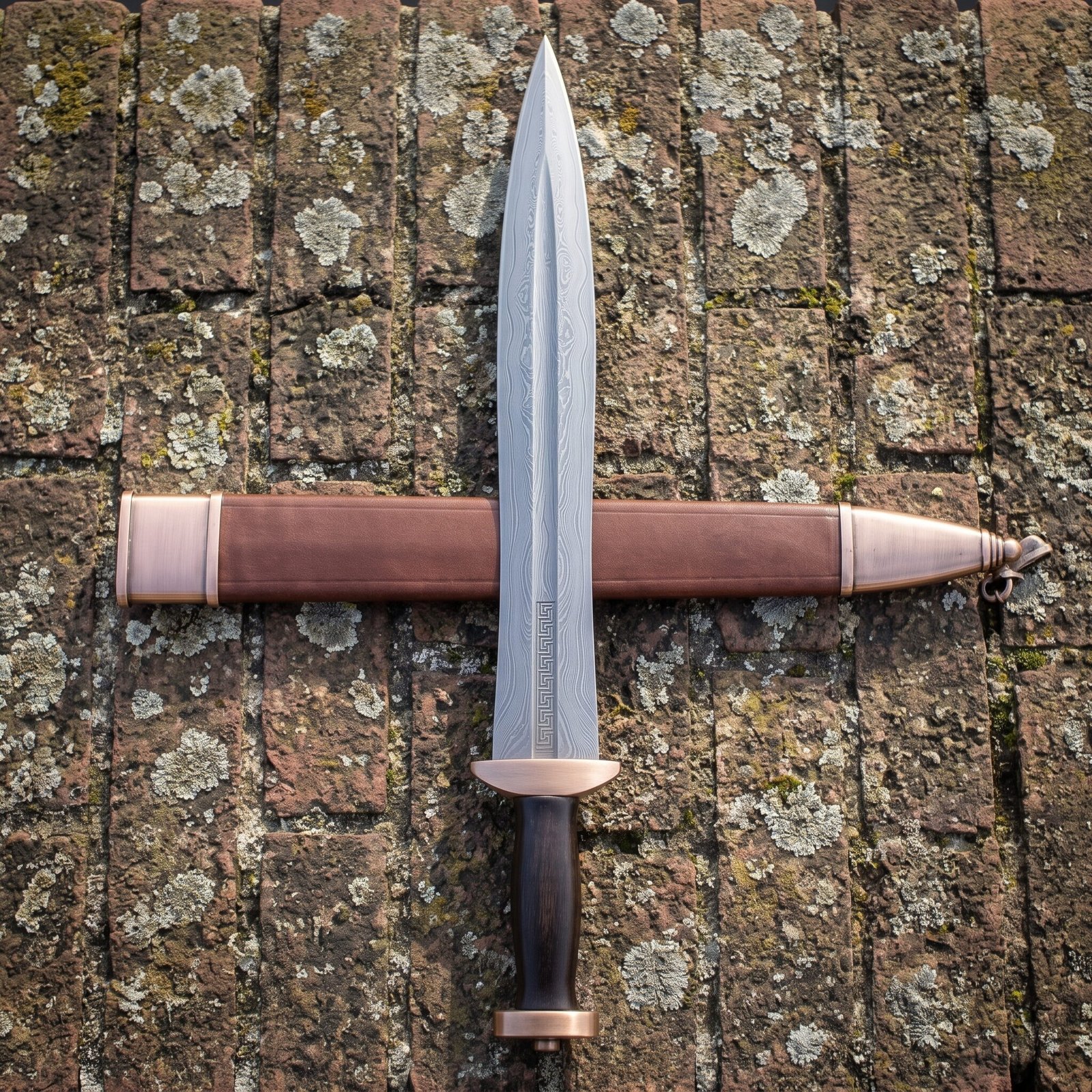
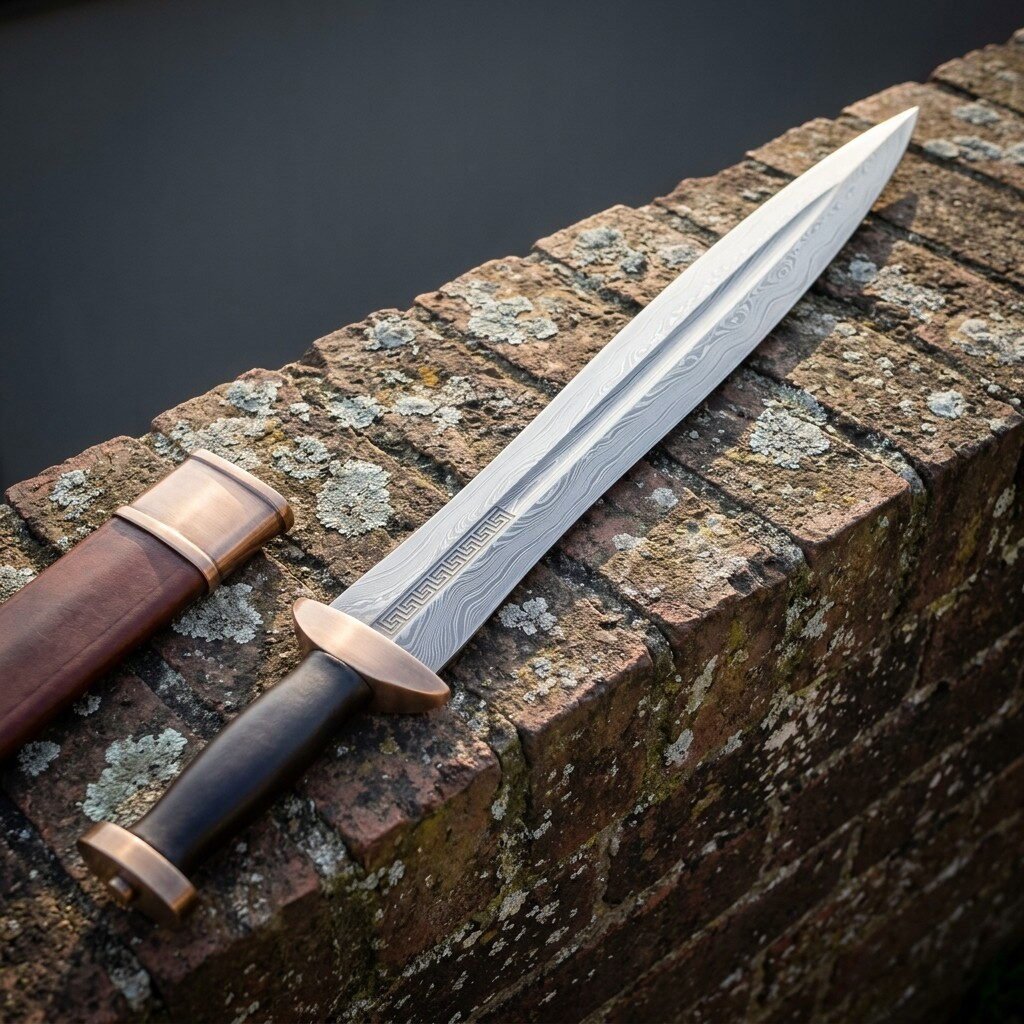
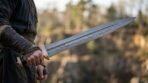
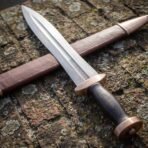
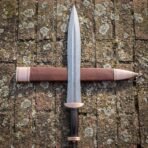
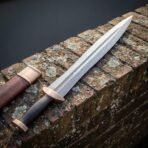
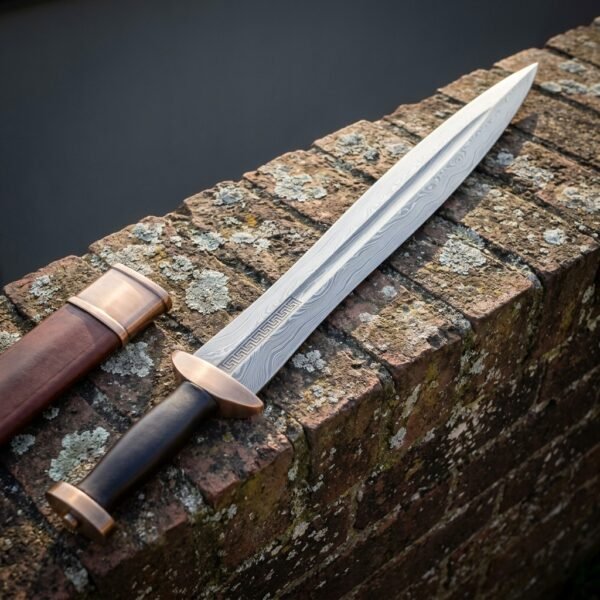
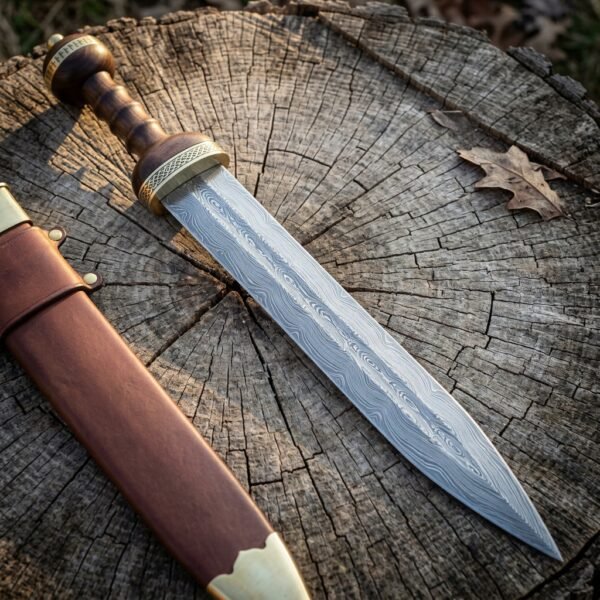
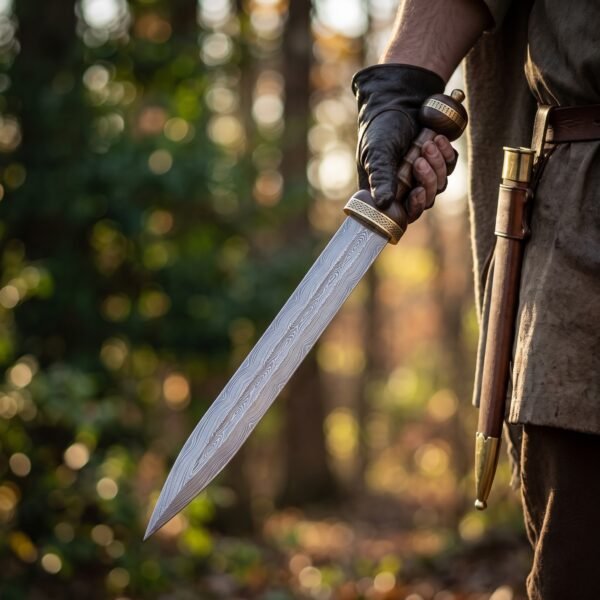
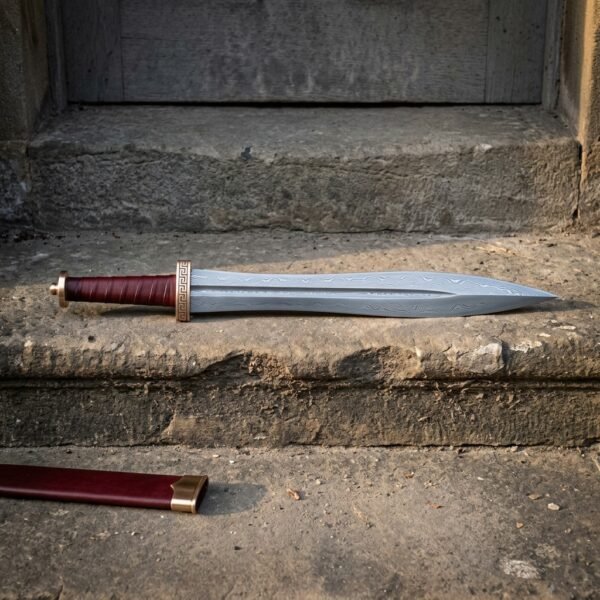
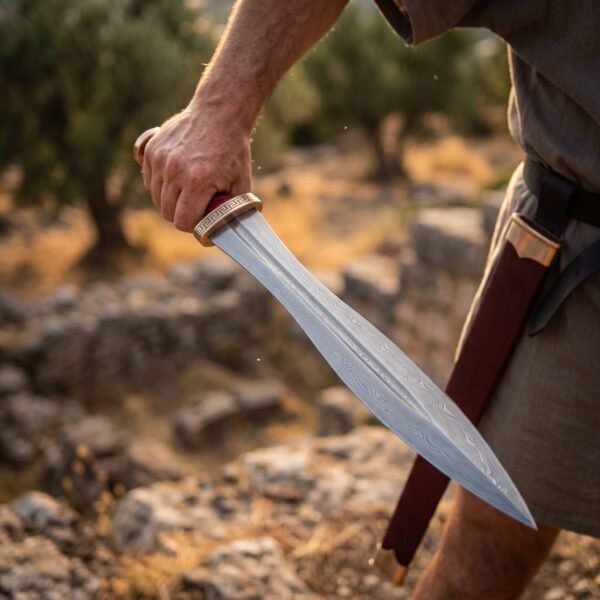
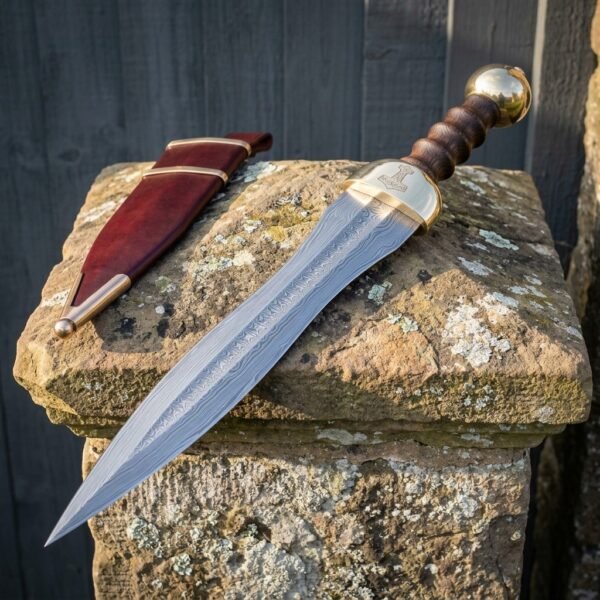
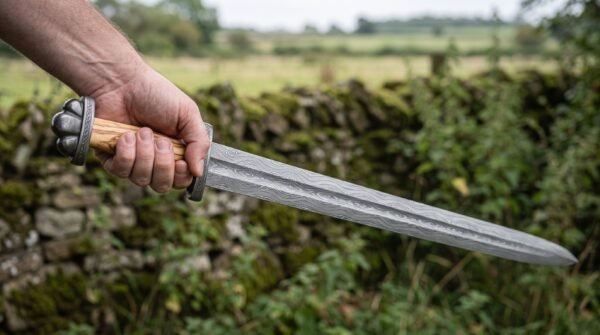
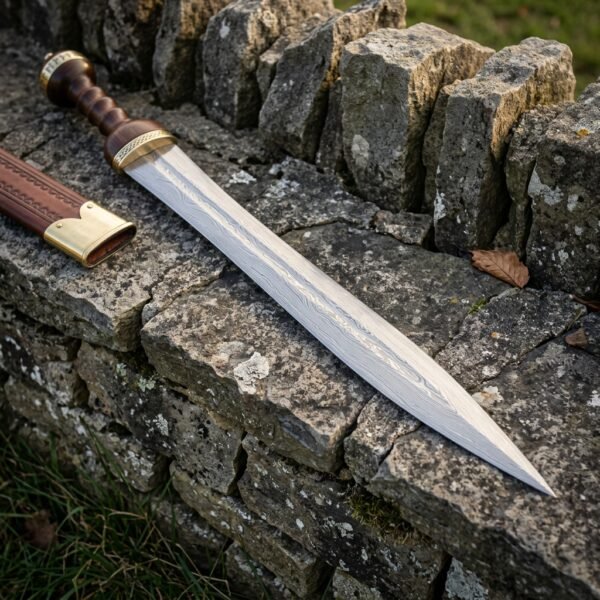
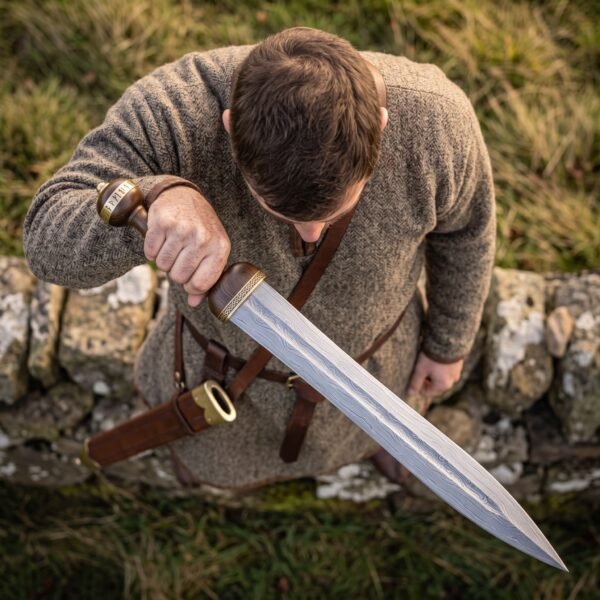
This is a hand forged gladius, the Roman legionary short sword, with a broad double edged blade in layered 1095 and 15N20 Damascus, a central fuller, a Greek key panel cut into the flat at the forte, and a bronze guard and flat disc bronze pommel either side of a dark wooden grip. It comes with a leather covered scabbard with bronze mounts. The pattern in the steel is real forge welded layering, visible on the bevels as well as the flats because it runs through the metal rather than sitting on it.
The gladius is the sword that built an empire, and it worked because of how it was used rather than because it was clever. A legionary fought behind a large curved shield in close formation, and in that position there is no room to swing. What there is room for is a short hard thrust through the gap beside your own shield into the man opposite. Vegetius, writing a military manual centuries later, is blunt about it. A cut, he says, however forcefully delivered, rarely kills, because the vital organs are protected by bone and armour, but a thrust of two inches is fatal. The whole Roman system, the shield, the formation, the drill and this blade, follows from that one observation.
Each gladius is forged, ground, etched, heat treated, engraved and fitted in a Czech Republic workshop, and the bronze is cut and finished at the bench. It ships in its scabbard with blade oil and a care card. This one is kept with the gladius blades, and the arming swords sit right beside it.
Specifications
| Blade material | 1095 and 15N20 Damascus, hand forged and acid etched, 58 to 60 HRC |
|---|
| Overall length | Approximately 27 inches |
|---|
| Blade length | Approximately 20 inches |
|---|
| Blade profile | Double edged, tapering steadily from the guard to a long narrow point, with a central fuller |
|---|
| Engraving | Greek key meander panel cut into the flat at the forte |
|---|
| Grip | Smooth dark wooden grip, single hand |
|---|
| Guard | Solid bronze oval guard |
|---|
| Pommel | Flat disc bronze pommel, peened tang |
|---|
| Scabbard | Brown leather covered wooden scabbard with a bronze locket and a bronze chape ending in a button |
|---|
| Weight | Approximately 2 lb 2 oz |
|---|
| Included | Gladius, scabbard, blade oil, care card |
|---|
| SKU | RK-1703 |
|---|
Why the point is that long and the blade that short
Look at the profile. The blade tapers steadily from the guard and draws into a long narrow point over the last several inches. That point is not a decorative taper, it is the working end. A long triangular point concentrates the whole force of a thrust into a very small area and keeps cutting as it goes deeper, because the blade behind the point is still widening. A short stubby point would stop as soon as the shoulders met resistance.
The short overall length is the other half of the design. Twenty inches of blade is exactly enough to reach past your own shield and no more. Longer would foul the man beside you in formation, would be slower to recover, and would tempt a soldier into swinging it. Roman drill was relentless about that, and the archaeology of Roman battlefield injuries reflects it, with far more penetrating wounds than the massive limb trauma you see on Northern European sites of the same period.
The bronze fittings are period correct. Roman sword furniture was overwhelmingly copper alloy rather than iron, partly because bronze casts and finishes beautifully and partly because it does not rust in a scabbard sitting against a soldier’s hip in the rain. The pommel here is peened over the tang, hammered into a rivet head, not threaded on.
The steel and the pattern
The blade is forge welded from alternating layers of 1095 high carbon steel and 15N20 nickel alloy steel, folded, drawn out and forged to shape. The two harden together but etch differently, so acid leaves the 1095 dark and the 15N20 bright and the visible bands are the actual layer boundaries inside the metal. Grind into the bevel and the same pattern reappears, which is the simplest test of whether Damascus is real or printed.
Historically this is a happier match than it might sound. Roman blades were often pattern welded, made from bundled rods of different irons and steels twisted and forge welded together, and the surviving examples show a visible figured surface. Roman pattern welding was done for structural reasons as much as decorative ones, because it let a smith combine hard and tough material in one blade at a time when consistent steel was hard to make. Modern Damascus is decorative rather than structural, since the base steels are now uniform, and it is honest to say so.
The blade is hardened and tempered to 58 to 60 HRC, which is workable on a twenty inch blade because it is short, thick in section and well supported. The Greek key panel at the forte is cut with hand gravers after etching, so the strokes sit bright against the darker pattern.
Engraving, runes and your own design
Use the rune converter on this page to turn a name, a date or a short phrase into Elder Futhark and we will cut it into the steel, the leather or the wood. If you would rather have a Viking pattern than a rune line, choose your own design in the engraving option above the add to cart button and tell us where it goes. Where a piece already carries an engraved design, your chosen engraving replaces it rather than sitting alongside it.
On this sword the Greek key panel already sits on the flat at the forte, so a chosen engraving replaces the panel rather than crowding into it. Many buyers instead ask for lettering on the bronze guard or on the scabbard locket, which keeps the panel intact and reads very cleanly against polished bronze. Roman soldiers stamped and scratched their names on everything they owned, so a name on this piece is more authentic than it looks. See the engraving page.
Handling and balance
The balance sits close to the guard, only two or three inches forward, which makes the sword feel far quicker than its weight suggests. That is a thrusting balance. The point comes up fast and it goes where you put it, and the heavy bronze pommel behind the hand does most of the work of getting it there.
This is a hand forged display, collection and reenactment piece. We do not sell it as a battle ready sparring sword and it should not be used in full contact bouts or in edge on edge work against another blade. The point is stiff and genuinely sharp. Keep it scabbarded when it is not in your hand and draw it slowly, because a short sword clears its scabbard much faster than people expect.
Care
Wipe the blade and oil it after handling, every time. An etched Damascus surface shows neglect faster than a plain polish because the dark layers rust first and leave a speckle. Mineral oil, gun oil or a purpose made blade oil on a soft cloth is enough. If rust appears, lift it with a rust eraser or a brass brush and re oil, and never reach for sandpaper, because sanding cuts through the etch and leaves a bright flat patch that cannot be blended back. There is more in steel care.
Polish the bronze if you want it bright, or leave it to develop the warm brown patina that Roman bronze always ends up with and that most collectors prefer. Feed the leather scabbard with a neutral balm once or twice a year, and do not store the blade in it for years on end, because leather and wood hold moisture against steel.
Made in the Czech Republic
The work behind this piece happens in a Czech Republic workshop that has kept to the old methods. Steel is forged and heat treated by hand, the grind is taken down by eye rather than by machine, and the handle, fittings and sheath are cut and finished one at a time. Because of that, every piece carries small marks of the hand that made it.
Ransack Viking is a United States company. We import direct, check each piece when it reaches us, and ship from our Chicago, Illinois warehouse. Engraving is added here in the United States after arrival, so the piece you receive is finished to your order.
A note on handmade variation
Every gladius is hand made rather than machine made or bulk produced, so what arrives will not be a pixel for pixel copy of the photograph. Damascus is the clearest example. No two billets etch the same way, so the bands and swirls on your blade will run differently, and where the pattern crosses the long point it stretches in its own direction. The Greek key is cut by hand, so the corners carry a human line. Bronze varies in warmth depending on the pour and on how it is filed and polished. The leather is natural hide. The length, the steel, the heat treat and the build are the same every time. The character is not. Read keeping Damascus from staining when you have a minute, and what Damascus steel actually is if you are still comparing.
Frequently asked questions
Is this real Damascus?
Yes, forge welded 1095 and 15N20. The pattern is visible on the bevels as well as the flats because it runs through the thickness of the steel rather than sitting on the surface.
Is it sharp out of the box?
Yes. It arrives with a finished cutting edge and a sharp stiff point. Draw it carefully and keep it in the scabbard when it is not being handled.
Can I use it for reenactment fighting?
No. It is a display and collection piece. It is not built or sold for full contact bouts, and it must not be used edge on edge against another blade.
Are the fittings solid bronze?
Yes, solid copper alloy rather than plated steel. They will patinate to a warm brown over time, which is what Roman bronze does and what most owners prefer.
Is the scabbard included?
Yes. A leather covered wooden scabbard with bronze locket and chape ships with the sword and is fitted to that specific blade.
How long does shipping take?
Making time is one to two weeks and United States shipping is free. Custom engraving adds a few days because it is cut after etching.
What is in the box
- One hand forged Damascus gladius with cut Greek key panel and solid bronze fittings
- Leather covered wooden scabbard with bronze locket and chape
- Bottle of blade oil
- Care card covering oiling, rust removal and bronze patina
- Lifetime warranty against defects in forging, grind, heat treat and fittings
- Forged and finished in the Czech Republic
Explore the range
Browse the gladius short swords, the Damascus swords and the wider sword range, or read the guides for more on pattern welding, point geometry and bronze fittings.
Compare it with these
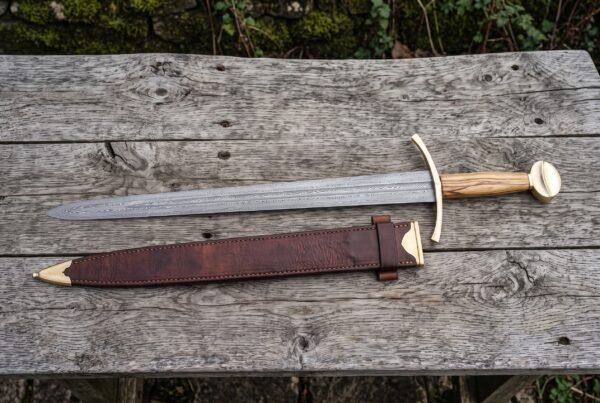
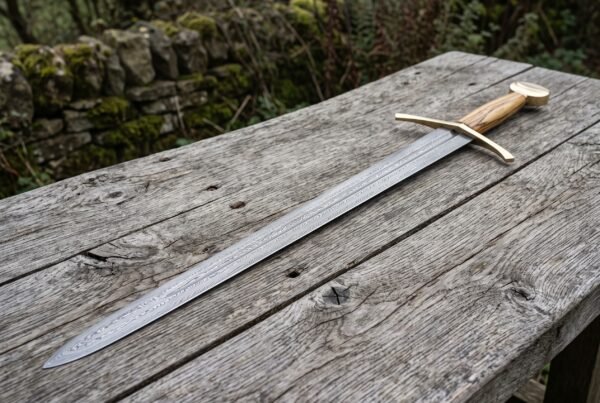
Also in this group is the Emberlegion gladius, 27 inches overall. Sitting beside it in the catalogue is the Stormleaf gladius, 28 inches overall. Another in the same line is the Legionward gladius, 27 inches overall.
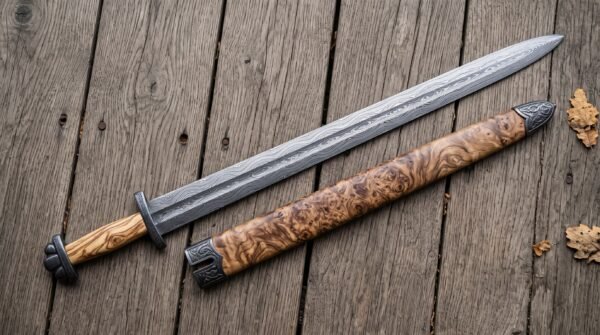
For a different piece from the same family, look at the Ashbraid short sword. Pick the steel, the length and the fittings yourself on the custom Viking sword page.

Reviews
There are no reviews yet