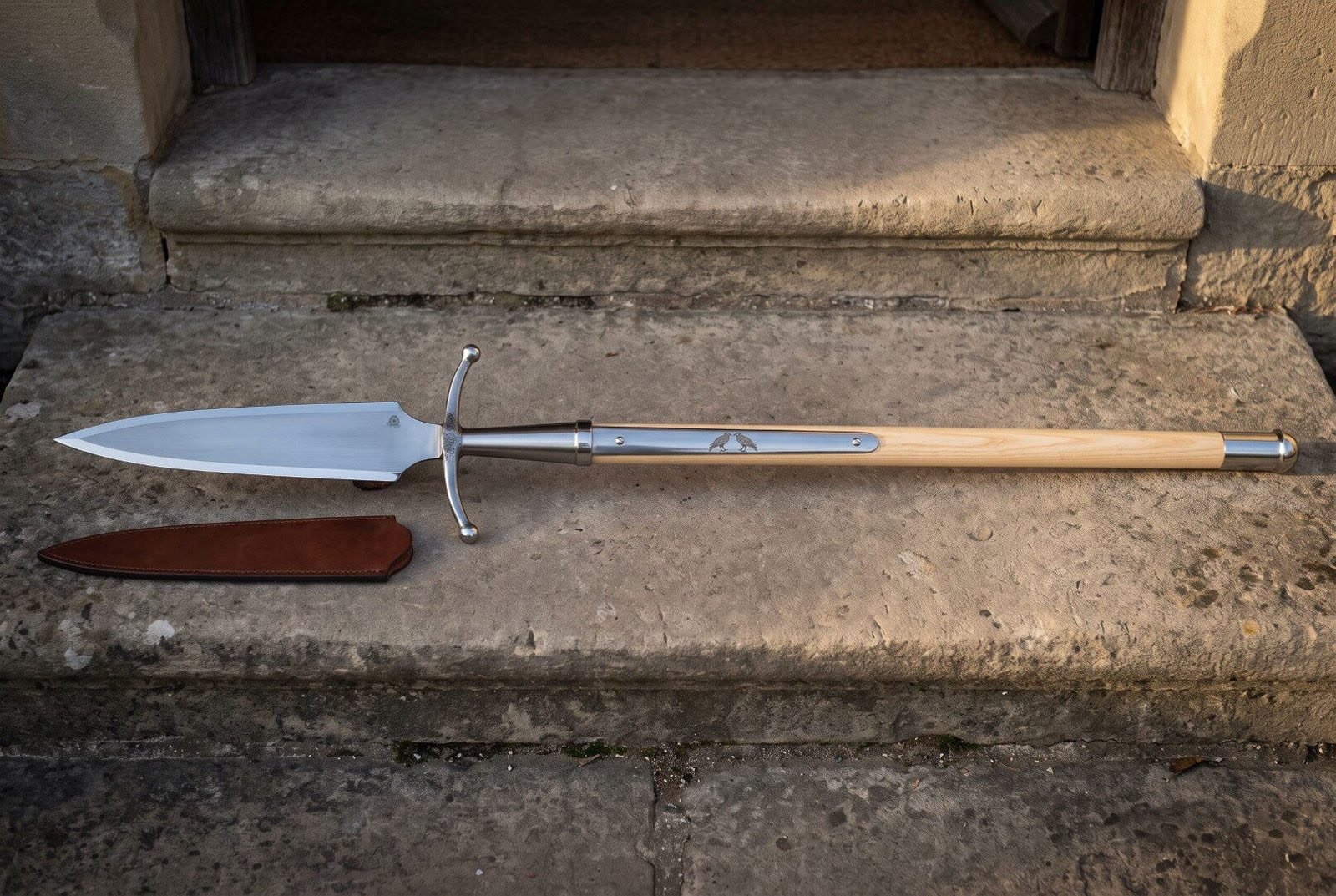
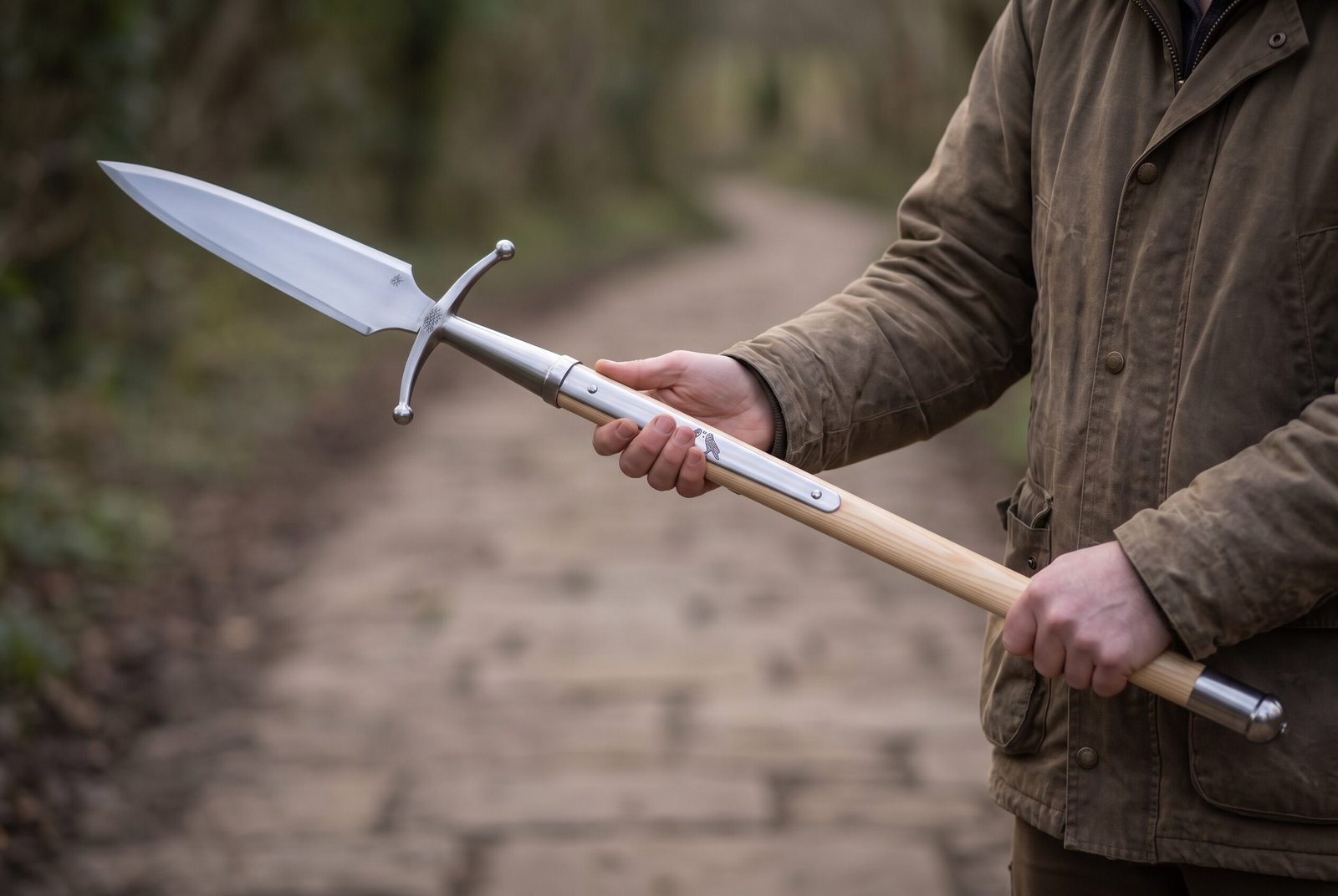
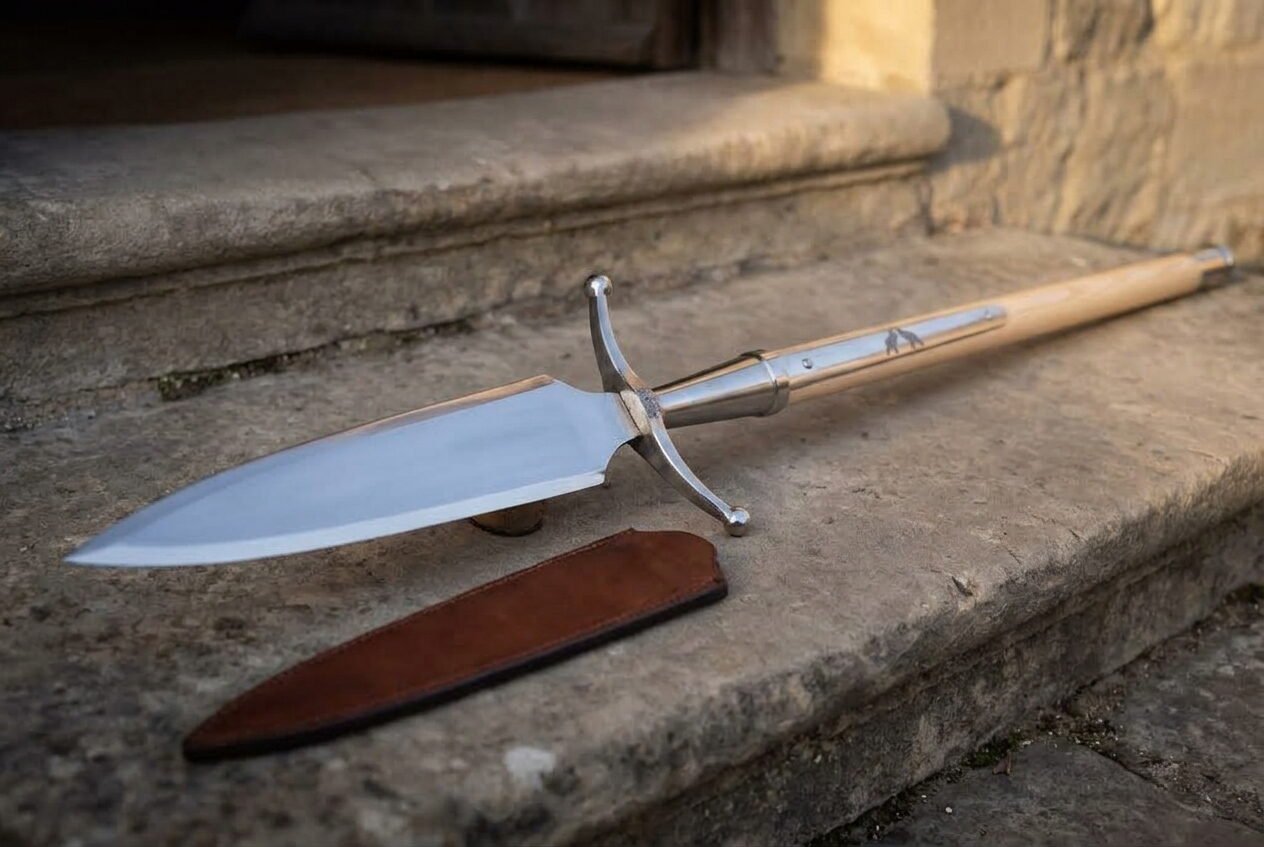
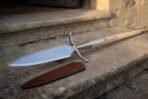
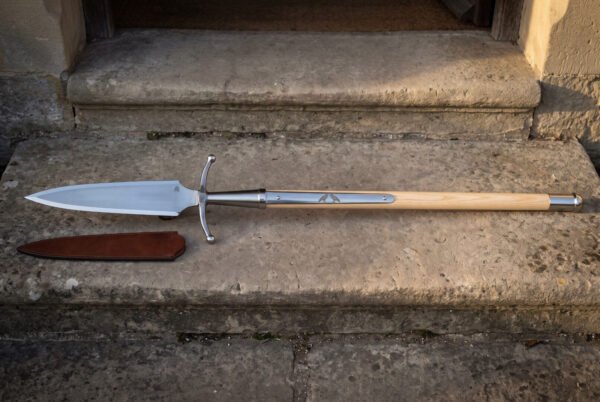
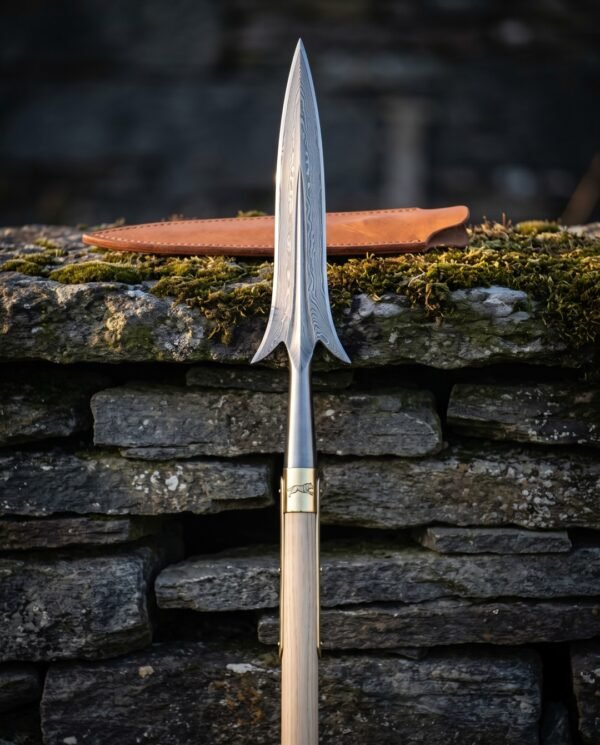
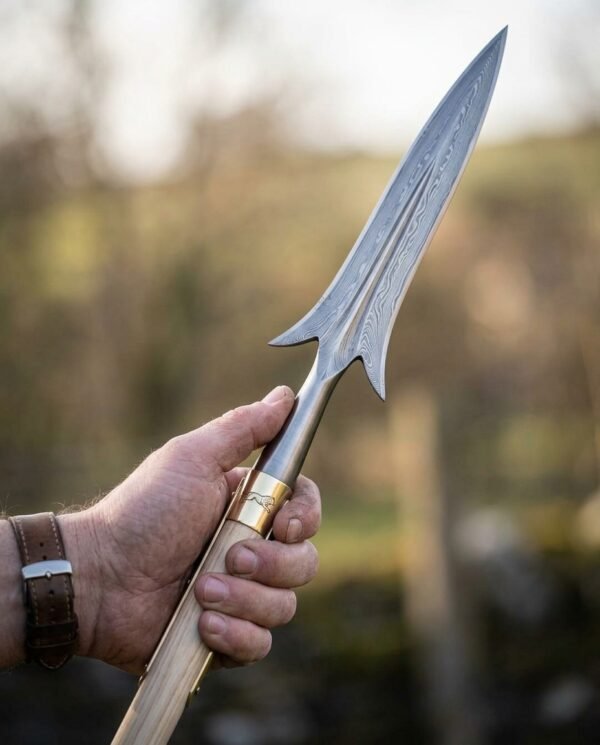
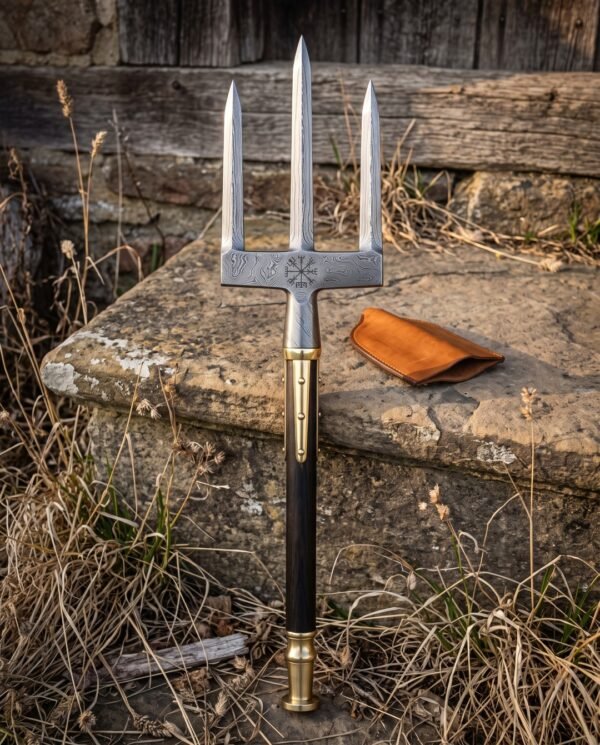
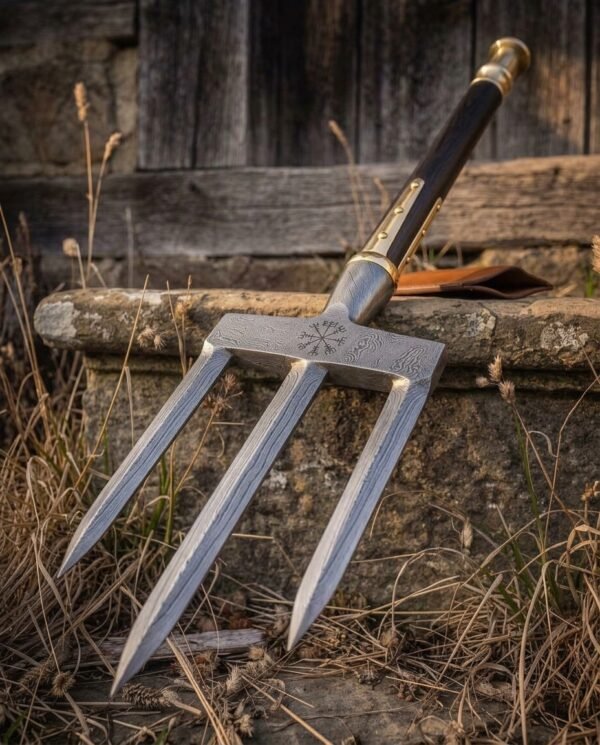
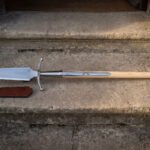
This is a hand forged boar spear. The head is a broad leaf shaped blade with a raised central spine, ground bright, sitting above a curved steel crossbar with rounded finials. Below that the blade runs into a steel socket with long langets riveted through onto a pale ash haft, and the butt is capped with a turned steel ferrule. A russet leather sheath is supplied to cover the blade when it is stored or carried.
The crossbar is the whole point of this pattern, and it exists because of one specific and very unpleasant piece of hunting knowledge. A wild boar that takes a spear does not stop. It drives forward along the shaft, using its own weight and its shoulder shield of gristle, and a spear with a plain tapered head will simply run through the animal and let it reach the person holding the other end. Continental hunters solved it first with a cord or a leather thong wrapped as a stop behind the blade, which is where the German name Schweinsfeder comes from, and later with a forged bar exactly like the one here. This spear is forged, ground and hafted in a Czech Republic workshop and ships with its sheath and our lifetime warranty. This one is kept with the glaives and polearms, and the Viking spears sit right beside it.
Specifications
| Blade material | 1095 high carbon steel, polished |
|---|
| Hardness | 54 to 58 HRC |
|---|
| Blade form | Broad leaf profile with a raised central spine and long bevels |
|---|
| Crossbar | Curved forged steel bar with rounded ball finials, set at the blade base |
|---|
| Socket | Steel socket with long steel langets running down the haft, riveted through |
|---|
| Haft | Pale ash, clear finished |
|---|
| Butt | Steel butt ferrule |
|---|
| Overall length | Cut and fitted by hand, so it varies slightly between pieces |
|---|
| Included | Russet leather blade sheath |
|---|
| SKU | RK-1636 |
|---|
What the crossbar does, and how it differs from a winged spear
People often lump the boar spear and the Viking winged spear together because both have something sticking out behind the blade, but they are answering different questions. The lugs on a winged spear are short forged wings that grow straight out of the socket. They stop the head burying itself past the point where you can pull it back, and just as importantly they give you a hook and a catch for the shaft of an opponent, which is why the winged spear turns up so often in period fencing manuals as a staff spear rather than only a throwing head.
The crossbar on a boar spear is longer, thinner, set further forward and usually curved. It is a stop and nothing else. It has to be wide enough that an animal driving up the shaft cannot get past it, and it is curved forward so the load pushes into the bar rather than sliding off the ends. That curve is doing real structural work. A straight bar under the same load wants to bend at the middle, while a curve puts the same force into compression along the arc.
The steel and the ash
The blade is 1095 high carbon steel, forged, ground and then hardened and tempered to 54 to 58 HRC. On a spear that range is chosen for toughness rather than maximum hardness, because a spear point takes shock along its length and a very hard point is a brittle point. The central spine you can see running up the blade is not cosmetic. It thickens the blade exactly where a thrust loads it and keeps the point from flexing sideways, which is the same reason a bayonet or a stiletto carries a pronounced medial ridge.
The haft is ash, which has been the northern European handle timber for as long as there have been handles. Its ring porous structure alternates open spring growth with dense summer growth, and that layering lets the shaft flex and damp shock instead of transmitting it all into the hands. It is also straight grained enough that a long shaft can be riven along the fibres rather than sawn across them, which is what keeps a long haft from snapping across a weak spot.
Engraving, runes and your own design
Use the rune converter on this page to turn a name, a date or a short phrase into Elder Futhark and we will cut it into the steel, the leather or the wood. If you would rather have a Viking pattern than a rune line, choose your own design in the engraving option above the add to cart button and tell us where it goes. Where a piece already carries an engraved design, your chosen engraving replaces it rather than sitting alongside it. On this spear the socket and the flat above the crossbar both take a rune line, and the leather sheath takes a name or a date. See the engraving page.
Handling and balance
The balance point on a socketed spear sits well forward of the middle, closer to the hand than you might expect from the size of the head, because the socket puts a good deal of steel down the shaft. In practice that means the piece feels lively rather than tip heavy and it does not want to dive when you hold it level. The crossbar also gives the front hand something to register against, which is exactly how it was used.
The blade arrives with a working edge and a genuinely sharp point. Keep the sheath on it when it is not being displayed, keep it out of reach of anyone who does not understand what it is, and be aware of the crossbar finials when you carry it through a doorway. We sell this as a display, collection and reenactment piece. It is not built for full contact sparring and it should not be used that way. If you intend to hunt with a spear, check your own state regulations first, because spear hunting is legal in some places and not in others.
Care
The blade is high carbon steel and will rust if left wet or handled and put away. Wipe it after handling and keep a thin film of mineral oil or light gun oil on the blade, the crossbar and the socket. Do not store it sheathed for long periods in a damp room, because vegetable tanned leather holds moisture against steel and will draw a rust line. Wipe the ash haft dry, and give it a coat of boiled linseed or hardwood oil once a year so it does not dry out and shrink away from the socket rivets. There is more detail on the steel care page.
Made in the Czech Republic
The work behind this piece happens in a Czech Republic workshop that has kept to the old methods. Steel is forged and heat treated by hand, the grind is taken down by eye rather than by machine, and the handle, fittings and sheath are cut and finished one at a time. Because of that, every piece carries small marks of the hand that made it.
Ransack Viking is a United States company. We import direct, check each piece when it reaches us, and ship from our Chicago, Illinois warehouse. Engraving is added here in the United States after arrival, so the piece you receive is finished to your order.
A note on handmade variation
This spear is hand made, not machine made and not bulk produced, so what arrives will not be a pixel for pixel copy of the photograph. Ash is a natural timber, so haft colour runs from near white to a warm biscuit and the grain lines differ on every shaft. The blade is ground by hand so the bevel width and the exact leaf profile vary a fraction, the crossbar is bent hot and its curve is never identical twice, and the leather sheath takes its own tone from the hide it came from. The steel, the heat treat, the construction and the fittings are the same every time. The character is not. Read how steel and hardness actually work when you have a minute, and the arms in Vikings and The Last Kingdom if you are still comparing.
Frequently asked questions
Is it sharp out of the box
Yes. It arrives with a working edge on both bevels and a sharp point. Keep the sheath on it in storage and treat it as you would any bladed tool.
How long is the whole spear
Every haft is cut and fitted by hand, so the overall length varies a little from piece to piece and we would rather not quote a figure we cannot guarantee for yours. Message us before ordering and we will measure the piece we would send you.
Is the head removable
No. The socket is riveted through the haft so the head is fixed. That is a stronger joint than a friction fit and it is how a spear meant to be handled should be built.
Can I use it as a walking staff
Please do not. The butt ferrule is a finish cap rather than a spike, and the haft is sized for a spear rather than for taking your body weight at an angle.
Will mine look exactly like the photo
Close, but not identical. The grind, the crossbar curve, the ash grain and the leather tone all vary because each one is worked by hand from natural materials.
How long does shipping take
One to two weeks of processing, then free shipping inside the United States. Long parcels sometimes take a couple of extra days in transit.
What is in the box
- Hand forged 1095 steel boar spear head with curved crossbar
- Ash haft with riveted steel socket and steel butt ferrule
- Russet leather blade sheath
- Care card for high carbon steel and ash
- Lifetime warranty against defects in forging, grind, heat treat and fittings
- Forged and finished in the Czech Republic
Explore the range
See more in the Viking spears, the glaives and polearms and the Norse arms, or read the guides on socketed heads and hafting.
Compare it with these
In the same category sits the Whitecrest polearm, 56 inches overall. A near match for this one is the Ravenreave polearm, 62 inches overall. Closest to this in the range is the Tidecleave polearm, 54 inches overall.
Fitting out further, the Ashpoint Viking spear belongs with it. Pick the steel, the length and the fittings yourself on the custom Norse arms page.

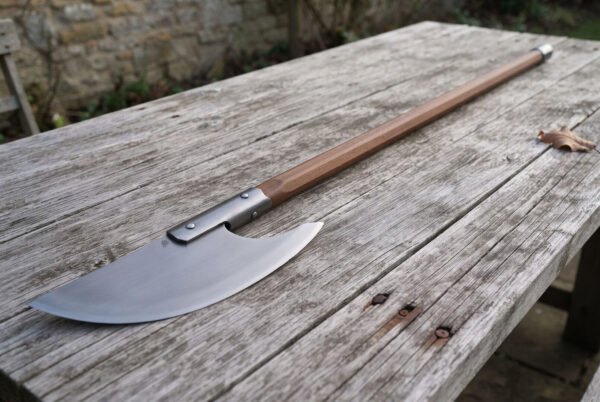
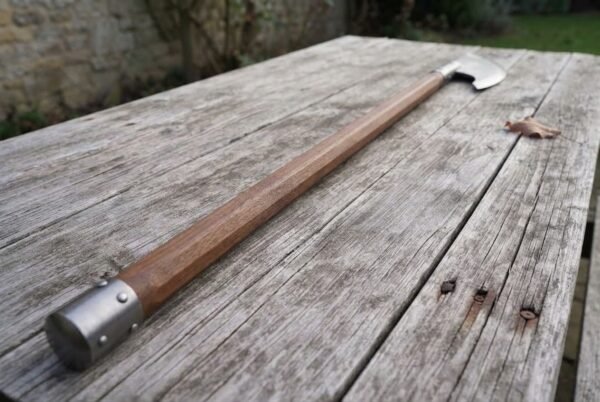
My husband was speechless when he opened this. Steel head is heavy in a good way. You can tell it’s not hollow. Great for reenactment or just display. Either way it looks amazing. 10/10 would buy again.
Absolutely blown away by this polearm. Can’t recommend this enough.
Can’t stop showing this off to everyone who comes over. Great for reenactment or just display. Either way it looks amazing. So worth it.