
Blog
The Norse Goddesses

The Norse goddesses are harder to write about than the gods, and not because there are fewer of them. Snorri lists fourteen in a row in Gylfaginning and then gives most of them a single line each. We know their names, we know a job title, and for several of them that is the entire surviving record.
What follows takes ten of them and says exactly what the sources support. Where a goddess has one attestation and everything else you have read about her was made up in the last two hundred years, this page says so. That is less satisfying than the usual list and considerably more accurate.
Two families, and a problem with the word goddess
The female figures in the material do not sort neatly. Some are Aesir. Freyja is Vanir. Skadi is a giantess who marries in and is treated as one of the group anyway. Hel is Loki’s daughter and rules the dead. Snorri’s word for the goddesses is asynjur, the feminine of the word for the Aesir, and he applies it more loosely than a modern taxonomy would like.
The wider structure of the pantheon is on the page for the Norse gods. What matters here is that the boundary between goddess, giantess and personified abstraction is not one the sources were interested in policing.
Ten goddesses, and what is actually known
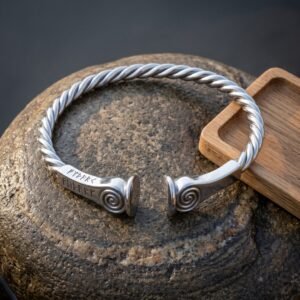 Coilspire Hand Made Twisted Viking Arm Ring with Spiral Terminals & Elder Futhark Runes | Open Cuff Torc | Norse Oath Gift | RK-1761
 Coilbright Hand Made Twisted Viking Arm Ring with Rope Coil Body & Rounded Terminals | Norse Wedding Gift | RK-1779
 Ropewind Hand Made Norse Rune Ring with Twisted Rope Borders & Elder Futhark Centre Band | 9mm Wide | Groomsmen Gift | RK-1604
Frigg
Odin’s wife and the first among the goddesses. She lives in Fensalir, the fen-halls. Snorri says she knows every fate though she does not speak of it, which is a good line and a rare instance of a goddess being given an interior.
Her one full story is the death of Baldur. She takes oaths from everything in the world not to harm her son, overlooks the mistletoe, and loses him. In Lokasenna, when Loki starts on her, Freyja warns him that Frigg knows all fates, and Loki responds by taking credit for the killing to her face. That is on the page about Baldur.
Friday carries her name, from Old English Frigedaeg, matched to the Roman day of Venus. She is the goddess most often confused with Freyja, and the argument about whether they were once one figure is genuinely open.
Freya
The most fully drawn of them. Vanir by family, goddess of desire, gold and seidr magic, and the one who takes half of everyone who dies in battle while Odin takes the rest. She owns the necklace Brisingamen and a cloak of falcon feathers that Loki keeps borrowing, and drives a chariot pulled by two cats.
She gets her own page here, because there is enough material for one: Freya, the goddess who takes half the slain.
Idun
Keeper of the apples that keep the gods from ageing. Her story survives in Skaldskaparmal. The giant Thjazi, in eagle form, extorts Loki into luring her out of Asgard with her apples, and the gods begin to grow old and grey within weeks. They work out who is responsible, threaten Loki, and he borrows Freyja’s falcon cloak, turns Idun into a nut, and carries her home with Thjazi in pursuit until the giant burns up in fires the gods have lit on the wall.
Her husband is the poet god Bragi. Lokasenna has Loki accuse her of sleeping with her brother’s killer, which is the usual quality of his contributions. The apples themselves are worth a footnote: the word Snorri uses, epli, could mean fruit generally in Old Norse, and apples as we know them were not native to Scandinavia in the period.
Sif
Thor’s wife, known almost entirely for her hair. Loki cut it off while she slept, Thor threatened to break every bone in him, and Loki fixed it by commissioning replacement hair of spun gold from the dwarves. That commission is the same episode that produced Odin’s spear and Thor’s hammer, described on the page for Gungnir.
The golden hair has been read as a grain association, with the goddess standing for a ripe field, which is plausible and unprovable. Beyond that story she barely appears. She has a son called Ull, a god of archery and skiing with heavy place name evidence and almost no surviving myth, which is one of the more irritating gaps in the record.
Skadi
A giantess, daughter of Thjazi, who arms herself and marches on Asgard to demand compensation for her father. She gets it. The settlement includes a husband, chosen by looking at the feet of the assembled gods and nothing else, which she does hoping to pick Baldur and which lands her Njord instead. It also includes the gods making her laugh, which Loki manages by tying a rope between his testicles and a goat’s beard.
The marriage fails on geography. She wants the mountains, he wants the shore, and neither can sleep in the other’s country. Ynglinga saga has her later with Odin. She is a hunter, associated with skis and the bow, and her name may be connected with the second element in Scandinavia.
Hel
Loki’s daughter by the giantess Angrboda, sister to Fenrir and Jormungandr. Snorri says Odin threw her into the world below and gave her authority over everyone who dies of sickness or old age, and describes her as half flesh-coloured and half black, and grim to look at.
She is not a devil and her realm is not a punishment. She has one moment of real character, in the Baldur story, where she sets the condition that everything in the world must weep and then holds the gods to the letter of it when one refuses.
Eir
Snorri says she is the best of physicians. That is close to the whole record. She appears in a list of valkyries in one poem and among Menglod’s attendants in another, and those may or may not be the same figure.
Every website that tells you about Eir’s healing rituals, her herbs or her worship is inventing. The honest position is one attribute and no story.
Gefjon
The one with an actual plot. She got land from the Swedish king Gylfi, as much as four oxen could plough in a day and a night, then turned her four sons by a giant into oxen and ploughed so deep that she tore the land loose and dragged it into the sea, where it became the Danish island of Zealand. The hole left behind became a lake. Snorri tells it and quotes an older skaldic verse by Bragi Boddason for it, so the story is not his invention.
Snorri elsewhere says unmarried women who die go to her, and calls her a virgin, while Lokasenna has Loki accuse her of trading sex for jewellery and the Ynglinga saga has her married to a Danish king. The sources contradict each other flatly and nobody has fixed it.
Sigyn
Loki’s wife, and the subject of the most quietly devastating image in the corpus. After Loki is bound with the entrails of his own son, a serpent is fixed above him to drip venom on his face. Sigyn stands beside him holding a bowl to catch it. When the bowl fills she has to take it away to empty it, and in those moments the venom lands and Loki convulses, and that is what earthquakes are.
She does nothing else in any source. She has no dialogue. The Gosforth Cross in Cumbria appears to show a bound figure with a woman holding a vessel above him, which means the scene was known in Norse England before any of it was written down. It is one of the very few goddess images that can be matched to a text.
Nanna
Baldur’s wife. In Snorri’s account she sees his body carried to the funeral ship, her heart breaks, and she dies and is placed on the pyre beside him. Later, when Hermod reaches the world of the dead to bargain, she is there and sends gifts back: a linen robe for Frigg and a gold ring for Fulla.
Saxo Grammaticus gives her a different life entirely, as a mortal king’s daughter courted by two rivals, who chooses the man she prefers on the reasonable grounds that a demigod would be an unsuitable husband. The two accounts have almost nothing in common.
The ones Snorri lists and then abandons
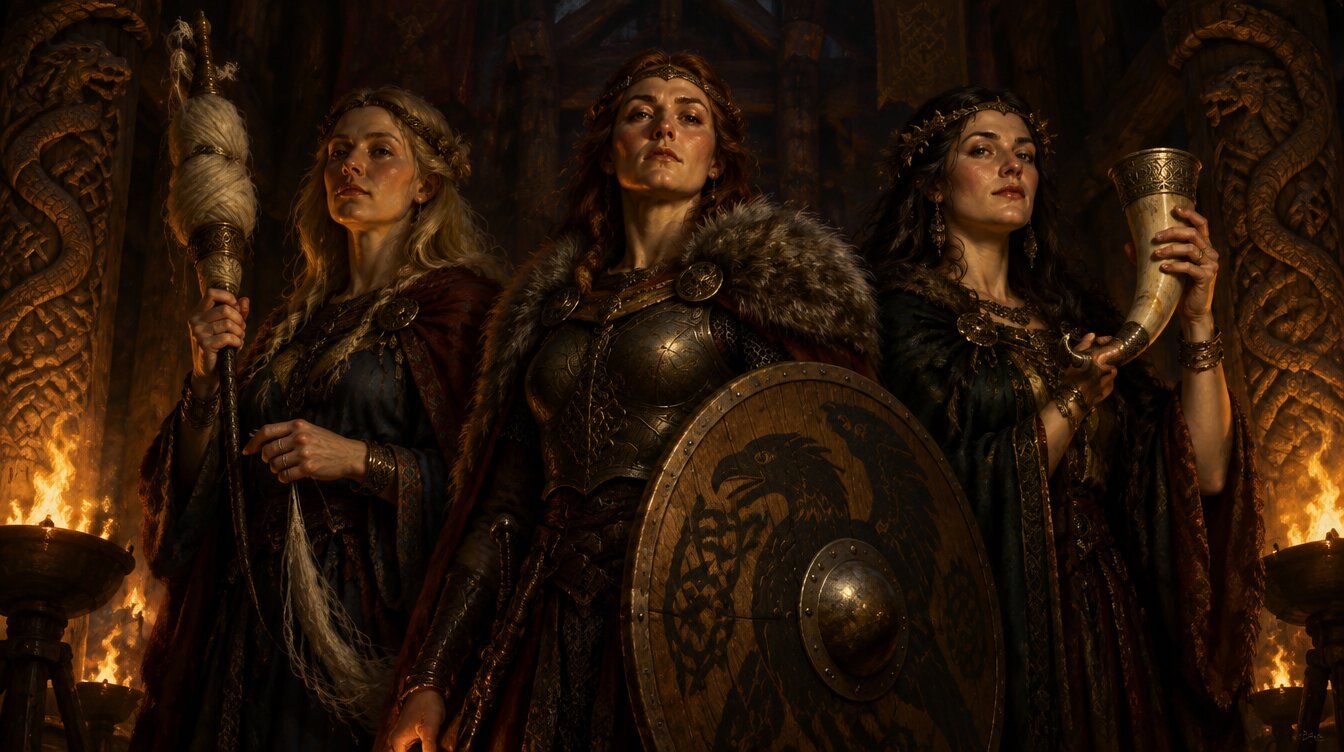
Gylfaginning runs through a further set with a line each. Saga, who drinks with Odin. Fulla, a maiden with loose hair and a gold band, who carries Frigg’s box and knows her secrets. Sjofn, who turns minds to love. Lofn, who gets permission for unions otherwise forbidden. Var, who hears oaths between people and punishes those who break them. Vor, from whom nothing can be hidden. Syn, who guards the door and denies entry, and is called on in legal defences. Hlin, who protects those Frigg wishes to keep from danger. Snotra, who is wise and courteous. Gna, who rides through air and water on a horse called Hofvarpnir.
Several of those names are ordinary Old Norse abstract nouns, which has led to a long argument about whether they are genuine cult figures or Snorri’s own personifications assembled to fill out a list. Nobody can prove it either way. Treat them as names in a thirteenth century catalogue rather than as goddesses with followings.
What the evidence for worship looks like
Place names are the best measure, and they favour the male gods heavily. Freyja and Frigg leave traces, though fewer than Thor, Odin, Freyr or Ull.
Grave goods tell a different story. The Oseberg ship burial of 834 contained two women, a wagon and an enormous quantity of goods, and whoever the principal occupant was, she was buried with more ceremony than almost any man in the archaeological record of the period. Small female figurines with drinking horns or neck rings turn up in graves and settlements. They are usually read as valkyries or goddesses, without anyone being able to say which. The record of what people actually carried is set out on the page for Viking symbols.
Carrying it
Ransack Viking is a US company in Chicago, Illinois. Pieces are handmade in the Czech Republic, then imported, inspected and shipped from Chicago, and engraving is cut here after arrival. Plain 1095 runs 54 to 58 HRC and Damascus of 1095 and 15N20 runs 58 to 60. US orders ship free and tracked with no import duty, and everything carries a lifetime warranty against defects. The ranges most often engraved with Norse work are Viking rings and arm rings, Norse pendants and drinking horns. The rest of the writing is in the guides.
Questions people ask
Who are the main Norse goddesses?
Frigg and Freyja are the two with the most material behind them. After those, Idun, Sif, Skadi, Hel, Gefjon, Sigyn and Nanna each have at least one real story. Snorri lists a further group including Eir, Saga, Fulla, Var and Syn with a single line each, and several of those may be his own personifications rather than figures anyone worshipped.
What is the difference between Frigg and Freya?
Frigg is Aesir, Odin’s wife, associated with foreknowledge and with the death of Baldur. Freyja is Vanir, associated with desire, gold, seidr magic and the battle dead. Some scholars think they split from a single earlier goddess, since both have husbands whose names begin with Od and both weep for an absent one. The sources treat them as separate.
Which Norse goddess is the goddess of death?
Hel, Loki’s daughter, who governs everyone who dies of sickness or old age. Her realm is not a place of punishment and she is not a devil figure. Freyja also has a claim on the dead, since she takes half of those killed in battle, but she is not a death goddess in the way Hel is.
Is Skadi a goddess or a giantess?
Both, in the sense the sources allow. She is the daughter of the giant Thjazi and comes to Asgard armed, demanding compensation for his killing. She is settled with a marriage to Njord and is thereafter counted among the goddesses. The boundary between the two categories was not one the Norse material worked hard to defend.
What do we actually know about Eir?
That Snorri calls her the best of physicians. That is close to all of it. She appears in a valkyrie list in one poem and among a group of attendant women in another, and whether those are the same figure is unclear. Anything you read about her rituals, herbs or temples is modern invention.
What is the story of Gefjon and Zealand?
She was promised as much land as four oxen could plough in a day and a night by the Swedish king Gylfi, turned her four sons by a giant into oxen, and ploughed so deep that the land came away and was dragged into the sea to become the Danish island of Zealand. Snorri quotes a much older skaldic verse for the story, so it did not start with him.
Why does Sigyn hold a bowl over Loki?
Because a serpent was fixed above him to drip venom on his face after he was bound. She catches it in a bowl, and when she has to leave to empty it the venom falls and he writhes, which the sources say causes earthquakes. She does nothing else in any surviving text, and a carving on the Gosforth Cross in Cumbria appears to show the scene.
Were the Norse goddesses actually worshipped?
Freyja and Frigg clearly were, on place name and personal name evidence, though less heavily than the major male gods. For most of the others there is no independent evidence at all, only Snorri’s list. The Oseberg ship burial shows that a woman could be buried with extraordinary ceremony, but it cannot tell us which goddess, if any, was involved.
The shop side of this
Carried in the shop, the Knotvow Viking rune ring and the Ropewind Norse rune ring. The Wayfinder Vegvisir pendant and the Tinebraid bone Viking comb sit with them.
Shop the range
Coilspire Hand Made Twisted Viking Arm Ring with Spiral Terminals & Elder Futhark Runes | Open Cuff Torc | Norse Oath Gift | RK-1761Coilbright Hand Made Twisted Viking Arm Ring with Rope Coil Body & Rounded Terminals | Norse Wedding Gift | RK-1779Ropewind Hand Made Norse Rune Ring with Twisted Rope Borders & Elder Futhark Centre Band | 9mm Wide | Groomsmen Gift | RK-1604 Everrune Hand Made Viking Rune Ring with Elder Futhark Band & Bevelled Polished Edges | 6mm Wide | Norse Wedding Gift | RK-1603
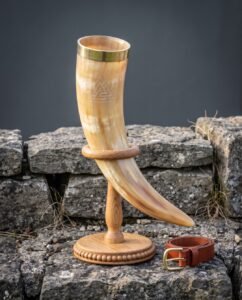 Amberdraught Hand Made Valknut Drinking Horn and Oak Stand | Pale Natural Ox Horn | Solid Brass Rim Band with Tan Leather Belt | Norse Wedding Gift | RK-1685
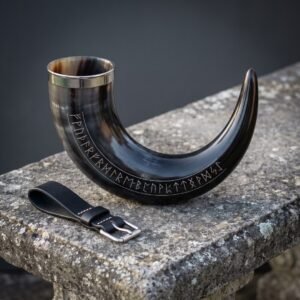 Runemead Hand Made Rune Drinking Horn | Full Elder Futhark Row | Dark Natural Ox Horn and Polished Steel Rim with Black Leather Belt Loop | Norse Mead Gift | RK-1675