
Blog
Gungnir, Odin’s Spear

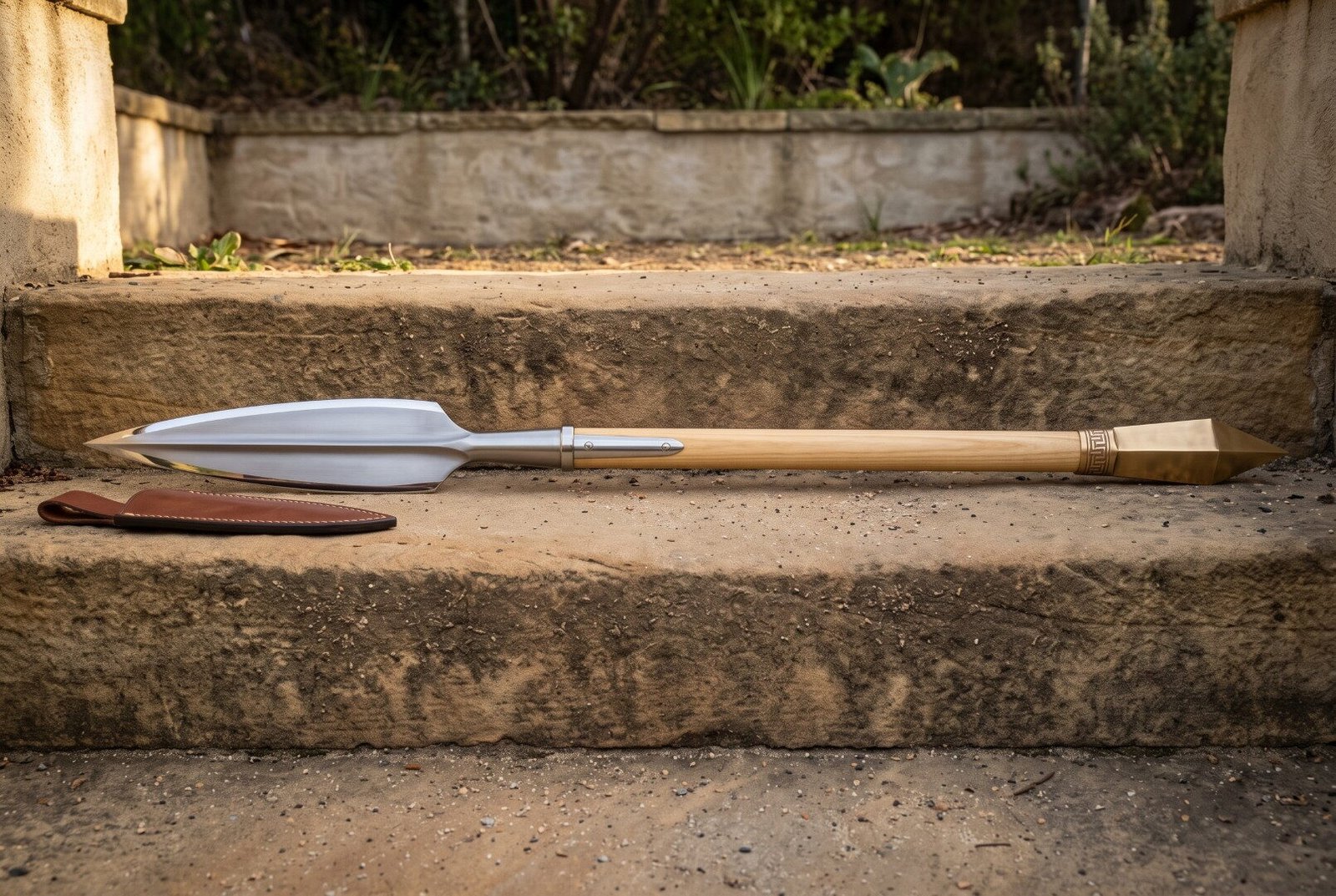
Odin’s spear is called Gungnir, and it is the one piece of divine kit in the Norse material that also seems to have been used by actual people, on actual battlefields, in a way we can partly reconstruct. Thor’s hammer is a story. Gungnir is a story attached to a practice.
It is also a good demonstration of how much of what people confidently repeat about Norse myth comes from later summary rather than from a source. This page separates the two.
What the name means
Gungnir comes from a verb meaning to sway or to swing. The usual translations are the swaying one, the rocker, or the trembler. That is a description of what a spear does in the hand before it is thrown, or of the vibration of a shaft in flight, and it is a far more physical name than most divine objects get.
It is not, on any reading, a word meaning unerring, piercing or unstoppable. Whoever named it was thinking about how the thing behaves, not about what it guarantees.
Where it actually appears
The list is short, and worth having in full.
 Runeleaf Hand Forged Elder Futhark Spear | 44 Inch Overall with 11 Inch Head | Ash Haft, Red Leather Grip and Brown Leather Head Sheath | Norse Reenactment Gift | RK-1981
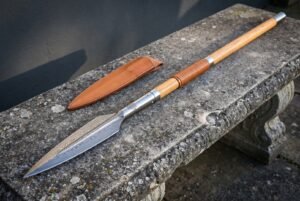 Serpentcast Hand Forged Damascus Spear | 42 Inch Overall with 12 Inch Head | Ash Haft, Leather Grip Wrap and Brown Leather Head Sheath | Norse Reenactment Gift | RK-1976
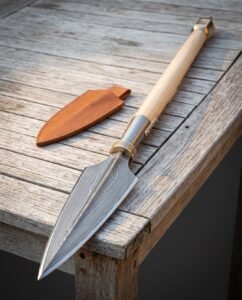 Dawnleaf Hand Forged Damascus Viking Spear | 28 Inch Overall with a 12 Inch Leaf Blade | Ash Shaft, Riveted Socket, Brass Collar and Leather Blade Cover | Norse Collector Gift | RK-1744
Sigrdrifumal, in the Poetic Edda, has the valkyrie Sigrdrifa tell Sigurd that runes were carved on the point of Gungnir. That is the earliest clear naming of the object, and it is in a passage about where runes are found: on a bear’s paw, on Bragi’s tongue, on a wolf’s claw, on the point of the spear.
Skaldskaparmal, in Snorri’s Prose Edda, tells how it was made. Loki, having cut off Sif’s hair and needing to fix the situation, went to the dwarves called the sons of Ivaldi. They produced Sif’s new golden hair, the ship Skidbladnir, and the spear. Loki then wagered his head with two other dwarves that they could not match the work, which is how Thor’s hammer came into existence and how Loki got his mouth sewn shut. The spear is given to Odin.
Snorri describes the spear as so well balanced that it would strike whatever it was aimed at, whoever threw it and however weak they were. That sentence is the entire basis for the modern claim that Gungnir never misses. The difference matters. Snorri is describing a very good spear, not a homing device, and the wording is about balance rather than magic.
The throw that starts the first war
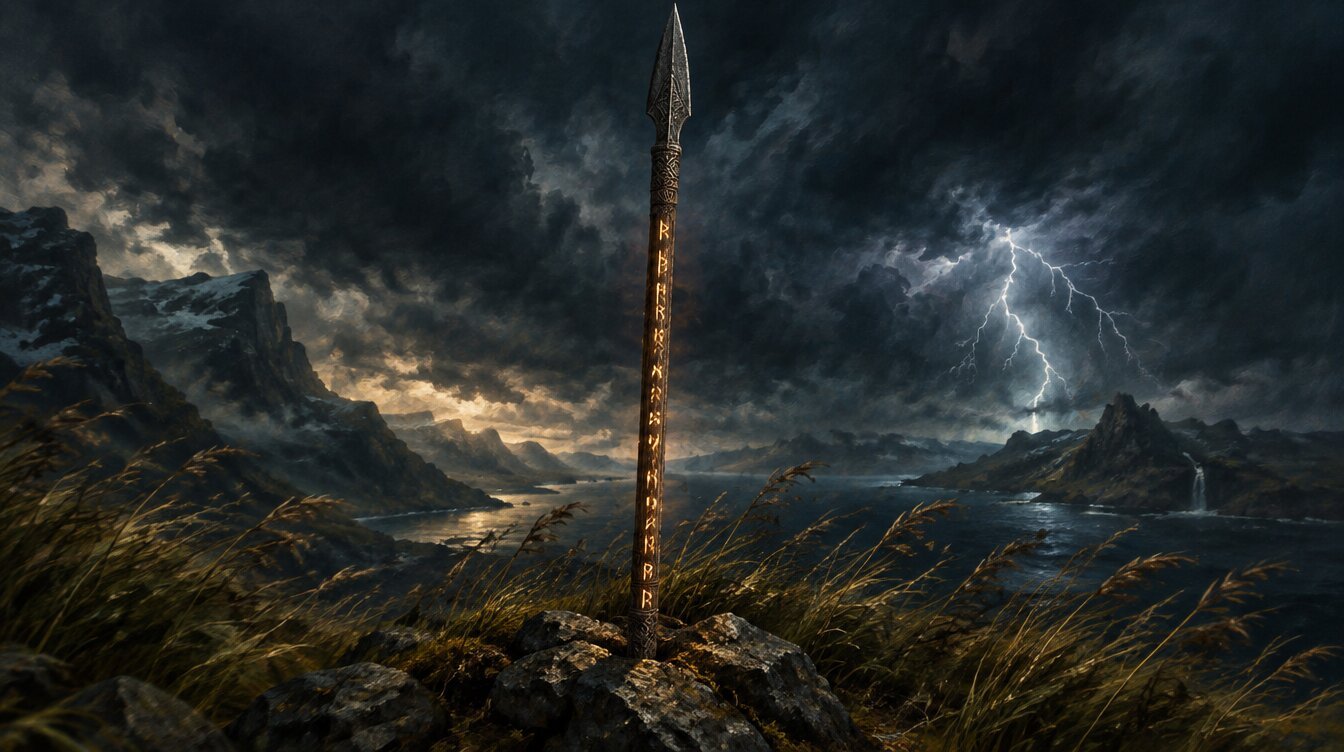
Voluspa describes Odin casting a spear over a host, and says that was the first war in the world. The passage is short and famously difficult, and it sits at the point where the Aesir and the Vanir begin fighting.
Here is the detail almost every popular account gets wrong. Voluspa does not say the spear was Gungnir. It says Odin threw a spear. The identification is a reasonable inference and it may well be right, but it is an inference, and the poem does not make it.
The practice behind the story
The interesting part is that this was not only a story. Several sources describe a battlefield act in which a spear is thrown over an enemy force to dedicate that force to Odin, giving him the dead in advance.
Ynglinga saga has Odin himself marked with a spear point as he lay dying, and says he claimed all men killed by arms. Styrbjarnar thattr describes a spear cast over an army with a formula giving those men to Odin. The practice, whatever its real extent, appears in more than one text and in more than one form.
Archaeology gives a partial echo. Deposits of war gear in Danish bogs at Illerup, Nydam and Ejsbol contain enormous quantities of military equipment deliberately destroyed and thrown into water, some of it in the centuries before the Viking Age. Those are war offerings on a scale that took organisation. Whether Odin was the recipient, or whether the practice connects directly to the spear-casting described in the later sagas, is not something the finds can tell us. What they establish is that dedicating the results of a battle to a god was a real thing people did in the north, not a literary flourish.
What the spear says about Odin
Odin’s associations are consistently with the spear rather than the sword or the axe. He hangs on the tree wounded with a spear, given to himself. He marks himself with a spear point at death. He carries one at Ragnarok, and on Thorwald’s Cross on the Isle of Man the figure read as Odin is holding a spear downward at a wolf.
The spear is the tool of the leader who decides an outcome rather than of the fighter in it, and it is thrown at range over the heads of others. That fits a god who starts wars for the interest of watching them. The rest of his character is on the page for Odin the All Father.
It also fits the archaeology of Norse fighting kit. The spear was the common arm of the north, far more common than the sword, and the practical side of that is covered on the page for the Viking spear.
The spear in the hand of a god who does not fight fairly
Odin is not a duellist. Nothing in the surviving material shows him standing in a shield wall or trading blows. What he does is decide, at a distance, who is going to lose, and then collect them afterwards. Ynglinga saga says outright that he could make his enemies blind or deaf or struck with terror, and that their edges bit no better than sticks.
A thrown spear fits that exactly. It commits an army to a result before the fighting starts, it is done by one person on behalf of a side, and the person doing it does not have to be anywhere near the consequences. Compared with Thor, who solves problems by walking up to them with a hammer, it is a colder instrument, and the coldness is the point. The hall where the results are collected is described on the page for Valhalla.
Runes on the point
The Sigrdrifumal passage deserves more attention than it gets. It places runes on the point of the spear alongside a list of other surfaces, and the surrounding stanzas are instructions for cutting particular runes for particular purposes, including victory runes on a sword hilt with Tyr named twice.
Actual rune-inscribed spearheads survive. The Kragehul spear shaft from Denmark, the Mos spearhead from Gotland and the Dahmsdorf and Kovel points all carry Elder Futhark inscriptions, several of which appear to be names for the object itself with meanings like tester or attacker. Naming an individual spear was a real habit, not a mythological one. The rune row is set out on the page for the Elder Futhark, and the wider question of what was really carved and what is modern is on the page for Viking symbols.
What Gungnir is not
It is not a symbol that was worn. There is no Gungnir amulet type. The triple-horn, valknut and hammer shapes have genuine Viking Age instances behind them, in varying degrees of certainty, and the spear does not.
It was not made by Dvalin alone, nor by Brokk and Eitri, whatever various retellings say. Skaldskaparmal credits the sons of Ivaldi, and the second pair of dwarves make the hammer, the boar and the ring, having been challenged to beat the first set.
And it does not appear in Voluspa by name, does not kill anyone in any surviving narrative, and is never described in physical detail. There is no attested shape, no length, no material for the head. Every illustration of it is somebody’s invention, which is fine, as long as nobody claims otherwise.
Owning a spear
If the mythology has a lesson about spears, it is that the north took them seriously and the sword got the better publicity. Ransack Viking is a US company in Chicago, Illinois. Pieces are handmade in the Czech Republic, then imported, inspected and shipped from Chicago, with engraving cut here after arrival. Plain 1095 runs 54 to 58 HRC and Damascus of 1095 and 15N20 runs 58 to 60. US orders ship free and tracked with no import duty, and everything carries a lifetime warranty against defects. The relevant ranges are Viking spears, engraved pieces and Norse pendants. The rest of the writing is in the guides.
Questions people ask
What is Gungnir?
Odin’s spear, made by the dwarves called the sons of Ivaldi and given to him by Loki, according to Snorri’s Skaldskaparmal. Sigrdrifumal in the Poetic Edda says runes were carved on its point. It is Odin’s characteristic piece of kit, and the spear rather than the sword is the arm associated with him throughout the material.
What does Gungnir mean?
It comes from a verb meaning to sway or swing, so the swaying one, the rocker or the trembler. It describes how a spear moves rather than what it does to a target. There is nothing in the name about accuracy or unstoppability, despite how often that is claimed.
Does Gungnir never miss?
Not quite as stated. Snorri writes that the spear was so well balanced it would strike its mark whoever threw it and however weak they were. That is a description of superb balance rather than of a magical guarantee, and the popular never misses formula is a tightening of Snorri’s sentence rather than a translation of it.
Did Odin throw Gungnir to start the first war?
Voluspa says Odin cast a spear over a host and that this was the first war in the world, but it does not name the spear. The identification with Gungnir is an inference that most readers accept, and it may be right, but no surviving source actually says it.
Who made Gungnir?
The dwarves known as the sons of Ivaldi, in the episode where Loki has to replace Sif’s hair. The same pair of workshops also produced Skidbladnir, Mjolnir, the boar Gullinbursti and the ring Draupnir, in a contest Loki started and nearly lost his head over.
Did Vikings really throw spears to dedicate armies to Odin?
Several written sources describe the practice, including Styrbjarnar thattr and, in a related form, Ynglinga saga. Large deliberate deposits of military equipment in Danish bogs at Illerup, Nydam and Ejsbol show that dedicating the results of battle was genuinely done in the north, though the finds cannot name the god who received it.
Are there real spears with runes on them?
Yes. The Kragehul shaft from Denmark, the Mos spearhead from Gotland, and the Dahmsdorf and Kovel points all carry Elder Futhark inscriptions. Several look like names given to the individual object, with meanings along the lines of tester or attacker, so naming a spear was an ordinary human habit as well as a mythological one.
What did Gungnir look like?
No source says. There is no description of its length, its head shape or its material anywhere in the surviving corpus. Every image of it is a modern artist’s decision, which is perfectly reasonable so long as nobody presents it as reconstruction.
If nothing on the shelf is quite right, build a custom spear, hammer or polearm and choose the head, the steel, the shaft timber and the shaft length.
Where to see these
Closest to this in the shop, the Runeleaf Elder Futhark spear and the Ashreach Viking spear. Alongside them, the Skyrend Viking spear and the Serpentcast spear.
Shop the range
Runeleaf Hand Forged Elder Futhark Spear | 44 Inch Overall with 11 Inch Head | Ash Haft, Red Leather Grip and Brown Leather Head Sheath | Norse Reenactment Gift | RK-1981Serpentcast Hand Forged Damascus Spear | 42 Inch Overall with 12 Inch Head | Ash Haft, Leather Grip Wrap and Brown Leather Head Sheath | Norse Reenactment Gift | RK-1976Dawnleaf Hand Forged Damascus Viking Spear | 28 Inch Overall with a 12 Inch Leaf Blade | Ash Shaft, Riveted Socket, Brass Collar and Leather Blade Cover | Norse Collector Gift | RK-1744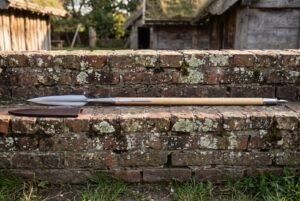 Ashgleam Hand Forged 1095 Viking Spear | 11 Inch Leaf Blade on a 76 Inch Ash Haft | Rune Engraved Socket and Leather Head Sheath | Reenactment Gift | RK-1594
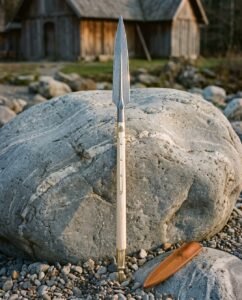 Ashreach Hand Forged Damascus Viking Spear with Leaf Shaped Head | Brass Valknut Ferrule and Ash Wood Haft | Leather Point Cover Included | Norse Reenactment Gift | RK-1614
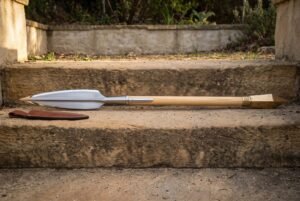 Ashfang Hand Forged 1095 Steel Viking Spear | 40 Inch Overall Length | Broad Leaf Head on an Ash Haft with Brass Butt Spike | Norse Reenactment Gift | RK-1773