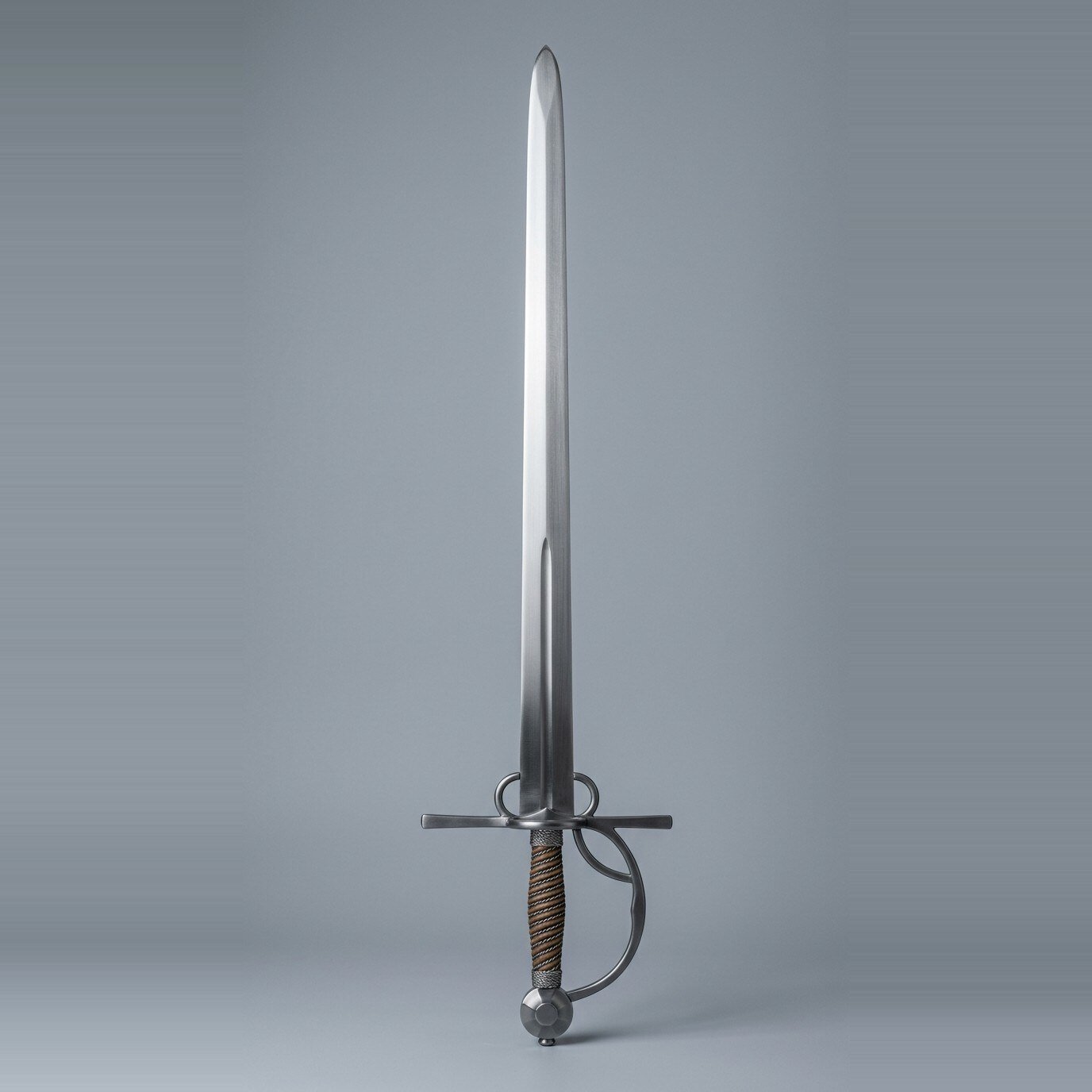
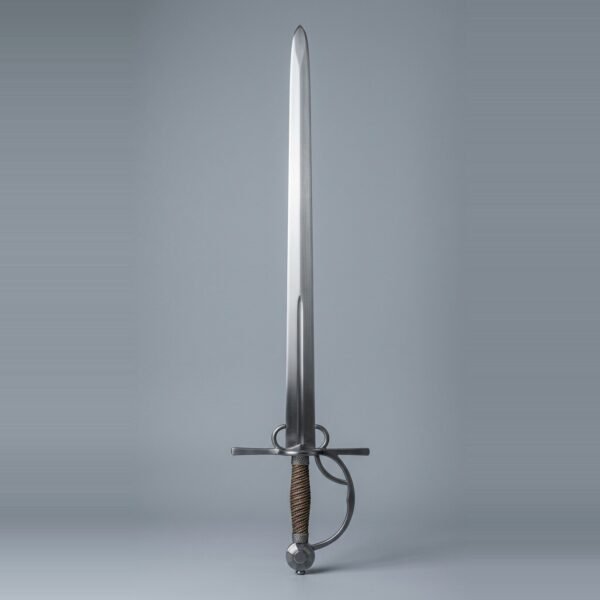
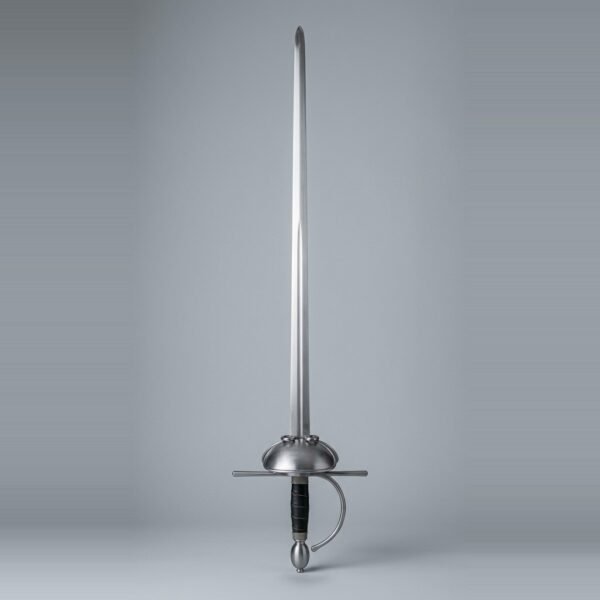
Two side rings, a counterguard loop and a knuckle bow. That is a lot of steel around one hand, and every piece of it is there because a fencer in the sixteenth century put a finger over the cross and then found out what happens to that finger. The Thanmir is the sidesword with its hand protection worked out properly, and it is the version to buy if you intend to fence rather than to drill on your own in a garage.
Under the rings the blade runs out through a flat ricasso into a double edged cut and thrust profile, blunt, with a rolled and flared point. The grip is wound in wire of two colours over a shaped core, which is a period habit and a practical one, since the change of colour gives your hand a reference for where it is on the grip without looking. The pommel is a faceted wheel, peened over the tang so the cross, the rings, the loop and the grip are all held in compression by one piece of hot worked metal.
Steel is 51CrV4 hardened to 49 to 52 HRC, which is the spring steel range every blunt we make sits in. Before you choose, how to choose your first HEMA sword is worth ten minutes and blunt versus sharp training swords settles the question people most often get wrong. Then compare it against the rest of the HEMA sideswords. Where the sidesword stops and the rapier starts is set out in rapier against sidesword.
Specifications
| Material | 51CrV4 spring steel, hardened to 49 to 52 HRC |
|---|
| Overall length | About 42 inches, hand made so it varies a little piece to piece |
|---|
| Blade length | About 35 inches |
|---|
| Blade type | Double edged cut and thrust blade with a flat ricasso beneath the rings |
|---|
| Edge | Blunted, about 3 mm flat land, not sharpened |
|---|
| Tip | Rolled and flared, about 15 mm across |
|---|
| Guard | Cross with two side rings, a counterguard loop running back under the hand, and a knuckle bow |
|---|
| Pommel | Faceted wheel, peened over the tang |
|---|
| Grip | Two colour wire wound over a shaped core |
|---|
| Flex | Medium, for drill and controlled sparring |
|---|
| Included | Sword only, no scabbard |
|---|
| SKU | RK-3018 |
|---|
Fingering the ricasso and why the counterguard is there
Put your index finger over the cross and onto the flat ricasso and two things change at once. The sword becomes far easier to point, because the pivot has moved back into your hand, and your finger becomes the most exposed part of you. Every ring and bar on this hilt exists to answer the second half of that trade. The two side rings stand over the outside and cover the fingered hand from a cut or a thrust that slides down the blade. The counterguard loop runs back underneath, so a blow that gets past the rings does not simply carry on into the knuckles. The knuckle bow closes the inside line. None of it is armour and none of it makes an unarmoured hand safe, but together they make a fingered grip a sensible thing to fence with.
That grip is what the sources assume. The Bolognese plays, Marozzo in 1536 and dall Agocchie in 1572, are full of work at mezza spada where the blades are crossed near the middle and neither fencer wants to leave. You hold the bind, feel whether the pressure is hard or soft, and answer with a turn of the point or a disengage underneath. All of that is easier with a finger over the cross and all of it is reckless with a bare cross and no rings. A hilt like this is what makes the Italian cut and thrust material teachable at speed.
The cut and thrust blade and the spring steel under it
Cut and thrust is a real category and not a hedge. The blade is broad enough at the forte to put weight behind a mandritto, tapered enough through the foible that the point stays quick, and given a flat ricasso so the fingered grip has somewhere safe to sit. Pick it up expecting a rapier and it will feel short and heavy in the middle. Pick it up expecting an arming sword and it will feel pointier than you thought. It is doing both jobs on purpose, which is the whole argument of the sidesword.
The steel is 51CrV4 at 49 to 52 HRC. That is softer than the 1095 at 54 to 58 HRC we use for our cutting swords and the difference is deliberate. Hardness is for holding an edge. A trainer has no edge to hold and instead has to survive being crossed hard, hundreds of times a session, by someone who is not being gentle. Spring steel at this hardness bends under that load and returns to straight instead of taking a set or letting go. Edges are left as a flat land of about 3 mm, the point is rolled and flared to about 15 mm, and the flex sits in the medium band, which is where clubs want a sidesword. If flex tiers mean nothing to you yet, HEMA sword flex explained is the short version.
Engraving, runes and your own design
Use the rune converter on this page to turn a name, a date or a short phrase into Elder Futhark and we will cut it into the steel or the grip. Club names, a founding year, a line from the source you train out of, all of it works.
Engraving is done in the United States after the piece lands in North Babylon, so nothing is cut until you have told us what you want. Text and runes are $19, a symbol is $39 and a family crest is $49. If you would rather have your own design than a rune line, choose your own design in the engraving option above the add to cart button and tell us where it goes. Where a piece already carries an engraved design, your chosen engraving replaces it rather than sitting alongside it. More on the engraving page.
Handling and balance
We publish no weight and no point of balance for this sword and we are not going to start guessing. What we will tell you is that the wheel pommel is substantial and sits the balance closer to the hand than the blade length suggests, so the point comes up quickly and stays where you put it. With a finger over the cross the sword becomes noticeably more precise and the rings stop you thinking about the consequences. Close the fist behind the cross and it swings harder for cutting at the cost of that precision. The two colour wire gives the palm something to bite on, and the hilt is heavy enough that a strong crossing does not knock the sword out of line. New fencers usually notice the stability before they notice anything else.
Care
Carbon steel wants attention and a hilt with this much furniture wants a little more. Wipe the blade down after training and oil it before it goes away. When you clean, get into the junction where the rings and the loop meet the quillon block, because that is where sweat sits and that is where rust starts. Dry a wire grip properly rather than closing it into a damp bag. Check the pommel peen for movement every few weeks, since a hilt like this relies on that peen to keep every bar seated. Dress burrs off the edge land with a fine file and leave the land flat. Everything else you need is in the blade care guide.
Made in the Czech Republic
Made by hand in the Czech Republic and imported by Ransack Viking. Nothing here is drop shipped out of an importer catalogue straight to a customer. Every one is checked for hilt tightness, pommel seating and blade straightness at our North Babylon, New York warehouse, and ships from there. Shipping in the United States is free, returns run for seven days, and the lifetime warranty against defects in the forging, the grind, the heat treat and the fittings has no end date and needs no receipt.
A note on handmade variation
This is hand forged. It is not machine made, not cast and not bulk produced, so what arrives will not be a pixel for pixel copy of the photograph on this page. Rings and loops are bent, fitted and filed by hand, so the exact sweep of each bar, the gap under the loop and the way the two colours of wire meet will differ slightly from sword to sword. The steel, the hardness range, the blunt land and the rolled tip are constant, and those are the things that keep a partner safe.
Frequently asked questions
Whether this sidesword is sharp
No. The edges carry a flat blunt land of about 3 mm and the point is rolled and flared. It is built for sparring and drill, it is not a cutting sword, and we do not sharpen trainers on request.
Whether the rings fit a gloved finger
Yes, they are sized for a finger over the cross with a normal fencing glove on. If you fence in unusually heavy gauntlets, ask us first rather than assuming, and we will give you a straight answer.
What flex tier this blade sits in
Medium, which is what most clubs want for sidesword. We name a tier rather than printing a number in pounds, because this individual blade has not been measured on a flex rig and we will not publish a figure we cannot stand behind.
Whether it is tournament legal
That depends on the ruleset and you must check the one you are fencing under. The rolled tip is about 15 mm across, which clears the 1.5 cm minimum that the Berlin HEMA Cup uses, but no piece is described here as tournament legal without naming the ruleset that allows it.
Whether a scabbard is included
No. This is sold as a sword only and no scabbard is offered for it.
Who this sword is for
Fencers already working Bolognese or Italian cut and thrust material who want proper hand protection, instructors who need a loan sword that survives beginners, and anyone moving across from longsword to a single handed system.
What is in the box
- The Thanmir ringed sidesword trainer, blunt, blade about 35 inches
- A warranty card covering the forging, the grind, the heat treat and the fittings, with no end date
- Care notes for the spring steel blade and the wire wound grip
- Your engraving already cut into the piece, if you chose one at checkout
Explore the range
Look across the rest before you settle. The HEMA sideswords hold every hilt in this family, the arming swords show the simpler sword this one grew out of, the HEMA rapiers show where it was heading, and the HEMA swords hub gathers all of it. Start with the guides hub if you want the reading first.
Others in the same line
From the same run, look at Orveldt sidesword, about 42 inches overall, Brekavik schiavona, about 41 inches overall, Valdris sidesword, about 41 inches overall, Fenrholt rapier, about 47 inches overall and Norvakt rondel trainer, about 18 inches overall before you decide.
The whole HEMA sidesword category and the HEMA sword hub carry everything else in this range, and the custom sword builder will take a spec of your own.








Reviews
There are no reviews yet