This is a blunt training sword, not a sharp one. The edge is left as a flat land and is not sharpened, and the tip is blunted. Photographs of a trainer can sometimes look like a sharp sword and buyers have asked us about this, so to be clear, this piece will not cut. The exact edge width and tip shape are listed in the specifications table further down the page.
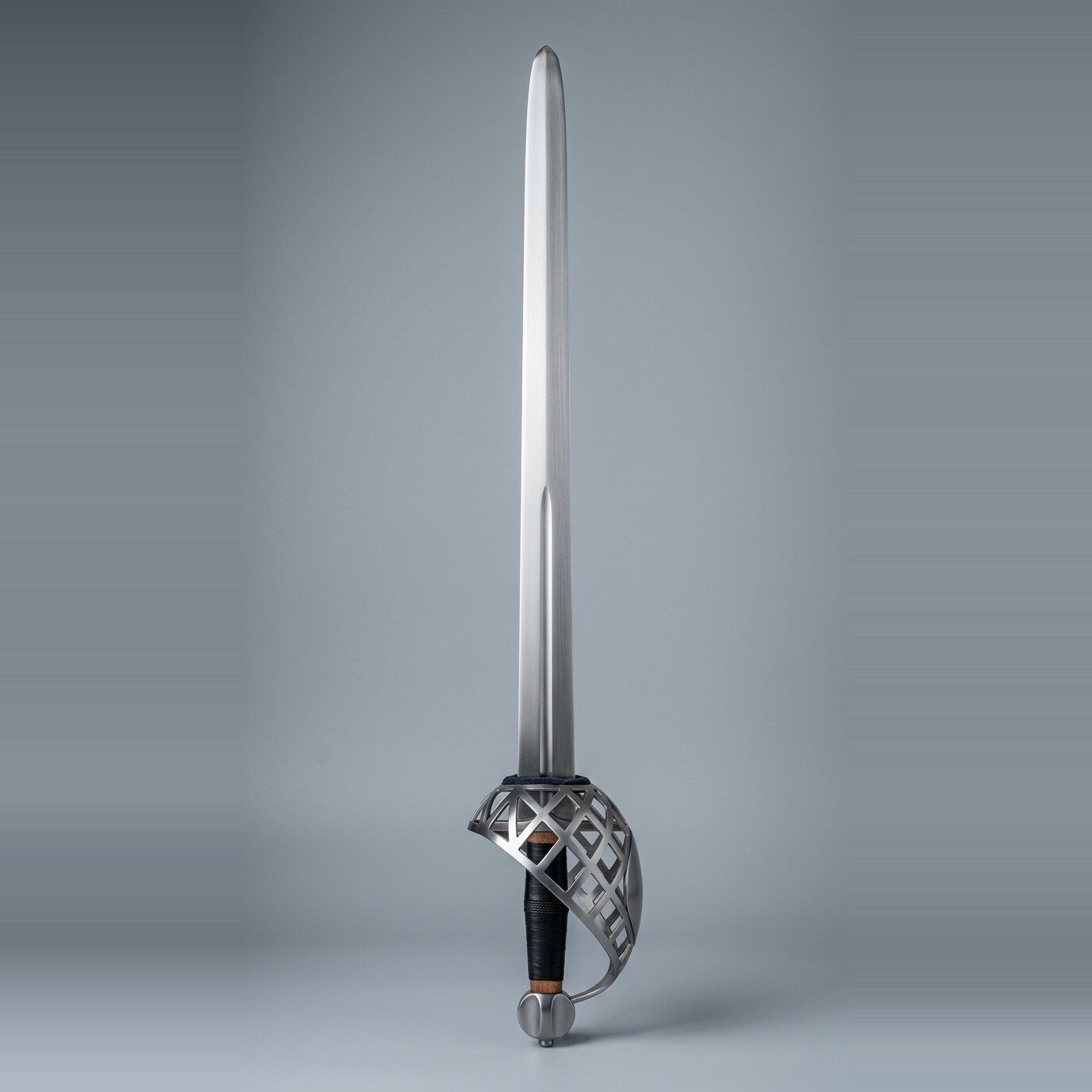
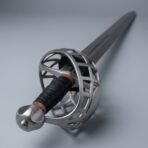
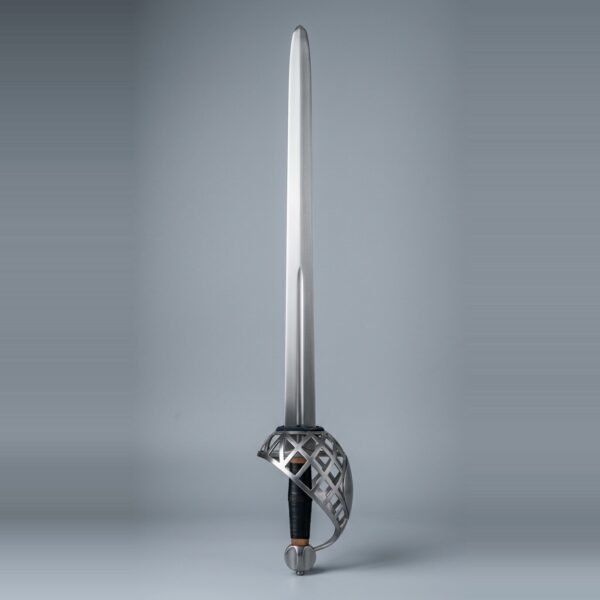
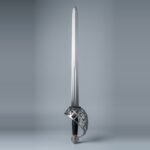
The schiavona is the basket hilted sword of the Venetian world, carried through the seventeenth century and well into the eighteenth by the soldiers Venice recruited from the Dalmatian coast. This piece is built in that style rather than copied from any one surviving sword, with a full basket of flat bars that wraps the whole hand and a lobed cap closing the top of the hilt.
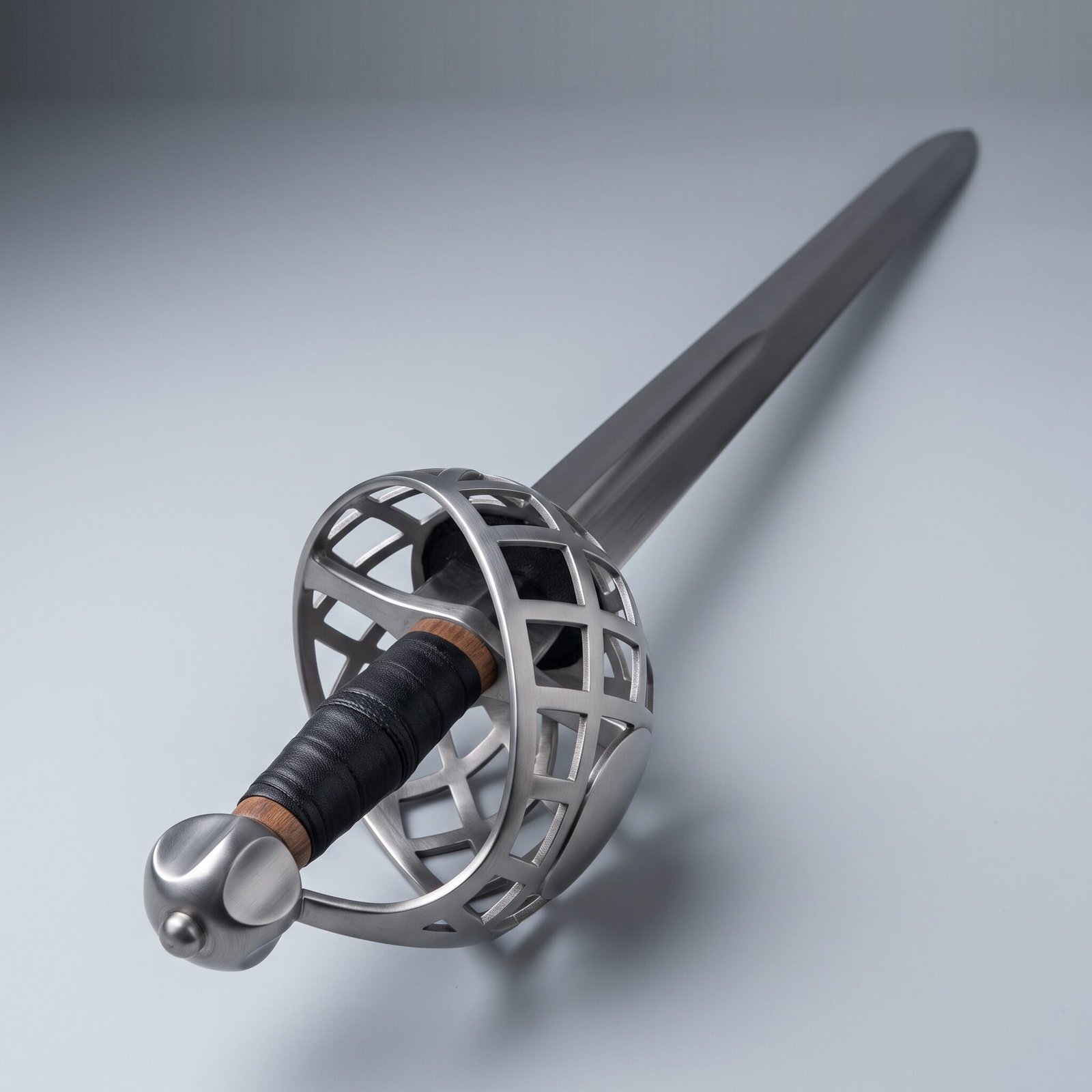
The blade is a blunt cut and thrust profile, broad enough to cut with and straight enough to thrust with, which is what the original hilt was married to. The basket is built from bars rather than plate, so it covers without enclosing the hand in a solid shell. The grip is ribbed and bound in black with a wooden ferrule at each end, and the pommel above it is a plain lobed cap.
If you are weighing a basket hilt against an open hilted sword, read rapier against sidesword and how to choose your first HEMA sword. The rest of the cut and thrust hilts are in HEMA sideswords.
Specifications
| Material | 51CrV4 spring steel, hardened to 49 to 52 HRC |
|---|
| Overall length | About 41 inches, hand made so it varies a little piece to piece |
|---|
| Blade length | About 34 inches |
|---|
| Blade type | Straight double edged blunt, cut and thrust profile with a central fuller at the forte |
|---|
| Edge | Blunted, about 3 mm flat land, not sharpened |
|---|
| Tip | Rolled and flared, about 15 mm across |
|---|
| Guard | Full basket of flat bars in a lattice, schiavona style, joined to the pommel by the knuckle bar |
|---|
| Grip | Ribbed and bound in black leather with a wooden ferrule at each end |
|---|
| Pommel | Lobed steel cap with an end button, peened over the tang |
|---|
| Flex | Medium tier, the working range for cut and thrust |
|---|
| Included | Sword only. No scabbard. |
|---|
| SKU | RK-3014 |
|---|
The schiavona style basket and the cut and thrust sword of the seventeenth century
By the seventeenth century the argument about hand protection was settled. A fencer who kept a sword out in front of them was going to be hit on the hand, and the answer across Europe was to build a cage around it. Italy, Scotland, England and the German states all arrived at basket hilts of one kind or another, and the schiavona is the Venetian answer, associated with the Dalmatian troops in Venetian service.
What makes a basket different to fence with is that the hilt itself becomes part of the defence. You stop needing to void the hand out of every line, which means you can hold a forward guard and stay there, and you can take a bind with the hand where it is most useful instead of where it is safest. The trade is weight and the loss of the finger over the ricasso, so point control comes from the wrist and the whole arm rather than from a finger hooked forward.
The blade is the other half of it. A straight cut and thrust blade in a basket is a military sword: it will throw a cut from the shoulder, hold a thrust down a line and take a hard displacement without complaint. Fence it in gloves, a mask with back of head protection, a gorget and a rated jacket. A basket protects your hand and does nothing at all for your partner’s.
Bar basket geometry, blade section and where the mass sits
A basket made from flat bars behaves differently from one pierced out of plate. Bars give you gaps, which means airflow and a lighter hilt, and they take a blow by flexing very slightly rather than by denting. They also mean that a thin blade can find a gap, which is why gloves stay part of the kit even with a hilt like this one. The lobed cap closes the top of the basket and locks everything to the tang.
All that steel around the hand sits behind the balance point, so the sword handles lighter than its overall weight suggests. The blade can then be built broad enough to cut without the whole thing turning into a club. The blade carries a central fuller through the forte, with a flat edge land ground on both sides, over the 2 mm minimum that club and tournament gear lists ask for.
Steel is 51CrV4 hardened to 49 to 52 HRC rather than the 1095 at 54 to 58 HRC we use on cutting swords. Spring steel at this hardness bends and returns instead of taking a set or snapping under a hard bind, and a sword that invites forward guards will meet plenty of hard binds. Flex is in the medium tier, the band the market sells at roughly 25 to 29 lb, with light at 15 to 21 lb and strong or tournament grade at 30 to 43 lb above it. We name the tier rather than a figure. The tip is rolled and flared to about 15 mm across, matching the at least 1.5 cm rolled or spatulated tip that the Berlin HEMA Cup requirements describe.
Engraving, runes and your own design
Use the rune converter on this page to turn a name, a date or a short phrase into Elder Futhark and we will cut it into the steel or the grip. On this one the outer bars of the basket and the flat of the blade below the basket both take a rune line, and the wooden ferrules can take one too if you would rather have it in wood than steel.
Text and runes are $19, a symbol is $39 and a family crest is $49, and the work is done in the United States after the piece has landed and passed inspection. If you would rather have your own design than a rune line, choose your own design in the engraving option above the add to cart button and tell us where it goes. Where a piece already carries an engraved design, your chosen engraving replaces it rather than sitting alongside it. More on the engraving page.
Handling and balance
Put the hand in and the first thing you notice is that you stop thinking about it. The basket takes the job of protecting the fingers away from you, and what is left is a straightforward cut and thrust sword that wants to be held out in front. The ribbed grip and the wooden ferrules keep the hand from sliding along the grip inside the cage, which matters more here than on an open hilt because you cannot simply regrip mid bind.
Hand size is worth thinking about before you order. A basket is a fixed volume, and a large hand in a thick glove will fill it. We do not publish a weight, a point of balance or an internal measurement of the basket. There is no scale in the photograph, every hilt is bent and fitted by hand, and a number printed here would be a guess rather than a measurement.
Care
A basket collects sweat in every corner and holds it there. Wipe the inside of the bars out after every session with a rag pushed through the gaps, then oil the blade and the inner faces of the basket before the sword goes back in the bag. Neglect this and the rust starts inside the hilt where you cannot see it.
Check the wooden ferrules and the seat of the lobed cap for movement every few sessions, because a basket loosens from the top down. Take any burr on the edge land back flat with a fine file rather than chasing it into an edge. Our full routine for oiling, rust and long storage is in the care guide.
Made in the Czech Republic
Made by hand in the Czech Republic and imported by Ransack Viking. Nothing here is drop shipped out of an importer catalogue straight to a customer. Every one is checked for hilt tightness, pommel seating and blade straightness at our Chicago, Illinois warehouse, and ships from there. Shipping in the United States is free, returns run for seven days, and the lifetime warranty against defects in the forging, the grind, the heat treat and the fittings has no end date and needs no receipt.
Every bar in a basket like this is bent, fitted and joined by hand, so the joints of the cage and the seating of the lobed cap get the closest look of anything in the range when the crate is opened, along with blade straightness.
A note on handmade variation
This is hand forged. It is not machine made, not cast and not bulk produced, so what arrives will not be a pixel for pixel copy of the photograph on this page. No two baskets come out identical. The bars are bent by eye, the gaps between them vary, the lobed cap is filed to shape rather than cast, and the wooden ferrules take a slightly different finish from batch to batch.
This is built in the schiavona style and it is not a reproduction of any particular surviving sword, so treat the photograph as a good likeness rather than a drawing. Every one still leaves the workshop straight, tight and blunted to the same standard.
Frequently asked questions
Whether this is a copy of a particular original
No. It is built in the schiavona style, with a full bar basket and a lobed cap, and it is not measured off any one surviving sword. We would rather say that plainly than dress a modern trainer up as a reproduction.
How a basket changes the way you fence
It lets you hold a forward guard without spending all your attention on hand safety, and it takes away the finger over the ricasso, so point control moves into the wrist and the arm. Most fencers adapt inside a session or two.
Whether it fits a large hand in a glove
A basket is a fixed volume and heavily padded gloves take up room. We do not publish an internal measurement because every hilt is bent by hand, so if you fence in bulky mitts, factor that in before ordering.
Whether a scabbard is included
No. This ships as the sword alone and we do not sell a scabbard for it. Carry it in a padded bag and dry the inside of the basket before it goes in.
Whether it can be used for sparring
Yes, that is what it is built for. The blade is blunted along the full edge, the tip is rolled and flared, and the steel is a sparring hardness rather than a cutting one.
Whether the blade can be sharpened
Do not sharpen it. 51CrV4 at 49 to 52 HRC is chosen to bend and return under a bind, not to hold a cutting edge, and sharpening it would turn a safe trainer into something else.
What is in the box
- The Brekavik schiavona style basket hilt sword, blunted along the full edge.
- A protective film of oil on the steel, which comes off with a rag.
- A printed card covering oiling, drying out the basket and storage.
- The lifetime warranty against defects in the forging, the grind and the fittings.
Explore the range
More enclosed hilts sit in basket and shell hilt swords, the open cut and thrust hilts in HEMA sideswords, curved blades in HEMA sabres, and the whole training line under HEMA swords. The written side is in the guides.
Also in this part of the catalogue
Sitting alongside it in the catalogue are Thanmir sidesword, about 42 inches overall, Elmgarth sidesword, about 41 inches overall, Valdris sidesword, about 41 inches overall, Corvalde rapier, about 48 inches overall and Norvakt rondel trainer, about 18 inches overall.
See the HEMA sidesword category and the HEMA sword hub for the full spread, and the custom sword builder if none of them is right.




Reviews
There are no reviews yet