
Blog
D2 Steel for Knives: Pros, Cons and How It Compares

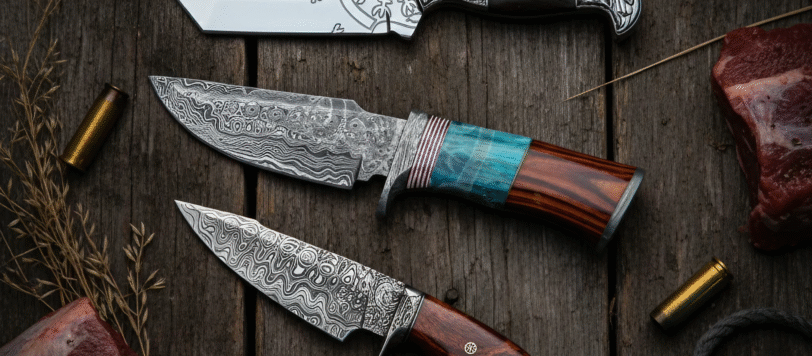
Yes, D2 is a good knife steel, and for many users it is a great one. D2 is a high-carbon, high-chromium tool steel (roughly 1.5% carbon and about 12% chromium) originally developed for industrial dies that stamp and cut other metals. In a knife, that translates to outstanding wear resistance and long edge retention at a working hardness typically around 58 to 62 HRC. Its trade-offs are just as real: D2 is only “semi-stainless,” it is harder to sharpen than simple carbon steels, and its toughness is moderate, so razor-thin edges can chip under hard impact. Here is the full picture, including how D2 compares with 1095, Damascus, and true stainless steels.
What Exactly Is D2 Steel?
D2 belongs to the family of cold-work tool steels, alloys designed to hold shape and resist abrasion while working harder materials. Its chemistry centers on two ingredients. High carbon (around 1.5%) forms hard chromium carbides throughout the steel; these microscopic particles act like teeth that keep cutting long after a softer steel would dull. Chromium at roughly 12% boosts wear resistance and gives meaningful corrosion protection, but because much of that chromium is tied up in carbides rather than free in the steel matrix, D2 falls just short of the free-chromium level needed to qualify as stainless. That is why knife people call it semi-stainless: it shrugs off humidity and casual moisture far better than 1095, yet it will still spot and stain if left wet or stored dirty.
D2 Steel Pros
Edge retention near the top of its price class
The dense carbide structure means a D2 edge keeps cutting through cardboard, rope, hide, and wood long after simpler steels need a touch-up. For hunters processing game or workers breaking down boxes all day, this is D2’s headline feature.
High attainable hardness
Properly heat treated, D2 runs around 58 to 62 HRC, which supports a crisp, stable edge and resists rolling in normal cutting tasks.
Better corrosion resistance than carbon steel
With about 12% chromium, D2 tolerates sweat, humidity, and field conditions far better than 1095 or other plain carbon steels, making it a low-stress choice for a pocket knife that rides against your body all day.
Proven, widely available, and fairly priced
D2 has been used in tooling for the better part of a century. Its behavior in heat treatment is thoroughly understood, so a well-made D2 blade from a competent maker is a known quantity rather than a gamble.
D2 Steel Cons, the Honest Part
It is not stainless
Leave a D2 blade wet in a sheath and you will find gray staining or rust spots. It needs less babying than carbon steel, but it still appreciates a wipe-down and occasional oil.
Sharpening takes more work
The same carbides that hold the edge resist your sharpening stones. D2 rewards diamond or ceramic abrasives and a bit of patience; with soft natural stones it can feel stubborn. The flip side: you sharpen it far less often.
Moderate toughness
D2 is not the steel for prying, batoning through knotty wood, or hard lateral abuse. At very thin edge geometry it can micro-chip rather than roll. Field knives in D2 should carry a slightly more robust edge angle than a carbon-steel equivalent.
Coarse edge character
D2’s large carbides mean it takes a wickedly aggressive slicing edge but is harder to bring to a perfectly polished, push-cutting razor finish than fine-grained steels. Most users never notice; straight-razor perfectionists do.
D2 vs Other Knife Steels
| Property | D2 (tool steel) | 1095 (carbon steel) | Damascus (1095/15N20) | Typical stainless |
|---|---|---|---|---|
| Edge retention | Excellent | Good | Good | Good |
| Toughness | Moderate | Very good | Very good | Good |
| Corrosion resistance | Semi-stainless | Low | Low | High |
| Ease of sharpening | Harder; diamond stones help | Very easy | Easy | Moderate |
| Typical hardness | 58 to 62 HRC | 56 to 60 HRC | 56 to 60 HRC | 56 to 59 HRC |
| Character | Workhorse, low maintenance | Traditional, easy to maintain | Unique pattern, hand-forged | Zero-fuss |
Numbers vary with heat treatment, but the pattern holds: D2 wins on wear resistance, carbon steels win on toughness and sharpening ease, and true stainless wins on corrosion. For a deeper look at the maintenance side of that triangle, see our Damascus steel vs stainless steel guide.
What Kind of Knife Should Be D2?
D2 shines wherever long cutting sessions meet limited sharpening opportunities. That makes it a natural fit for folding pocket knives that eat cardboard and rope all week, and for hunting knives that need to stay sharp through an entire animal without a mid-job touch-up. It also suits tracker-style knives and general camp blades, provided the edge is ground with a bit of muscle rather than to a fragile zero. Where D2 is the wrong answer: choppers and hard-use survival blades that see impact and prying, a tougher carbon steel serves better there, and marine environments, where true stainless earns its keep.
D2 vs Damascus: Different Answers to Different Questions
Buyers often cross-shop D2 and pattern-welded Damascus, but the two solve different problems. D2 is an industrial performance answer: maximum wear resistance per dollar, semi-stainless convenience, purely functional looks. Damascus made from 1095 and 15N20 is a craft answer: excellent all-around field performance, easy resharpening, plus a hand-forged pattern that makes the knife personal. A working hunter who values raw edge life may prefer D2; someone who wants an heirloom that cuts beautifully and looks like nothing else on the bench will land on Damascus, many end up owning both, as blades like our Viking knives demonstrate on the Damascus side of the aisle.
Is D2 Steel Good for Knives? FAQ
Is D2 steel good for knives?
Yes. D2 is a proven tool steel with excellent edge retention, high hardness around 58 to 62 HRC, and better corrosion resistance than plain carbon steels. Its trade-offs are harder sharpening and moderate toughness, which is why it suits cutting-focused knives more than chopping tools.
Is D2 steel stainless?
No. D2 contains about 12% chromium, but much of it is locked in carbides, leaving too little free chromium to qualify as stainless. It is best described as semi-stainless: notably more rust-resistant than carbon steel, yet still capable of staining if neglected.
Does D2 steel rust?
It can, though slowly. Sweat, salt, and long wet storage will produce gray staining or rust spots on D2. A quick wipe after use and a light coat of oil for storage keeps a D2 blade clean with far less effort than a carbon-steel knife demands.
Is D2 steel hard to sharpen?
Harder than average, yes. Its abundant chromium carbides resist abrasion, which is exactly what makes the edge last. Diamond or ceramic stones cut it efficiently; soft natural stones struggle. The practical upside is that you sharpen far less often.
Is D2 better than Damascus steel?
Neither is universally better. D2 typically holds a working edge longer and resists rust better; 1095/15N20 Damascus is tougher, much easier to resharpen, and carries a unique hand-forged pattern. Choose D2 for maximum wear resistance, Damascus for all-around field performance with character.
What hardness is D2 steel in knives?
Most D2 knife blades are heat treated to roughly 58 to 62 HRC. Within that window, makers balance edge retention against chipping risk, hunting and everyday-carry blades often sit near the middle so the edge stays both durable and serviceable.