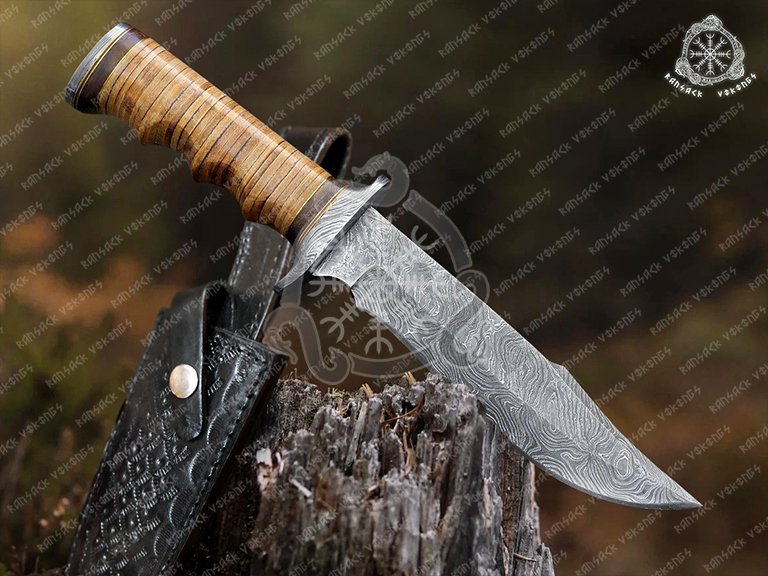
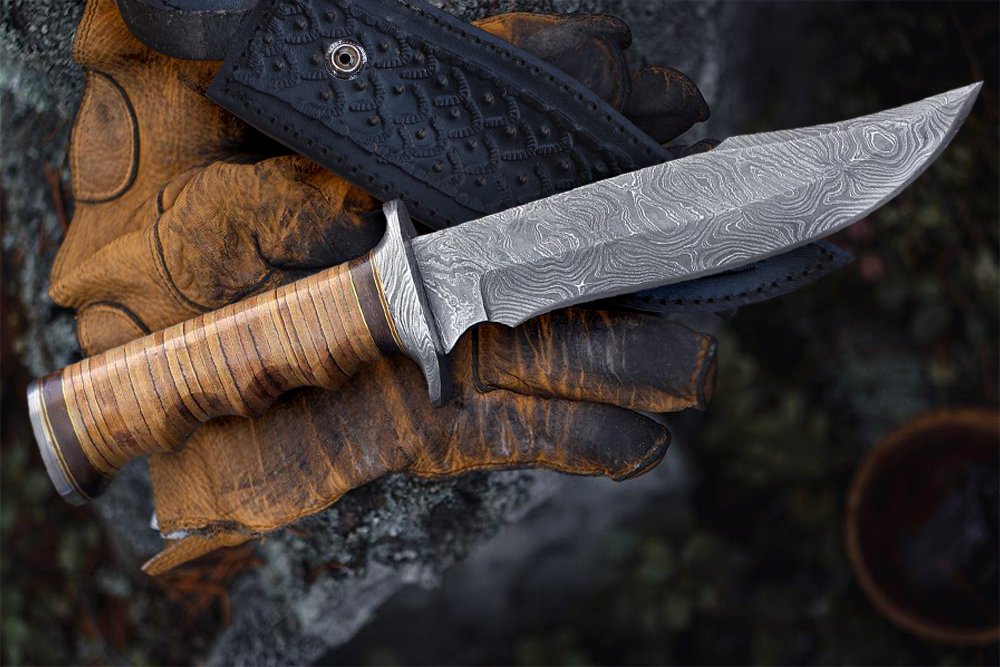
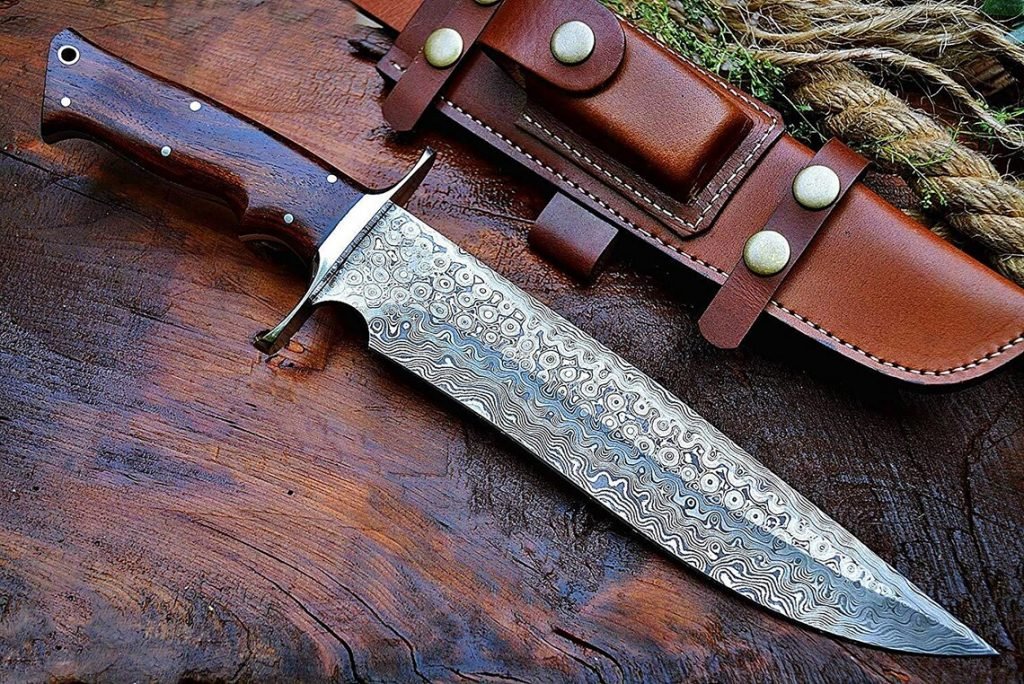
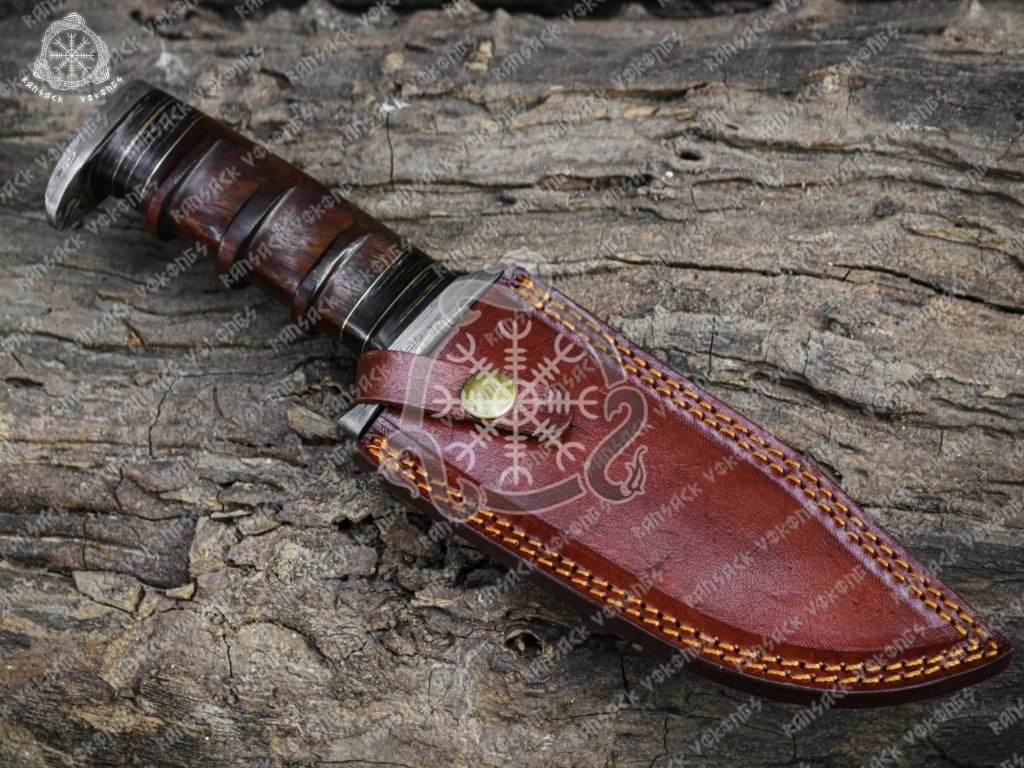
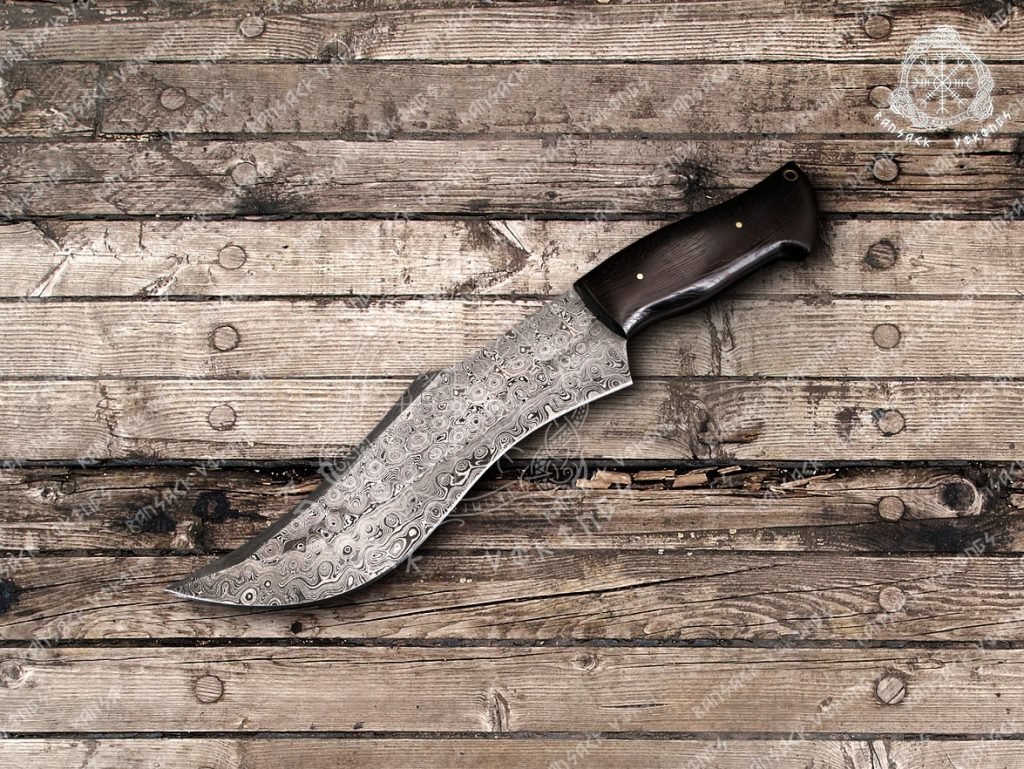
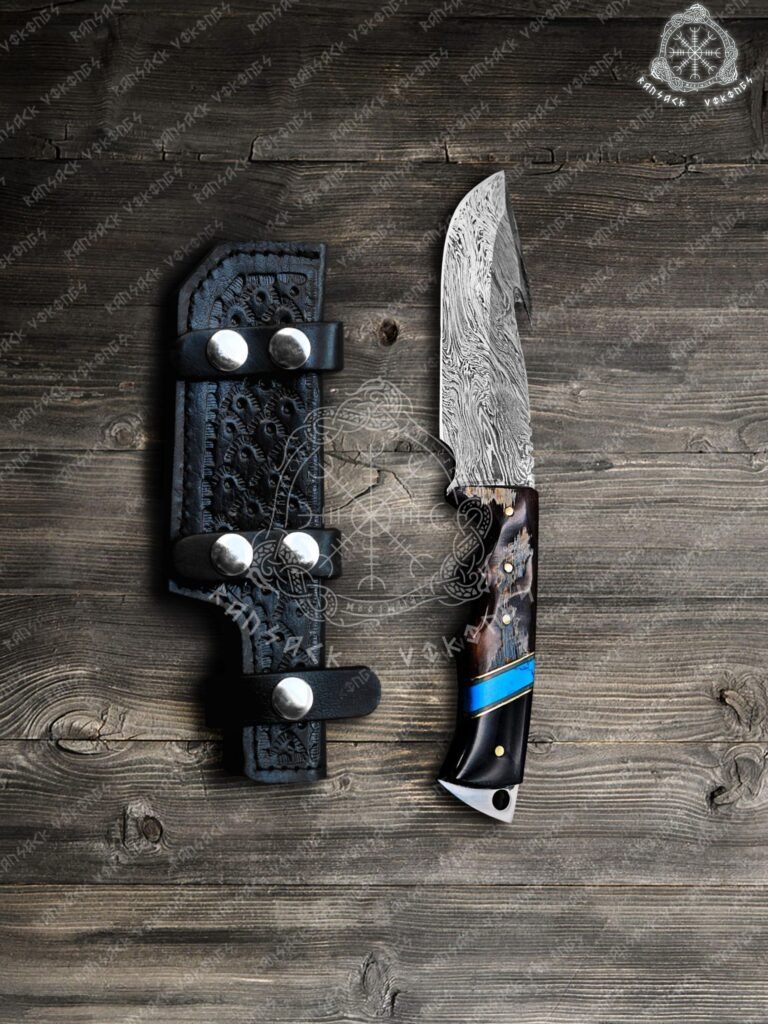
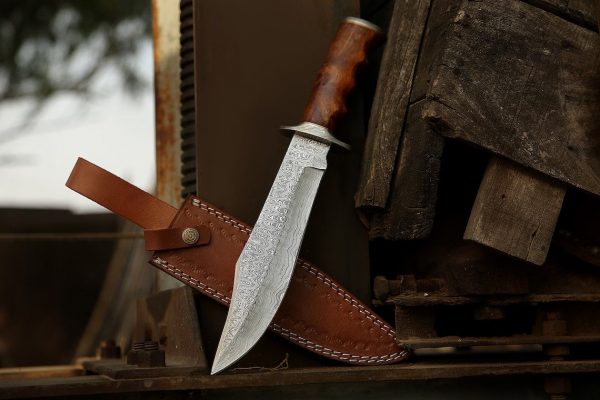
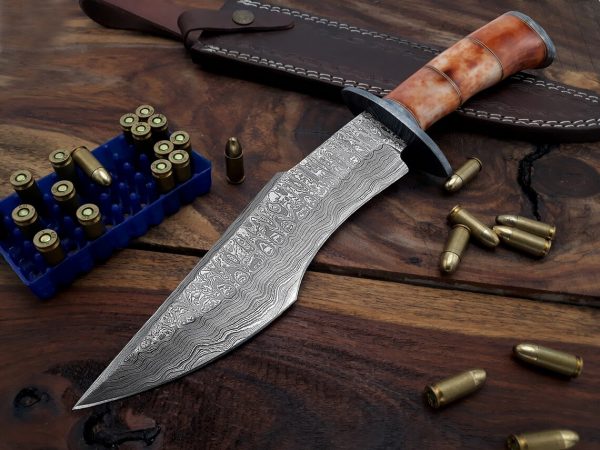
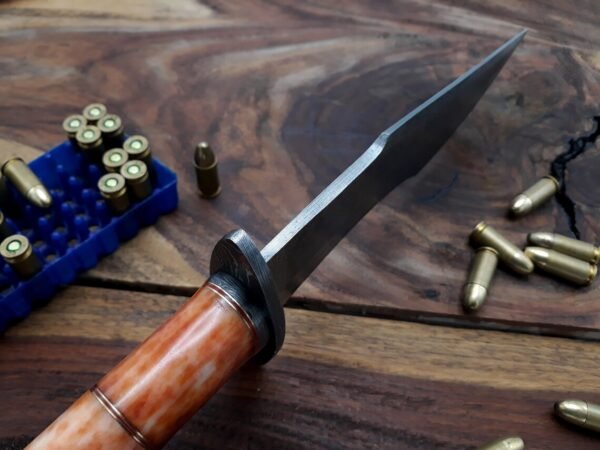
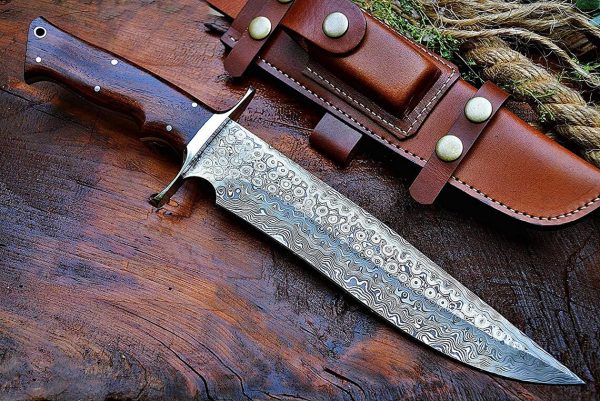
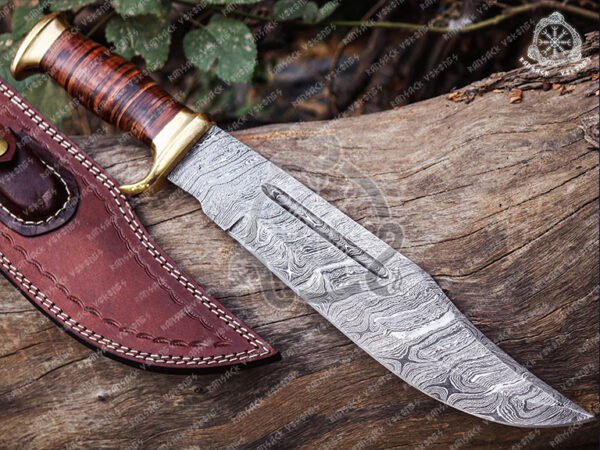
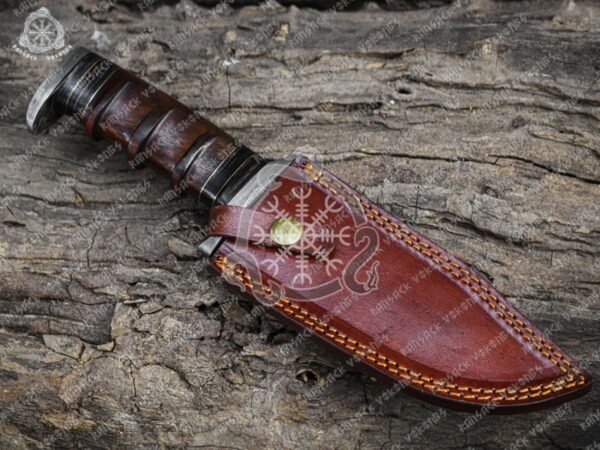
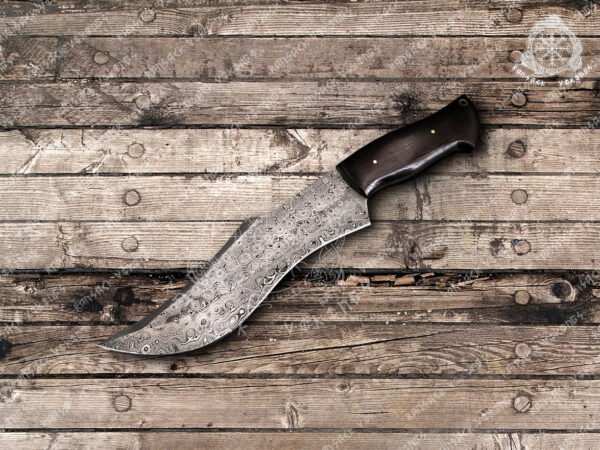
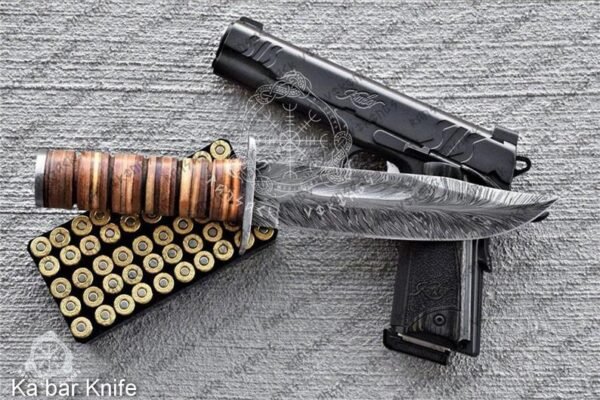
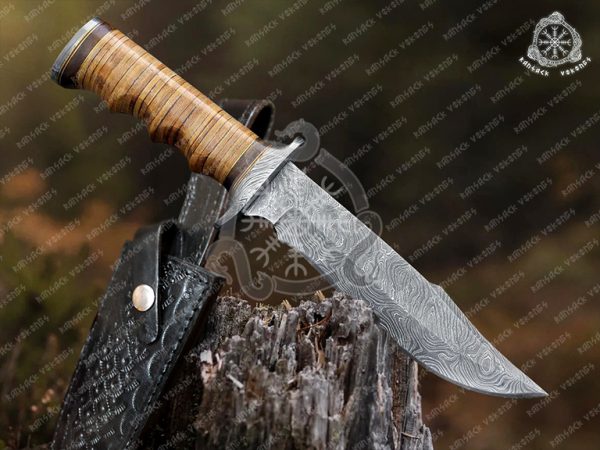
There is nothing stamped about the Staghide. The Damascus blade is drawn out under the hammer from a 352 layer billet, the handle is built up from stag horn and stacked leather rings against a Damascus bolster, and the whole Bowie knife is finished before it is boxed. Ten and a half inches overall on a 6 inch blade, ten and a half ounces in the hand, and the balance sits just ahead of the guard where a Bowie should carry it.
The pattern is named after a man and a specific fight. Jim Bowie was carrying a large knife of his brother Rezin’s design at the Sandbar Fight near Natchez in September 1827, a duel that turned into a general brawl; Bowie was shot and stabbed and still killed one of his attackers with it. The newspaper accounts travelled, and within a few years American cutlers and Sheffield exporters were selling knives labelled Bowie by the thousand. Almost none of them matched whatever the original actually looked like, which is still argued over. What stuck was the concept: a big fixed blade with a guard, a long belly for slicing and a clipped point for control.
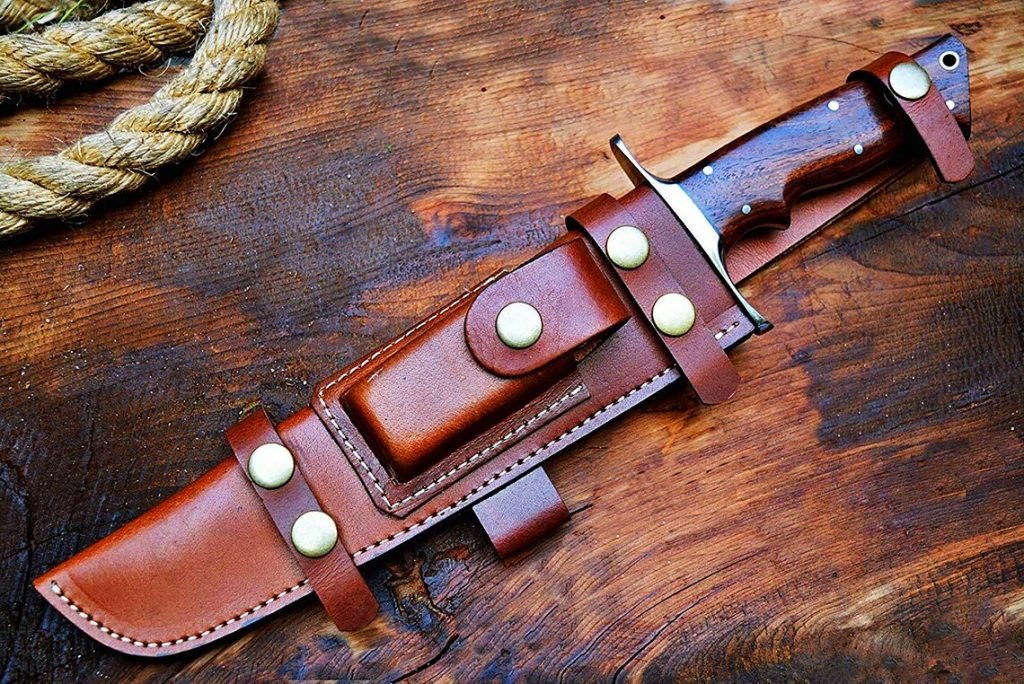
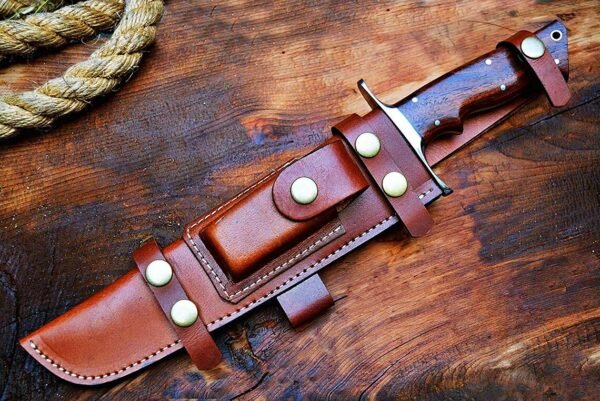
Forged and finished in Memphis, Tennessee. It ships with a leather sheath, protective packaging and an edge that is ready to work.
Specifications
| Steel | Hand forged Damascus, 1095 and 15N20 |
|---|
| Hardness | 58 to 60 HRC |
|---|
| Damascus layers | 352 layers |
|---|
| Overall length | 10.5 inches |
|---|
| Blade length | 6 inches |
|---|
| Handle length | 4.5 inches |
|---|
| Weight | 10.5 oz |
|---|
| Handle | Stag horn and stacked leather with Damascus bolster |
|---|
| Sheath | Leather sheath |
|---|
| SKU | RK 385 |
|---|
What the clip point is for
The clip is the section of the spine that has been cut away in a concave sweep from about a third of the way back to the tip. It exists to solve a specific problem: a big knife has a thick spine, and a thick spine carried all the way to the point gives you a tip like a chisel that will not enter anything cleanly and cannot do fine work.
Clipping the spine drops the point down towards the centre line of the blade and thins the last inch and a half of steel dramatically. What you get is a tip fine enough to start a cut in hide, pick a knot loose or do detail work at a joint, on a knife that is otherwise built for heavy slicing. It also puts the point roughly in line with the axis of your forearm, which is why a Bowie steers so naturally.
Behind the clip sits the belly, and that long shallow curve is the working part of the blade. It keeps a long arc of edge in contact through a draw cut, which is what makes a Bowie good at skinning and camp butchery as well as general chopping. The guard is not decoration either. On a knife with this much mass, it is the thing that stops your hand travelling forward onto the edge when the point stops suddenly.
Why Damascus and not stainless
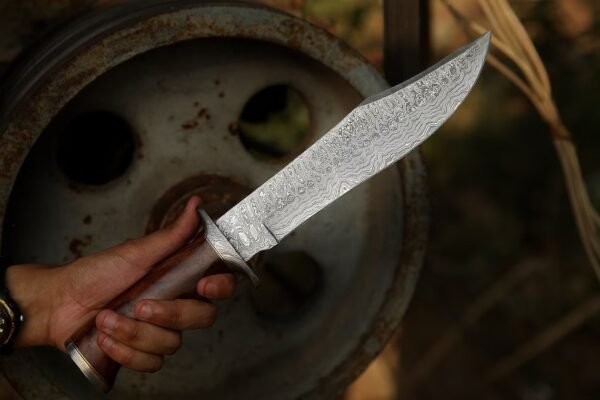
The billet is built from alternating layers of 1095 and 15N20, forge welded, folded and drawn down to 352 layers before the blade is cut from it. That is why the pattern follows the grind instead of running flat across it, and why it cannot wear off. Hardened to 58 to 60 HRC, the 1095 carries the edge and the 15N20 carries the toughness, which matters on a blade this size because a Bowie takes lateral loads a kitchen knife never sees.
Stainless would need less maintenance. It also, at the sizes and price points this knife competes with, tends to be run softer to keep it from chipping, and it will not hold an edge through a long day of camp work the way a properly tempered carbon Damascus will. Wipe this blade dry, keep a film of oil on it and it will not rust. Leave it in a wet sheath and it will. The whole comparison is in Damascus versus stainless.
Stag horn, stacked leather and why that combination
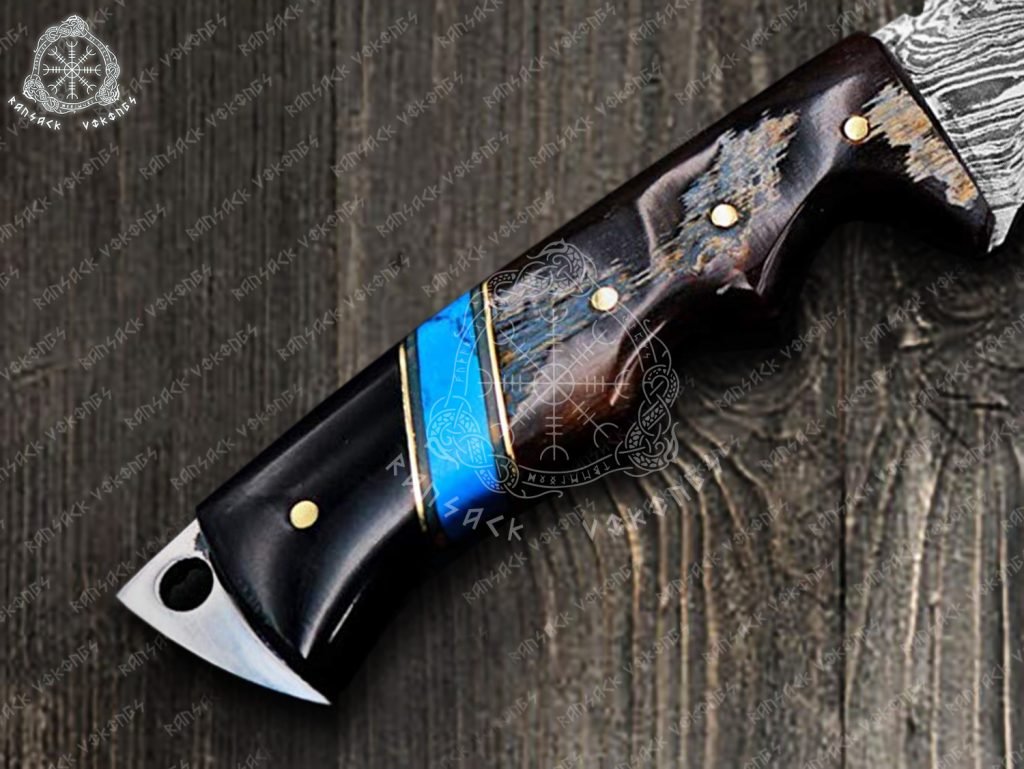
This handle is two materials doing two jobs. The stag horn section gives you the grip. Stag has a natural texture that gets better rather than worse when your hands are wet or bloody, which is precisely the condition a hunting Bowie is used in, and no synthetic reproduces it convincingly.
The stacked leather section is the older trick. Discs of vegetable tanned leather are punched, threaded onto the tang, compressed hard under a nut and then turned and sanded to shape as if they were a solid block. It is the construction used on generations of American military knives for good reason: it absorbs shock, it stays warm and grippy in the cold, and it does not transmit impact into your palm the way a solid metal or hard synthetic handle does. Against the Damascus bolster you get a handle that damps a heavy chop.
Both materials are organic and both want feeding. Keep the handle out of long soaks, dry it after wet work, and give it a light coat of mineral oil or a leather conditioner once or twice a year so the horn does not dry and the leather discs do not shrink and loosen against the nut. The method carries over from wooden handle care.
Engraving, runes and your own design
Use the rune converter on this page to turn a name, a date or a short phrase into Elder Futhark and we will cut it into the steel or the handle. If you would rather have a Viking pattern than a rune line, choose your own design in the engraving option above the add to cart button and tell us whether it goes on the blade or the handle. Where a piece already carries an engraved design, your chosen engraving replaces it rather than sitting alongside it. A Bowie has more usable flat than anything else in the range, so a full name and a date, or a rune line of a dozen characters, sits comfortably above the bevel. See the engraving page.
Care and sharpening
Damascus is high carbon at heart, so it will rust if you leave it wet. Dry it after use and give it a wipe of mineral or camellia oil before it goes away for the season. Pay attention to the join between the blade and the bolster, because that is where water sits and hides.
Sharpening is ordinary work on a stone. On a blade this long, work in sections rather than trying to take the whole edge in one pass, and follow the belly with a slight rolling motion so you do not flatten the curve. A 1000 grit stone does the cutting, a 3000 refines, and a strop finishes. Never store the knife inside the leather sheath long term, since vegetable tanned leather holds moisture and tanning salts against steel. Both jobs are covered in steel care and sharpening with a whetstone.
Forged in Memphis
We forge in Memphis, Tennessee. The billet is stacked and welded here, the steel is worked hot, quenched, tempered and ground by hand here, the stag and leather are fitted here, and the sheath is cut and stitched to the finished blade rather than to a template. Nothing on this page is drop shipped from an importer catalogue.
A 352 layer billet takes time to build before a blade can even be cut from it, which is part of why processing runs one to two weeks before dispatch. US shipping is free, and returns are open for seven days from delivery.
A note on handmade variation
The Staghide is hand forged. It is not machine made and it is not bulk produced, so what arrives will not be a pixel for pixel copy of the photograph. Stag is the most variable material we work with: colour runs from pale cream through to deep brown, the surface texture is different on every piece, and the crown and the grooves are wherever the animal grew them. The stacked leather takes its own tone as it is turned, and the Damascus pattern lands differently on every blade.
The dimensions, the steel, the hardness and the build are the same every time. The character is not, and on a stag handled Bowie that difference is the reason people buy it.
Frequently asked questions
Is the Staghide full tang
The tang runs the full length of the handle and the stacked leather and stag are built onto it and drawn up tight under a nut at the pommel, which is the standard construction for a stacked handle and is what allows it to be re tightened rather than replaced.
Can a stacked leather handle come loose
It can compress very slightly over years of hard use, which is normal and is why the construction uses a threaded pommel. Keeping the leather conditioned prevents it. It is a repairable handle, unlike a bonded synthetic one.
Is a 6 inch Bowie big enough for camp work
Yes for almost everything short of felling. Six inches will baton kindling, prepare game, cut cord and handle food. If you want a chopper first and a knife second, look at the longer Bowies or at an axe.
What are 352 layers actually giving me
A finer, tighter pattern. Layer count changes how the Damascus looks rather than how hard it is; hardness comes from the heat treat. More layers mean a denser figure across a wide blade like this one.
Is the guard removable
No. It is fitted as part of the build and the handle is drawn up against it. That is what makes it strong enough to actually stop a hand under load.
Can I carry this legally
Fixed blade carry rules vary by state and by city, and a 6 inch blade is above the threshold in some of them. Most owners transport it sheathed for hunting and camping. Check your local law before carrying it on your person.
What is in the box
- One Staghide Damascus Bowie knife
- Leather sheath
- Protective packaging
- Care notes for carbon steel, stag horn and stacked leather
- Forged and finished in Memphis, Tennessee
Explore the range
Compare it against the other Bowie knives, the wider hunting knives and the Damascus skinner knives if you want a dedicated hide blade. Background sits in the guides.












Reviews
There are no reviews yet