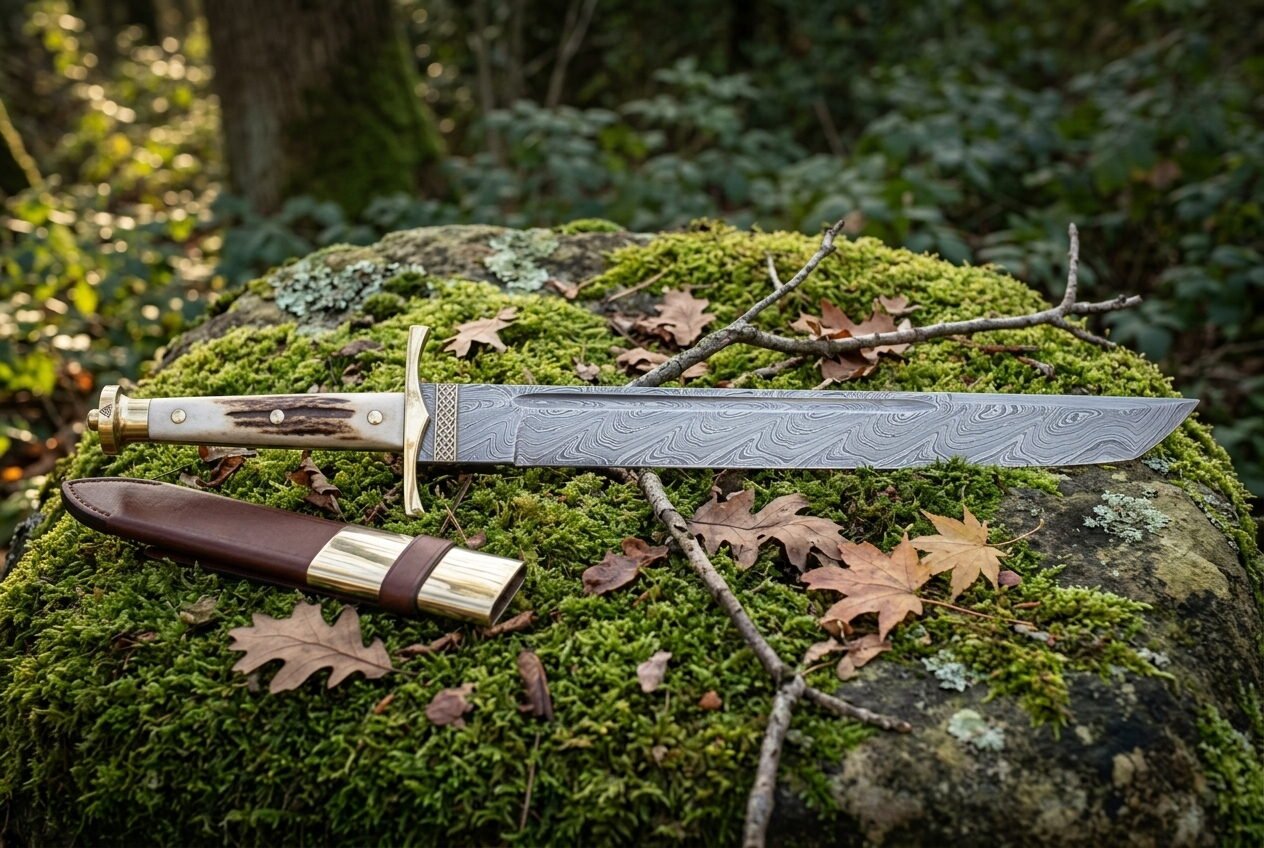
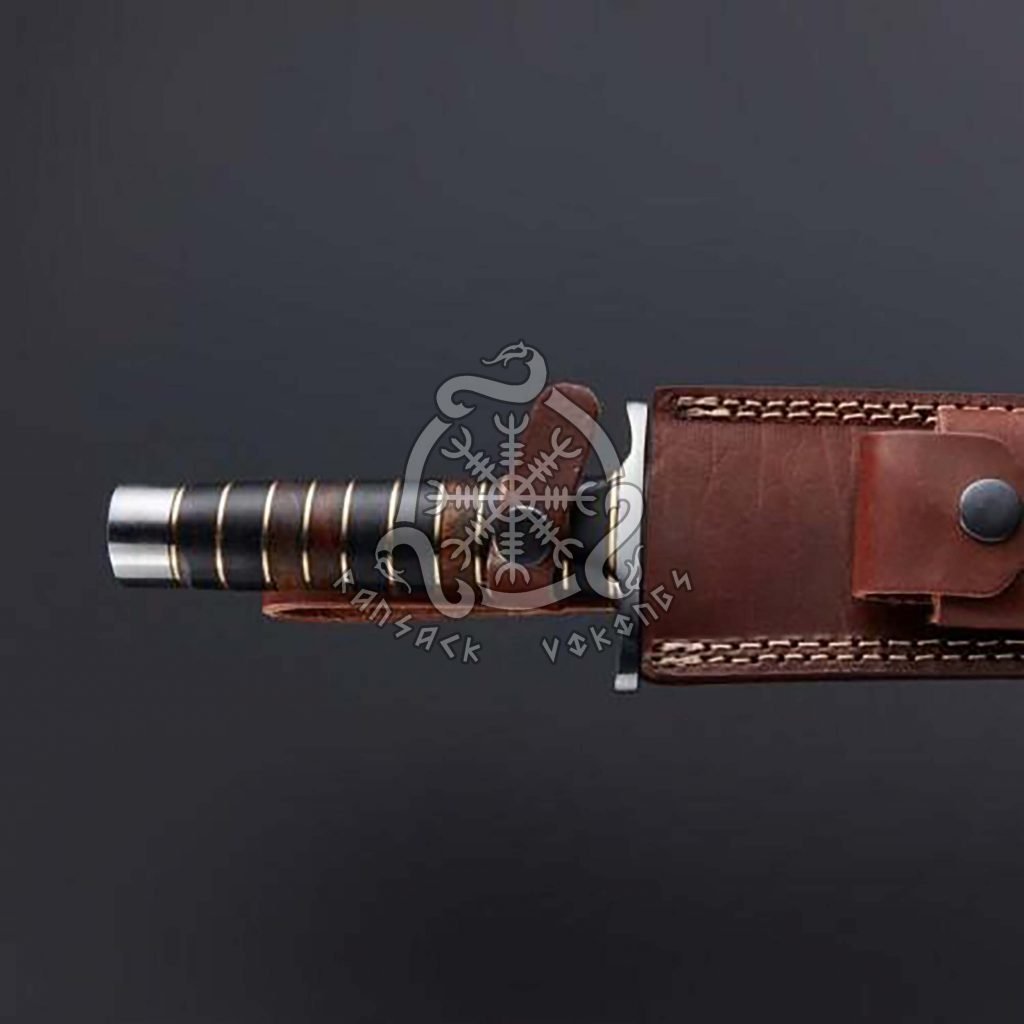
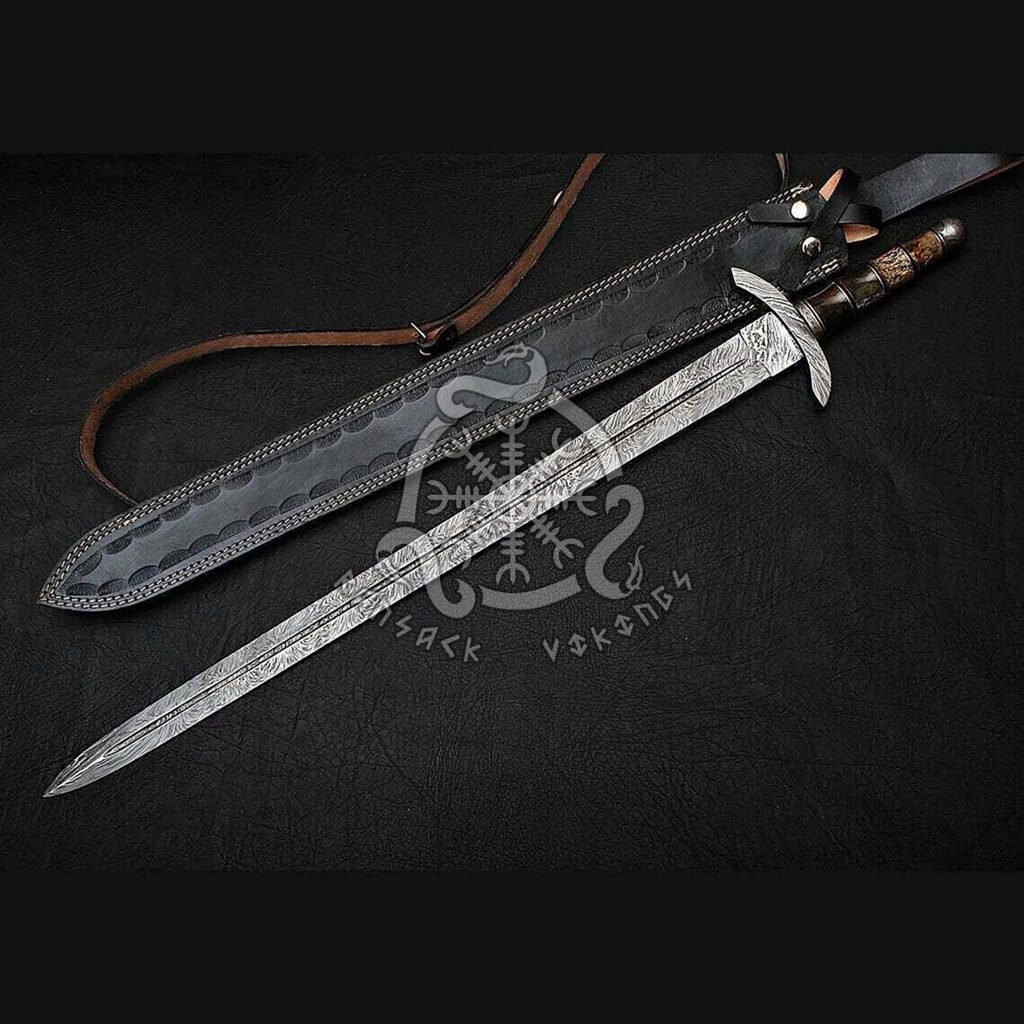
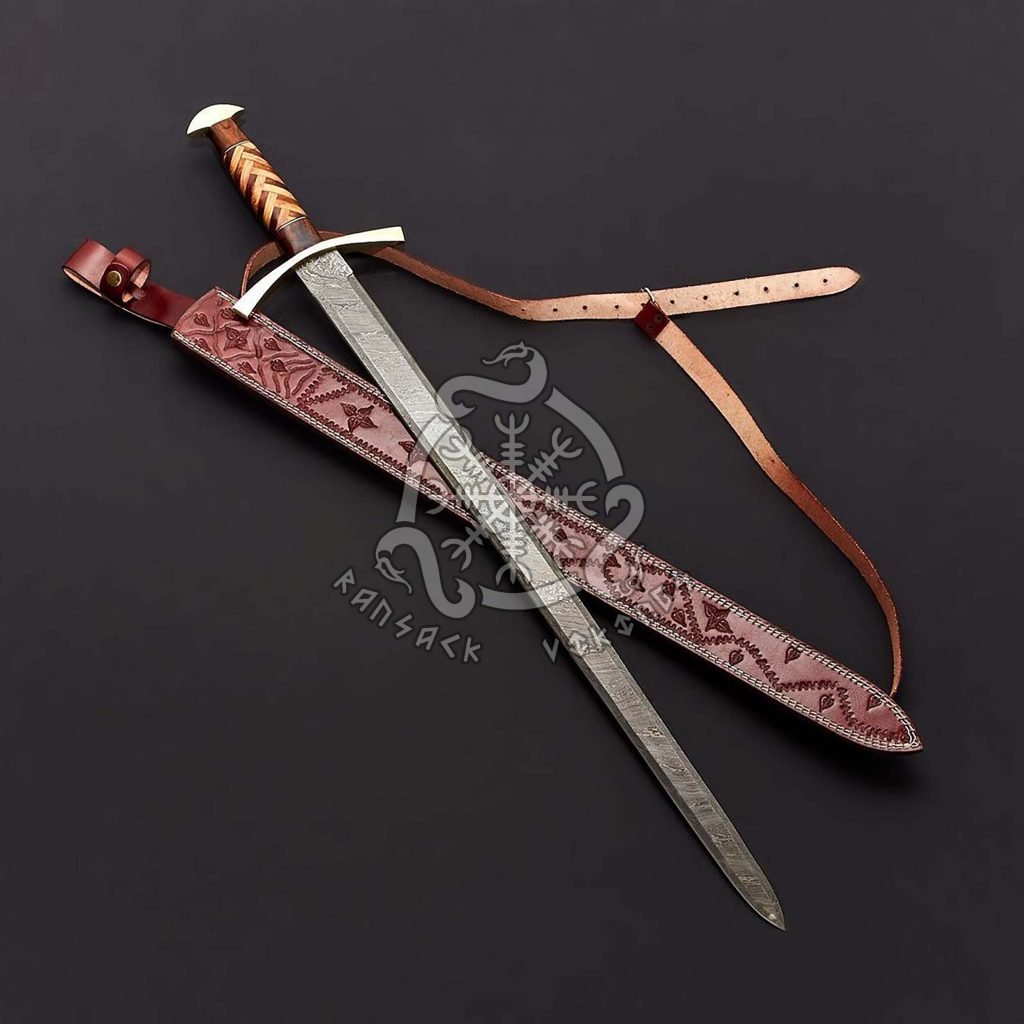
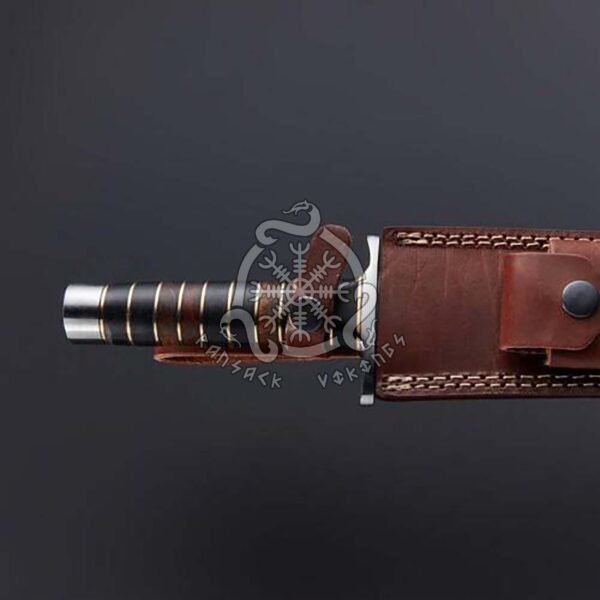
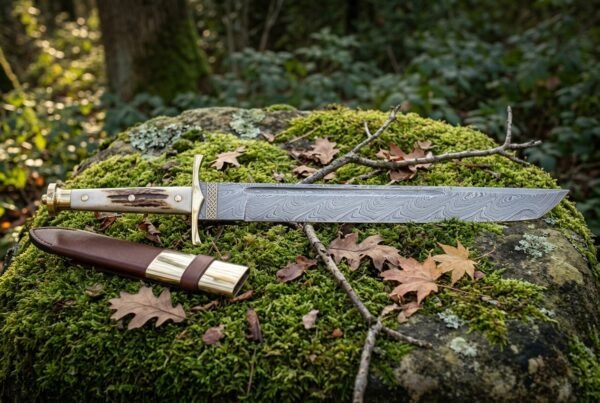
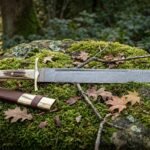
A seax was worn flat across the front of the belt with the edge turned upward, not hanging at the hip like a sword. Grave finds across England, Frisia and Scandinavia show them lying horizontally across the pelvis often enough that the position is not in doubt. The reason is practical. A long single edged blade hanging vertically fouls the legs and cannot be drawn while seated, on horseback or in a boat, all of which describe most of a Viking age life. Worn flat and edge up, the blade is reached by either hand, it comes out in one movement without the elbow travelling behind the body, and the weight sits across the hips where it is easiest to carry. The sheath in the photographs is built to hang that way. Stagwarden is a long seax in forge welded Damascus of 1095 and 15N20, hardened to 58 to 60 HRC, with an 18 inch blade under a stag antler handle.
Forge welded, ground, heat treated, etched and mounted by hand in our shop in Memphis, Tennessee. It ships with the brown leather sheath shown and a protective coat of oil on the blade. Shipping inside the United States is free.
Specifications
| Steel | Forge welded Damascus of 1095 and 15N20 |
|---|
| Hardness | 58 to 60 HRC |
|---|
| Overall length | 24.5 inches |
|---|
| Blade length | 18 inches |
|---|
| Blade profile | Broad single edged langseax with a broken back clipped point and a deeply etched layer pattern |
|---|
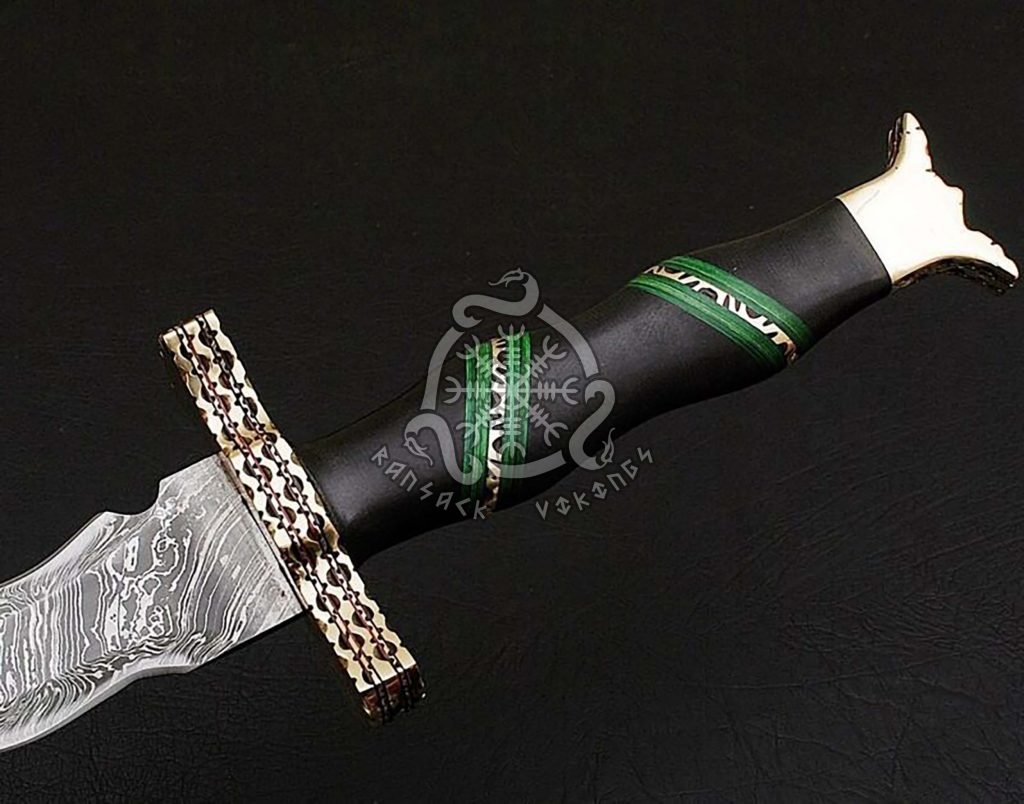
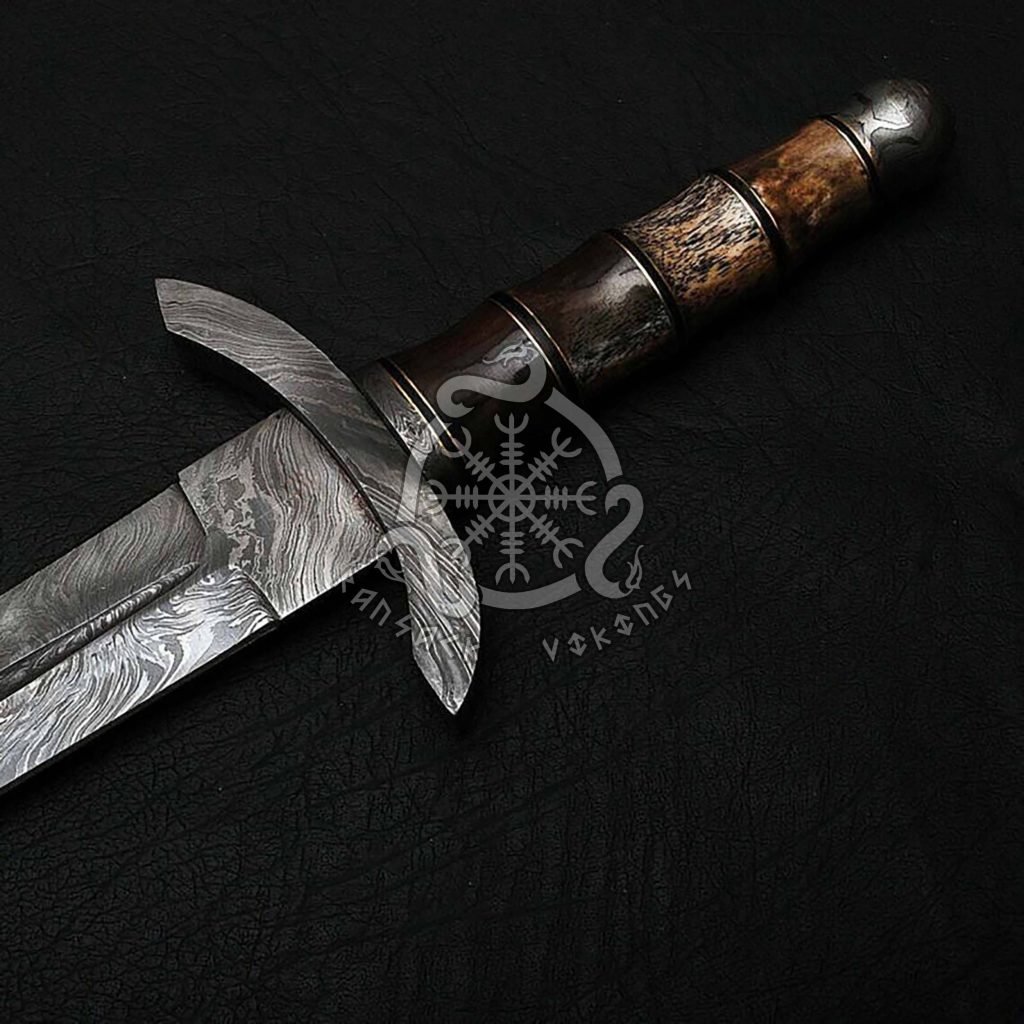
| Handle | Natural stag antler over a full length tang |
|---|
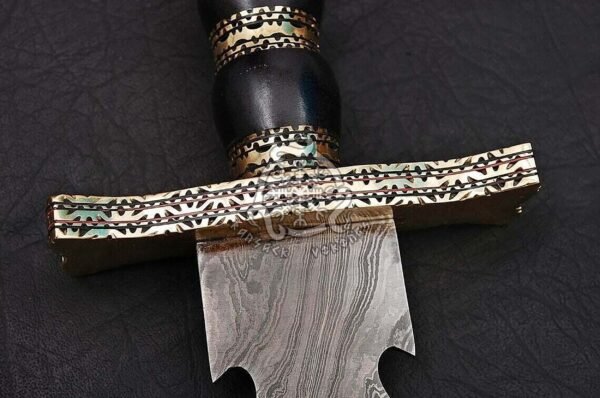
| Guard | Brass cross guard with a matching brass pommel |
|---|
| Sheath | Brown leather with a brass throat and belt loop |
|---|
| Weight | Approximately 2 pounds bare, 2.5 pounds sheathed |
|---|
| SKU | RK-1282 |
|---|
Why antler was the default handle material
Antler turns up on more surviving Viking age knife handles than any other material, and it was not chosen for looks. Deer shed their antlers every year and grow a new set, so an entire settlement had a renewable supply of a hard structural material arriving free each spring, without killing anything for it. That alone would explain its use, but antler also happens to be very well suited to the job.
Structurally it is a natural composite. The outer wall is dense compact bone, hard and stiff, and the core is a porous cancellous structure a bit like a stiff foam. Engineers spent the twentieth century deliberately building sandwich panels on exactly that principle, a hard skin over a light core, because it gives you high stiffness at low weight and it absorbs shock rather than transmitting it. A handle made of antler is therefore hard on the outside where it needs to resist wear, and quietly cushioned inside, which is why a heavy chopping blade with an antler grip is less punishing on the hand than the same blade with a solid one.
The surface is the other half of it. Antler is naturally ridged and pitted, and it grips better with a wet or bloody hand than a smooth polished handle does, which for a butchering and fighting tool is not a small thing. What it costs is uniformity. Every piece of antler is a different diameter, a different curve and a different colour, so every handle has to be fitted individually and no two come out alike.
Why forge welded Damascus and not stainless
The pattern in this blade is the steel itself. Two steels are stacked and welded together at forging heat, 1095 for the carbon that lets the edge harden properly and 15N20 for toughness and the nickel it carries. The billet is drawn out and folded until a stack of a dozen layers has become hundreds, then ground to shape, which cuts through the layers at a shallow angle and exposes them across the surface. The etch bites the 1095 dark and leaves the nickel bearing layers bright, and that contrast is the pattern.
Neither of those steels contains chromium, and that is deliberate. Chromium is what makes a steel stainless, and it is also what would stop the blade etching into a visible pattern and what coarsens the carbides that limit how fine a stainless edge can be. This blade will rust if left wet, and the etched face holds moisture a little more readily than a bright polish, so it wants oil and a wipe. That is the trade, set out properly in Damascus versus stainless.
Looking after antler and leather
Antler asks for very little. Wipe it dry, keep it out of long soaking and out of hot direct sun, and it will outlast everyone reading this. If it looks chalky after a few years, a trace of light oil worked in with a cloth restores the depth. What antler dislikes is being dried out quickly, so keep the seax off sunny windowsills and away from radiators, because fast drying is what starts fine cracks in any natural material.
There is no wood on this piece, but the same principles apply to every natural handle material and they are set out in wooden handle care. The leather sheath wants a light dressing once or twice a year and should be dried slowly rather than fast if it ever gets soaked.
Engraving, runes and your own design
Use the rune converter on this page to turn a name, a date or a short phrase into Elder Futhark and we will cut it into the steel or the handle. If you would rather have a Viking pattern than a rune line, choose your own design in the engraving option above the add to cart button and tell us whether it goes on the blade or the handle. Where a piece already carries an engraved design, your chosen engraving replaces it rather than sitting alongside it. On this piece the blade is the better surface for a long line, because antler is uneven by nature, though short marks cut into antler beautifully. See the engraving page for what fits where.
Care and sharpening
Wipe the blade after every handling and keep a thin film of light mineral oil on the etched surface. If the pattern looks faint over time it has usually been burnished flat by hands rather than lost, and a light re etch brings the contrast straight back. Avoid long term storage inside the leather sheath in a damp room, because vegetable tanned leather is mildly acidic and holds moisture against steel.
Sharpening is straightforward. The long straight section of the edge takes ordinary water stones easily at the angle it was ground at, and the alternating hard and tough Damascus layers mean the edge takes slightly longer to raise a burr and then holds it well. Finish on a fine stone and strop it. Full detail in steel care and sharpening with a whetstone.
Forged in Memphis
The billet is stacked, forge welded and drawn out here in Memphis, Tennessee, and the antler is cut and fitted here as well. Nothing is bought in as finished Damascus bar from an importer catalogue, and nothing on this site is drop shipped. That is why Damascus carries a longer lead time than plain steel, because all the pattern welding happens before the normal work of making a blade even starts. Most Damascus orders leave within two to three weeks and engraving adds a few days. If a piece is going to run longer than that we write to you before the date rather than after it.
A note on handmade variation
Stagwarden is hand forged. It is not machine made and it is not bulk produced, so what arrives will not be a pixel for pixel copy of the photograph. Antler is the least uniform material we work with, so the handle you receive will differ in diameter, curve, ridging and colour from the one shown, and it can range from pale grey through to warm brown. The Damascus pattern is unique to the billet it was drawn from and no two are alike. The brass tones its own way and the leather takes dye unevenly. Dimensions, steel and build are the same every time. The character is not.
Frequently asked questions
Will my antler handle look like the one in the photograph?
Close in shape and size but not in detail. Antler is a natural material with its own ridging, curve and colour, and each handle is fitted individually. Expect the same piece, not the same pattern.
Is the Damascus pattern real?
Yes. Forge welded 1095 and 15N20 running through the full thickness of the blade. Grind into it and the pattern continues, because it is the structure of the steel and not a surface finish.
Does it arrive sharp?
Sharpened and ready to use. Ask in the order notes if you want it blunt for reenactment, for display or for a household with children, and there is no extra charge. Most reenactment societies require blunt edges, so check your group rules first.
Can I have runes engraved on it?
Yes, and a seax is the most historically fitting piece in the range for it, since inscribed seaxes genuinely survive. Use the rune converter on this page for Elder Futhark, or choose a Viking pattern in the engraving option above the add to cart button. The blade is the better surface for a long line.
How does this compare to the bone handled seax?
Same blade, same steel, same fittings. Bone is smoother, harder and more uniform in colour. Antler is ridged, grippier in the wet, absorbs shock better and is completely individual piece to piece. It is a question of feel and of looks rather than of performance.
How long does shipping take?
Free inside the United States. Damascus pieces take two to three weeks in the shop, longer with engraving, then two to five days in transit.
What is in the box
- Stagwarden hand forged Damascus seax in 1095 and 15N20
- Brown leather sheath with brass throat and belt loop
- Protective oil coat on the blade
- Damascus care card covering oiling, antler, leather and re etching
- Elder Futhark rune engraving where selected
- Forged and finished in Memphis, Tennessee
Explore the range
Browse the rest of the Viking seax, the full Damascus sword range, the wider Viking weapons, or read the guides.








Reviews
There are no reviews yet