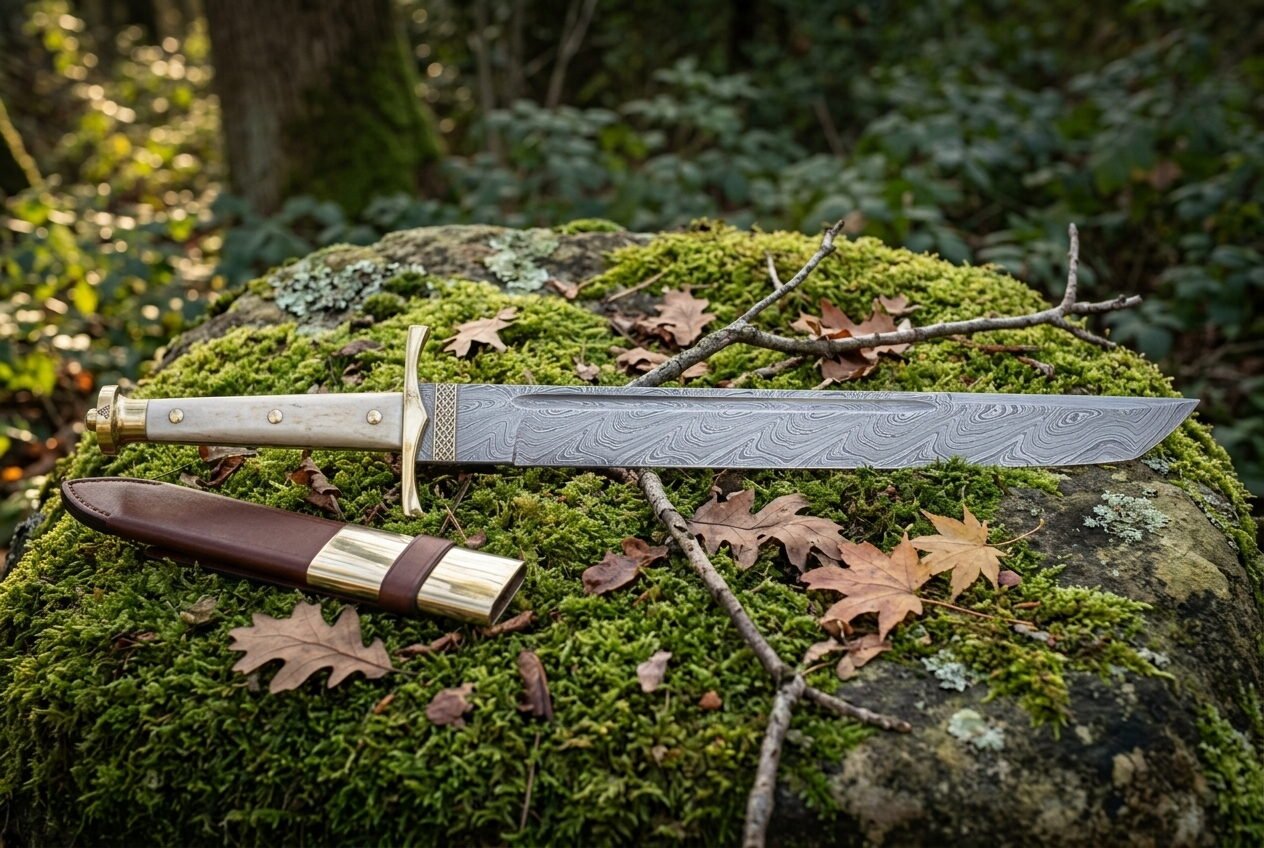
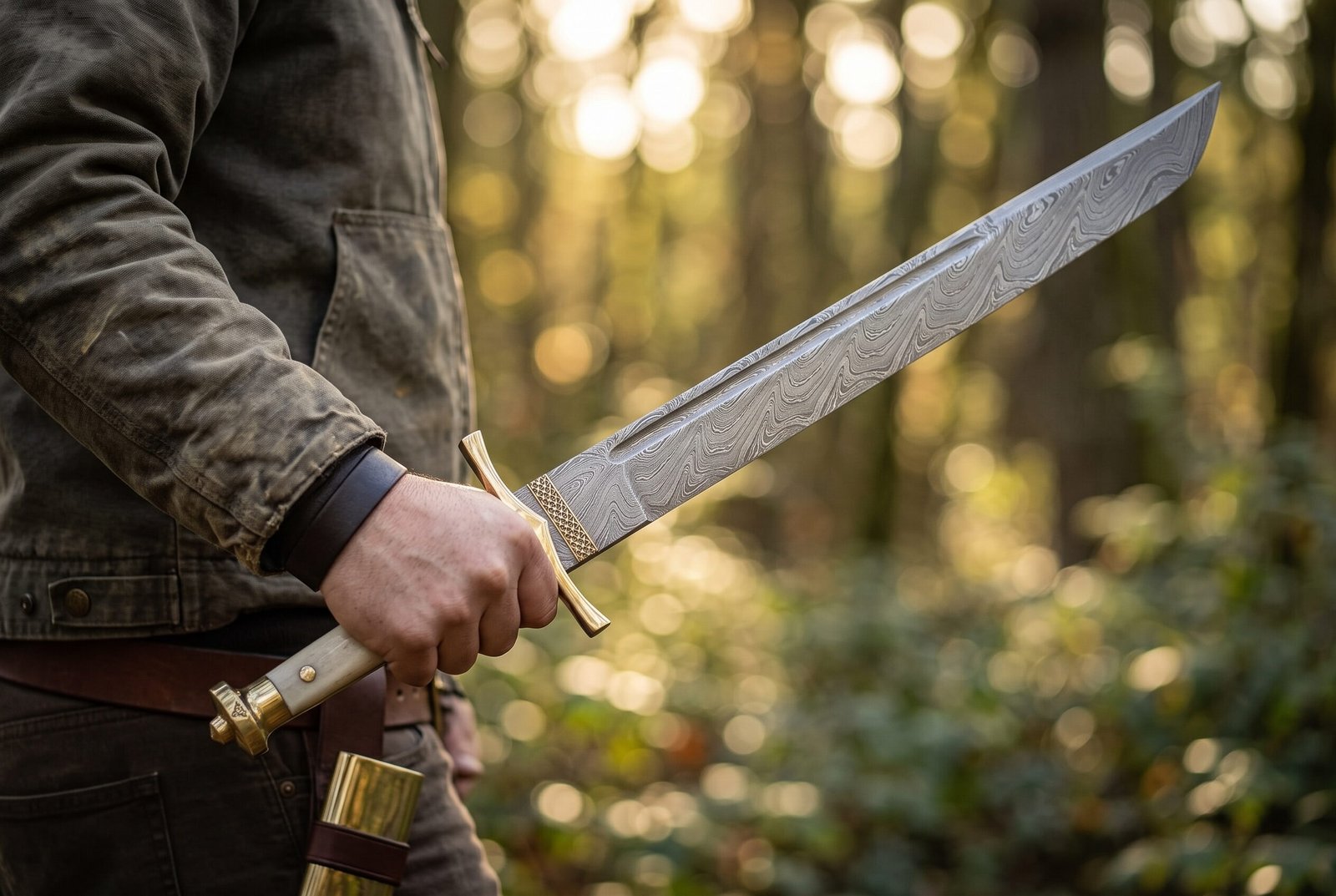
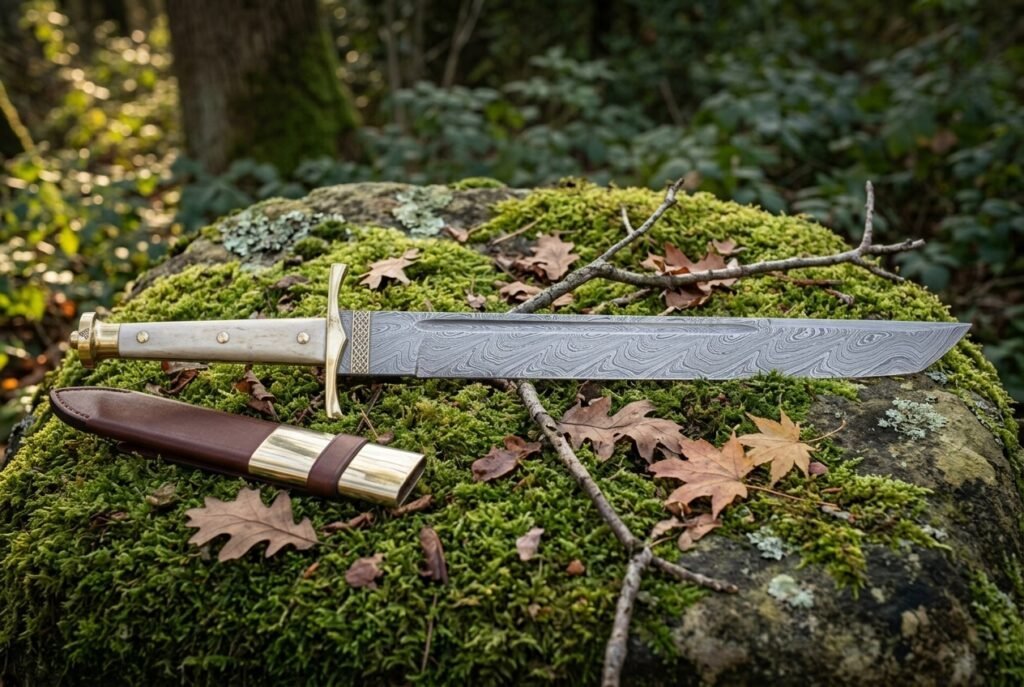
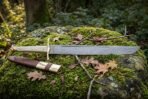
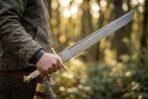
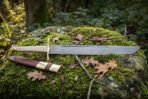
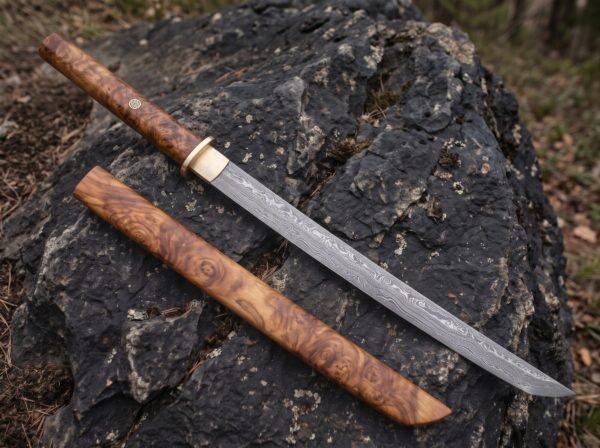
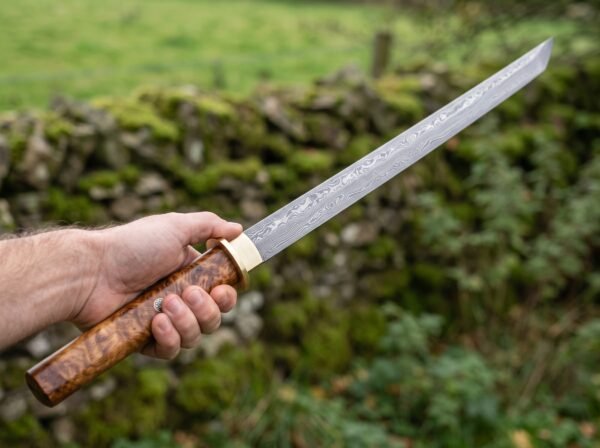
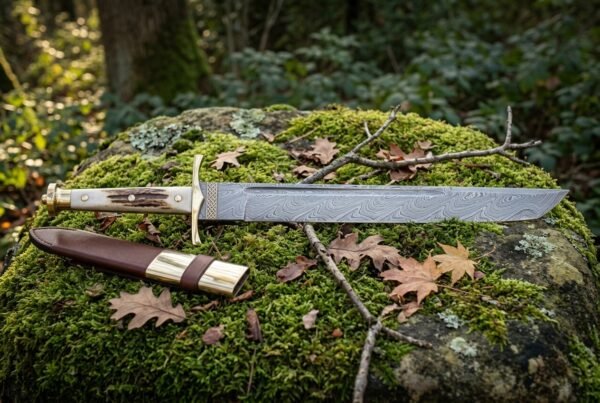
The seax is the blade that named a people. The Saxons took their name from it, and for four hundred years across northern Europe it was the one blade almost everyone owned, from a farmer with a six inch working knife to a warrior carrying a langseax nearly as long as a sword. It is always single edged, always heavy in the forward half, and it was carried horizontally across the front of the belt with the edge upward, which is why so many are found in graves lying flat across the hips. What made it universal was that it did everything. It butchered, it cut wood, it ate dinner, and it fought, and unlike a sword it was not restricted by law or by wealth to a particular class of man. Bonewarden is a long seax in forge welded Damascus of 1095 and 15N20, hardened to 58 to 60 HRC, with an 18 inch blade. The history behind this shape is written up in the knife every Viking carried.
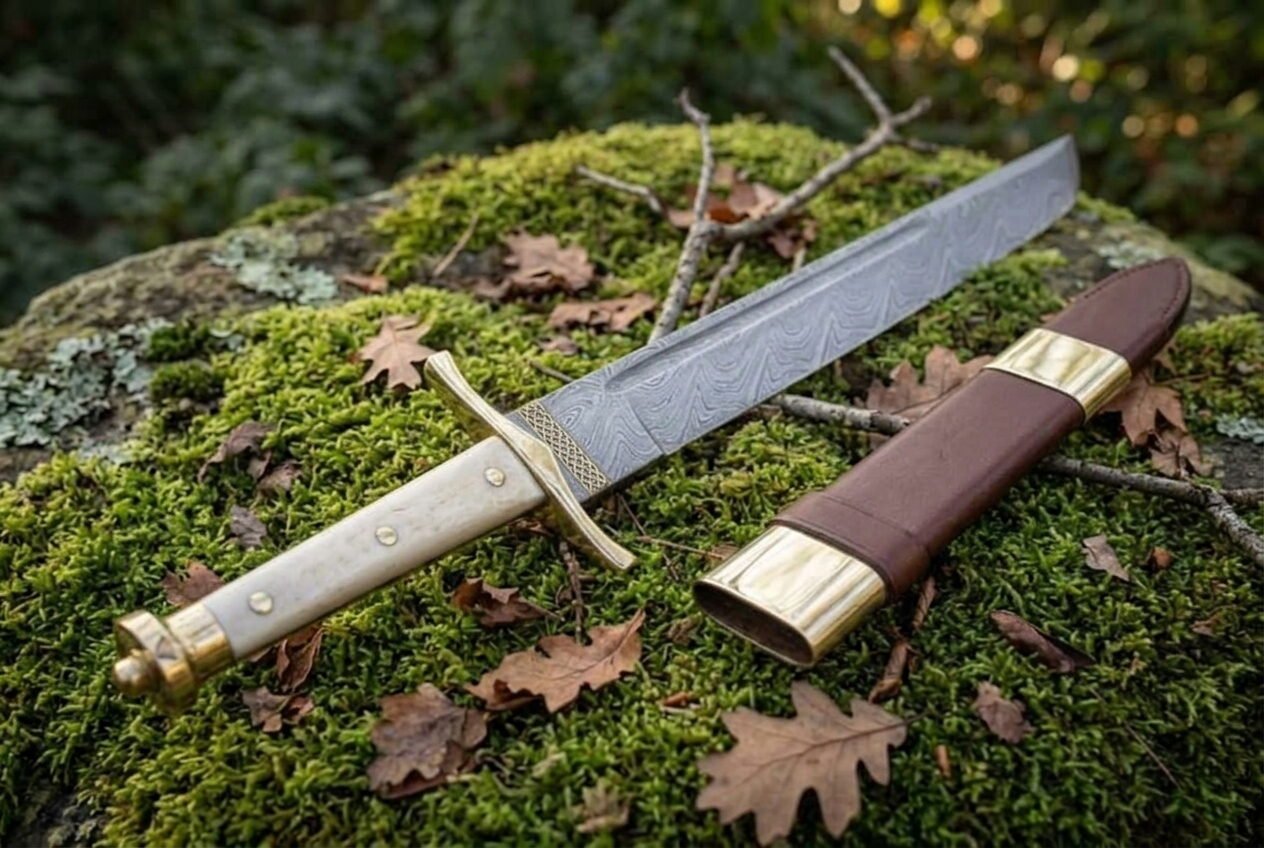
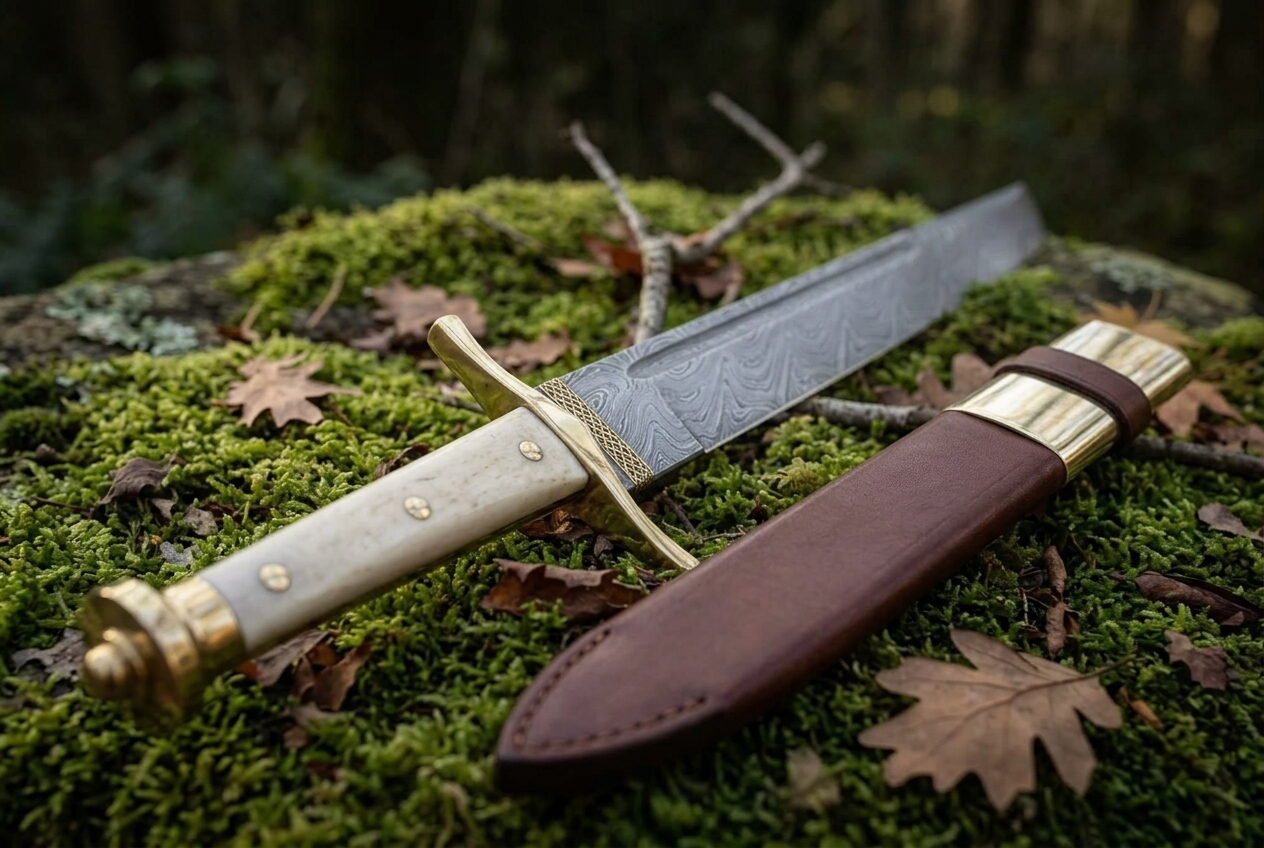
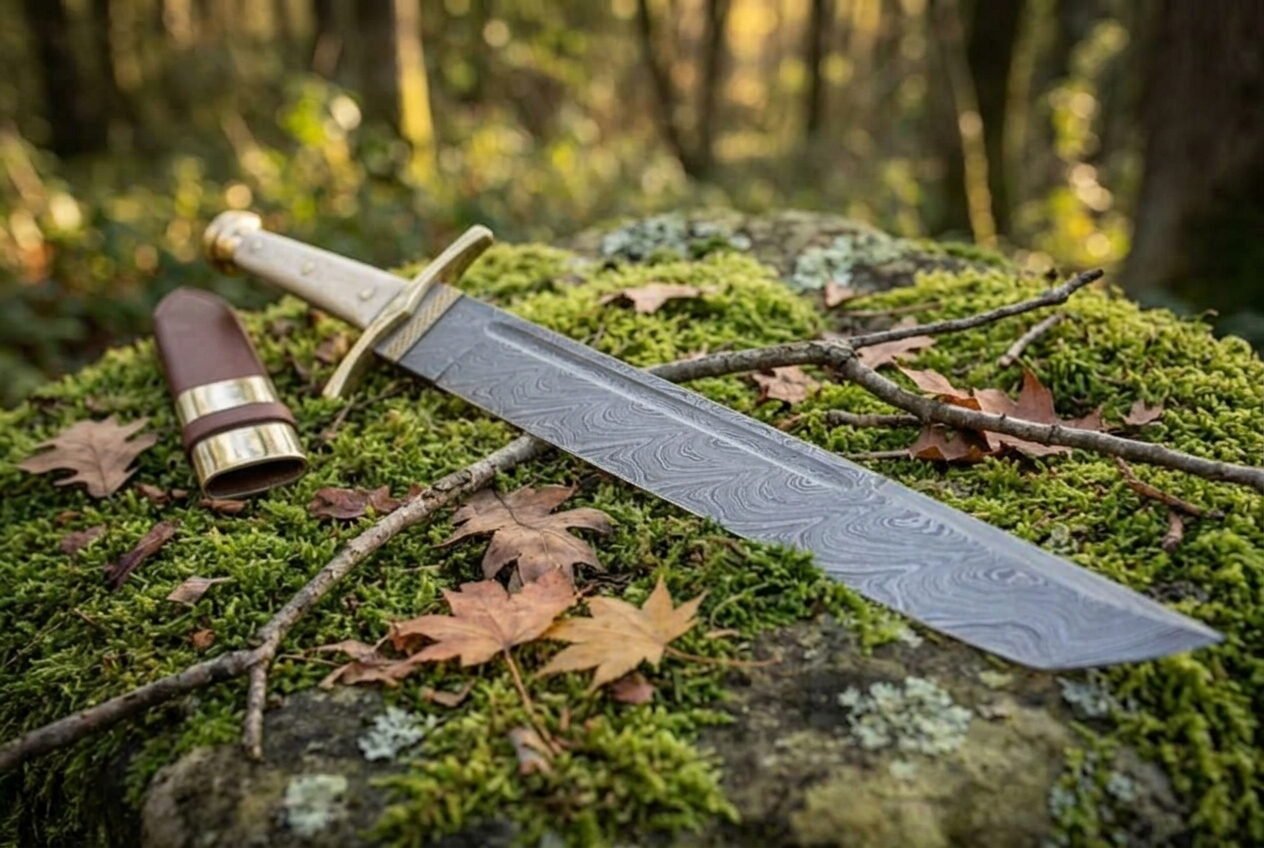
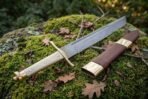
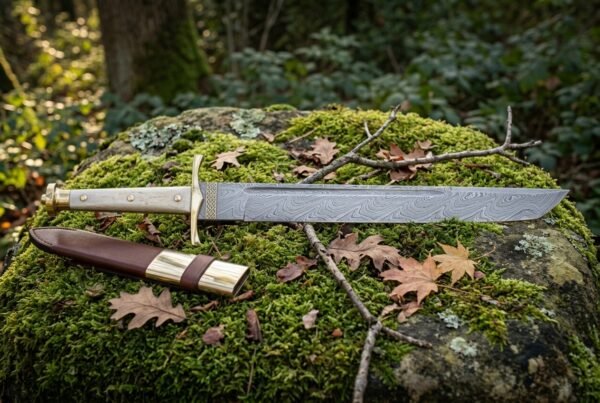
Forge welded, ground, heat treated, etched and mounted by hand in the Czech Republic. It ships with the brown leather sheath shown in the photographs and a protective coat of oil on the blade. Shipping inside the United States is free.
Specifications
| Steel | Forge welded Damascus of 1095 and 15N20 |
|---|
| Hardness | 58 to 60 HRC |
|---|
| Overall length | 24 inches |
|---|
| Blade length | 18 inches |
|---|
| Handle length | 6 inches |
|---|
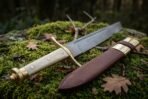
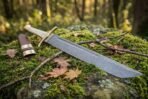
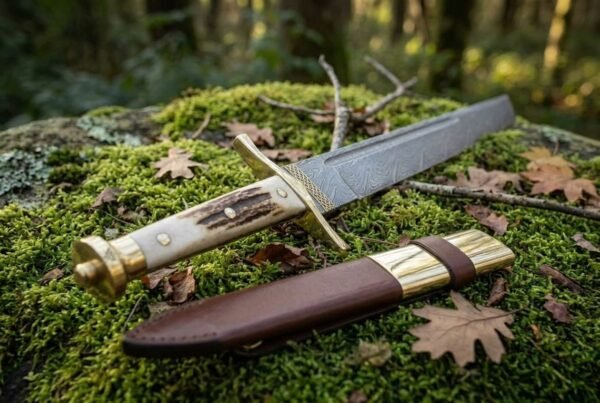
| Blade profile | Broad single edged langseax with an angled clipped point, a narrow fuller under the spine and a crosshatched band at the blade root |
|---|
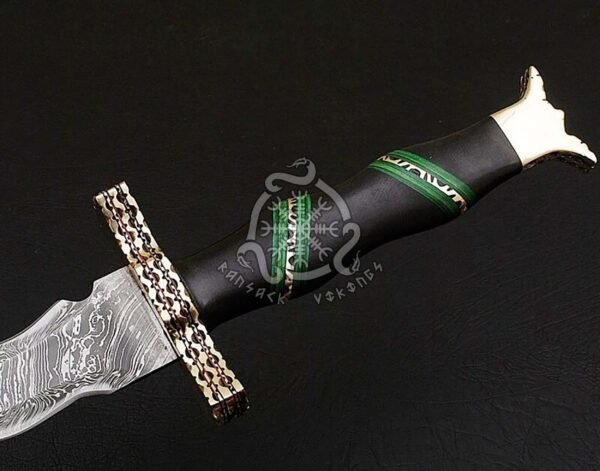
| Handle | Polished natural bone scales over a full tang |
|---|
| Pins | Three brass pins |
|---|
| Guard | Slim straight brass cross guard |
|---|
| Pommel | Brass cap pommel with a round end button |
|---|
| Sheath | Brown leather with a brass throat and a brass chape |
|---|
| Weight | Approximately 1.9 pounds bare, 2.4 pounds sheathed |
|---|
| SKU | RK-1281 |
|---|
Why a seax has only one edge
A double edged sword looks like the more serious blade and for a warrior with the money for one it was. But the single edge on a seax is a deliberate design choice rather than a saving, and it buys three things.
The first is a thick spine. With only one edge to grind, all the steel that would have gone into the second bevel stays in the back of the blade as a heavy flat spine, which makes the seax enormously stiff for its weight and lets it survive being levered, batoned and used against bone and wood without complaint. The second is that you can put your other hand on it. A thumb or a flat palm on the spine gives you the control for fine work, and no double edged blade will ever allow that. The third is the weight distribution. All the mass sits behind a single edge instead of being split between two, so a seax hits like a much larger blade than it is.
The clipped point on this one, where the spine drops in a straight angled line to meet the edge at the tip, is the shape archaeologists call a broken back seax and it is one of the most recognisable blade forms of the early medieval north. It puts the point on or near the centre line of the blade so it will thrust properly, without giving up any of the belly behind it that makes the thing cut.
Why forge welded Damascus and not stainless
The pattern on this blade is the structure of the steel, not a finish applied to it. Two steels are stacked and welded at forging heat, 1095 for the carbon that lets the edge get hard and 15N20 for toughness and for the nickel it carries. The billet is drawn out and folded until a stack of a dozen layers has become hundreds, and grinding the blade cuts through them at a shallow angle and lays them bare on the surface. The etch bites the 1095 dark and leaves the nickel bearing 15N20 bright, which is why the pattern is visible at all.
Neither steel contains chromium, and that is the point. Chromium is what makes stainless stainless, and it is also what would prevent the blade from etching into a pattern and what coarsens the carbides that limit a stainless edge. This blade will rust if you leave it wet, and an etched surface is slightly more absorbent than a bright polish, so it wants oil and a wipe. That is the honest trade, and it is laid out properly in our steel and hardness notes.
The bone handle and the leather sheath
The handle is natural bone, cut, drilled and fitted to a full length tang between a brass cross guard and a brass pommel, then polished. Bone is unforgiving to work because it will crack rather than compress if the fit is wrong, so it has to be right the first time, but what it gives in return is a handle with no give in it at all. It does not settle loose over years of handling the way a wrapped or a wooden grip can, and it takes a polish that deepens rather than dulls with use. Because it is a natural material every handle carries its own faint grain and its own tone, from near white through to warm cream.
There is no wood on this piece, but bone wants the same discipline any natural handle material does. Keep it out of long soaking, out of hot direct sun and away from radiators, wipe it dry, and work a trace of light oil into it once a year if you live somewhere very dry. The same principles are set out in handle and sheath care. Feed the leather sheath with a leather dressing once or twice a year and never dry it fast after a soaking.
Engraving, runes and your own design
Use the rune converter on this page to turn a name, a date or a short phrase into Elder Futhark and we will cut it into the steel or the handle. If you would rather have a Viking pattern than a rune line, choose your own design in the engraving option above the add to cart button and tell us whether it goes on the blade or the handle. Where a piece already carries an engraved design, your chosen engraving replaces it rather than sitting alongside it. A seax is the most historically appropriate piece in the whole range for runes, because inscribed seaxes genuinely exist, and there is more on the engraving page.
Care and sharpening
Wipe the blade every time you handle it and keep a thin film of light mineral oil on the etched surface. If the pattern ever looks faint it has usually been polished flat by handling rather than lost, and a light re etch brings it straight back. Do not store the seax in the leather sheath long term in a damp room, because vegetable tanned leather is mildly acidic and holds moisture against steel.
The edge sharpens on ordinary water stones at the angle it was ground at. The long straight section makes it easy work, and the alternating hard and tough layers mean a Damascus edge takes a little longer to raise a burr and then holds it well. Finish fine and strop. Both jobs are covered in steel care and sharpening with a whetstone.
Made in the Czech Republic
Every piece we sell is made by hand in the Czech Republic. The smiths there work the way the trade has been worked for a long time, heating and hammering the steel, taking the bevels down by eye, and fitting the handle and the leather one at a time. There is no automated line anywhere in it, so small differences from one piece to the next are normal and expected.
Ransack Viking is a United States company based in Chicago, Illinois. We bring the pieces in ourselves, inspect them on arrival and ship them from our own warehouse. If you add engraving, that is carried out here in the United States before your order goes out.
A note on handmade variation
Bonewarden is hand forged. It is not machine made and it is not bulk produced, so what arrives will not be a pixel for pixel copy of the photograph. No two Damascus blades carry the same pattern, because the pattern is a record of how that particular billet was folded, drawn and ground. The bone will have its own tone and its own faint grain, the brass its own colour, and the leather its own shade, because dye never takes evenly on hide. Dimensions, steel and build are the same every time. The character is not, and that is what working by hand from natural materials means.
Frequently asked questions
Is the Damascus pattern real?
Yes. It is forge welded 1095 and 15N20 running right through the blade. Grind into it and the pattern continues, because it is the structure of the steel rather than a coating on the surface.
Does it arrive sharp?
Sharpened and ready to use. If you would rather have it blunt for reenactment, for display or for a household with children, say so in the order notes and there is no extra charge. Most reenactment groups require a blunt edge, so check your society rules first.
Can I use it for reenactment or sparring?
For display and for kit, yes, and blunted on request. Not for contact sparring. This is a hardened cutting blade and steel on steel chips a hardened edge, which is why reenactment combat uses purpose made blunts with rolled edges.
Can I have runes engraved on it?
Yes, and it is the most fitting piece in the range for it. Inscribed seaxes are a genuine historical thing. Use the rune converter on this page for Elder Futhark or choose your own pattern in the engraving option above the add to cart button.
What is the difference between a seax and a Viking sword?
A seax is single edged, thick spined, and was carried by everyone. A Viking sword is double edged, lighter for its length, more expensive to make and was a mark of status. A seax is a tool that fights. A sword does nothing else.
How long does shipping take?
Free inside the United States. Damascus pieces take two to three weeks in the shop, longer with engraving, then two to five days in transit.
What is in the box
- Bonewarden hand forged Damascus seax in 1095 and 15N20
- Brown leather sheath with brass throat and belt loop
- Protective oil coat on the blade
- Damascus care card covering oiling, leather and re etching
- Elder Futhark rune engraving where selected
- Forged and finished in the Czech Republic
Explore the range
See the rest of the Viking seax, the full Damascus sword range, the wider Norse arms, or read the guides.
Near neighbours in the shop
Sitting beside it in the catalogue is the Stagwarden Viking seax, 5 inches overall. Another in the same line is the Wolfnotch Viking seax, pattern welded Damascus. Next along the rack is the Hornsax Viking seax, 12 inches overall.
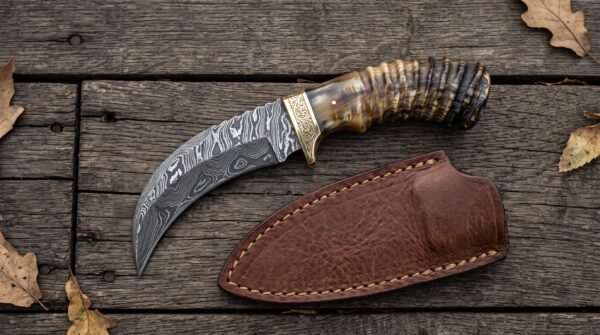
Fitting out further, the Clawshade karambit knife belongs with it. You can have this made your way instead on the custom Damascus knife page.

Got this as a gift and now I want one for myself too. Leather sheath is thick and well stitched. Not the cheap stuff you usually get. Edge retention has been great even after regular use. So worth it.
This knife is a genuine work of art. Fit and finish is museum quality. You can tell real craftsmen made this by hand. Leather sheath is thick and well stitched. Not the cheap stuff you usually get. Already planning my next purchase from this shop.
My whole family was impressed when I unboxed it. Weight and balance make it feel like a real functional piece not some cheap replica. Fit and finish is museum quality. You can tell real craftsmen made this by hand. Damascus blade holds a razor edge right out of the box. Love it.
Perfect gift. Perfect quality. No complaints. Came in a nice gift box which made it feel even more special. Can’t recommend this enough.
Best knife I’ve ever owned. Weight and balance make it feel like a real functional piece not some cheap replica. Highly recommend this one.