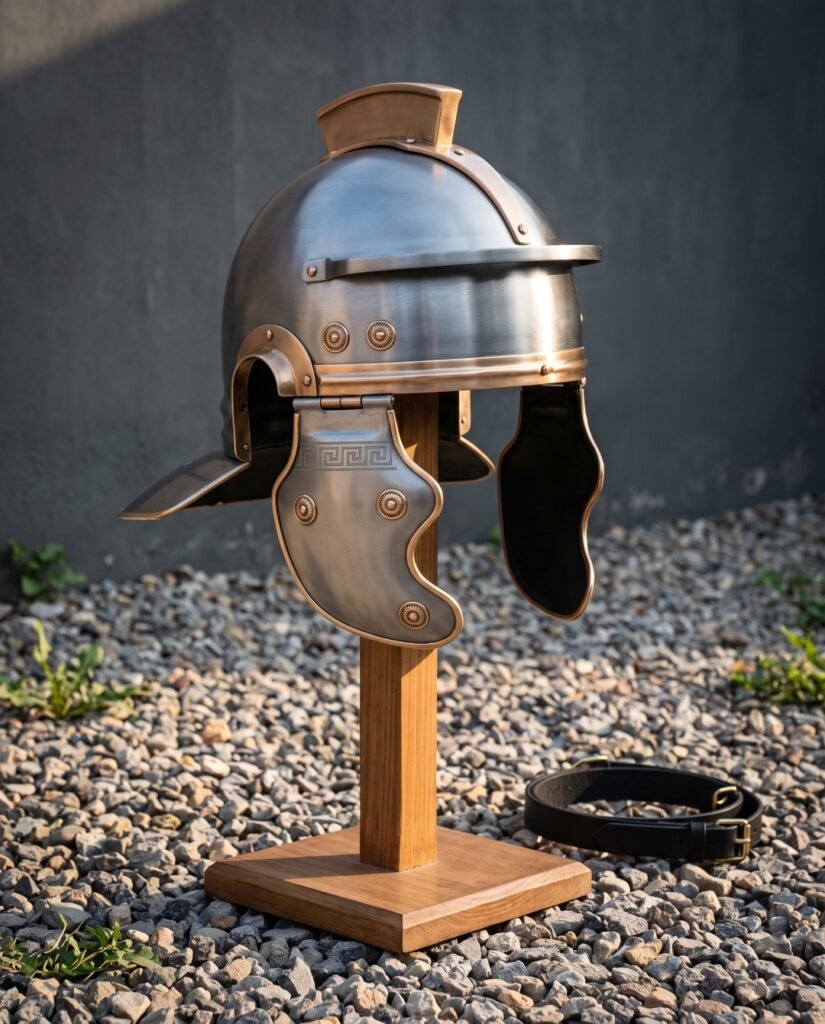
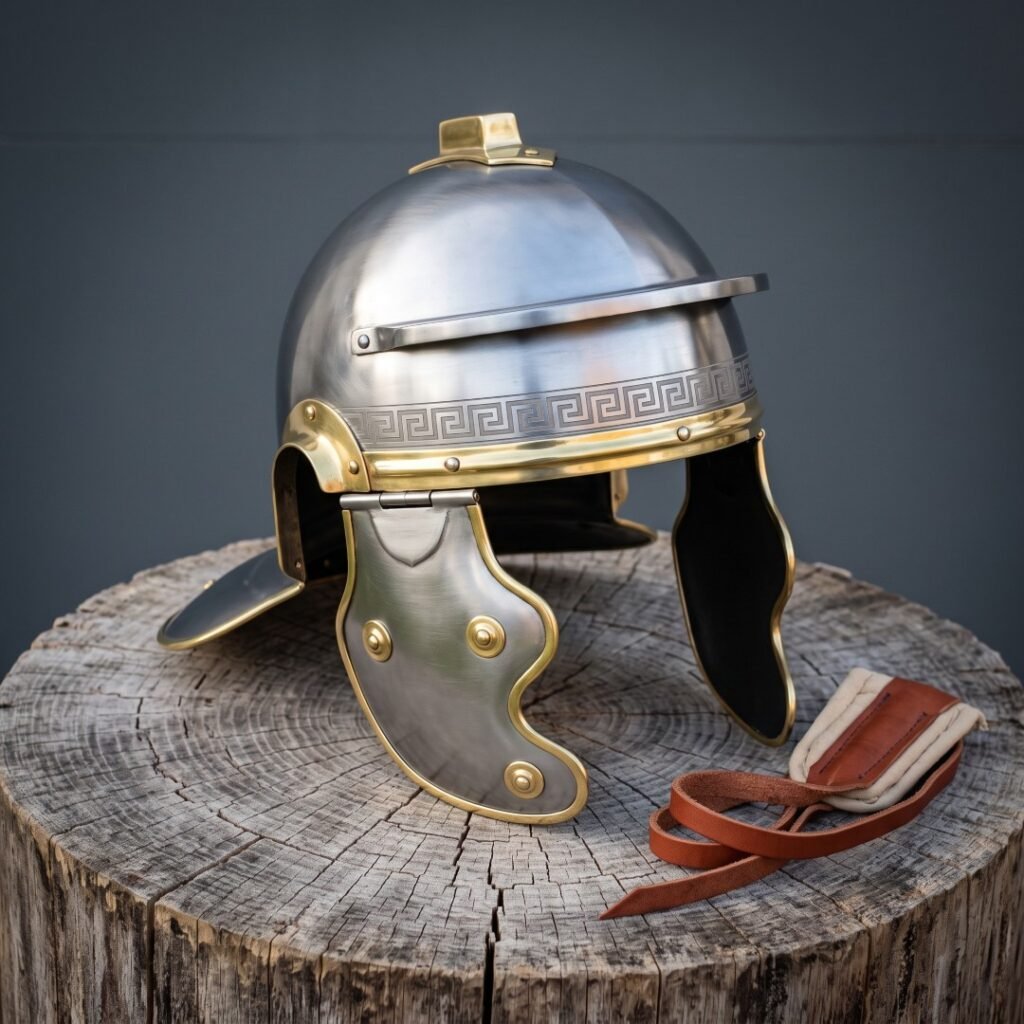
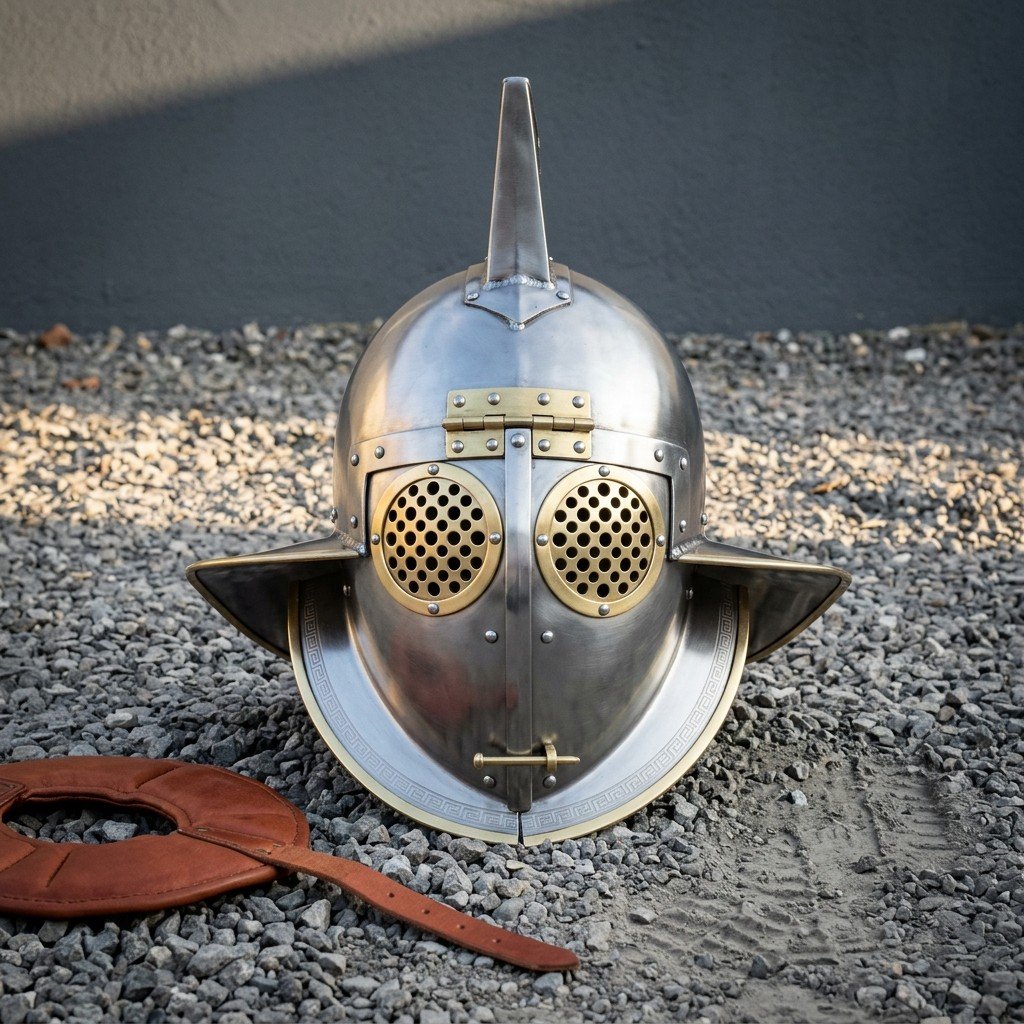
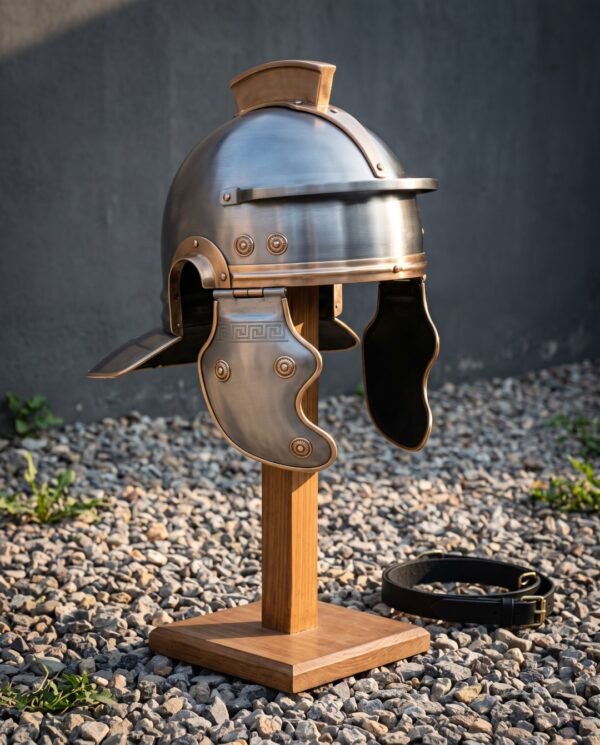
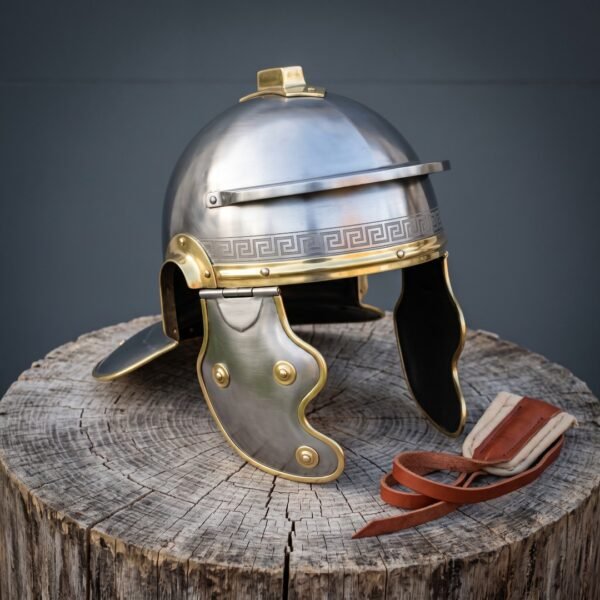
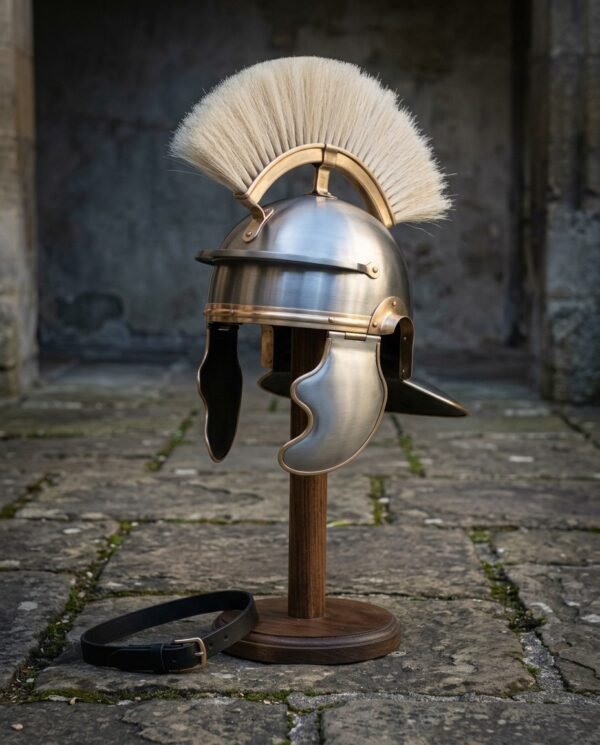
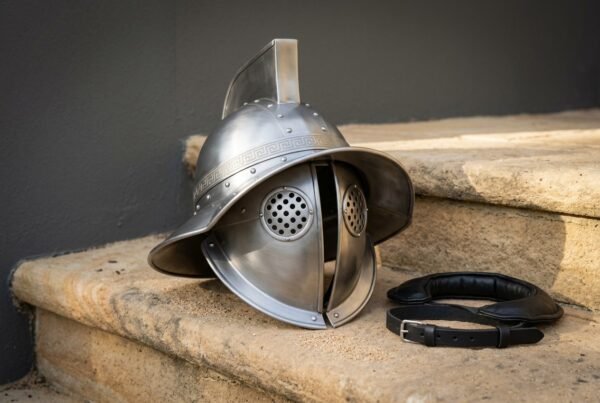
Roman helmets are the most thoroughly evolved head protection of the ancient world, and this one shows why. The bowl is drawn down at the back into a wide flared neck guard, a riveted brow band runs round the front, a pair of deep hinged cheek pieces close over the jaw, and each cheek carries a pierced disc over the ear. That last detail is the one that separates a good Roman helmet from a bad one. Earlier Greek helmets sealed the ears completely and left the wearer deaf, which is fine for a phalanx that moves as one block and disastrous for troops expected to hear a trumpet or a shouted order. Piercing the ear disc gave back hearing without giving up the cheek plate.
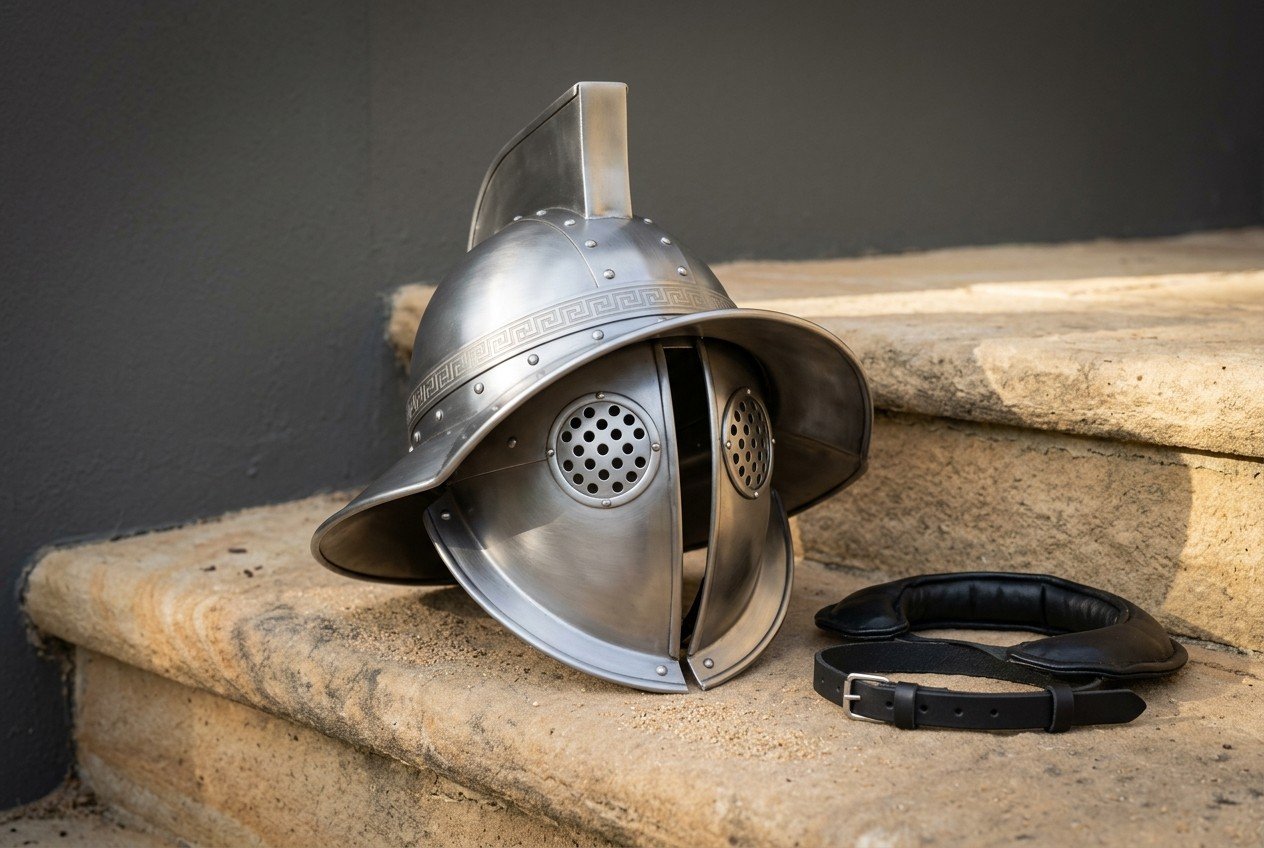
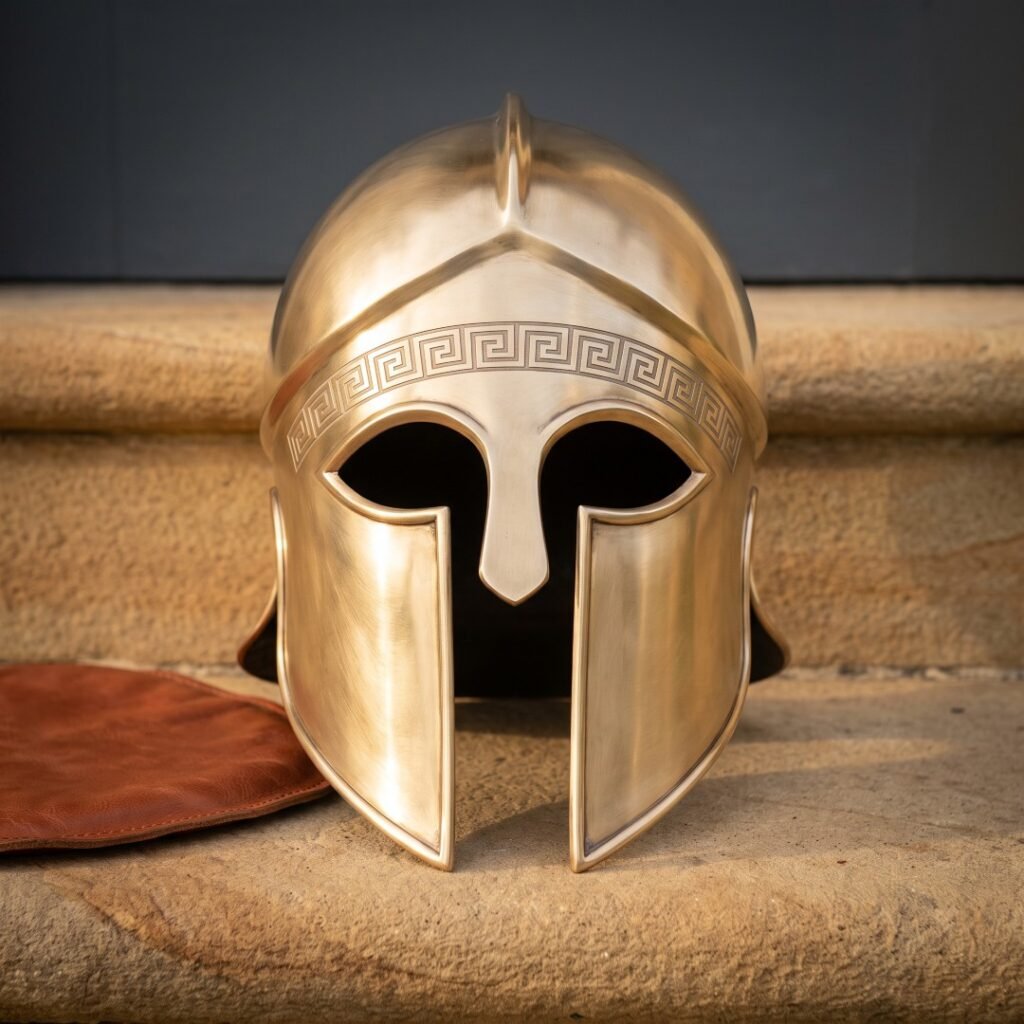
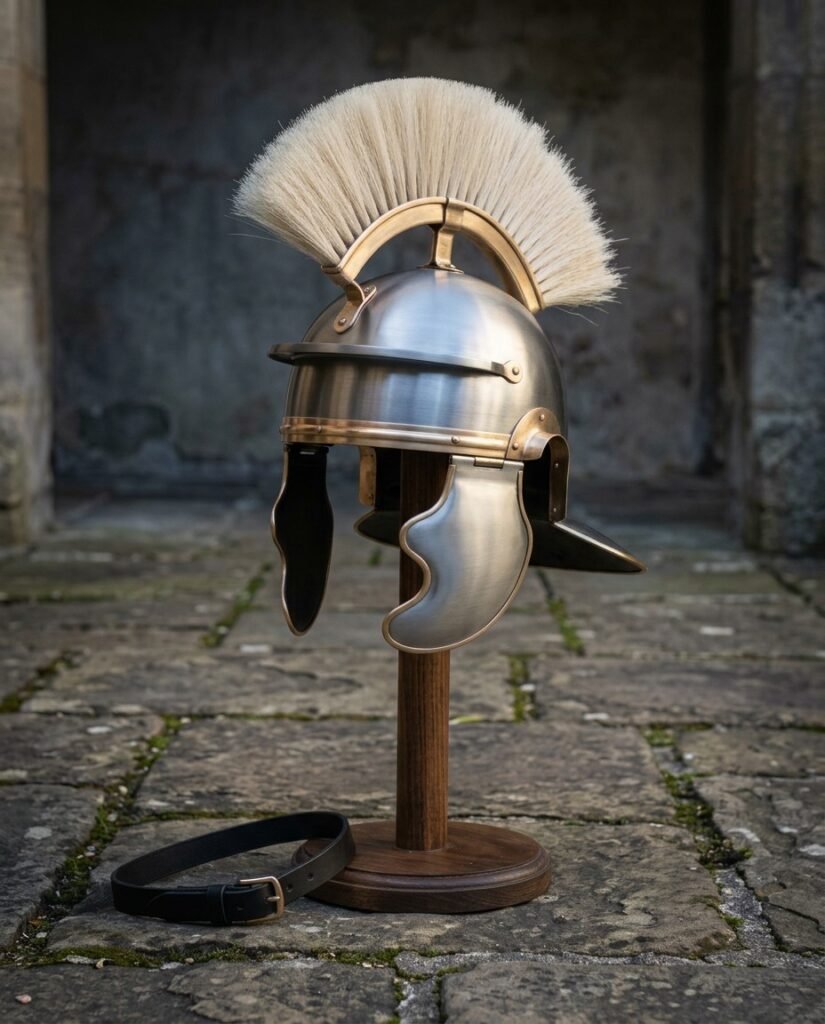
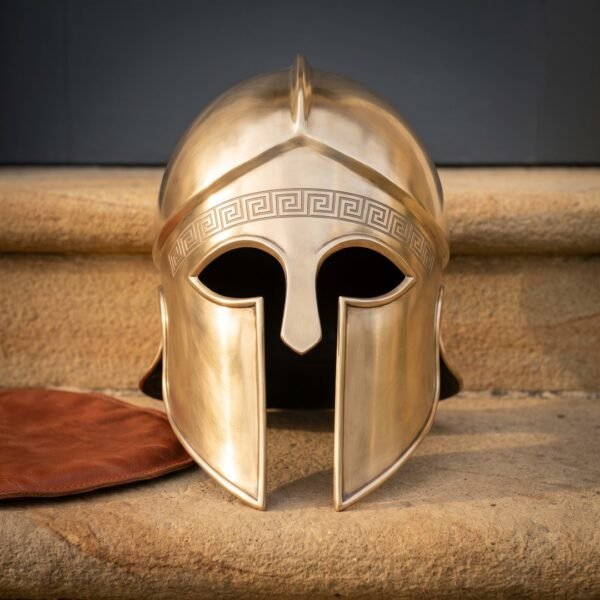
This helm is raised and finished in Memphis, Tennessee. The bowl carries a chased Greek key meander around the brow band, the crest holder stands proud on the crown ready for a horsehair plume, and the cheek pieces swing on riveted hinges. The padded collar and the leather belt in the photograph are studio props and are not included, and neither is a crest.
Specifications
| Material | Mild steel, hand raised and planished |
|---|
| Gauge | 16 gauge, approximately 1.6 mm |
|---|
| Type | Roman cavalry pattern helmet with a flared neck guard |
|---|
| Cheek pieces | Deep hinged plates with pierced ear discs, both sides |
|---|
| Brow band | Riveted, chased with a Greek key meander |
|---|
| Crest | Upright crest holder on the crown, crest not supplied |
|---|
| Size | Fits a head circumference of roughly 22 to 24 inches over a padded cap |
|---|
| Weight | Approximately 5 lb |
|---|
| Lining | Supplied without a fitted liner, sized to be worn over a padded cap |
|---|
| Finish | Brushed and polished steel, oiled |
|---|
| SKU | RK-1484 |
|---|
The neck guard, the cheeks and the crest
The flared plate at the back is the single most Roman thing about this helmet. It projects out and down over the neck rather than hugging it, and the reason is a downward cut from a rider or from a man on higher ground. A close fitting neck plate transmits that blow straight into the vertebrae. A projecting one takes the strike several inches away from the body and spreads it into the bowl. It also sheds rain and sun off the neck, which mattered more than you might think to an army that marched.
The cheek pieces hinge rather than being fixed. That lets the helmet go on and come off easily over the ears and lets the cheeks be tied together under the chin so the whole assembly clamps to the head instead of resting on it. Historical examples were tied with a thong through a ring or a hook; ours are set up so a lace can be run between them.
The crest holder on the crown is an empty fitting on purpose. Crests were a unit and rank marker, they were fitted transversely or fore and aft depending on who you were, and they were removed for the march. We supply the fitting and leave the choice of crest to you, because a red horsehair box crest and a black transverse crest say completely different things about the man wearing it.
Steel and gauge
The bowl is mild steel at 16 gauge, roughly 1.6 mm, hand raised rather than pressed so the metal thickens as it climbs into the dome instead of thinning across the crown. Sixteen gauge is the right weight for a wearable display helmet: heavy enough to hold its form and to feel like the real thing on your head, light enough to wear for an event day without a stiff neck.
Armour is described by gauge and by whether the stock is mild or spring steel. There is no cutting edge on a helmet and therefore no hardness figure that means anything, so we do not quote one. The Greek key on the brow band is chased with a graver rather than acid etched, which leaves a cut wall in the groove that catches light from across a room.
To be plain about function: this is a wearable display and living history helmet without a fitted suspension liner. It is not certified combat armour, and 16 gauge mild steel is display and light reenactment weight rather than full contact weight.
Engraving, runes and your own design
Use the rune converter on this page to turn a name, a date or a short phrase into Elder Futhark and we will cut it into the steel or the leather. If you would rather have a Viking pattern than a rune line, choose your own design in the engraving option above the add to cart button and tell us where it goes. Where a piece already carries an engraved design, your chosen engraving replaces it rather than sitting alongside it, so the Greek key band can become a rune line, a legion number, a name or a pattern of your choosing. The cheek pieces and the neck guard also take a cut line well. See the engraving page.
Fit and sizing
This helmet is sized around the head and it is meant to be worn over padding. The standard build takes a head circumference of roughly 22 to 24 inches measured around the brow, with a padded cap making up the rest. Roman soldiers wore a padded cap or a thick felt liner under the bowl and so should you, both for comfort and because a helmet that sits directly on the skull transmits every knock.
Measure around your head just above the ears and the eyebrows and add the thickness of the cap you plan to wear. Two extra numbers help on this pattern: the width across your cheekbones, which sets how the hinged plates close, and the length from the base of your skull to your shoulders, which decides whether the neck guard clears your shoulder line when you look up. Send them and we will build to you. If your measurements fall outside the standard range, message us before ordering.
Care
Wipe the inside dry after every wear. Condensation from your breath and sweat off the brow will start rust inside a helmet long before anything shows on the outside. Keep a film of light machine oil or paste wax on both faces. Put a drop of oil on the cheek hinges two or three times a year and swing them through their travel so the pins do not seize.
Store it upright with the cheeks open so air can move through it, never sealed in a bag and never with a damp cap inside. Surface bloom lifts with fine steel wool and oil worked along the direction of the polish rather than across it. If you fit a horsehair crest, take it off before storage, because organic crest material holds moisture against the crown. Our notes on steel care apply to armour as well as to blades.
Forged in Memphis
The bowl was raised, the neck guard drawn, the cheeks cut and hinged, the brow band chased and the whole helmet riveted and finished in our own shop in Memphis, Tennessee. Nothing here is drop shipped from an importer catalogue with a new label. Because we make it, the lifetime warranty against defects in forging, grind, heat treat and fittings is a genuine promise, with no end date and no receipt needed.
A note on handmade variation
This helmet is hand made, not machine made or bulk produced, so what arrives will not be a pixel for pixel copy of the photograph. The sweep of the neck guard, hammer texture under the polish, rivet placement, the spacing of the pierced ear disc and the depth of the chased meander all vary, because every helmet is worked by hand from natural materials. The dimensions, the material and the build are the same every time. The character is not.
Frequently asked questions
Is a crest included?
No. The crest holder is fitted and empty. Crests were a unit and rank marker and were removed for the march, so we leave the choice of colour and orientation to you.
Do the cheek pieces move?
Yes. They swing on riveted hinges so the helmet goes on and off easily, and they are set up to be laced together under the chin.
Can I hear anything with it on?
Yes, and that is the point of the pierced ear discs. They keep the cheek plate over the ear while letting sound through, which sealed Greek helmets did not do.
Is it wearable or display only?
Fully wearable over a padded cap, and intended for display, living history and costume. It is not certified combat armour and should not be used for full contact fighting.
Does it come with a liner?
No fitted liner is supplied. It is sized on the assumption that you will wear a padded cap or a felt liner of your own underneath.
How long before it ships?
Processing is one to two weeks because the bowl is raised and the cheeks fitted to your size. Shipping inside the United States is free and returns are accepted within seven days.
What is in the box
- One hand raised steel Roman helmet with a flared neck guard
- Pair of hinged cheek pieces with pierced ear discs, fitted
- Riveted brow band chased with a Greek key, or your own engraving in its place
- Upright crest holder, crest not supplied
- Light protective oil coat applied before packing
- Care and storage card
- Forged and finished in Memphis, Tennessee
Explore the range
See more in roman and greek helmets, round shields, plate armor and medieval helmets, or read the guides.




Reviews
There are no reviews yet