
Blog
Best Viking Axes in 2026: A Hand-Forged Buyer’s Guide

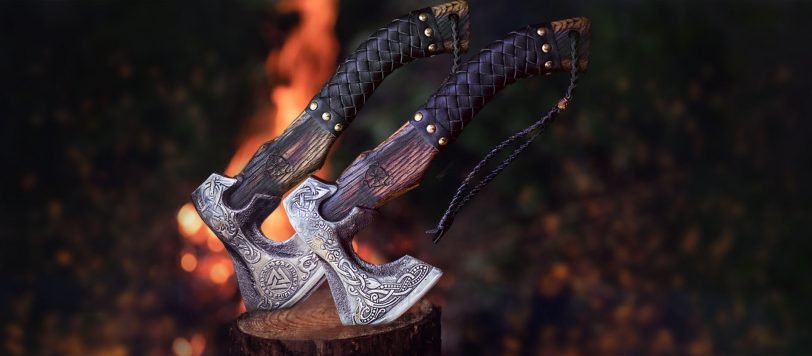
The best Viking axe for most buyers in 2026 is a hand-forged bearded axe with a high-carbon steel head, a hardened cutting edge, and a solid hardwood haft. That combination gives you the classic Norse profile, real chopping ability, and a display piece that looks the part. Below we break down the main types of Viking axes, what separates a genuine hand-forged axe from a wall-hanger, and how to choose the right one whether you plan to split kindling at camp, throw at a backyard target, or build a collection. Every axe in our hand-forged Viking axe collection ships from Memphis, TN, and many can be personalized with engraving.
What Actually Makes a Viking Axe “Viking”?
Historical Norse axes were working tools first and fighting tools second. They shared a few traits that good modern reproductions keep: a relatively light head compared to a modern felling axe, a cutting edge that flares wider than the eye of the axe, and a straight or gently curved wooden haft. The most recognizable style is the bearded axe (skeggox), where the lower part of the blade drops well below the eye. That “beard” lets you choke up behind the head for carving and controlled cuts while keeping a long cutting edge.
Rune marked heads are part of that look, and the ones we make are gathered under Norse runic axes.
A modern hand-forged Viking axe is shaped by a smith with hammer, anvil, and forge rather than stamped out by a machine. You can usually spot hand forging by the subtle hammer texture on the cheeks of the head and slight asymmetries that make each piece one of a kind.
The Main Types of Viking Axes
Bearded Axes
The all-rounder. The dropped beard gives you a long edge on a light head, so it chops, carves, and displays equally well. If you only buy one Viking axe, make it a bearded axe. The bearded axe collection is the largest single group of axes on the site for that reason.
One-Handed Battle Axes
Lighter heads on hafts around 20 to 26 inches. These are quick in the hand, ideal for reenactment, costume, and display, and still capable of real camp chores.
Two-Handed Long-Bearded Axes
The dramatic “Dane axe” silhouette: a broad blade on a haft of 30 inches or more. These are commanding display and collection pieces, though less practical for everyday cutting tasks.
Throwing Axes
Compact heads, straight-grained hafts, and balanced weight for rotation. If axe throwing is your goal, pick a purpose-built thrower rather than risking an ornate collector piece.
Camp and Bushcraft Axes in Viking Style
Norse styling on a hard-working tool: full-size edge, tough high-carbon head, and a haft length around 16 to 20 inches for one-handed splitting and limbing.
Viking Axe Types Compared
| Type | Typical Haft Length | Best For | Skill Level |
|---|---|---|---|
| Bearded axe | 16 to 24 in | All-around use, carving, display | Beginner |
| One-handed battle axe | 20 to 26 in | Reenactment, costume, display | Beginner |
| Two-handed long axe | 30 to 40 in | Collections, wall display | Collector |
| Throwing axe | 14 to 19 in | Target throwing | Intermediate |
| Camp axe (Viking style) | 16 to 20 in | Kindling, camp chores | Beginner |
Bearded, Dane or Hand Axe: Which One Is Right for You
A bearded axe is the answer if you want one piece that does a bit of everything. The beard lets you slide your hand up behind the edge and use it almost like a big knife, which is why Norse woodworkers used it for shaping planks. It splits kindling, it carves, it hangs on a wall, and it is light enough to swing one-handed for a long time.
A Dane axe is the two-handed long axe with the broad, thin blade. It was a fighting axe in its day, built to be swung in wide arcs from behind a shield line, and the thin blade that made it fast also makes it a poor splitter. Buy one for the silhouette, for a wall, a hall or a reenactment kit. Do not buy one expecting to process firewood.
A hand axe is the compact one-handed pattern with a smaller head and a short haft. It is the one that goes in a pack. It will not clear a trail, but it will split kindling and do most camp chores, and it is the easiest of the three to control if you are new to axes.
If you want to see all three side by side, the wider Norse arms collection holds the axes alongside the spears, seaxes and hammers from the same forge tradition.
Display Axe or User: How to Tell the Difference
The same silhouette can be built two ways, and a listing will not always say which. Here is what separates an axe you can swing from one that should stay on the wall.
The saga themed pieces, including our Ragnar Lothbrok style axes, sit on the display side of that line while still being forged steel.
The edge. A user is hardened and tempered along the bit and comes sharp or ready to sharpen. A display axe may have a soft edge, a thick blunt bevel, or a decorative finish that would chip off the first time it hit wood.
The eye and the hang. On a user, the haft passes fully through the eye and is locked with a wooden wedge. Grab the head and try to twist it; there should be no movement at all. On many display pieces the head is glued or pinned to a haft that stops short of the eye, fine for a wall and dangerous for a swing.
The haft. A working haft is plain dense hardwood with the grain running the length of the handle. Heavy carving, deep leather wrap under the head and brass fittings look good but usually mean the maker did not expect the axe to take impact.
None of this makes display axes bad. Plenty of buyers want a wall piece and nothing else. The mistake is buying one and then taking it camping.
Head Weight and Haft Length: Sensible Ranges
These are general ranges for the type, not specs for any one axe. Always check the listing for the piece you are buying.
For a one-handed bearded or hand axe, a head around one to two pounds on a haft of roughly 16 to 24 inches is the range most people find comfortable. Heavier than two pounds and a one-handed swing gets tiring fast, and control suffers.
For a two-handed long axe, hafts run 30 to 40 inches. Historical Dane axe heads were surprisingly light for their size because the blade was thin, so a modern reproduction with a heavy head is often a sign it was cast or made thick to look impressive.
The rule of thumb is that head weight should match haft length. A heavy head on a short haft is exhausting to swing accurately. A light head on a long haft feels whippy and hard to place. When in doubt, go lighter and shorter for your first axe.
How to Choose the Best Viking Axe
1. Head Steel and Edge Hardness
High-carbon steel is the traditional choice for axe heads because it takes a keen edge and stands up to impact. Some forges also offer Damascus-patterned heads, which layer steels for a distinctive rippled look. If you are weighing pattern-welded steel against plainer options, our guide to Damascus steel vs stainless steel explains the trade-offs in edge holding, corrosion resistance, and maintenance.
2. Haft Wood and Grain
Look for dense hardwoods such as ash, hickory, or rosewood. On a user axe, the grain should run parallel to the haft for shock resistance. Decorative hafts with leather wrapping or carving are fine for display pieces but check that the wrap sits below where your hands land if you plan to swing it.
3. Weight and Balance
A usable one-handed Viking axe generally carries a head in the 1 to 2 pound range. Heavier is not better: the Norse favored fast, light heads. Hold the axe (or check the listed weight) and imagine swinging it for ten minutes; if your forearm complains, size down.
4. How the Head Is Hung
On traditional builds the head is fitted to the haft and secured with a wedge. A well-hung head has no wobble. Any axe you intend to swing should be checked before first use and periodically after, since wood shrinks and swells with humidity.
5. Sheath and Extras
A leather edge cover protects both the blade and everything the blade touches in transport. Many buyers also add engraving on the head or haft, a name, a rune, or a date, which turns a tool into an heirloom. Engraving is one of the most popular options for groomsmen gifts and retirement presents.
What 1095 Means on an Axe Head
The axe heads on this site are forged from 1095 high-carbon steel, and the Damascus heads from 1095 forge welded with 15N20. Here is what those names mean in practice.
1095 is a plain carbon steel with roughly one percent carbon and very little else. That carbon is what lets it harden. There is no chromium in it, so it is not stainless and it will rust if neglected, but it is also simple, predictable, easy to forge, and easy to sharpen with ordinary stones and files.
The number that matters more than the steel name is the hardness after heat treatment. Our plain 1095 pieces are heat treated to 54 to 58 HRC on the Rockwell C scale, deliberately softer than a kitchen knife. An axe edge takes hard impact, sometimes against knots or a hidden stone, and a very hard edge chips under that abuse where a slightly softer one dents and can be filed back. The Damascus heads, welded from 1095 and 15N20, run 58 to 60 HRC because the nickel in the 15N20 layers adds toughness and lets the steel carry that extra hardness without becoming brittle.
What 1095 does not mean is indestructible. It will not survive being beaten with a sledge, and it will not enjoy a damp shed. It will do an honest day of work, take a fresh edge in a few minutes, and last for generations if you keep it dry.
Sheath and Blade Cover
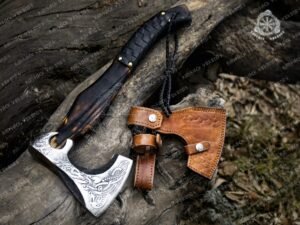
A leather blade cover, sometimes called a mask, is a strip of thick leather that wraps the bit and fastens with a strap or snap. It protects the edge from nicks in transport, and it protects your hands, your pack, and your truck seat from the edge. If a listing does not mention one, ask, or budget for one. Two habits keep it useful: put the axe away dry, because a wet axe in a sealed cover is how rust starts, and take the cover off for long storage. The cover is for carrying, not for living in.
Engraving a Viking Axe
Engraving is the most common way people make an axe theirs. A name on the head, a date on the haft, or a rune band turns a good tool into a gift that gets kept. Engraving on this site is done in the US after the axe has arrived and been inspected. The custom engraving page explains what can be engraved, where it works best, and how to order it. Keep engraving on the flats of the head or on the haft, away from the bit, so sharpening never touches it.
Who Should NOT Buy a Viking Axe?
Honesty helps here. Skip the Viking axe if you mainly need to fell trees or split large rounds, a modern splitting maul does that job better. Skip the ornate two-hander if you want a thrower; decorative heads and target boards do not mix. And if you want a zero-maintenance tool that can live in a damp garage untouched, high-carbon steel will punish you with rust. Every axe and knife here is 1095 or Damascus, so if you cannot commit to a light oil wipe-down now and then, a hand-forged axe is not the right buy for you.
Caring for a Hand-Forged Axe
Care is simple but non-negotiable. Wipe the head dry after use and apply a thin coat of mineral oil or wax before storage. Touch up the edge with a fine file or whetstone at a consistent angle. Store the axe indoors, out of direct sun, and never in a sealed leather sheath long term, since leather traps moisture. Treat the haft to occasional boiled linseed oil to keep the wood from drying out. Ten minutes of care a season keeps a forged axe serviceable for decades.
Where These Axes Come From
Ransack Viking is a US company in Memphis, Tennessee. The axes are not made in Memphis. Every one is handmade in the Czech Republic the old way, using the 1095 and 15N20 steels described above, then imported to Memphis, inspected, and shipped from there. Any engraving is done in the US at that stage. A buyer paying for hand forging deserves a straight answer on where the hammer fell.
Where to Buy in 2026
Buy from a seller who shows real photographs of the actual forging style, states the steel and haft wood, and stands behind the product. Our axes ship from Memphis, TN, so US orders do not sit in overseas transit, and you can browse companion pieces like Viking hammers and shields to round out a display. For more buying guides, visit the Ransack Viking guides.
Questions people ask
Are Viking axes legal to own in the US?
In general, yes. Axes are tools, and owning one at home is not restricted the way some blades are. Carrying an axe in public is a different matter, and rules differ between cities and states, and again for vehicles, parks, and events. Check your local ordinances before transporting one anywhere other than directly to a campsite or range.
Can you actually use a hand-forged Viking axe, or is it just for display?
A properly forged high-carbon axe with a soundly hung head is a fully functional tool that will split kindling, limb branches, and handle camp chores. The exceptions are highly ornate or oversized display pieces, which are built for looks. If you plan to swing your axe, choose a working design and inspect the head fit before first use.
What is the difference between a bearded axe and a regular axe?
A bearded axe has a cutting edge that extends well below the eye of the axe, creating a hook-like “beard.” This gives a longer edge on a lighter head and lets you grip the haft directly behind the blade for fine, controlled carving cuts, something a conventional axe profile cannot do. It is the most versatile Norse pattern for a first buyer.
How do I keep a carbon steel axe head from rusting?
Keep it dry and keep it oiled. After each use, wipe the head clean, dry it fully, and apply a thin film of mineral oil, camellia oil, or paste wax. Store it indoors rather than in a damp shed, and take it out of its leather cover for long-term storage since leather holds moisture against the steel.
What length Viking axe should a beginner buy?
A haft between 16 and 24 inches is the sweet spot for a first axe. It is long enough to chop effectively and display well, but short and light enough to control one-handed. Go longer only if you specifically want a two-handed wall piece or a reenactment axe, and expect a long axe to be a poor splitter.
Can Viking axes be engraved for gifts?
Yes. Engraving names, dates, initials, or runes on the axe head or haft is one of the most popular ways to personalize a Viking axe. Engraved axes are frequent choices for groomsmen gifts, anniversaries, and milestone birthdays, and the engraving does not affect how the axe cuts. Details are on the custom engraving page linked above.
One thought on “Best Viking Axes in 2026: A Hand-Forged Buyer’s Guide”
Comments are closed.