
Blog
Viking Axe History: Bearded Axes, Dane Axes and How They Were Used


Viking axe history begins not on the battlefield but on the farm. Nearly every free man in Viking Age Scandinavia (roughly 793 to 1066 AD) owned an axe for felling timber, building ships, and splitting firewood, which is exactly why it became the most common Norse fighting tool. Swords were expensive status symbols; an axe was affordable, familiar, and devastating in trained hands. Over three centuries, Norse smiths refined the simple wood-axe into specialized war axes, most famously the one-handed bearded axe (skeggöx) and the towering two-handed Dane axe, that shaped how Vikings raided, fought, and were remembered.
Why the Axe Became the Signature Viking Fighting Tool
Iron was hard to produce in early medieval Scandinavia, and a pattern-welded sword could cost as much as a small herd of cattle. An axe, by contrast, needed far less iron: a compact head on a wooden haft, often with only the cutting edge made of hardened steel welded onto a softer iron body. That economy meant a farmer called to a raid could arrive armed with the same tool he used every day.
Archaeology backs this up. Axe heads are among the most frequent war gear finds in Viking Age graves across Norway, Denmark, and Sweden, appearing in burials of both modest farmers and wealthy chieftains. The famous Mammen axe from Denmark (dated by tree-ring evidence to the 970s AD) is inlaid with silver ornament, showing that by the late tenth century the axe had climbed the social ladder from farm tool to aristocratic showpiece.
The Petersen Typology in Plain Words
Read anything serious about Viking axes and you will run into letters: Type E, Type H, Type M. They come from Jan Petersen, a Norwegian archaeologist who published a classification of Viking Age swords, spearheads and axe heads in 1919. He worked mostly from Norwegian grave finds, sorted the axe heads by shape, and gave each group a letter from A to M. A century later it is still the standard shorthand.
The letters roughly follow time, but the order is not strict and several types were in use at once. What separates them is a handful of features you can see with your own eyes:
- Blade width. Early types are narrow, with an edge not much wider than the socket. Later types flare out into broad crescents.
- The beard. Some types have a lower edge that drops well below the socket. Others are closer to symmetrical, with the blade spreading evenly above and below the center line.
- The socket and its lugs. Many later heads have small projections, often called lugs, that run up and down the haft from the socket and help lock the head in place. Their presence and shape is one of the clearest type markers.
- Blade thickness. The big late broadaxes are forged remarkably thin behind the edge, which is how such a wide head can still be swung fast.
In practice most people only need to remember a few. Type E is the classic bearded head that many modern reproductions copy. Types G and H are broad, fairly even blades that served as working and fighting axes through the middle of the period. Types L and M are the large broadaxes we call Dane axes, with M the biggest and thinnest. Because Petersen built the scheme on Norwegian material it fits Norway best; finds from Denmark, Sweden and Britain are matched to it more loosely.
The Bearded Axe (Skeggöx)
The bearded axe takes its name from the “beard”, a lower edge of the blade that extends down well below the socket where the haft meets the head. This design appeared in Scandinavia as early as the sixth century, before the Viking Age proper, and remained popular throughout it.
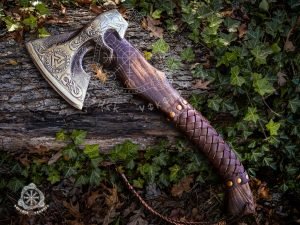
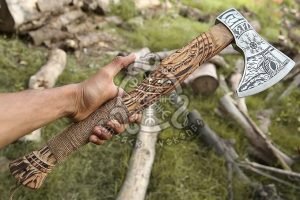
Our own hand forged bearded axes follow this profile, from a 14 inch hand axe to a 32 inch Dane axe on an ash haft.
The beard did three clever things at once:
More cutting edge, less weight
The drooping blade gave a long cutting edge without the mass of a full wide axe head, keeping the axe fast enough to use one-handed alongside a shield.
A built-in hook
In a fight, the beard could hook an opponent’s shield rim or ankle and yank it aside, opening him up for a follow-up strike. Sagas and later combat treatises describe hooking techniques that only work with a bearded profile.
A choked grip for fine work
A user could slide his hand up the haft and grip behind the beard, using the axe head almost like a knife for planing wood or dressing a kill, a reminder that most bearded axes never stopped being tools.
The beard was never only a fighting feature. Scandinavian carpenters’ axes still carry one today, for exactly that reason. So when a bearded head comes out of a grave, archaeologists usually cannot say whether its owner used it on ship planks or on people, and the honest answer is probably both. Modern bearded axes inherit that dual nature, and the good ones will split kindling at camp and still look right on the wall.
The Dane Axe: The Two-Handed Battle Axe
The Dane axe (also called the broadaxe, or breidöx in Old Norse) was built purely for war, with no farmyard pretensions. It appeared in the tenth century and matches the archaeologist Jan Petersen’s Type L and Type M classifications: a broad, thin, crescent-shaped blade, often 20 to 30 cm across the edge, mounted on a haft roughly a meter or more long and swung with both hands.
Because the blade was forged thin (some surviving examples are only a couple of millimeters thick behind the edge), a Dane axe was lighter than it looks and shockingly fast. Contemporary accounts credit it with cleaving helmets and shields. Its most famous portrait is the Bayeux Tapestry, where the English huscarls, elite troops fighting in a Scandinavian tradition, wield Dane axes against Norman cavalry at Hastings in 1066, the battle usually taken as the close of the Viking Age.
The trade-off was protection: swinging a two-handed axe meant giving up your shield. Dane axemen typically fought behind the front rank of a shield wall or stepped out to break an enemy line, trusting mail and helmet rather than a shield of their own.
Two-handed use changes the whole feel of the tool. With one hand near the end of the haft and the other well up toward the head, the axe can be steered and checked rather than simply swung. Slide the upper hand down and the same axe becomes a wide, fast cut with reach beyond any sword. The thin blade means the head is not a hammer, so the technique relies on speed and edge alignment rather than mass. That is also why the big late heads so often have socket lugs: a loose head on a two-handed swing is dangerous to everyone nearby. The long axe outlived the Viking Age in the hands of the Varangian Guard in Constantinople, who were known there as the axe bearers.
A Timeline of Viking Axe Development
| Period | Development | Typical Form |
|---|---|---|
| 500s, 700s AD | Bearded profiles emerge in Scandinavia; axes are primarily tools that double as fighting tools | Small one-handed heads, short beards |
| 793 to 900 AD | Raiding era; one-handed war axes standard alongside spear and shield | Petersen Types A, E, compact bearded heads |
| 900s AD | Specialized war axes grow larger; decorated prestige axes appear (Mammen axe, c. 970s) | Broader blades, silver inlay on elite pieces |
| 1000 to 1066 AD | Dane axe reaches full size; used by royal huscarls in Scandinavia and England | Petersen Types L, M, thin crescent blades on long hafts |
| After 1066 | Long axes persist in Norman, Scottish, and Byzantine (Varangian Guard) service | Evolves toward later medieval poleaxes |
Hafts and the Woods They Were Made From
The head is the part that survives, so it is the part that gets studied, but the haft decided how the axe handled. Wood rots in most soils, so complete Viking Age hafts are rare. What we have comes from waterlogged sites, a few well preserved graves, and mineralized wood traces left inside sockets, which can sometimes be identified to species.
Those traces point to the same hardwoods a modern axe maker would reach for. Ash is the wood most often cited, and for good reason: it is straight grained, springy and forgiving of shock, and it grew everywhere in northern Europe. Oak, elm and birch also appear. What matters more than the species is straight grain running the full length of the haft, because a haft with the grain running across it will snap at the first hard blow. Hafts were shaped by hand with a slightly oval cross section, so the hand could feel where the edge was pointing without looking.
How the head was fixed depended on the socket: some hafts were wedged through the eye, others relied on a snug taper, and late heads with lugs gripped the haft above and below the eye. A few showpieces, the Langeid axe among them, had metal fittings around the haft below the head. If a reproduction ever needs a new handle the same rules apply, and a straight grained hardwood axe haft is the only thing worth fitting.
How Axes Were Carried
There is no evidence for a standard axe sheath or belt hanger in the Viking Age, and it is easy to see why. A one-handed bearded axe hangs from a belt on its own: hook the beard over the belt with the haft pointing down and it stays put, ready to be lifted off in one motion. The sagas describe men walking with an axe resting on the shoulder, and that is how a Dane axe would have traveled too, head behind the shoulder and a meter of ash out of everyone’s way. A leather or wooden edge guard tied over the blade would have protected the edge and the owner’s leg, and would leave nothing for an archaeologist to find. At sea and in camp the axe was a tool first, so it lived wherever the work was.
How Viking Axes Were Actually Used in Battle
Viking battles were not the wild free-for-alls of film. Warriors formed a shield wall (skjaldborg), overlapping shields with spears as the first line of offense. Within that formation the one-handed axe worked at close quarters: hooking shields down with the beard, chopping over the wall’s rim, and punching with the horn of the blade.
The axe had two underrated virtues. First, unpredictability, an axe’s weight is at the end of the haft, so feints and rebounding strikes follow different lines than a sword’s. Second, economy of damage: even a strike that failed to cut could break bones through mail. Sagas also mention thrown axes, though historians treat throwing as opportunistic rather than standard doctrine, since disarming yourself mid-battle is rarely wise.
It is worth separating evidence from legend here. Archaeology tells us what the axes looked like; the Icelandic sagas, written down centuries after the events they describe, supply the fighting stories. The sagas are invaluable but are literature, not reportage, so specific duels and named axes (like Skarphéðinn’s axe “Ogress of War” in Njáls saga) should be read as tradition rather than verified history.
What Archaeology Tells Us: Famous Finds
Three finds anchor what we know. The Mammen axe (Denmark, c. 970s) is a small ceremonial axe inlaid with silver wire in a style so distinctive it named an entire art style. The Langeid axe (Norway, early 1000s) is a huge two-handed broadaxe with a brass-bound haft, found in a grave from the era of King Cnut’s wars, and now displayed in Oslo. And the many plainer heads from graves and rivers, including dozens dredged from the Thames in London, show the everyday working axes behind the showpieces.
A Modern Hand Forged Axe Next to a Museum Piece
Put a museum axe head beside a good modern reproduction and the outline can be identical while almost everything underneath is different. The original was made from bloomery iron, soft and uneven and full of slag, so the smith saved his scarce steel for where it counted and forge welded a hardened steel bit into the edge of a softer iron body. Hardness varied from axe to axe and even along a single edge, and a thousand years of corrosion has left the edge thicker and the surface rougher than on the day it left the forge.
A modern hand forged axe is made from a known steel with a known heat treatment. Our plain carbon axes are forged from 1095 and hardened to 54 to 58 HRC, hard enough to hold an edge and soft enough to take a knock without chipping. The Damascus pieces are forge welded from layers of 1095 and 15N20 and finished at 58 to 60 HRC; the 15N20 carries nickel, which is what draws the bright lines in the pattern once the blade is etched. Either way the steel is consistent through the whole head, which no Viking smith could manage, and the fit of head to haft is checked before the axe ships.
Every axe we sell is handmade in the Czech Republic by smiths who still work the old way, then imported, inspected and shipped from Memphis, Tennessee. Engraving is done in the US. The battle axes and war axes in the range are forged and heat treated as working tools, not poured into a mold, though a reproduction usually carries a little more steel behind the edge than a razor-thin original for the sake of durability.
Owning a Piece of the Tradition Today
If you are choosing a functional axe today, the same questions a tenth-century buyer asked still apply: one-handed or two-handed, beard length, edge profile, and haft wood. You can browse hand-forged Viking axes built along historical bearded and broadaxe lines, or compare them with other Norse-inspired blades like Viking knives and swords. If you are weighing steel choices for a working blade, our guide to Damascus steel vs stainless steel covers the practical differences.
The short hafted version of the same head is what we file under hunting axes, sized for a pack rather than a shield wall.
Questions people ask
What is the difference between a bearded axe and a Dane axe?
A bearded axe is a one-handed axe whose lower blade edge extends down past the socket, creating a hook-like “beard” that adds cutting edge without extra weight; it was used with a shield in the other hand. A Dane axe is a two-handed war axe from the late Viking Age with a broad, thin, crescent-shaped blade on a haft around a meter or more long, built purely for battle and used without a shield.
Did Vikings really use axes more than swords?
Yes, in the sense that far more people owned axes. Swords required much more iron and skilled labor, making them expensive status pieces, while nearly every household already owned axes as tools. Grave finds across Scandinavia show axes and spears were the common warrior’s kit, with swords concentrated in wealthier burials.
What do the Petersen axe types mean?
Jan Petersen sorted Norwegian Viking Age axe heads into types lettered A to M in 1919, based on blade shape, beard, socket lugs and thickness. Earlier letters are broadly older forms. The ones you will meet most are Type E, a classic bearded head, Types G and H, broad even blades, and Types L and M, the big thin broadaxes known as Dane axes.
Did Vikings throw their axes?
Occasionally, but it was not standard tactics. Sagas mention thrown axes in specific moments, and a light axe can certainly be thrown, but deliberately disarming yourself in a shield-wall battle was a poor trade. The throwing-axe image owes more to movies than to Viking Age evidence.
Were double-headed Viking axes real?
No. No double-bitted axe has been found in a Viking Age context; every excavated Viking axe is single-bladed. The double-headed “barbarian” axe is a modern fantasy-art invention. There is nothing wrong with owning one if you like the look, but treat it as fantasy rather than history.
How big was a real Viking axe?
One-handed axe heads typically had edges of roughly 7 to 15 cm on hafts around 60 to 90 cm, light enough to swing fast with a shield. Dane axe blades could span 20 to 30 cm across the edge on hafts of a meter or more, yet the thin blade kept the whole axe surprisingly light for its size.
What wood were Viking axe handles made from?
Surviving hafts and wood traces point to tough, shock-resistant hardwoods, with ash the most commonly cited, alongside oak, elm, and birch. The same woods dominate modern functional replicas for the same reason: they absorb impact without snapping.
2 thoughts on “Viking Axe History: Bearded Axes, Dane Axes and How They Were Used”
Comments are closed.