Blog
The Horn of Odin: The Triple Horn, the Snoldelev Stone and the Mead of Poetry

The Horn of Odin is three drinking horns locked together into a knot, and it is one of the few popular Norse symbols that a Viking would actually have recognised. That is the good news. The less convenient news is that nobody in the Viking Age wrote down what it meant, and the meaning printed on most pendant cards today is a modern reading, attached to the old design by people who very much wanted it to fit.
This page sets out what is genuinely old, where the Odin story comes from, and where the two have been joined by later hands. It sits alongside our wider guide to Viking symbols and their meanings, which covers the rest of the field with the same habit of checking dates.
What the Symbol Looks Like
The design is three curved horns, each with its mouth turned outward and its tip curling in, interlaced so that each horn passes through the next. Seen whole it reads as a triangle or a three armed spiral. Some people call it the triple horn, some the horn triskele, and sellers of jewellery tend to call it the Horn of Odin or the Horns of Odin, which is the name with the best search volume and the least historical support.
Like the Valknut, it is built on threes, and the two are often lumped together. The Valknut is made of triangles and the triple horn of horns, and nobody can say for certain whether the Norse saw them as related at all.
The Snoldelev Runestone
The single most important object is a runestone from Snoldelev, on Zealand in Denmark. Farmers found it in the late eighteenth century, and it is now in the National Museum of Denmark in Copenhagen. It is dated to the ninth century, which puts it early in the Viking Age.
The inscription is short and, unusually, gives a job title. It reads, in a standard modern translation, Gunnvaldr’s stone, son of Hróaldr, thul at Salhaugar. Salhaugar is generally identified with the village of Salløv, not far away, and the name means hall mounds, which suggests a place of some standing. The word thul, þulr in Old Norse, is harder. It seems to mean a reciter or speaker, a man who knew the old verses and lore and perhaps spoke them at gatherings or rites. Some scholars read it as a kind of priest or official, others as something closer to a skald.
Above the runes the carver cut three interlocking horns. Beside them is a swastika, an ancient sign found across many cultures for thousands of years before the twentieth century ruined it for everybody. Neither carving is explained by the text. They are simply there, next to the name of a man whose title had to do with speech and memory, and that juxtaposition is the whole foundation of the modern Horn of Odin.
Other Viking Age Horns
Snoldelev is not completely alone. A similar knot of horns has been noted on a picture stone from Lillbjärs on Gotland. More broadly, the drinking horn shows up across Viking Age art. Several Gotland picture stones show a woman holding out a horn to an arriving rider, a scene usually read as a welcome into the hall of the dead. Small silver pendants of women carrying a horn have been found at several Scandinavian sites, and they are often called valkyrie figures, though nobody labelled them.
The horns themselves survive too, or at least their metal fittings do, since horn rots long before bronze. Rims and terminals turn up in graves across the north, and the much older gold horns from Gallehus in Denmark, from around the fifth century, show how seriously the region took a drinking vessel. How real horns were made, fitted and used is covered in the Viking drinking horn.
What none of this gives us is a written key. The art tells us horns mattered at feasts and in scenes connected with death. It does not tell us what three of them knotted together meant to Gunnvaldr or to the man who carved his stone.
The Mead of Poetry
The Odin story comes from the Prose Edda, written by the Icelander Snorri Sturluson around 1220, in the part known as Skáldskaparmál. It is a long tale and a strange one, and it is worth having straight.
After the war between the Aesir and the Vanir, the gods made peace by spitting into a vessel, and from that spittle they made a man called Kvasir, so wise that no question defeated him. Two dwarves, Fjalar and Galar, killed him and mixed his blood with honey to make a mead. Whoever drank it became a poet or a scholar. They kept it in three vessels: a kettle called Óðrerir and two crocks or vats called Boðn and Són.
The mead passed, by way of more murder, to a giant called Suttungr, who hid it inside a mountain and set his daughter Gunnlöð to guard it. Odin, travelling under the name Bölverkr, which means something like evil doer, worked a summer for Suttungr’s brother, had a hole bored through the rock, slipped through it as a snake, and spent three nights with Gunnlöð. She allowed him three drinks. With the first he emptied Óðrerir, with the second Boðn and with the third Són. He then turned into an eagle and flew back to Asgard with Suttungr chasing him, also as an eagle, and spat the mead into vessels the gods had set out.
Snorri adds that some of it escaped from the other end of the eagle in the panic, and that this portion is the share of bad poets. It is one of the few genuinely rude jokes in medieval literary criticism, and it has never stopped being useful.
The older poem Hávamál, in the Poetic Edda, tells the Gunnlöð episode from Odin’s side in a few stanzas. There he admits that he repaid her badly and that his oath on a ring is not worth much. It is an unusually honest moment for the god of deception, and it fits his record in what the sources say about Odin.
Where the Two Get Joined
Notice what the story actually contains. There are three vessels and three drinks, and the vessels are a kettle and two crocks. There are no horns. Snorri never describes the mead being drunk from a horn, and no source connects the Snoldelev carving, or any other triple horn, with Kvasir, Gunnlöð or Odin.
The link was made in modern times, by readers who saw three horns on a stone, remembered three draughts of mead, and noticed that the stone also named a thul, a man whose trade was words. Put that way it is an attractive idea, and it might even be right. It is also exactly the kind of connection that feels like evidence and is in fact interpretation. The honest description is a ninth century design with an unknown original meaning, given a thirteenth century story by twentieth century enthusiasts.
Other readings are possible and none is provable. The horns may refer to toasting in general. Heimskringla, also by Snorri, describes sacrificial feasts at which toasts were drunk in order, the first to Odin for victory and power, others to Njord and Freyr for good seasons and peace, and memorial toasts to dead kinsmen. Three horns on a stone raised for a man of standing could point to that kind of ritual drinking as easily as to a myth. They could also be pure decoration that someone liked. Carvers were allowed to like things.
Odin and Drink in the Sources
One more detail tends to get lost. In the poem Grímnismál, Odin gives the food on his table to his two wolves and lives on wine alone. He is, in the sources, a drinker of wine and of the mead of poetry, and a god who goes to Mimir’s well for wisdom. The horn most closely tied to a god in the myths is Gjallarhorn, and that belongs to Heimdall, who will blow it at Ragnarok. Odin’s best known possessions are his spear, his ring, his horse and his ravens, and a horn is not among them. If you are wearing a Horn of Odin because you want to carry something of Odin, you are wearing a reading of him, which is fine, as long as you know that is what it is.
The Symbol Today
The triple horn is used now by a number of modern heathen groups as an emblem of their faith, and as a sign of poetry, inspiration and the shared toast. It suits jewellery and engraving well, because it is a clean line design with no lettering to get wrong. For people who want a Norse mark with a genuine Viking Age pedigree, it is one of the better choices available, provided the meaning is held a little loosely.
It is not a stock design on our pendants, so if you want it cut on a blade, a horn band or a tankard, the emblem upload on the engraving page is the way to do it, and the three horn knot reproduces well as line art.
A Real Horn to Drink From
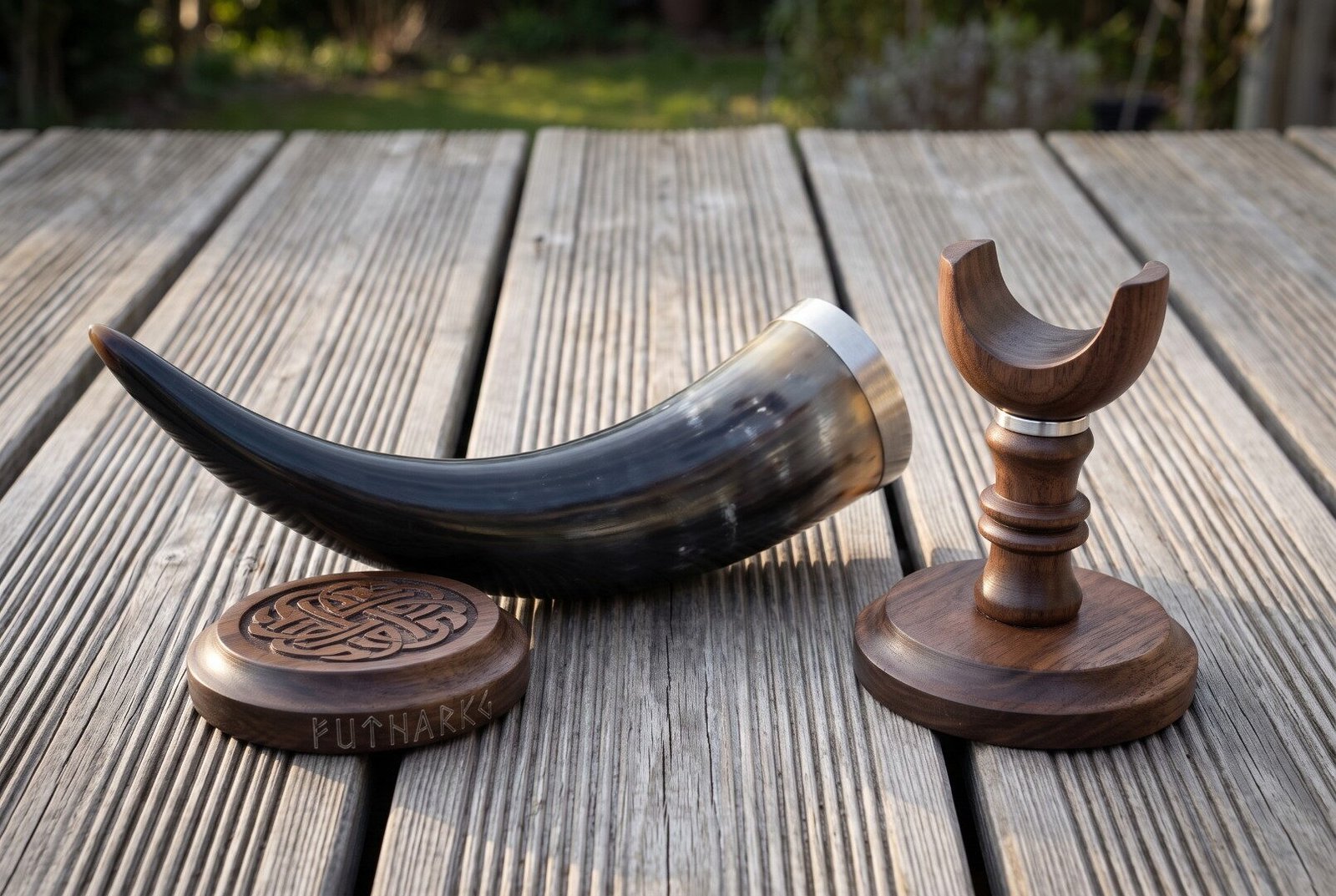
The symbol is three horns; the object is one, and it holds more. Our drinking horns are natural ox horn with steel or brass rims, sealed food safe inside. The Runemead rune drinking horn carries the full Elder Futhark row, and the Oakcradle horn with stand solves the eternal problem of a cup that cannot be put down. If you would rather have a handle, the horn mugs and tankards are the practical end of the range, and wearable Norse marks are in Norse pendants. Sealing, capacity and cleaning are covered in buying a drinking horn, and the stone the symbol comes from sits in a long tradition explained in runestones explained.
Ransack Viking is a US company in Chicago, Illinois. The pieces are made by hand in the Czech Republic, then inspected and shipped from Chicago, and US orders ship free and tracked. The rest of the writing is in the guides.
Questions people ask
What does the Horn of Odin symbol mean?
The popular meaning links the three horns to the three draughts of the mead of poetry that Odin took from the giantess Gunnlöð, so the symbol stands for inspiration and poetry. That link is a modern interpretation. No Viking Age text explains the design.
Is the triple horn a real Viking symbol?
Yes. Three interlocked horns are carved on the Snoldelev runestone from Zealand in Denmark, dated to the ninth century, and a similar knot has been noted on a picture stone from Gotland. The design is genuinely Viking Age, even though its original meaning is unknown.
What is the Snoldelev stone?
A Danish runestone from the ninth century, now in the National Museum of Denmark. Its inscription names Gunnvaldr, son of Hróaldr, a thul at Salhaugar, and it carries three interlocked horns and a swastika above the runes.
Does the Prose Edda mention horns in the mead story?
No. Snorri names the three vessels as a kettle, Óðrerir, and two crocks, Boðn and Són. The mead is drunk from them directly. Horns come from the modern reading of the symbol.
Is the Horn of Odin the same as the Valknut?
No. Both are built on threes and both appear in Viking Age art, but the Valknut is made of interlocked triangles and the triple horn of drinking horns. Whether the Norse thought of them as related is unknown.
Was Gjallarhorn Odin’s horn?
No. Gjallarhorn belongs to Heimdall, who will sound it at Ragnarok. In some accounts Mimir drinks from it at his well. Odin’s best known possessions are his spear, his ring, his horse and his ravens.
What the shop carries
On the shelf in the same spirit, the Amberdraught Valknut drinking horn and the Hornmoot ox horn tankard. Next to those, the Draughtraven drinking horn and belt hanger.
For the triple horn on a wall, the Fourmark Norse symbols shield paints it in bone white beside the Valknut, Mjolnir and the Helm of Awe.
