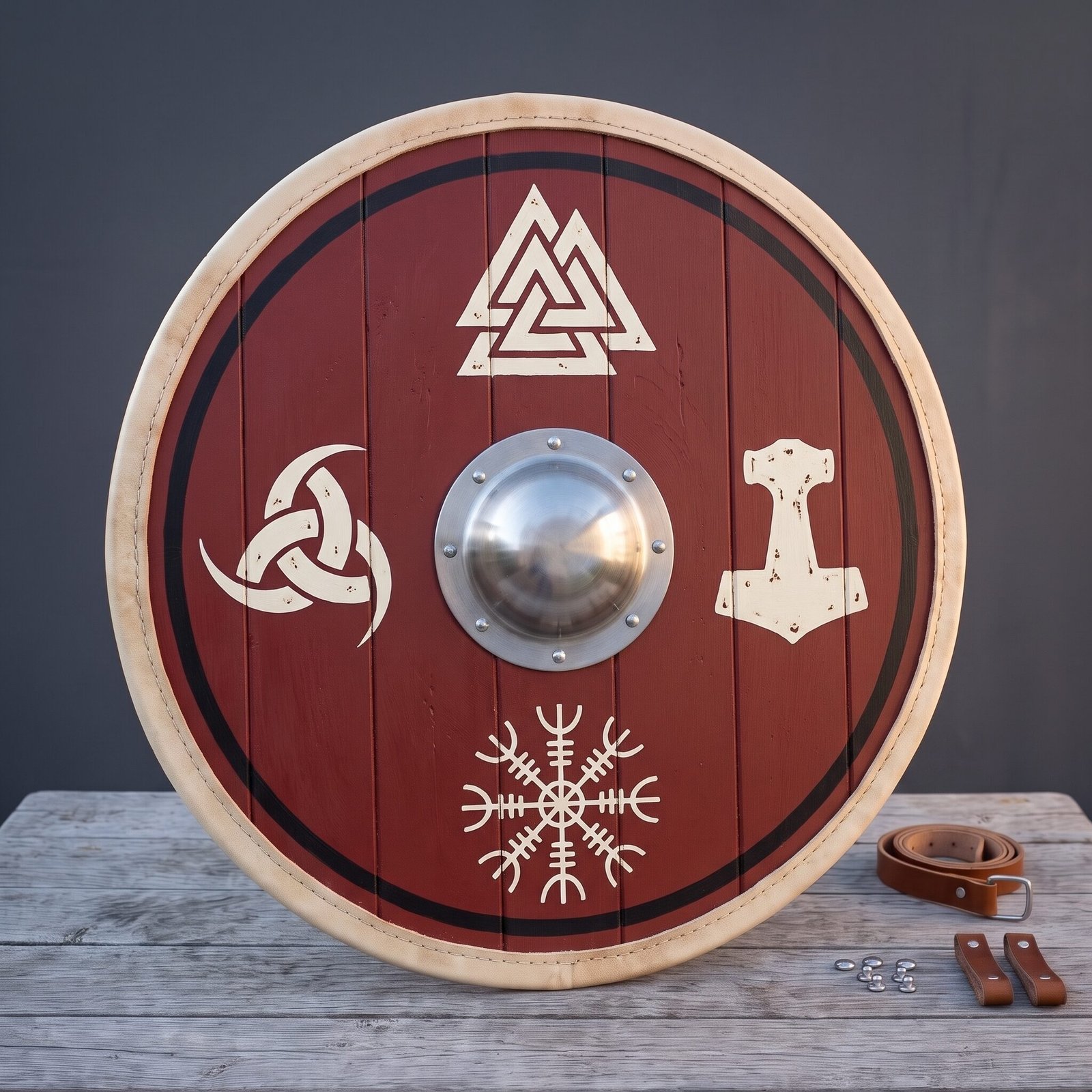
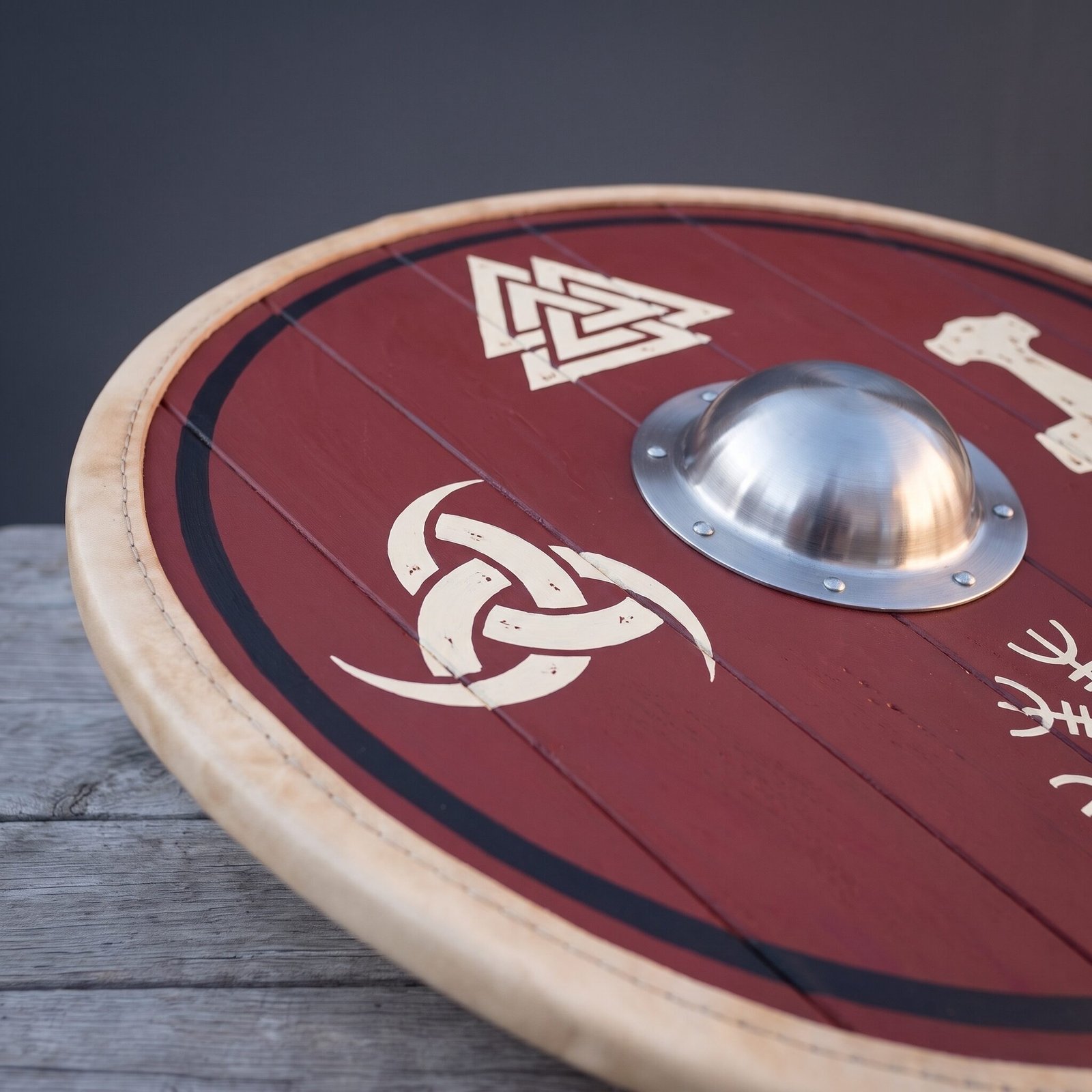
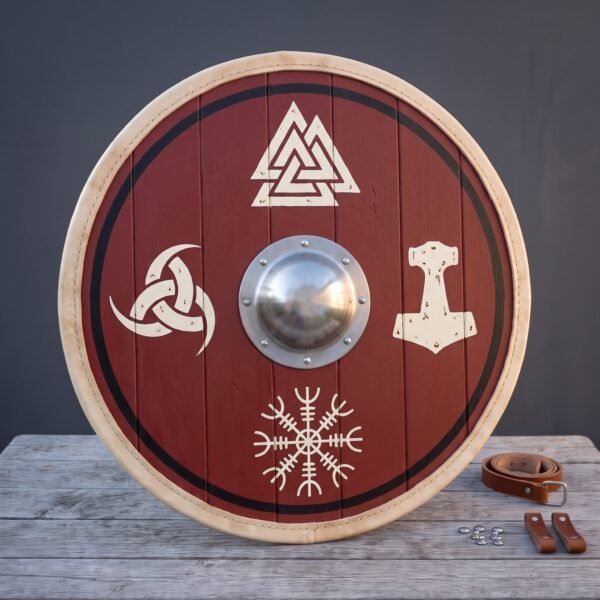
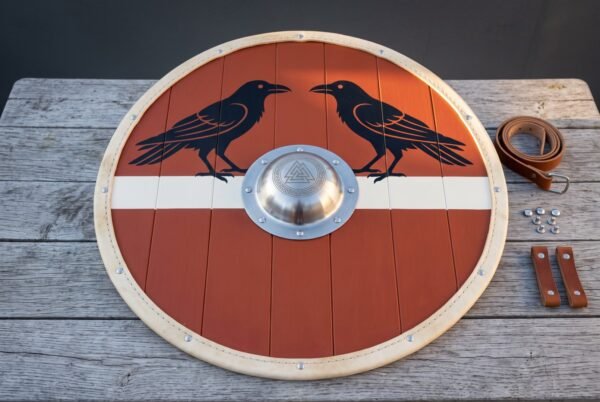
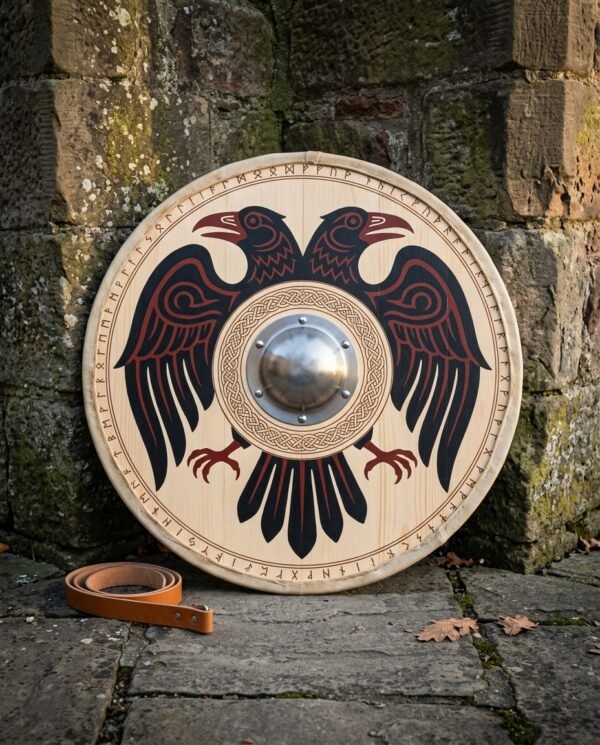
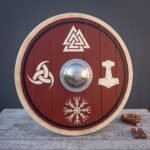
Fourmark is a hand made Viking round shield that carries four Norse symbols at once. The planks are painted a deep oxblood red with a thin black ring near the rim, and around the polished steel boss sit four signs in bone white, one in each quarter: the Valknut at the top, Thor’s hammer Mjolnir to the right, the Helm of Awe at the bottom and the triple horn of Odin to the left. It is 24 inches across and bound in pale stitched rawhide.
Most of our painted shields commit to one image. This one is for the person who cannot pick, or who wants a single piece on the wall that says Norse in four dialects. Each symbol has its own space, so none of them is crowded, and the boss in the middle ties the four together.
The shield is planked, painted, bound and bossed by hand in a Czech Republic workshop and shipped from our Chicago, Illinois warehouse. The strap, grip and rivets come loose in the box. We have written longer pieces on two of the four signs: the horn of Odin and the Valknut.
Specifications
| Material | Wooden planks butted and glued edge to edge, about 12 mm thick, hand painted face |
|---|
| Diameter | 24 inches |
|---|
| Design | Oxblood red ground, black ring band near the rim, four bone white symbols around the boss |
|---|
| Symbols | Valknut (top), Mjolnir (right), Helm of Awe (bottom), triple horn of Odin (left) |
|---|
| Boss | Plain polished steel dome, riveted through the flange over the centre hole |
|---|
| Rim | Pale rawhide edging, hand stitched around the circumference |
|---|
| Fittings supplied | Leather arm strap with steel buckle, leather hand grip, shield rivets |
|---|
| Intended use | Display, wall mounting, costume and light reenactment |
|---|
| SKU | RK-2324 |
|---|
The four symbols, one at a time
The Valknut
Three interlocked triangles. The Valknut appears on Gotland picture stones such as Stora Hammars I and Tangelgarda, often near scenes of death, sacrifice or Odin’s ravens, and on a carved bedpost from the Oseberg ship burial. The name is modern and its meaning was never written down, though the company it keeps points toward Odin and the dead. We go through what is known and what is guessed in The Valknut: where it appears and what we actually know.
Mjolnir
Thor’s hammer is the easiest of the four to read. In Snorri’s telling it was forged by dwarfs, came back to Thor’s hand when thrown and had a short handle because Loki, in the shape of a fly, bit the smith at the bellows. Small hammer pendants were worn across Scandinavia in the tenth century, and the sign stands for protection and strength. There is more in the meaning of Thor’s hammer.
The Helm of Awe
Eight forked arms around a centre. The name comes from the helm of terror worn by the dragon Fafnir in the Sigurd legend. The drawing is recorded later, in Icelandic books of magical staves, as a sign of protection and of fear put into enemies. It is the youngest of the four as a drawing and the most popular as a tattoo.
The triple horn of Odin
Three drinking horns linked at their points. The figure is carved on the Snoldelev stone from Zealand in Denmark, a runestone from around the ninth century, and is usually tied to the story of the mead of poetry, which Odin won back from the giant Suttungr and carried off in his belly. That last detail rarely makes it onto the gift card. Our guide to the horn of Odin covers the stone and the story.
Why these four together
They cover a lot of ground between them. Two belong to Odin, one to Thor, and one comes from the hero legends and Icelandic folk magic. Two are firmly Viking age in their surviving forms, the Valknut and the hammer, and two are better known from later sources. Put on one face, they give a fair picture of what people now mean by Norse symbolism, without pretending they all come from the same century.
The layout follows the boss. The Valknut sits at the top because a triangle reads best pointing up, Mjolnir hangs to the right with its head down as the pendants are worn, the Helm of Awe takes the bottom so its arms have room, and the horns sit to the left with their curve turning toward the centre.
Why oxblood red
Red was one of the commonest shield colours in the period, and the sagas use red shields as a sign of war. We went for a deep oxblood rather than a bright red because four pale symbols need a dark enough ground to stand out, and because a deep red looks like old paint rather than a fire engine. The black ring band near the rim frames the four signs and stops the red running straight into the rawhide.
Hanging it on a wall
At 24 inches across, Fourmark fits over a fireplace, a sideboard, a bed or a desk without crowding the wall. Hang it so the boss sits roughly at standing eye level, or a little higher over furniture. Side light from a window or a lamp shows the surface far better than a ceiling light directly above, which flattens everything it touches.
Use two strong picture hooks or a pair of brackets that catch the rim at the left and right, so the weight is shared and the shield cannot rock. A French cleat screwed to the back also works if you are happy drilling into the planks. Please do not hang it from the arm strap. Leather stretches slowly for months and then gives up all at once, usually at night.
Keep it away from radiators, heating vents and the wall above a wood stove. Warm dry air blowing across planks year after year is the quickest way to open the joints. For sizes and placement across the range, read choosing a shield for display.
The planks, the boss and the rim
Under the finish this is the same build as a Viking age board shield. The face is several planks glued edge to edge rather than one sheet of board, which is why the joints show through. The middle is cut through for the hand and covered by the steel boss, riveted through its flange. The edge is bound in pale rawhide that goes on wet and tightens as it dries, holding the plank ends together.
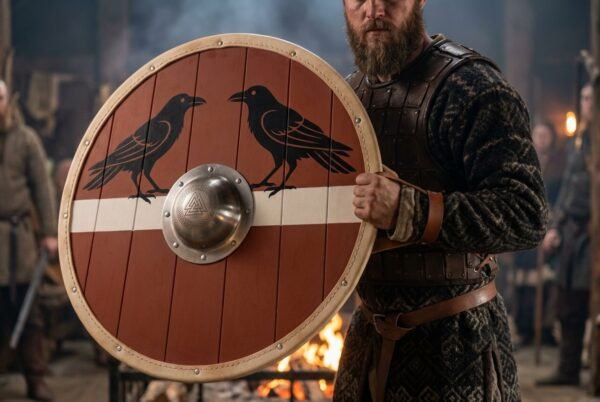
That build is why the shield can be carried as well as hung. With the strap and grip fitted it works on a centre grip, held in the fist behind the boss the old way. It suits costume events, photo shoots and light living history. It is not made for full contact combat, where groups set and inspect their own board, rim and boss standards, and we would rather say so now than after a weekend at a reenactment field. Our guide to Viking shields covers the history of the build.
Engraving, runes and your own design
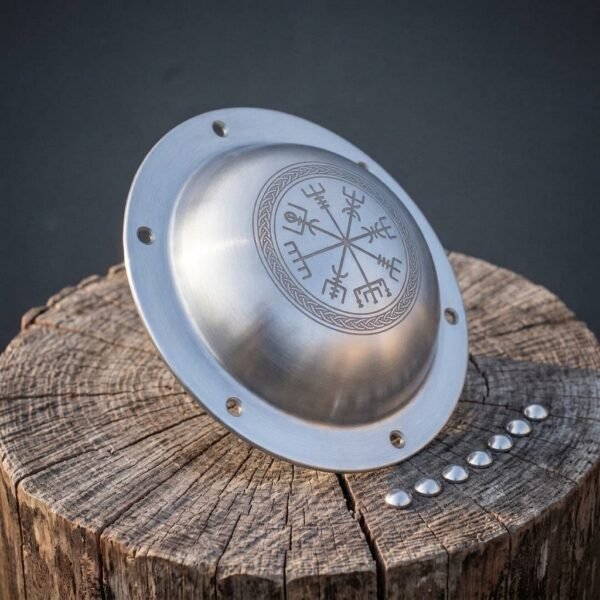
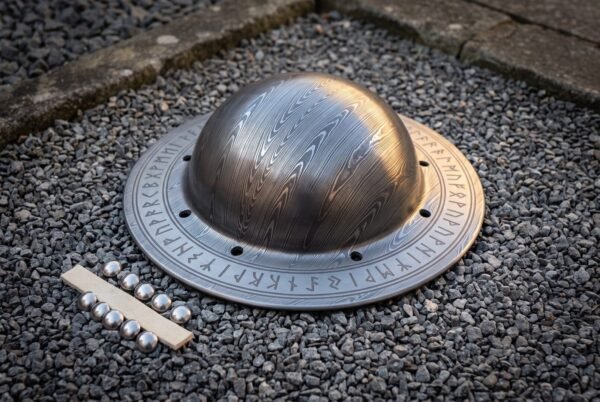
Use the rune converter on this page to turn a name, a date or a short phrase into Elder Futhark and we will cut it into the steel boss. If you would rather have a Viking pattern than a rune line, choose your own design in the engraving option above the add to cart button and tell us where it goes. Where a piece already carries an engraved design, your chosen engraving replaces it rather than sitting alongside it. The boss on Fourmark is plain, so a name or a short line in runes sits in the centre of the four symbols. A family name ringed by the four signs is a common request. See the engraving page for how it works.
Care
Dust the face with a soft dry cloth. Leave polish, sprays and anything with solvent away from the paint. Keep the shield indoors and dry, because wood, paint and rawhide all dislike long damp spells.
Give the steel boss a thin film of light oil or paste wax once or twice a year. If a rust spot appears, lift it with fine steel wool and a drop of oil, then wax again. The steel care page has the details.
Giving it as a gift
Fourmark is an easy gift for someone with a general love of Norse myth, because it does not force you to know which god they prefer. It suits a den, a games room, a bar or an office wall, and the four symbols give people something to ask about. If you want help choosing between our symbol shields, start with Viking symbols and their meanings.
Order a couple of weeks ahead of a birthday or holiday, since each shield is painted to order and boss engraving adds a few days.
Made in the Czech Republic
Fourmark is made by hand in a Czech Republic workshop. The planks are cut and glued, the face is sanded, sealed and painted red, the ring band and the four symbols are laid out and painted by hand, the rawhide is soaked and stitched, and the boss is fitted last. Ransack Viking is a United States company. We check each piece when it reaches us and ship it from our Chicago, Illinois warehouse.
A note on handmade variation
Each shield is painted by hand from the same layout, so the four symbols will sit where they sit in the photographs and match them closely, without being identical brushstroke for brushstroke. Size, colours and build are the same each time.
Frequently asked questions
Which symbol is where
Valknut at the top, Mjolnir on the right, Helm of Awe at the bottom and the triple horn of Odin on the left, as you face the shield.
Are all four symbols from the Viking age
The Valknut and Mjolnir survive in Viking age carvings and pendants. The horn triskele appears on a ninth century Danish runestone. The Helm of Awe drawing is known from later Icelandic manuscripts, although its name comes from older legend.
Can I swap one of the symbols
This listing has these four. If you want a different sign in one quarter, contact us before ordering and we will tell you whether the workshop can do it.
Can I carry it
Yes, for costume, photos and light reenactment. The strap and grip ship loose. It is not built for full contact fighting.
Can I put a name on it
Yes. The plain boss takes a rune line or a chosen design through the engraving option on this page.
How long does it take to ship
Processing is one to two weeks because each shield is built and finished to order, then shipping is free within the United States. Returns are accepted within seven days. Custom boss engraving adds a few days.
What is in the box
- One 24 inch planked Viking round shield painted oxblood red with four Norse symbols, rawhide bound
- Plain polished steel dome boss, riveted in place
- Leather arm strap with buckle and leather hand grip, supplied loose
- Set of shield rivets for fitting the strap and grip
- Made in the Czech Republic
Explore the range
See more in round shields and viking shields. If one sign is enough, the Hammerhewn carved Mjolnir shield and the Awemark Helm of Awe shield each give one symbol the whole face.

Reviews
There are no reviews yet