
A chef knife earns its place by being the one knife you reach for without thinking. That means a blade long enough to slice through a cabbage in one pass, a belly curved enough to rock through herbs, a tip fine enough for shallots, and enough height at the heel that your knuckles clear the board. Everything else is preference, though it is worth reading how to look after a hand forged kitchen knife first.
The knives here run 11.5 to 14 inches overall with blades of 7 to 8.5 inches, and the cleavers reach 4 inches of blade height at the heel. Most are forge welded Damascus of 1095 and 15N20 hardened to 58 to 60 HRC, with listed layer counts of 352 and 393. A few are plain 1095 at 54 to 58 HRC and one nakiri style cleaver is stainless. Handles run to rosewood, walnut, wenge, olive wood, pakka wood, buffalo horn, stag horn, resin and cord wrap, with brass, steel and Damascus bolsters.
Two five piece sets sit here as well, both in leather rolls. Those are the wedding gift.
Free US shipping
On most pieces. Heavier and oversized ones carry a flat charge.
Hand Forged
Heated, hammered and ground by hand.
Engraving available
Names, dates or Norse runes on most pieces.
Ships from Memphis
Inspected and dispatched from our Tennessee warehouse. No import duty, no customs delay on US orders.
Chef Knives
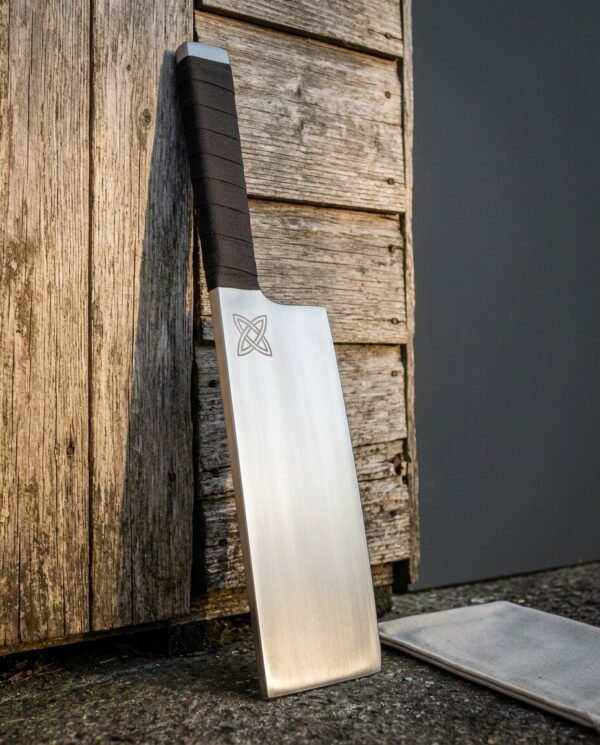
Blockward Hand Forged Viking Cleaver with Engraved Celtic Knot | 14 Inch Overall Length | Tall Straight Edge, Cord Wrapped Handle and Canvas Roll | Kitchen and Chef Gift | RK-1826
Original price was: $249.00.$211.65Current price is: $211.65.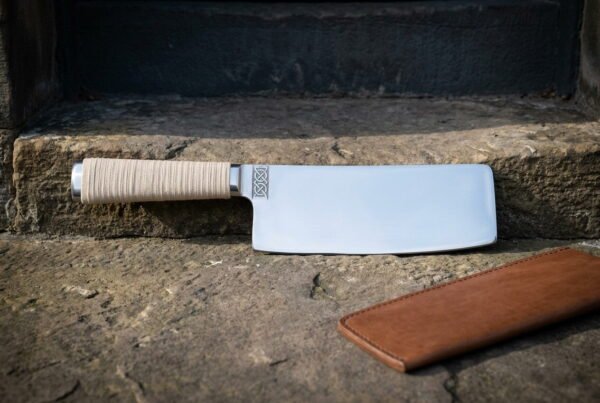
Boardkeen Hand Forged Stainless Steel Viking Kitchen Cleaver | Flat Nakiri Style Blade | Cord Wrapped Handle and Engraved Knotwork Panel with Leather Sleeve | Cook Gift | RK-1801
Original price was: $209.00.$177.65Current price is: $177.65.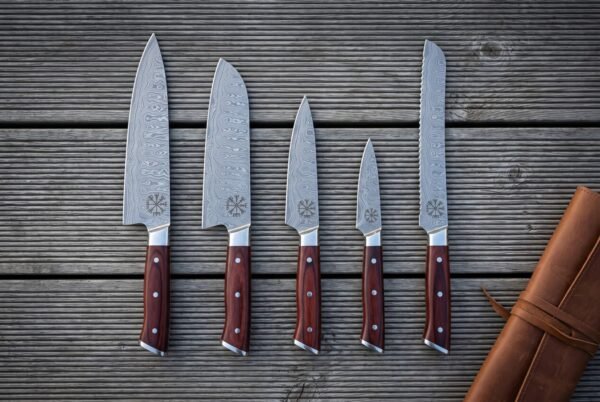
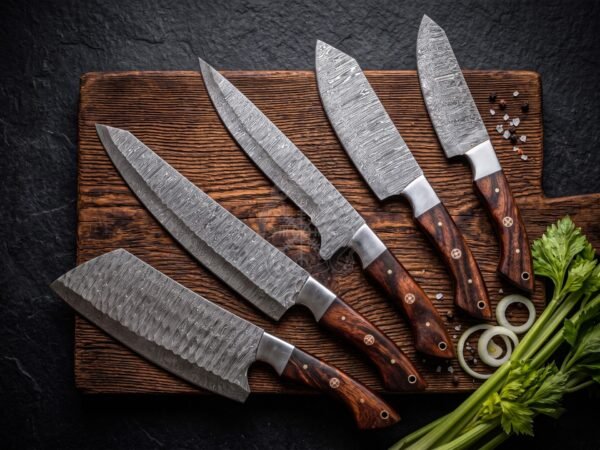
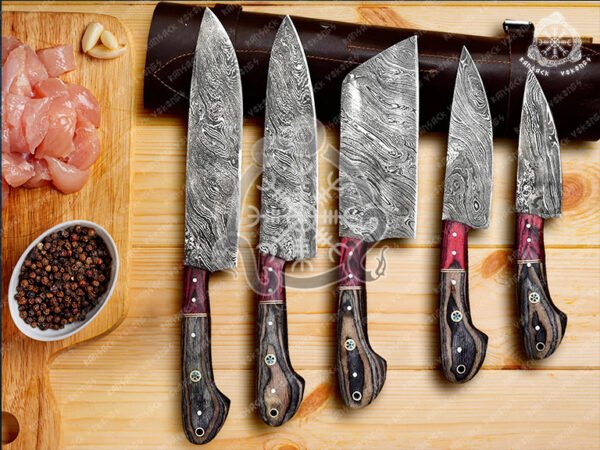
Hearthfold Hand Forged Damascus Chef Knife Set of Five with Rosewood Handles | Vegvisir Etched Blades | Full Tang Build and Leather Knife Roll | Kitchen Wedding Gift | RK-1763
Original price was: $529.00.$449.65Current price is: $449.65.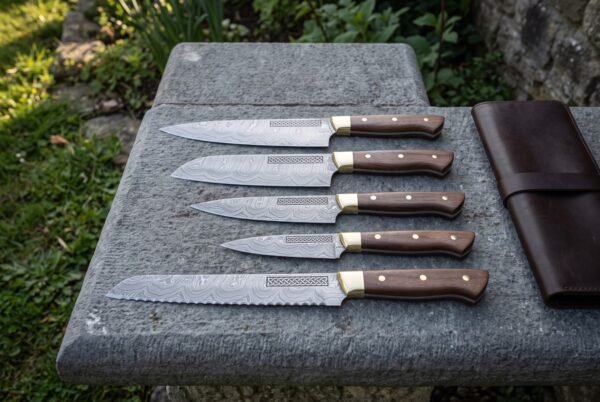
Hearthkeen Hand Forged Damascus Viking Chef Knife Set | 5 Piece Kitchen Roll | 1095 and 15N20 Blades with Walnut Handles and Brass Bolsters | Wedding Gift | RK-1778
Original price was: $499.00.$424.15Current price is: $424.15.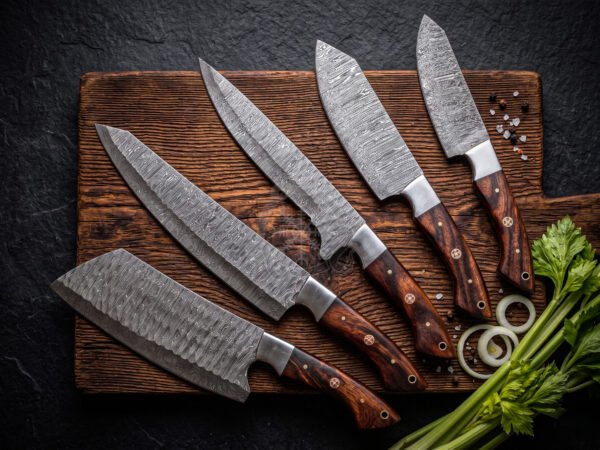
Rosechef Hand Forged Damascus Chef Knife with Rosewood Handle and Damascus Steel Bolster and Mosaic Pin & Leather Sheath | Chef Kitchen and Wedding Gift | RK-10473
Original price was: $159.00.$135.15Current price is: $135.15.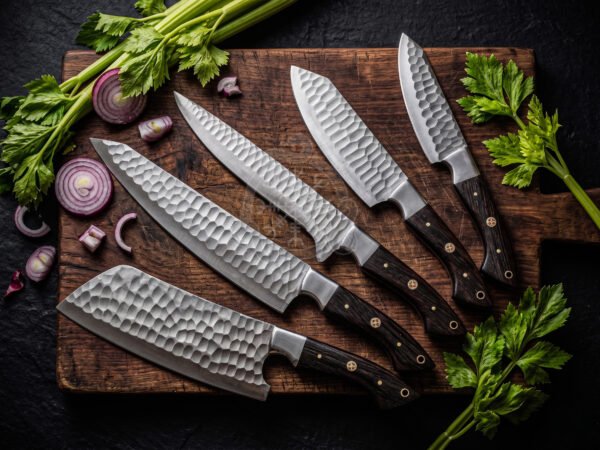
Wengechef Hand Forged Damascus Chef Knife with Wenge Wood Handle and Steel Bolster and Mosaic Pin & Leather Sheath | Chef Kitchen and Housewarming Gift | RK-1137
Original price was: $159.00.$135.15Current price is: $135.15.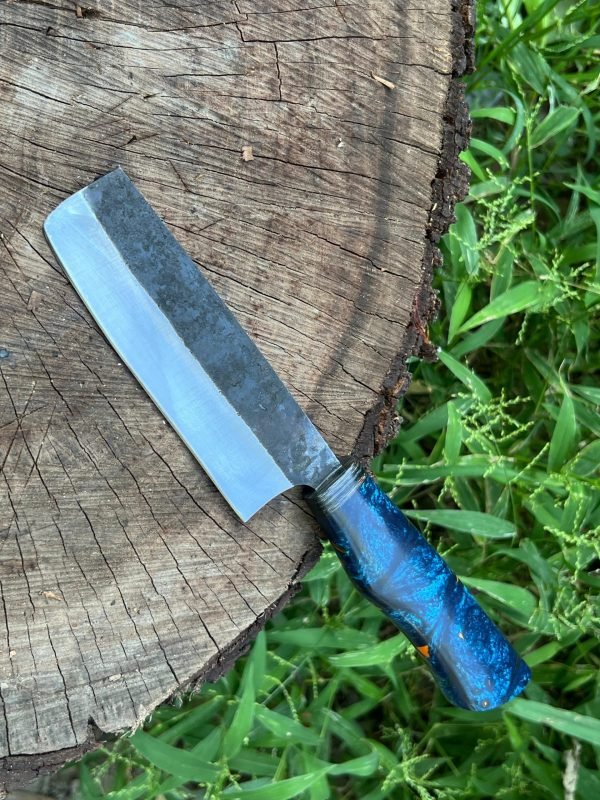
Bluecleaver Hand Forged High Carbon Steel Cleaver with Blue Resin Handle and Damascus Steel Guard & Leather Sheath | Butcher Kitchen and Chef Gift | RK-0010
Original price was: $109.00.$92.65Current price is: $92.65.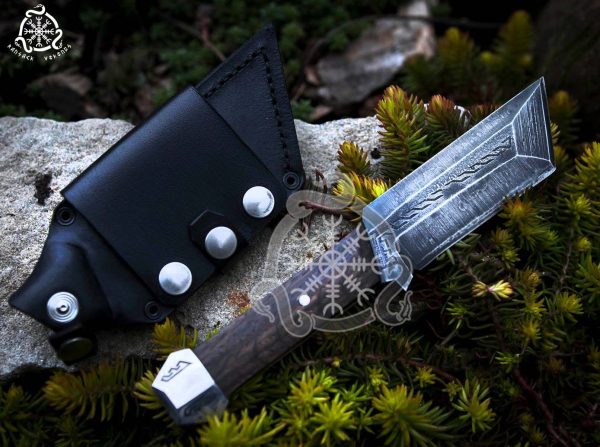
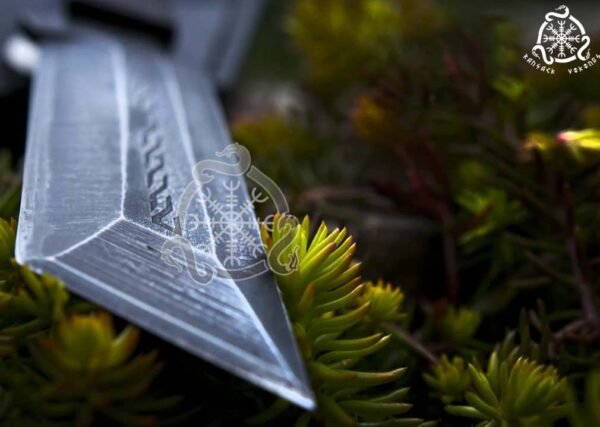
Woodsax Hand Forged High Carbon Steel Viking Seax Knife with Solid Wooden Handle | Norse Bushcraft Kitchen and Collector Gift | RK-662
Original price was: $179.00.$152.15Current price is: $152.15.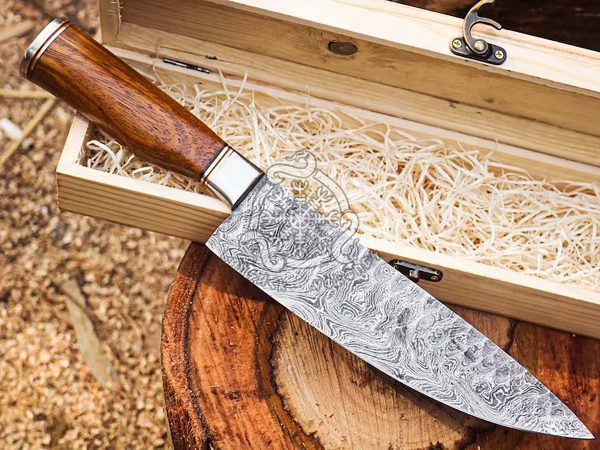
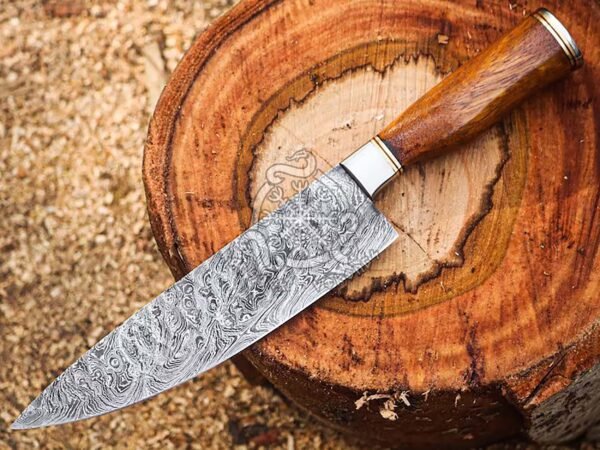
Fireleaf Hand Forged Damascus Chef Knife with Wood Handle and Steel Bolster and Fiber Spacers & Leather Sheath | Chef Kitchen and Wedding Gift | RK-500
Original price was: $139.00.$118.15Current price is: $118.15.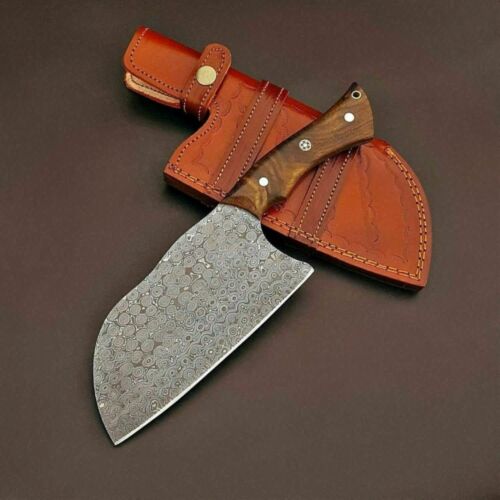
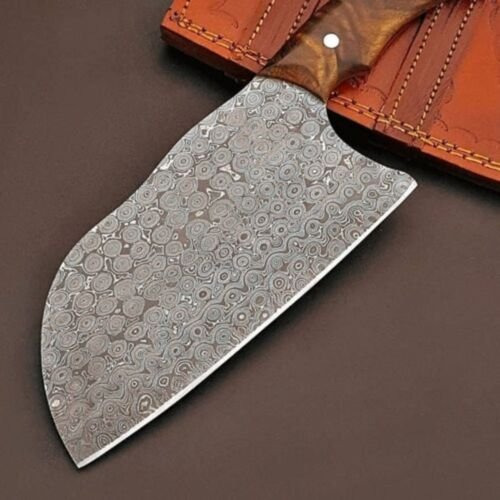
Blockbreaker Hand Forged Damascus Cleaver with Stag Horn and Walnut Wood Handle & Leather Sheath | Butcher Kitchen and Chef Gift | RK-436
Original price was: $139.00.$118.15Current price is: $118.15.
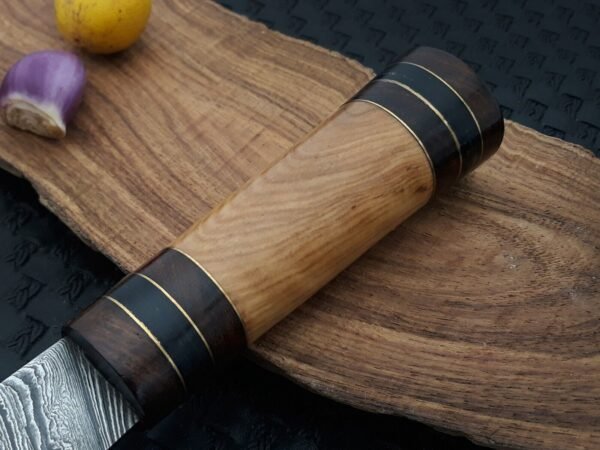
Olivekeen Hand Forged Damascus Chef Knife with Stag Horn and Olive Wood Handle & Leather Sheath | Chef Kitchen and Wedding Gift | RK-434
Price range: $101.15 through $169.15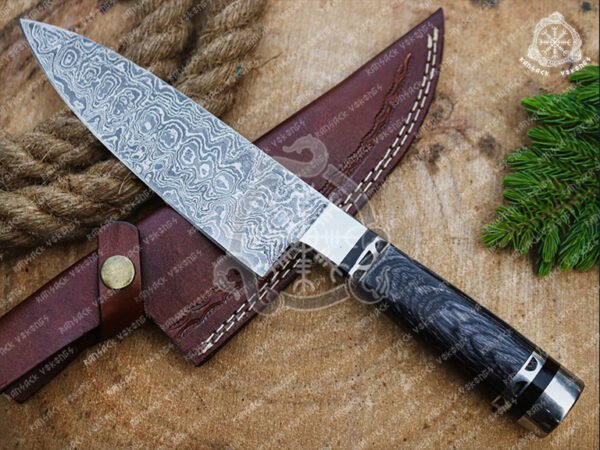
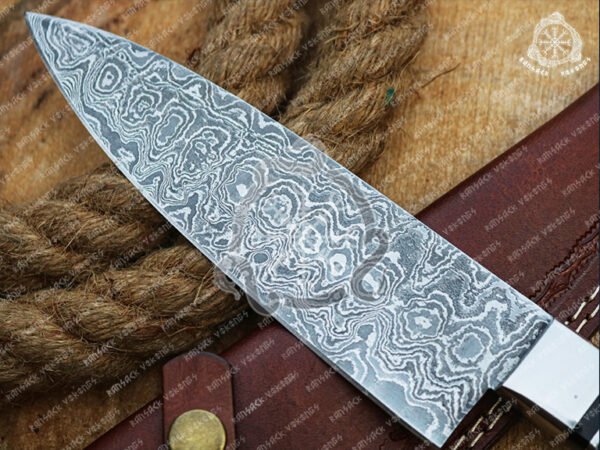
Brasshearth Hand Forged Damascus Chef Knife with Hardwood Handle and Brass Bolster and Fiber Spacers & Leather Sheath | Chef and Housewarming Gift | RK-396
Original price was: $139.00.$118.15Current price is: $118.15.
Hornsmith Hand Forged Damascus Chef Knife with Buffalo Horn and Pakka Wood Handle and Brass Bolster and Mosaic Pin & Leather Sheath | Chef and Kitchen Gift | RK-378
Original price was: $229.00.$194.65Current price is: $194.65.
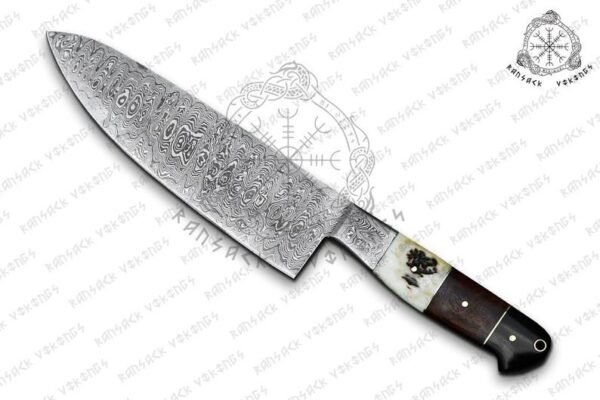
Kitchenskald Hand Forged Damascus Santoku Chef Knife with Buffalo Horn Handle & Leather Sheath | Kitchen and Chef Gift | RK-364
Original price was: $229.00.$194.65Current price is: $194.65.What makes a kitchen blade different
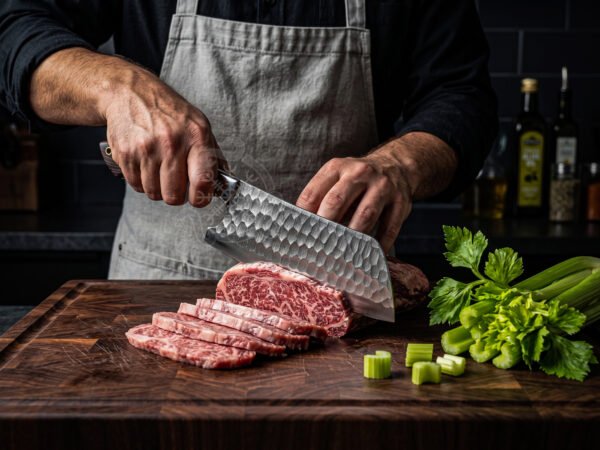
Every knife on this page is thin. That is the single thing that separates a kitchen blade from a field knife, and it matters more than steel, handle or pattern. A knife going through an onion is wedging the two halves apart as much as it is cutting, so the thinner the blade is behind the edge, the less force it takes and the less the food splits ahead of the cut. A hunting knife is ground thick because it will hit bone. A chef knife is ground thin because it will not.
The second difference is height. A chef knife has enough blade above the edge to keep your knuckles off the board, which is why a knife that looks oversized in the hand feels right once you are actually chopping. The cleavers here take that further, at about 4 inches at the heel, which turns the flat of the blade into a tool of its own for crushing garlic and carrying a pile of diced onion off the board.
The third is the curve. A western chef profile has a continuous belly so the edge rocks. A santoku and a nakiri have a flatter edge that meets the board along most of its length, which suits push cutting and chopping straight down. Neither is better. They are two different hand movements, and most people already know which one they use.
The knives in this collection
Fourteen listings sit on this page, from a single knife to a five piece set in a roll. Steel splits them first and profile splits them second.
Damascus chef knives
The bulk of the page. Forge welded 1095 and 15N20 at 58 to 60 HRC, etched so the layers show, with listed layer counts of 352 and 393 and patterns described as fire pattern and wind and mix twist. Sizes run 12 to 14 inches overall with 7 to 8.5 inches of blade. Two carry a Damascus or steel bolster and a mosaic pin, one has brass file work along the spine, and one lists a blade width of 1.75 inches at the heel. Listed weights are 13 oz on two of them.
Cleavers and the flat edged blades
Four pieces with a tall profile. One is 1095 at 54 to 58 HRC, 14 inches overall with 8 inches of straight edge and about 4 inches of height at the heel, flat ground and thin behind the edge, with a quaternary Celtic knot cut into the flat and a canvas blade roll. One is Damascus at 393 layers, 12 inches overall with a 7.5 inch broad blade and a stag horn and walnut handle. One is 1095 with a black polished finish and a blue resin handle set against a Damascus guard. The fourth is the outlier, a nakiri style cleaver in stainless steel with a squared tip, a cream cord wrapped handle and a stitched tan leather sleeve. A santoku in Damascus with a buffalo horn handle sits alongside them, flat edged with a dropped tip.
The five piece sets
Two, both Damascus at 58 to 60 HRC, both full tang with three pins per handle, both supplied in a leather roll. One runs a chef knife with a kiritsuke tip at about 8 inches, a 7 inch santoku, a 5 inch utility, a 3.5 inch paring knife and an 8 inch narrow slicer, on rosewood scales with a Vegvisir etched into every blade. The other runs a slicer, chef, utility, paring and serrated bread knife on oiled walnut with polished brass bolsters and a Celtic knotwork panel behind each bolster.
Sizes, steel and handles across the range
Every figure below comes from the specification panel of a knife on this page. These are forged and ground by hand, so read the numbers as what to expect rather than as a guarantee to the millimetre.
| Type | Overall length | Blade length | Steel and hardness | Handle | Layers or weight |
|---|---|---|---|---|---|
| Santoku | 11.5 in | Flat edge, dropped tip | Damascus at 58 to 60 HRC | Buffalo horn | Fire pattern |
| Chef knife | 12 in | 7 in | Damascus at 58 to 60 HRC | Rosewood, Damascus bolster, mosaic pin | Not listed |
| Chef knife | 12 in | 7 in | Damascus at 58 to 60 HRC | Wenge wood, steel bolster, mosaic pin | Not listed |
| Cleaver | 12 in | 7.5 in | 1095 at 54 to 58 HRC | Blue resin with a Damascus guard | Black polished |
| Cleaver | 12 in | 7.5 in | Damascus at 58 to 60 HRC | Stag horn and walnut | 393 layers |
| Seax style kitchen knife | 12 in | 7 in | 1095 at 54 to 58 HRC | Solid wood grip | Not listed |
| Chef knife | 12.5 in | 8 in, 1.75 in at the heel | Damascus at 58 to 60 HRC | Buffalo horn and pakka, brass bolster | Fire pattern |
| Chef knife | 13 in | 8 in | Damascus at 58 to 60 HRC | Wood, steel bolster, fiber spacers | 352 layers, 13 oz |
| Chef knife | 13 in | 8 in | Damascus at 58 to 60 HRC | Hardwood, brass bolster, fibre spacers | 352 layers, 13 oz |
| Chef knife | 14 in | 8.5 in | Damascus at 58 to 60 HRC | Stag horn and olive wood | 393 layers, brass file work |
| Cleaver, straight edge | 14 in | 8 in, 4 in at the heel | 1095 at 54 to 58 HRC | Cord wrapped full tang, steel butt cap | Canvas blade roll |
| Nakiri style cleaver | Not listed | Tall, squared tip | Stainless | Cream cord over a steel ferrule | Tan leather sleeve |
| Five piece set, rosewood | Set of five | 3.5 to 8 in blades | Damascus at 58 to 60 HRC | Rosewood scales, three pins each | Vegvisir etched, leather roll |
| Five piece set, walnut | Set of five | Paring to slicer | Damascus at 58 to 60 HRC | Walnut scales, brass bolsters | Knotwork panels, leather roll |
Layer counts are worth reading calmly. More layers means a finer pattern, not a better knife. A 352 layer billet and a 393 layer billet made from the same two steels cut identically. What changes is how tight the figure looks once the acid has done its work.
Carbon steel in a kitchen, honestly
Almost everything here is carbon steel and it will react with food. That is not a fault, it is the trade you make for an edge that gets sharper and comes back faster than stainless does. But you should know what you are signing up for.
Cut an onion, leave the blade wet for ten minutes, and you will see grey shadows on the steel. That is patina, a stable oxide layer, and it is protective. It builds unevenly at first and then settles into a mottled grey that many people like. Tomatoes, lemons, vinegar and anything acidic speed it up. None of that harms the knife or the food.
Rust is different. Rust is orange, it grows, and it pits. It happens when a carbon blade is left wet, put away damp, or left sitting in a sink. Wash the knife by hand as soon as you are done, dry it immediately with a towel, and it will never rust. Leave it overnight in water and it will.
The one stainless piece on this page exists for exactly this reason. If the knife is going to live near a wet sink and get treated like an appliance, stainless is the sensible answer.
Damascus and plain 1095, which to buy
Damascus here is 1095 and 15N20 forge welded, folded, drawn out and acid etched. The 15N20 carries nickel, resists the acid and stays bright, while the 1095 darkens. That contrast is the pattern and it runs through the steel rather than sitting on the surface. Hardened to 58 to 60 HRC it takes a very fine edge and holds it through a long prep session.
Plain 1095 at 54 to 58 HRC is softer, which sounds worse and is not. It comes back on a stone in a couple of minutes, it is more forgiving of a bad angle, and on a cleaver that occasionally meets a joint it is the tougher choice. The two 1095 pieces here are both cleavers, and that is not an accident.
Handles, tangs and bolsters
Every handle here is natural material or resin over a tang, with pins through. The five piece sets and the straight edged cleaver are described as full tang, with the steel running the full length and width of the grip and three pins holding the scales. That is the strongest arrangement and the one to want on a knife that gets used daily.
Materials run to rosewood, walnut, wenge, olive wood, pakka wood, hardwood, buffalo horn, stag horn, blue resin and cord wrap. Rosewood, wenge and pakka are dense and oily and cope well with kitchen humidity. Walnut and olive are drier and want a wipe of food safe oil once or twice a year. Horn looks best and likes dry heat least, so keep it away from an oven vent or a radiator.
Bolsters here are brass, steel and Damascus, with mosaic pins on two knives and fiber spacers on two more. A bolster adds weight at the front of the handle, which shifts the balance forward toward the blade. On an 8 inch chef knife that is usually what you want.
Sharpening and the board
These arrive sharp and they will need a stone eventually. A 1000 grit waterstone restores a working edge and a 3000 grit polishes it. Match the angle already on the blade rather than inventing one, work until you feel a burr along the whole edge, then flip and take the burr off with light strokes. A leather strop finishes it.
The board matters as much as the stone. Wood and plastic are fine. Glass, stone, ceramic and steel boards will destroy an edge in one meal, and at 58 to 60 HRC a Damascus blade is hard enough to chip rather than roll when it hits something harder than it is. End grain wood is the kindest surface a knife can meet.
Never put any of these in a dishwasher. Heat, detergent and a long wet cycle will rust the steel, dry out the wood and loosen a scale from its pins. Hand wash, dry, done.
Storage and care
Store knives so the edges touch nothing. A magnetic strip, a knife block, an in drawer tray or the leather roll the sets come in all work. Loose in a drawer is how edges get chipped and how people get cut reaching for a spoon.
Give carbon blades a very light wipe of food safe oil if the knife will sit unused for weeks. Mineral oil sold for cutting boards is ideal and costs almost nothing. Leather sheaths are for carrying, not for long storage, because leather holds moisture against steel.
Engraving and gifting
Most knives here can be engraved after they arrive in the United States, and one is listed by the maker as ready for engraving with a clear panel left in the pattern. Names, dates and short lines go on the flat of the blade or on a bolster. Text engraving is 19 dollars, a symbol is 39 dollars and a family crest is 49 dollars.
Several pieces already carry cut work: a quaternary Celtic knot on a cleaver heel, a Vegvisir etched into all five blades of one set, knotwork panels behind the bolsters of the other. Engraving is permanent and an engraved knife cannot be returned, so check the spelling twice.
Where these come from and how they ship
Ransack Viking is a US company based in Memphis, Tennessee. The pieces are handmade in the Czech Republic, then imported, inspected and shipped from Memphis. Engraving is done in the US after arrival. Single knives ship in a leather sheath or sleeve and the sets ship in a leather roll.
No two Damascus blades come out of the acid identically, and horn and wood vary in colour from piece to piece. If you want a matched pair, order them together and say so.
How to choose
If this is your first hand forged kitchen knife, take an 8 inch chef blade at 12.5 to 13 inches overall. That covers most of what a kitchen asks for and it is the size your hands already expect. Add a paring knife later, or buy one of the sets and skip the decision.
If you already own a good chef knife, buy the shape you are missing. A cleaver for vegetables and for scooping the board, a santoku or nakiri if you push cut rather than rock, a slicer for roasts. And if the knife is a wedding or housewarming gift, one of the five piece rolls in Damascus is difficult to beat and impossible to mistake for something ordinary.
Browse related categories
- Damascus knives across every pattern we stock
- Fillet knives with thin flexible blades
- Damascus skinner knives for field work
- Viking seax knives, the single edged Norse blade
- Wedding and groomsmen gifts
- Leather sheaths and replacements
Guides worth reading first
- The best Damascus chef knives and how to pick one
- Caring for a hand forged kitchen knife
- How to sharpen a knife with a whetstone
- Damascus vs high carbon steel: which should you buy
Frequently asked questions
What size chef knife should I buy?
An 8 inch blade covers almost everything a home kitchen asks for, and on this page that means a knife of about 12.5 to 13 inches overall. Go to 8.5 inches if you have long hands or cut a lot of large vegetables. Under 7 inches you are into utility knife territory.
Will these knives rust?
The carbon steel ones will if you let them. Wash by hand, dry immediately and they will not. Grey patina is not rust, it is a stable oxide layer that builds from cutting acidic food and it protects the steel. Orange spotting is rust and it lifts with fine abrasive and oil.
Can they go in the dishwasher?
No. Heat, detergent and a long wet cycle will rust carbon steel, dry out a wooden handle and loosen scales from their pins. This applies to the stainless one too, because the handle materials object even when the blade does not.
Do they arrive sharp?
Yes. Every blade is ground and finished by hand and arrives with a working edge. The sets are listed as sharpened and ready to use. A few passes on a fine stone will take any of them further if you want more.
Is Damascus actually better for a kitchen knife?
It is harder here, at 58 to 60 HRC against 54 to 58 for the plain 1095 pieces, so it holds a fine edge longer. It is also more work to sharpen and more likely to chip on a hard board. Buy Damascus for edge retention and for the pattern. Buy plain 1095 on a cleaver.
What board should I use?
Wood or plastic. End grain wood is the kindest. Never glass, stone, ceramic or steel, because a hardened blade chips rather than rolls when it meets something harder than it is, and one meal on a glass board can ruin an edge.
How do I look after the handle?
Wipe it dry and give wooden handles a little food safe oil once or twice a year. Keep horn and stag away from dry heat, so not next to an oven vent or a radiator, because they shrink as they dry and can pull away from a pin.
Where are these knives made?
They are handmade in the Czech Republic, then imported, inspected and shipped by Ransack Viking from Memphis, Tennessee. Engraving is added in the United States after arrival.
Featured pieces
Brasshearth Hand Forged Damascus Chef Knife with Hardwood Handle and Brass Bolster and Fiber Spacers & Leather SheathOriginal price was: $139.00.$118.15Current price is: $118.15.
Olivekeen Hand Forged Damascus Chef Knife with Stag Horn and Olive Wood Handle & Leather SheathPrice range: $101.15 through $169.15
Blockbreaker Hand Forged Damascus Cleaver with Stag Horn and Walnut Wood Handle & Leather SheathOriginal price was: $139.00.$118.15Current price is: $118.15.
Fireleaf Hand Forged Damascus Chef Knife with Wood Handle and Steel Bolster and Fiber Spacers & Leather SheathOriginal price was: $139.00.$118.15Current price is: $118.15.