
Blog
Caring for a Hand Forged Kitchen Knife

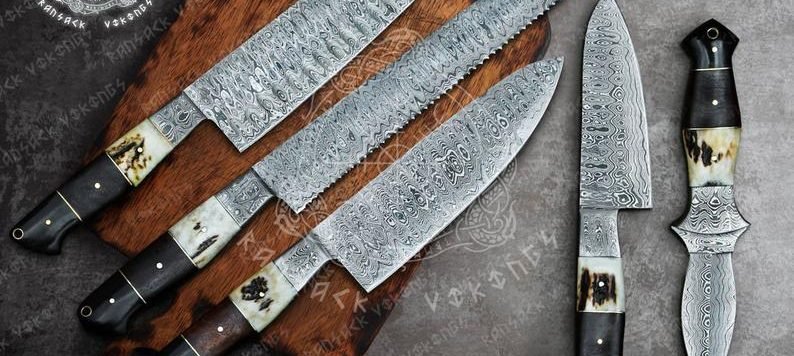
A hand forged kitchen knife needs three habits: wash and dry it by hand straight after use, never leave it wet or in a sink, and keep it off hard surfaces. Carbon steel will rust in minutes if you ignore the first two, and the dishwasher will ruin a knife faster than any amount of cutting ever will. Everything else is refinement.
That is the whole of it in one paragraph, and if you only take that away, your knife will outlive you. What follows is the detail: the daily routine, what to do about the patina, how to sharpen and how often, what board to use, and the small number of things that genuinely destroy a blade.
Why a forged carbon knife is different
Most kitchen knives sold in supermarkets are stamped from stainless sheet. They resist rust well, they hold a middling edge, and they are designed to survive neglect, which is the main thing most kitchens ask of them. A hand forged knife in high carbon steel is a different proposition. The steel takes a finer, sharper edge and holds it longer, and it will react with everything acidic you cut and with the water you leave on it.
That reactivity is not a defect. It is the trade you make for a better edge. Managed properly, the surface darkens into a stable grey or blue grey film called a patina, and that film protects the steel underneath. Managed badly, you get orange rust, which eats the steel and pits the surface permanently. The difference between the two outcomes is entirely down to how quickly you dry the blade.
The daily routine, step by step
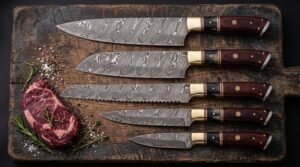 Hornsmith Hand Forged Damascus 5 Piece Chef Knife Set with Buffalo Horn and Pakka Wood Handles and Brass Bolsters and Mosaic Pin & Leather Sheath | Chef and Kitchen Gift | RK-378
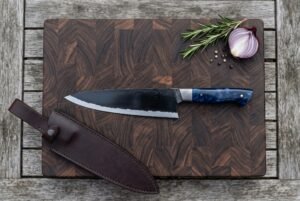 Bluecleaver Hand Forged High Carbon Steel Chef Knife with Blue Resin Handle and Damascus Steel Bolster & Leather Sheath | Butcher Kitchen and Chef Gift | RK-0010
 Bonecliff Hand Forged 1095 Carbon Steel Viking Bowie Knife with Bone Handle & Brass Guard | 13 Inch Overall | Clip Point Blade and Leather Belt Sheath | Hunting Gift | RK-1704
1. Wipe as you go
While you are working, keep a folded cloth or a piece of kitchen towel beside the board. After cutting anything acidic (onion, tomato, citrus, apple, vinegar), give the blade a quick wipe. This takes two seconds and prevents almost every problem that follows.
2. Wash by hand, immediately
When you have finished, wash the knife under warm water with a drop of dish soap and a soft sponge or cloth. Hold it by the spine and wash away from the edge. Do this before you sit down to eat, not after. A knife left in a wet sink for an hour will come out spotted.
3. Dry completely
This is the step that matters most. Dry both faces, the spine, the edge and, critically, the join where the blade meets the handle. Water sits in that gap and works its way under a bolster or a scale where you cannot see it. Then leave the knife out on the rack or the board for a few minutes before putting it away, so any trace of moisture in the handle material evaporates.
4. Store it dry and protected
A magnetic strip, a slotted block, a knife roll or the leather sheath the knife came in are all fine. What is not fine is a drawer, where the edge bangs against other metal, or a closed sheath while the blade is still even slightly damp. Leather holds moisture against steel and will cause rust in a sheath faster than open air ever will. Store a knife in its sheath only when it is bone dry.
5. Oil it if the knife will sit unused
If the knife is going into a drawer or a roll for weeks, wipe a very thin film of food safe mineral oil over the blade first. Camellia oil is the traditional choice and works well. Do not use cooking oils such as olive or sunflower, which go rancid and sticky. A light coat once before storage is enough.
The patina, and whether to force one
Leave a carbon blade to its own devices and it will develop a mottled grey film within a few weeks of use. Some people love the look, some hate it, and neither camp has ever talked the other round. Either way it is protective, and scrubbing it off with an abrasive pad every time simply exposes fresh steel to start again.
You can force an even patina if you prefer a uniform finish. The usual method is to warm a cup of white vinegar or strong black coffee, stand the blade in it for around fifteen to twenty minutes, rinse, dry and repeat if the colour is uneven. Do this only on the blade, keep the handle out of the liquid, and expect a darker, more consistent grey. Mustard applied in patterns produces a mottled effect that some makers use deliberately.
If the patina ever turns orange and flaky rather than grey and smooth, that is rust, not patina. Deal with it below.
Dealing with rust
Catch it early and it is nothing. A light orange bloom comes off with a wine cork or a soft cloth and a smear of baking soda paste, worked along the blade rather than across it. Rinse, dry, oil. Slightly heavier spotting responds to a rust eraser block or the finest grade of a non woven abrasive pad, again worked along the length.
Deep pitting cannot be undone. Once rust has eaten below the surface, removing it leaves a hollow, and the only fix is grinding the blade down, which is a job for someone with the right equipment. This is why the two second wipe matters.
Sharpening
A forged carbon blade takes a keener edge than stainless and is easier to sharpen, because the steel is more responsive on a stone. Most home cooks need a stone in the 1000 grit range for real sharpening and something around 3000 to 6000 for finishing. A leather strop with a little compound keeps an edge alive between sharpenings.
Honing against sharpening
These are different jobs. Honing straightens an edge that has rolled over slightly with use and removes no meaningful metal. A smooth steel or a ceramic rod does this, and a few passes before each session of cutting is a good habit. Sharpening removes metal to create a new edge, and a well kept kitchen knife needs it perhaps every few months rather than every week, whatever the internet has told you.
The stone routine
Soak or splash the stone according to its type. Find the existing angle by laying the blade flat and lifting the spine until the bevel sits flush, then hold that. Draw the blade across the stone with light, even pressure, working from heel to tip, the same number of strokes on each side. Work until you can feel a burr along the whole length on the opposite side, then swap. Finish on the higher grit, then strop. Our knife care guide goes deeper into angles and stone choice, and the steel glossary explains why hardness changes how a steel behaves on a stone.
Boards, and the mistake that costs edges
Cut on end grain wood or on a soft plastic board. Do not cut on glass, stone, marble, ceramic tile or a metal tray. A glass board will visibly dull a fine edge in a single session and can chip it. Bamboo is harder than most people realise and is tougher on an edge than maple or beech, though it is far better than glass.
Never use the blade to scrape chopped food off the board. Turn it over and use the spine. Scraping with the edge rolls it over in a way that a few dozen cuts would not.
What actually ruins a hand forged knife
The dishwasher is the worst thing you can do to one, and it is also the most popular. It combines standing water, high heat, aggressive detergent and knocking against other items, and it will rust a carbon blade, crack a wooden handle and loosen a bolster in a handful of cycles. There is no dishwasher setting that makes this safe. This is not a warranty technicality; it is a knife destroyed.
Close behind it: leaving the blade in a sink of water, putting the knife away damp in a leather sheath, storing it loose in a drawer, and using it as a lever or a screwdriver. A thin hard blade snaps when twisted. Prying open anything with a kitchen knife is how tips break, and a tip only breaks once.
Handle care
Wooden and horn handles want the same treatment as a wooden spoon. Keep them out of standing water, dry them properly, and wipe a little food safe mineral oil into them two or three times a year, more if the wood looks dry or chalky. Stag horn and buffalo horn benefit from exactly the same. Never soak a handle, and never leave a knife handle down in a jug of water.
What we make
Our chef knives range covers santoku, chef, cleaver and utility patterns in 1095 and 15N20 Damascus with buffalo horn, stag, olive wood and pakka wood handles, most supplied with a leather sheath. The Viking knives and Viking seax ranges take the same forging into historical shapes that work perfectly well on a board, and fish fillet knives covers the thin flexible blades. Plain blades are 1095 hardened to 54 to 58 HRC; Damascus is 1095 and 15N20 forge welded at 58 to 60 HRC. Every knife is handmade in the Czech Republic the old way, then imported, inspected and shipped from Chicago, Illinois, and engraving is done in the US after arrival.
A simple schedule
After every use: wash by hand, dry completely, put away dry. Before every session: a few passes on a hone or a strop. Every few months: a proper sharpening on stones. Twice a year: oil the handle, check the fit where blade meets handle, and look over the edge for chips. That is the entire commitment, and it takes less time in a year than one trip to buy a replacement knife.
If you are choosing a shape rather than caring for one you own, our guide to knife blade shapes explains what each profile is good at.
Our pick of the kitchen range is in the best Damascus chef knives, and the stone technique this relies on is set out in sharpening with a whetstone.
Questions people ask
Can I put a hand forged knife in the dishwasher?
No. The combination of standing water, heat and harsh detergent will rust a carbon blade and dry out or crack a natural handle, and knocking against other items chips the edge. There is no cycle that makes it safe. Wash by hand in warm soapy water, dry immediately, and the knife will last decades instead of months. It will also outlast the dishwasher.
Why has my knife turned grey or blue?
That is patina, and it is the blade doing you a favour. Carbon steel reacts with food acids and air to form a stable oxide film that protects the steel underneath. It usually starts as mottled grey or blue grey and evens out with use. Orange, flaky discolouration is different: that is rust, and it should be removed with baking soda paste or a rust eraser, then oiled.
How often should I sharpen a kitchen knife?
Properly, on stones, perhaps every few months for normal home use. Between those sessions, a few passes on a smooth steel or a leather strop before you start cooking will keep the edge aligned and doing its job. If you find yourself pressing harder to cut a tomato, that is the signal, and waiting past it just means more work on the stone.
Is it safe to store the knife in its leather sheath?
Only when the blade is completely dry. Leather holds moisture against steel and can cause rust inside a sheath faster than open air would. Dry the blade thoroughly, leave it out for a few minutes, then sheath it. For long term storage a magnetic strip or an open block is safer than any closed cover.
What board should I use?
End grain wood is best, and a soft plastic board is a good second. Avoid glass, stone, marble and ceramic entirely, since they will dull a fine edge within a single session and can chip it. Bamboo is harder than most hardwoods and wears an edge faster than maple or beech, but it is still far kinder than glass.
What oil should I use on the blade?
Food safe mineral oil, or camellia oil if you want the traditional choice. Both are stable, tasteless and will not go rancid. Do not use olive, sunflower or any other cooking oil, which turn sticky and sour on the steel over time, and smell like it. A very thin film is all you need, and only before the knife goes into storage rather than after every wash.
On the shelf
If you are shopping rather than reading, the Olivekeen chef knife and the Fireleaf chef knife are the nearest match. Also worth opening, the Kitchenskald santoku chef knife and the Blockward Viking cleaver.
Shop the range
Hornsmith Hand Forged Damascus 5 Piece Chef Knife Set with Buffalo Horn and Pakka Wood Handles and Brass Bolsters and Mosaic Pin & Leather Sheath | Chef and Kitchen Gift | RK-378Bluecleaver Hand Forged High Carbon Steel Chef Knife with Blue Resin Handle and Damascus Steel Bolster & Leather Sheath | Butcher Kitchen and Chef Gift | RK-0010Bonecliff Hand Forged 1095 Carbon Steel Viking Bowie Knife with Bone Handle & Brass Guard | 13 Inch Overall | Clip Point Blade and Leather Belt Sheath | Hunting Gift | RK-1704 Chainfell Hand Forged 1095 Steel Chain Sword Pair | Two Straight Backed Blades and Two Scabbards | Ring Pommels on Blackened Chains with Oxblood Grips | Collector Display Gift | RK-1806
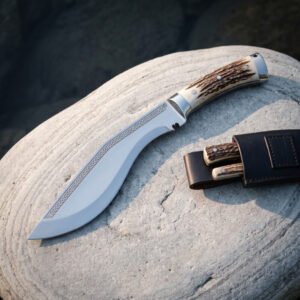 Hornstag Hand Forged 1095 Steel Kukri Knife | 16 Inch Overall | Stag Horn Scales and Polished Steel Bolster with Leather Belt Sheath and Two Companion Blades | Bushcraft Gift | RK-2100
 Stavehelm Hand Forged 1095 Kukri Knife with Stacked Leather Handle & Helm of Awe Bolster | About 16 Inches Overall | Tan Leather Sheath | Norse Camp Gift | RK-2198