
Blog
The Real Axe Behind the Leviathan: Norse Sources and Screen Invention

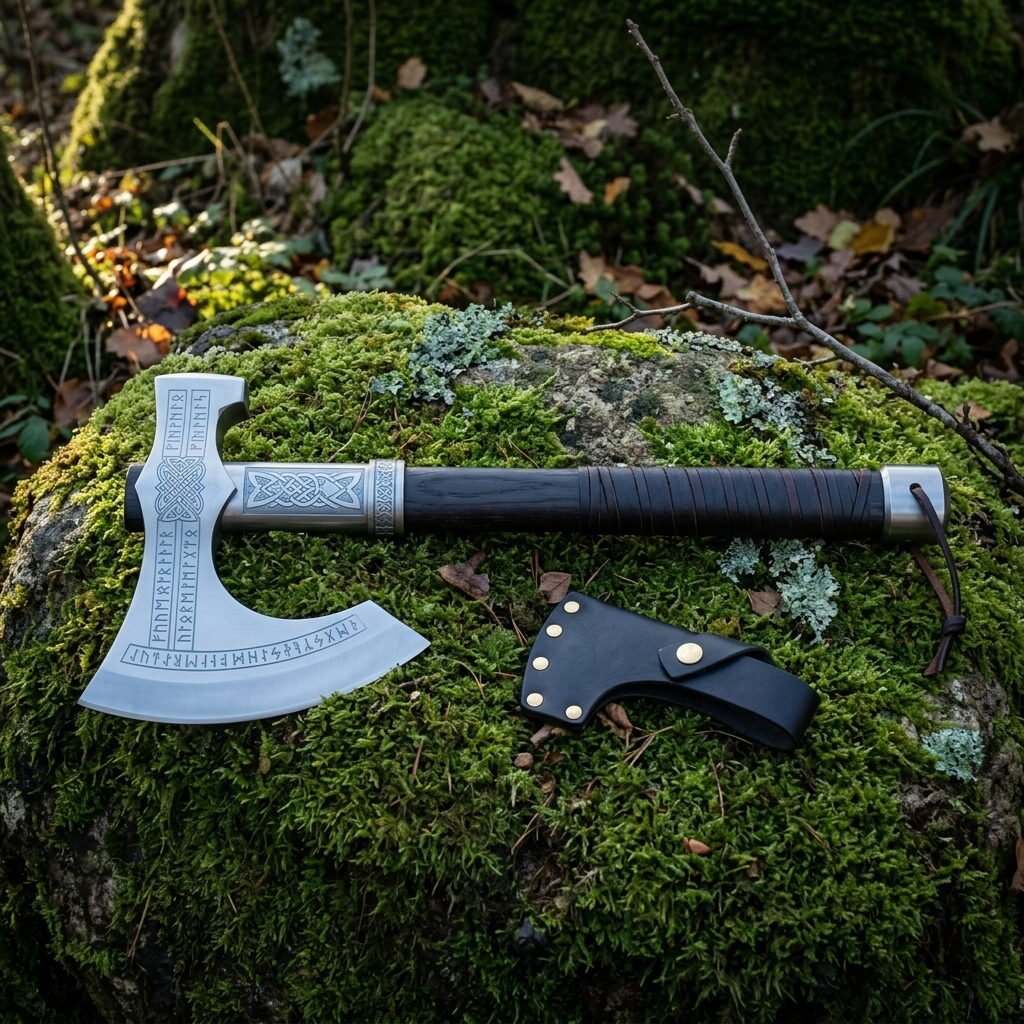
The axe at the centre of the 2018 God of War game was invented for that game, and it does things no axe does, which is fine, because it is a game. No axe of that name appears in Norse myth, no god in the Eddas carries one, and nothing matching it has come out of a Scandinavian grave. What is real is the shape underneath the fiction: the Viking Age bearded axe, a well documented head with the lower corner of its edge drawn down into a hook.
That gap between the screen and the archaeology is the interesting part, and it is more useful set out plainly than smoothed over in a product description. Below is what the sources actually support, what the game made up, and why the made up parts still work as storytelling.
Where the name comes from
Leviathan is not a Norse word and not a Norse idea. It belongs to the Hebrew Bible, where it appears as a vast sea creature in Job, in the Psalms and in Isaiah. Norse cosmology has its own world serpent in Jormungandr, the beast that circles the sea of men and meets Thor at the end of things, but these are separate traditions that were never joined until modern fantasy joined them. The game takes a biblical name, sets it in a Norse world, and lets the mismatch pass unremarked. A great deal of modern Norse fiction does exactly the same, and loses no sleep over it.
If you want the Norse side of that story as the poems tell it, our guide to Ragnarok and the end of the Norse world follows the serpent from its binding to the last battle.
What Norse sources actually say about axes
The gods of the Eddas are not axe carriers. Odin has a spear, Thor has a hammer, Freyr has a sword said to fight on its own. The famous named objects of Norse myth include no axe at all, and that absence is worth sitting with, because a game that hands its Norse pantheon an axe as the signature piece is quietly reversing the pattern of the source material. In the myths, the axe belongs to mortals.
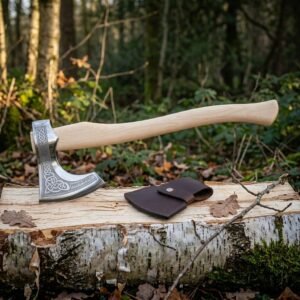 Birchskeg Hand Forged High Carbon Steel Viking Bearded Axe | 19 Inch Overall with 4.5 Inch Cutting Edge | Norse Bushcraft Gift | RK-1210
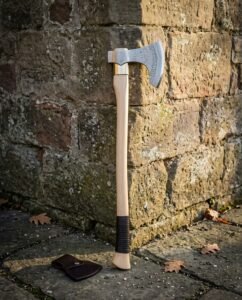 Ashwarden Hand Forged Damascus Viking Battle Axe | 21 Inch Overall with 5 Inch Cutting Edge | Pale Ash Haft and Straight Grain and Oil Finish | Norse Battle Collector Gift | RK-1212
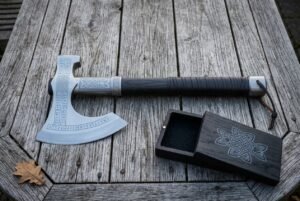 Runecask Hand Forged High Carbon Steel Norse Runic Bearded Axe with Knotwork Wooden Keepsake Box | Dark Leather Wrapped Ash Haft and 18 Inch Axe | Norse Bushcraft Gift | RK-1221
Named axes in the sagas
Mortals named their axes constantly, roughly the way people now name boats. Njal’s saga gives Skarphedinn an axe called Rimmugygr, a name usually read as something close to battle troll. The Icelandic sagas are full of that habit: a good head was worth naming, worth inheriting, and worth killing over. Those sagas were written down in Iceland generations after the events they describe, so they are literature before they are record, and a careful reader treats their detail as period colour rather than reportage. The naming habit, though, is consistent enough across independent texts to be worth believing.
The Mammen axe
The best single answer to the question of what a decorated Viking axe really looked like sits in the National Museum of Denmark. The Mammen axe came out of a rich burial in Jutland dated to the later tenth century. Its iron head is inlaid with silver, worked with animal and plant ornament so distinctive that art historians named an entire style after the find. It is a genuine object, it is beautiful, and it never glowed, never froze anything, and never came back when thrown.
Decoration on Viking axe heads, where it exists at all, is usually inlay of that kind: silver or brass wire hammered into channels cut in the iron. Carved runic lettering on axe heads is rare in the surviving record. Where runes do appear on Viking Age metal and stone, they belong to the Younger Futhark, the sixteen character row in ordinary use through the period, not the older and longer row that had fallen out of daily use centuries before. Our page on the Elder Futhark and how the rune rows changed sets that out properly, and it is the single detail modern Norse styled design gets wrong most often.
What is real and what is invented
Real: the bearded head shape itself, with a long lower edge that hooks below the eye of the axe. Real: light heads on long hafts, most surviving examples far lighter than film choreography implies. Real: silver inlay and animal ornament on high status pieces. Real: the axe as the common man’s arm, cheaper in iron than a sword and useful for felling timber and splitting firewood on any day nobody was fighting.
Invented: the name, which comes from another continent’s scripture. Invented: the frost. Invented: a throw that brings the head back to the hand. Invented: a runic band that functions as a magical circuit rather than as ornament. Invented too, though nobody says it out loud, is the implied mass. The animation reads as a head two or three times heavier than anything an excavation has produced, because a light axe does not look weighty enough on a screen.
One further piece of screen invention deserves flagging, because it is a borrowing rather than a fabrication. The returning throw is a hammer idea in Norse myth, not an axe idea. Mjolnir comes back to Thor’s hand in the sources. Moving that property onto an axe is a design decision, and a strong one, but a listener in a tenth century hall would have found it odd.
The one thing the game gets right that people assume is wrong
Players sometimes complain that the axe is too short to be a serious fighting piece. That complaint is backwards. Short hafted axes are genuinely common in the archaeology, carried on the belt, used single handed alongside a shield, and thrown at need. The long hafted two handed type is the later and more specialised form. Our history of the Viking axe across the period tracks how the two types sat beside each other, and what a bearded axe actually is explains why the hooked lower edge is a working feature rather than a decorative one.
Why the bearded shape earned its keep
The beard does three jobs at once. It puts more cutting edge on the head without adding much iron, which mattered when iron was expensive. It lets a hand choke up behind the edge for close carving and shaping, which turns a fighting head into a woodworking tool. And in a fight it gives a hook: the lower corner can catch a shield rim and pull it aside.
That combination is why the shape survived the Viking Age entirely and turns up again in later Scandinavian and Baltic carpentry axes. It was never a fantasy silhouette. It was a solution to a shortage of steel and an abundance of jobs.
Pieces in that spirit from our range
We do not sell anything from a film or a game, and we do not describe anything we sell as connected to one. What we do stock is the historical shape the fiction borrowed. Our hand forged bearded axes follow the excavated profile, with the long lower edge and a straight or gently curved haft, and several carry rune cut or knotwork engraved collars in the decorative tradition of inlay work rather than as any claimed magical device. For the heavier long hafted pieces that suit a wall as much as a hand, the Norse battle axes run to thirty inches and beyond. The broader Viking axe range covers the belt sized heads, the camp axes and the pattern welded Damascus pieces.
Every head we sell is either plain 1095 carbon steel hardened to 54 to 58 HRC or Damascus of 1095 and 15N20 forge welded together and taken to 58 to 60 HRC. Each piece is handmade in the Czech Republic the old way, then imported, inspected and shipped from our base in Chicago, Illinois. Engraving is done in the US after arrival, so a rune band or a name can be cut to order.
Buying notes for a Norse styled axe
Decide first whether the axe is for a wall or a hand. A display piece can carry a heavier decorated head and a longer haft, since nobody is going to swing it for an hour, and there is no shame in owning something that is mostly for the wall. A working or reenactment axe wants a lighter head, a haft with straight grain running the length of it, and an edge geometry you can actually maintain.
On steel, ignore any claim you cannot check. High carbon steel at a sensible hardness will hold an edge and take a strop. Damascus is a pattern and a joining method, not a magic alloy, and its value is in the look and the labour rather than in cutting performance. Our explanation of what Damascus steel really is is the honest version of that conversation.
On haft length, anything past about twenty four inches becomes a two handed piece in practice. Below that you can pair it with a shield or a second hand free. And on decoration, a rune band looks best when it says something. Ask for a real transliteration rather than shapes picked because they looked runic to whoever drew them.
The same question comes up about the games, which we answer in the arms of Assassin’s Creed Valhalla. For where the historical shapes actually diverge, see the Norse axe against the medieval one.
Questions people ask
Was the Leviathan axe a real Viking axe?
No. The name, the frost and the returning throw are all invented for the 2018 God of War game. The underlying silhouette is a real one, the Viking Age bearded axe, which is well represented in Scandinavian archaeology. So the shape has history behind it. The object does not, and the game is no worse for it.
Did any Norse god carry an axe?
Not in the surviving sources. Odin is associated with a spear, Thor with a hammer, Freyr with a sword. The Eddas name a good many divine objects and none of them is an axe. Axes in Norse literature belong to human heroes, and the sagas name plenty of those.
Are the runes on game and film axes real writing?
Usually not. Screen runes are commonly drawn for their look, sometimes mixing rows from different centuries. Viking Age inscriptions use the sixteen character Younger Futhark. The older and longer row had left everyday use well before the Viking Age began, though it is the one most often copied today, because it looks better spread across a poster.
How heavy was a real Viking axe head?
Lighter than most people guess. Surviving heads are generally slim, and much of an axe’s felt weight in a fight comes from where the mass sits rather than how much of it there is. Film and game animation exaggerates the swing, which is why replicas built to look right on camera often feel wrong in the hand.
Do you sell an official version of a game axe?
No, and we would not claim to. Nothing in our range is connected to or endorsed by any film, game or show. Anyone telling you otherwise is guessing, or hoping you will not check. What we sell is the historical Norse form: bearded and battle axes forged to documented shapes, with engraving available in our own decorative vocabulary of runes and knotwork.
Which axe should a first time buyer choose?
A short hafted bearded axe in plain carbon steel is the most useful starting point. It reflects the commonest historical type, it costs less than a long hafted display piece, and it is genuinely usable at a campsite. Add a leather head cover so the edge survives storage and travel.
If you are buying
The catalogue carries the Trinebeard bearded axe and the Prowshear bearded axe. So do the Knotwarden Valknut axe and the Stormcleft bearded axe.
Shop the range
Birchskeg Hand Forged High Carbon Steel Viking Bearded Axe | 19 Inch Overall with 4.5 Inch Cutting Edge | Norse Bushcraft Gift | RK-1210Ashwarden Hand Forged Damascus Viking Battle Axe | 21 Inch Overall with 5 Inch Cutting Edge | Pale Ash Haft and Straight Grain and Oil Finish | Norse Battle Collector Gift | RK-1212Runecask Hand Forged High Carbon Steel Norse Runic Bearded Axe with Knotwork Wooden Keepsake Box | Dark Leather Wrapped Ash Haft and 18 Inch Axe | Norse Bushcraft Gift | RK-1221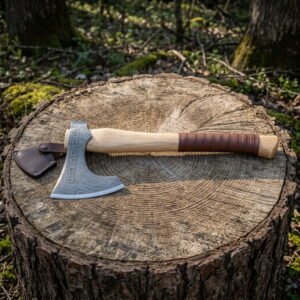 Whorlbeard Hand Forged Damascus Bearded Axe | 16 Inch Ash Haft | Rune Bordered Head with Leather Edge Cover | Norse Camp and Carving Gift | RK-1835
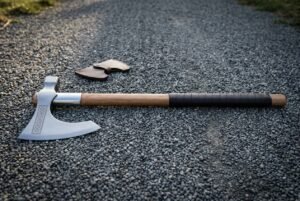 Langbeard Hand Forged 1095 Steel Bearded Axe | 21 Inch Ash Haft | Knotwork Engraved Head with Steel Collar and Leather Edge Guard | Norse Reenactment Gift | RK-1914
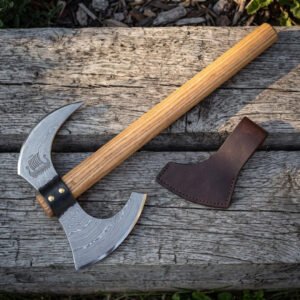 Prowshear Hand Forged Damascus Bearded Axe with Engraved Longship | 20 Inch Haft and 7 Inch Edge | Hooked Horn and Riveted Leather Collar and Blade Mask | Norse Gift | RK-2134