
Blog
What Is a Katana? Construction, Curve and the Parts Named

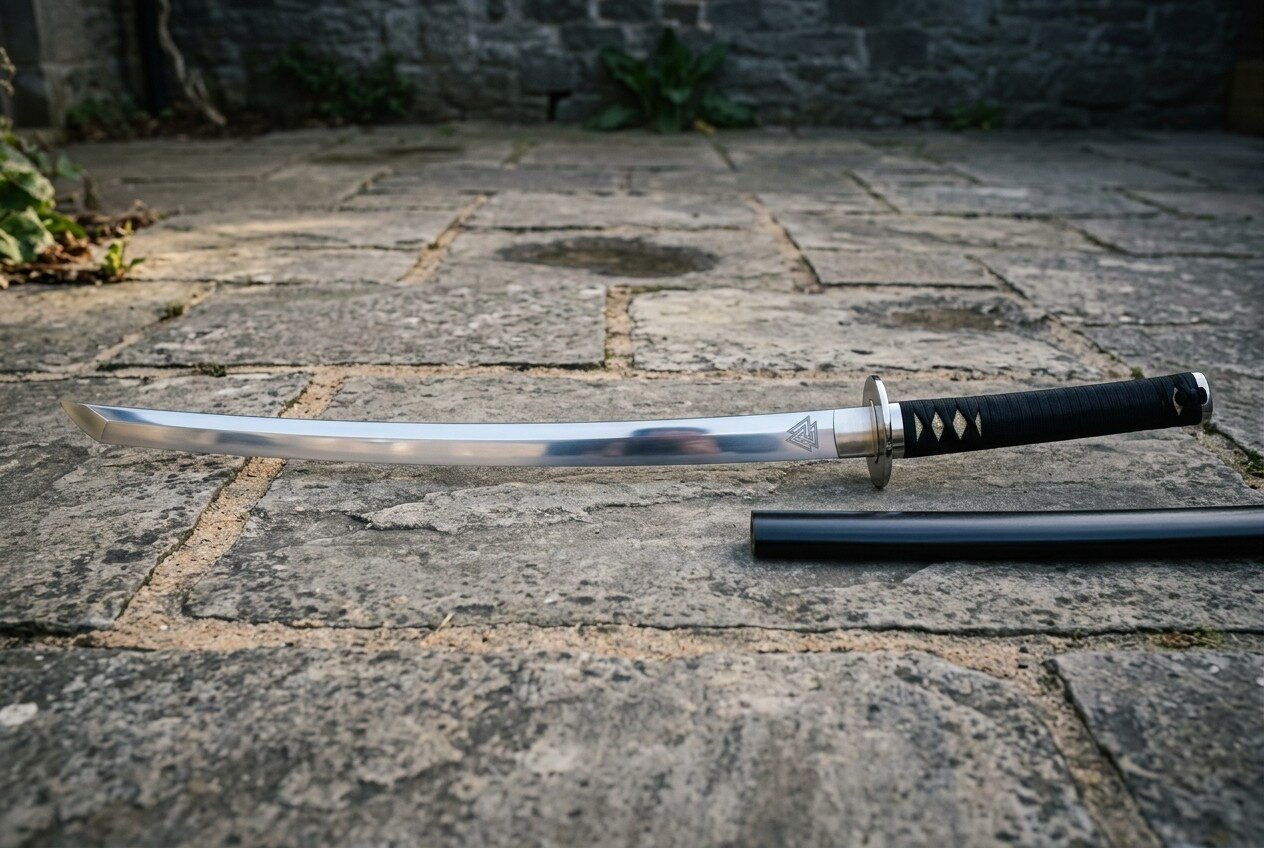
A katana is a Japanese single edged sword with a blade longer than about 60 centimetres, a gentle curve, and one defining habit: it is worn edge up, thrust through a sash rather than hung from a belt. That last detail is what separates it from the older tachi, and it changed how the sword was drawn, how it was made and how it was mounted. Almost everything else said about the katana was added later, mostly by people with one to sell.
Where the shape came from
Japanese swords were curved long before the katana existed. The tachi, the cavalry sword of the Heian and Kamakura periods, is a curved single edged blade slung edge down from cords at the hip. As fighting moved off horseback and into close infantry work through the Muromachi period, the sword got shorter, the curve moved back towards the middle, and swordsmen began carrying it edge up in the obi so it could be drawn and cut in one motion.
Length settled into a system that is still used to classify blades. A shaku is roughly 30.3 centimetres. A blade over two shaku is a katana. Between one and two shaku it is a wakizashi. Under one shaku it is a tanto. The paired long and short blades worn together, the daisho, became the mark of samurai status in the Edo period, when swords were as much a legal badge as a fighting tool.
How a traditional blade was made
Tamahagane
The raw material is iron sand, satetsu, smelted with charcoal in a clay furnace called a tatara over several days. The furnace is broken open at the end and the bloom is broken up by hand, then sorted by eye and by fracture into pieces of high and low carbon. That sorted steel is tamahagane, and the sorting is the first and most important act of quality control in the whole process.
Folding
The smith stacks pieces of tamahagane, welds them into a billet, then folds and welds it again and again. The purpose is not to add mystical layers. It is to squeeze out slag, even out the carbon that the sorting could not perfect, and produce homogeneous steel from an inconsistent starting material. Ten to sixteen folds is typical, and because every fold doubles the count you end up with thousands of layers, which is where the folded a thousand times stories come from. Modern steel arrives homogeneous from the mill, so folding a modern bar is a decorative choice rather than a necessary one.
Hard skin, soft core
Most traditional blades are composite. A jacket of hard, high carbon steel called kawagane is wrapped around a core of softer, lower carbon shingane, a construction known as kobuse. Other arrangements exist, with side pieces and a separate spine, but the principle is constant: hard where you cut, soft where you need to absorb shock without snapping.
The clay and the quench
This is the step that produces both the curve and the famous line along the blade. Before hardening, the smith paints the blade with a clay slurry, thick along the spine and thin or absent along the edge. Heated and plunged into water, the thinly coated edge cools fast enough to form martensite, hard and brittle. The thickly coated spine cools slowly and stays softer.
Two things follow. First, the boundary between the two structures is visible after polishing as the hamon, the temper line, which is a real feature of the steel and not a surface decoration. Second, the edge expands as it transforms while the spine does not, and the blade bends away from the edge. Most of the curve, the sori, appears in that moment. A smith who quenches badly gets a blade with the wrong curve, or a crack, and starts again.
Polishing
Traditional polishing is a separate profession, and it is the step buyers underestimate most. A togishi works through a long series of natural and synthetic stones of decreasing coarseness, and the job takes weeks. Polishing is what makes the hamon and the grain of the steel visible at all, which is why a badly polished blade of good steel looks like nothing much.
The parts, named
The blade
The tang is the nakago, and if the smith signed it the signature is the mei. The spine is the mune, the edge is the ha. Running between them on most blades is a ridge line, the shinogi, with the flat area above it called the ji. The point section is the kissaki, separated from the rest of the blade by a short straight line called the yokote, and the hamon as it runs through the point is the boshi. A collar called the habaki sits at the base of the blade and wedges it tight into the scabbard mouth. A small hole through the tang, the mekugi-ana, takes the bamboo peg that holds the whole sword together.
The mounts
The mounting as a whole is the koshirae. The handle is the tsuka, built over the tang from two wooden halves, faced with ray skin called same and bound with a cord wrap, the tsuka-ito. Small ornaments called menuki sit under the wrap where the palm grips, doing real work as well as decorative. The collar and pommel are the fuchi and the kashira. The guard is the tsuba, held between thin washers called seppa. The scabbard is the saya, with its mouth the koiguchi and a knob called the kurikata for the cord, the sageo, that ties it to the sash.
What to look for when you buy
The tang
This matters more than anything else on the page. A proper sword has a full nakago running most of the length of the handle, held by one or two bamboo pegs through the mekugi-ana. A cheap sword has a thin rod welded to the blade, sometimes threaded at the end and held with a nut, and that joint is where it will fail. If a listing does not say how the tang is made, ask, and treat a vague answer as an answer.
Real hamon or etched
A hamon produced by clay and water is a structural boundary in the steel and has a soft, cloudy edge with activity along it. A hamon produced by acid or by wire wheel is a line drawn on the surface, usually too even and too sharply defined. Neither is dishonest as long as the seller says which it is. A blade that has been through hardened rather than differentially hardened has no hamon at all, and the honest description for that is a polished line or none.
Steel
Almost every hand forged sword made outside Japan today uses modern steel rather than tamahagane, and that is not a defect. Plain 1095 is a straightforward high carbon steel that hardens well and sharpens easily. Damascus, forge welded from two steels with different alloy content, is chosen for the pattern the etch reveals. Our steel glossary explains the numbers and what hardness figures mean, and if the layered pattern is what draws you, our post on what Damascus steel actually is is the one to read first.
Balance and fit
Pick up the sword, if you can, and find the balance point. Somewhere between 10 and 15 centimetres in front of the guard is a comfortable place for a katana of normal proportions. Further forward and the sword feels heavy and slow. Closer to the hand and it feels lively but weak in the cut. Check that the blade sits in the saya without rattling and that the habaki holds it there when the scabbard is turned over.
Care
Carbon steel rusts, and a katana blade has a lot of surface area. Wipe the blade with a lightly oiled cloth after handling, store it horizontally with the edge up, and do not leave it in the scabbard for months in a damp room, because rust does its best work out of sight. Never store a wet or fingerprinted blade in the saya, because the wood will hold moisture against the steel.
The katanas we make
Our katana and Japanese sword range is hand forged in plain 1095 at 54 to 58 HRC and in Damascus forge welded from 1095 and 15N20 at 58 to 60 HRC, with cord wrapped handles over ray skin, iron or blackened steel tsuba, and lacquered wooden saya. Overall lengths run to around 40 inches on the katanas, with 27 to 29 inch blades, and the range includes wakizashi at 28 to 30 inches overall and paired daisho sets. Several blades carry etched Norse knotwork or a valknut, which is a house design rather than a historical Japanese motif, and we say so plainly. You will find the whole catalogue of long blades in our sword range, and if it is the shorter Japanese and European forms you want, look at the dagger range. Collectors comparing eastern and northern blades may also like our list of the best Viking swords for collectors. Ransack Viking is a US company in Memphis, Tennessee. Every piece is handmade in the Czech Republic the old way, then imported, inspected and shipped from Memphis. Engraving is done in the US after arrival.
The full set is put side by side in katana, wakizashi and tanto. The companion blade has its own page in what a wakizashi is, as does the short one in what a tanto is.
Questions people ask
What is the difference between a katana and a tachi?
Mostly how it is worn. A tachi hangs edge down from cords at the hip and belongs to an earlier, more cavalry focused period. A katana is thrust through the sash edge up, which allows a draw and a cut in one movement. Tachi blades tend to be longer with the deepest part of the curve nearer the handle, though there is plenty of overlap.
Why is a katana curved?
The curve is mostly created rather than designed in. When a clay coated blade is quenched, the thinly coated edge cools fast and expands as it hardens while the thicker spine does not, and the blade bows away from the edge. Smiths control the result through the shape of the blade before hardening and the way the clay is laid on, but the shape arrives in the quench rather than on a drawing board.
What is the hamon?
The hamon is the visible boundary between the hard martensitic edge and the softer body of the blade, produced by clay coating the spine before the quench and revealed by polishing. It is a real structure in the steel, not a surface finish. Lines painted, etched or wire brushed onto a through hardened blade imitate the look without the underlying difference in hardness, which is fine when the seller says so and less fine when they do not.
How long is a katana?
The classification works in shaku, a unit of about 30.3 centimetres. A blade over two shaku, which is roughly 60.6 centimetres or 24 inches, counts as a katana. One to two shaku is a wakizashi, and under one shaku is a tanto. Complete katanas usually run somewhere near 100 centimetres overall once the handle is included.
Is a full tang important on a katana?
Yes, more than any other feature. A proper sword has a wide tang running most of the length of the handle, secured with bamboo pegs through a hole in the tang. Cheap swords use a thin rod welded or threaded to the blade, and that joint breaks. Ask how the tang is made before buying, since it is invisible once the handle is fitted and you will find out the truth at the worst possible moment.
Do you use tamahagane?
No, and almost nobody outside Japan does. Our blades are plain 1095 at 54 to 58 HRC or Damascus forge welded from 1095 and 15N20 at 58 to 60 HRC, which are modern steels chosen for consistency and edge holding. Every piece is handmade in the Czech Republic the old way, then imported, inspected and shipped from Memphis, Tennessee, with engraving done in the US after arrival.
Shop the range
 Emberdusk Hand Forged High Carbon Steel Katana | 40.5 Inch Overall with 28 Inch Blade | Black Lacquered Wooden Saya and Cord Sageo | Japanese Collector Gift | RK-1270
 Nightreed Hand Forged High Carbon Steel Katana | 41 Inch Overall with 28.5 Inch Blade | Black Lacquered Wooden Saya and Cord Sageo | Japanese Collector Gift | RK-1271
 Brasswind Hand Forged High Carbon Steel Katana | 39.5 Inch Overall with 27 Inch Blade | Black Lacquered Wooden Saya and Cord Sageo | Japanese Collector Gift | RK-1273
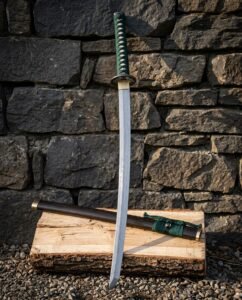 Jadewake Hand Forged Damascus Katana Sword | 40 Inch Overall | Green Silk Ito Wrap with Brass Tsuba and Hardwood Saya | Martial Arts Collector Gift | RK-1651
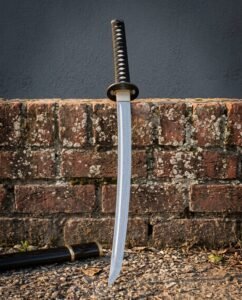 Emberfold Hand Forged Damascus Katana | 40 Inch Overall with 27 Inch Blade | Black Ito Wrapped Tsuka and Lacquered Saya | Collector Sword Gift | RK-1756
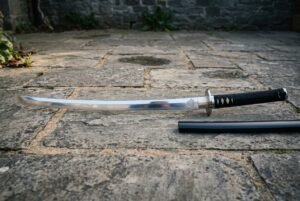 Valkgleam Hand Forged 1095 Steel Katana | Valknut Etched Blade | Polished Steel Tsuba with Rayskin and Black Cord Tsuka | Norse Collector Gift | RK-1885
One thought on “What Is a Katana? Construction, Curve and the Parts Named”
Comments are closed.