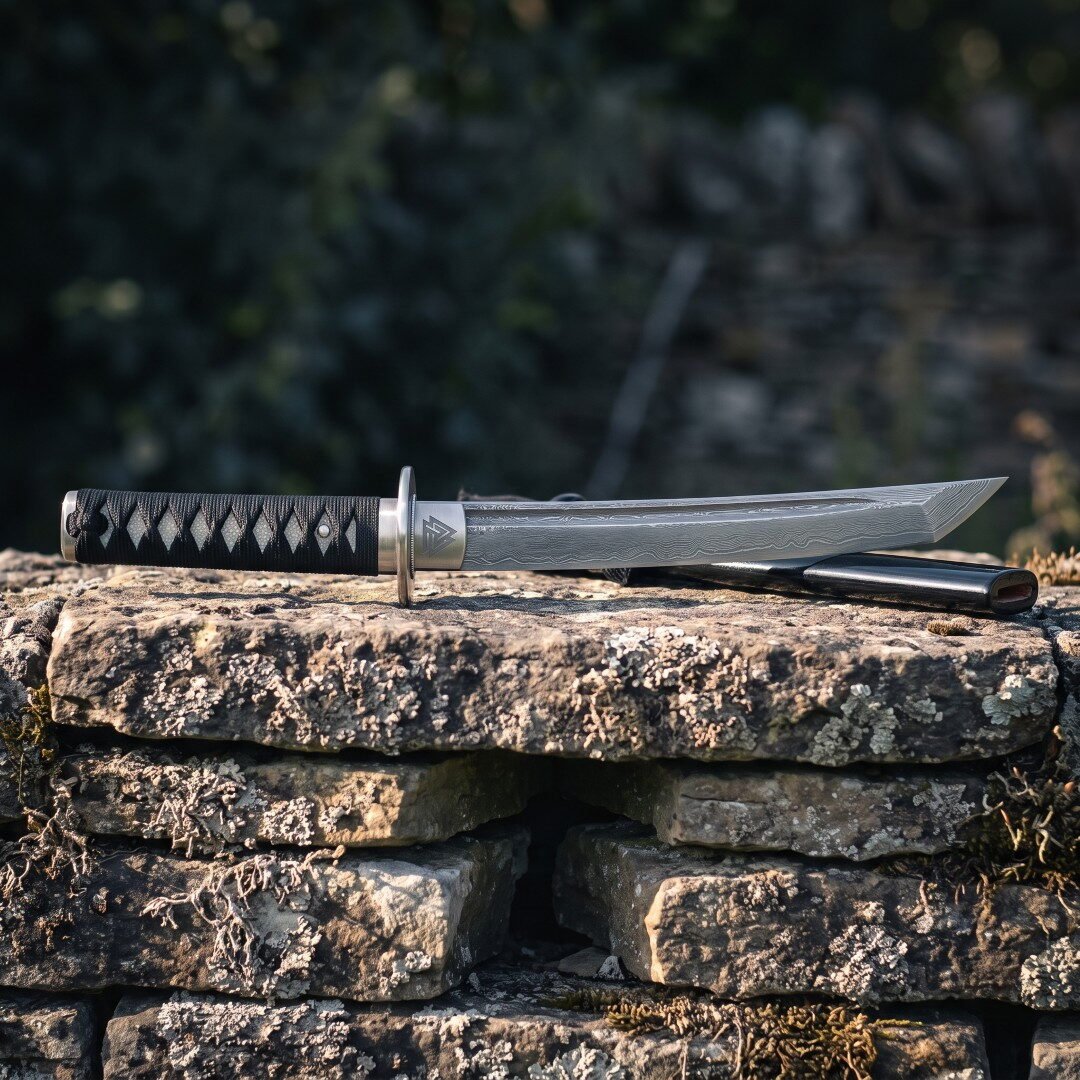
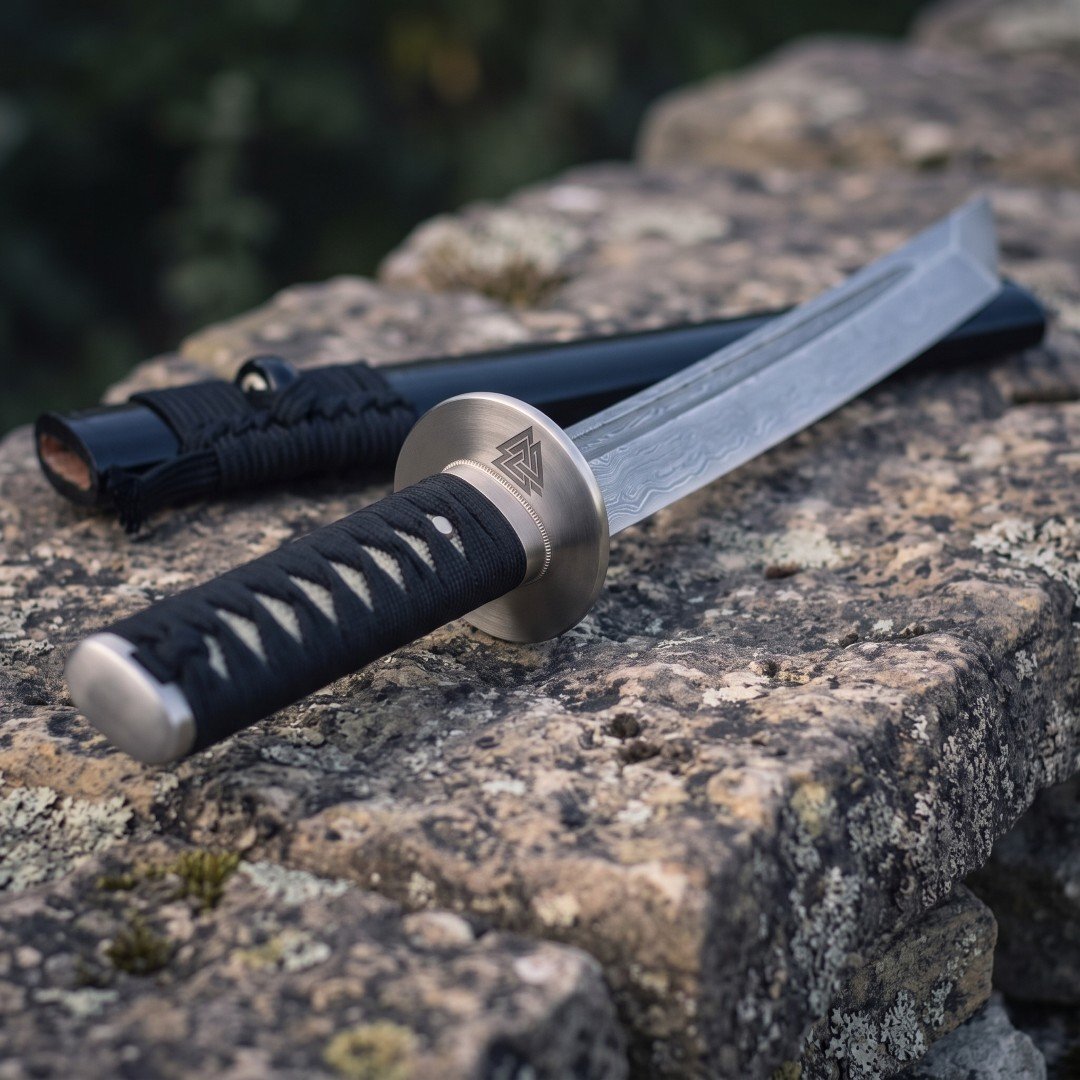
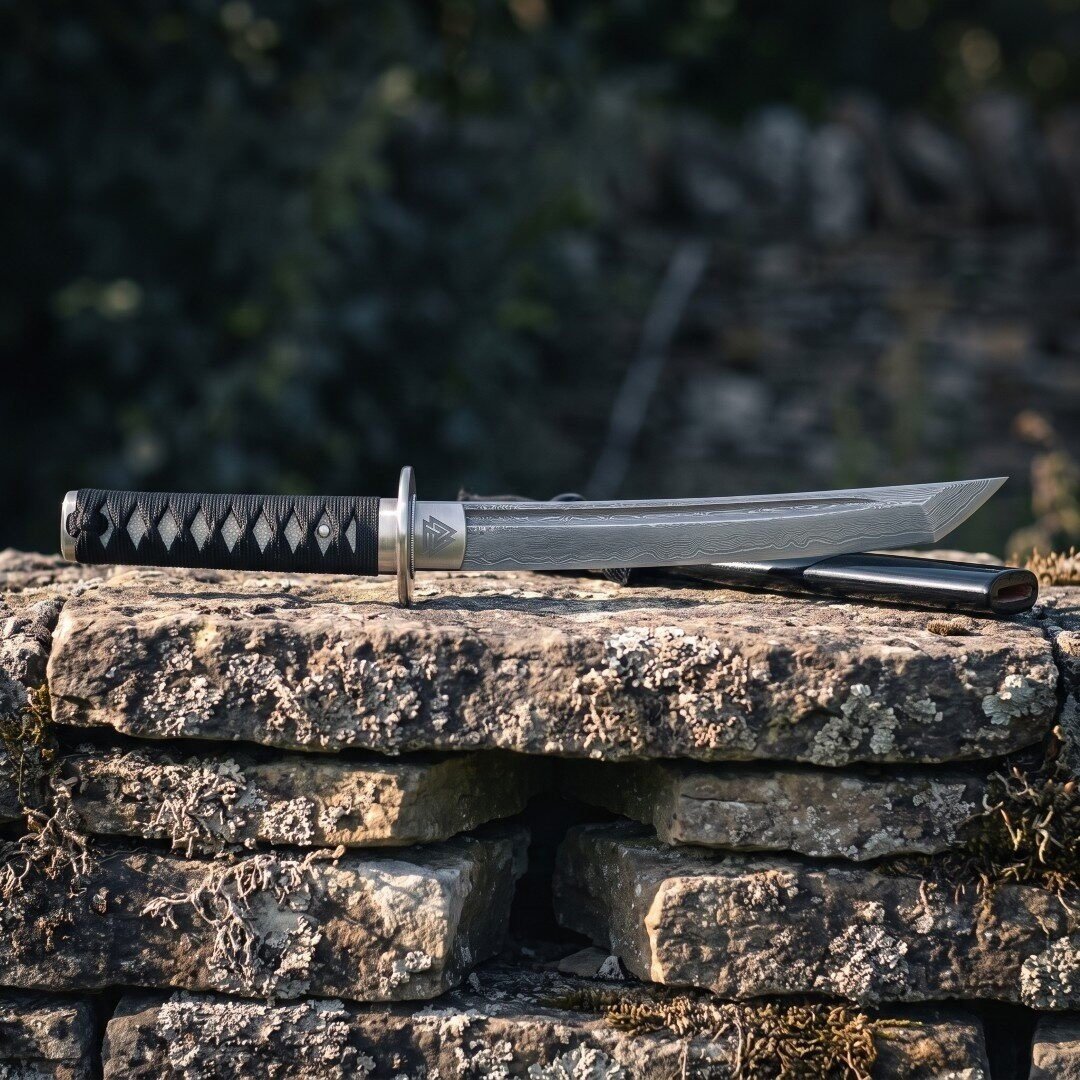
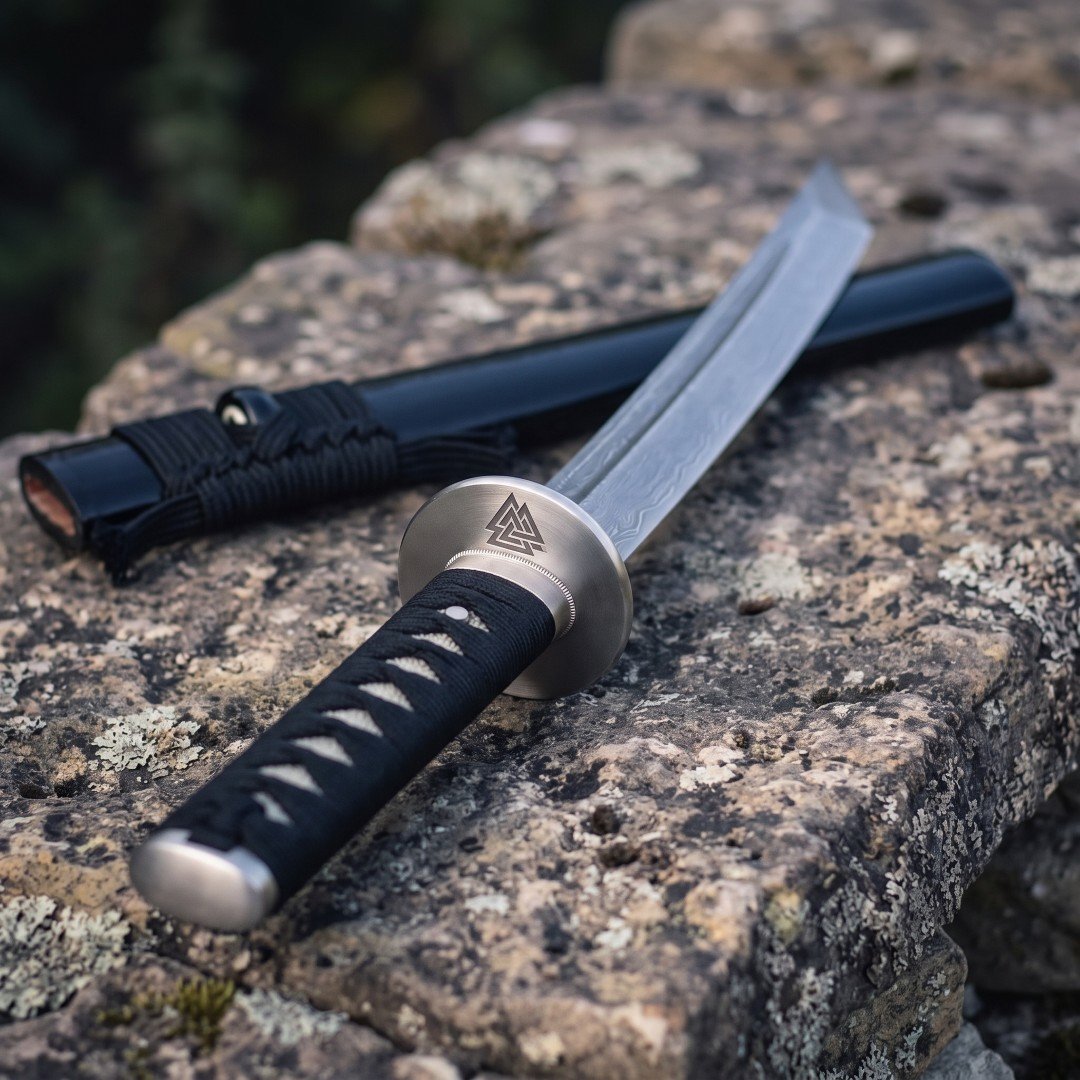
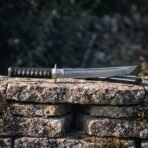
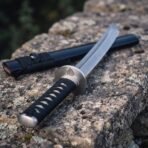
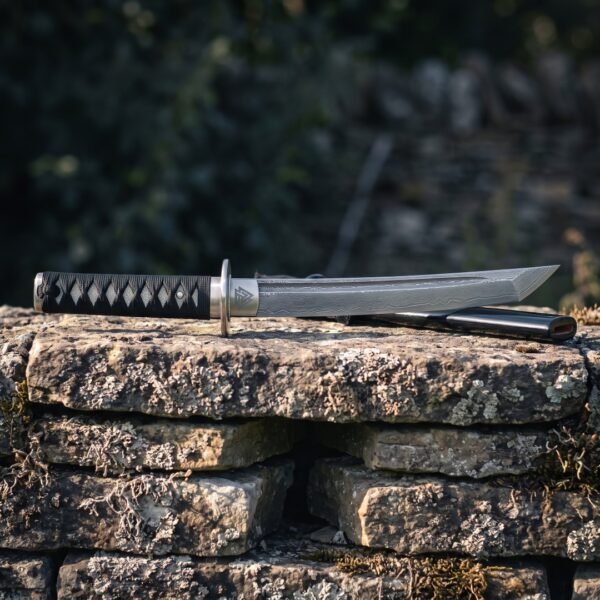
The Trinesaya is a tanto with a pattern welded blade, a black cord wrapped handle over a pale textured underlay, a small round steel tsuba and a matching black scabbard. Cut into the flat just above the collar is a Valknut, the three interlocked triangles of Norse carving, which is not a decoration you expect to find on a Japanese blade form and is exactly why this piece works. The Damascus figure runs the whole length of the blade in tight flowing bands, tighter than the same steel would show on a long sword because the billet has been drawn out into a much narrower section.
The Valknut on this blade is the tricursal form, three separate triangles woven through one another rather than a single unbroken path. Both forms appear in the surviving Viking Age carvings, and the tricursal version is the one found on the Stora Hammars stones and on a bed post from the Oseberg ship burial in Norway. The Trinesaya is made by hand in the Czech Republic, imported and checked over by Ransack Viking, and shipped from our Memphis, Tennessee warehouse. It comes with the fitted black scabbard shown in the photograph.
Tanto means a short Japanese blade before it means a point shape, which the tanto explained sorts out. That knot of three triangles is the valknut, and where the valknut appears comes down to a handful of picture stones. At sword length the same lines turn up in the short swords.
Specifications
| Type | Tanto, Japanese short blade form |
|---|
| Blade | Pattern welded 1095 and 15N20 Damascus, 58 to 60 HRC |
|---|
| Blade profile | Single edged with a shallow curve rising to a fine point |
|---|
| Blade etching | Valknut cut into the flat above the collar |
|---|
| Tsuba | Small plain round steel guard |
|---|
| Handle | Black cord wrapped in the alternating diamond pattern over a pale underlay |
|---|
| Fittings | Steel fuchi, kashira and collar, with a cord loop at the butt |
|---|
| Scabbard | Matt black fitted scabbard |
|---|
| Finish | Etched Damascus blade, bright steel furniture |
|---|
| Included | Tanto and fitted black scabbard |
|---|
| SKU | RK-2074 |
|---|
What a tanto actually is, and what it is not
This is the single most confused term in the whole knife trade, and it is worth clearing up. In Japanese usage, tanto is a length classification and nothing else. A blade under one shaku, roughly a foot, is a tanto. Between one and two shaku it is a wakizashi. Over two shaku it is a katana or a tachi depending on how it was worn. The word says how long the blade is. It says nothing whatsoever about the shape of the point.
What the American knife industry calls a tanto point, that angular chisel tip with a sharp secondary bevel across the front, is a modern western invention from the 1980s. It is a good geometry and it puts a lot of steel behind the point, but it is not what a Japanese tanto looks like. Historical tanto overwhelmingly carry a normal curved kissaki or a straight kiriha profile, and the angular western tanto tip does not appear in the classical record at all.
The Trinesaya is a tanto in the Japanese sense. It is a short blade with a shallow curve and a conventional fine point, mounted with a small round tsuba and a cord wrapped handle. If you want the angular chisel tip, that geometry lives in our tanto knives section under western tanto point blades, and it is a different thing wearing the same name.
Why Damascus reads differently on a short blade
Both this blade and a full length Damascus sword start as the same kind of billet, alternating layers of 1095 and 15N20 forge welded into a stack. The difference is what happens next. To make a sword the billet is drawn out into a long thin bar, which stretches the layers along the length and opens the pattern into wide flowing bands. To make a tanto the same billet is drawn out far less, so the layers stay compressed and the pattern reads as a tight dense figure rather than a loose one.
That is why a short Damascus blade often looks busier and more detailed than a long one from the same shop. It is the same steel and the same layer count, simply less stretched. The bright lines are the 15N20, which carries around two percent nickel and resists the etching acid, and the dark lines are the 1095. The pattern goes all the way through the blade rather than sitting on the surface, and it is exposed by the grind rather than applied to it.
Hardened and tempered to 58 to 60 HRC, this blade holds a fine edge and takes a very sharp finish, which suits a short blade used with the fingertips rather than the whole arm. Carbon Damascus is not stainless and needs oiling.
Engraving, runes and your own design
Use the rune converter on this page to turn a name, a date or a short phrase into Elder Futhark and we will cut it into the steel, the leather or the wood. If you would rather have a Viking pattern than a rune line, choose your own design in the engraving option above the add to cart button and tell us where it goes. Where a piece already carries an engraved design, your chosen engraving replaces it rather than sitting alongside it. On the Trinesaya that means a rune line would take the place of the Valknut on the flat. There is limited room on a blade this narrow, so short phrases and single names work best. See the engraving page for what fits.
Handling and balance
A tanto is held in one hand and worked with the wrist and fingers rather than the arm, and this one balances almost exactly at the tsuba, which is where a short blade wants to sit. The cord wrap gives a positive grip in either a normal or a reversed hold, and the alternating diamond pattern creates raised nodes that stop the hand sliding forward under pressure. The cord loop at the butt is a retention point rather than a decoration.
The scabbard is a friction fit at the collar, so the blade holds in place by the tightness of the mouth rather than by a strap. Draw it with the edge turned up and the scabbard held from the side rather than wrapped underneath, which is simply good habit with any fitted scabbard.
This is a hand made collector and display piece with a real edge. It is not sold as a sparring or contact item.
Care
Wipe the blade after handling and keep a light film of oil on it. Etched Damascus has a slightly open surface and will take rust spots faster than a mirror polish if it is left damp or fingerprinted. Camellia oil is the traditional choice for a Japanese style blade and any light mineral or blade oil works just as well.
Do not store the tanto inside the scabbard for long periods, and never sheath a damp blade. Keep the cord wrap dry and out of long direct sun, which fades and weakens cord. The steel fittings can be wiped with the same oiled cloth you use on the blade. Our steel care guide covers the rest.
Damascus wants oil more than plain steel does, because the etch that shows the pattern also opens the surface, and caring for a Damascus pattern covers what to use.
Made in the Czech Republic
This tanto is made by hand in the Czech Republic. Ransack Viking imports it, checks the etch, the tsuba seating, the wrap tension and the scabbard fit, and ships it from our Memphis, Tennessee warehouse. Nothing goes out drop shipped from an importer catalogue without being seen first. Shipping within the United States is free. Processing usually takes one to two weeks and engraving adds to that. Returns are accepted within seven days. The lifetime warranty against defects in forging, grind, heat treat and fittings has no end date and needs no receipt.
A note on handmade variation
This piece is hand made rather than machine made or bulk produced, so what arrives will not be a pixel for pixel copy of the photograph. Pattern welded steel is never twice the same, and the exact figure across your blade depends on how that individual billet drew out under the hammer. The cord wrap will differ slightly in the pitch of the diamonds, the etched Valknut will sit a fraction differently on the flat, and the depth of the etch varies a little with time in the acid. The dimensions, the material and the build are the same every time. The character is not.
Frequently asked questions
Is this a knife or a short sword
It is a tanto, which in Japanese terms is a short blade class rather than a knife or a sword. In practical terms treat it as a short bladed sidearm. It is listed under tanto knives and under Japanese swords because it genuinely sits between the two.
Does it have a western tanto point
No. It has a conventional curved point in the Japanese manner. The angular chisel style tip that western catalogues call a tanto point is a modern shape and this is not it.
Is the Damascus pattern real
Yes. The blade is forge welded from alternating layers of 1095 and 15N20 and then etched, so the light and dark bands are the actual internal structure of the steel exposed by the grind, not a print or a coating.
Will the Valknut wear off
No. It is cut into the steel rather than printed on it, so it survives sharpening, polishing and normal handling. Only aggressive abrasive work on that part of the flat would touch it.
Can I carry this on a belt
The scabbard is a fitted saya without a belt loop, so it is not set up for belt carry as supplied. Check the knife laws where you live before carrying any fixed blade in public.
How long until it ships
Processing runs one to two weeks from our Memphis warehouse, then free standard shipping inside the United States. Rune engraving is cut here after it arrives, so add a few days if you order it.
What is in the box
- Trinesaya Damascus tanto with etched Valknut
- Fitted matt black scabbard
- Light protective oil film on the blade
- Hand made in the Czech Republic, shipped from our Memphis, Tennessee warehouse
Explore the range
More in tanto knives, katana and Japanese swords, Norse arms and engraved and personalised pieces, or read the guides.

Reviews
There are no reviews yet