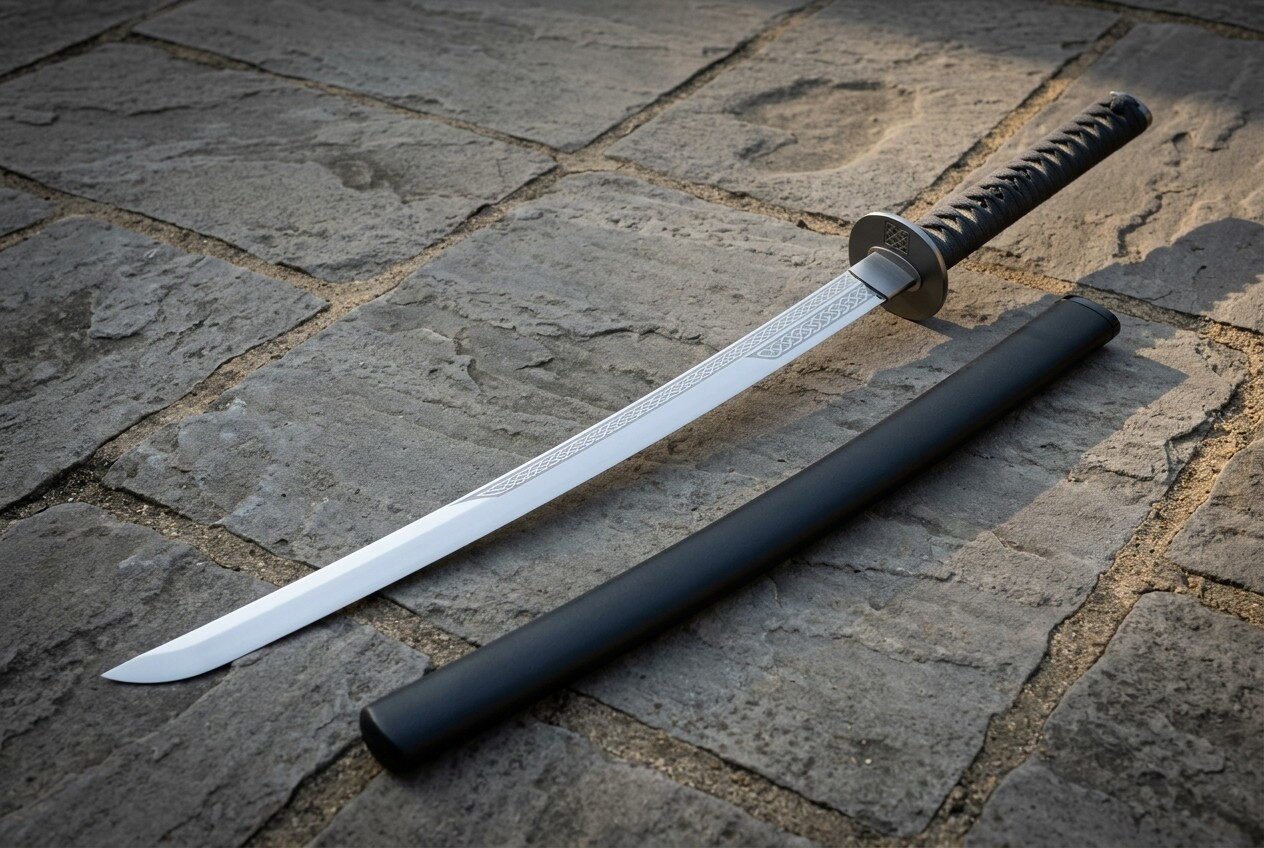
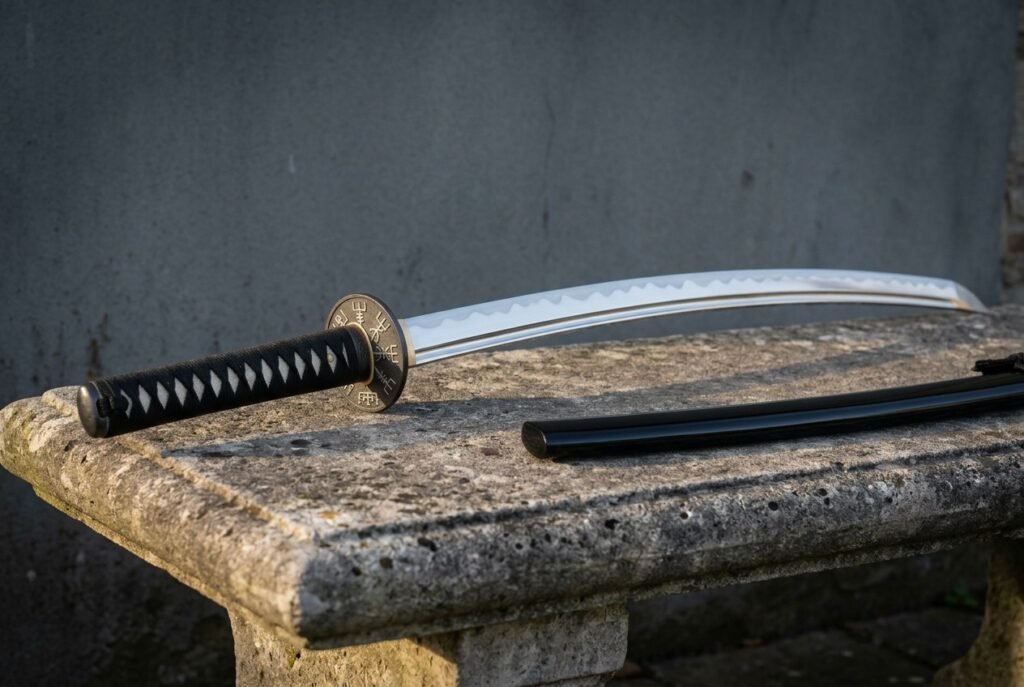
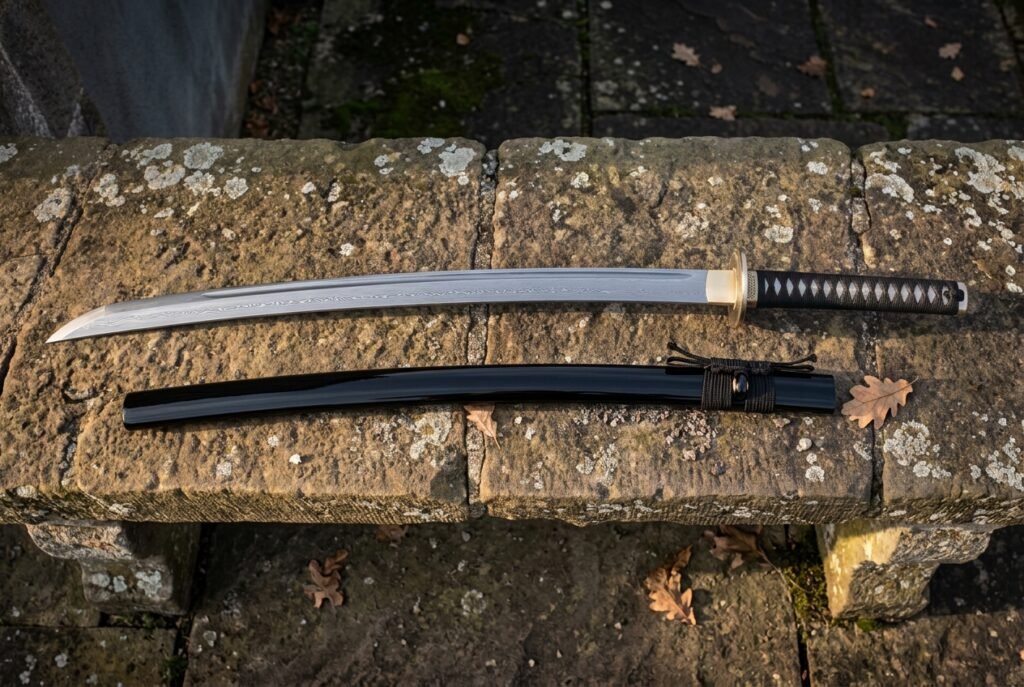
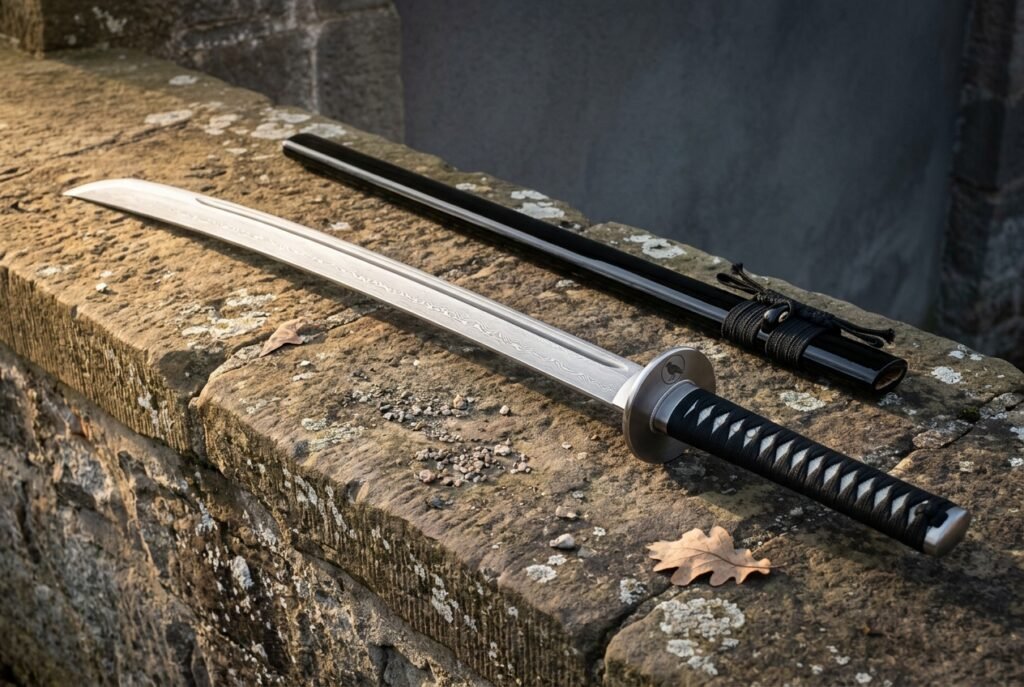
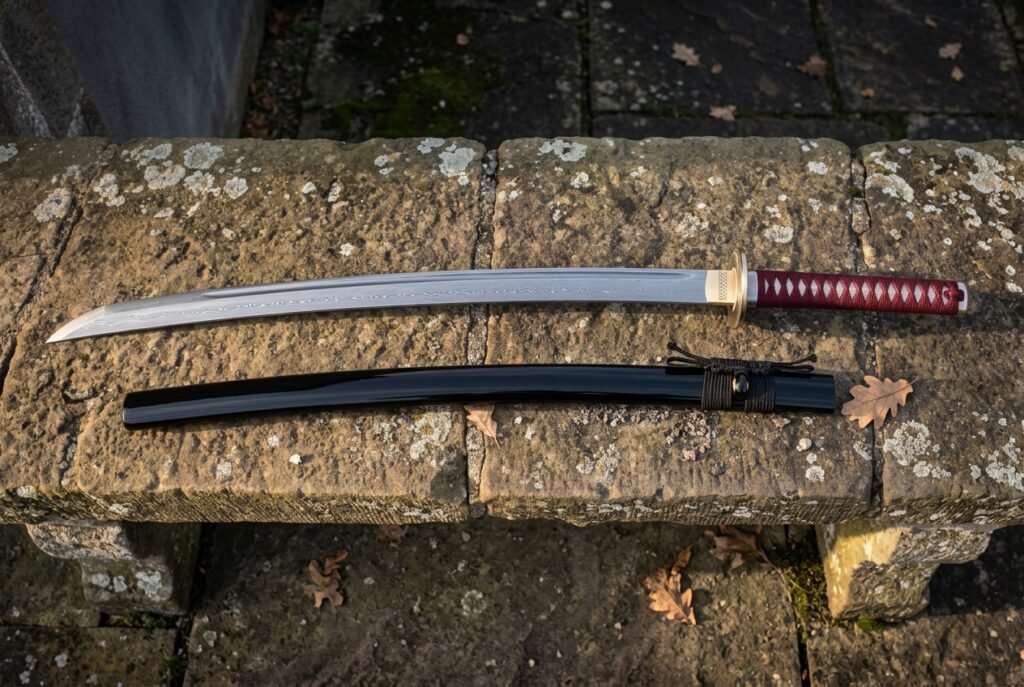
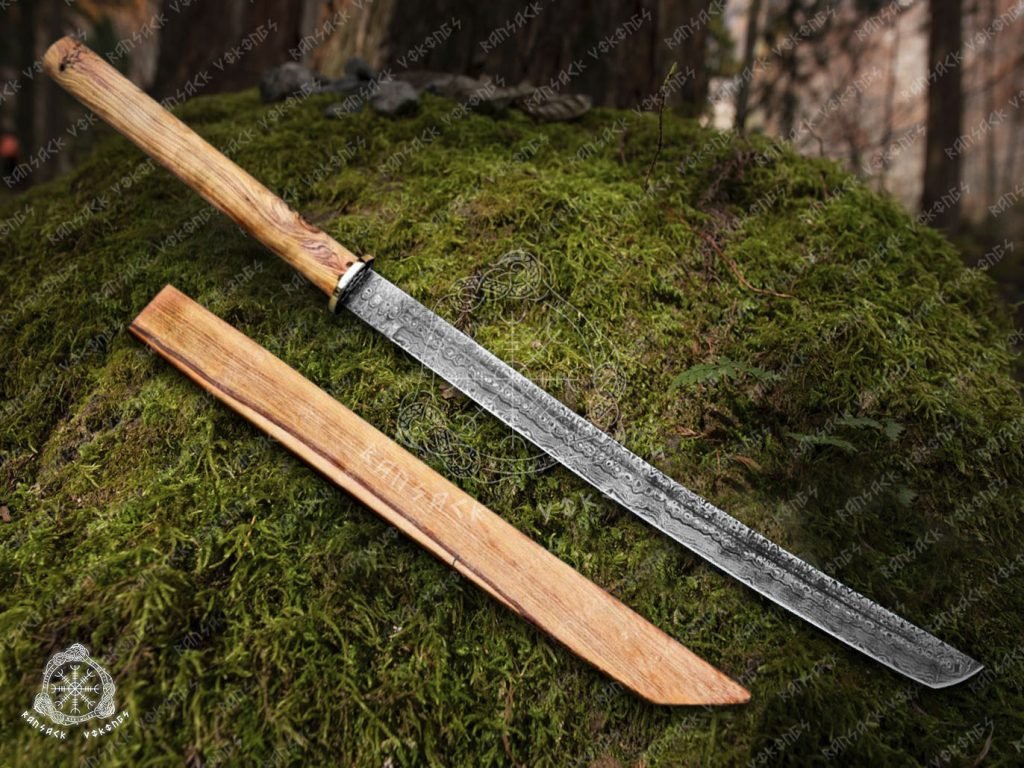
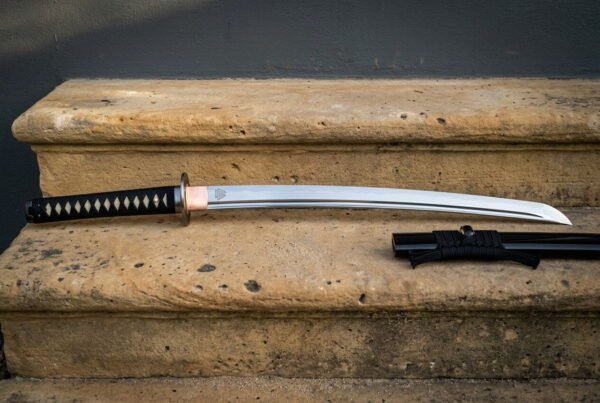
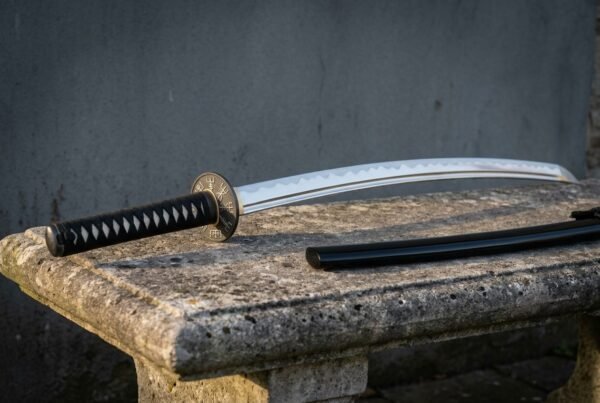
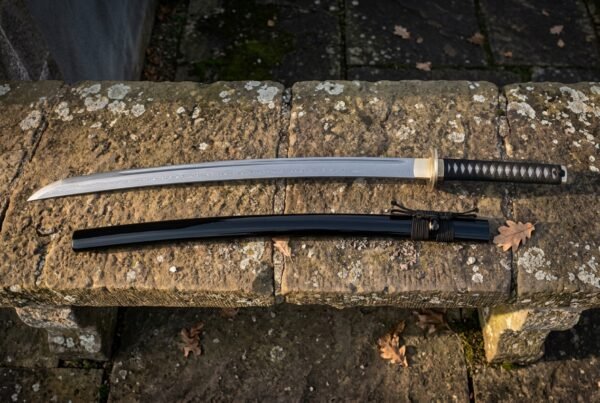
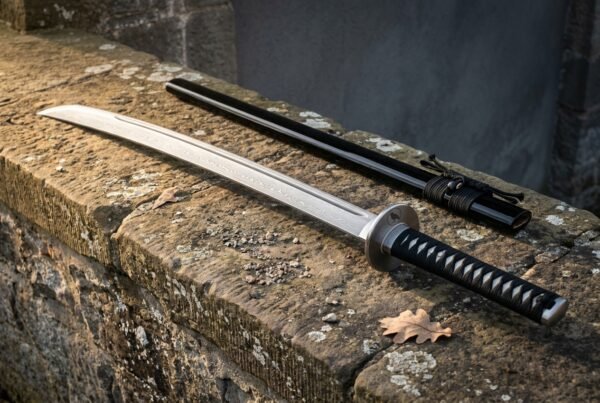
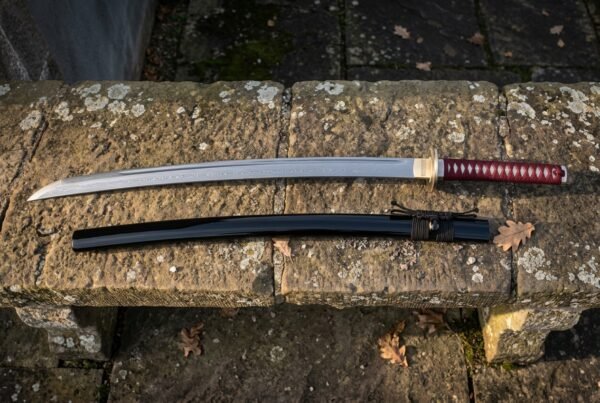
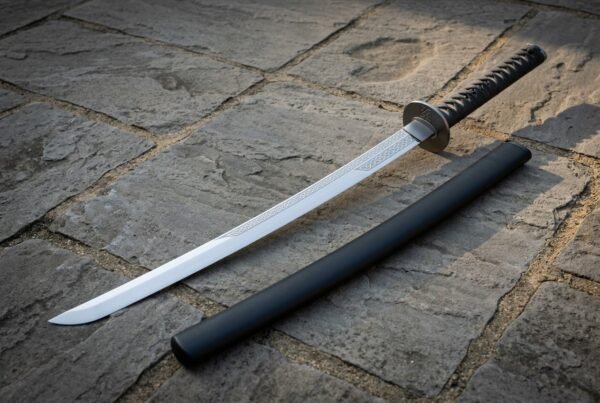
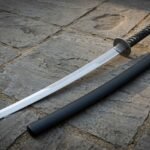
The Knotcurve is a full length katana in 1095 high carbon steel, polished bright, with a running band of Norse knotwork etched along the upper flat of the blade from the guard almost to the point. The curve is shallow and even, the point a clean kissaki with a defined line. The tsuba is a round blackened disc with a pierced and engraved lattice panel, the tsuka is wrapped in black cord over a black core, and the saya is plain black.
The curve of a Japanese blade is a by product of how it was hardened, which is one of the neatest accidents in the history of metallurgy. A traditional smith coats the blade in clay, thick along the spine and thin or absent along the edge, then heats it and quenches it. The thinly coated edge cools fast and transforms into hard martensite, which occupies more volume than the steel it came from. The thickly coated spine cools slowly and stays softer and denser. The edge expands, the spine does not, and the blade bends backwards into its sori as it cools. The visible boundary between the two zones is the hamon. We should say plainly that this blade is not clay tempered and carries no hamon: the line you can see along the flat is the etched knotwork band. This sword is forged and finished in the Czech Republic.
Curve, temper line and furniture all have names, and what a katana is goes through the parts. Interlace of this kind was the standard decorative language of the period, and the symbols guide covers the patterns that keep coming back. The tanto knives carry the same furniture at knife length.
Specifications
| Blade | 1095 high carbon steel, hardened to 54 to 58 HRC |
|---|
| Blade profile | Curved single edged with a defined kissaki point |
|---|
| Blade length | Approximately 28 inches |
|---|
| Overall length | Approximately 40 inches |
|---|
| Blade decoration | Etched Norse knotwork band running the upper flat |
|---|
| Tsuba | Round blackened disc with a pierced and engraved lattice panel |
|---|
| Tsuka | Black cord wrapped over a black core |
|---|
| Saya | Plain black |
|---|
| Finish | Mirror polished blade, blackened fittings |
|---|
| Included | Sword and saya |
|---|
| SKU | RK-1882 |
|---|
What the curve does to the cut
A curved edge cuts better than a straight one for a reason you can test with a kitchen knife. When a straight edge meets material square on, the whole width of contact has to be pushed apart at once. When a curved edge meets it, only a small part of the edge is in contact at any moment, and as the blade travels that contact point slides along the edge. The result is a drawing cut that happens automatically, without the swordsman having to pull the blade deliberately. Force is concentrated on a smaller area and the cut goes deeper for the same effort.
The curve also changes how the sword is drawn. A curved blade in a curved scabbard clears the mouth in an arc, which is what makes iaijutsu, the art of drawing and cutting in one motion, possible at all. A straight blade has to come fully clear before it can be turned. Everything about the katana, from the length of the tsuka to the shape of the saya mouth, follows from that single geometric fact.
The steel and the knotwork
The blade is 1095 high carbon steel hardened to 54 to 58 HRC and then ground and polished through progressively finer stages to a bright finish. On a blade this long, toughness matters more than the last point of edge hardness, and this range gives a blade that flexes and returns rather than one that is brittle.
The knotwork band is acid etched into the polished surface after finishing. Because it is etched rather than printed or engraved with a wheel, it sits below the surface and cannot be worn, rubbed or washed off. The pattern is a continuous interlaced band with no start and no end, which is the defining feature of Norse and Insular knotwork: it is one line, and if you follow it with a finger you come back to where you began. Putting that on a Japanese blade profile is deliberately a crossover, not a claim to historical Japanese practice.
Engraving, runes and your own design
Use the rune converter on this page to turn a name, a date or a short phrase into Elder Futhark and we will cut it into the steel, the leather or the wood. If you would rather have a Viking pattern than a rune line, choose your own design in the engraving option above the add to cart button and tell us where it goes. Where a piece already carries an engraved design, your chosen engraving replaces it rather than sitting alongside it. On this katana the knotwork band occupies the upper flat, so a rune line ordered for the blade takes its place. If you want the band kept, ask for the runes near the habaki or on the tsuba instead. See the engraving page.
Handling and balance
A katana is a two hand sword and the tsuka length is set for it: both hands on the grip with a gap between them, the left hand near the pommel doing most of the work and the right hand near the guard steering. Held that way the sword feels far lighter than it does one handed, because the left hand acts as the fulcrum and the right hand only has to guide.
The balance point sits a few inches forward of the tsuba, which is where a cutting sword wants it. Too far forward and the sword is slow to stop; too far back and it does not carry through a cut. This is a sharp collector and display sword. It is not a training sword and it is not certified for cutting practice, partner drills or contact of any kind.
Care
Wipe the blade after every handling and keep a light film of oil on it. Choji oil is traditional and mineral oil works just as well. A mirror polished carbon steel blade shows fingerprints within days and the acid in skin will etch marks into it permanently if they are left, so be disciplined. Treat the blackened tsuba gently: dust it, do not polish it with abrasives, because blackening is a surface finish. Do not store the sword in the saya for months at a time. Full detail is on our steel care page.
A curve like this does not sharpen the way a straight edge does, and sharpening a curved blade works through the stroke.
Made in the Czech Republic
This piece is made by hand in the Czech Republic, in a workshop that still works the old way. The steel is forged, ground, heat treated and finished by smiths who learned the trade from the people before them, and the wood, horn and leather are cut and fitted by hand rather than pressed out on a line. That is also why no two pieces come out exactly the same.
Ransack Viking is a United States company. We import these pieces ourselves, check every one when it lands and ship from our warehouse in North Babylon, New York. Engraving is done here in the United States after the piece arrives, so your runes or your own design go on before it leaves for you.
A note on handmade variation
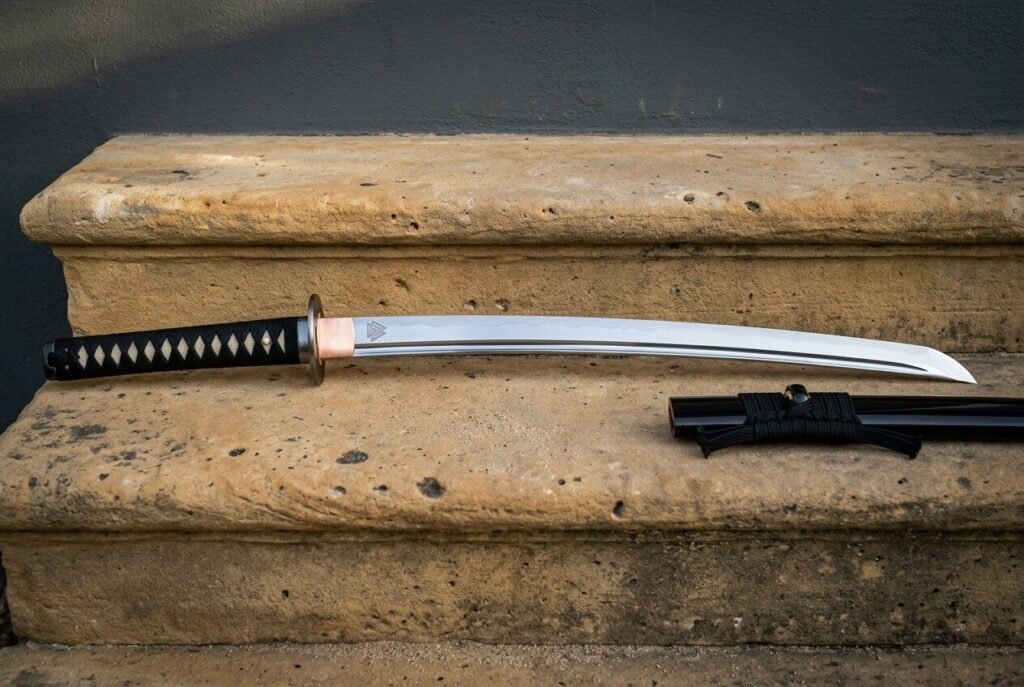
This is hand made, not machine made or bulk produced, so what arrives will not be a pixel for pixel copy of the photograph. The etched band comes from the same artwork every time but sits a fraction differently along each blade. The cord wrap on the tsuka is done by hand, so the diamond spacing varies. Blackening takes slightly differently on every tsuba. Polish always carries a little of the hand that did it. The dimensions, the material and the build are the same every time. The character is not.
Frequently asked questions
Does this katana have a hamon
No. It is not clay tempered, and we would rather tell you that up front than let you assume. The line running along the blade is the etched knotwork band, not a temper line.
Is it sharp when it arrives
Yes, it arrives with a working edge. Ask in the order notes and we will send it blunt instead, which is a sensible choice for a display sword in a busy house.
Can I use it for cutting practice
No. We sell this as a collector and display sword and we do not certify it for tameshigiri, partner training or contact work. Buy a purpose built cutting sword if that is what you need.
Will the knotwork band come off with polishing
Light cleaning will not touch it, because it is etched into the surface. Heavy abrasive polishing over many years would eventually soften it, so keep abrasives off the blade.
Is the tsuka wrap real cord
Yes, it is cord wrapped by hand over a shaped core, not a moulded or glued sleeve. The diamonds are formed by the wrap itself.
How long is the wait
One to two weeks of processing, then free US shipping. Tell us in the order notes if you need it by a set date and we will be honest about it.
What is in the box
- Knotcurve 1095 steel katana with etched Norse knotwork band
- Plain black saya
- Care card for polished carbon steel and blackened fittings
- Lifetime warranty against defects in forging, grind, heat treat and fittings
- Forged and finished in the Czech Republic
Explore the range
See more in katana and Japanese swords, wakizashi and swords, or read the guides on blade geometry and looking after a polished edge.
Other pieces in this group
Also in this group is the Brasswind Japanese sword, 5 inches overall. Sitting beside it in the catalogue is the Moonedge Japanese sword, forged from 1095. Another in the same line is the Jadecord Japanese sword, 40 inches overall.
For a different piece from the same family, look at the Twinsaya wakizashi. Nothing here exactly right, build one to your own spec on the design your own page.





Reviews
There are no reviews yet