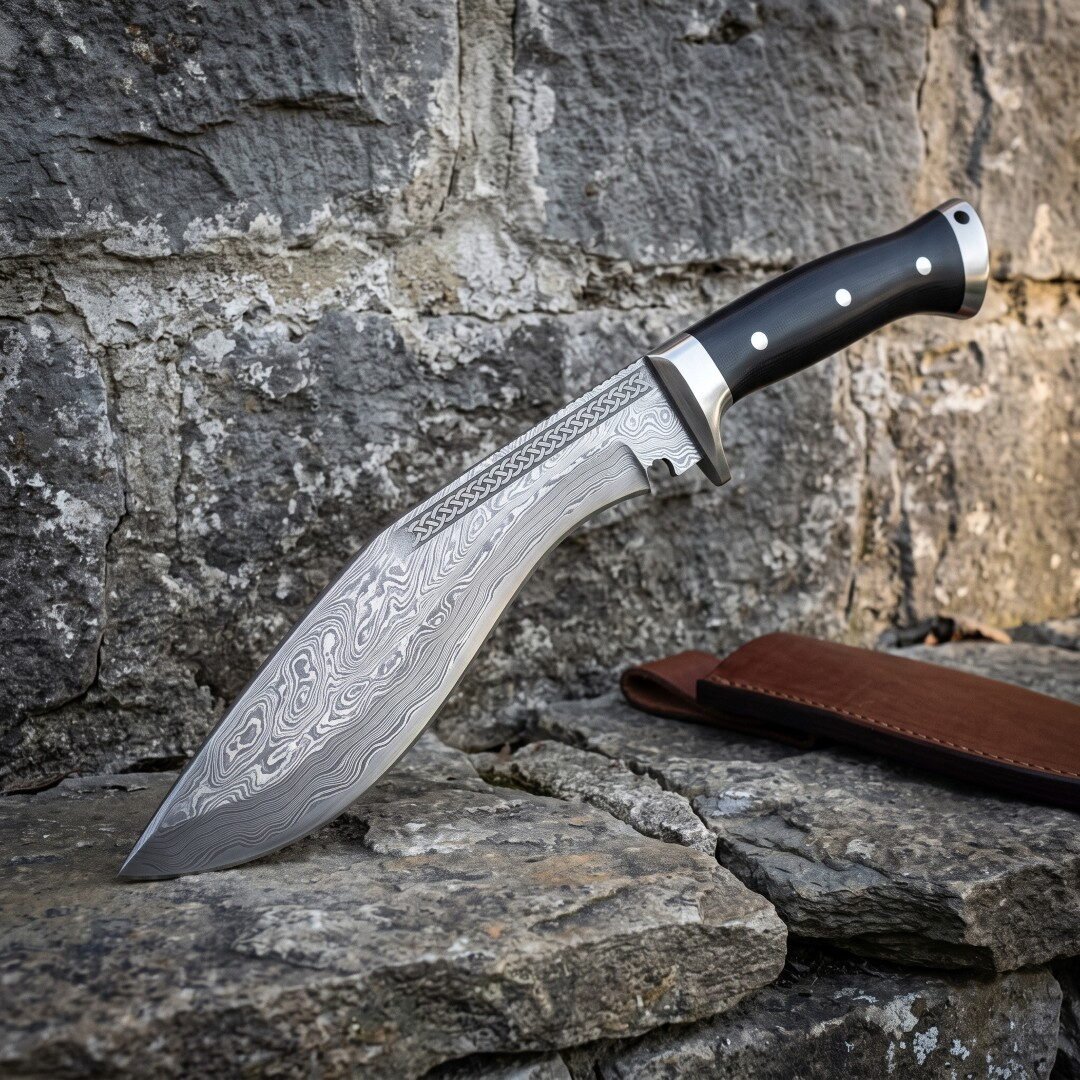
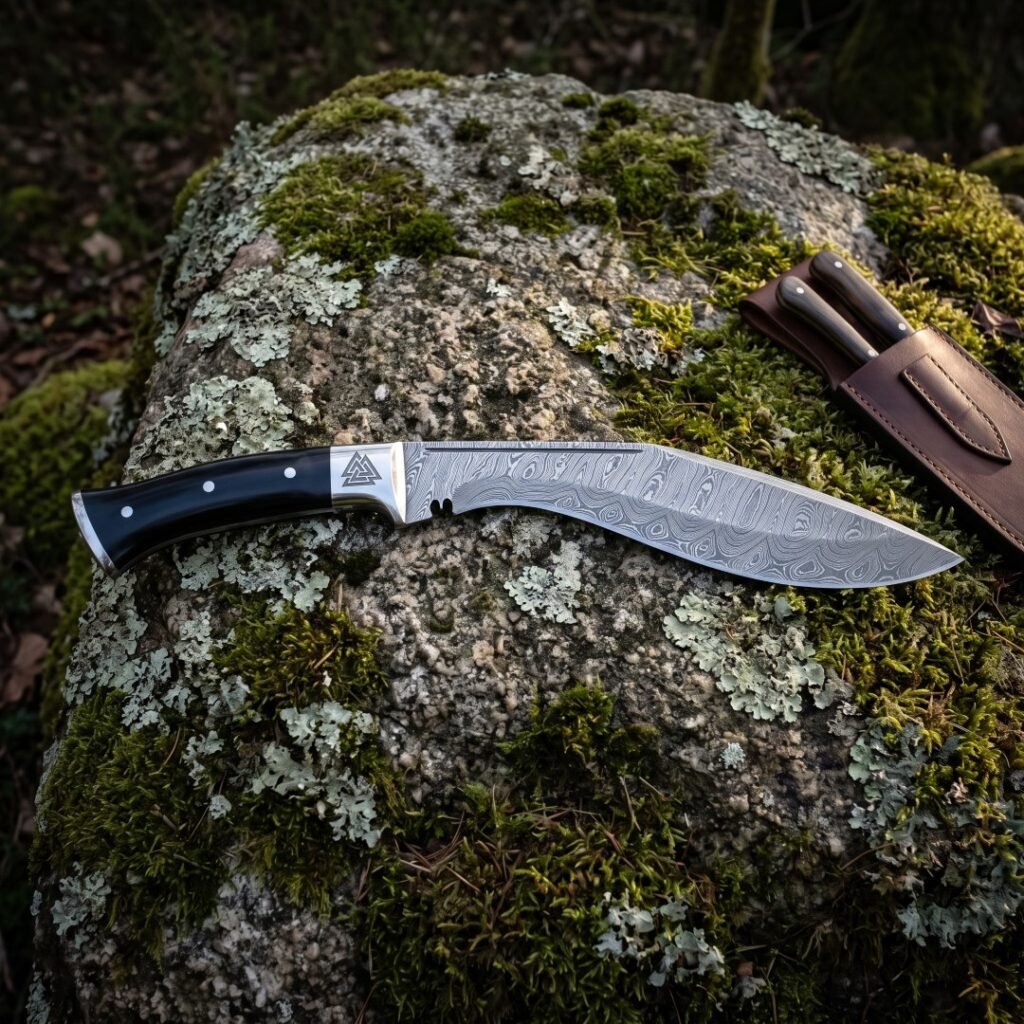
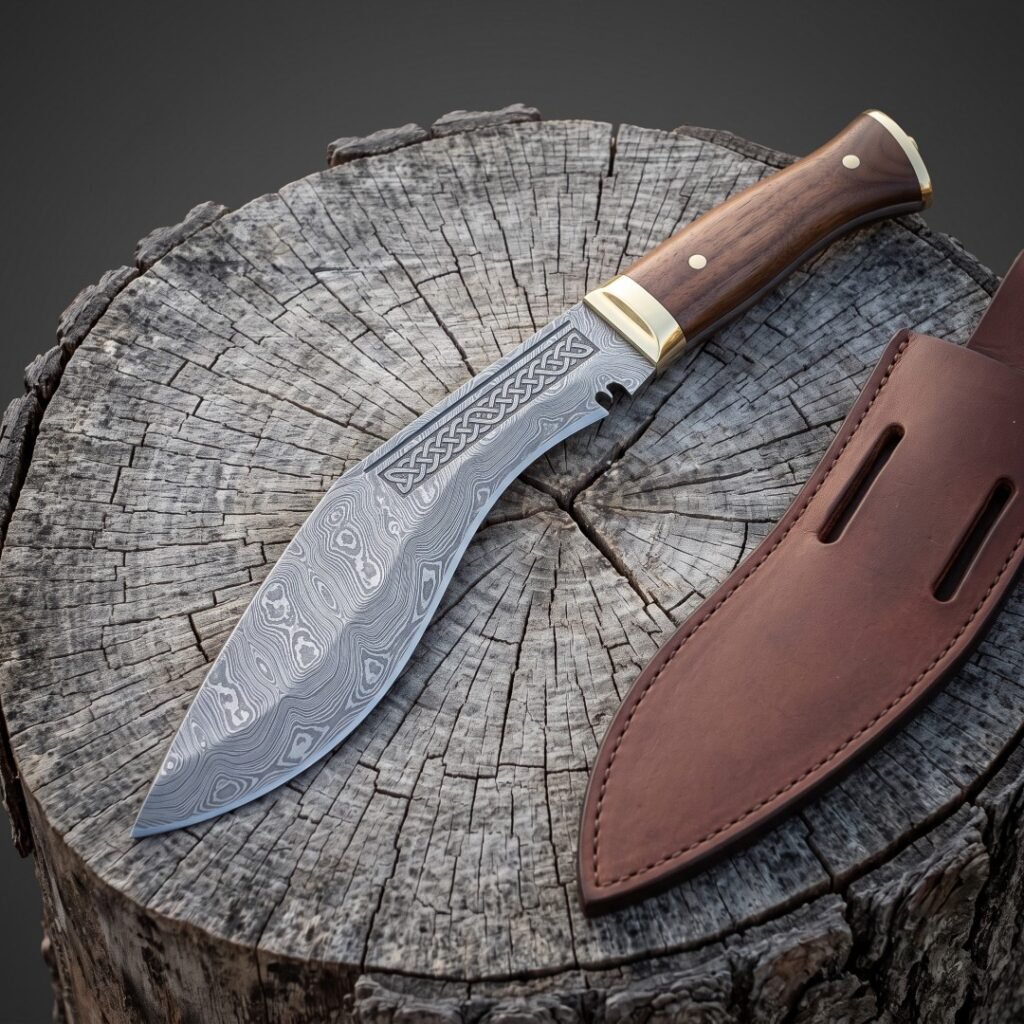
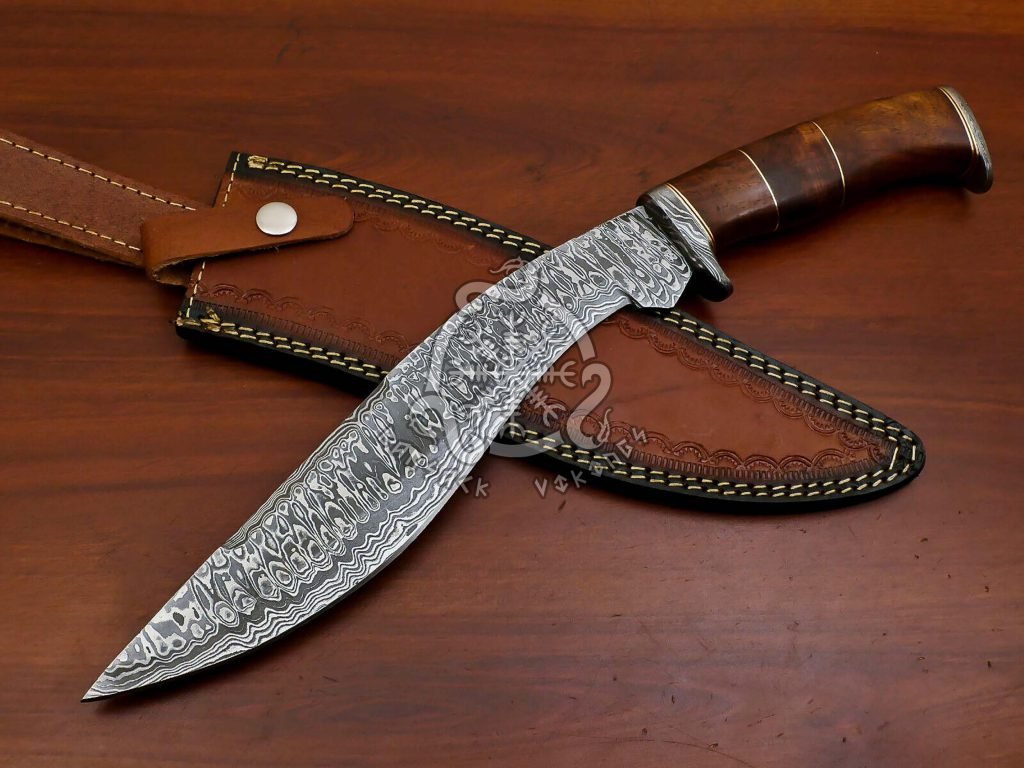
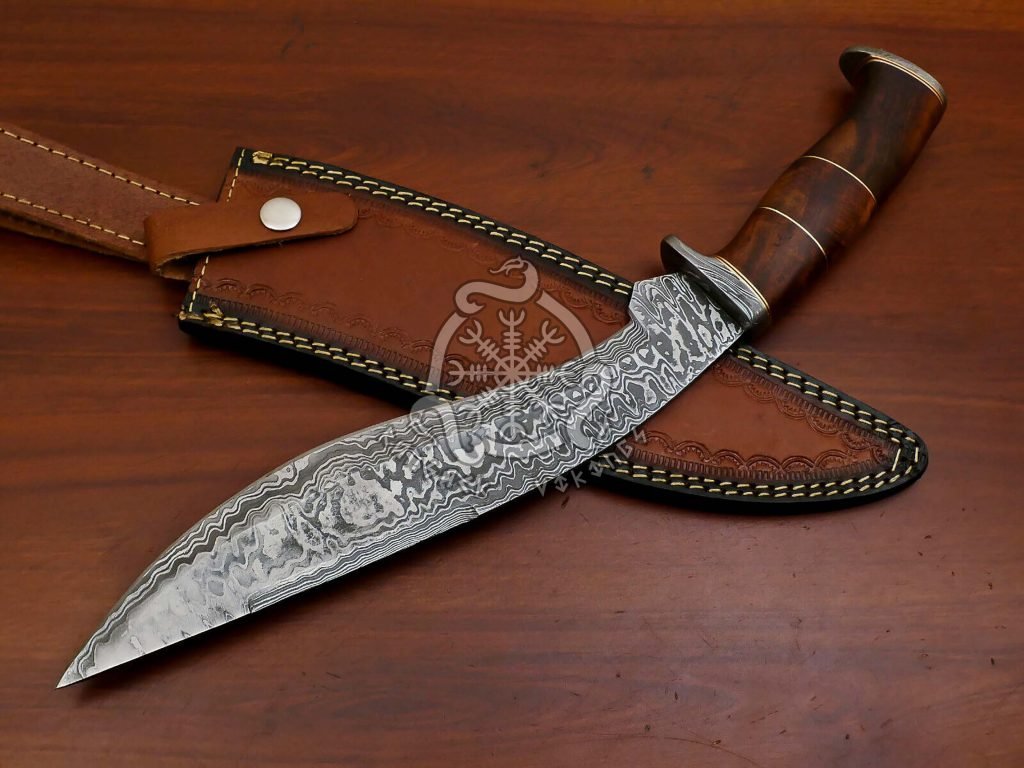
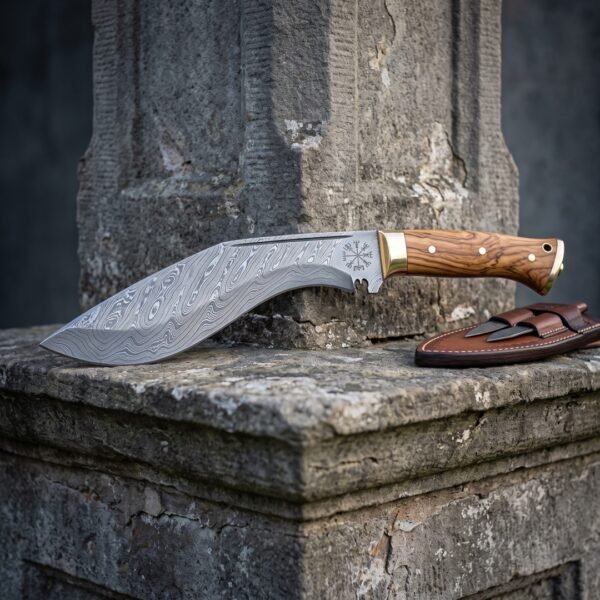
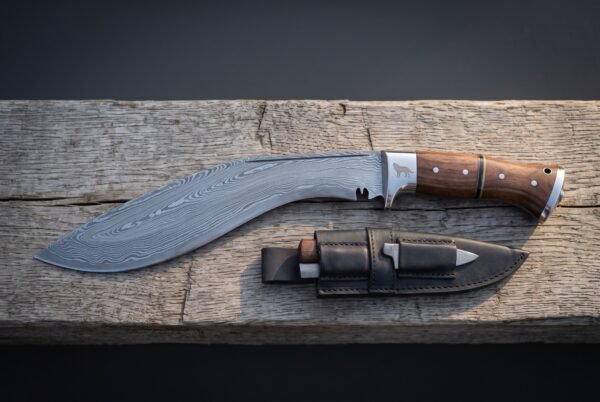
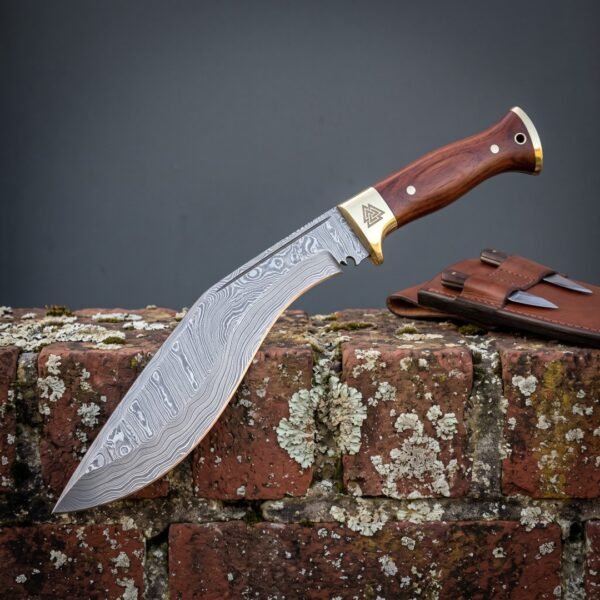
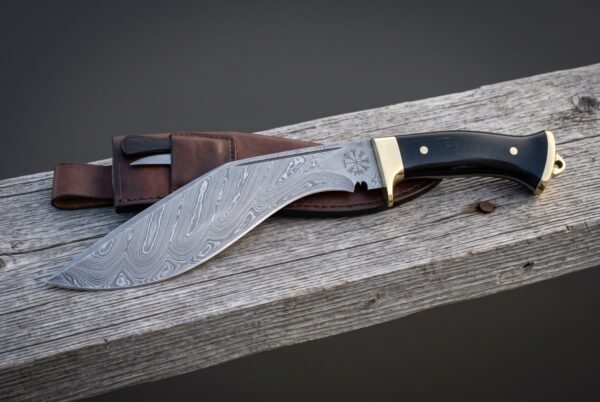
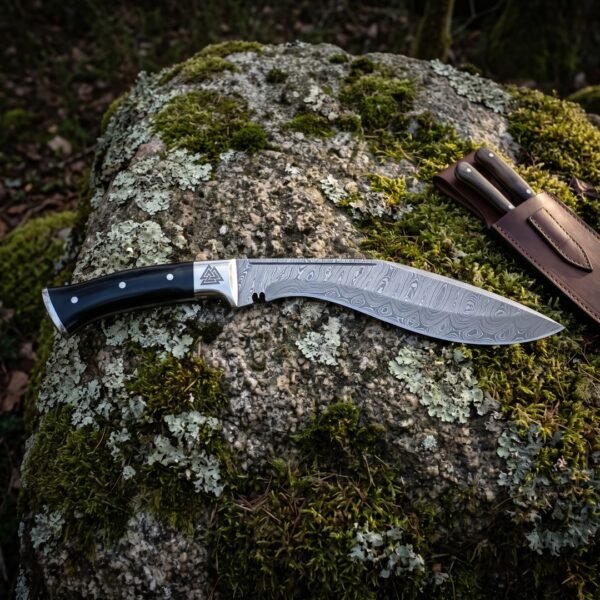
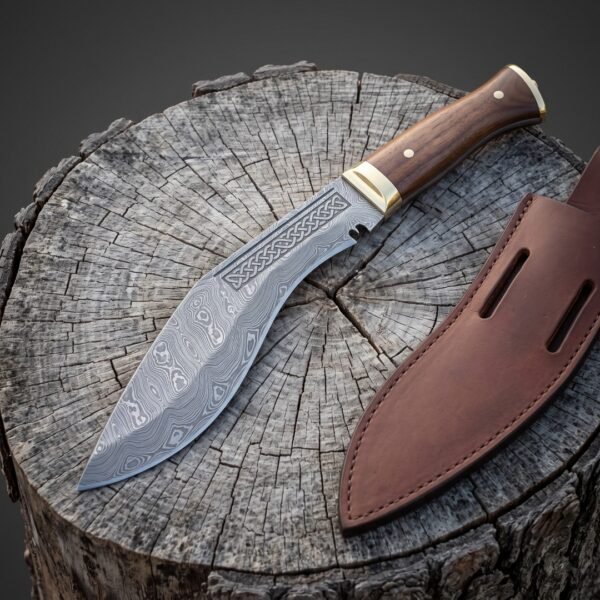
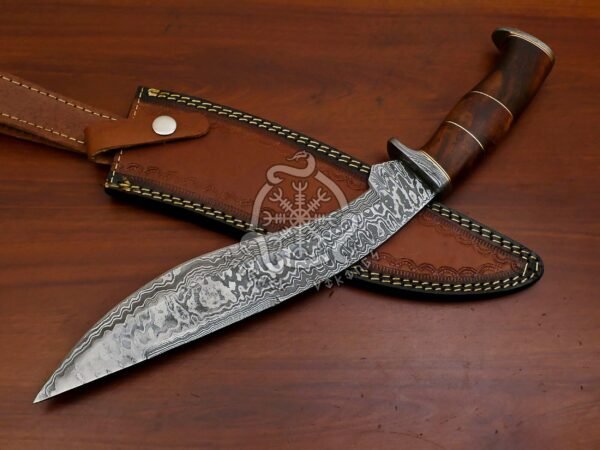
The kukri is the forward curved working blade of the Nepali hills, and this one is cut from 1095 and 15N20 Damascus with a deep belly and a hard sweeping edge. The bend is not decoration. Because the edge sits forward of the line of the grip, the mass of the blade arrives ahead of your hand and the tool chops far above its apparent size, which is why the shape survived several centuries of hill farming with almost no change to its outline.
Look closely at the spine and you will find a band of interlaced knotwork cut into the steel above the fuller line, running from the bolster down into the belly. The scales are black canvas micarta, pinned through the full tang with three steel pins, and the bolster and butt cap are polished steel. There is a lanyard hole through the cap. Every one of these is made by hand in the Czech Republic. Ransack Viking imports them, checks each blade, edge and fitting before it goes on the shelf, and ships it from our Memphis, Tennessee warehouse with a fitted brown leather belt sheath.
A recurve and a drop point cut in completely different ways, and the guide to blade shapes covers how each behaves. Interlace of this kind was the standard decorative language of the period, and the symbols guide covers the patterns that keep coming back. If you want a shorter belly for dressing game, the skinner knives cover that job.
Specifications
| Blade steel | 1095 and 15N20 Damascus, 58 to 60 HRC |
|---|
| Blade profile | Forward curved kukri with a deep belly and a cho notch at the ricasso |
|---|
| Construction | Full tang, three visible steel pins |
|---|
| Handle | Black canvas micarta scales |
|---|
| Fittings | Polished steel bolster and steel butt cap with a lanyard hole |
|---|
| Engraving | Interlaced knotwork band cut along the spine |
|---|
| Finish | Etched and hand polished Damascus, satin fittings |
|---|
| Included | Brown leather belt sheath |
|---|
| SKU | RK-2170 |
|---|
Why a kukri chops the way it does
Set a straight knife and a kukri of the same weight side by side and swing both. The straight knife lands with its balance point somewhere near your fist. The kukri lands with its balance point well out along the belly, so the same effort delivers a much heavier blow. That forward bend does something else as well. It puts the edge at an angle to the direction of travel, so the cut slices as much as it splits, and a slicing cut passes through green wood with less shock than a square chop.
The small notch at the base of the edge, right where the blade meets the bolster, is the cho. It is not a bottle opener and it is not a sharpening relief in the modern sense. It marks the end of the edge and stops a cut running back into the handle, and on traditional pieces it carries a symbolic reading as well. Keep it clean and unsharpened, as it is here.
The steel and the pattern
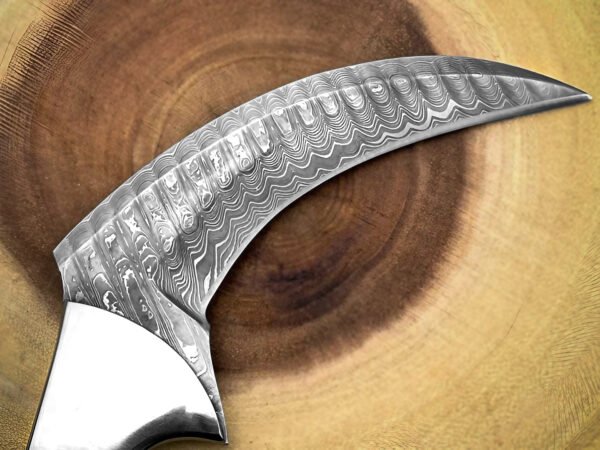
This blade is layered 1095 and 15N20. The two steels are close in carbon but differ in nickel, so when the billet is folded, drawn and etched, the 15N20 layers resist the acid and stand out bright against the darker 1095. The pattern you see is a cross section through that folded stack, which is why it wanders and doubles back along the belly rather than running in tidy stripes.
Hardened to 58 to 60 HRC, it holds a working edge well and takes a fine polish. Damascus of this kind is not stainless. The bright layers will spot if the blade is left wet, so it wants a wipe and a film of oil after use. Canvas micarta is layered cloth set in resin, cut and ground to shape, and it grips better wet than dry, which is the reason it has been a standard on hard use blades for a long time.
Engraving, runes and your own design
Use the rune converter on this page to turn a name, a date or a short phrase into Elder Futhark and we will cut it into the steel, the leather or the wood. If you would rather have a Viking pattern than a rune line, choose your own design in the engraving option above the add to cart button and tell us where it goes. Where a piece already carries an engraved design, your chosen engraving replaces it rather than sitting alongside it. On this kukri the natural place is the flat above the fuller, or across the bolster. Engraving is done here in the United States after the piece arrives. See the engraving page for what fits in the space and how the finished cut looks on Damascus.
Handling and balance
Hold it near the butt rather than choked up behind the bolster and let the curve do the work. A kukri rewards a loose wrist and a relaxed swing, and it punishes a tight grip with a jarred hand. The micarta swell under the palm and the flared butt cap together stop the handle sliding forward on a hard chop, and the lanyard hole takes a wrist loop if you are working over water or off a ladder.
For finer jobs, choke up so your thumb rests on the spine just behind the knotwork band and use the straighter section near the ricasso like a camp knife. That is how the shape is actually used in the hills, one tool doing the work of three.
Care
Wipe the blade dry after every outing and put a light film of mineral oil, camellia oil or a plain gun oil over the whole flat, including under the bolster line where moisture collects. If a spot of surface rust appears, lift it with a cork or a soft brass brush and a little oil rather than sandpaper, which will flatten the etched contrast. Do not store it in the leather sheath for long periods, because vegetable tanned leather holds moisture against steel. Micarta needs nothing beyond soap and water. Feed the sheath two or three times a year with a neutral leather cream. There is more on all of this in steel care.
Damascus wants oil more than plain steel does, because the etch that shows the pattern also opens the surface, and caring for a Damascus pattern covers what to use.
Made in the Czech Republic
This kukri is made by hand in the Czech Republic by people who forge, grind, fit and finish it themselves. Nothing here is drop shipped from an importer catalogue. Ransack Viking buys the pieces, brings them into the United States, checks each one for edge, fit and finish, and holds them in the Memphis warehouse so an order goes out from stock rather than from a factory queue. Processing takes one to two weeks because pieces are checked and, where an engraving has been ordered, cut before they ship. Shipping within the United States is free. Returns run for seven days. The lifetime warranty against defects in forging, grind, heat treat and fittings has no end date and needs no receipt.
A note on handmade variation
This is hand made, not machine made or bulk produced, so what arrives will not be a pixel for pixel copy of the photograph. Damascus is the clearest example of that. The pattern is a slice through a folded billet, so no two blades carry the same figure, and the contrast varies a little with how deep the etch bit. Micarta cut from a different sheet will show a slightly different weave shadow, and the leather sheath will take dye at its own rate. The dimensions, the steel, the hardness and the build are the same every time. The character is not.
Frequently asked questions
Is it sharp when it arrives
Yes. It ships with a working edge that will shave hair off your arm and take bark off a limb without help. It is a cutting tool and should be treated as one from the moment the box is open.
Will the Damascus pattern wear off
The pattern is structural, not printed. It runs all the way through the steel. Heavy polishing will reduce the contrast at the surface, and a fresh etch brings it back, but ordinary use and oiling will not remove it.
Can I put my own runes on the spine
Yes. The flat above the fuller takes a rune line cleanly. Order the engraving option, send your text, and it is cut here in the United States before the kukri ships. Note that your engraving replaces the knotwork band rather than joining it.
Is the sheath included
It is. A fitted brown leather belt sheath comes with every one. It is cut for this blade specifically, not a generic pouch, and the belt loop takes a standard width belt.
Is this a display piece or a working tool
A working tool. The tang is full, the pins are steel through the scales and the edge is properly hardened. It will chop, split kindling and clear brush. It is not a pry bar and the tip is not meant for digging.
How long until it reaches me
Processing is one to two weeks from our Memphis warehouse, plus transit. An engraved order sits at the top of that range because the cut is done after the piece arrives and before it ships.
What is in the box
- One Damascus kukri with black canvas micarta scales and steel fittings
- One fitted brown leather belt sheath
- Your Elder Futhark rune line or chosen Viking design, if ordered
- Lifetime warranty against defects in forging, grind, heat treat and fittings
- Hand made in the Czech Republic, shipped from our Memphis, Tennessee warehouse
Explore the range
More in kukri knives, Viking knives, Norse arms and engraved and personalised pieces, plus the guides.





Reviews
There are no reviews yet