
Blog
Kukri Knife Guide: History, Shapes and What to Look For

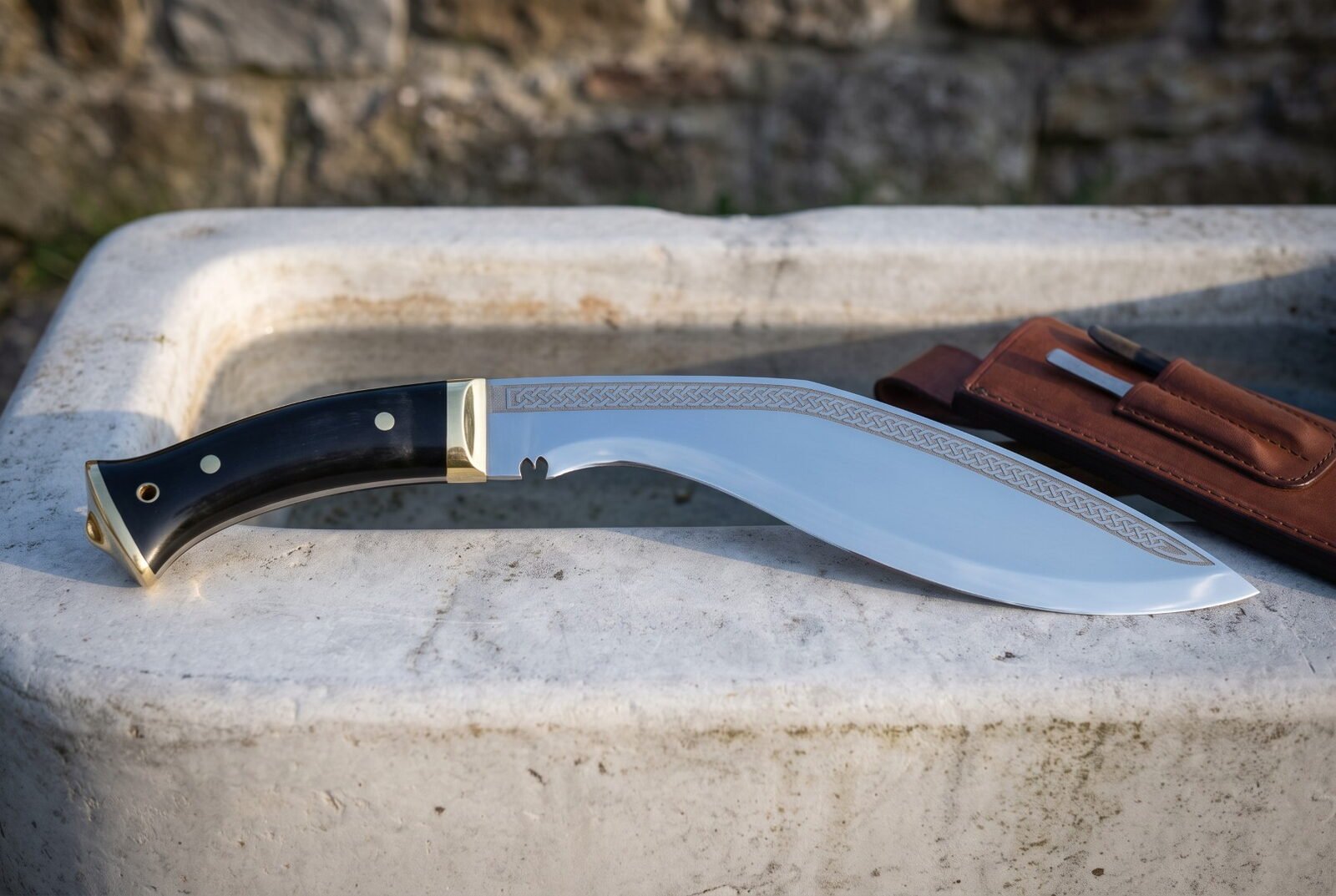
A kukri is a chopper that happens to be shaped like a knife. The blade bends forward, the weight sits ahead of your hand, and every cut you make borrows energy from that geometry whether you asked it to or not. That is the whole design in one sentence, and it explains why a kukri feels wrong for two minutes and then obvious for the rest of its life.
This is a buying guide rather than a history lesson. If you want the background, the shape, the parts and the Nepalese context, that is covered in what a kukri actually is. What follows is the part that decides whether you end up with a blade you use or a blade you photograph once.
What the Forward Curve Actually Does
Hold a straight knife and the point of impact sits roughly in line with your wrist. Hold a kukri and the impact point sits forward and below, so the blade arrives at the wood with a small mechanical advantage built in. Two things follow. The first is that a kukri chops far above its weight, since the mass concentrated near the belly is doing the work at the end of a longer lever. The second is that the same curve pulls through a cut on the draw, which is why kukris are surprisingly good at kitchen and camp tasks that a machete handles badly.
The trade is control. A blade that wants to keep going is harder to stop precisely, and the belly that makes it chop well is the same belly that makes fine slicing awkward. This is why traditional kukri sheaths carry two small companion knives rather than expecting the big blade to do everything.
The Shapes You Will Meet
Nepalese pattern names are regional and inconsistent, and the same word can mean slightly different things from one valley to the next. Treat these as families rather than fixed specifications.
Sirupate
Slim and long, named after the narrow leaf of the siru grass. A sirupate carries less weight in the belly, swings faster and cuts vegetation cleanly. It is the pattern to pick if you want something that behaves more like a large field knife than a small axe.
Ang Khola
The heavy one. A thick spine, often with a groove running along it, and a deep belly. Ang khola blades are built to split and chop, and they are the reason the kukri has a reputation for doing axe work. Expect real weight in the hand and real fatigue after an hour.
Bhojpure and other broad village patterns
Broad through the belly, moderate in length, meant as a general farm and household tool. These sit between the sirupate and the ang khola and are usually the sensible first kukri, because they do everything reasonably rather than one thing brilliantly.
Service patterns
The blades issued to Gurkha regiments from the nineteenth century onward were standardised into numbered patterns, and modern copies of those shapes are common. They tend to be around twelve to thirteen inches overall with a broad, fairly heavy blade, which is a compromise the British and Indian armies arrived at after a long time thinking about it.
Kukri Sizes Compared
| Overall length | Typical weight | What it suits | What it struggles with |
|---|---|---|---|
| 10 to 12 inches | Light | Belt carry, camp chores, food prep | Serious chopping, thick limbs |
| 13 to 15 inches | Medium | General bushcraft, clearing, the usual first choice | Nothing much, which is why it is the default |
| 16 to 18 inches | Heavy | Splitting, felling small growth, display presence | Fatigue, close work, carrying it all day |
| Over 18 inches | Very heavy | Ceremonial and display pieces | Being a knife in any practical sense |
Steel and Hardness
Traditional Nepalese kukris are differentially hardened, with the edge taken harder than the spine so the blade can absorb impact without cracking. That principle still holds. A kukri is an impact tool, so a brittle edge is worse than a slightly soft one.
Our kukris are plain 1095 carbon steel at 54 to 58 HRC, or Damascus of 1095 and 15N20 at 58 to 60 HRC. Plain 1095 is the practical choice for a blade that will meet knots and gravel, because it takes a beating and comes back with a file and a stone. Damascus is harder and holds an edge longer, and it is the one people buy when the knife will spend more time being admired than abused. Neither is a mystery metal. The steel glossary spells out what the numbers mean, and Damascus against plain high carbon covers the trade in detail.
Tang Construction
Two traditional builds exist. A full flat tang with horn or wood slabs riveted to either side is the stronger arrangement and the one you can inspect by eye. A stick or rat-tail tang runs a narrower spike through a solid one piece handle to a butt cap, which is lighter, more traditional in look, and entirely dependent on how well it was fitted.
For a kukri specifically, this matters more than it does on a straight knife, because chopping loads the handle joint in a way that slicing never does. If you intend to chop, take the full tang. The reasoning is set out at length in full tang against partial tang.
Handles, and Why Yours Might Be Uncomfortable
Traditional kukri handles have a pronounced flared butt and a ring or collar in the middle. That shape is not decoration. It stops the handle escaping your grip on a hard swing, which is a genuine risk with a blade that heavy. It also means the handle can feel blocky to a hand used to modern ergonomics.
Buffalo horn is the classic material and looks superb, though it moves slightly with humidity and can develop hairline cracks over years. Hardwoods such as rosewood and walnut are more stable and more forgiving in cold weather. Stacked leather washers give the best shock absorption of the three and take a very good patina. Cord wrap over a full tang is the most secure grip when your hands are wet.
The Sheath and the Two Small Knives
A proper kukri sheath is leather over a wooden core, cut deep enough that the blade sits in it without rattling, with a retaining strap over the handle. The wooden core matters. A soft leather sheath alone will be cut through by the belly of the blade within a season.
Many sheaths carry two small companion knives in a pocket at the back. One is a small utility knife for the fine work the big blade cannot do. The other is a plain unsharpened steel rod used as a burnisher and, at a push, as a striker. They are genuine working items rather than souvenirs, and a kukri sold without them is not incomplete, just simpler.
What to Check Before You Buy
Look at the spine thickness at the bolster and at the start of the belly. A kukri that is thick at the handle and thin at the belly is balanced for speed. One that keeps its thickness forward is balanced for chopping. Neither is wrong, but sellers rarely say which they have made.
Check that the edge grind is even along the curve. The belly is the hardest part of a kukri to grind well, and an uneven bevel there is the clearest sign of a rushed blade. Look at how the handle meets the bolster, since a visible gap will collect moisture. Ask what the tang is if you cannot see it. And weigh the thing in your mind honestly against how far you intend to carry it, because a two pound blade is heroic in the yard and miserable on a hill.
Sharpening a Curve
A kukri cannot be sharpened flat on a bench stone in one pass, because the edge changes angle relative to your stroke the whole way along. Work in short sections, rolling the blade slightly as you move from the recurve near the notch out to the tip, and keep the belly consistent since that is where the work happens. A round or half round file suits the inner curve near the notch. Full method for this and other curved blades is in sharpening a curved blade.
Carbon steel rusts. Wipe the blade after use, keep a light film of oil on it, and store it out of the sheath if the sheath has been wet. The knife care guide covers the rest, and Damascus has its own routine set out in Damascus steel care.
Carry and the Law
A kukri is a large fixed blade. In most of the United States that puts it firmly in the category of things that are legal to own and to transport in a sensible way, and much less legal to carry on your belt through a city centre. Rules differ by state and sometimes by city, so check before you travel with one. Our knife laws by state reference is the starting point, though it is not legal advice and local ordinances can be stricter than state law.
Where Ours Come From
Ransack Viking is a US company based in Memphis, Tennessee. The kukris are made by hand in the Czech Republic, then imported, inspected and shipped from Memphis, which is also where any engraving is cut after the blade arrives. US orders ship free, tracked, with no import duty or customs delay, and every piece carries a lifetime warranty against defects with no end date on it.
The full range sits at kukri knives, and if you want the same steel in other shapes, the Damascus knives and hunting knives ranges use the same stock. Blade and handle can be engraved to order through custom engraving, and the rest of the writing lives in the guides.
Questions people ask
What size kukri should I buy first?
Something between thirteen and fifteen inches overall. That range chops well enough to be useful, stays light enough to carry, and does not punish you for a mistake in technique the way an eighteen inch blade does. Buy the heavy one second, once you know whether you actually want it.
Is a kukri better than a machete?
For thick woody growth and for splitting, yes, because the weight and the curve give it real chopping power. For light green vegetation and long reach a machete is faster and less tiring. They are different tools that happen to overlap in the middle.
What are the two small knives in the sheath for?
One is a small utility knife for the detailed cutting the main blade is too heavy for. The other is an unsharpened steel rod used to burnish and true the edge between proper sharpenings. Both are traditional and both are still useful.
Should I choose 1095 or Damascus for a kukri?
Plain 1095 at 54 to 58 HRC if the blade is going to work, because it absorbs impact and is easy to bring back with a file. Damascus of 1095 and 15N20 at 58 to 60 HRC if edge retention and the pattern matter more to you than shrugging off abuse. Both rust if neglected.
What is the notch near the handle for?
Opinions differ and none of them are settled. The practical readings are that it stops a cut running back into the handle and that it lets rain and sap drip clear of the grip. Symbolic readings are also offered, and the honest answer is that nobody can prove which came first.
Do Gurkha soldiers still carry kukris?
Yes. It remains part of the issued kit in Gurkha regiments of the British and Indian armies, used as a tool and carried as a regimental emblem. The parade version and the working version are not always the same blade.
Can a kukri be engraved?
It can. Engraving is cut in Memphis after the blade arrives from the Czech Republic, on the flat of the blade or on a brass bolster. Runes, initials and short lines of text all work. Long paragraphs do not, for reasons of physics rather than policy.
Shop the range
 Inkbraid Hand Forged Full Tang Kukri with Buffalo Horn Handle & Etched Knotwork Spine | About 16 Inches Overall | Brass Fittings and Leather Sheath | Norse Camp Gift | RK-2203
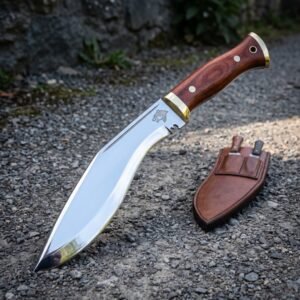 Greyfang Hand Forged Gurkha Kukri Knife with Rosewood Scales & Etched Wolf Head | About 16 Inches Overall | Brass Fittings and Leather Sheath Holding Two Companion Knives | Camp Gift | RK-2202
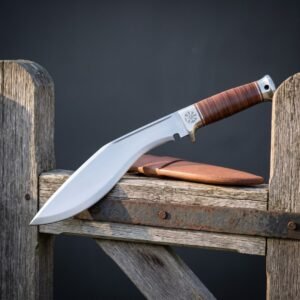 Stavehelm Hand Forged 1095 Kukri Knife with Stacked Leather Handle & Helm of Awe Bolster | About 16 Inches Overall | Tan Leather Sheath | Norse Camp Gift | RK-2198
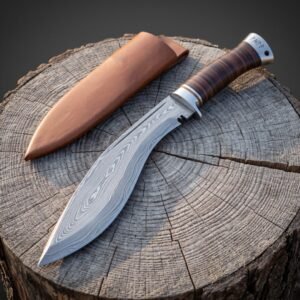 Coilbrand Hand Forged Damascus Kukri Knife with Stacked Leather Handle & Runed Steel Pommel | About 16 Inches Overall | Tan Leather Sheath | Norse Collector Gift | RK-2196
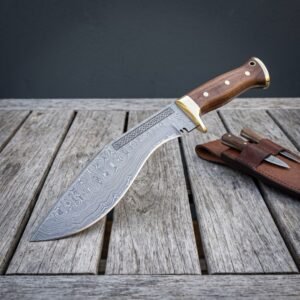 Fellcarve Hand Forged Damascus Kukri Knife with Walnut Scales & Brass Bolster | About 16 Inches Overall | Leather Sheath and Two Companion Knives | Norse Camp Gift | RK-2195
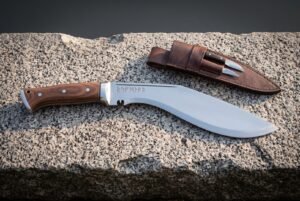 Runehollow Hand Forged High Carbon Kukri with Elder Futhark Engraved Blade | Rosewood Scales and Steel Bolster | Leather Sheath and Two Companion Knives | Norse Gift | RK-2184