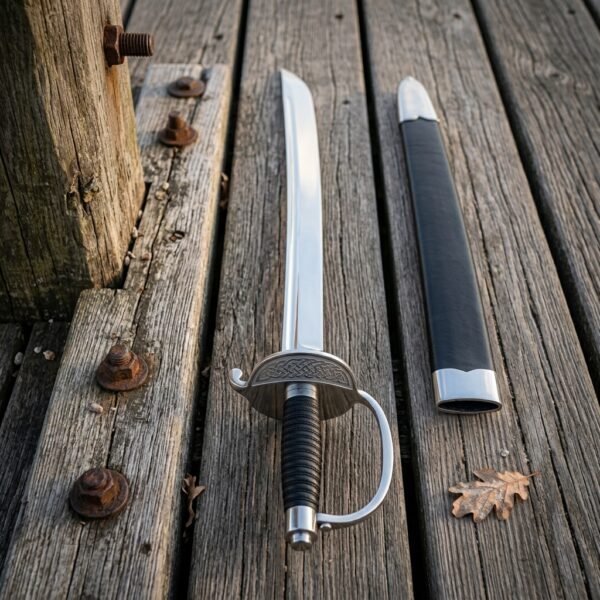
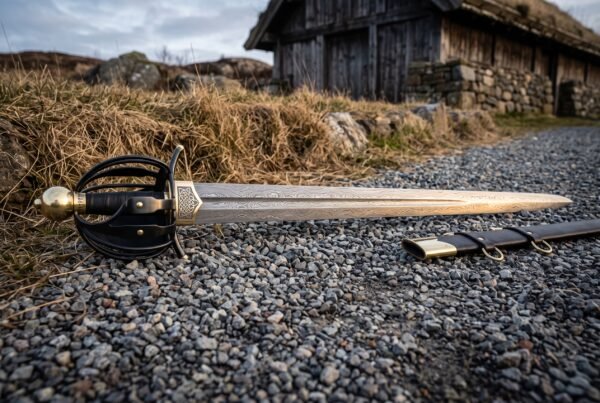
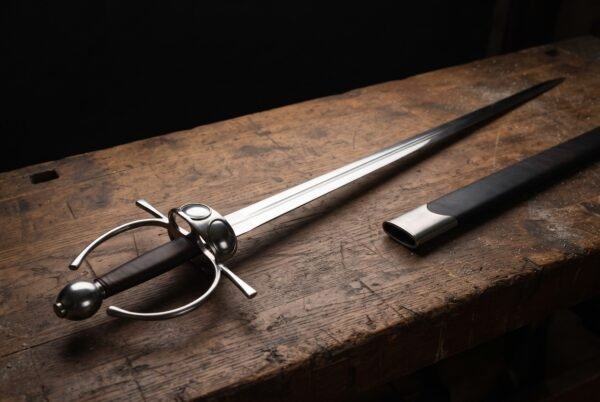
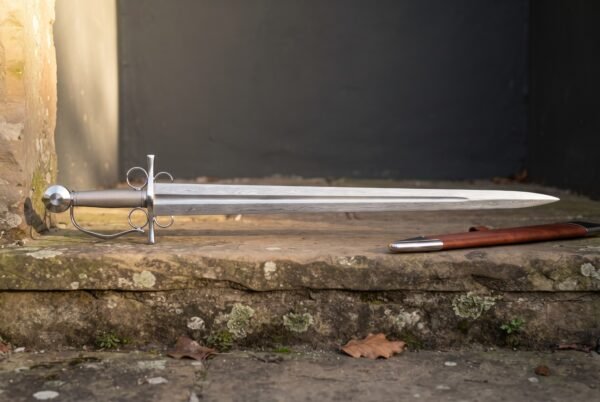
Short swords are the blades that sit between a large knife and a full sword. The core of this collection runs 24 to 31 inches overall with 18 to 25 inches of blade, all single handed, and it covers Roman gladius leaf blades, Norse and Viking short swords descended from the broad seax, hunting hangers with shell guards, sawback blades, flame bladed pieces, wakizashi and cutlasses. A run of Renaissance side swords and espada ropera shares the page at 38 to 41 inches overall for anyone who wants the same one handed handling with far more reach.
Two steels run through the group. Plain 1095 high carbon is hardened to 54 to 58 HRC. Damascus of 1095 and 15N20 is forge welded, folded and acid etched, hardened to 58 to 60 HRC. Listed bare weights fall between 1 lb 12 oz and 2 lb 6 oz, which is roughly half what a full length sword weighs.
Decide first whether you want the Roman leaf blade or the straight Norse profile, because those two account for most of the page.
Free US shipping
On most pieces. Heavier and oversized ones carry a flat charge.
Hand Forged
Heated, hammered and ground by hand.
Engraving available
Names, dates or Norse runes on most pieces.
Ships from New York
Inspected and dispatched from our New York warehouse. No import duty, no customs delay on US orders.
Short Swords

Why a short sword instead of a sword
A short sword is not a compromise. For most of recorded history it was the sensible answer, and the long sword was the specialist. The reason is shields and formations. If you are standing in a line behind a shield, a 30 inch blade is all you can use, because anything longer catches on the man beside you on the backswing and cannot be recovered in the space you have. The Roman legions won with a blade of about 20 inches for exactly that reason.
Weight is the other half of it. The pieces here that state a bare weight run from 1 lb 12 oz to about 2 lb, against 2 lb 6 oz to 3 lb 2 oz for the full length swords elsewhere on the site. That difference is felt within about thirty seconds of holding one. A short sword can be worn all day, drawn in a doorway, and handled by someone who has never held a blade before without alarming anybody.
For a buyer that has practical consequences. Short swords cost less than full length pieces because there is less steel and less grinding in them. They hang on a wall in spaces where a 40 inch sword will not fit. And they are far easier to bring to a costume event or a photo shoot, because you can move through a room without clearing it first.
The shapes on this page
Seven families cover almost everything here. Length varies less than shape does, so pick the profile first.
Gladius and leaf blades
The Roman infantry sword and its relatives. A waisted leaf profile that narrows behind the shoulder, widens again towards the front third and finishes in a long triangular point. That shape puts mass forward for the cut and still gives a point stiff enough to thrust through mail and linen. Examples here run 26 to 28 inches overall with 19 to 21 inch blades, in both high carbon and Damascus, with turned hardwood grips cut with finger ribs, bronze or brass meander guards, and ribbed leather over shaped cores. Bronze leaf blade pieces from the pre Roman tradition sit in the same group.
The name gladius simply meant sword in Latin, and the shape shifted across the centuries the Romans used it. Earlier examples are longer with a pronounced waist, later ones shorter and closer to parallel, which is why two gladius pieces of the same nominal type can differ by two inches of blade. Judge the ones here on their stated figures rather than on a period label.
Norse and Viking short swords
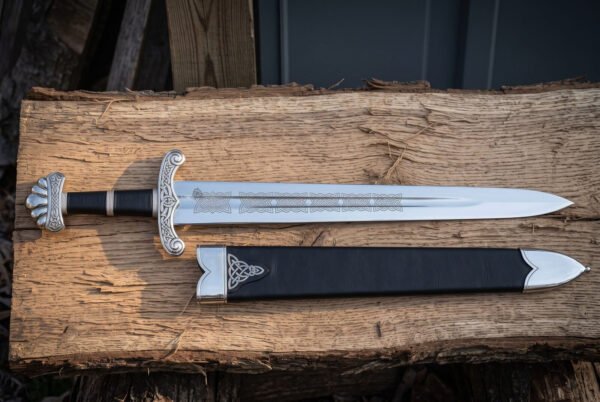
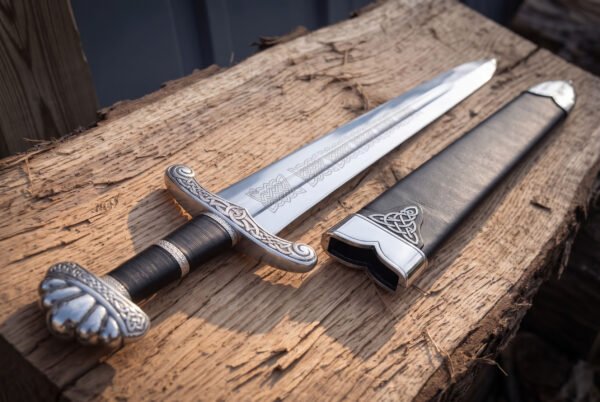
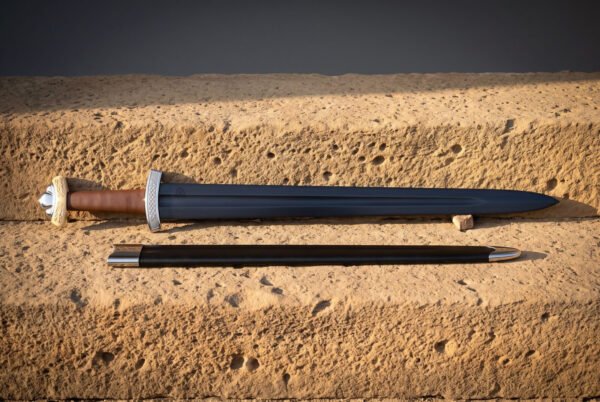
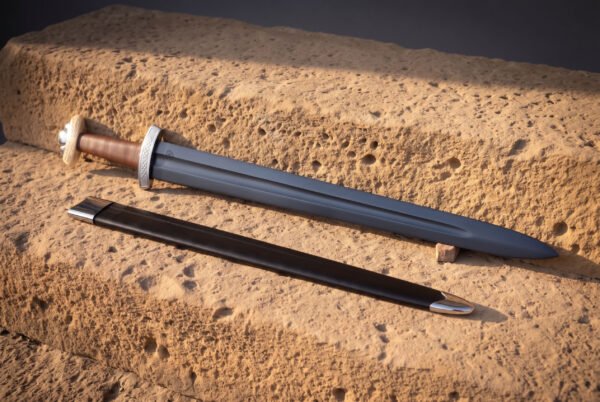
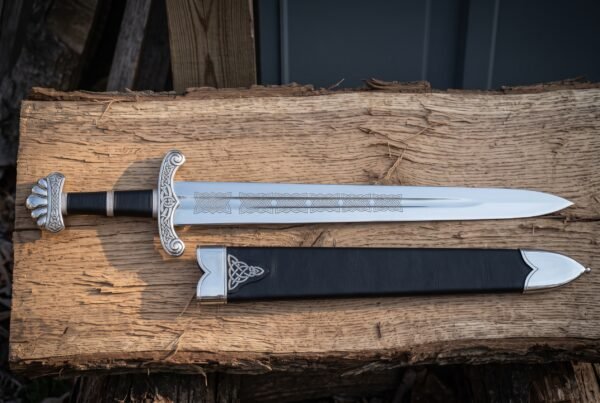
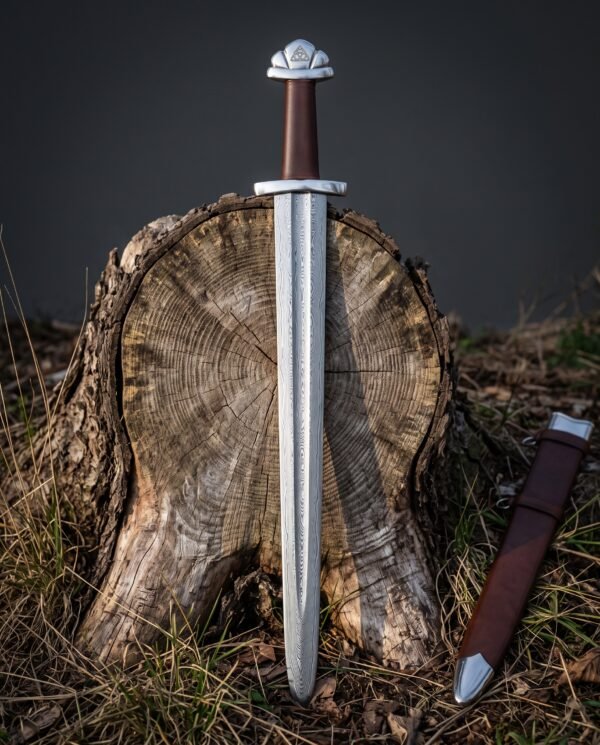
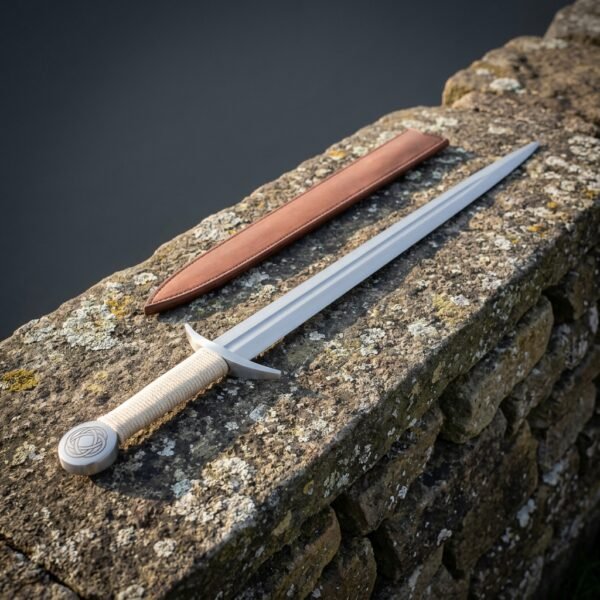
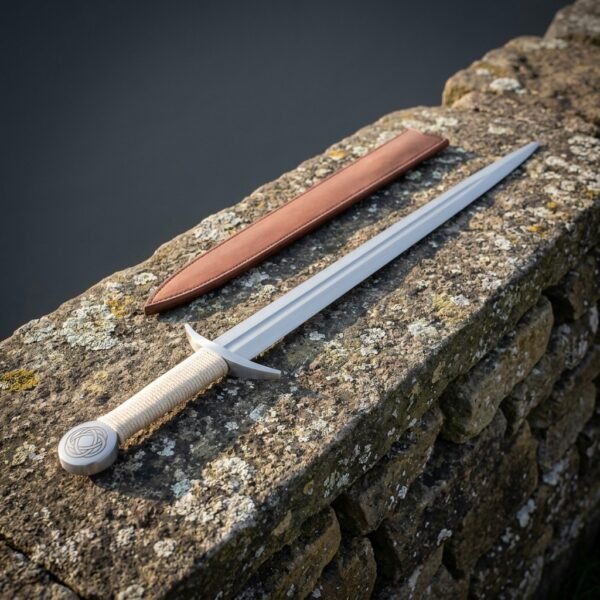
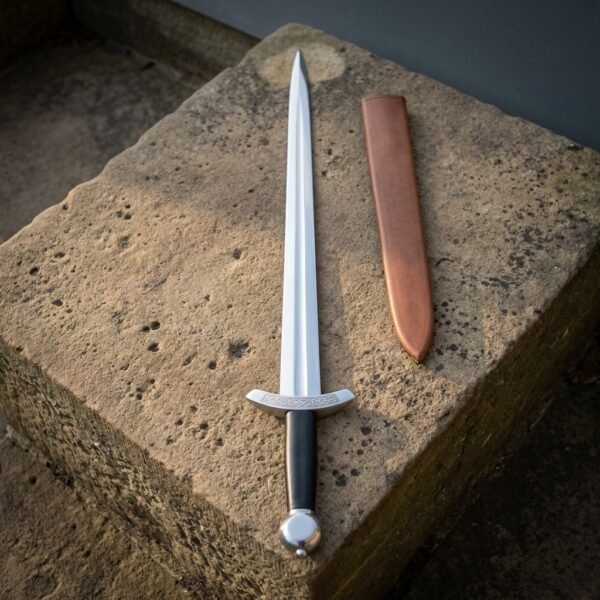
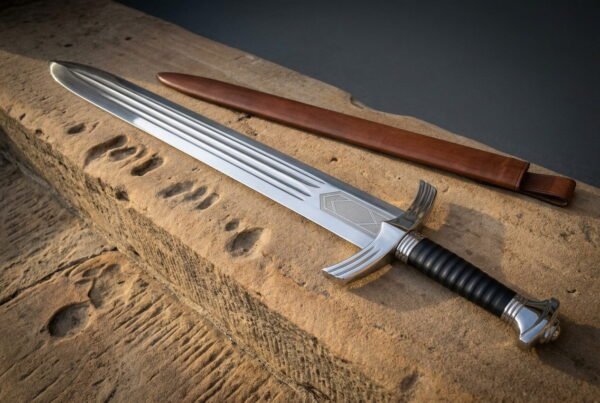
Straight, broad, double edged blades with lobed or disc pommels, running 26 to 31 inches overall with 20 to 25 inches of blade. These sit on the line where the broad seax stops being a knife and starts being a sword, which is a boundary the Norse themselves never drew sharply. A langseax with a 13 inch blade and a short sword with a 20 inch blade are the same idea at two sizes. Listed bare weights here are around 1 lb 14 oz to 1 lb 15 oz. Grips are leather or cord over a timber core, often banded with wire or raised rings.
Hunting hangers and shell guards
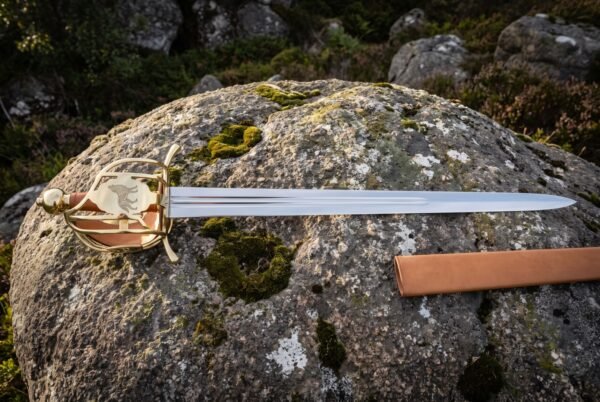
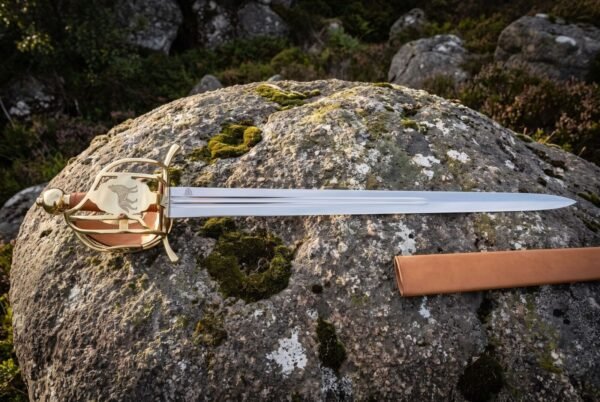
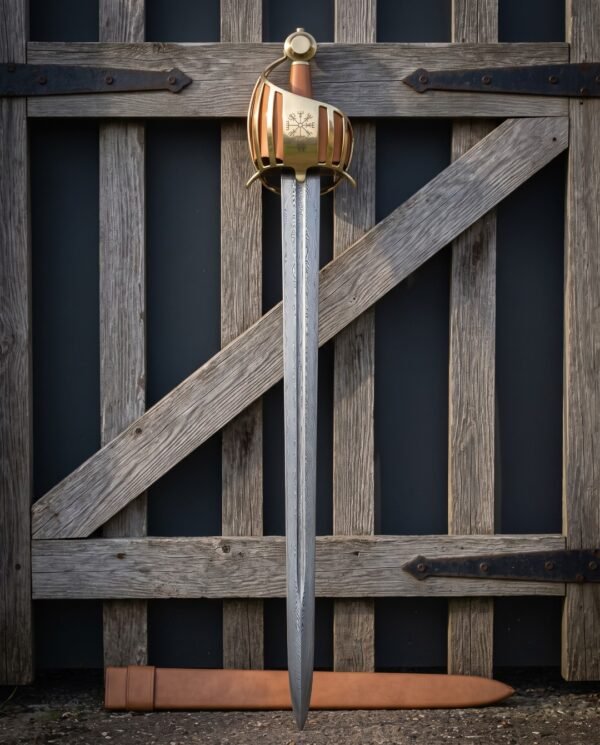
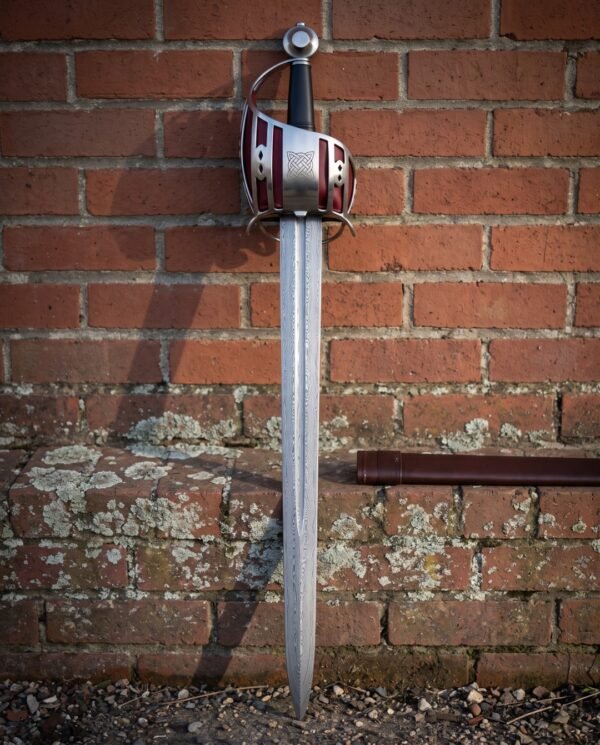
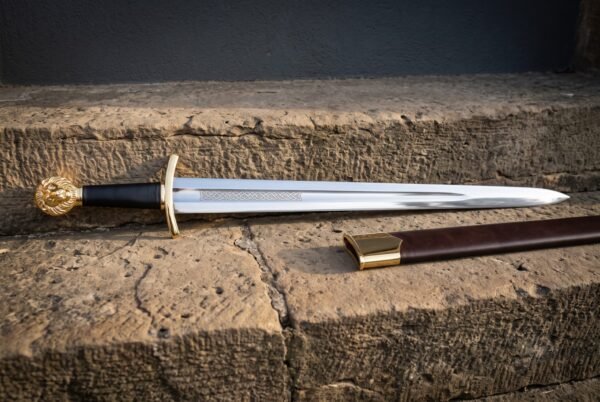
The short sword a gentleman carried into the field from the seventeenth century onward, and the ancestor of the modern hunting knife. A single edged or clipped blade around 22 inches, a brass shell guard pierced or engraved with a motif, and a leather wrapped grip. The pieces here run about 28 inches overall. Some carry an unsharpened display edge with a rounded point, which the listing states.
Sawback short swords
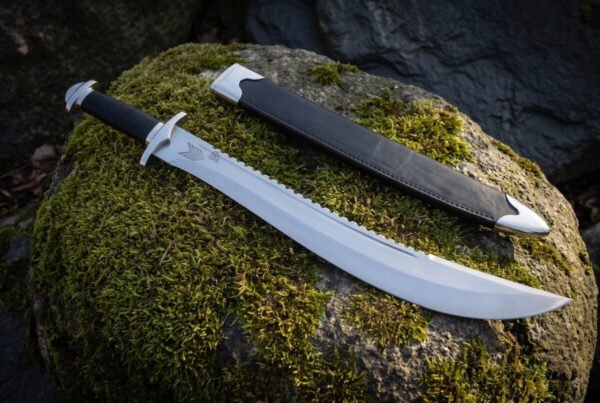
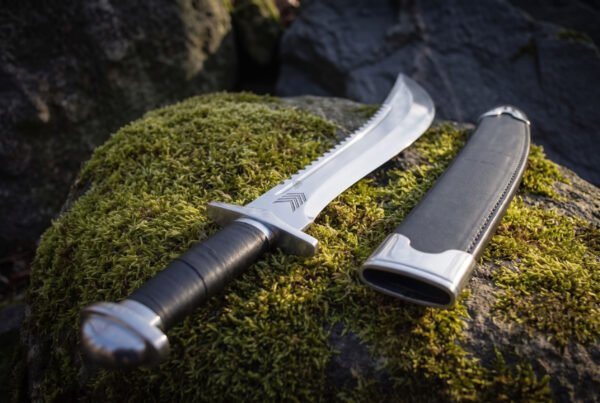
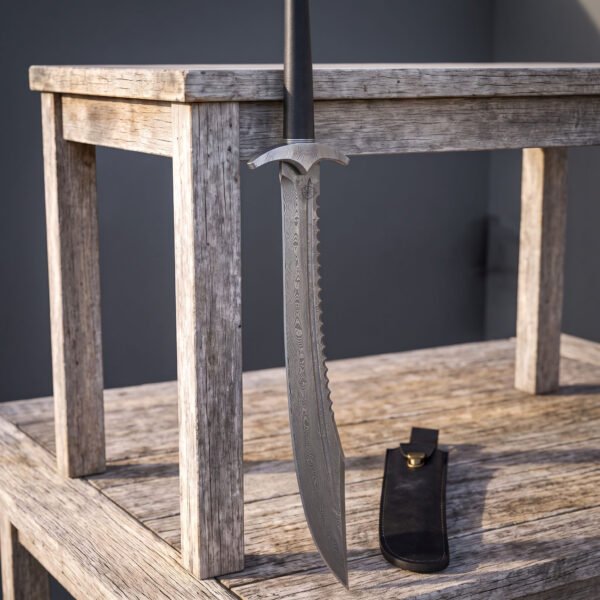
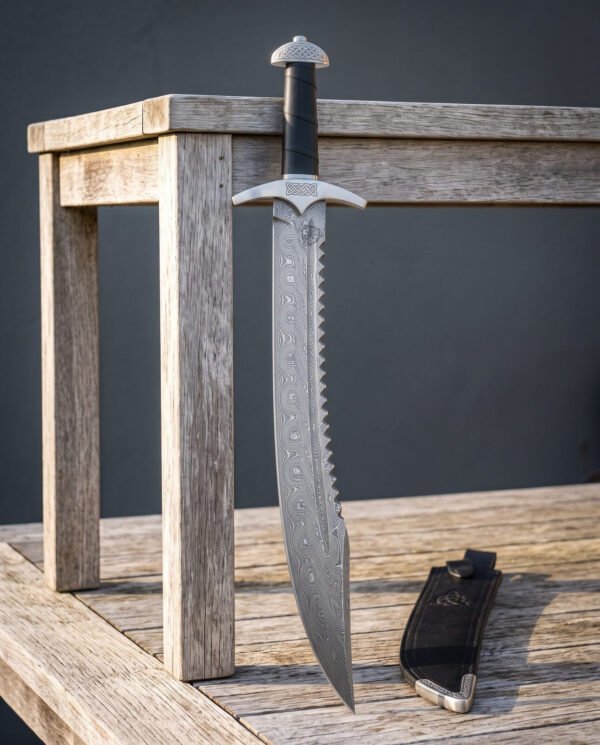
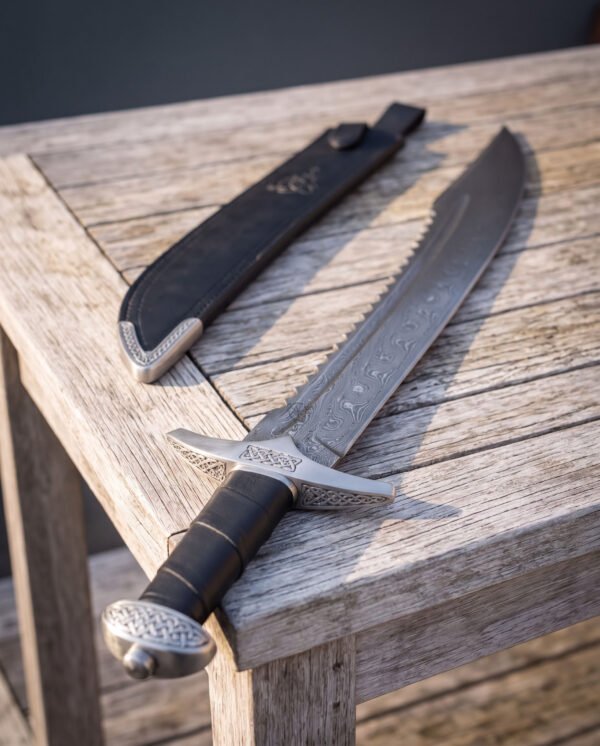
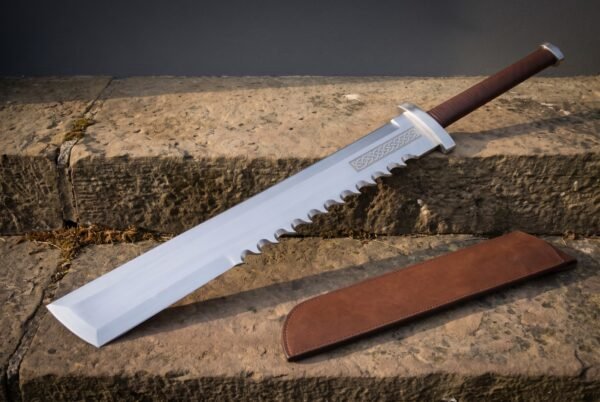
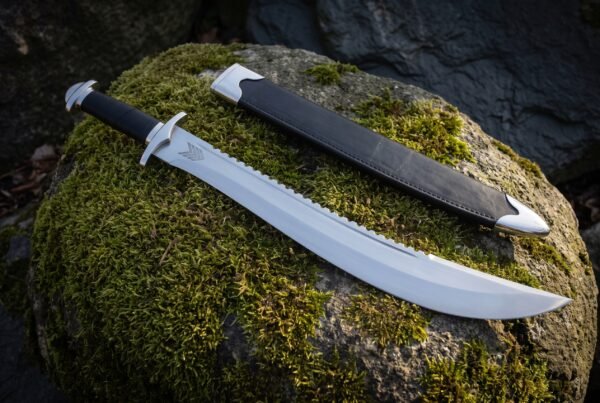
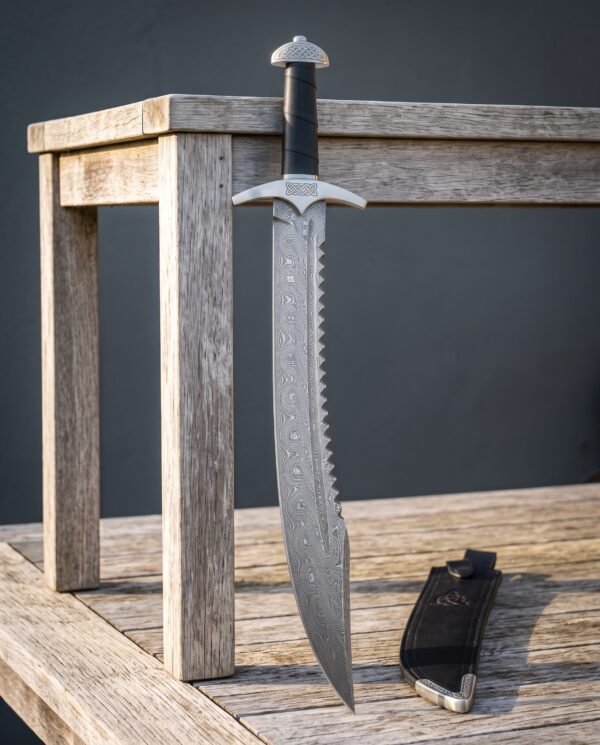
A working profile with saw teeth cut along the spine, 24 to 25 inches overall with 18 to 19 inch blades and listed weights of 1 lb 12 oz to 1 lb 14 oz. On the pieces here the main edge is sharpened and the saw teeth are left unsharpened, which the listings say plainly. The teeth are a visual feature on a display piece rather than a functioning wood saw, and nobody should expect otherwise.
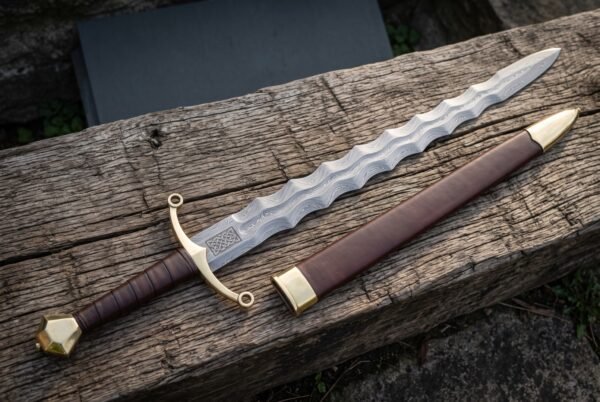
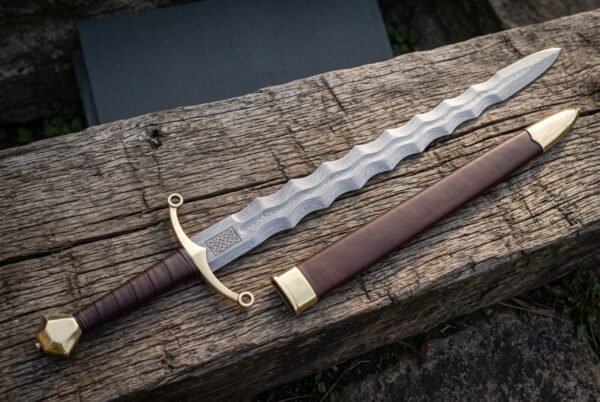
Flame bladed short swords
Undulating double edged blades in the flamberge tradition, about 27 to 28 inches overall with 20 to 21 inch blades, in both 1095 at 54 to 58 HRC and Damascus at 58 to 60 HRC. The waves were originally meant to catch and shiver against an opposing blade. Today they are the reason these pieces catch a room's attention on a wall, which is honestly why most people buy them.
Wakizashi and ninjato
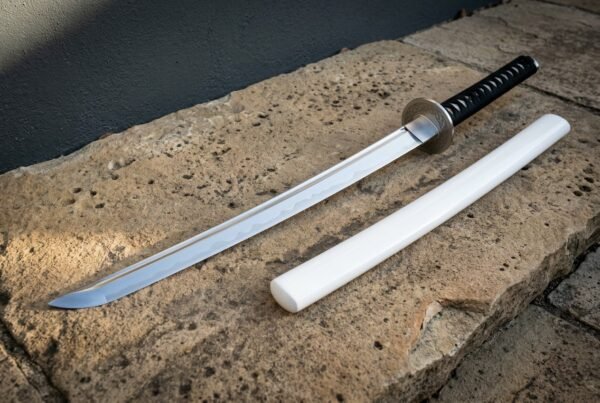
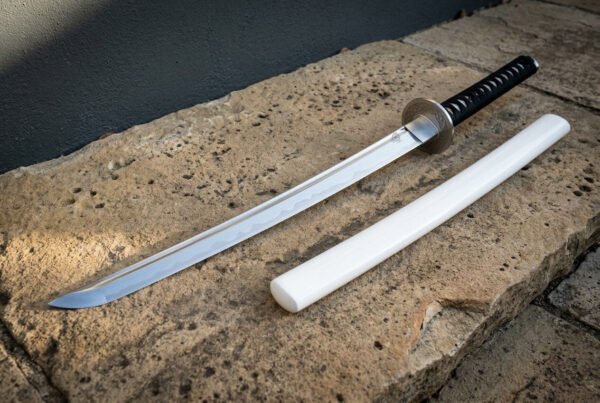
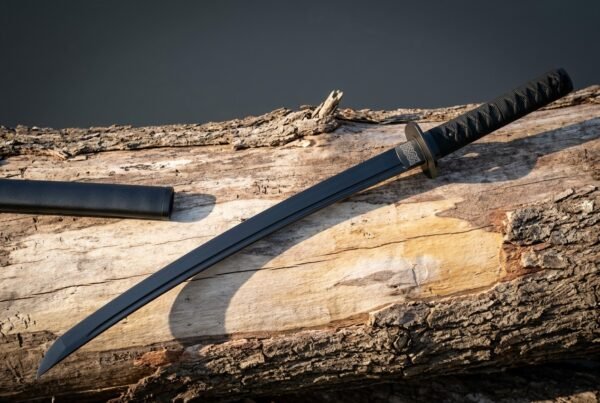
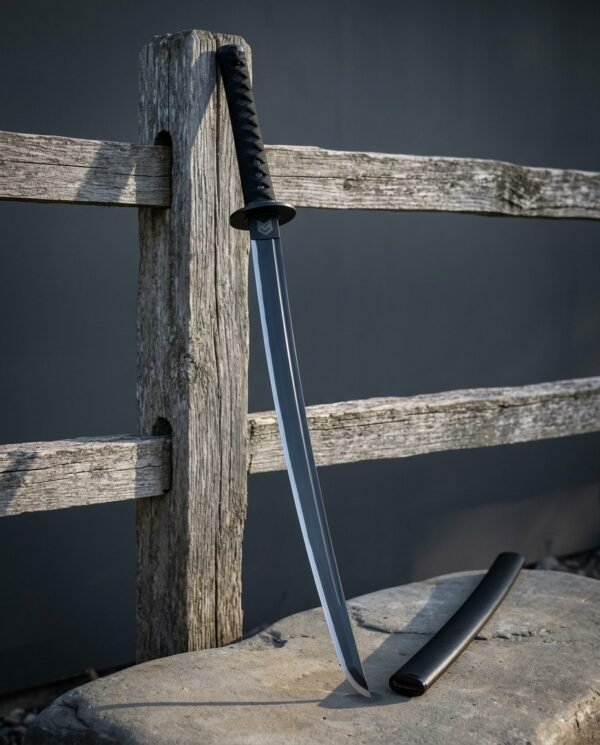
The Japanese short blades that share this page with their western cousins. Wakizashi here run 26 to 30 inches in the saya with 18 to 20 inches of blade measured from the habaki, at about 1 lb 14 oz to 1 lb 15 oz without the scabbard. The ninjato is a straight bladed piece around 35 inches overall. Both are covered in more depth on the Japanese sword page.
Renaissance side swords and cutlasses
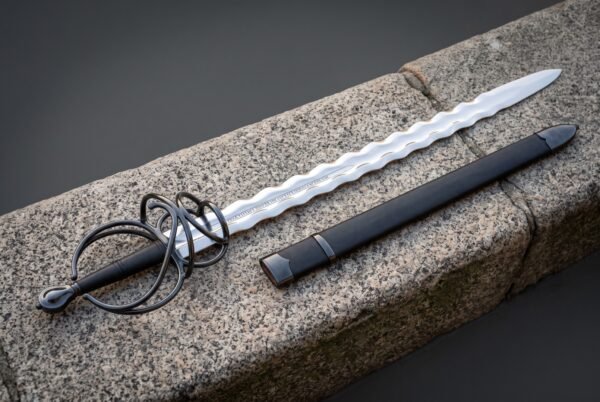
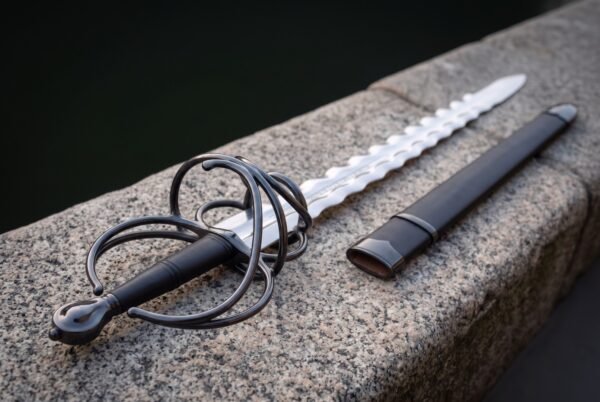
The long tail of the page. Side swords, espada ropera and fencing swords at 38 to 41 inches overall with 31 to 34 inch blades, with swept bars, wire wrapped grips and disc or ball pommels. Cutlasses at about 30 inches with a heavy curved blade and a knuckle bow. These are one handed like everything else here, but they are long enough to need a wall rather than a shelf.
Lengths, weights and steel across the range
Every figure below comes from the specification panel or the title of a product on this page. Nothing is estimated, and a blank is shown as not listed rather than filled in.
| Piece | Overall length | Blade length | Steel per the listing | Bare weight | Note |
|---|---|---|---|---|---|
| Legionfold Damascus gladius | About 26 in | About 19 in | Damascus | Not listed | Leaf profile with a long triangular point |
| Leafwarden Roman gladius | 28 in | 21 in | High carbon | Not listed | Roman leaf blade |
| Legionward Damascus gladius | About 27 in | About 20 in | 1095 and 15N20 Damascus | Not listed | Turned hardwood grip with a brass ferrule |
| Knotlobe Viking short sword | 26 in | 20 in | 1095 at 54 to 58 HRC | About 1 lb 14 oz | Black leather over a timber core |
| Trinelobe Damascus Viking short sword | 28 in | 22 in | Damascus | About 1 lb 15 oz | Sharpened on both edges |
| Trinecrown Viking short sword | 31 in | 25 in | 1095 high carbon | About 1 lb 15 oz | 4 in cream cord bound grip |
| Gildwolf hunting hanger | About 28 in | About 22 in | 1095 at 54 to 58 HRC | Not listed | Unsharpened display edge, rounded point |
| Brassflame flame blade short sword | About 27 in | About 20 in | Damascus at 58 to 60 HRC | Not listed | Double edged and undulating |
| Sawfeather sawback short sword | 24 in | 18 in | 1095 high carbon | About 1 lb 12 oz | Main edge sharpened, saw teeth left blunt |
| Shadowcurve wakizashi | 28 in in the saya | 19 in from the habaki | 1095 high carbon | About 1 lb 14 oz | Matching black saya |
Two measurements need care. Japanese blades are quoted from the habaki, the collar at the base, rather than from the guard, and the overall figure is usually given with the sword in its scabbard, so a wakizashi listed at 28 inches is shorter than a gladius listed at 28 inches. And a stated weight is bare in almost every case, so add a scabbard and a belt before you judge how it will hang.
Steel, hardness and the edge you get
Two steels are presented as a house standard across this site and no others. Plain 1095 is hardened to 54 to 58 HRC. Damascus of 1095 and 15N20 forge welded, folded and etched is hardened to 58 to 60 HRC. Where an older listing states a different grade in its own specification table, that table is the accurate answer for that piece.
On a blade this length the hardness question is less fraught than it is on a full sword. A 20 inch blade is a much shorter lever than a 32 inch blade, so it is under less stress in a bend, and the harder Damascus is a perfectly sensible choice here. Plain 1095 still sharpens faster and forgives more on a stone, and it is the better pick if the piece will be handled often.
Read the edge line on the product page. Some short swords here are listed as sharpened on both edges or sharpened and ready to use. Some carry an unsharpened display edge with a rounded point. The sawback pieces sharpen the main edge and leave the teeth blunt. Where no edge line appears, assume a display grind. A blunt 25 inch bar of hardened steel is still perfectly capable of breaking a bone, so treat all of them as sharp around other people.
Hilts, guards, scabbards and care
Grips are leather, cord or turned hardwood over a shaped core, sometimes with wire rings or raised bands to stop the hand sliding, sometimes ribbed under the wrap. Guards run from the plain straight bar of the Norse pieces through pierced brass shells to the swept bars and basket cages of the Renaissance swords. Pommels are steel, brass or bronze, peened over the tang, which means the assembly is permanent and cannot be taken apart for cleaning.
How a short sword hangs matters more than it does on a long one. A 40 inch sword can only be worn on a belt at the hip, but a 26 inch blade will sit comfortably on a hip, across the back or high on the chest, which is why costume and living history buyers gravitate to this length. If you intend to wear rather than display, check the scabbard's suspension in the product photographs before you order, since a scabbard with a single fixed loop is limited to hip carry.
Most pieces here ship with a scabbard, and several of the Japanese blades come with a lacquered or leather covered saya. Keep the blade out of the scabbard in storage. Leather and lacquered timber both hold moisture against the steel, and a carbon blade left sheathed through a damp season comes out spotted.
Wipe the blade with a light oil, deal with fingerprints the same day, and keep the piece away from radiators and direct sun, which dries out leather wraps and shrinks timber cores. Grey patina on carbon steel is stable and harmless. Orange spotting lifts with fine abrasive and oil before it pits.
Every piece on this page is made by hand in the Czech Republic. Finished swords are imported into the United States, inspected by Ransack Viking in North Babylon, New York, and shipped from there, with engraving added after arrival. Two swords of the same name will differ slightly in grind and finish, because two people made them on two different days.
Browse related sword categories
- Roman gladius swords with leaf shaped blades
- Viking swords in the full single handed length
- Wakizashi, the Japanese companion blade
- Arming swords, the medieval single handed sword
- Longswords and hand and a half swords
- The full sword range across every period and shape
- Viking seax knives, where the short sword line begins
- Leather scabbards and replacement sheaths
Guides worth reading first
- The seax: from belt knife to langseax to short sword
- Seax and bowie compared, two big blades doing different jobs
- How to buy your first sword without wasting money
- Display sword or battle ready: what the terms actually mean
- Viking seax buyer's guide: history, types and what to look for
Frequently asked questions
What counts as a short sword?
Roughly a blade between 16 and 25 inches on a single handed hilt. Below that you are into langseax and large knife territory, above it into arming sword length. The pieces on this page mostly sit at 18 to 25 inches of blade with a 24 to 31 inch overall length.
Is a seax a short sword?
At the large end, yes in every way that matters. A broad langseax with a 13 inch single edged blade and a short sword with a 20 inch blade are the same idea at two sizes, and the Norse never drew a sharp line between them. The main difference is that a seax is single edged with a thick spine, while most short swords here are double edged.
How is a gladius different from a Viking short sword?
The gladius has a waisted leaf profile that narrows behind the shoulder and widens again before a long triangular point, built for a thrust in a shield line. The Norse short sword is broad and close to parallel with a wide fuller and a rounded point, built to cut. They are similar lengths doing opposite jobs.
Are these short swords sharp?
It varies by piece and the product page says which. Several are listed as sharpened on both edges or sharpened and ready to use. Others carry an unsharpened display edge with a rounded point. The sawback pieces sharpen the main edge and leave the teeth blunt.
How heavy is a short sword?
The listings here that state a weight run from about 1 lb 12 oz on a 24 inch sawback to about 1 lb 15 oz on a 31 inch Norse piece, bare. That is roughly half the weight of a full length sword, which is why a short sword can be worn and handled all day.
Which short sword should I buy first?
If you want a Norse or Viking display piece, take a 26 to 28 inch straight blade with a lobed pommel in 1095. If you want the Roman look, take a gladius at 26 to 28 inches. If the piece is a gift or the pattern is the point, take one of the Damascus versions of either.
Will these blades rust?
Yes. Both 1095 and the Damascus here are carbon steel, not stainless. Keep a light film of oil on the blade, wipe fingerprints off promptly, and store the sword out of its scabbard rather than sheathed, since leather and lacquered timber both hold damp against steel.
Where are these short swords made?
They are made by hand in the Czech Republic, then imported, inspected and shipped by Ransack Viking from North Babylon, New York, with engraving added in the United States after arrival.