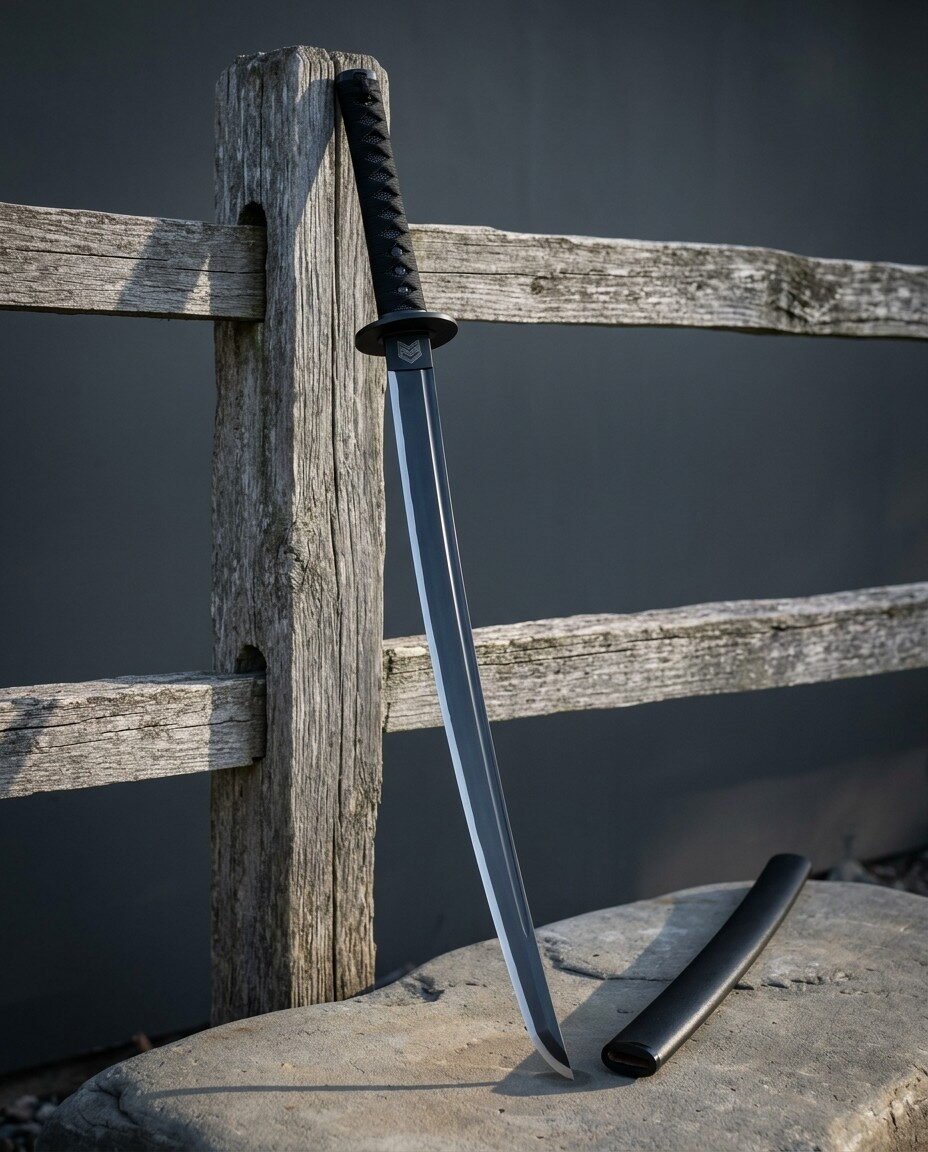
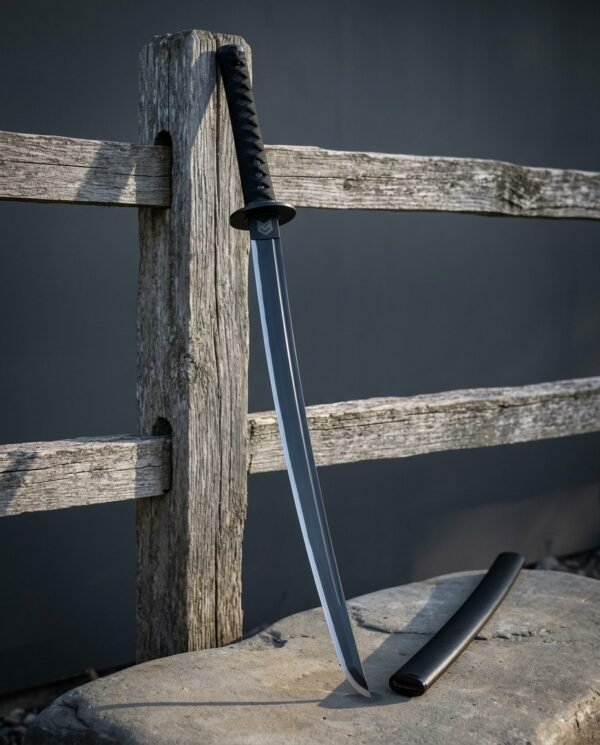
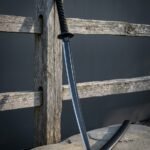
The Blackreed is a ninjato: a straight, single edged Japanese style sword with an angled chisel point, a square guard and a black cord wrapped tsuka. The blade is 1095 high carbon steel finished dark, with a bright ground edge bevel running the full length so the cutting edge stands out against the blackened flat. The square tsuba carries a chiselled chevron motif. It comes with a plain black saya.
Here is the honest history, because it is more interesting than the marketing version. There is no archaeological or documentary evidence that historical shinobi carried a distinctive straight sword. The straight bladed ninjato as a recognised object is a twentieth century creation, popularised by post war martial arts schools and then cemented by film. What is real, and much older, is the chokuto: the straight, single edged sword that was the standard Japanese blade through the Kofun and Nara periods, before smiths began quench hardening only the edge. That differential hardening is what makes a Japanese blade curve, because the hardened edge expands more than the softer spine and bows the blade as it cools. The curved tachi and later katana came out of that discovery. A straight Japanese blade is not a fantasy shape. It is simply an older one. This sword is forged and finished in the Czech Republic.
Specifications
| Blade | 1095 high carbon steel, hardened to 54 to 58 HRC |
|---|
| Blade profile | Straight single edged with an angled chisel point |
|---|
| Blade length | Approximately 24 inches |
|---|
| Overall length | Approximately 35 inches |
|---|
| Finish | Blackened flats with a bright ground edge bevel |
|---|
| Guard | Square steel tsuba with a chiselled chevron motif |
|---|
| Handle | Black cord wrapped tsuka over a shaped core |
|---|
| Saya | Plain black scabbard |
|---|
| Included | Sword and saya |
|---|
| SKU | RK-1876 |
|---|
Why a square guard and a straight blade change the sword
The round tsuba on a katana is not just decoration. It is a counterweight and a hand stop on a sword built around drawing and cutting in the same motion. A square tsuba does the same job but gives you flat faces, and that is the practical reason the shape shows up on ninjato: flat edges register against the hand and against a wall or a belt in a way a circle does not, so you always know where the edge is pointing without looking.
The straight blade changes the cut. A curved blade slices, because the point of contact travels along the edge as the sword moves and turns a chop into a draw cut almost automatically. A straight blade does not do that for you, so the cut has to be pulled or pushed deliberately. In exchange you get a blade that thrusts far better than a curved one, since the point sits directly in line with the grip, and one that is quicker to draw from a tight scabbard because there is no arc to clear. The angled chisel point is the same logic taken further: it puts a great deal of steel behind a very small area.
The steel and the blackened finish
The blade is 1095 high carbon steel, hardened to 54 to 58 HRC. On a sword length blade that range is the right compromise. Harder steel holds an edge longer but a long blade needs to survive being knocked, dropped and levered, and toughness is worth more than the last few points of edge retention.
The dark surface is a blackened finish over the flats, with the edge bevel ground bright afterwards so the two contrast. Blackening on steel is a surface treatment rather than a paint layer, and it does something useful beyond looking good: it slows the start of rust by giving the steel a stable oxide skin rather than raw bright metal. It does not make the blade rustproof. It is not stainless, and it still needs oil.
Engraving, runes and your own design
Use the rune converter on this page to turn a name, a date or a short phrase into Elder Futhark and we will cut it into the steel, the leather or the wood. If you would rather have a Viking pattern than a rune line, choose your own design in the engraving option above the add to cart button and tell us where it goes. Where a piece already carries an engraved design, your chosen engraving replaces it rather than sitting alongside it. On this sword the flat of the blade near the guard takes engraving well, and engraved lines cut through the blackening to bright steel underneath, which gives very high contrast. See the engraving page.
Handling and balance
Because there is no curve, this sword points where the grip points, and people used to a katana notice that immediately. The balance sits forward of the guard but not far, since a straight blade of this length carries less steel out toward the tip than a broad curved one. Two hands fit the tsuka comfortably with a gap between them, which is the standard Japanese grip and the one that gives you control of the edge.
This is a sharp sword sold as a collector and display piece. It is not a training weapon. Do not use it for partner drills, contact work or any kind of sparring. If you want something for practice, use a bokken or a blunt iaito made for the purpose.
Care
Wipe the blade after handling and keep a light film of oil on it. Traditional choji oil works well and so does plain mineral oil. Be gentle with the blackened flats: do not scrub them with abrasive pads or metal polish, because the finish is a surface layer and abrasive cleaning will cut straight through it and leave bright patches. The bright edge bevel is the part that will spot first, so it is the part to keep oiled. Do not store the sword in the saya for months at a time. Our steel care page covers what to do if rust appears.
Made in the Czech Republic
The work behind this piece happens in a Czech Republic workshop that has kept to the old methods. Steel is forged and heat treated by hand, the grind is taken down by eye rather than by machine, and the handle, fittings and sheath are cut and finished one at a time. Because of that, every piece carries small marks of the hand that made it.
Ransack Viking is a United States company. We import direct, check each piece when it reaches us, and ship from our Memphis, Tennessee warehouse. Engraving is added here in the United States after arrival, so the piece you receive is finished to your order.
A note on handmade variation
This is hand made, not machine made or bulk produced, so what arrives will not be a pixel for pixel copy of the photograph. Blackening is a chemical finish and it takes slightly differently on every blade, so the depth and evenness of the dark surface varies. The cord wrap on the tsuka is done by hand, so the exact diamond spacing shifts a little. The chiselled motif on the tsuba is cut by hand. The dimensions, the material and the build are the same every time. The character is not.
Frequently asked questions
Is the blade sharp when it arrives
Yes, it arrives with a working edge. Tell us in the order notes if you want it left blunt for display or for a household with children and we will do that at no extra cost.
Is this a historically accurate ninja sword
No, and we would rather say so. The straight ninjato is a modern design with a real ancestor in the ancient chokuto, but there is no evidence historical shinobi carried a sword of this specific type. It is a good looking, well built straight sword, and that is what we sell it as.
Can I use it for training or cutting practice
No. This is a display and collector sword and it is not certified for partner training, sparring or contact work. Use purpose built training equipment for that.
Will the black finish scratch off
It can be scratched, like any surface finish, and abrasive polish will remove it. Normal handling and wiping will not. Small bright marks that appear over the years on the high points are normal wear.
Does the saya lock the sword in place
It is a friction fit at the mouth, which is the traditional arrangement, so the sword sits in firmly but there is no catch. Hold the saya when you draw and always draw the edge away from your body.
How long does it take to arrive
One to two weeks of processing while it is made, then free shipping within the US. If you need it by a set date, put that date in the order notes before ordering.
What is in the box
- Blackreed 1095 steel ninjato with blackened flats and bright edge bevel
- Plain black saya
- Care card for blackened carbon steel
- Lifetime warranty against defects in forging, grind, heat treat and fittings
- Forged and finished in the Czech Republic
Explore the range
See more in katana and Japanese swords, wakizashi and short swords, or read the guides on blade geometry and carbon steel care.








Reviews
There are no reviews yet