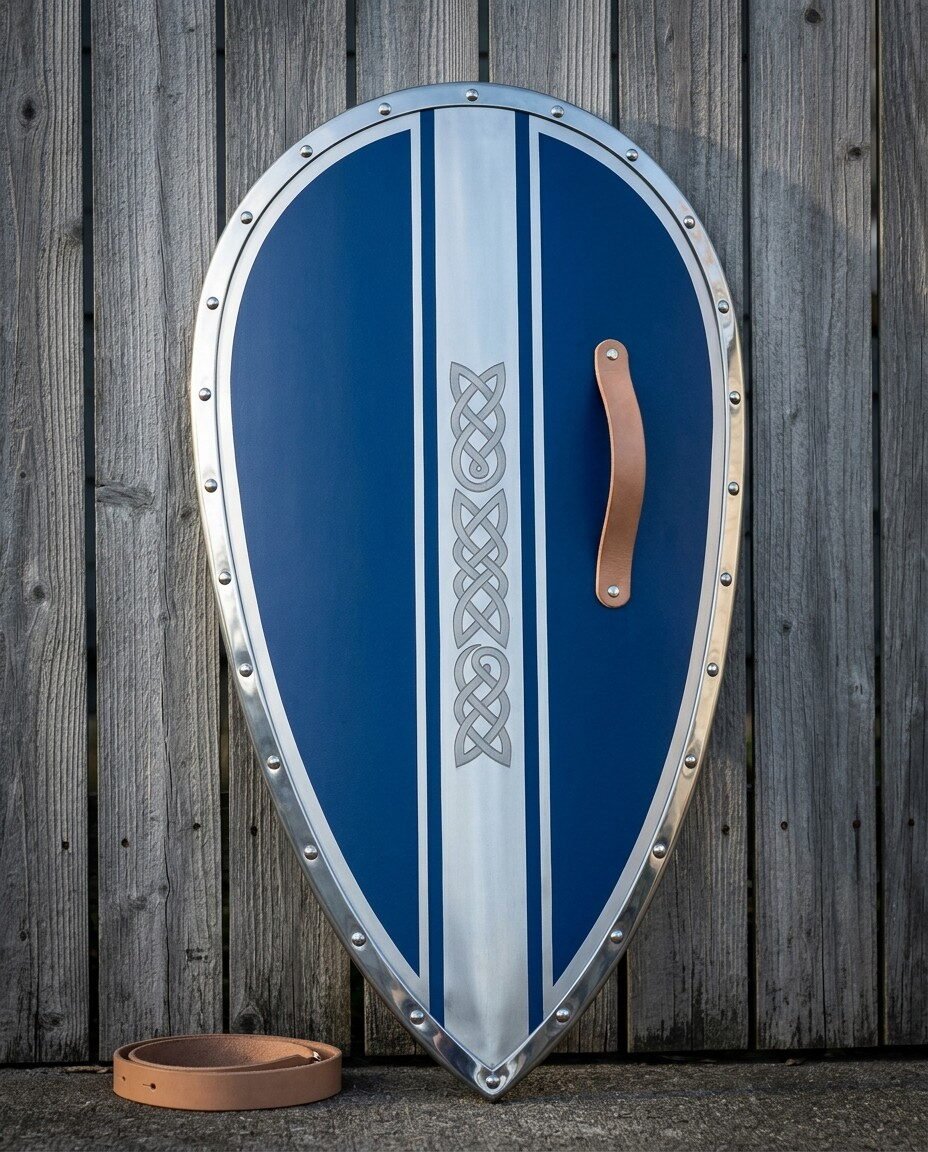
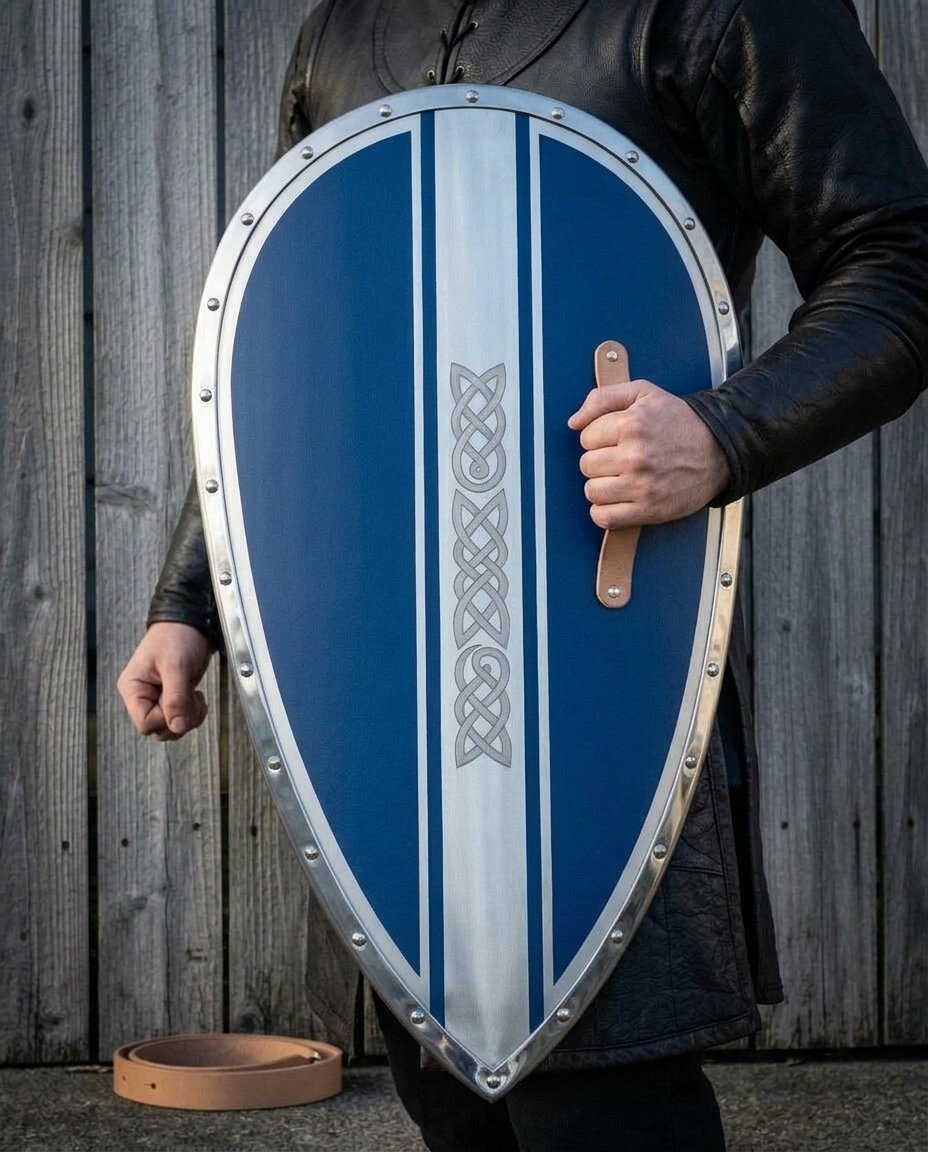
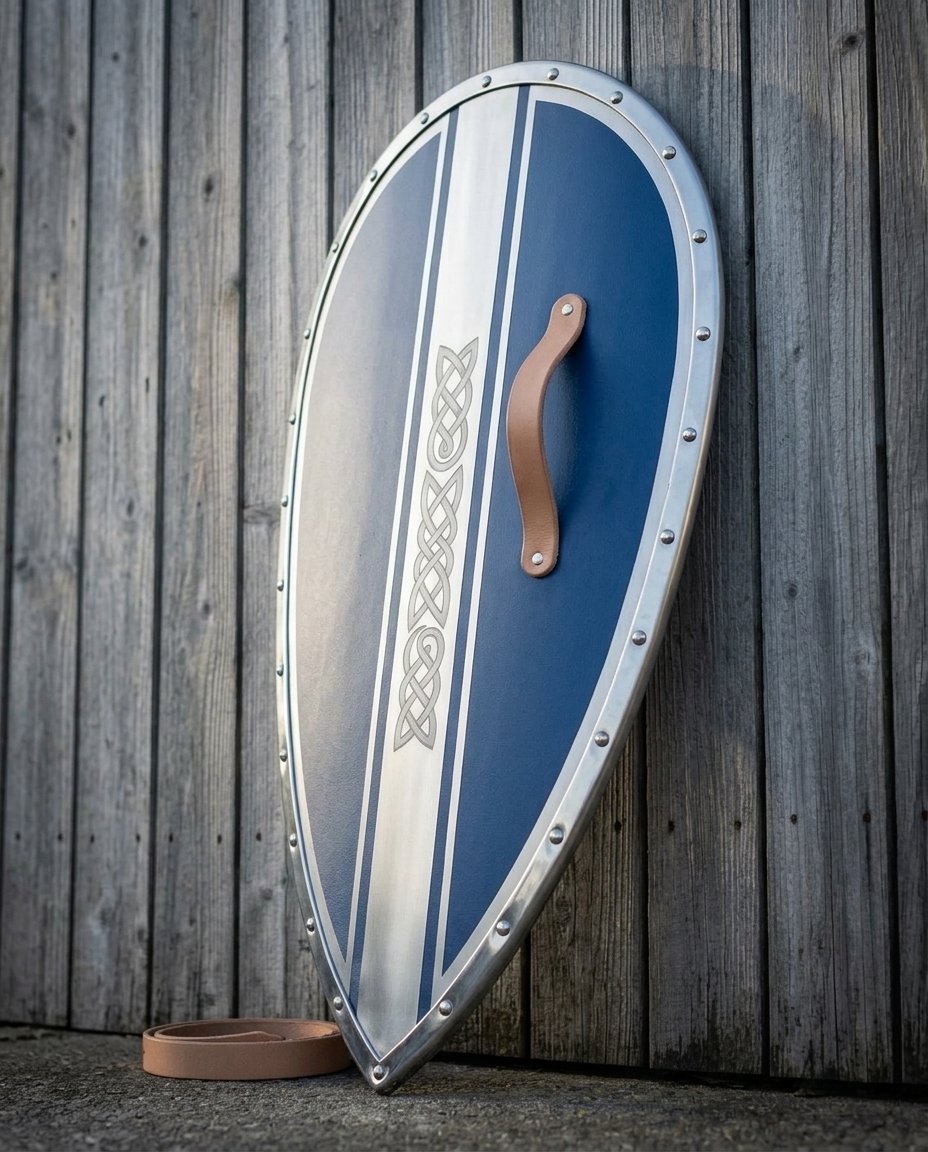
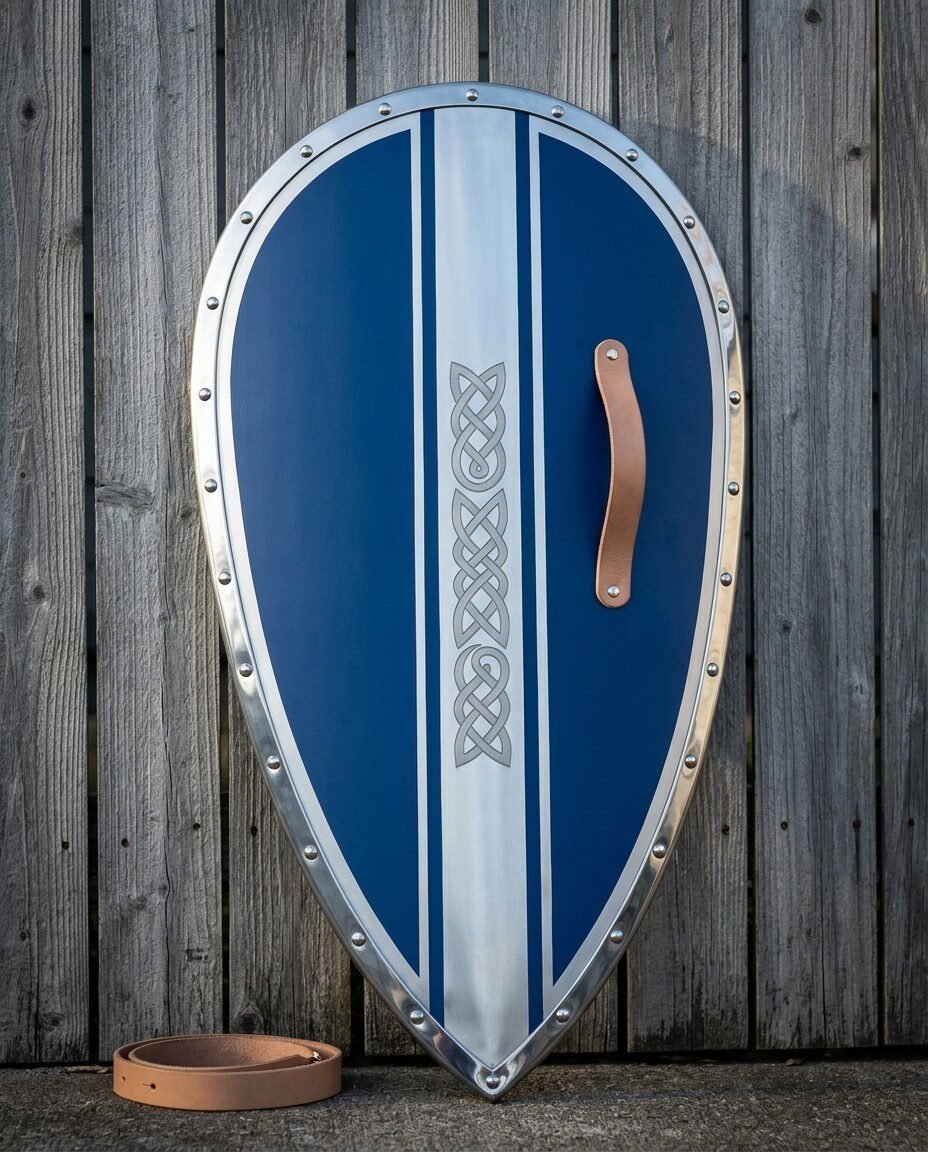
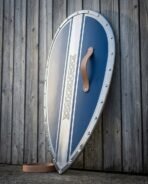
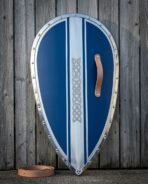
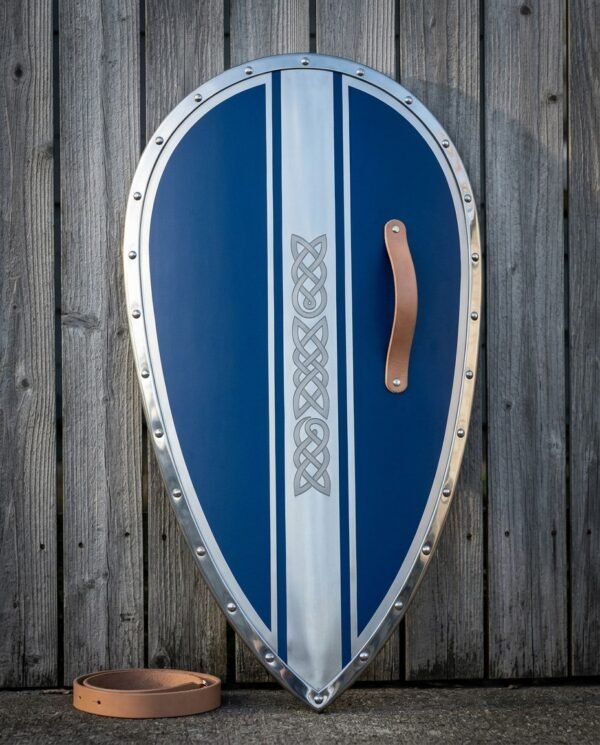
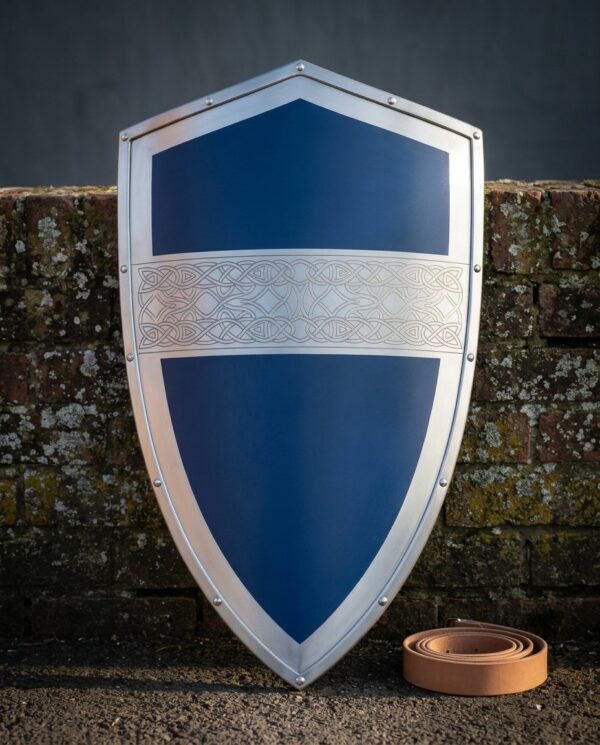
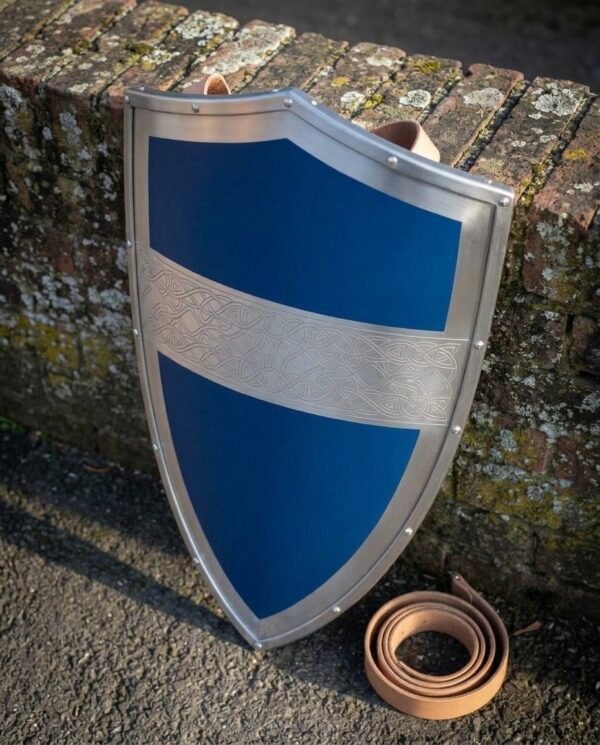
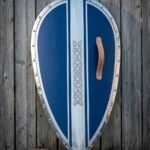
The Kiteward is a full size Norman kite shield: a long teardrop face, rounded across the top and drawn down to a point at the bottom, built over a shaped wooden core and bound all the way round with a riveted steel rim. The face is finished in deep blue either side of a bright polished steel centre band, with a narrow steel stripe either side of it, and a panel of Celtic knotwork is etched into the middle of that band. A tan leather grip strap is riveted to the face and a separate long leather guige strap is included.
The kite shape exists for one reason: the horse. Through the tenth and eleventh centuries the mounted warrior with a couched lance became the decisive arm in western Europe, and a rider has a problem a man on foot does not. His left leg hangs down the flank of the animal, exposed, and a round shield cannot cover it without becoming unmanageably large. Lengthening the bottom of the shield into a tail solved it. By 1066 the type was everywhere, and the Bayeux Tapestry shows kite shields on both sides at Hastings, carried by mounted Normans and by English housecarls fighting on foot. As mail chausses and later plate leg harness improved through the twelfth century the tail stopped earning its keep, the bottom was cut back, and the kite became the heater shield. This one is made and finished in the Czech Republic.
The kite shape came in when men started fighting from horseback, and a round shield against a kite shield covers the change. Insular knotwork travelled with the Norse and came back changed, and the symbols guide covers the shapes that recur. The medieval helmets are the obvious thing to stand with it.
Specifications
| Type | Norman kite shield, full length teardrop profile |
|---|
| Overall height | Approximately 48 inches |
|---|
| Width | Approximately 30 inches at the widest point |
|---|
| Core | Shaped wooden core |
|---|
| Rim | Polished steel rim riveted around the full edge with domed rivets |
|---|
| Face | Deep blue finish with a bright polished steel centre band flanked by two narrow steel stripes |
|---|
| Decoration | Celtic knotwork panel etched into the middle of the centre band |
|---|
| Grip | Tan leather grip strap riveted at each end |
|---|
| Included | Shield and separate long tan leather guige strap |
|---|
| SKU | RK-1875 |
|---|
Enarmes, guige and how a kite shield was actually carried
A Viking round shield is held one way: a single central grip behind a boss, with the fist closed around a bar and the hand sitting in the hollow of the boss. A kite shield is held completely differently, and it is the reason there is no boss on this one. The straps on the back are called enarmes. The forearm goes through one and the hand grips the other, so the shield is strapped to the arm rather than punched out on a fist. That costs you reach and the ability to bind an opponent’s blade with the rim, and it buys you the ability to hold a big shield steady all day and to keep it in place while your hand does something else, like holding reins.
The long strap supplied separately is the guige. It goes over the head and rests on the right shoulder so the shield hangs on the back on the march, and in a fight it takes some of the weight off the arm. On horseback it stops the shield swinging away when the rider drops his arm. Between the enarmes and the guige, a kite shield could be slung, shouldered or gripped without ever being put down, which is what made it practical to carry something this size.
Materials and build
The body is a shaped wooden core, which is what every historical shield of this family was: boards, not sheet metal. Wood absorbs and spreads a blow rather than transmitting it into the arm, and it is light enough to hold up. The edge is where shields fail, because that is where cuts land and where the boards want to split, so the rim here is steel, wrapped over the edge and riveted through with domed rivets at close intervals.
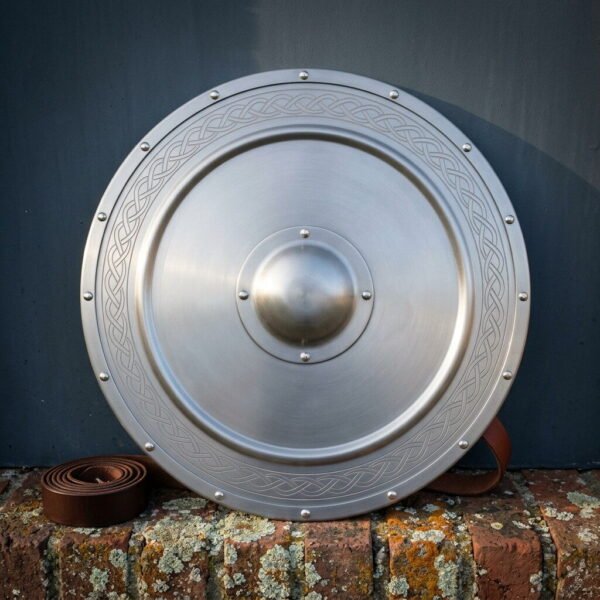
The face is finished in a deep blue either side of a bright polished steel centre band. The knotwork on the band is etched into the steel rather than printed onto it, so it sits below the surface and will not wear off with handling. Plain blue with a contrasting central stripe is a good historical choice for a shield of this date. Norman shields of the period were painted in flat blocks of strong colour with simple devices, well before the elaborate rules of later heraldry existed.
Engraving, runes and your own design
Use the rune converter on this page to turn a name, a date or a short phrase into Elder Futhark and we will cut it into the steel, the leather or the wood. If you would rather have a Viking pattern than a rune line, choose your own design in the engraving option above the add to cart button and tell us where it goes. Where a piece already carries an engraved design, your chosen engraving replaces it rather than sitting alongside it. On this shield the steel centre band is the obvious place, which means a rune line there takes the place of the knotwork panel. The leather guige will also take a short engraved line if you would rather keep the knotwork. See the engraving page.
Carrying it and hanging it
On the arm, set the enarmes so the forearm strap sits just below the elbow and the grip falls naturally into a closed hand. A kite shield wants to be carried slightly angled rather than flat, with the top edge just below eye level so you are looking over it and not through a gap. Adjust the guige so the shield hangs clear of the hip when it is slung.
On a wall, this is a large piece and it deserves a proper fixing. Hang it from the guige over a substantial hook fixed into a stud or a masonry anchor, or use two D rings and picture wire rated well above the weight. A steel rimmed shield of this size is heavy enough to pull a plasterboard fixing out of the wall. Keep it off damp exterior walls, because a wooden core and steel rim in a cold damp room will eventually show it.
Care
The steel rim and the polished centre band are bare steel, so they need the same treatment as any blade. Wipe them down with a dry cloth after handling and put a very light film of oil on the rim once or twice a year, buffing it off so it does not sit wet. Do not use abrasive metal polish on the etched band, because it will soften the crispness of the knotwork over time. Feed the leather grip and guige with a leather balm twice a year and let them dry naturally. The painted face wipes clean with a barely damp cloth and nothing else. Our steel care page covers rust spotting and removal.
Steel like this wants the same light oil that mail does, and caring for steel armour covers storage.
Made in the Czech Republic
Every piece we sell is made by hand in the Czech Republic. The smiths there work the way the trade has been worked for a long time, heating and hammering the steel, taking the bevels down by eye, and fitting the handle and the leather one at a time. There is no automated line anywhere in it, so small differences from one piece to the next are normal and expected.
Ransack Viking is a United States company based in Chicago, Illinois. We bring the pieces in ourselves, inspect them on arrival and ship them from our own warehouse. If you add engraving, that is carried out here in the United States before your order goes out.
A note on handmade variation
This is hand made, not machine made or bulk produced, so what arrives will not be a pixel for pixel copy of the photograph. The rivets are set by hand, so their spacing round the rim varies a little. The wooden core is a natural material, so its grain and the way it takes the finish differ from shield to shield. The blue tone can shift slightly between batches, and the leather of the grip and guige varies in colour and grain because it comes from hides that were never identical. The dimensions, the material and the build are the same every time. The character is not.
Frequently asked questions
Is this usable or display only
It is a real strapped shield on a wooden core with a riveted steel rim, and it is built properly. We sell it as a display and reenactment presentation piece. We do not certify it for full contact combat, and organised reenactment groups have their own construction and safety standards you should check first.
How heavy is it
Heavy enough that you will notice it. A full length kite shield with a steel rim is a two hand lift to hang and a real load on the arm. That is historically accurate. The guige exists precisely because nobody wanted to carry this on the arm all day.
Does the guige strap come attached
The guige is supplied with the shield as a separate strap so you can set the length for your own height and shoulder before fitting it. Everything you need is in the box.
Can I have a different colour
The blue and steel finish shown is the standard build. If you want a different ground colour or a device on the face, contact us before ordering and we will tell you honestly what is possible and what it costs.
Will the knotwork wear off
No. It is etched into the steel band, not printed on top of it, so handling and cleaning will not remove it. Only heavy abrasive polishing would soften it.
How long until it arrives
One to two weeks of processing while it is built, then free US shipping. It travels in a large box because of its size. Tell us in the order notes if you have a date to hit.
What is in the box
- Kiteward Norman kite shield with riveted steel rim and etched knotwork band
- Long leather guige strap
- Care card for bare steel, painted finish and leather
- Lifetime warranty against defects in the build and the fittings
- Made and finished in the Czech Republic
Explore the range
See more in Viking shields, Viking armour and Viking home decor, or read the guides on shield construction and Norman kit.
Near neighbours in the shop
Sitting beside it in the catalogue is the Ringwall Viking shield. Another in the same line is the Cobaltward Viking shield. Next along the rack is the Ringward Viking shield.
Fitting out further, the Quarterfell buckler belongs with it. You can have this made your way instead on the design your own page.

Been eyeing this shield for months and it did not disappoint.