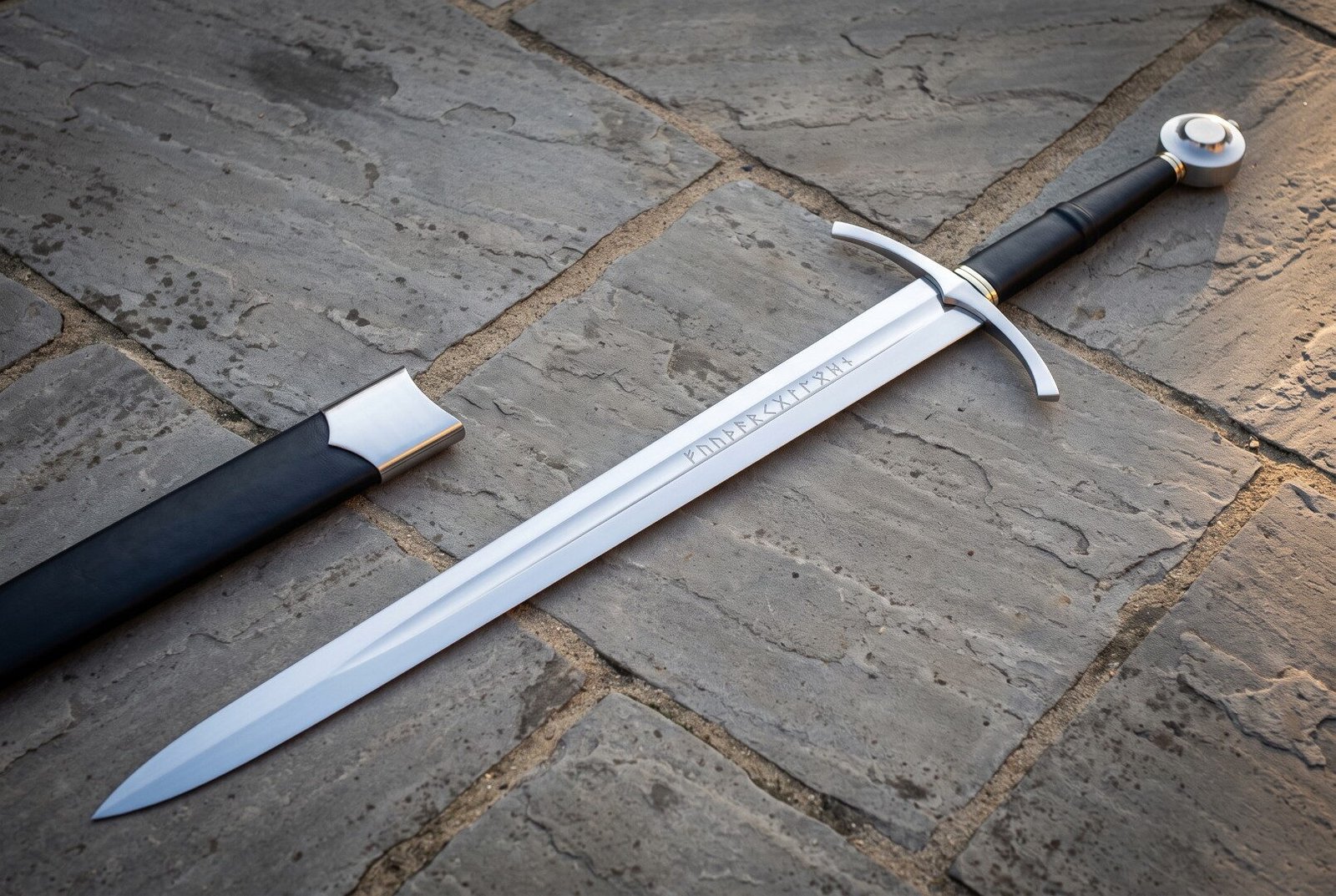
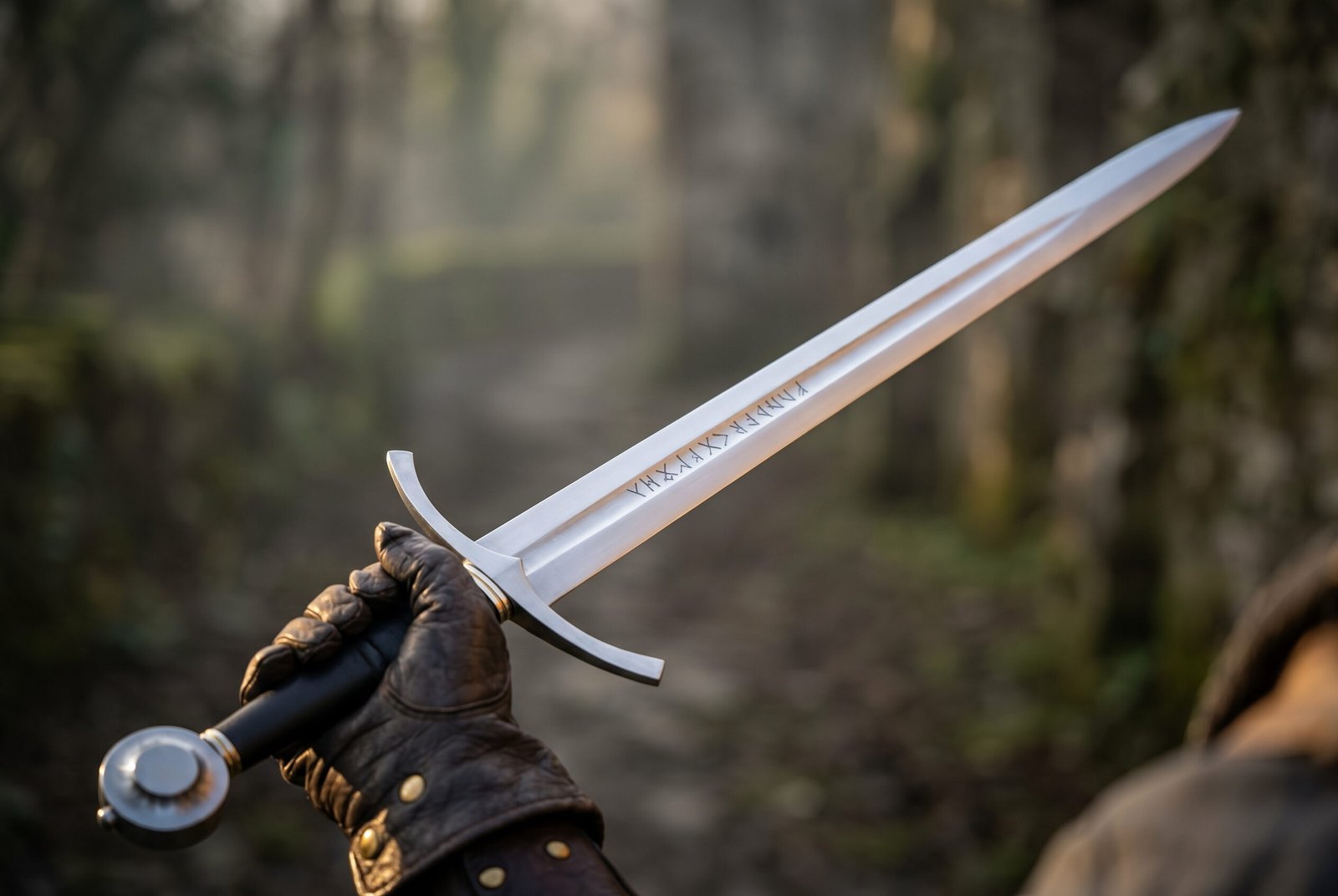
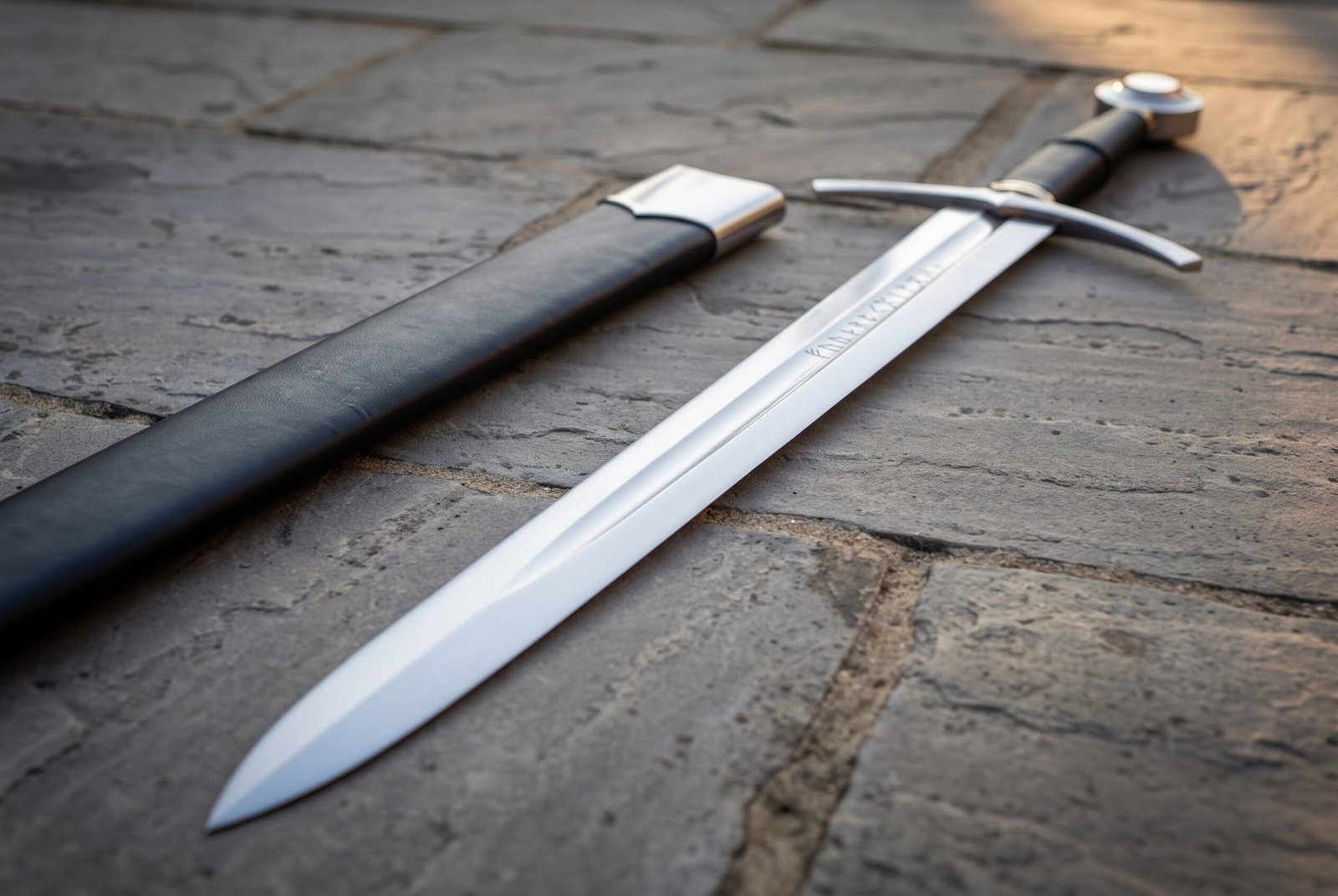
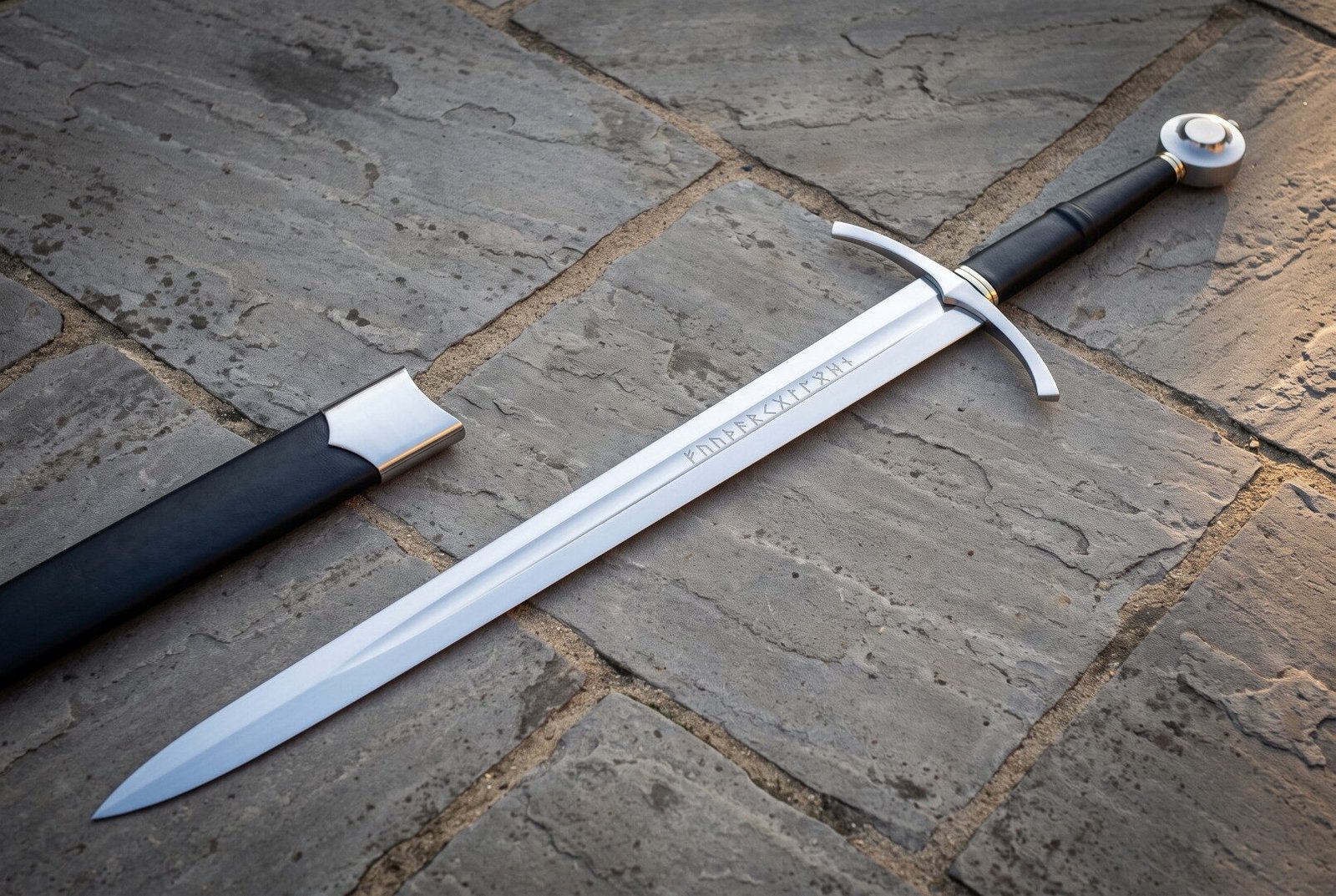
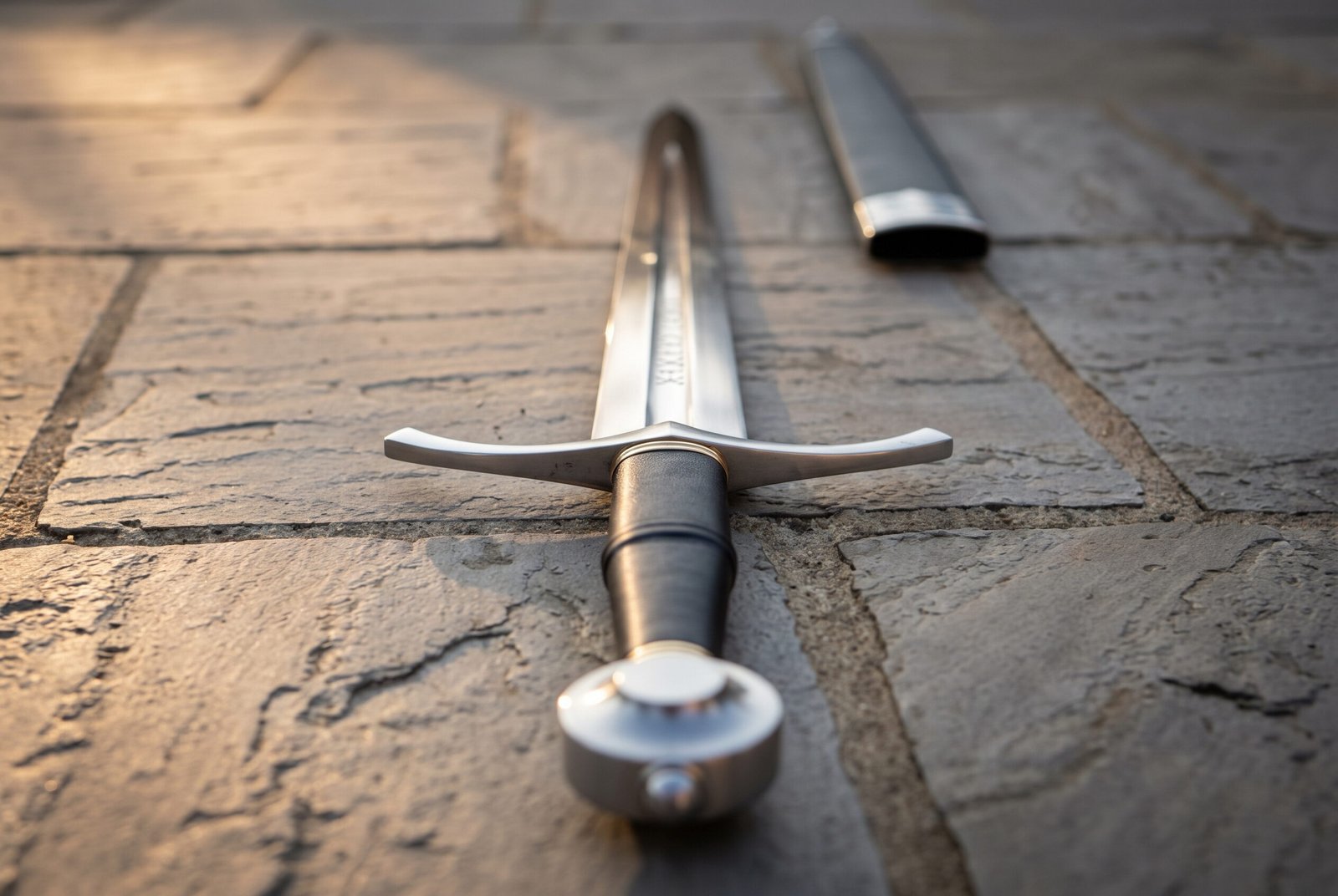
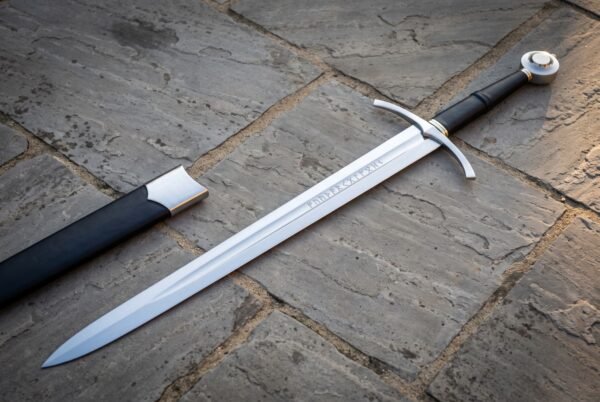
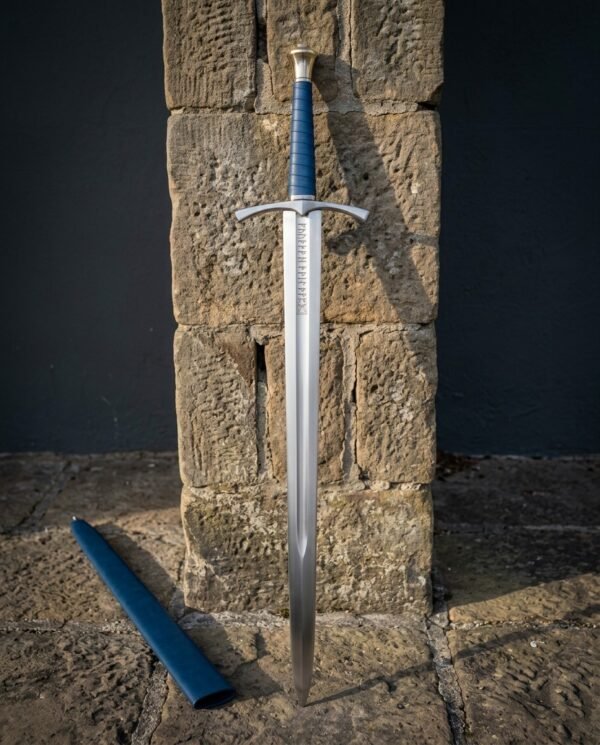
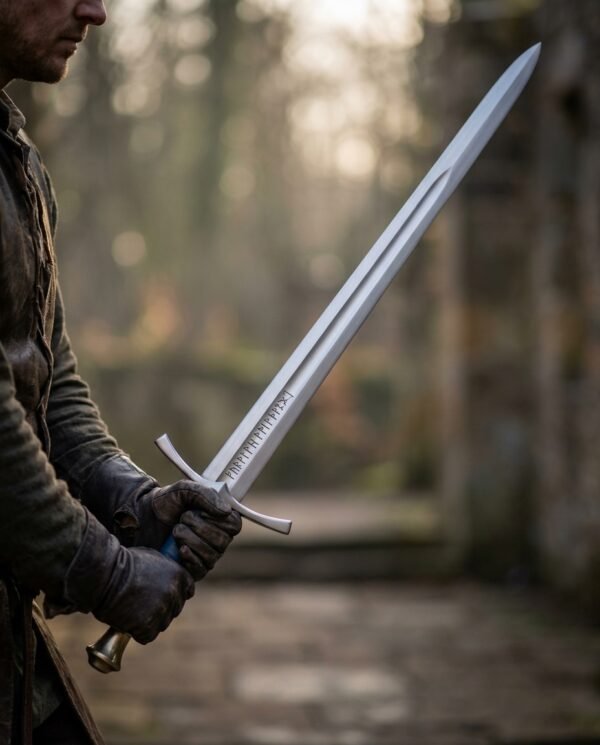
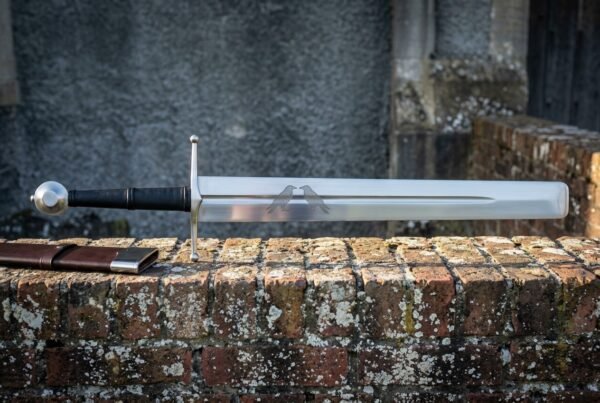
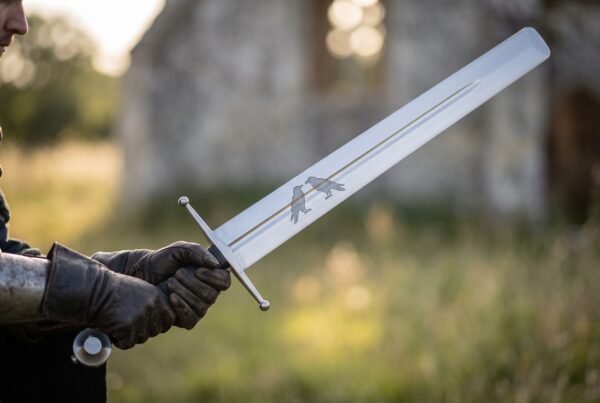
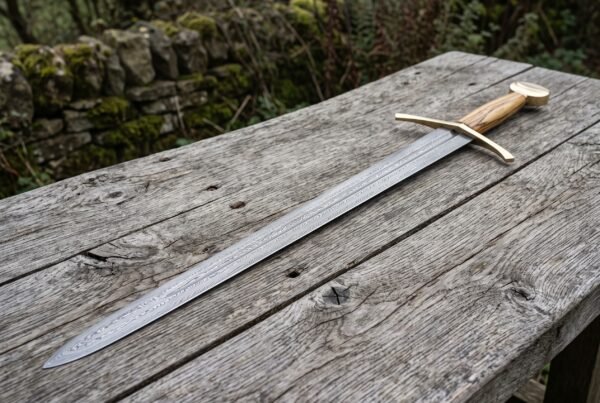
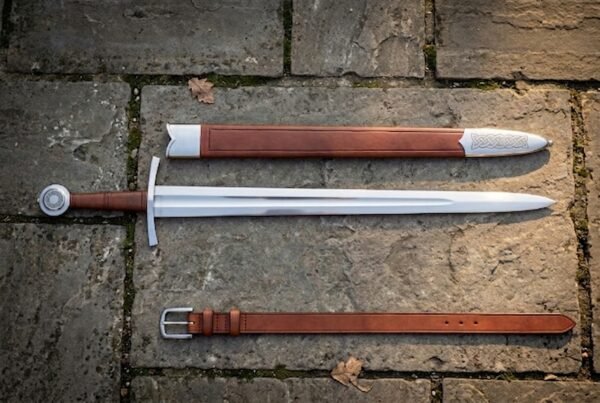
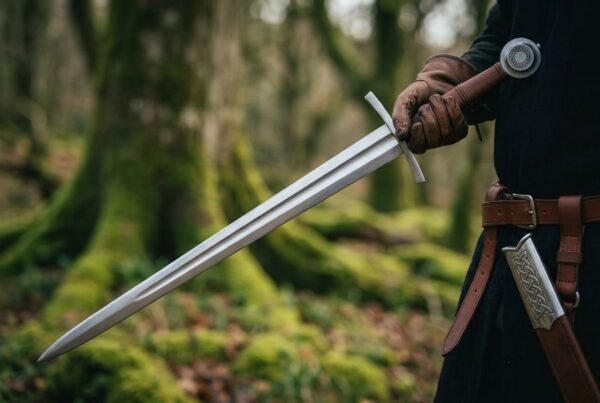
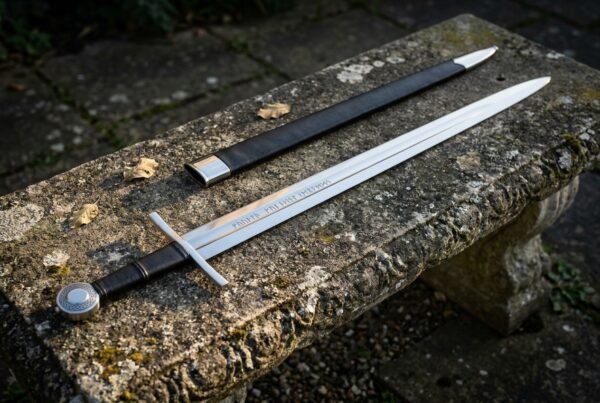
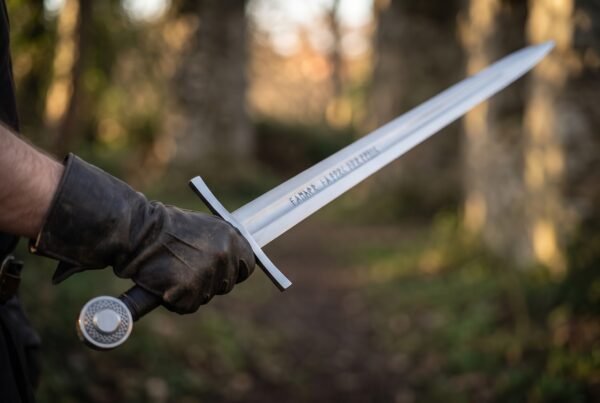
The Stonecleave is a knightly arming sword with a long slim blade, a shallow fuller running down the centre and a crossguard that curves forward toward the point. The grip is black leather over timber, the pommel is a steel wheel with a raised boss, and a short line of Elder Futhark runes is cut into the flat just below the guard. It ships in a black leather scabbard with a steel throat.
The curved guard is the detail worth noticing. Straight crossguards are the default from the eleventh century onward, but by the thirteenth and fourteenth a lot of surviving swords carry guards that bend toward the enemy, and the Oakeshott typology treats that curve as a real design decision rather than a flourish. A forward curved quillon catches an opposing blade sliding down your edge and stops it running onto your hand, and it also gives the fingers somewhere to hook when you grip over the guard. This one is forged and finished in the Czech Republic in 1095 high carbon steel, hand polished bright. It sits in the arming swords. The longswords cover the same ground from a different angle.
Specifications
| Material | 1095 high carbon steel blade, steel guard and pommel, leather over timber grip |
|---|
| Overall length | Approximately 38 in / 97 cm |
|---|
| Blade length | Approximately 31 in / 79 cm |
|---|
| Blade profile | Slim double edged blade with a shallow central fuller and an acute point |
|---|
| Hardness | 54 to 58 HRC |
|---|
| Finish | Hand polished bright, satin edges |
|---|
| Engraving | Short Elder Futhark rune line cut on the flat below the guard |
|---|
| Guard | Forward curved steel crossguard |
|---|
| Grip | Black leather over timber with a raised band at the middle |
|---|
| Spacers | Brass spacer at each end of the grip |
|---|
| Pommel | Steel wheel pommel with a raised central boss, peened tang |
|---|
| Scabbard | Black leather with a polished steel throat |
|---|
| Included | Sword and fitted leather scabbard |
|---|
| SKU | RK-1674 |
|---|
What the fuller is really for
The shallow groove running down the middle of this blade gets called a blood groove in films and that is nonsense. It is a fuller, and it is a stiffness trick borrowed from every other structure that has to be light and rigid at the same time. Removing metal from the centre of the flat, where the steel contributes least to resisting a bend, leaves an I beam section. The blade keeps almost all of its stiffness and loses a useful slice of its weight.
You can feel it in the hand. A sword this long with a solid flat section would be nose heavy and slow. Fullered, it comes up on line quickly and stops where you put it. The fuller is forged and ground in rather than milled, so it runs slightly wider at the shoulder and narrows toward the point, following the distal taper of the blade instead of cutting straight through it.
The other thing a fuller does is give an engraver somewhere to work. Historical blades carry maker names, crosses and inscriptions in the fuller precisely because it is the flattest and best protected part of the blade. On this sword the rune line sits just above the fuller on the wide flat, where it stays legible and out of the way of the edge.
The steel and the fittings
The blade is 1095, a plain high carbon steel with roughly one percent carbon and very little else. There is nothing exotic in it and that is the point. It is the steel a village smith would recognise, it forges predictably, it takes a fine edge and it responds honestly to heat treatment. This one is normalised, quenched and tempered to 54 to 58 HRC, which is where a long blade wants to sit. That range keeps the sword tough through the length so the point can flex and come back rather than snapping.
Because there is no nickel bearing layer in it, 1095 polishes to an even bright finish rather than showing a pattern. What you are looking at on this blade is the surface of the steel itself, taken up through the grits and finished by hand. It is not stainless. Bare 1095 will rust if it is left wet or handled and put away, and it needs the same wipe and oil routine any carbon blade does.
The crossguard and the wheel pommel are steel, and the tang is peened over the pommel so the assembly is mechanically locked rather than relying on glue or a nut. The grip is leather over a shaped timber core with a raised band at the middle and a brass spacer at each end. The scabbard is leather over a fitted core with a polished steel throat, shaped to hold the blade rather than let it rattle.
Engraving, runes and your own design
Use the rune converter on this page to turn a name, a date or a short phrase into Elder Futhark and we will cut it into the steel, the leather or the wood. If you would rather have a Viking pattern than a rune line, choose your own design in the engraving option above the add to cart button and tell us where it goes. Where a piece already carries an engraved design, your chosen engraving replaces it rather than sitting alongside it, so on this sword your line takes the place of the runes below the guard. Full details are on the engraving page.
Handling and balance
An arming sword of this length is a one handed sword that expects a shield or a buckler in the other hand. The balance sits a few inches ahead of the guard, close enough to the hand that the sword changes direction without arguing and far enough forward that a cut carries weight into the target.
Hold it with the heel of the hand under the pommel rather than jammed against the guard. The wheel pommel is a counterweight and it only works if the hand is behind it. The forward curved quillons give you something to index against with the thumb and forefinger, which makes it easy to know where the edge is pointing without looking at it.
The sword arrives sharp. It is a display, collecting and light cutting sword. It is not built for edge to edge sparring or full contact reenactment and we do not sell it for that.
Care
Wipe the blade down after handling and give it a thin coat of oil before it goes back in the scabbard. Bright polished 1095 shows every fingerprint and will start to grey where one has sat for a week, so a soft cloth and a little mineral oil live with the sword. Do not store it sheathed for long periods in a damp room. Vegetable tanned leather holds moisture and will hold it against your blade.
Take any rust spot off with oil and a fine synthetic pad, going along the length rather than across it, and re-oil straight after. Feed the leather grip and scabbard with a balm once or twice a year, and keep both out of long direct sun so the black does not fade. The steel throat and pommel want nothing more than a dry cloth. Fuller guidance is in steel care.
Made in the Czech Republic
Every piece we sell is made by hand in the Czech Republic. The smiths there work the way the trade has been worked for a long time, heating and hammering the steel, taking the bevels down by eye, and fitting the handle and the leather one at a time. There is no automated line anywhere in it, so small differences from one piece to the next are normal and expected.
Ransack Viking is a United States company based in Chicago, Illinois. We bring the pieces in ourselves, inspect them on arrival and ship them from our own warehouse. If you add engraving, that is carried out here in the United States before your order goes out.
A note on handmade variation
This is hand made rather than machine made or bulk produced, so what arrives will not be a pixel for pixel copy of the photograph. Hand polishing leaves its own faint direction in the finish, the fuller wanders a fraction because it is forged in by eye, the leather takes dye differently from hide to hide and the timber under the grip has its own grain. The dimensions, the steel, the hardness and the build are the same every time. The character is not. We go further into it in how steel and hardness actually work, and pick it up again in the steel glossary.
Frequently asked questions
Is it sharp out of the box
Yes. Both edges arrive with a working edge and the point is fully formed. Store it out of reach of children.
Why is the blade plain rather than patterned
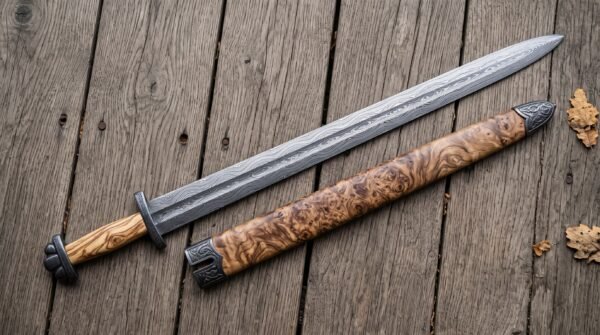
Because it is 1095 high carbon steel rather than layered Damascus. A single steel has no contrast to etch, so it polishes to an even bright finish. If you want a pattern, look at our Damascus swords.
Can I put my own name on it in runes
Yes. The rune converter on this page will set a name or a date in Elder Futhark and we cut it in place of the line shown.
Is this suitable for reenactment fighting
No. It is a sharp collector and display sword and it is not built for edge to edge contact.
Will the polish stay bright
It will if you oil it. Bare high carbon steel greys where skin acid sits on it, so wipe it down and oil it after handling.
How long does shipping take
Processing is one to two weeks and shipping inside the United States is free. Engraved orders sit at the longer end of that window.
What is in the box
- Stonecleave arming sword in 1095 high carbon steel at 54 to 58 HRC
- Fitted black leather scabbard with a polished steel throat
- Care card for high carbon steel and vegetable tanned leather
- Lifetime warranty against defects in forging, grind, heat treat and fittings
- Forged and finished in the Czech Republic
Explore the range
See more in arming swords, swords, longswords and Norse arms, or read the guides.
Near neighbours in the shop
Sitting beside it in the catalogue is the Oathmark arming sword, 37 inches overall. Another in the same line is the Cloverhilt arming sword. Next along the rack is the Slatewick arming sword, 36 inches overall.
Fitting out further, the Gloomridge broadsword belongs with it. You can have this made your way instead on the custom Viking sword page.
Our HEMA line includes the Molgarth langes messer for drills and sparring, and our messer guide is the place to look next.


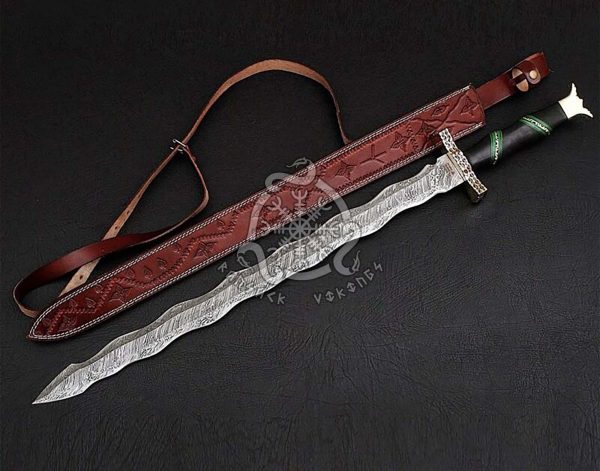
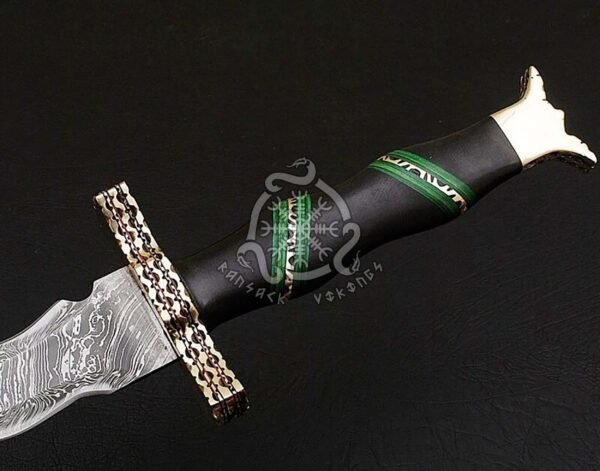
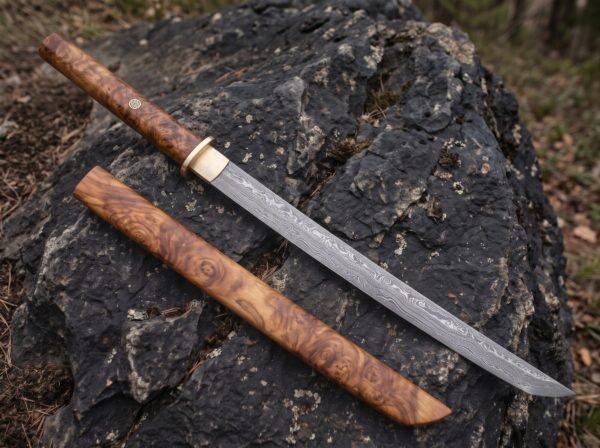
Knew this sword was special the second I opened the box. Leather sheath is thick and well stitched. Not the cheap stuff you usually get. Ransack Viking is quickly becoming my go to shop for anything Norse themed. Highly recommend this one.