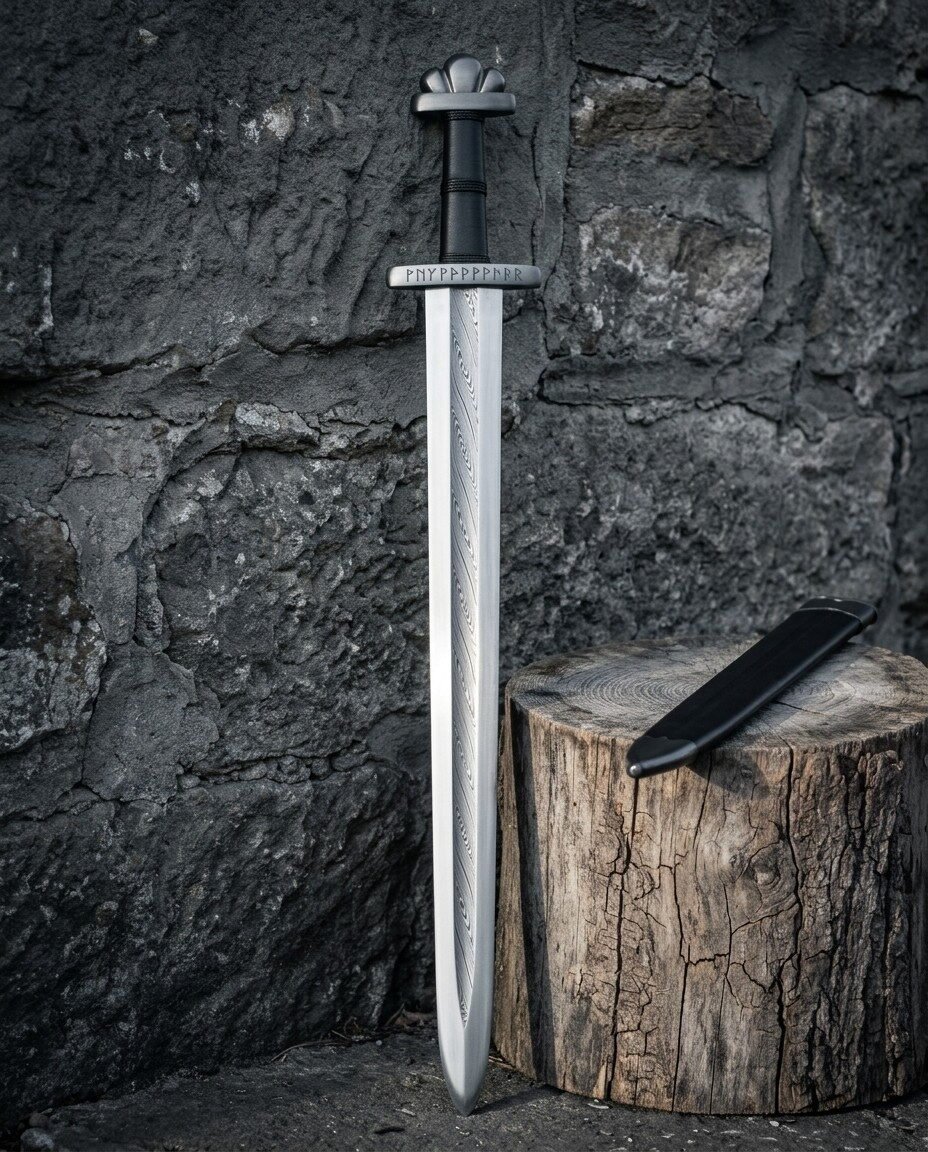
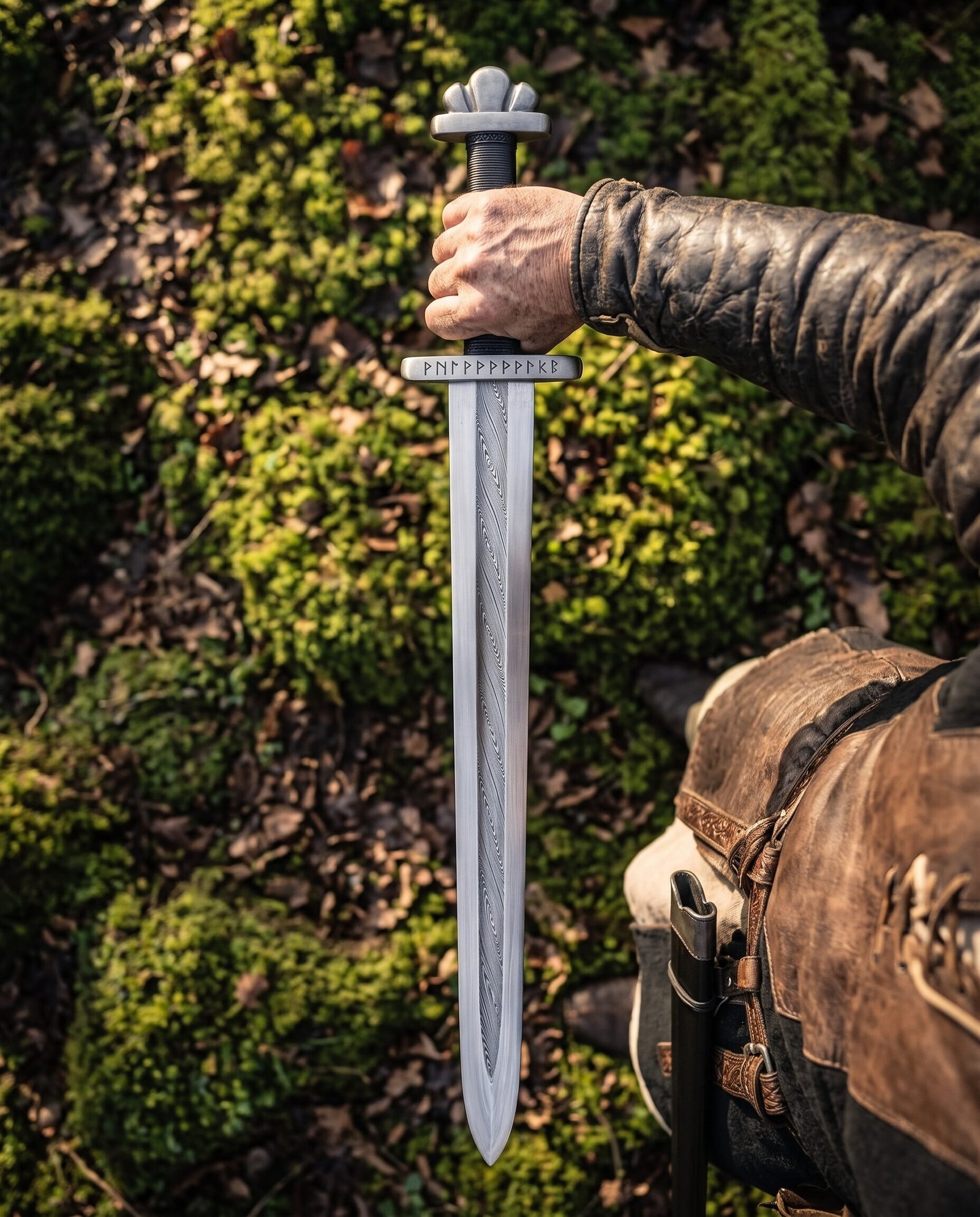
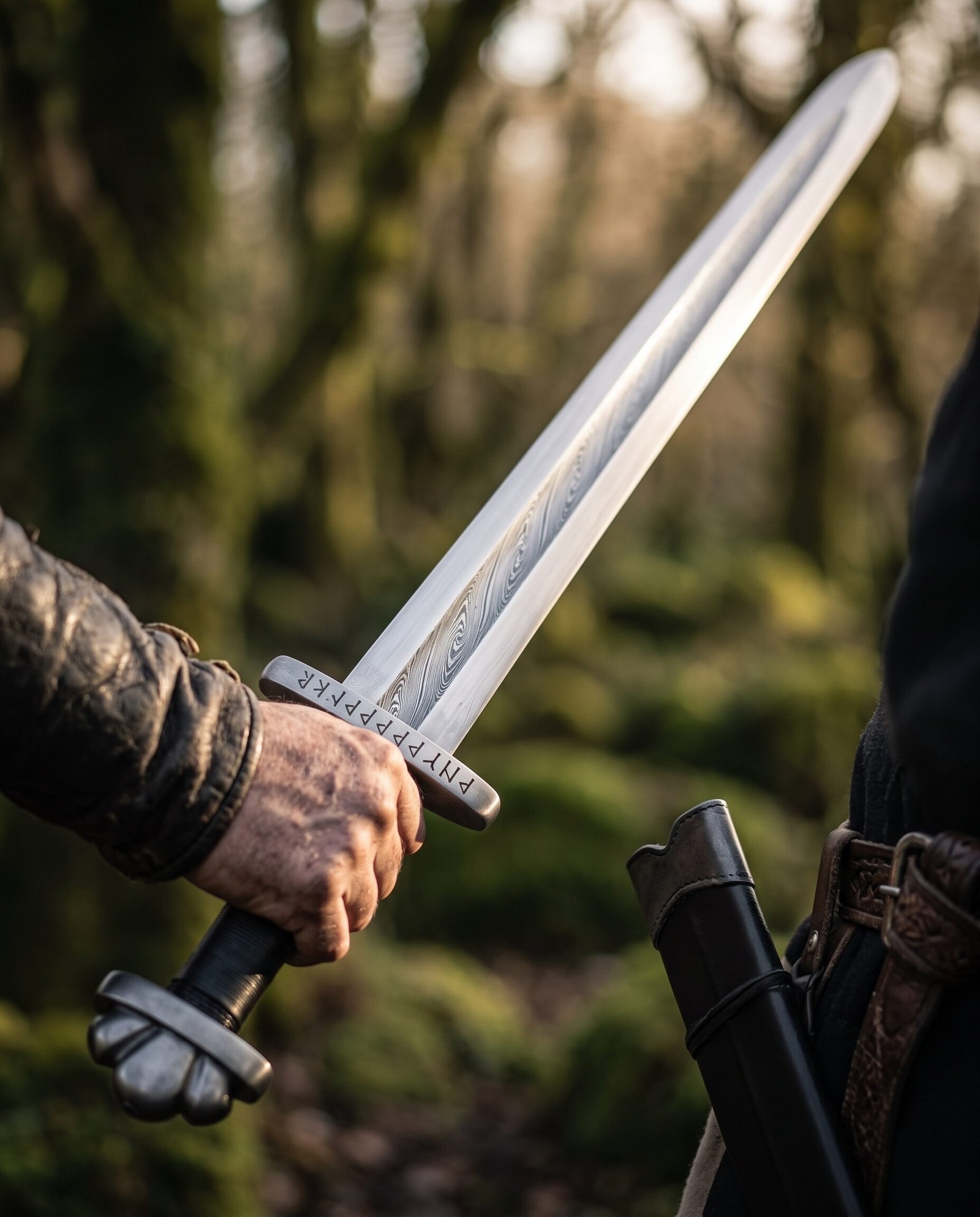
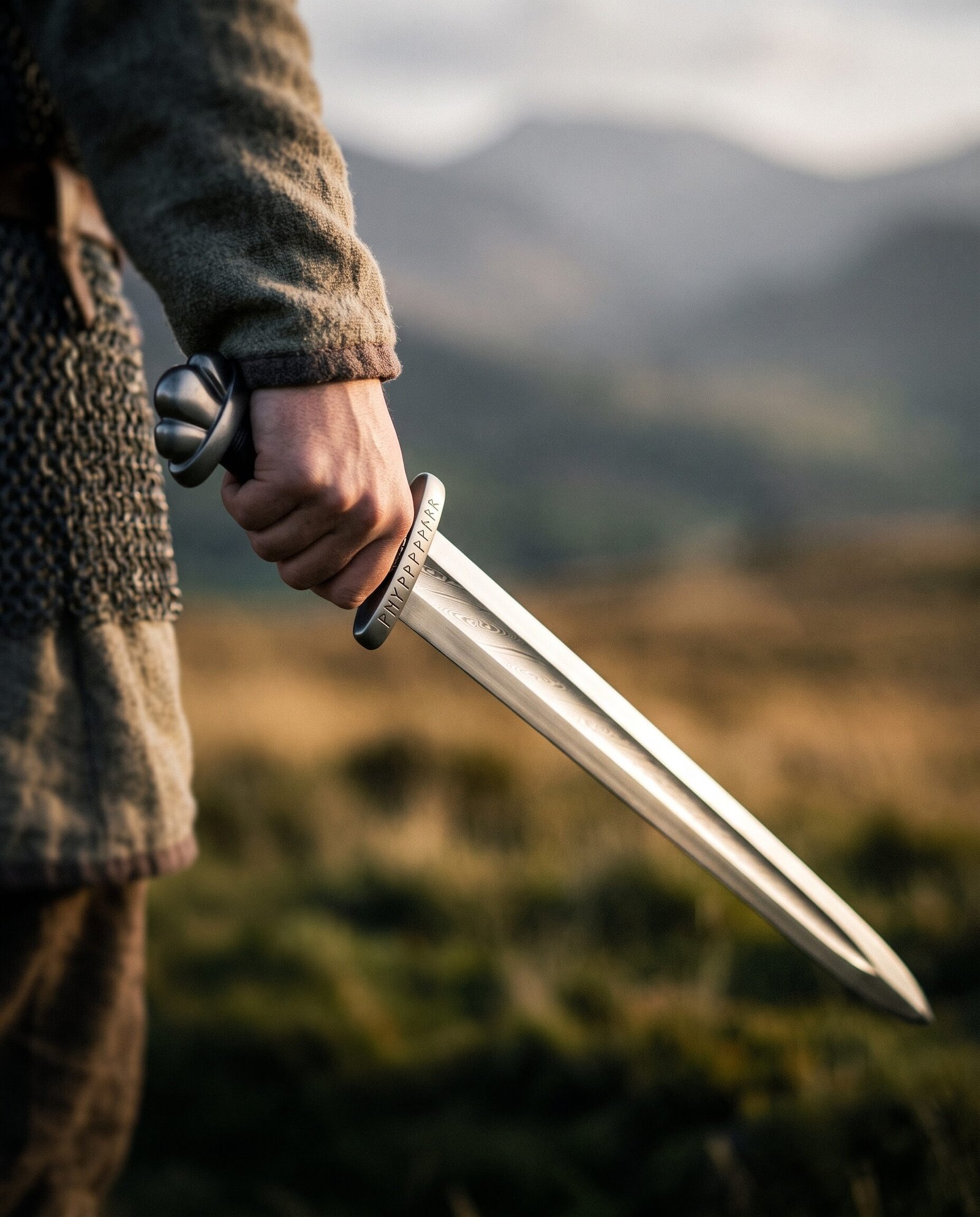
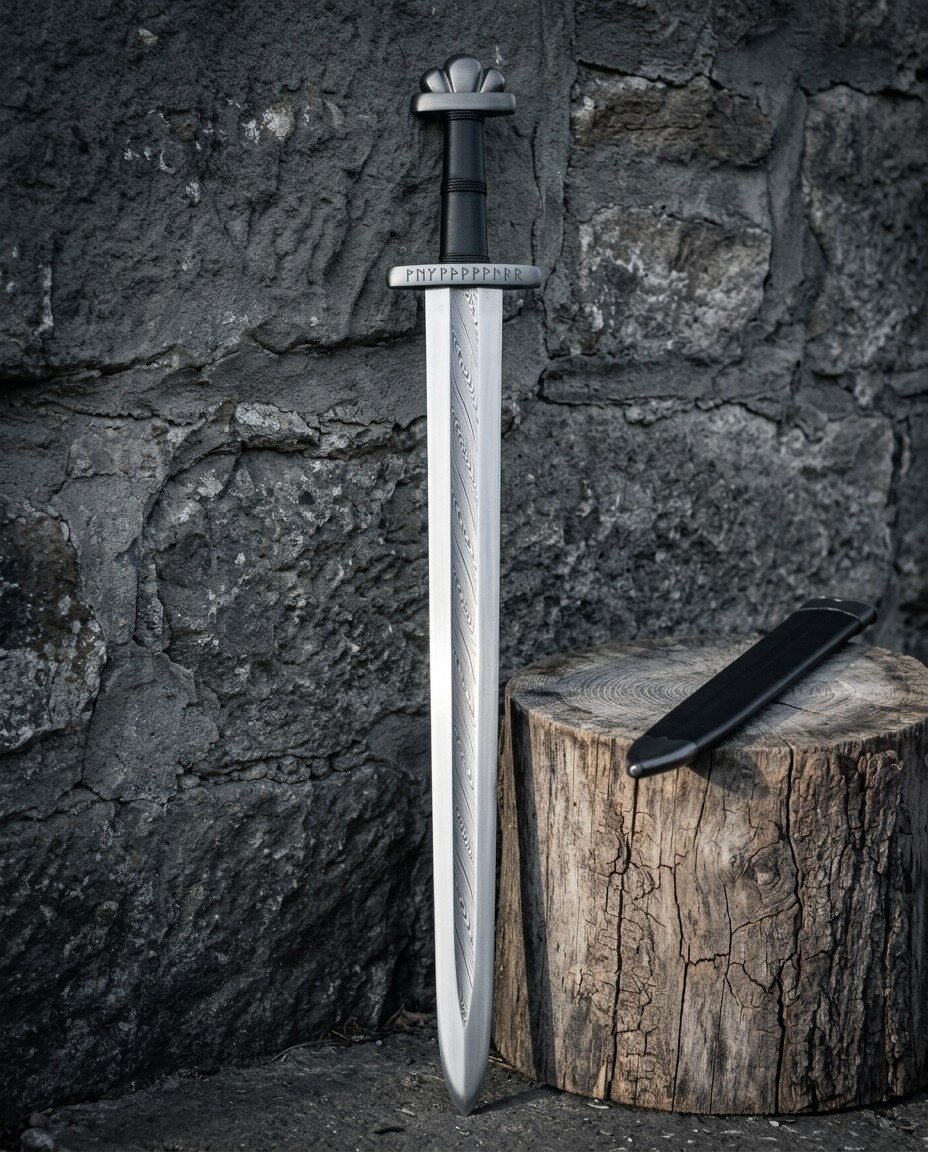
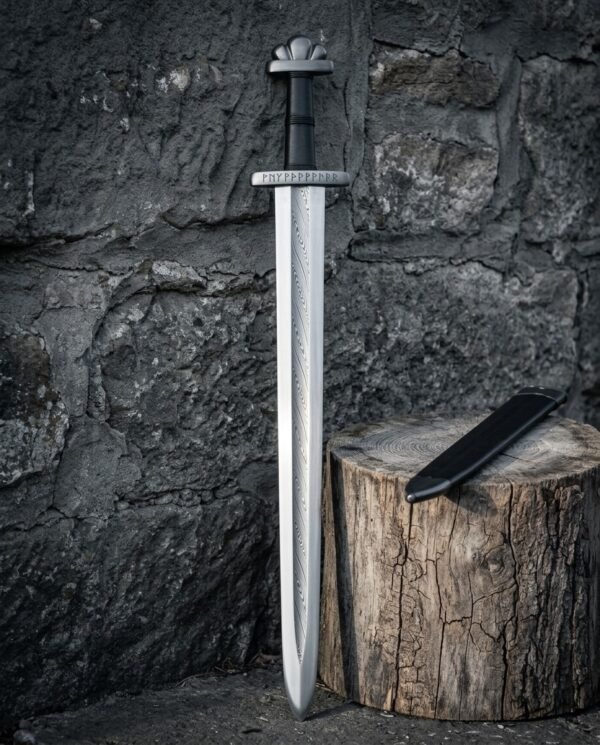
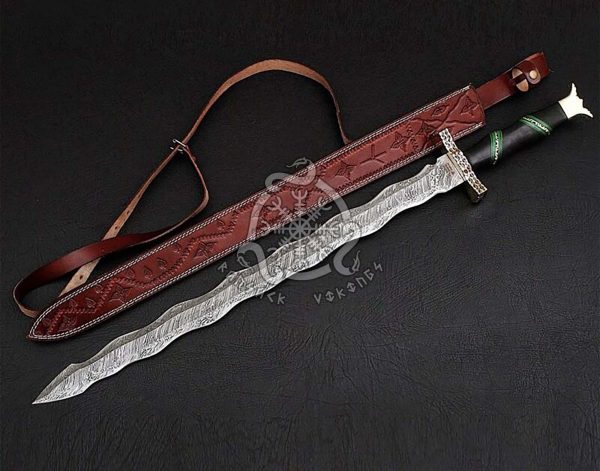
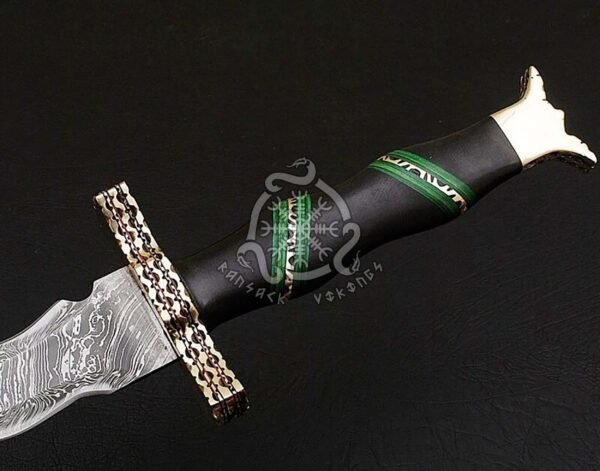
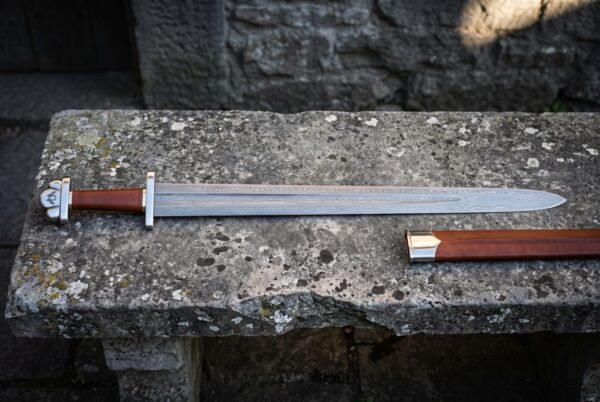
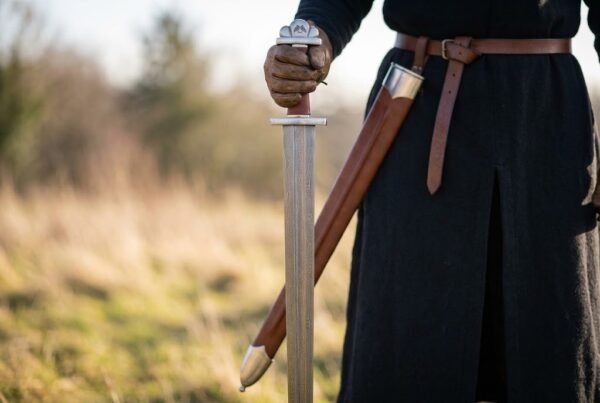
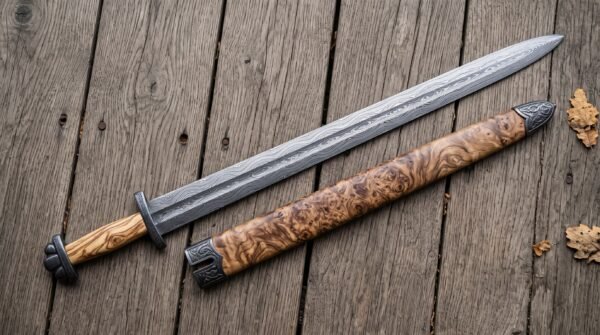
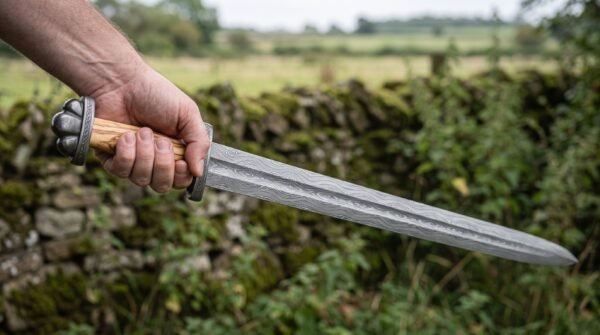
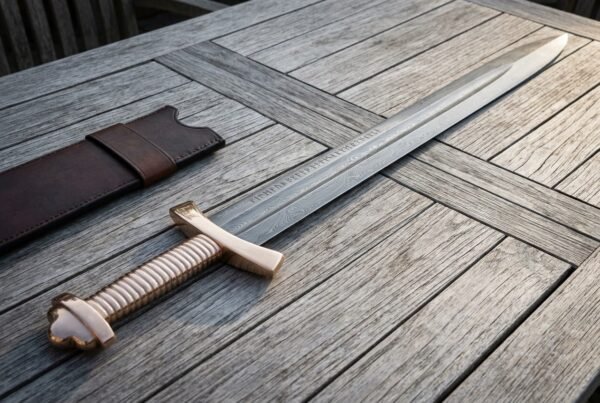
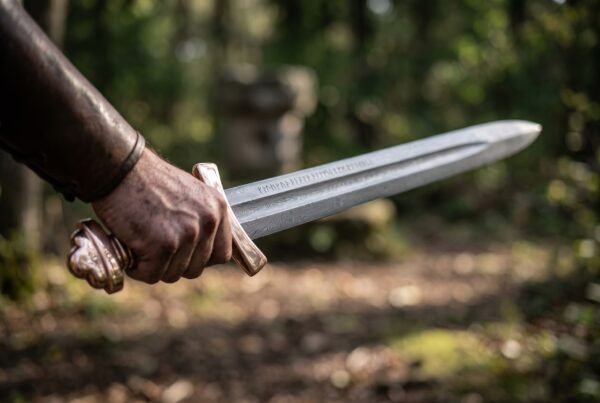
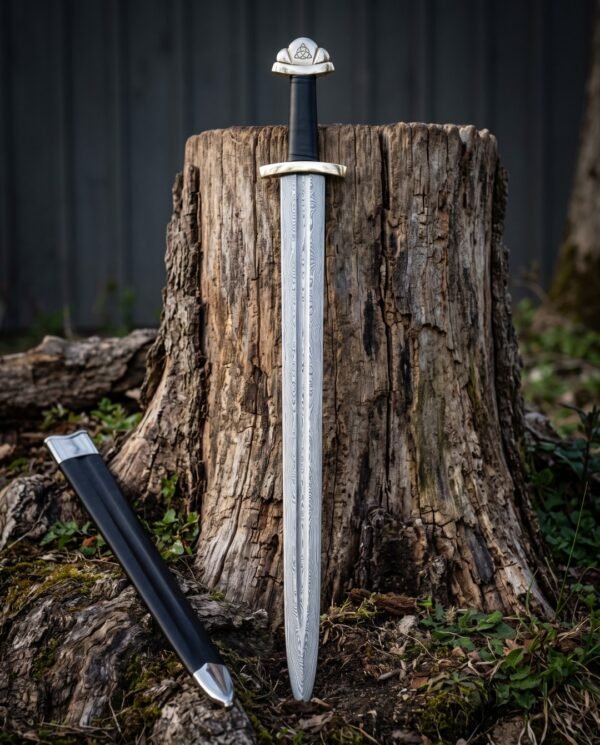
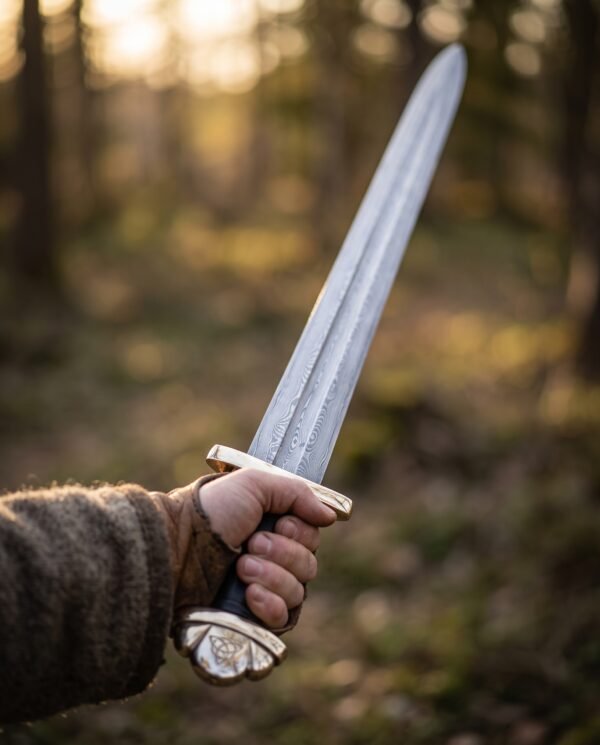
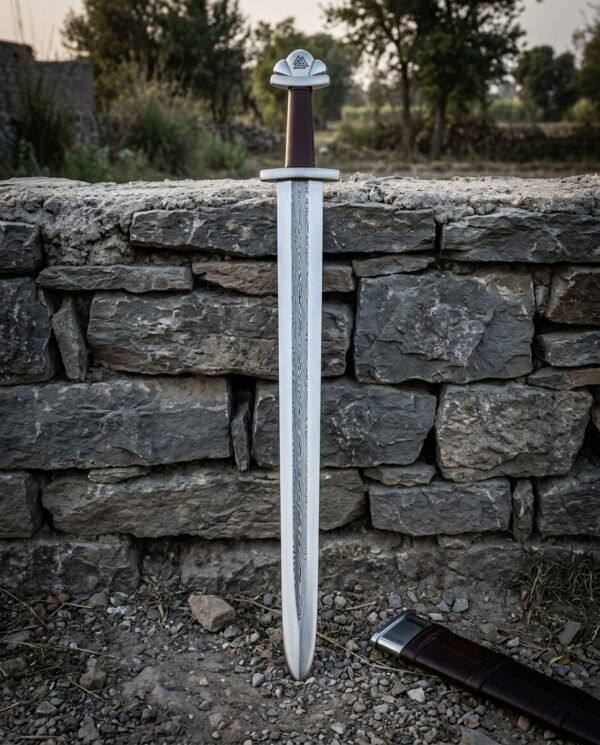
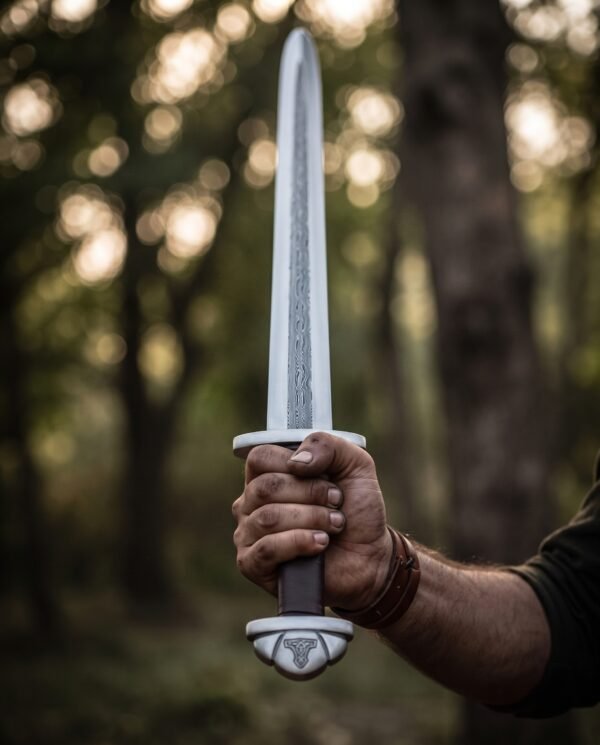
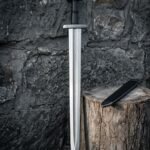
A Viking sword in 1095 and 15N20 pattern welded steel, with the pattern running as a repeating twisted figure down the centre of the blade and dying out into the bright polished edges. The hilt is the classic Norse arrangement: a short straight lower guard with a line of runes cut across it, a black leather grip with raised bands, and a five lobed pommel sitting on its own upper guard. It ships with a plain black scabbard.
The centre of this blade is doing something the Viking age would recognise. Early Scandinavian smiths built a sword core out of several thin rods, each one already made of layered iron and steel, and twisted them before welding them side by side. Then they welded hard steel edges on. The twisted rods produce the herringbone and serpent figures that show on almost every good sword recovered from the bogs at Nydam and Illerup, and the sagas talk about the shimmer in a blade as though it were alive. Modern homogeneous steel is metallurgically better than any of it, so on this sword the pattern is craft and history rather than necessity. Forged, ground, heat treated, etched and fitted in the Czech Republic. It sits in the Damascus swords, a step across from the Damascus knives.
Specifications
| Blade steel | 1095 and 15N20 pattern welded damascus, hardened to 58 to 60 HRC |
|---|
| Overall length | Approximately 36 inches |
|---|
| Blade length | Approximately 30 inches, double edged with a broad shallow fuller |
|---|
| Pattern | Repeating twisted figure down the centre, bright polished edge bevels |
|---|
| Lower guard | Short straight guard with a rune line cut across its face |
|---|
| Pommel | Five lobed Norse pommel on a straight upper guard bar, peened over the tang |
|---|
| Grip | Black leather wrapped core with raised cord bands, single hand length between the guards |
|---|
| Finish | Etched blade, dark grey steel hilt furniture |
|---|
| Scabbard | Plain black, fitted to the blade, with steel throat and chape |
|---|
| Edge | Sharpened, sold as a collector and display sword |
|---|
| SKU | RK-1743 |
|---|
The lobed pommel and how Viking swords are catalogued
The pommel on this sword is divided into five joined lobes sitting on a bar, and that shape is one of the most recognisable things in Norse archaeology. In 1919 the Norwegian archaeologist Jan Petersen went through the sword finds of Norway and sorted them purely by the shape of the hilt, giving each form a letter. His typology is still the working language of the field a century later, and the lobed pommels fall across several of his types depending on how many lobes there are and how the upper guard is shaped.
The lobes are not only ornament. A pommel of this size is the counterweight that makes a thirty inch blade manageable in one hand, and building it as separate lobes on a bar gives you that mass with less metal than a solid block of the same footprint. It also gives the peen a broad seat to spread against. On many surviving swords the lobes and the guards were decorated separately with inlaid wire in silver, copper or brass, hammered into cut grooves, which is the technique that produced the famous inscribed and patterned hilts.
The lower guard is short and straight, which tells you something about how these swords were used. A Norse sword was usually paired with a round shield, so hand protection came from the shield rather than from the hilt. The guard is there to stop your hand sliding onto the blade and to catch a sliding edge, and nothing more. That is why Viking hilts look austere next to later medieval crosses.
Pattern welding, then and now
The reason early smiths went to all that trouble was not decoration. Bloomery iron came out of the furnace in inconsistent lumps, some of it soft and some of it carburised into steel, and no single piece was reliable enough to make a sword from. Welding many thin pieces together averaged out the faults, so a flaw in one rod was surrounded by sound metal in the others. Twisting the rods before welding spread any remaining weakness along a spiral rather than leaving it in a straight line, which is a genuinely clever piece of engineering by people with no theory of metallurgy at all.
What we do now is different in intent. The billet here is 1095 and 15N20, two modern steels of known and consistent composition, stacked, forge welded, drawn out, folded and welded again into hundreds of layers, then manipulated to produce the repeating figure. The etch darkens the 1095 and leaves the nickel bearing 15N20 bright, which is what makes the pattern visible. Heat treated together the blade comes out at 58 to 60 HRC.
So the honest position is this. The pattern is not making the sword stronger than a good monosteel blade would be. It is making it a pattern welded sword, in the way the originals were, and it is doing that with steel that is far more reliable than anything a tenth century smith could get. It is sharp, it will cut, and it is sold as a collector and display sword rather than for sparring.
Engraving, runes and your own design
Use the rune converter on this page to turn a name, a date or a short phrase into Elder Futhark and we will cut it into the steel, the leather or the wood. If you would rather have a Viking pattern than a rune line, choose your own design in the engraving option above the add to cart button and tell us where it goes. Where a piece already carries an engraved design, your chosen engraving replaces it rather than sitting alongside it. On this sword the rune row across the lower guard is the obvious panel, and it is also the most historically appropriate place, since inlaid and cut lettering on Norse hilts almost always sits on the guards rather than on the blade. See the engraving page.
Handling and balance
Norse swords are shorter and broader than the medieval swords that followed them and they feel completely different in the hand. The blade is wide near the guard and tapers gently, so the mass sits forward enough to cut hard, and the heavy lobed pommel pulls it back so the point still moves quickly. The result is a sword that wants to be swung in arcs from the shoulder rather than fenced with from the wrist.
The grip is a single hand length and it is short by modern taste, because the pommel is meant to sit against the heel of the hand rather than leaving room behind it. Hold it so the pommel is contained by your palm and you will find the sword balances itself. Trying to grip further down towards the pommel, as you would on a longsword, makes it feel clumsy.
For display, lay it flat on a stand with the fuller and the pattern facing the room. Standing a sword on its point concentrates the whole weight of the blade on the smallest part of it.
Care
Pattern welded carbon steel is not stainless and it rusts readily. Wipe the blade dry every time you handle it, then lay a thin film of mineral oil or blade oil over the whole surface. On an etched blade fingerprints are worse than on a plain one, because the acid in skin oil will ghost a print into the etched surface within a couple of days and it takes a repolish to remove. There is more on steel care.
Pay attention to the seam where the blade meets the lower guard, since moisture collects there and it is easy to miss with a cloth. Do not store the sword inside the scabbard for months at a time. A fitted scabbard holds humid air against the steel and the throat is where rust rings appear first. If light surface rust does form, a little oil with 0000 grade steel wool lifts it without flattening the pattern.
Made in the Czech Republic
This is a handmade piece from the Czech Republic, made in a workshop that still forges, grinds and finishes by hand instead of stamping parts out. The smiths there have kept the older way of working, and the wood, horn and leather are shaped and fitted by hand as well. Two pieces of the same design will never be identical, and that is part of what you are buying.
Ransack Viking is a United States company. We handle the import ourselves, look over every piece when it lands and ship from our warehouse in Chicago, Illinois. Engraving is done in the United States after the piece arrives, so your design goes on before we send it out.
A note on handmade variation
This sword is hand made, not machine made and not bulk produced, so what arrives will not be a pixel for pixel copy of the photograph. Pattern welded steel is the least repeatable material there is. The twisted figures down your blade will land at their own spacing and each one will open out differently where the grinder cut into it, which is precisely what makes the pattern worth having. The lobes of the pommel are shaped by hand and no two sets sit identically. The dimensions, the steel and the build are the same every time. The character is not. Anyone new to this should read the gap between a display sword and a battle ready one first, then how steel and hardness actually work.
Frequently asked questions
Is the pattern in the steel or on the surface
In the steel. It is the layer structure of the billet showing through, and it runs all the way through the blade. The etch only makes it visible.
Is this how Viking swords were really made
The method is the same idea. The originals were pattern welded because their iron was unreliable and welding many pieces averaged out the faults. Ours uses two consistent modern steels, so the pattern is craft and history rather than necessity.
Is the scabbard included
Yes. The fitted black scabbard comes with the sword.
Is it sharp
Yes, it arrives sharpened. It is a sharp collector and display sword and not for sparring.
What does the writing on the guard say
It is a cut rune line across the face of the lower guard. If you would rather have your own name or a date there, your engraving replaces it.
Why is the grip so short
Because the pommel is meant to sit inside your palm rather than behind it. That is how Norse hilts were built and it is what makes the balance work.
What is in the box
- Wyrmweave hand forged pattern welded Viking sword
- Fitted black scabbard
- Blade wiped and oiled for transit
- Lifetime warranty against defects in the forging, the grind, the heat treat and the fittings, with no end date and no receipt needed
- Forged and finished in the Czech Republic
Explore the range
See the rest of the Viking swords, the damascus swords, the Norse arms and the guides.
Worth a look beside this
A near match for this one is the Skeinfell Viking sword, 33 inches overall. Closest to this in the range is the Duskfuller Viking sword, 36 inches overall. If this one is not quite right, there is the Knotdrift Viking sword, pattern welded Damascus.
The Pathstave arming sword covers the other half of the same kit. Or start from a blank sheet on the custom Viking sword page.


This thing is a beast in the best way. Weight and balance make it feel like a real functional piece not some cheap replica. This is my third order from Ransack Viking and they never disappoint. This will be a family heirloom for sure.
This sword beat every expectation I had. Ransack Viking’s attention to detail is honestly unmatched.
Can’t stop showing this off to everyone who comes over. The wood handle feels amazing and the balance is perfect. Made overseas in the Czech Republic yet shipped from a US location so no long customs wait. Shipping was fast and everything arrived well packaged.
Did not expect this level of quality for the price. Fit and finish is museum quality. You can tell real craftsmen made this by hand. Ransack Viking’s attention to detail is honestly unmatched. Came in a nice gift box which made it feel even more special. Will definitely order again for another gift.
My husband was speechless when he opened this. The wood handle feels amazing and the balance is perfect. Fit and finish is museum quality. You can tell real craftsmen made this by hand. Already telling my friends to check this out.
Perfect gift. Perfect quality. No complaints. The wood handle feels amazing and the balance is perfect. Fit and finish is museum quality. You can tell real craftsmen made this by hand. Weight and balance make it feel like a real functional piece not some cheap replica. Couldn’t be happier with this.
Absolutely blown away by this sword. Edge retention has been great even after regular use. Leather sheath is thick and well stitched. Not the cheap stuff you usually get. Even the small engravings are crisp and clean. Couldn’t be happier with this.
No regrets on this purchase at all. The wood handle feels amazing and the balance is perfect. This is going straight into my display case.
Did not expect this level of quality for the price. Even the small engravings are crisp and clean. Great buy overall.
Really happy with this sword overall. Wood handle looks great though it’s a little smaller than I imagined. Blade quality is solid. Arrived a bit less sharp than expected but a few passes on a strop fixed it. Would buy from this shop again.