
Blog
What Is a Tanto? The Short Japanese Blade and Its Modern Point

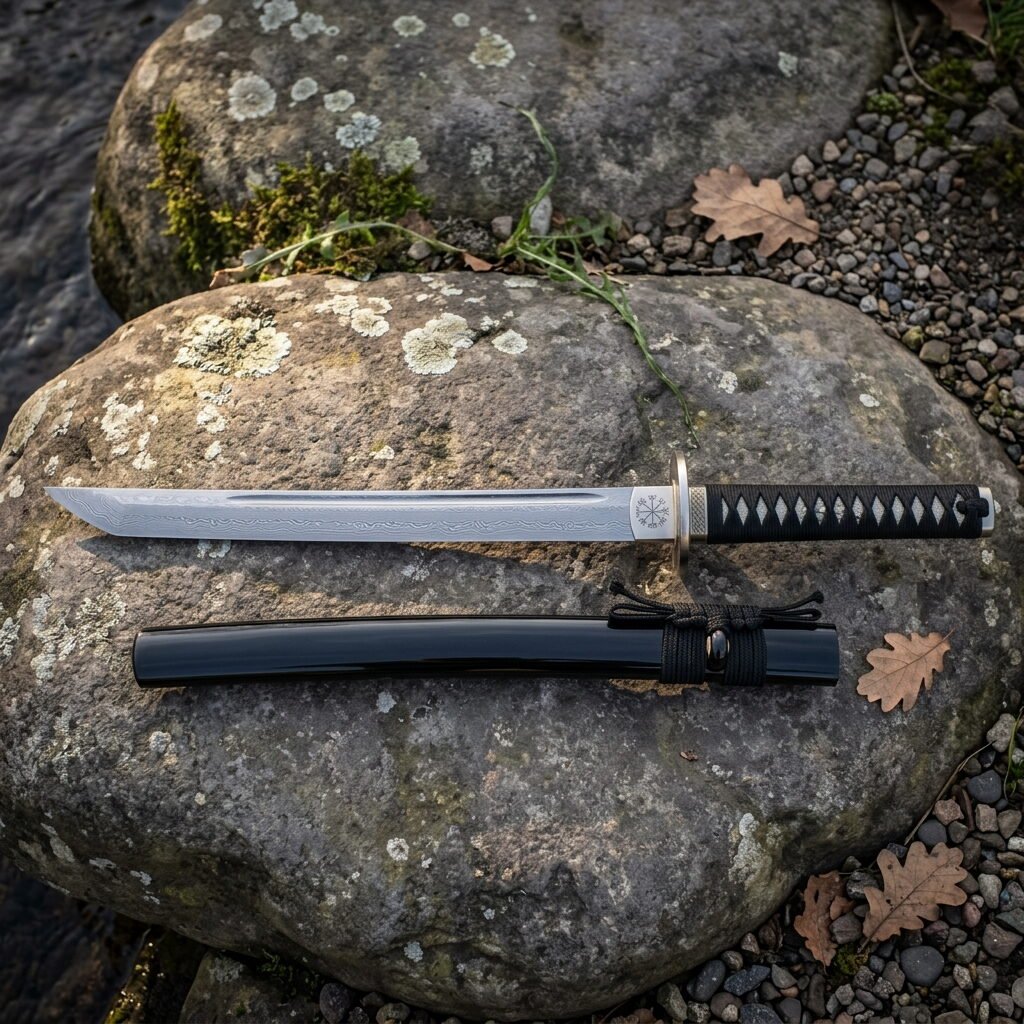
A tanto is a short Japanese blade, traditionally anything under one shaku, about 30 centimetres. That is the classical definition and it describes a dagger carried alongside a longer sword. The modern American tanto is a different animal: a blade profile with an angular, chisel-like tip, invented in the twentieth century and named after the Japanese original rather than descended from it. One word, two objects, and a great deal of confusion sold at both ends.
Both are called tanto, both are sold under that name, and they have almost nothing in common beyond the word. Sorting out which one a listing means is the first thing a buyer should do.
The traditional tanto
What it is
Japanese blades are classified by length in shaku, a unit of roughly 30.3 centimetres. Over two shaku is a katana, one to two shaku is a wakizashi, and under one shaku is a tanto. Our post on what a katana is covers the long end of that system and the construction methods, most of which apply here at a smaller scale.
The tanto appears as a fighting knife from the Heian period onward and stays in use for centuries. It was worn with the sword, used at grappling distance, and in the peaceful stretch of the Edo period it drifted towards being a dress and gift item with elaborate mounts, which is the usual fate of well made things once nobody needs them. Some were made specifically to punch through armour lacing, a very thick spined type usually called yoroi-doshi. A small tanto carried inside the clothing, often by women, is a kaiken.
Shapes and mounts
Blade sections have names worth knowing. Hira-zukuri is a flat blade with no ridge line and no separate point section, which is the most common tanto form and looks quite unlike a miniature katana. Shinogi-zukuri has the ridge and the defined tip of a full sword, shrunk down. Kanmuri-otoshi drops the spine away towards the point to lighten it.
Mountings split into two families. Aikuchi has no guard, so the handle meets the scabbard mouth directly and the whole thing looks like a smooth baton when sheathed. Hamidashi has a small guard, just enough to show at the joint. A large tsuba on a tanto is unusual and usually a modern styling choice.
How it was made
The same way as a longer blade, which is the point. Traditional smiths worked tamahagane smelted from iron sand, folded to even out the carbon, often built as a hard skin over a softer core, then coated in clay along the spine and quenched so the edge hardened and the body did not. That produces a hamon, the visible boundary between hard and soft steel, on a tanto exactly as it does on a katana. A short blade does not develop much curve in the quench, which is why so many tanto are close to straight.
The modern tanto point
Where it came from
What most people in the United States mean by a tanto is a blade shape rather than a length class: a flat or slightly hollow primary edge running to a sharp angle, then a short secondary edge climbing to a point that sits high on the blade. The corner between the two is the visual signature.
The American knifemaker Bob Lum is generally credited with working out that profile in the 1970s, taking cues from Japanese blades without copying them. It spread widely in the 1980s, with Cold Steel doing more than anyone to put it in front of the public, and by the 1990s it was standard on tactical folders and fixed blades from dozens of makers. Calling it Japanese is a stretch. Calling it Japanese inspired is fair.
What the shape is good at
The point is the whole argument. Because the tip sits at the meeting of two straight edges rather than at the end of a taper, there is far more steel immediately behind it than on a drop point or a clip point of the same size. That makes it strong in a stab, resistant to snapping when it is prised or driven into something hard, and easy to keep sharp at the tip because the secondary edge is a straight line on a stone.
The trade is slicing. A curved belly rolls through material and keeps cutting as you draw the blade. A tanto edge is two straight segments, so it works well for push cuts and badly for skinning, filleting or anything that wants a sweeping cut. If you want to see how that compares with the other profiles, our guide to knife blade shapes sets them side by side.
Chisel grind and the confusion around it
Two different things get lumped together, and a great deal of confident writing depends on it. The tanto profile describes the outline of the blade. A chisel grind describes the cross section, meaning the blade is bevelled on one side only and flat on the other. Many early production tantos used both, which is why people assume they are the same thing. They are not. You can have a tanto point with a normal double bevel, and plenty of makers do it that way because a symmetrical grind cuts straighter.
What to look for when you buy
Decide which tanto you want
If you want a Japanese piece, look for a curved or straight blade under about a foot, a hira-zukuri or shinogi-zukuri section, a wooden scabbard and mounts in the aikuchi or hamidashi style. If you want the modern profile, look for the angular tip and a handle built for grip rather than for looks. Sellers use the word for both, so read the photographs and the measurements rather than the name.
Length claims
Be aware that plenty of blades sold as tanto today run well past the traditional one shaku limit, and nobody in the trade seems troubled by it. Ours are a case in point: the blades in our range run 12.5 and 15 inches, which is longer than the classical definition allows and puts them into what a Japanese classification would call wakizashi territory. We are not going to pretend otherwise. If the historical category matters to you, measure the blade rather than trusting the label.
Tang and fittings
A short blade takes less leverage than a sword, but the same rule applies: the tang should run the length of the handle and be pinned or peened rather than glued into a hole. On a Japanese style mount, check that the habaki collar wedges the blade tight in the scabbard so it does not rattle or slip out when the piece is turned upside down.
Steel and hardness
Plain high carbon steel at a sensible hardness is the right choice for a using blade. Very hard steel gives a fine edge that holds well and chips if you lever with it, which matters more on a tanto than on most knives because the point invites prying. Damascus is chosen for the pattern rather than the performance. Whichever you buy, carbon steel needs oiling, and our knife care guide covers storage, rust and edge maintenance.
Saya and sheath
Wooden scabbards should hold the blade by friction at the mouth and nowhere else, so the edge never drags on wood. Leather sheaths should be stitched rather than glued at the seam, and a leather sheath is a poor long term home for a carbon steel blade because leather holds moisture and the tanning chemicals encourage rust. Store the blade out of the sheath if it will be sitting for months, which for most of these pieces it will.
The tantos we make
Our tanto blades are hand forged high carbon steel, with plain 1095 finished at 54 to 58 HRC and Damascus forge welded from 1095 and 15N20 at 58 to 60 HRC. The larger pieces are Japanese in styling, running 19 and 21.5 inches overall with 12.5 and 15 inch blades, one in a black lacquered wooden saya with a cord tie and one in a brown leather wrapped wooden saya. The smaller piece is a Damascus tanto knife with a stag horn and buffalo horn handle and a leather sheath, which is closer in size to the classical definition. They sit alongside the rest of the Japanese blades in our katana and Japanese sword range, and if you are comparing short blades across traditions, look at the dagger range and the Viking knife range for the European equivalents. The full catalogue of long blades is in our sword range. Ransack Viking is a US company in Memphis, Tennessee. Every piece is handmade in the Czech Republic the old way, then imported, inspected and shipped from Memphis. Engraving is done in the US after arrival.
For the two longer blades in the same set, see the wakizashi and the comparison in katana against wakizashi against tanto.
Questions people ask
Is a tanto a knife or a sword?
In the Japanese system it is a knife, defined by length rather than shape: any blade under one shaku, about 30.3 centimetres, sits in the tanto class. Above that it becomes a wakizashi and above two shaku a katana. In modern usage the word often describes a blade profile instead, which is why you will see folding pocket knives and long fixed blades both sold as tantos with equal confidence.
Is the American tanto point actually Japanese?
Not really. The angular tip with a straight secondary edge was worked out by American makers in the 1970s, with Bob Lum generally credited for the profile, and it spread widely in the 1980s. Japanese tanto tips are usually curved or gently tapered rather than angular. The modern shape borrows the name and some visual cues rather than the geometry.
Why does a tanto point break less often?
Because there is more steel directly behind it. On a drop point or a clip point the blade tapers to the tip, so the last few millimetres are thin. On a tanto the tip sits where two straight edges meet, and the full thickness of the blade carries almost all the way forward. That makes it strong in a stab and resistant to snapping when it is prised, which is the job most owners actually give it.
What is a chisel grind and does every tanto have one?
A chisel grind is bevelled on one side only, flat on the other, like a woodworking chisel. Several early production tantos used it and the two ideas got tangled together, but they are separate. The tanto profile is the outline of the blade; the grind is the cross section. Plenty of tantos are ground with a normal double bevel, which cuts straighter.
Can you skin or fillet with a tanto?
Badly. Those jobs want a curved belly that keeps cutting as you draw the blade through material. A tanto edge is two straight segments meeting at an angle, which is excellent for push cutting and piercing and poor at a sweeping slice. Choose a drop point or a skinner for game work and keep the tanto for jobs that reward a strong tip.
How should I store a carbon steel tanto?
Out of the sheath, wiped down with a lightly oiled cloth, in a dry room. Leather holds moisture and the chemicals used in tanning will pit a blade left in it for months, and a wooden saya will do the same if the blade goes back in wet or fingerprinted. Handle the steel, then wipe it before it goes away, every time and without exception.
Shop the range
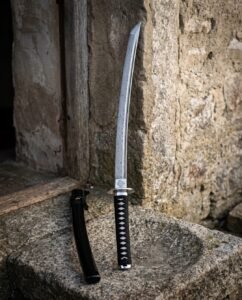 Inkfold Hand Forged Damascus Wakizashi Short Sword | 28 Inch Overall | 1095 and 15N20 Blade with Black Lacquer Saya and Cord Wrapped Tsuka | Japanese Collector Gift | RK-1937
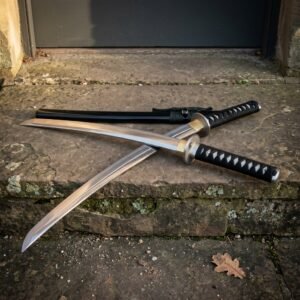 Stormcrane Hand Forged High Carbon Steel Katana | 41.5 Inch Overall with 29 Inch Blade | Black Lacquered Wooden Saya and Cord Sageo | Japanese Collector Gift | RK-1272
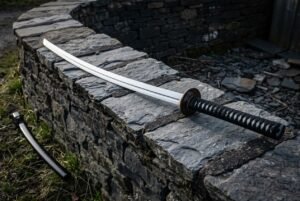 Moonedge Hand Forged High Carbon Katana with Bo Hi Fuller | 1095 Steel Blade at 54 to 58 HRC | Cord Wrapped Handle and Black Lacquer Saya | Japanese Sword Gift | RK-1619
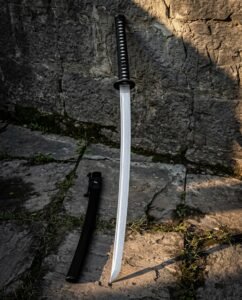 Stormfold Hand Forged Damascus Katana with Cord Wrapped Handle | 1095 and 15N20 Blade at 58 to 60 HRC | Oval Iron Tsuba and Black Lacquer Saya | Japanese Sword Gift | RK-1624
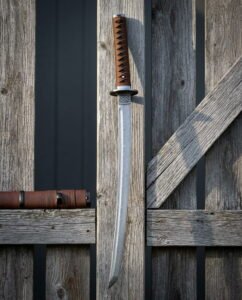 Rippleguard Hand Forged Damascus Wakizashi | 28 Inch Overall | Ladder Pattern Blade with Brown Leather Wrapped Handle and Saya | Japanese Sword Gift | RK-1839
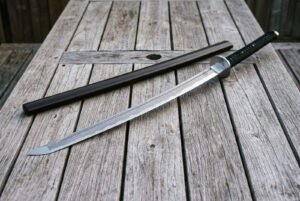 Shadowfen Hand Forged Damascus Ninjato | Straight Blade with Angled Chisel Point | Triskele Engraved Guard and Straight Hardwood Saya | Norse Collector Gift | RK-2011