
This is every piece in the catalogue that can carry a mark, gathered in one place. Swords, axes, seax and hunting knives, kukris, katana, shields, helmets, drinking horns and Damascus steel jewellery all appear here, and each of them can take a name, a date, a rune line or a symbol cut into the steel, the wood, the horn or the leather.
Engraving is done in the United States after a piece has arrived from the workshop and passed inspection, and before it is sheathed. Three options are chosen on the product page before you add to cart: plain lettering, Elder Futhark runes transliterated from what you type, or your own crest or monogram uploaded at checkout. The charge is per piece, not per order, because three engraved axes are three lots of hand work.
This page sells the pieces. If you want the detail of the service itself, the full rune chart, the placements and what each option costs, that lives on the engraving page. Two guides help before you send a spelling. Viking names and what they meant covers how a Norse name is built, and Odin the All Father covers the god most often asked for by rune. For a run of branded pieces, see logo engraved knives for companies and groups. To design a single piece from the steel up, start at Design Your Own.
Free US shipping
On most pieces. Heavier and oversized ones carry a flat charge.
Hand Forged
Heated, hammered and ground by hand.
Engraving available
Names, dates or Norse runes on most pieces.
Ships from New York
Inspected and dispatched from our New York warehouse. No import duty, no customs delay on US orders.
Engraved & Personalized
What this collection is
Most of the catalogue can be marked, and this category is where those pieces sit together so you can shop by the object rather than by the service. It runs from a 15 inch hand axe to a 44 inch longsword, from a 0.3 oz Damascus pendant to a 9 lb round shield. What they have in common is a surface flat enough, clean enough and thick enough to take a cut without weakening anything.
A mark changes what a piece is. An unmarked axe is an axe. The same axe with a date on the haft is the axe someone was given when their first child was born, and it stops being a thing that gets sold on. That is the whole reason this category exists, and it is why engraved orders are treated as final.
If a piece cannot take a mark, its own product page says so before you buy. Blades that are too thin at the flat, surfaces that are heavily textured from the forge, and a few coated finishes are the usual reasons.
Three ways a piece gets marked
The option is chosen on the product page, before the piece goes in the cart, and it is charged per piece.
Lettering
A clean serif in Latin letters, up to thirty characters. Names, dates, initials, a short line. It is the most legible option at small sizes, which matters on a ricasso or the face of a bolster where you have perhaps an inch and a half to work with. This is what most people choose for a gift, because a recipient can read it without being told what it says.
Elder Futhark
You type in English and the runes are cut from the transliteration. Both the runes and the English you typed are recorded against the order, so the spelling can be proofread rather than guessed at. Elder Futhark is a phonetic alphabet of twenty four staves, not a cipher, so a name is written by sound. There is no rune for C, Q, V, X or Y, and those are cut as their nearest sound, which is how the carvers themselves handled foreign names. TH, NG and EI are single staves rather than two.
Family crest or emblem
Your own crest, monogram or emblem, uploaded at checkout. Line art and solid silhouettes reproduce in steel far better than a photograph does, because engraving has no greyscale. If your image has fine shading, send the simplest version of it you have.
What can be marked, and where the mark goes
The placement is not decorative choice alone. It follows the geometry of the piece, and the right spot is the one that is flat, unhardened at the surface you are cutting, and visible when the piece is displayed the way it is meant to be.
Swords
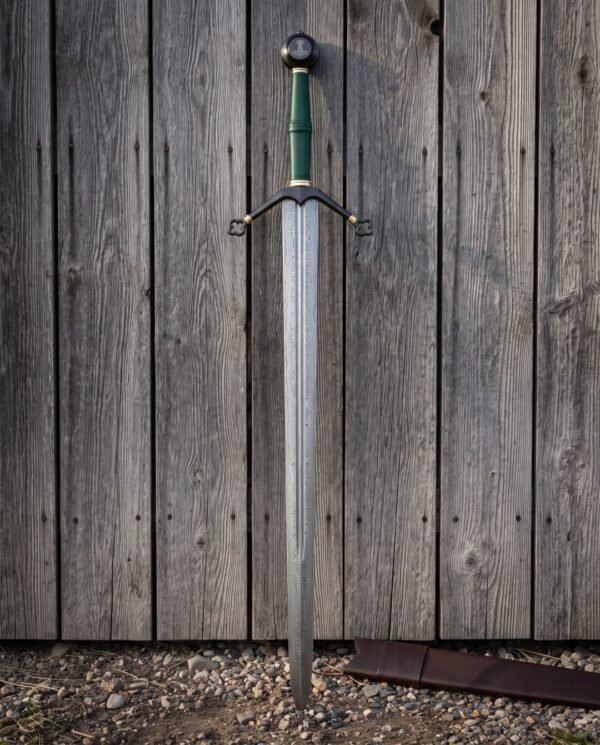
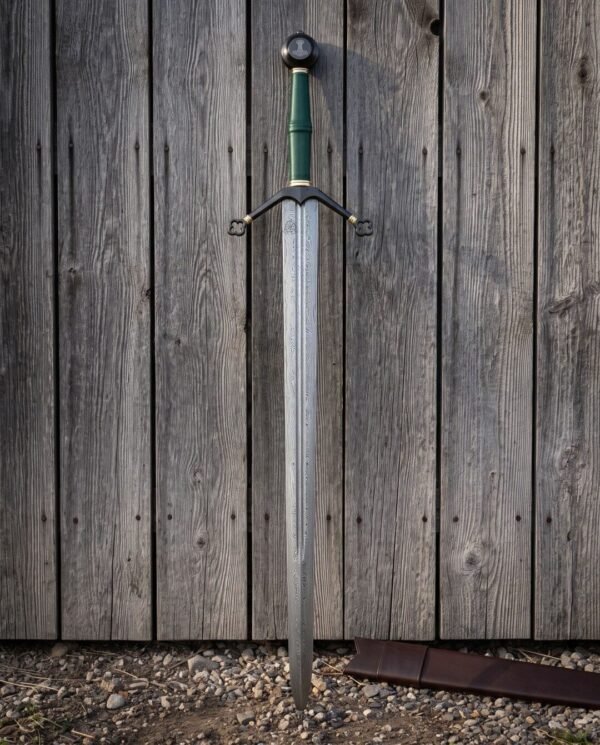
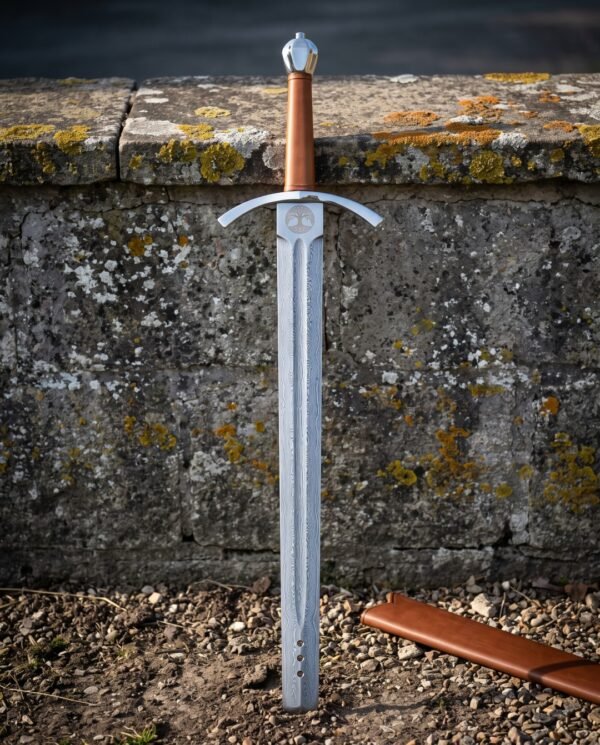
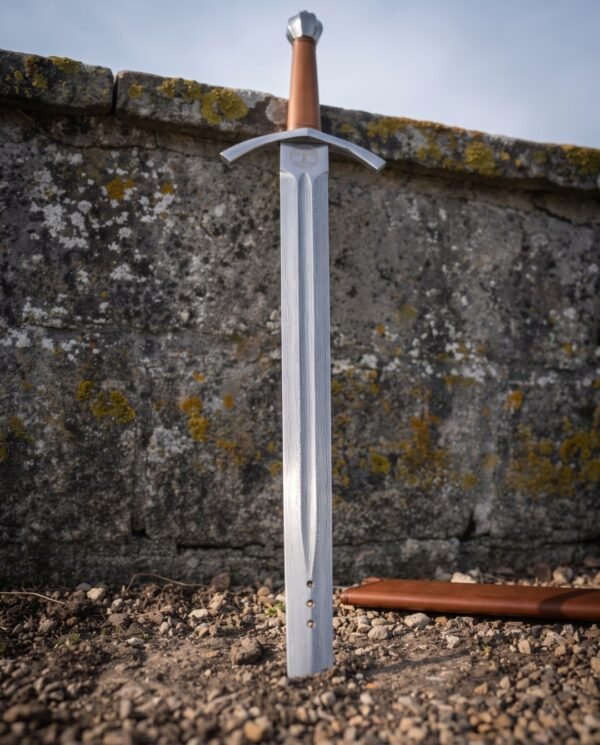
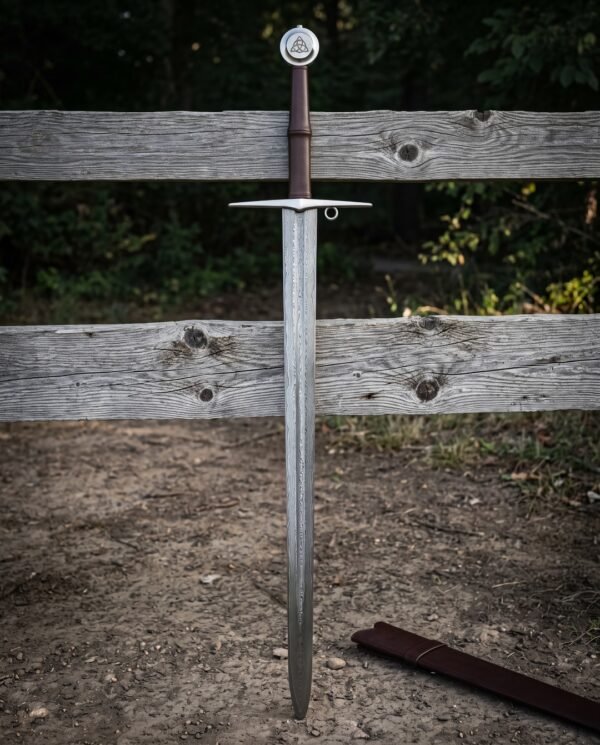
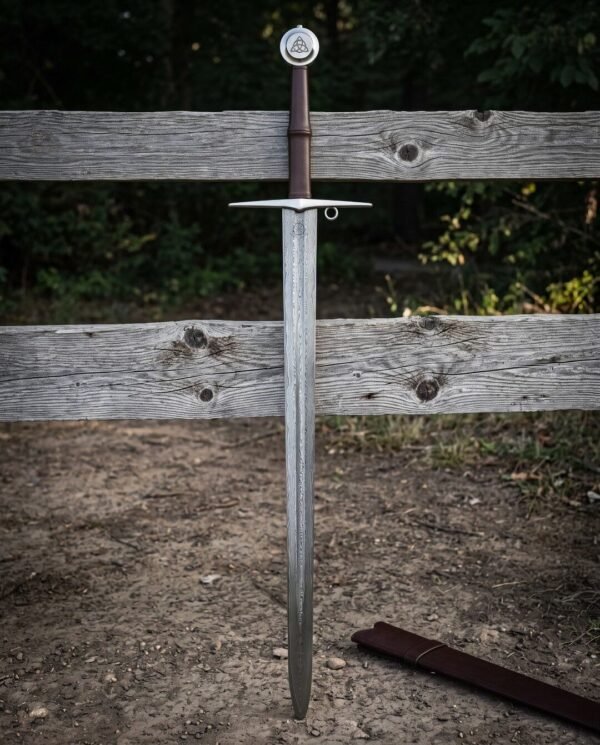
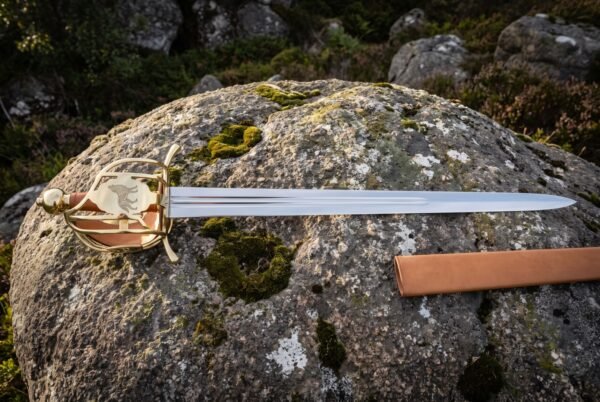
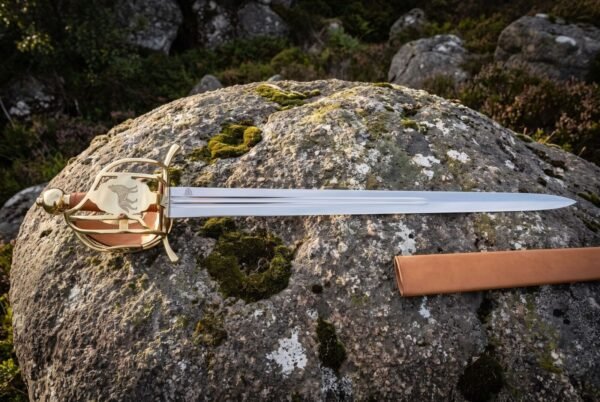
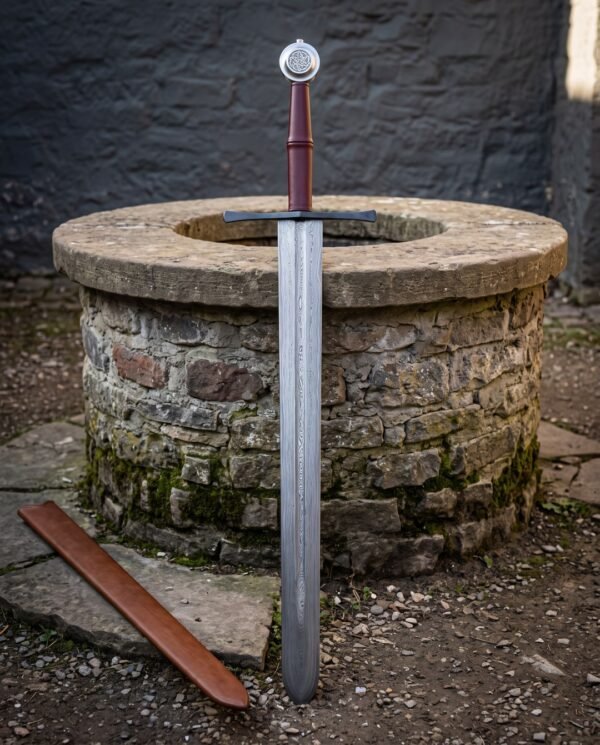
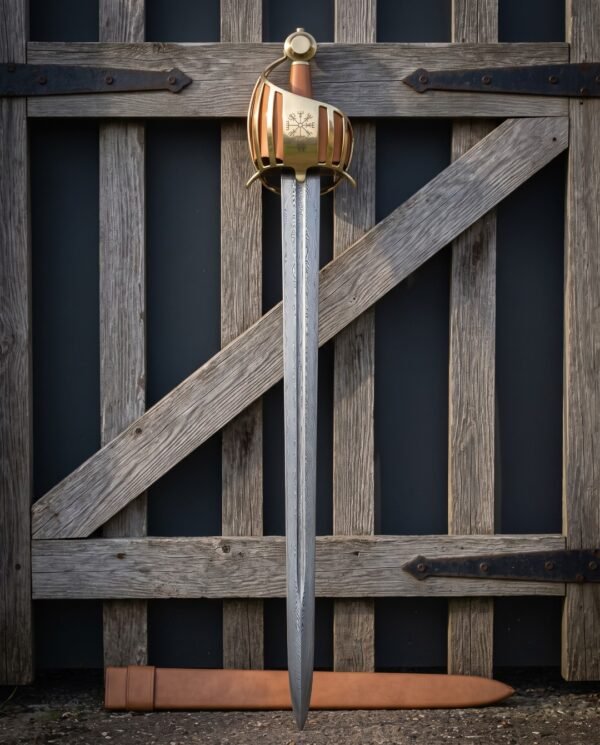
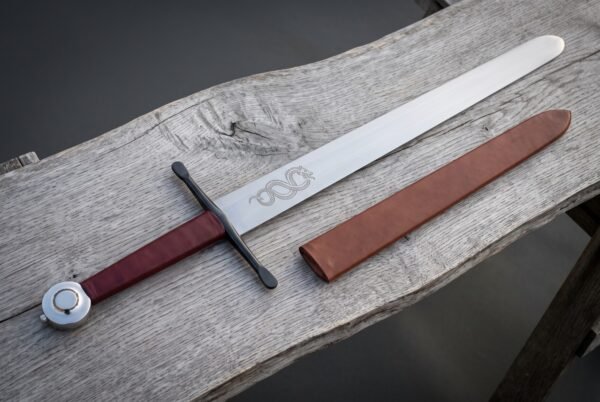
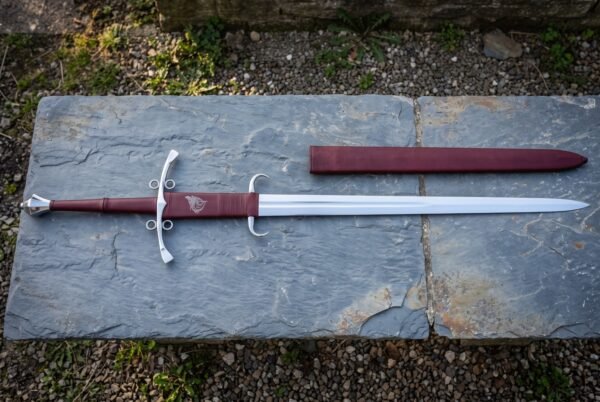
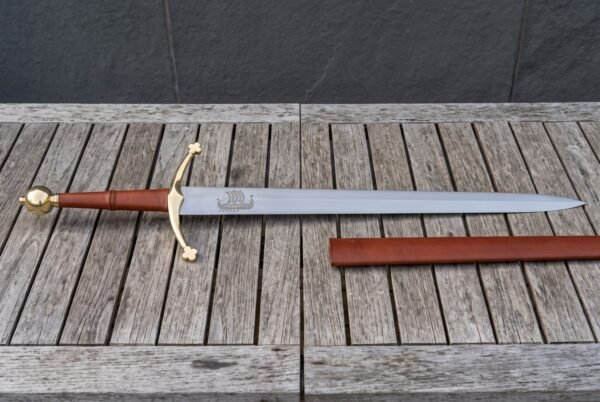
The ricasso and the flat just above it are the traditional spots, and they take a short mark cleanly. The arming swords here run 31 to 40 inches overall with 28 to 31 inch blades at 2 lb 8 oz to 2 lb 12 oz, and carry Yggdrasil roundels, knotwork panels and Celtic interlace above the ricasso. Viking swords run 26 to 38 inches overall at 2 lb 10 oz to 3 lb 2 oz, marked with Mjolnir over knotwork or a Vegvisir below the guard. Longswords are 38 to 44 inches at 3 lb 2 oz to 3 lb 9 oz. On the katana, 35 to 40 inches overall with 24 to 28 inch blades, the mark sits above the habaki.
Axes
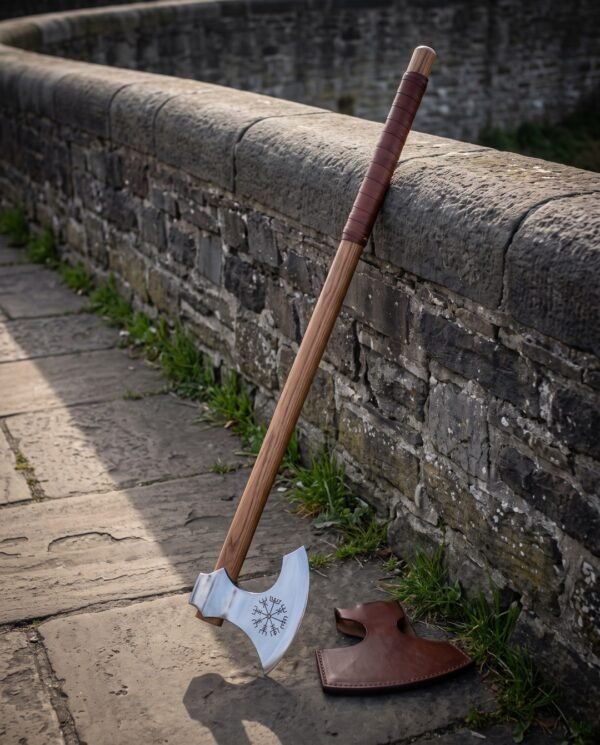
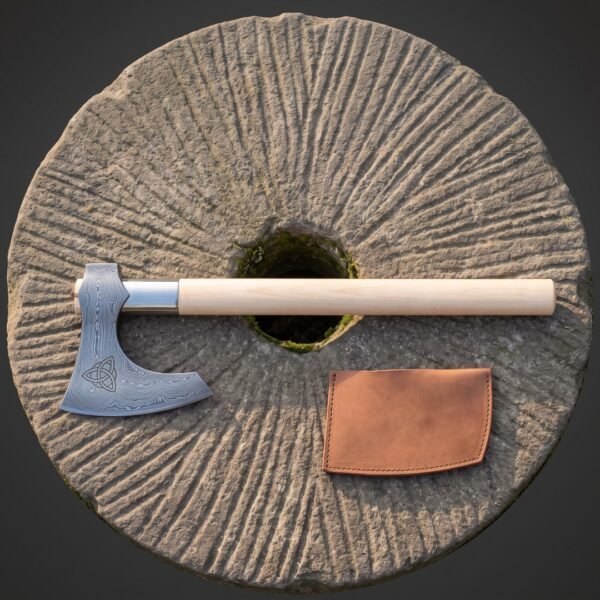
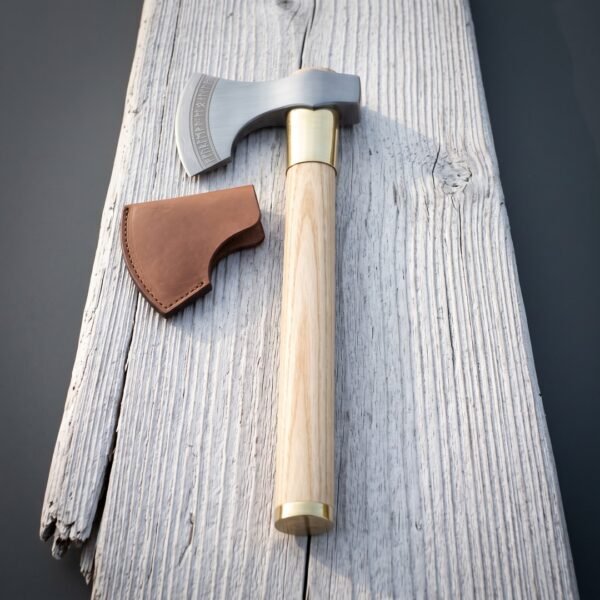
An axe gives you two surfaces and they behave differently. The cheek of the head is broad, flat and steel, so it takes a stave or a knot at a size you can read across a room. The haft is wood, so it takes lettering running along the grain, which is where a name or a date usually goes. The engraved axes here are 15 to 35 inches overall with 4 to 7 inches of cutting edge, weighing 1 lb 10 oz to 3 lb 4 oz, and the marks asked for most are Vegvisir, a triquetra and an Elder Futhark band on the cheek.
Knives and seax
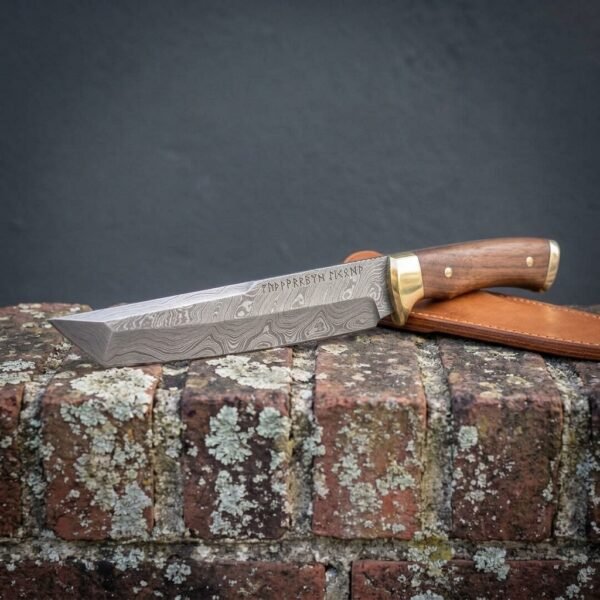
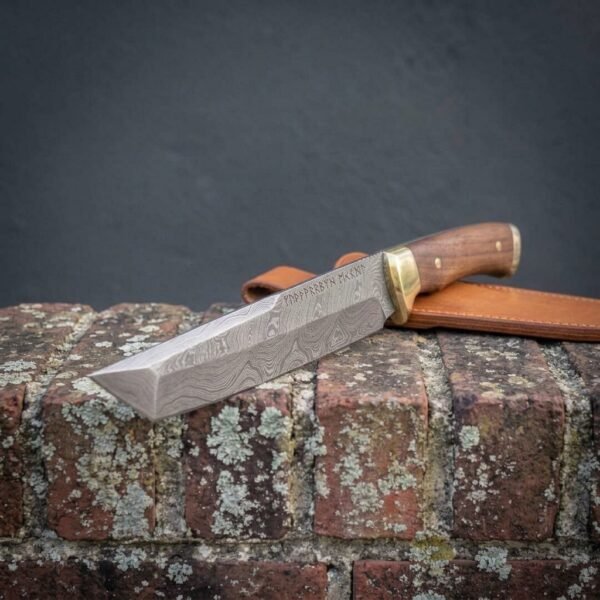
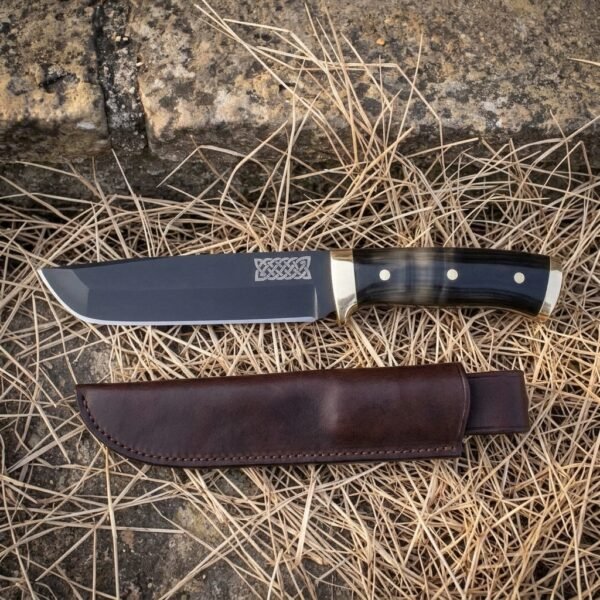
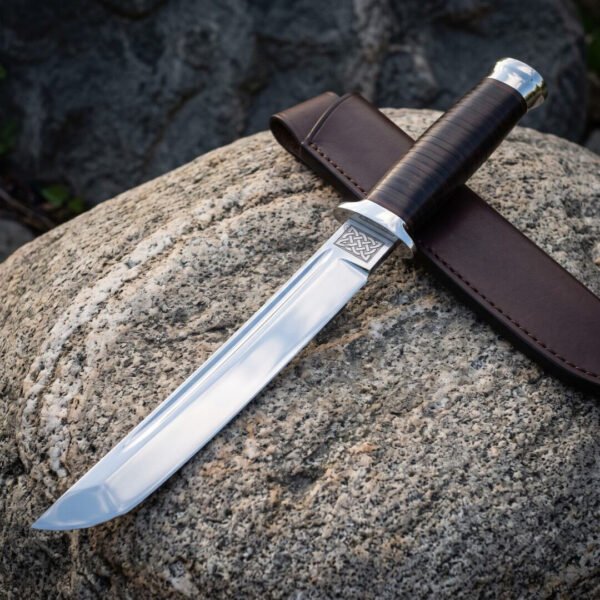
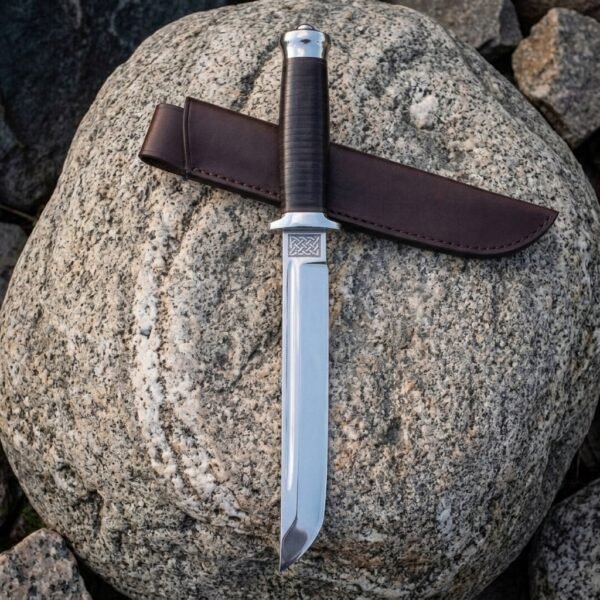
The spine is the flat top edge of the blade and it reads cleanly when the knife is laid down, which makes it the best place for a name or a rune row. The ricasso takes short marks. The flat of the blade is the widest canvas and the only one that suits a crest or a full stave. Engraved knives here run 8 to 20 inches overall with 6 to 11 inch blades at 11 oz to 1 lb 9 oz, carrying rune rows along the spine, knotwork bands, wolf heads behind the bolster and Valknuts on the ricasso.
Kukris and hunting knives
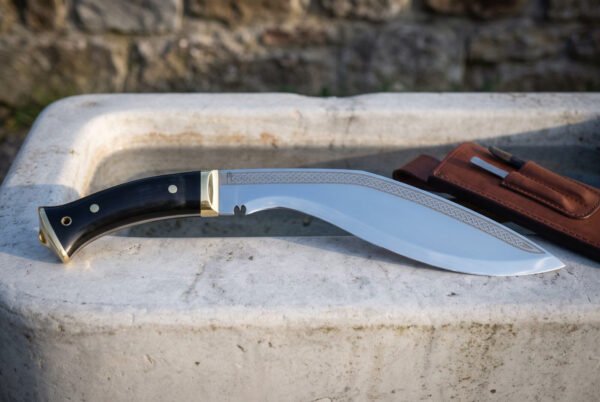
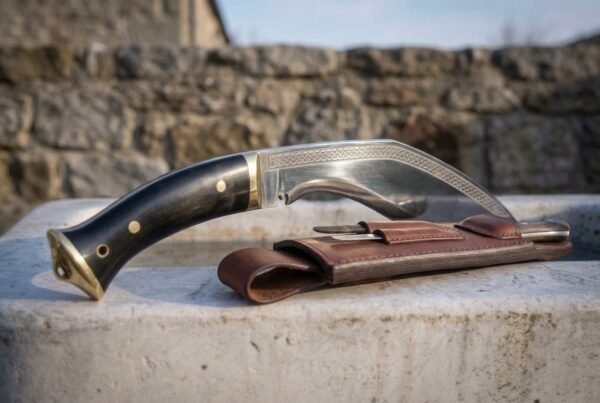
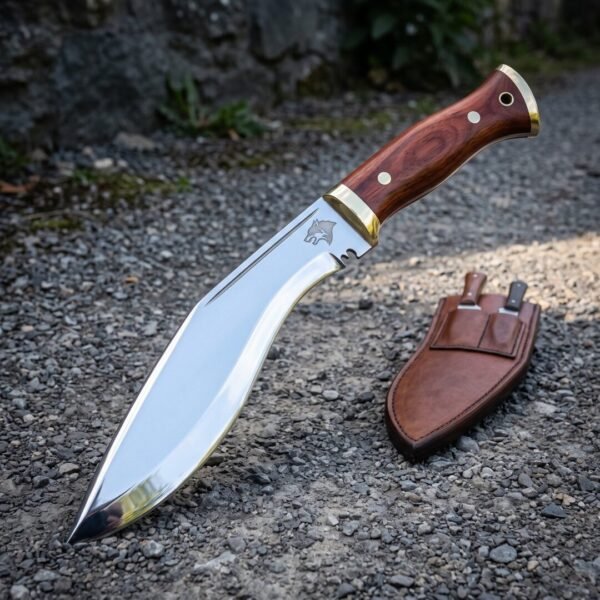
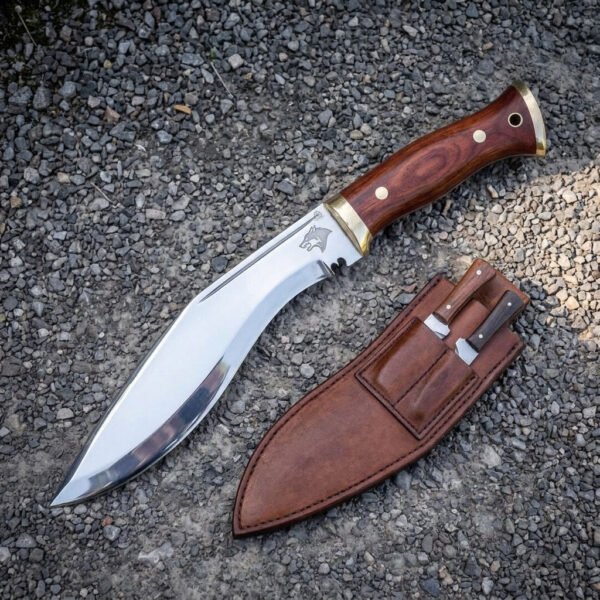
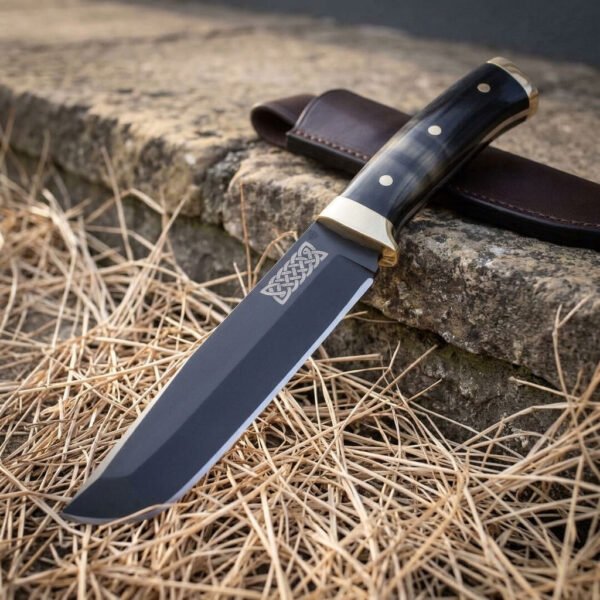
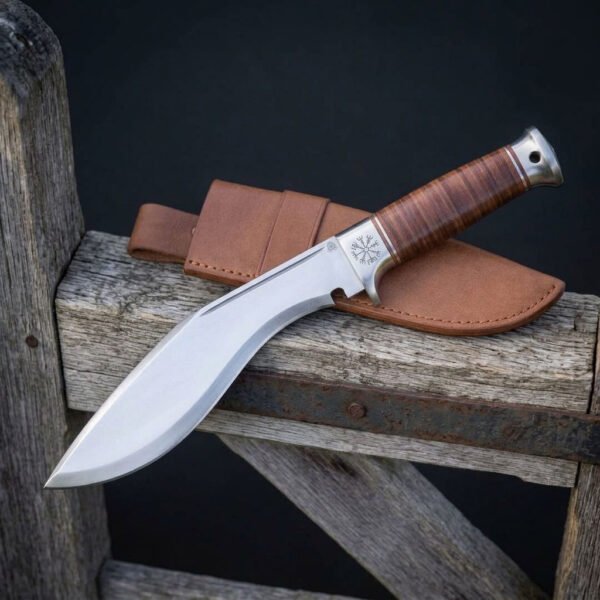
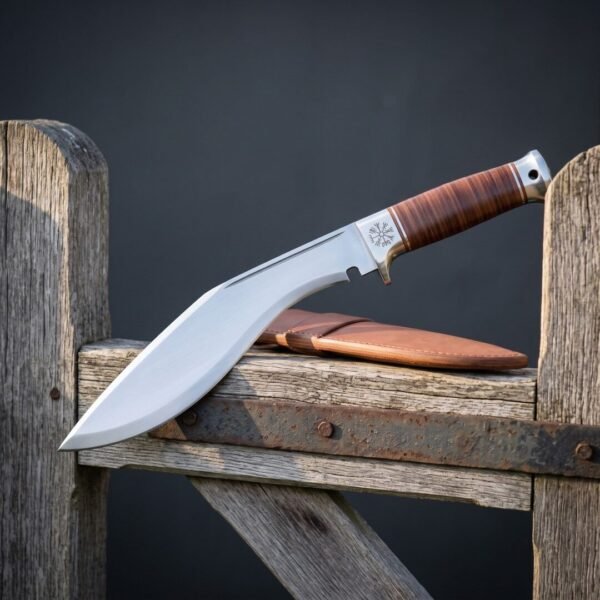
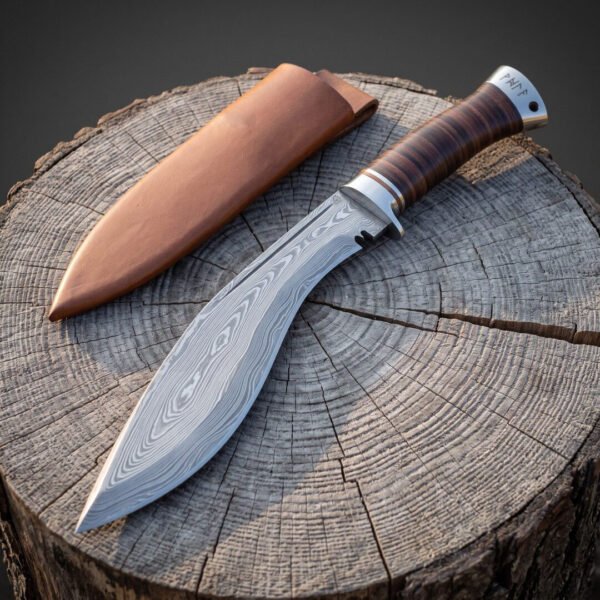
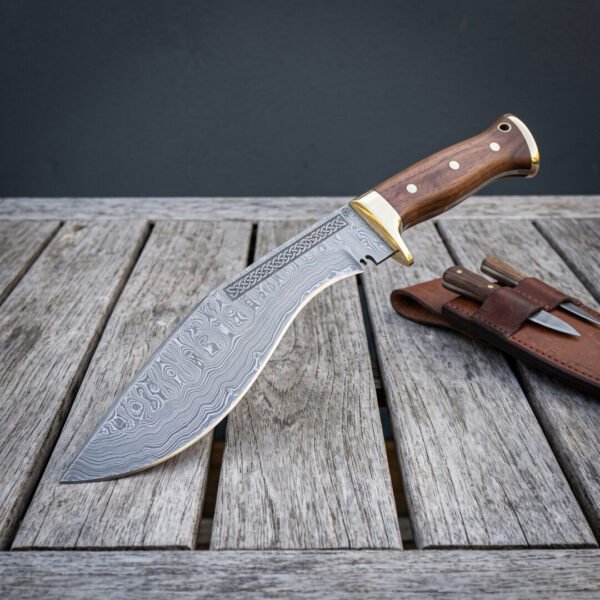
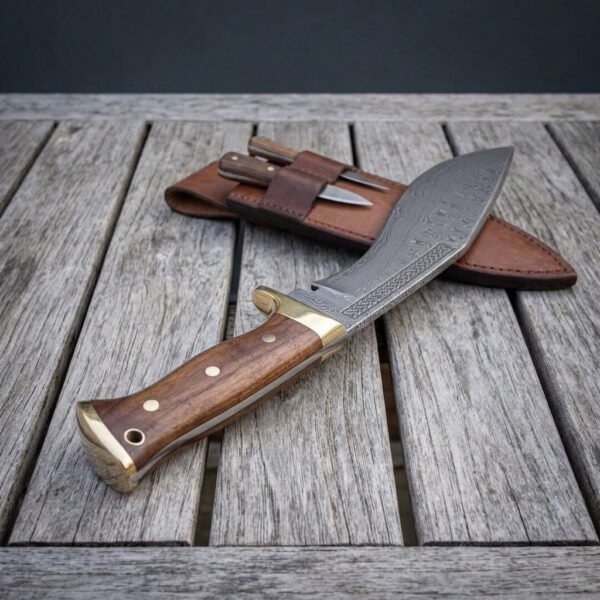
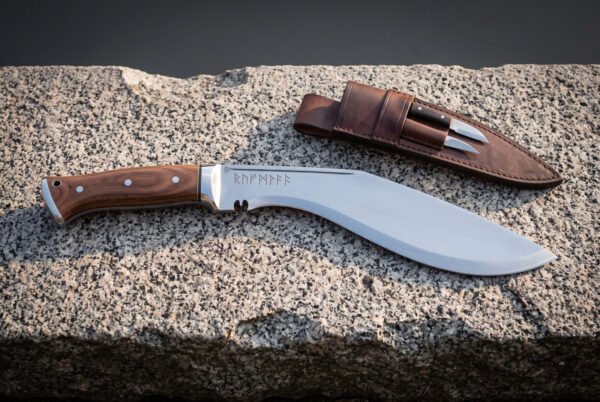
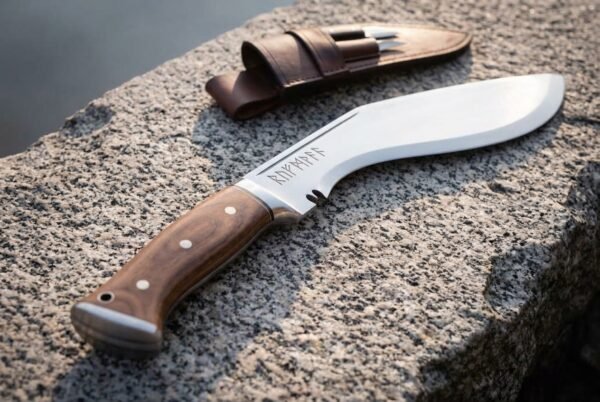
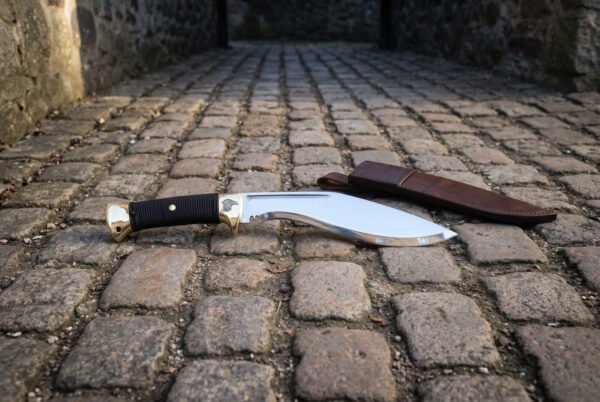
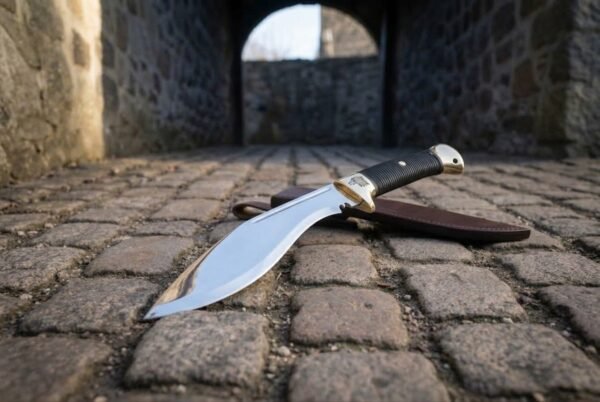
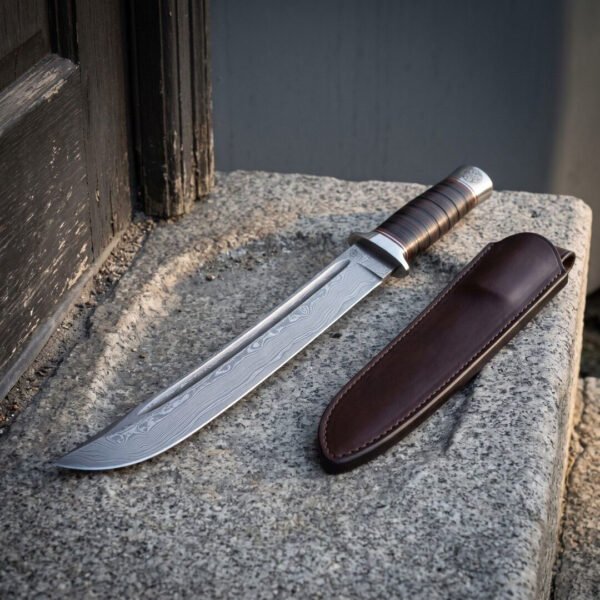
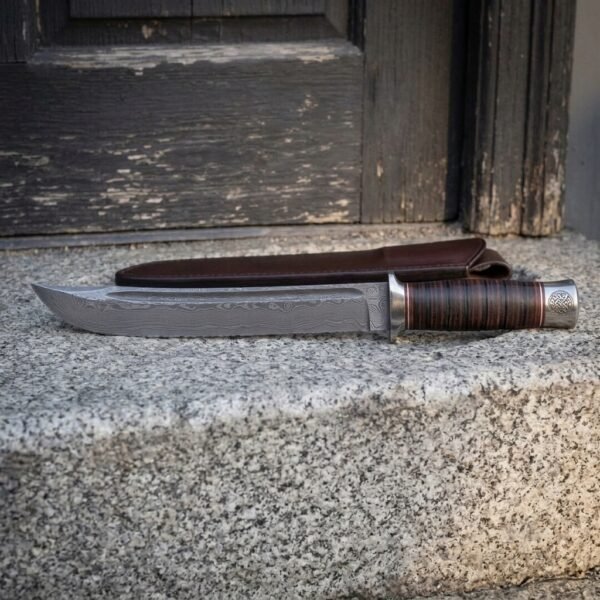
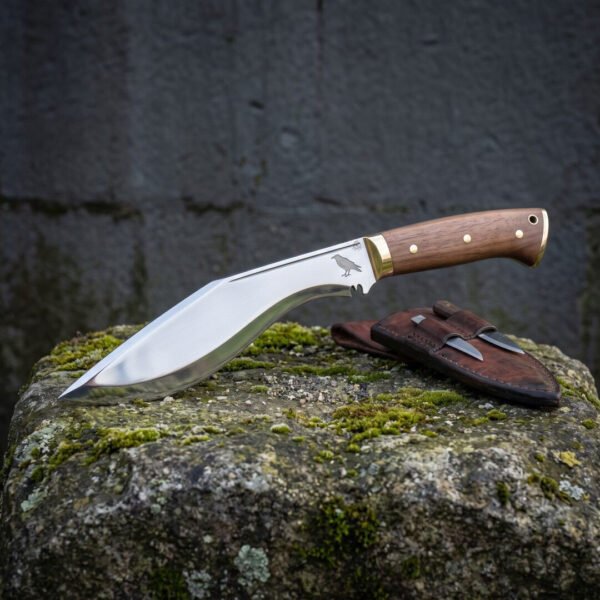
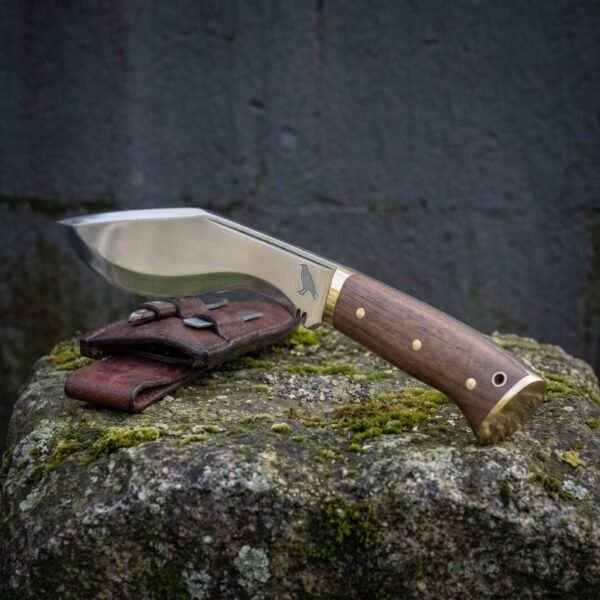
The kukris are 15 to 17 inches overall with roughly 11 inch blades at 1 lb 6 oz to 1 lb 8 oz, and the mark goes on the spine or the face of the bolster, with a Helm of Awe being a common request. Hunting knives run 8 to 16 inches overall with 7 to 11 inch blades at 12 oz to 1 lb 8 oz, marked on the blade flat or the ricasso above the cho notch.
Shields, helmets and horns
Not everything here is a blade. Round shields of 24 to 30 inches across, weighing 1 lb 14 oz to 9 lb, take a plaited knotwork band worked just inside the rim or across the widest point. Helmets weighing 4 lb up to 7 to 9 lb take a Valknut on the brow plate above the sight slit. Drinking horns of 12 to 16 fluid ounces take a stave on the outer face of the horn, a full twenty four character rune row following the outer curve, or a mark on the leather strap.
Damascus jewellery
The smallest pieces here, from about 0.3 oz to 1.6 oz. Runes are stamped rather than cut on rings, arm rings, pendants and beard beads, into the flats behind the terminals or the outer face of a band. On a pattern welded surface a stamped mark sits into the etch rather than on top of it, so it survives wear better than a shallow cut would.
Sizes, weights and placement across the range
Every figure below is taken from the specification panel of a piece in this category. These are hand made, so two pieces of the same name will differ a little. Read the ranges as what to expect.
| Piece | Size | Listed weight | Where the mark goes | Marks asked for |
|---|---|---|---|---|
| Arming sword | 31 to 40 in overall, 28 to 31 in blade | 2 lb 8 oz to 2 lb 12 oz | Ricasso and the flat above it | Yggdrasil roundel, knotwork panel |
| Viking sword | 26 to 38 in overall, 19 to 30 in blade | 2 lb 10 oz to 3 lb 2 oz | Flat above the ricasso, below the guard | Mjolnir with knotwork, Vegvisir |
| Longsword | 38 to 44 in overall, 30 to 34 in blade | 3 lb 2 oz to 3 lb 9 oz | Above the ricasso | Valknut, small circular device |
| Katana | 35 to 40 in overall, 24 to 28 in blade | 2 lb 6 oz to 2 lb 10 oz | Blade flat above the habaki | Triskelion |
| Short sword | 17 to 35 in overall, 18 to 24 in blade | 1 lb 14 oz to 2 lb 6 oz | Brass guard plate or shell | Running wolf, Vegvisir, knotwork |
| Viking axe | 15 to 35 in overall, 4 to 7 in edge | 1 lb 10 oz to 3 lb 4 oz | Cheek of the head, or the haft | Vegvisir, triquetra, Elder Futhark band |
| Knife and seax | 8 to 20 in overall, 6 to 11 in blade | 11 oz to 1 lb 9 oz | Spine, ricasso, flat behind the bolster | Rune row, knotwork band, wolf head |
| Kukri | 15 to 17 in overall, about 11 in blade | 1 lb 6 oz to 1 lb 8 oz | Spine or the face of the bolster | Knotwork band, Helm of Awe |
| Round shield | 24 to 30 in across | 1 lb 14 oz to 9 lb | Band just inside the rim | Plaited Norse knotwork |
| Drinking horn | 12 to 16 fl oz capacity | Not listed | Outer face of the horn, leather strap | Valknut, full Elder Futhark row, raven |
Size is the thing people underestimate when they choose a mark. Thirty characters look generous written down and small on the ricasso of a knife. If you want a long line, put it on a haft, a spine or the flat of a blade, where there is length to give it.
The symbols people ask for by name
These are staves and bound symbols rather than letters, and each one carries a meaning that survives being cut on a modern piece.
The Vegvisir is the wayfinder, eight staves around a centre so the carrier does not lose their way in bad weather. It comes from an Icelandic grimoire rather than from the Viking age, and it is still the most requested mark we cut. The Valknut is three interlocking triangles, found on the Stora Hammars stones and in the Oseberg ship burial, associated with Odin and with the bound fate of the slain. The Helm of Awe, Aegishjalmur, is eight tridents radiating from a point, worn between the brows in the sagas to hold the nerve steady. Yggdrasil is the world tree holding the nine realms, and it is cut most often on gifts marking a birth or a family line.
Mjolnir, triquetras, running wolves, ravens and plaited Norse interlace all appear on pieces in this category as well. None of them requires an explanation to work as a gift, which is part of the point.
How the mark is cut, and when
The piece is finished first. Forging, grinding, heat treatment and handle fitting all happen by hand in the Czech Republic. The finished piece is imported to the United States and inspected in North Babylon, New York, and only then is the mark cut, before the piece is sheathed and boxed. Nothing is engraved on speculation, which is why every engraved piece leaves as a one off.
Cutting after heat treatment matters. Engraving a blade before it is hardened risks the mark distorting as the steel moves in the quench, and it puts a stress riser into a part that is about to be brought to full hardness. Cutting into finished steel avoids both.
Add engraving time to the normal handling time on your order. If a piece is for a dated occasion, order with room to spare rather than to the day.
Gifts, weddings and groomsmen
An engraved axe or knife is the gift people keep, and the reason is simple: it has their name on it and it does not wear out. For a wedding party, matched pieces with different initials work better than identical ones, and a bearded axe at 1 lb 10 oz to 3 lb 4 oz complete is the piece that gets the reaction. For an anniversary or a birth, a date on a spine or a haft says more than a longer line would.
Engraving a larger set for a club, a team or a company? The wholesale page takes group orders, and pricing is worked out for the quantity.
Two practical points. Confirm that each recipient can legally receive what you are sending, because knife rules vary by state and shipping rules vary by carrier. And decide the wording before you order the set, since every piece is cut individually and a change of mind after the fact means a new piece rather than a correction.
Before you order
Send the exact spelling you want, in the exact capitalisation you want, and read it back once more before you submit. What you type is what gets cut. Check a date format, since 06 09 2026 means different months on either side of the Atlantic and the workshop cuts what is on the order.
An engraved piece is personalised and cannot be returned or exchanged. That is not a policy quirk, it is the nature of a one off cut into steel that nobody else will ever want. Everything else in the catalogue is covered by the normal returns and warranty terms.
If you are unsure how a name will look in runes, the engraving page has a transliteration tool that shows the exact staves the workshop cuts from.
Where these pieces are made
Every piece in this category is made by hand in the Czech Republic. Finished pieces are imported to the United States, inspected by Ransack Viking in North Babylon, New York, and shipped from there, with all engraving cut in the United States after arrival. Small differences in grind, colour, grain and finish between two pieces of the same name are normal, because two people made them on two different days.
Browse categories that take a mark
- Viking axes, the cheek and the haft both take a mark
- Viking knives and seax with room on the spine
- Viking swords marked above the ricasso
- Arming swords for a knightly single hander
- Swords across every medieval and Norse type
- Kukri knives marked on the spine or bolster
- Hunting knives for a field gift
- Damascus knives in forge welded 1095 and 15N20
- Wedding and groomsmen gifts already chosen for the job
- Drinking horns with room for a full rune row
- Viking round shields with a knotwork rim band
- Damascus steel jewellery with stamped runes
Guides worth reading first
- Engraving on knives: the options, placements and rune chart
- Elder Futhark: every rune, its name and its sound
- Viking symbols and their meanings
- Groomsmen gifts: engraved axes, knives and what gets kept
- Viking wedding gifts that are not a novelty
- The Valknut: where it appears and what we actually know
- Viking names and what they meant
- Odin the All Father, what the sources actually say
Frequently asked questions
What can be engraved?
Most of the catalogue: swords, axes, seax and hunting knives, kukris, katana, chef knives, folding knives, shields, helmets, drinking horns and Damascus jewellery. If a particular piece cannot take a mark, its own product page says so before you buy.
How many characters can I have?
Up to thirty for plain lettering. That is generous on a haft or a blade spine and tight on the ricasso of a small knife, so match the length of the line to the surface you are putting it on.
Can you cut my name in runes?
Yes. You type in English and the runes are cut from the transliteration, with both versions recorded on the order so the spelling can be proofread. Elder Futhark is phonetic, with twenty four staves and no rune for C, Q, V, X or Y, so those are cut as the nearest sound. TH, NG and EI are single staves.
Where on the piece does the mark go?
On a blade, the spine, the ricasso or the flat. On an axe, the cheek of the head or the haft. On a shield, a band inside the rim. On a helmet, the brow plate. You can say where you want it in the order notes, or leave it and it is placed where the piece reads best.
Can I send my own crest or logo?
Yes, uploaded at checkout. Line art or a solid silhouette reproduces in steel much better than a photograph, because engraving has no greyscale. Send the simplest version of the image you have.
Can an engraved piece be returned?
No. Personalised pieces are cut individually and cannot be returned or exchanged, so check the spelling, the capitalisation and the date format before you order. Everything unengraved is covered by the normal returns and warranty terms.
Does engraving weaken the blade?
Not at the depths used here. The mark is cut into the flat of a finished, hardened blade rather than into an edge or a load bearing section, and it is shallow relative to the thickness of the steel. It is also cut after heat treatment, so nothing moves afterwards.
Where is the engraving done?
In the United States. Pieces are made by hand in the Czech Republic, then imported and inspected by Ransack Viking in North Babylon, New York, and the mark is cut there after arrival and before the piece is sheathed.
Featured pieces
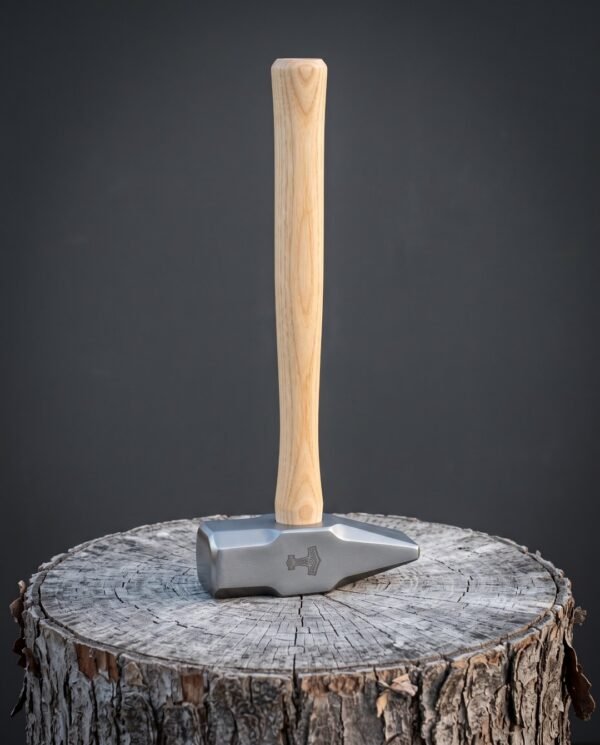 Thunderpein Hand Forged 1095 Steel Cross Pein Blacksmith Hammer with Mjolnir Engraving & Ash Handle
$229.00
 Knotpein Hand Forged 1095 Steel Cross Pein Forging Hammer with Mirror Polished Head & Knotwork Cheek
$199.00
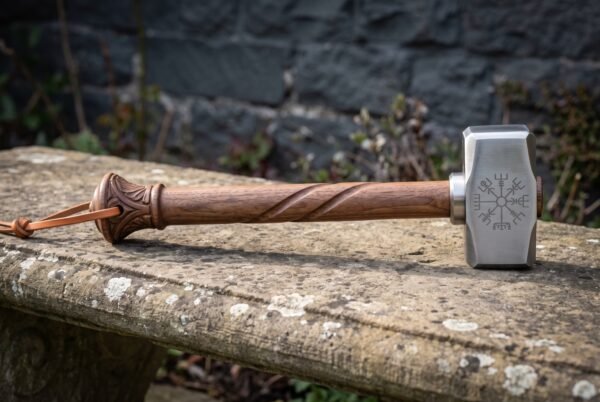 Wayrune Hand Forged 1095 Steel Blacksmith Hammer with Vegvisir Engraving & Carved Rosewood Handle
$199.00
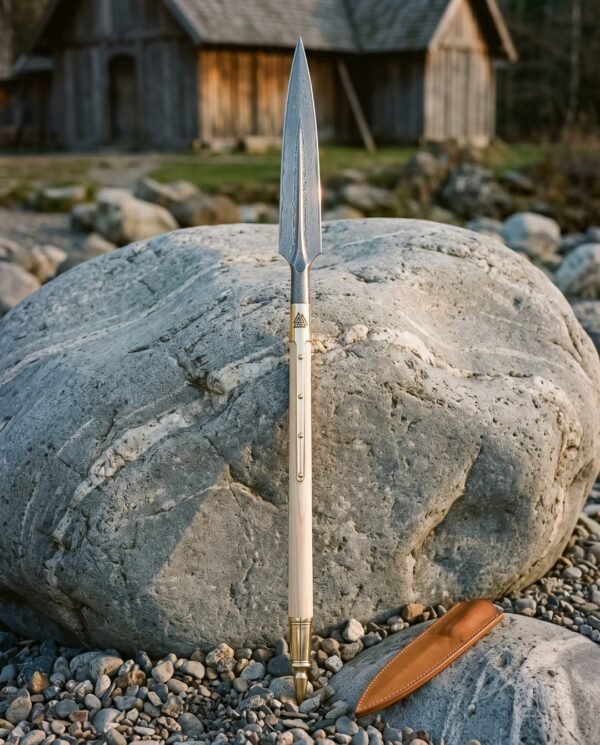 Ashreach Hand Forged Damascus Viking Spear with Leaf Shaped Head
$349.00