There is a good reason the messer survived so long as a type. It is the most economical sword design in European history. A knife maker could build one with the tools already on his bench, the flat tang wasted no steel, and the single edge meant only half as much grinding as a double edged blade. When you take that efficient shape and build it out of forge welded Damascus, you get something the original cutlers would have recognised immediately and could never have afforded to make. Pattern welding was a labour heavy technique that had gone out of general use in Europe centuries before the messer appeared, kept alive afterwards mainly for prestige pieces. For which of our two steels suits you, read Damascus or high carbon.
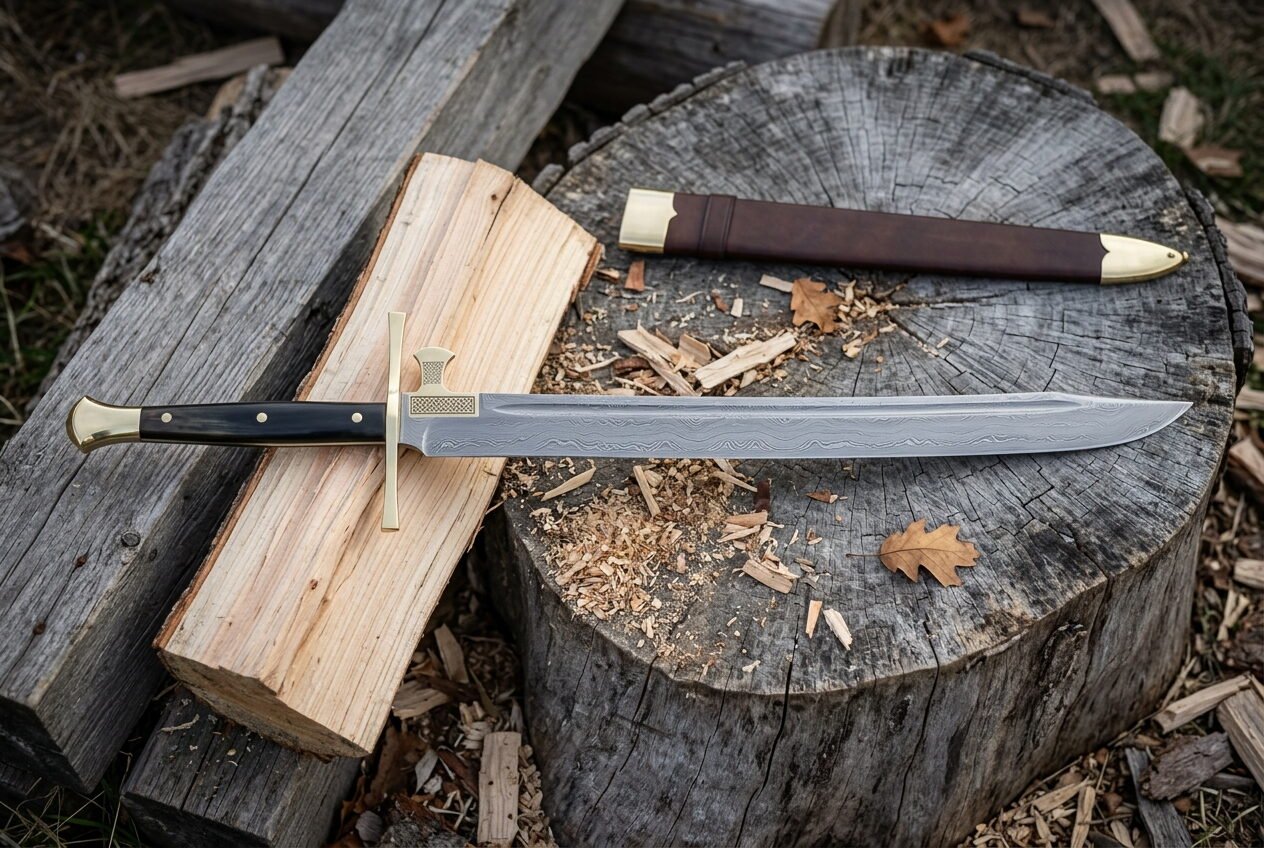
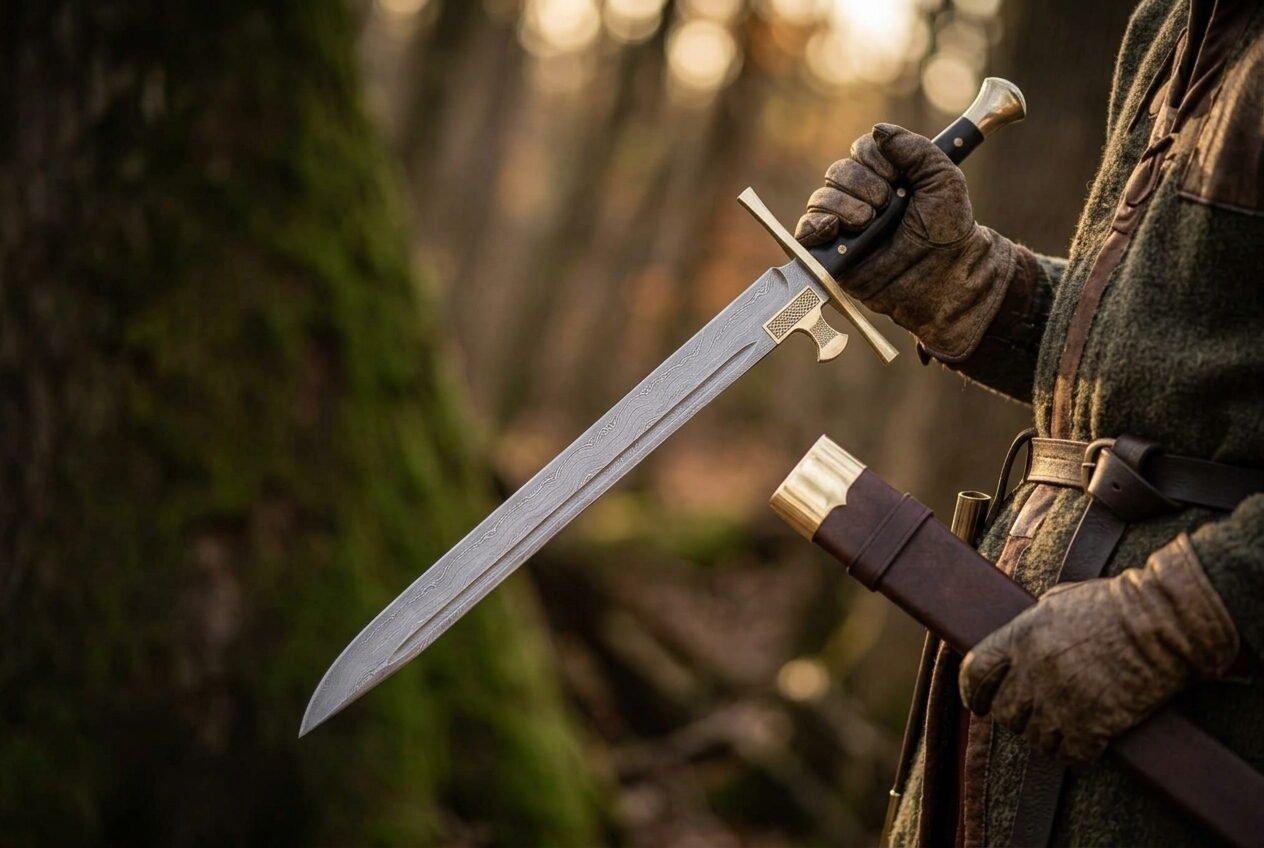
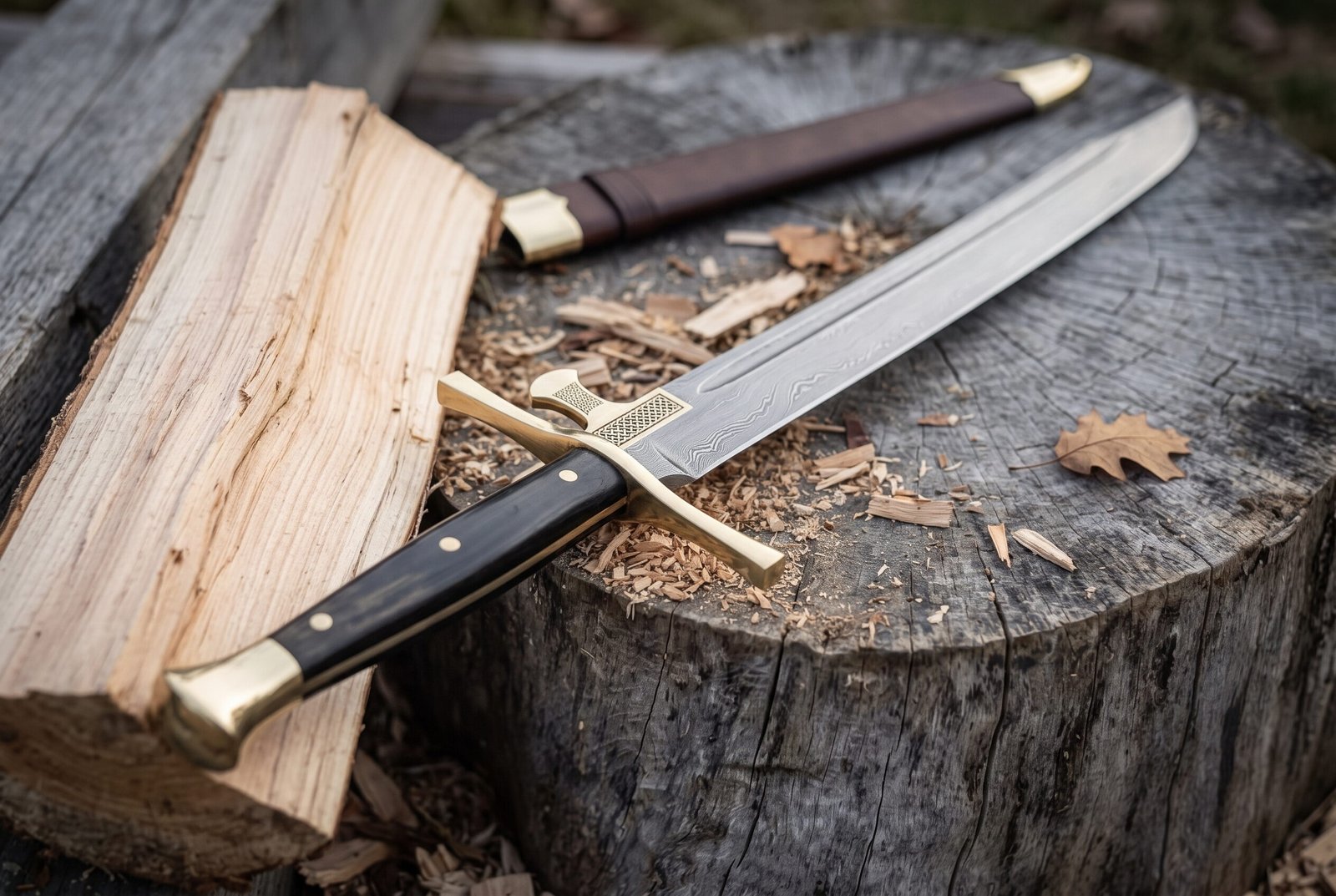
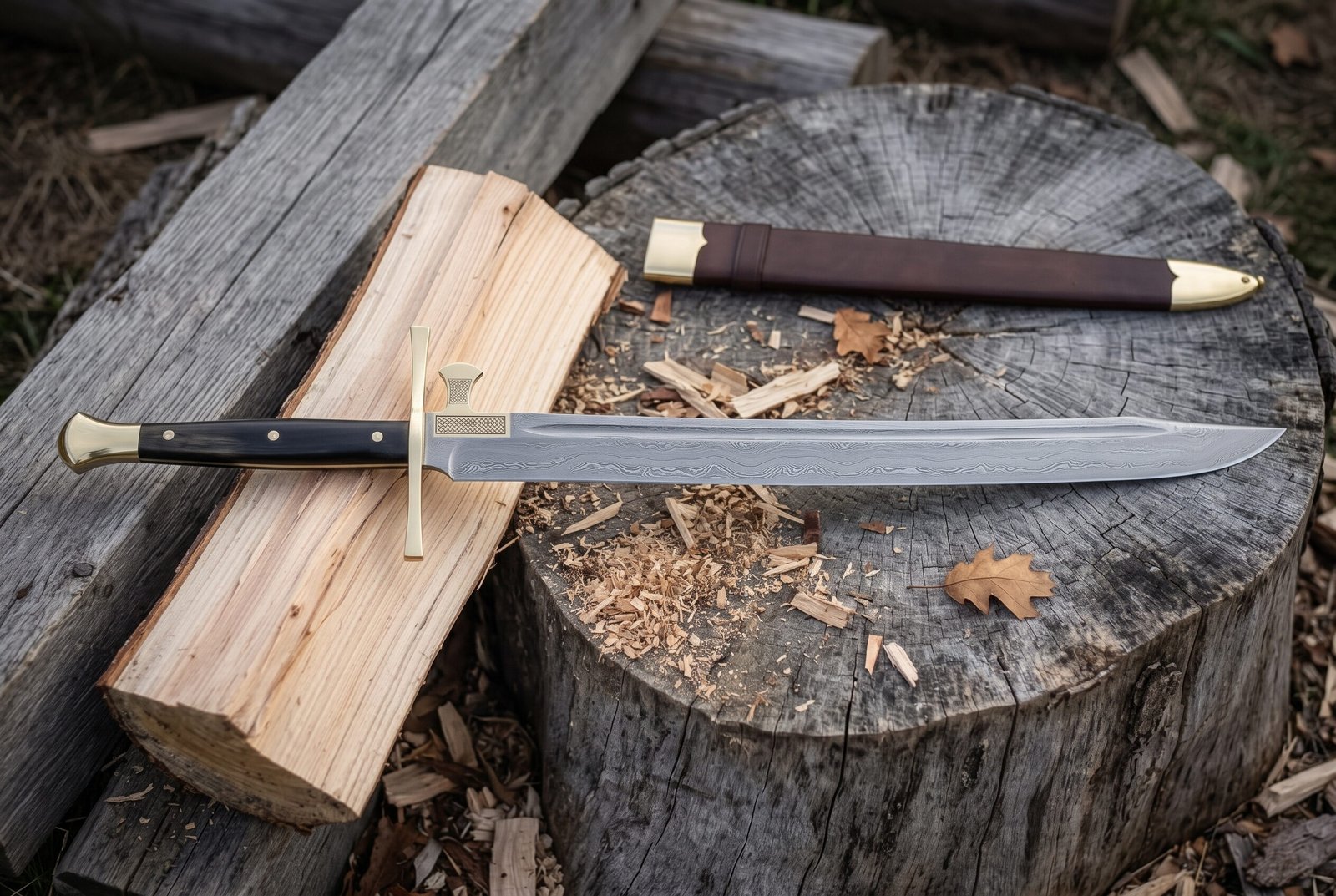
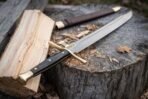
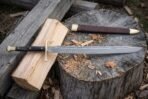
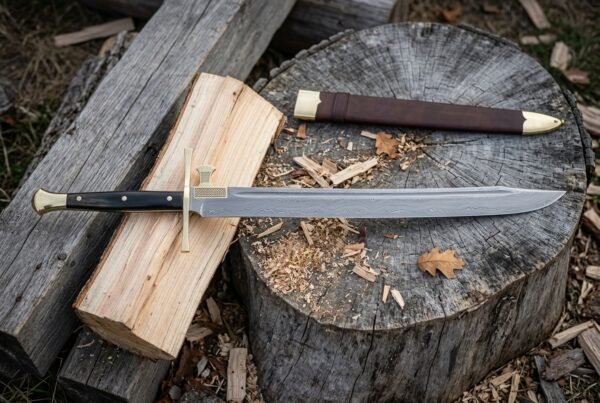
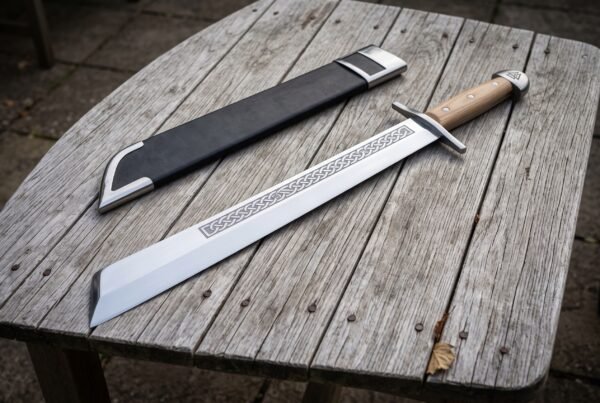
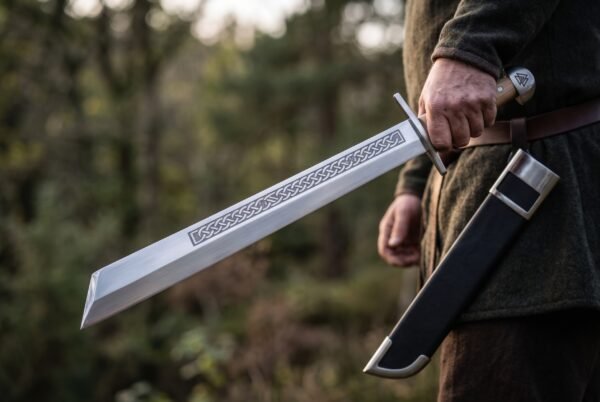
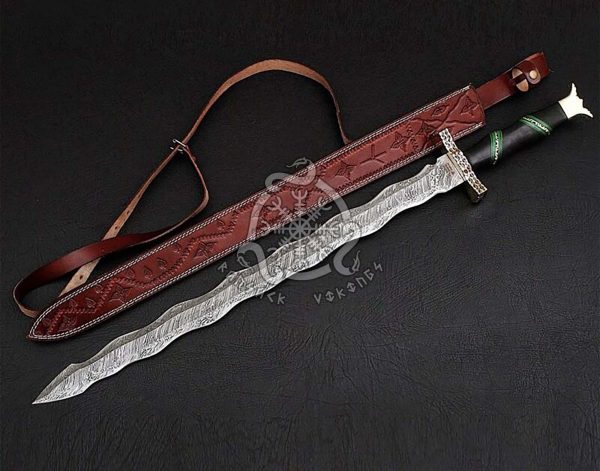
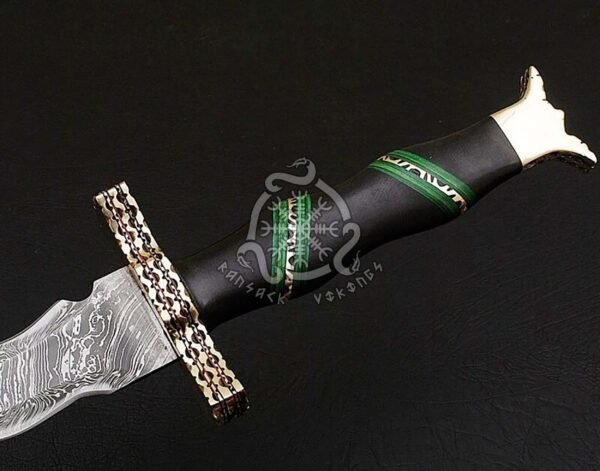
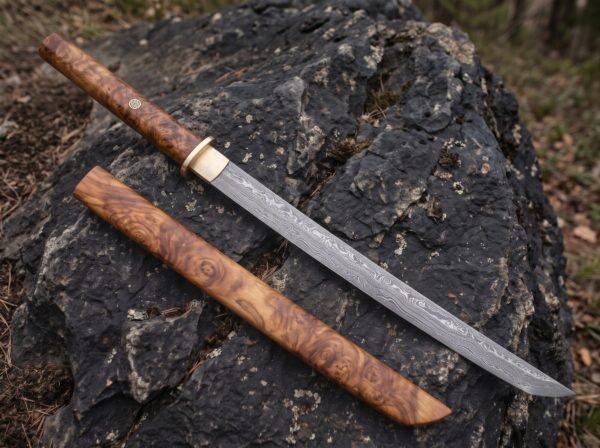
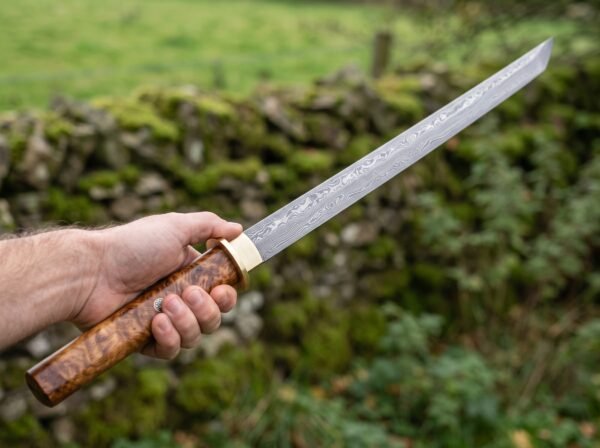
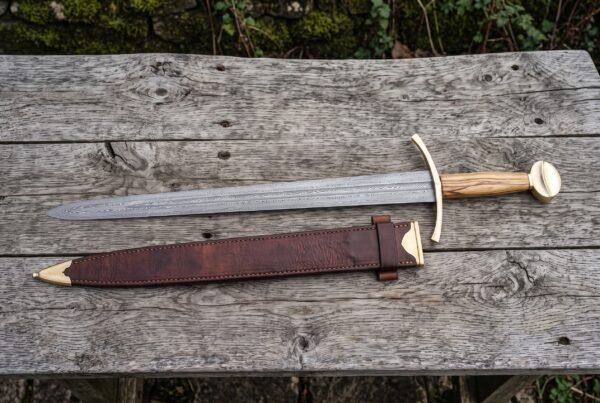
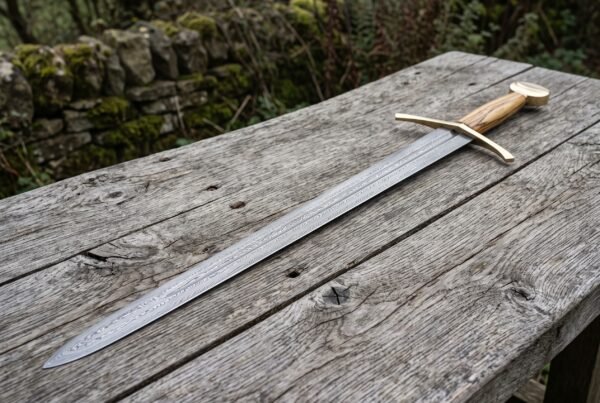
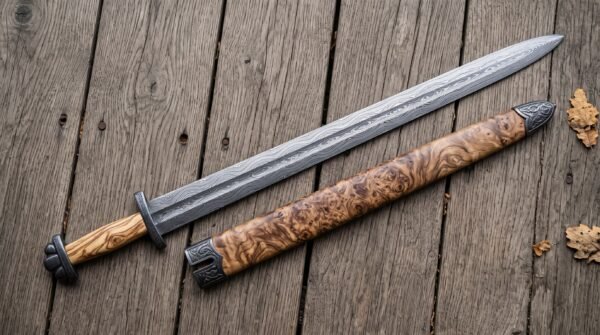
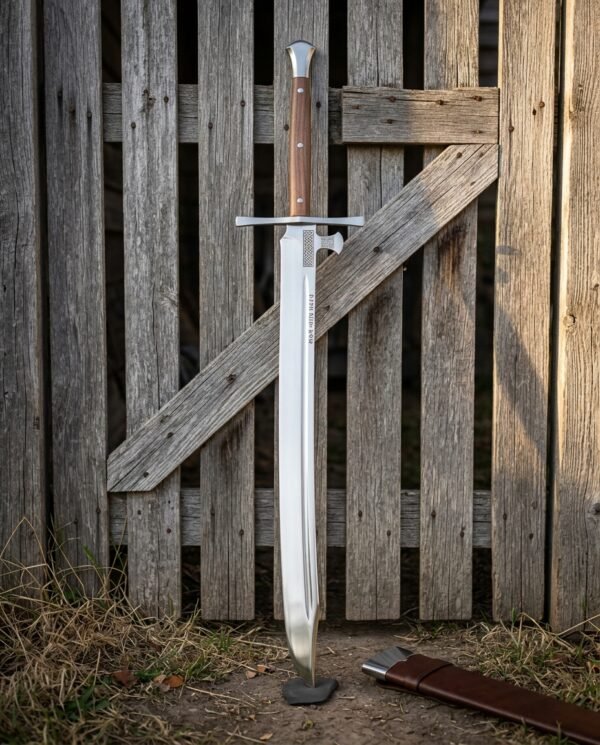
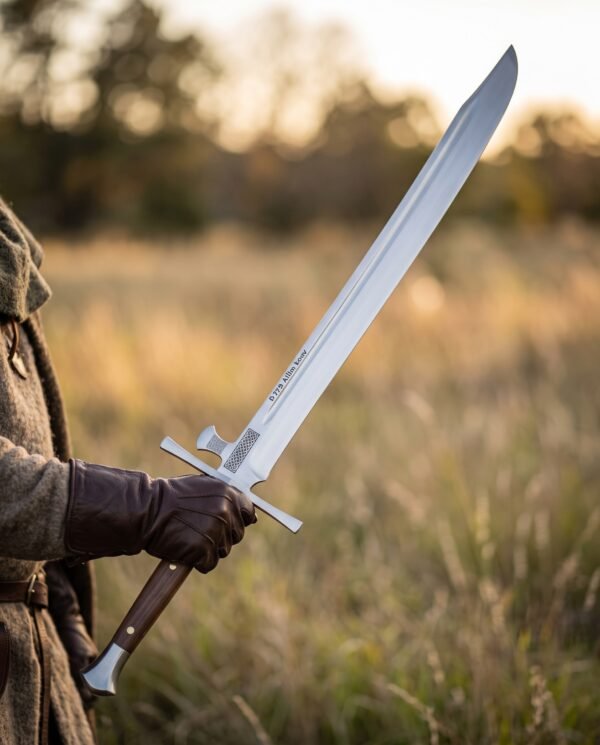
This Damascus messer is forged and finished by hand in the Czech Republic. The blade is 1095 and 15N20 forge welded in alternating layers, hardened to 58 to 60 HRC and etched so the pattern reads clearly across the flat. The hilt is a dark hardwood grip with brass pins, a straight brass crossguard with a side nagel and a brass pommel cap. It ships in a brown leather sheath with a brass chape, and shipping inside the United States is free.
Specifications
| Steel | 1095 and 15N20 forge welded Damascus |
|---|
| Hardness | 58 to 60 HRC |
|---|
| Overall length | 32 inches |
|---|
| Blade length | 25 inches |
|---|
| Blade width | 1.8 inches |
|---|
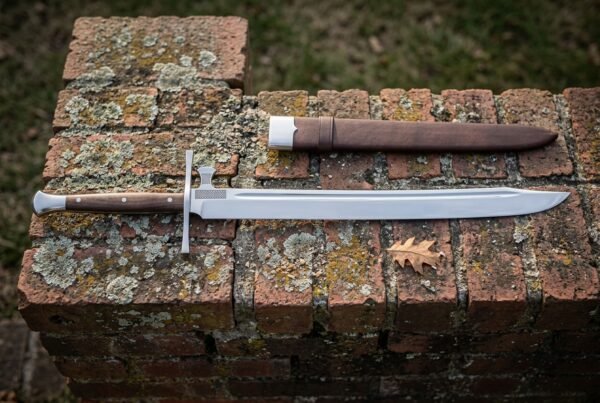
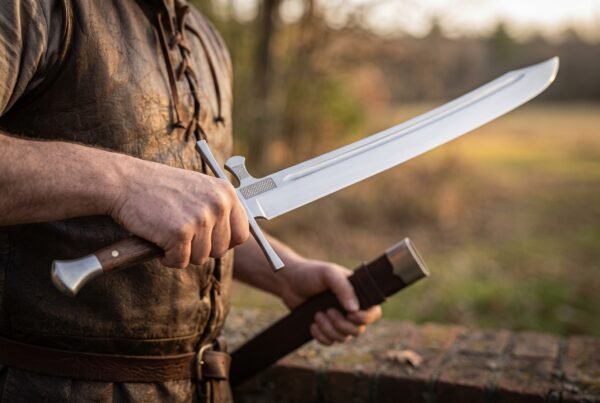
| Blade | Single edged, straight backed, with a narrow fuller along the spine and a slight clip at the point |
|---|
| Guard | Straight brass crossguard with a brass nagel and a knotwork brass plate at the blade root |
|---|
| Handle | Dark hardwood grip scales, 7 inches |
|---|
| Pins | Three brass pins |
|---|
| Pommel | Brass pommel cap |
|---|
| Sheath | Brown leather with brass throat and brass chape |
|---|
| Weight | Approximately 2 pounds 6 ounces |
|---|
| SKU | RK-1298 |
|---|
Why a messer blade shows Damascus so well
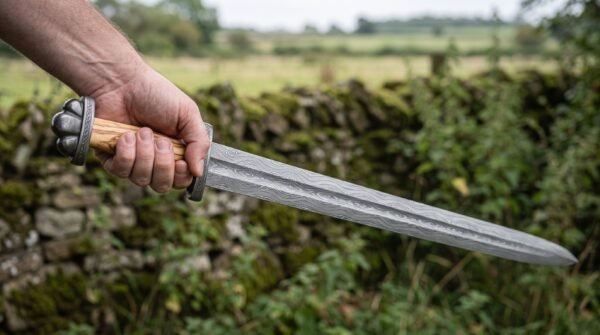
Pattern welded steel needs a surface to be seen on, and a messer gives it one. The blade is broad, the spine is straight, and because only one side is sharpened the flat above the edge stays wide from the guard to the clip. A narrow fuller runs close to the spine, so the pattern stays unbroken across the main flat below it, and there is no distal taper so aggressive that the layers compress into a blur at the tip.
The other thing that helps is the way the blade is forged. Drawing a billet out into a long straight blade stretches the layers along its length, so the bands run parallel to the spine and the eye follows them naturally from hilt to point. Grinding the single bevel then cuts across those layers at a shallow angle, which is why the pattern turns and swirls along the edge line while staying orderly on the flat. You are seeing the internal structure of the billet exposed by the geometry of the blade, not a surface treatment.
Why Damascus and not stainless
Two steels are used at this forge. Plain blades are 1095 high carbon steel at 54 to 58 HRC. Damascus blades like this one are 1095 and 15N20 forge welded together and taken to 58 to 60 HRC.
Those two are paired because they weld to each other cleanly and they react differently to acid. 1095 darkens in the etch, 15N20 has enough nickel to stay bright, and the contrast between them is what you can see. The nickel also toughens the billet, which is why we can run a Damascus blade a couple of points harder than a plain one without it becoming fragile. Stainless steel is ruled out on all three counts. Its chromium prevents a sound forge weld, it will not etch into contrast, and in a long blade it is brittle. Read Damascus versus stainless for the full comparison.
The hardwood grip and brass fittings
The grip is dark close grained hardwood, long enough at seven inches to take a second hand for a heavy cut, shaped to a flattened oval so the edge orientation is always obvious. A straight brass crossguard with a nagel on the side closes the front of the grip, three brass pins hold the scales to the tang and a brass pommel cap finishes the rear. Brass was chosen because its warm tone reads against the cool grey banding of the etched Damascus far better than steel would.
Keep the wood out of direct sun and dry heat and oil it once or twice a year so it does not shrink away from the brass. Our wooden handle care guide covers the routine.
Engraving, runes and your own design
Use the rune converter on this page to turn a name, a date or a short phrase into Elder Futhark and we will cut it into the steel or the handle. If you would rather have a Viking pattern than a rune line, choose your own design in the engraving option above the add to cart button and tell us whether it goes on the blade or the handle. Where a piece already carries an engraved design, your chosen engraving replaces it rather than sitting alongside it. Cut lettering on Damascus stands out because the fresh cut is bright against the etched flat. Examples are on the engraving page.
Care and sharpening
Etched Damascus needs a little more care than a plain polish. The acid that reveals the pattern also opens the surface slightly, so keep a light film of oil on the blade and wipe it after handling. Never use abrasive polish, wire wool or a rust eraser on the flats, because they will lift the etch and flatten the contrast permanently. Our steel care page explains how to deal with spotting without losing the pattern.
Sharpening does not affect the pattern on the flat, because you are working the bevel. Lay the existing bevel on a medium stone, take slow full length passes, refine on a fine stone and clear the burr on the back. Raise the handle a little through the clip so the point stays crisp. See sharpening with a whetstone.
Made in the Czech Republic
This is a handmade piece from the Czech Republic, made in a workshop that still forges, grinds and finishes by hand instead of stamping parts out. The smiths there have kept the older way of working, and the wood, horn and leather are shaped and fitted by hand as well. Two pieces of the same design will never be identical, and that is part of what you are buying.
Ransack Viking is a United States company. We handle the import ourselves, look over every piece when it lands and ship from our warehouse in Chicago, Illinois. Engraving is done in the United States after the piece arrives, so your design goes on before we send it out.
A note on handmade variation
This messer is hand forged. It is not machine made and it is not bulk produced, so what arrives will not be a pixel for pixel copy of the photograph. The Damascus figure is the obvious example, since no two billets fold identically, but the wood grain, the brass tone and the exact line of the clip vary too, because every part is worked by hand from natural materials. The dimensions, the steel, the layer count and the build are the same every time. The character is not.
Frequently asked questions
Is the pattern really forge welded?
Yes. The blade is made from a billet of 1095 and 15N20 welded, drawn and folded, so the pattern runs through the full thickness. It is not printed, etched on or coated.
Is it sharp, and can I cut with it?
It arrives sharp and it is a working messer, full tang and hardened through. Tatami, bottles and light green wood are all fine. It is not meant for steel to steel sparring.
Can I have runes engraved on the blade?
Yes. Use the rune converter above for Elder Futhark or choose your own Viking pattern in the engraving option. Cut lines read brightly against the etched surface.
Will my pattern match the photograph?
It will be the same style and contrast, but the exact figure is unique to your billet. Dimensions, layer count and hardness are consistent.
What is the difference between this and the plain steel messers?
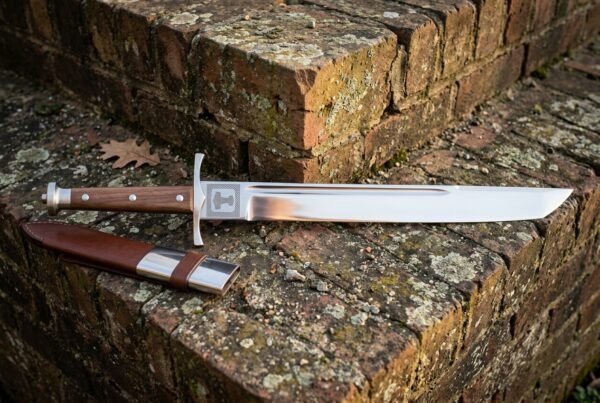
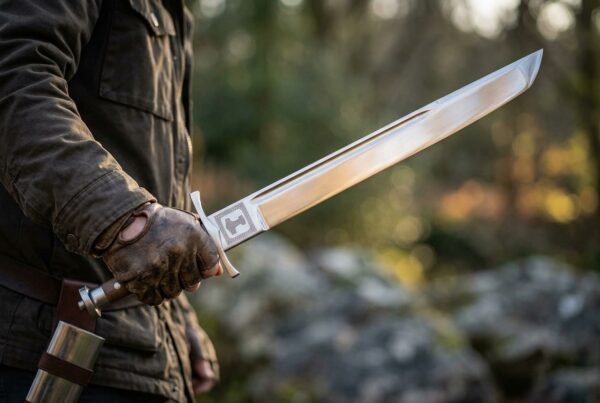
The plain messers are 1095 at 54 to 58 HRC with a bright polish. This one is forge welded 1095 and 15N20 at 58 to 60 HRC, etched, with brass fittings and a harder edge. It also takes a good deal longer to build.
How long does it take to arrive?
Shipping is free inside the United States, and stock pieces arrive five to seven business days after dispatch. Damascus takes three to four weeks in the shop first.
What is in the box
- One hand forged 1095 and 15N20 Damascus messer, 32 inches overall
- One brown leather sheath with brass chape
- Care card written specifically for etched Damascus
- Your Elder Futhark rune line or chosen pattern, if engraving was ordered
- Forged and finished in the Czech Republic
Explore the range
See the other Damascus swords, the plain steel messers, the falchions and the full sword range, or read the guides.
Also in this part of the catalogue
Sitting beside it in the catalogue is the Thornreave messer, 32 inches overall. Another in the same line is the Palebriar messer, 31 inches overall. Next along the rack is the Mossgrave messer, 32 inches overall.
Fitting out further, the Elmshade longsword belongs with it. Or start from a blank sheet on the custom Viking sword page.
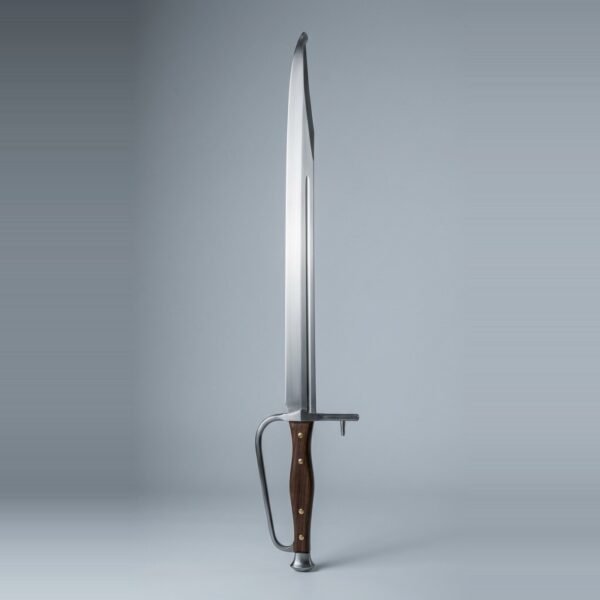
Our HEMA line includes the Brunhak messer trainer for drills and sparring, and our messer guide is the place to look next.

Reviews
There are no reviews yet