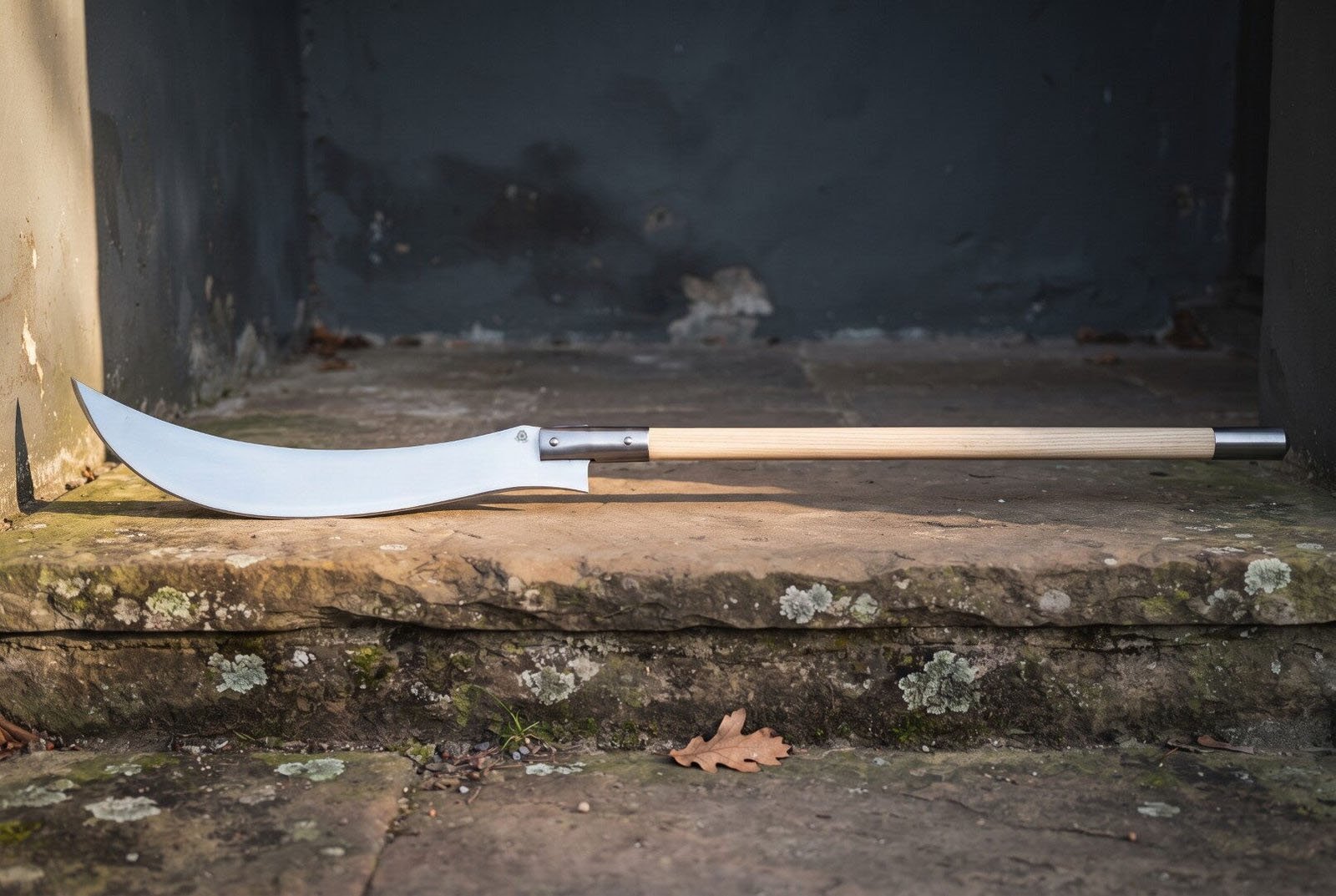
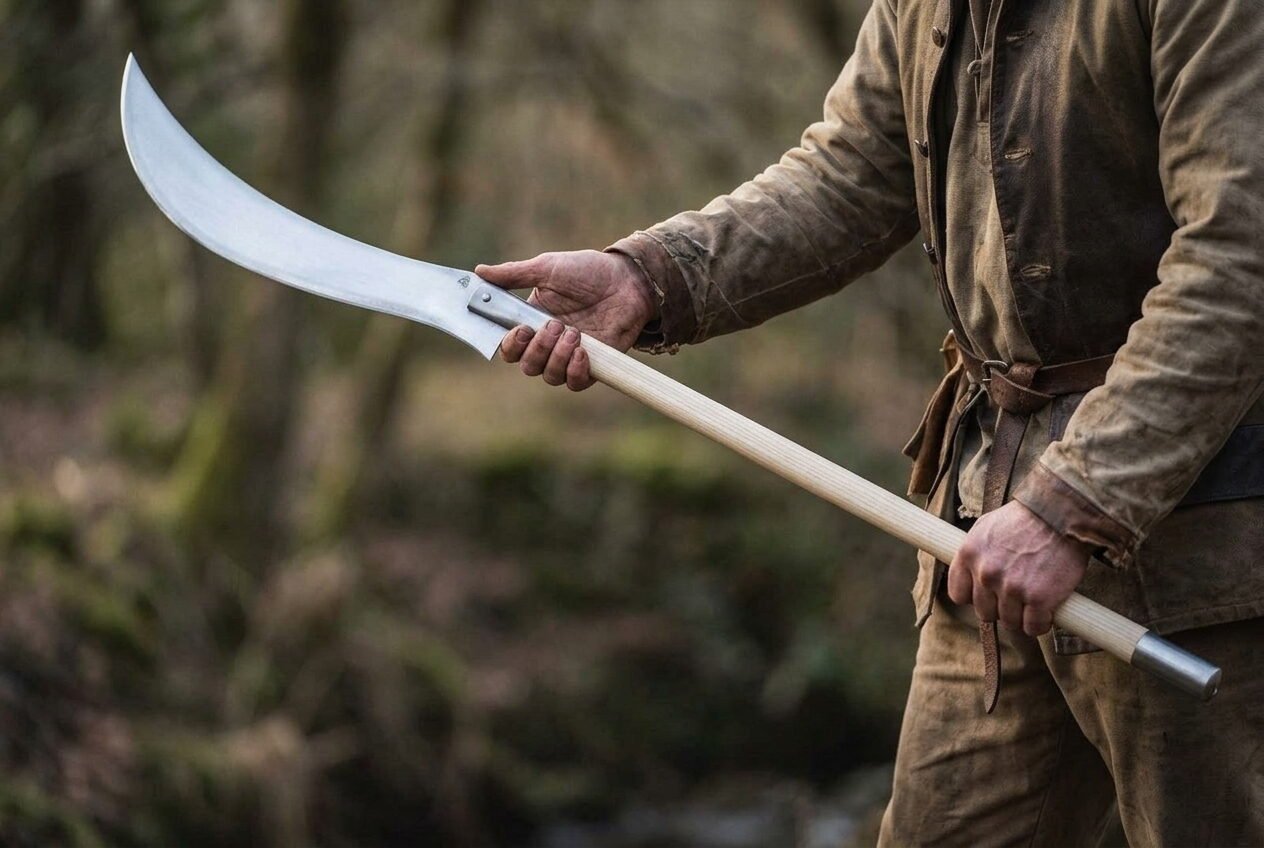
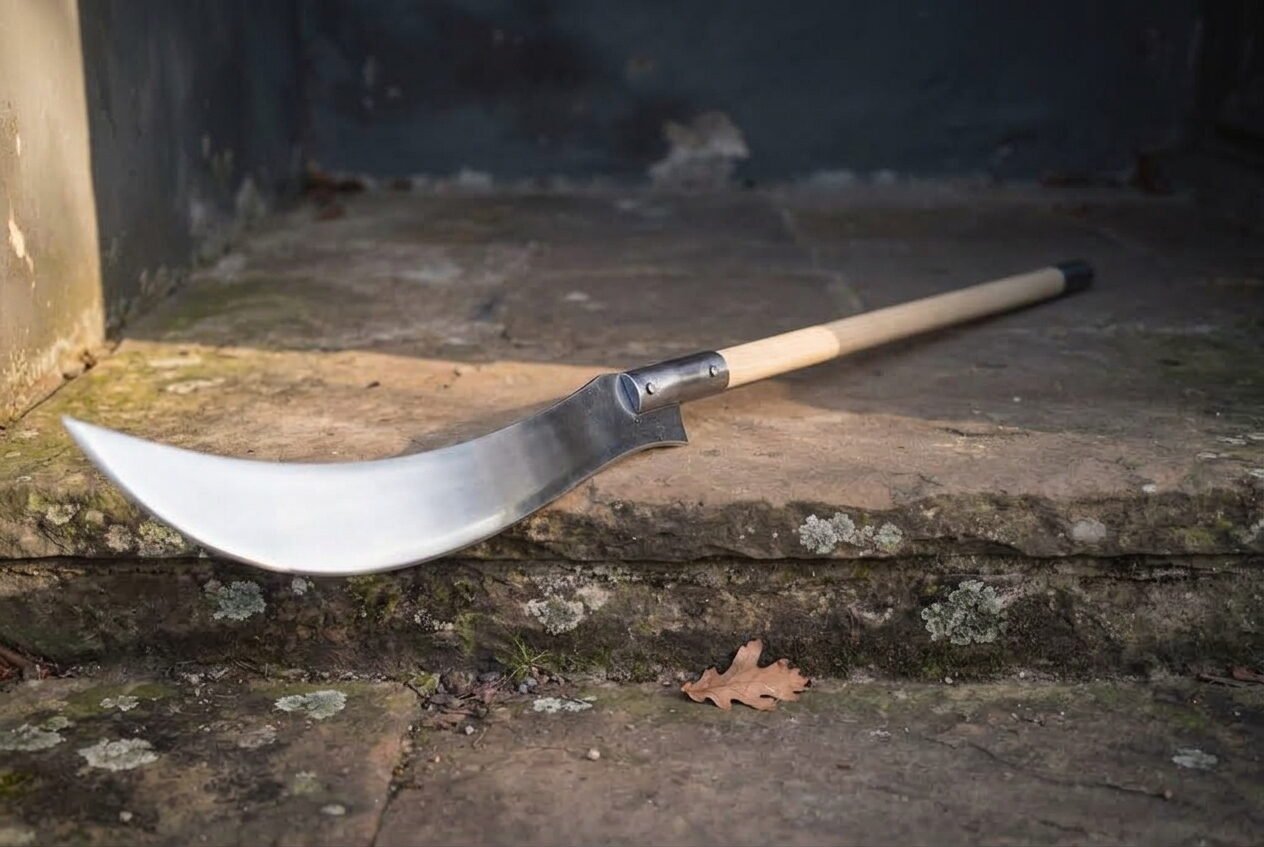
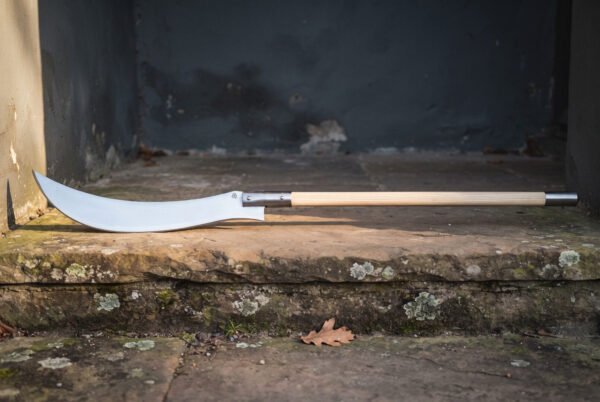
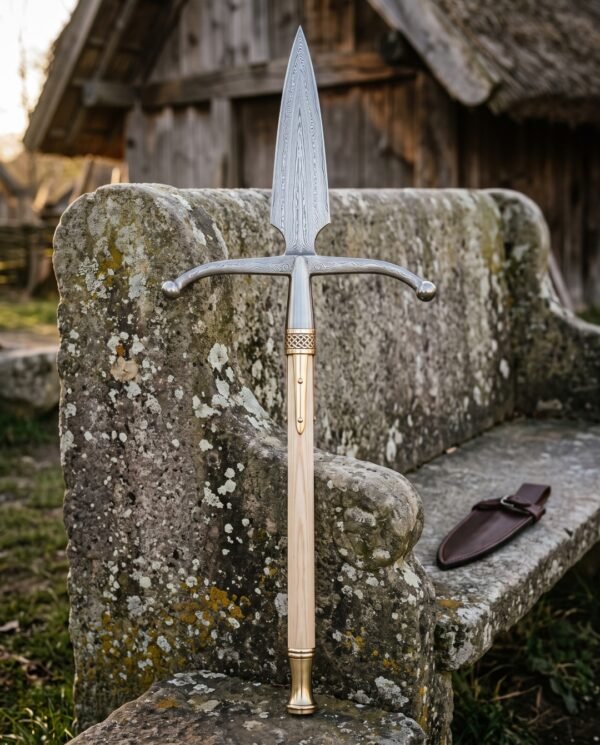
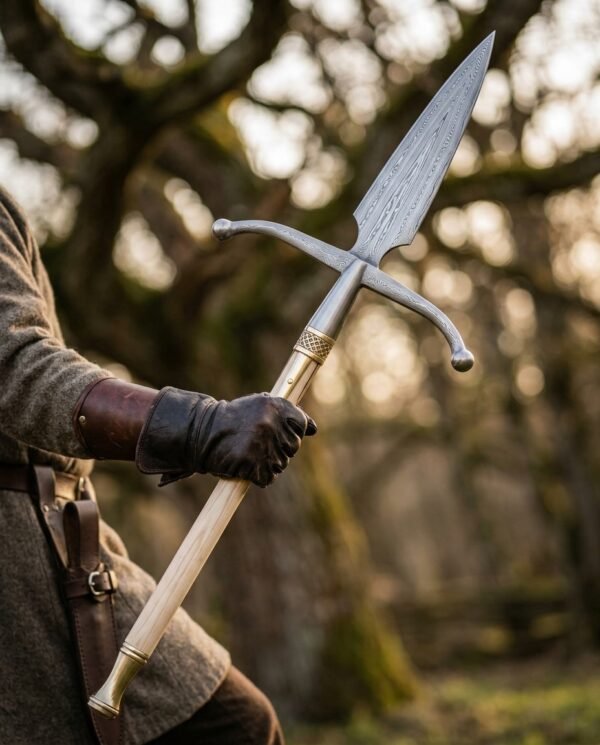
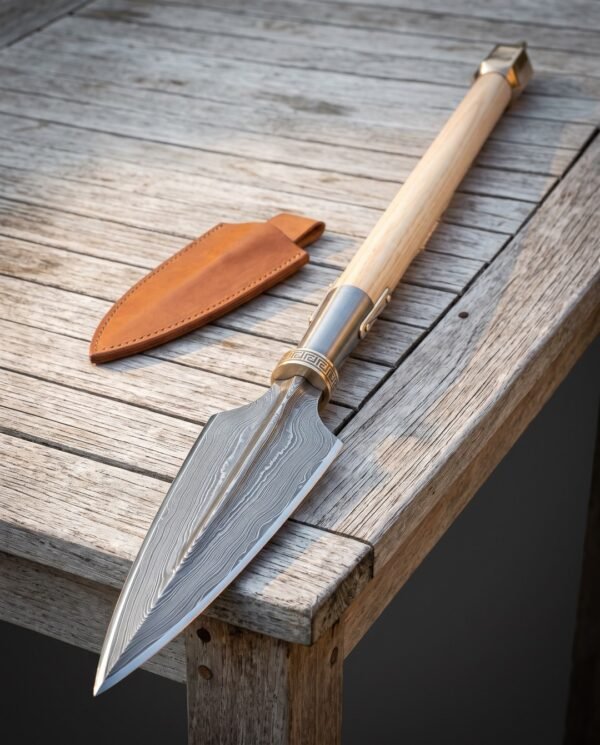
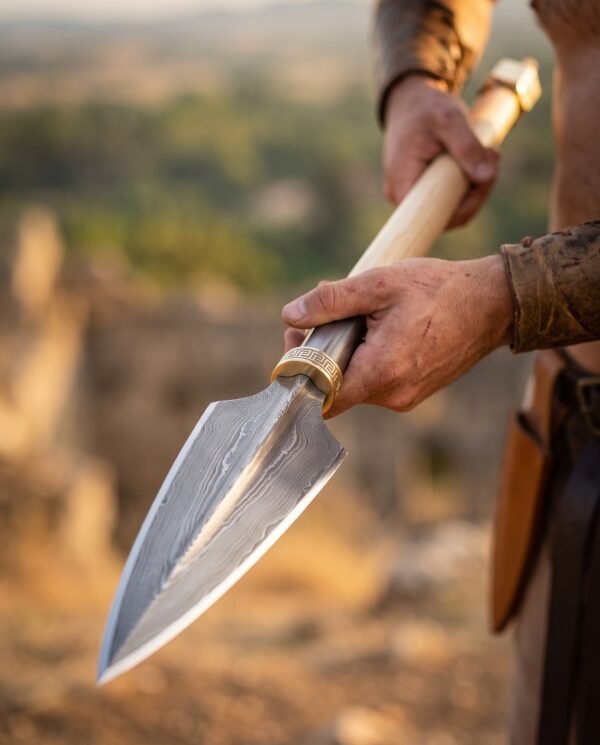
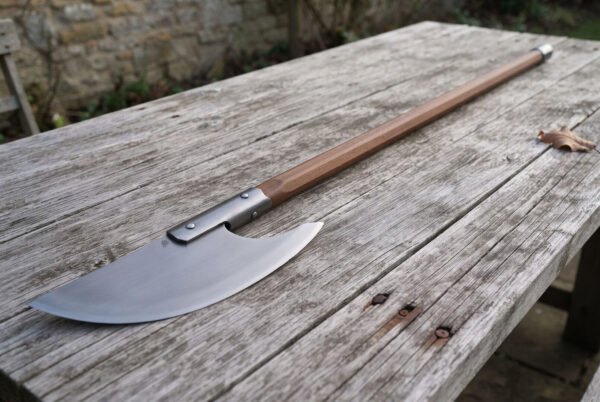
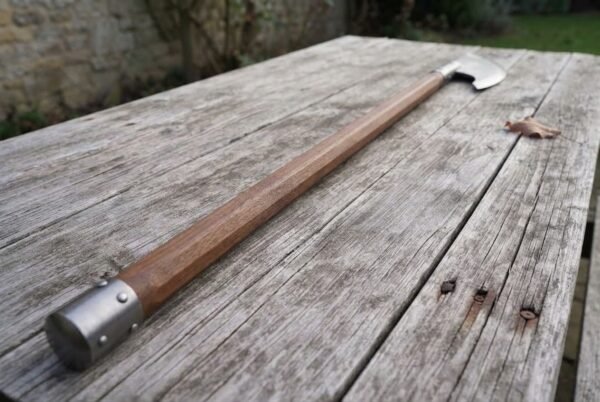
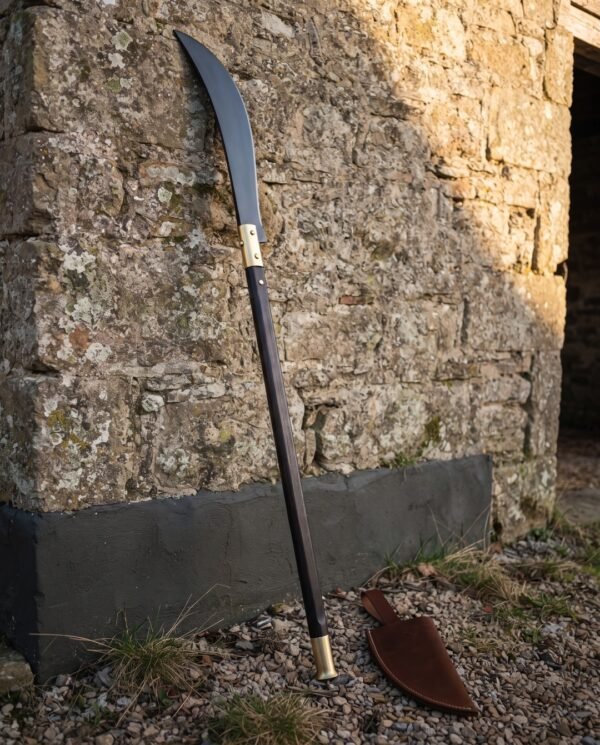
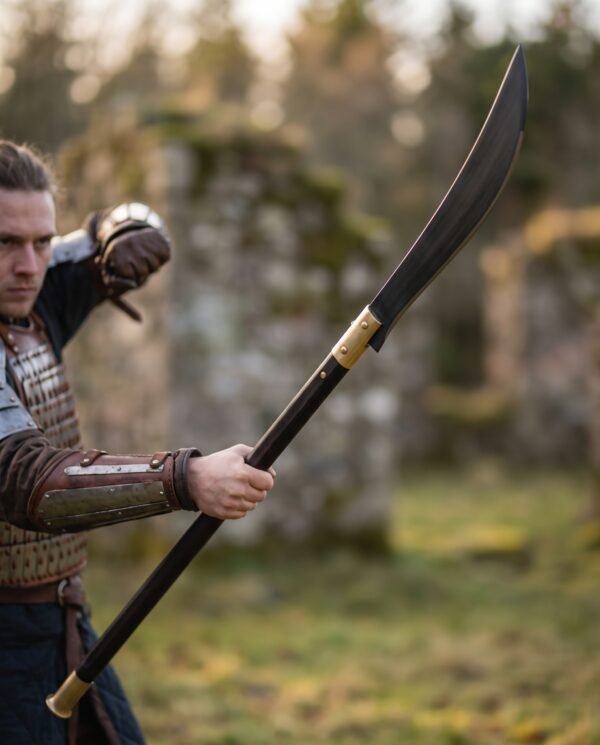
A glaive is a single edged blade set in line with a pole, and it is the closest thing the medieval armoury has to a sword on a stick. This one carries a twenty inch curved blade of 1095 high carbon steel, polished bright, socketed onto a pale ash stave with a steel ferrule at the butt. The glaive turns up across Europe from the thirteenth century onward under a dozen local names, and its appeal was always the same. A spear only threatens what is in front of it. A glaive threatens everything its edge can sweep through on the way there.
Forged, heat treated and finished by hand in the Czech Republic, hardened and drawn to 54 to 58 HRC. It ships free anywhere in the United States and it can be engraved with Elder Futhark runes or a Viking pattern of your choosing before it leaves the bench.
Specifications
| Steel | 1095 high carbon steel, polished |
|---|
| Hardness | 54 to 58 HRC |
|---|
| Overall length | 56 inches |
|---|
| Blade length | 20 inches, single edged and curved |
|---|
| Blade shape | Broad blade with a concave back that flares out to an upswept point, small stamped mark near the socket |
|---|
| Mounting | Steel socket fixed to the haft with two rivets |
|---|
| Haft | American ash, pale natural finish |
|---|
| Butt | Steel butt ferrule |
|---|
| Weight | approximately 4.4 lb |
|---|
| Sheath | None |
|---|
| SKU | RK-1372 |
|---|
Why the blade curves
Take a straight blade and swing it at something. The edge meets the target square, all along its length at once, and every part of it has to push straight in. Now curve the blade. The edge now meets the target at one point and that point travels along the curve as the swing continues, so the blade slices rather than shoves. That is a draw cut, and it is dramatically more efficient, which is why nearly every blade designed primarily to cut ends up curved somewhere in its history.
On a pole the effect is amplified, because the tip of a glaive is moving very fast at the end of a long arc. The curve also solves a practical problem. A straight edged blade on a five foot pole tends to bind in whatever it has cut into and stop the glaive dead. A curved edge keeps travelling along its own arc and comes out the other side. The flare toward the tip on this blade puts the mass where the speed is, so the cut lands with authority without making the glaive nose heavy to carry.
Why 1095 high carbon steel and not stainless
Every plain steel piece in this group is forged from 1095, a simple high carbon steel with roughly one percent carbon and very little else in it. That plainness is the point. A steel with nothing but iron and carbon to argue about moves predictably under the hammer, takes a clean quench, and comes back to a hardness a smith can actually hold to. These are hardened and drawn to 54 to 58 HRC, which is deliberately a touch softer than a kitchen knife. A head that has to survive impact wants to bend and rebound rather than chip, and 1095 in that range absorbs a bad hit instead of losing a piece of itself.
Stainless alloys buy their rust resistance with chromium, and above about thirteen percent that chromium ties up carbon in carbides that make the steel harder to forge and more brittle at the edge. On a small folding knife that trade is fine. On a head that lands with the weight of a haft behind it, it is not. The cost of choosing 1095 is that it will rust if you leave it wet. Wipe it, oil it, and it will outlast you. There is more on that trade in our guide to Damascus versus stainless.
The ash haft
The haft is American ash, the same timber that goes into tool handles and baseball bats, and it is here for one reason. Ash has long straight fibres that run the length of the stave, which means it flexes under a shock load and returns instead of snapping across the grain. That flex is what keeps a heavy head from beating your hands. It is turned, sanded and finished with oil rather than lacquer, so the grain stays open and the surface grips a dry hand instead of sliding.
Oil finishes want feeding. Once or twice a year, wipe on a thin coat of boiled linseed or a hardwood handle oil, let it soak for twenty minutes and wipe the surplus off. Do not leave it standing in a damp corner or propped against a masonry wall, because wood pulls moisture out of stone and the fit at the head will loosen. Our guide to wooden handle care covers the routine.
Engraving, runes and your own design
Use the rune converter on this page to turn a name, a date or a short phrase into Elder Futhark and we will cut it into the steel or the handle. If you would rather have a Viking pattern than a rune line, choose your own design in the engraving option above the add to cart button and tell us whether it goes on the blade or the handle. Where a piece already carries an engraved design, your chosen engraving replaces it rather than sitting alongside it.
Engraving is cut by hand after the piece is finished and before final oiling, so keep the line short and let it sit where the eye already goes. Names, dates, a line of a poem, a maker mark, a unit or a crew number all work. If you are unsure where a line should sit, send us the text and we will suggest a placement before we cut. Full details and examples are on the engraving page.
Care and sharpening
Carbon steel rusts. That is the only demanding thing about owning it. Wipe the steel down after handling, because fingerprints are salt and moisture and they will etch a bright surface in a week if you let them sit. A thin film of mineral oil, gun oil or paste wax on the metal is enough to keep it stable indoors. If the piece lives on a wall in a room that swings between damp and dry, check it every few months and re oil. Left alone in a garage or a basement it will spot, and once it spots the mark is permanent even after the rust is removed.
The edge is finished sharp from the forge and does not need attention until it stops biting. When it does, a coarse then fine whetstone, kept wet, held at the angle the bevel already carries, will bring it back in a few minutes. Do not take a powered grinder to it. Our guides cover steel care and sharpening with a whetstone in more detail.
Made in the Czech Republic
This piece is made by hand in the Czech Republic, in a workshop that still works the old way. The steel is forged, ground, heat treated and finished by smiths who learned the trade from the people before them, and the wood, horn and leather are cut and fitted by hand rather than pressed out on a line. That is also why no two pieces come out exactly the same.
Ransack Viking is a United States company. We import these pieces ourselves, check every one when it lands and ship from our warehouse in Chicago, Illinois. Engraving is done here in the United States after the piece arrives, so your runes or your own design go on before it leaves for you.
A note on handmade variation
This is hand forged. It is not machine made, not cast and not bulk produced, so what arrives will not be a pixel for pixel copy of the photograph on this page. The grain of the wood, the tone the steel takes from the fire and the oil, the exact run of a pattern, the precise curve of a profile, all of it shifts a little from one piece to the next because each one is worked by hand from natural materials. Two hafts cut from the same board will not read the same. Two etched blades from the same billet will not carry the same swirl.
What does not change is the specification. Dimensions, steel, hardness, fittings and build are the same every time. The character is the part that is yours alone, and it is the reason to buy something forged rather than something stamped.
Frequently asked questions
Is it sharp?
Yes. The full twenty inches of edge is ground and honed to a working sharpness and the point is finished as a point. This is a live blade on a long lever, so keep it out of reach and handle it by the haft.
What is the difference between this and a naginata?
Very little in principle and quite a lot in execution. A naginata has a differentially hardened tang seated deep in the haft, a shorter and more strongly curved blade, and a different balance. A glaive is socketed and blunter in profile.
Can I have runes engraved on it?
Yes. Use the rune converter on this page for Elder Futhark or choose your own Viking pattern. A glaive blade gives you twenty inches of clean flat, which is the best engraving surface on any polearm we make.
Will mine look like the photograph?
The blade profile, length and steel will match. The ash grain differs on every stave and a hand ground twenty inch curve carries its own faint grinding lines, so the light will run along yours a little differently.
Can I hang it on a wall?
Yes, and support it at two points rather than one. A single hook under the socket will slowly bow the haft. A bracket under the head and another on the lower stave keeps a five foot polearm straight for decades.
How long does shipping take?
Two to three business days if it is in stock, two to three weeks if it is being made or engraved. It ships braced in a long carton with the blade wrapped, free anywhere in the United States.
What is in the box
- One hand forged glaive in 1095 high carbon steel
- American ash haft with riveted steel socket and butt ferrule
- Care, oiling and sharpening notes
- Forged and finished in the Czech Republic
Explore the range
More in glaives and polearms, halberds, poleaxes and Norse arms, and read the guides.
Close to this one
In the same category sits the Ravenreave polearm, 62 inches overall. A near match for this one is the Moonreave polearm, 54 inches overall. Closest to this in the range is the Tidecleave polearm, 54 inches overall.
Fitting out further, the Ashwarden halberd belongs with it. Nothing here exactly right, build one to your own spec on the custom Norse arms page.

This is exactly what I wanted and then some. Steel head is heavy in a good way. You can tell it’s not hollow. Haft feels sturdy and well balanced for the size of the head. Beyond happy with how this turned out.
Been eyeing this polearm for months and it did not disappoint. Came in solid packaging and arrived in perfect condition. I keep coming back to Ransack Viking because it’s always this good. Couldn’t be happier with this.
Did not expect this level of quality for the price. Finish on the metal is even and clearly hand forged. Love it.