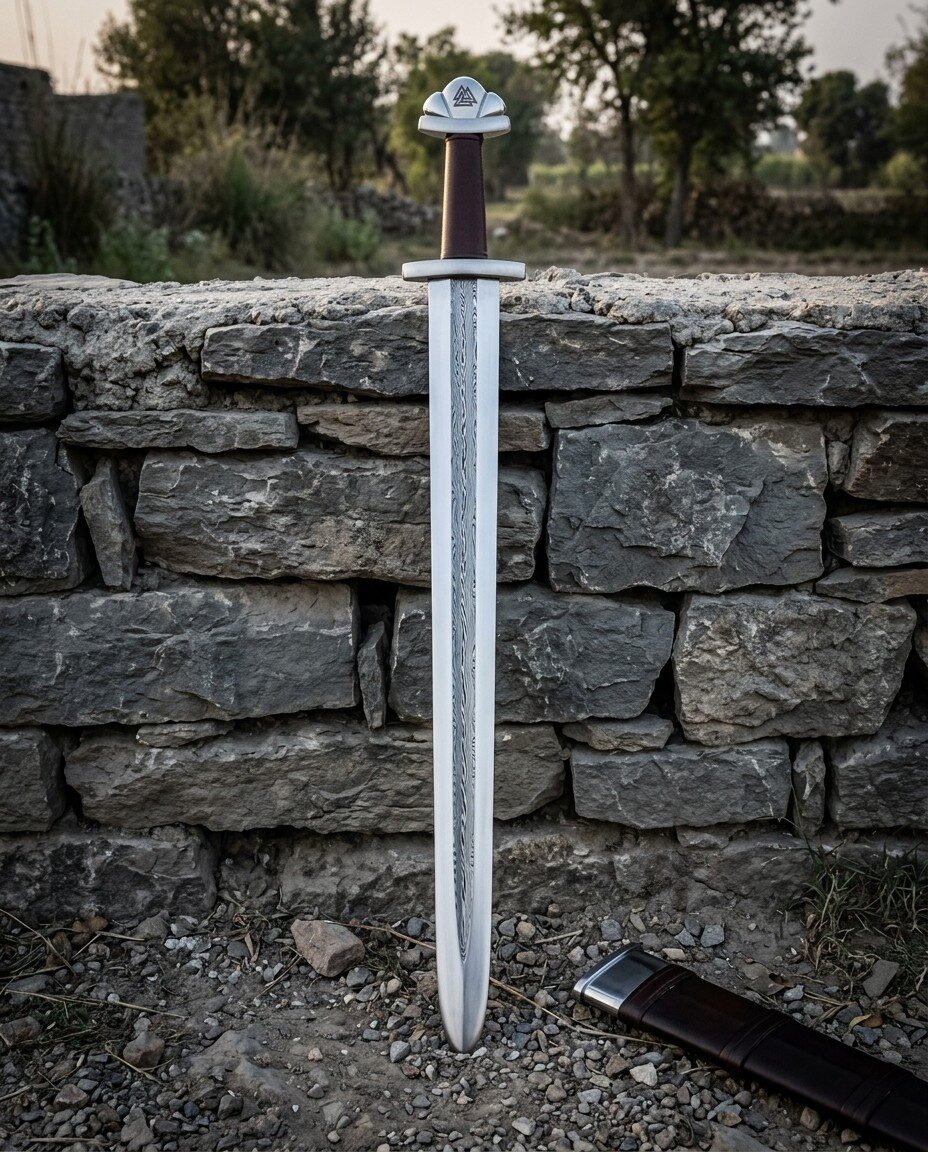
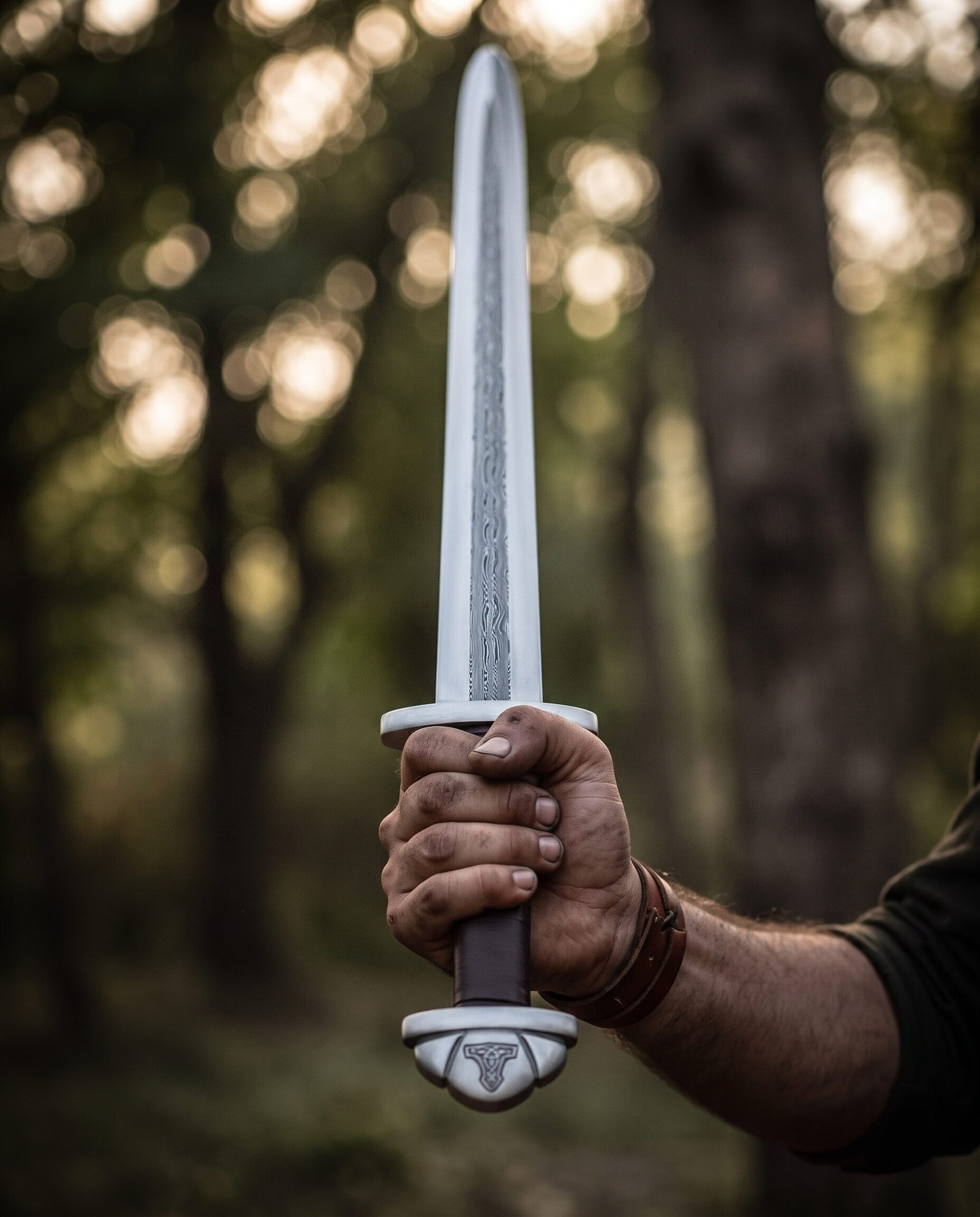
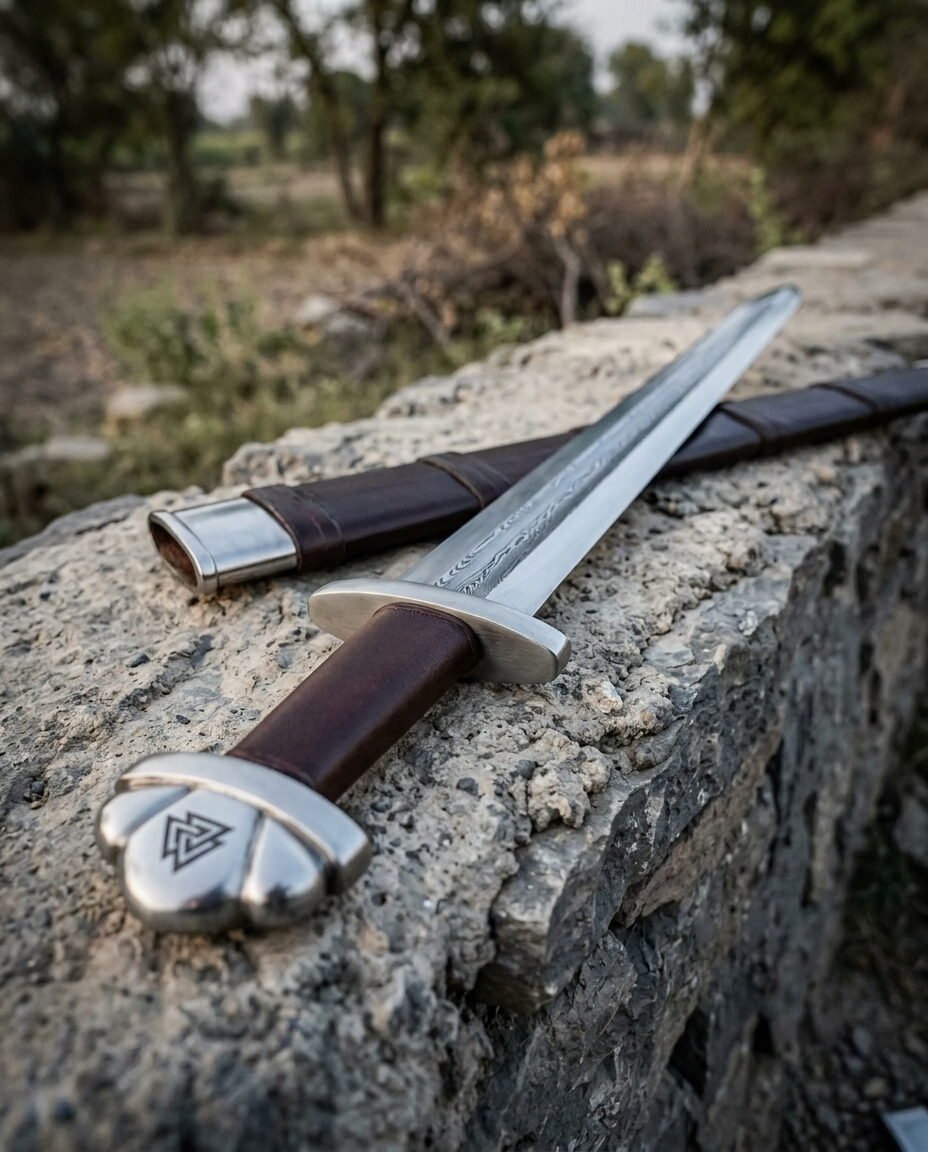
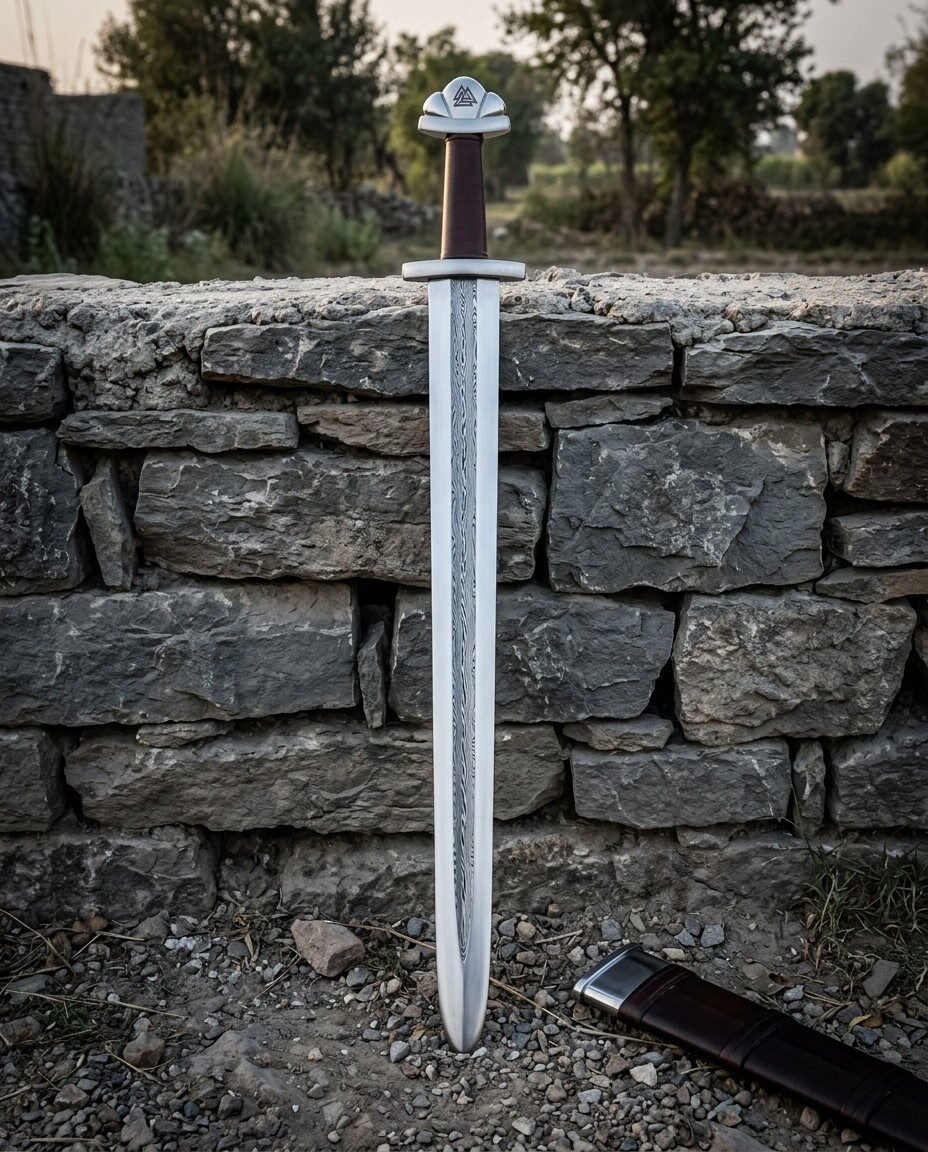
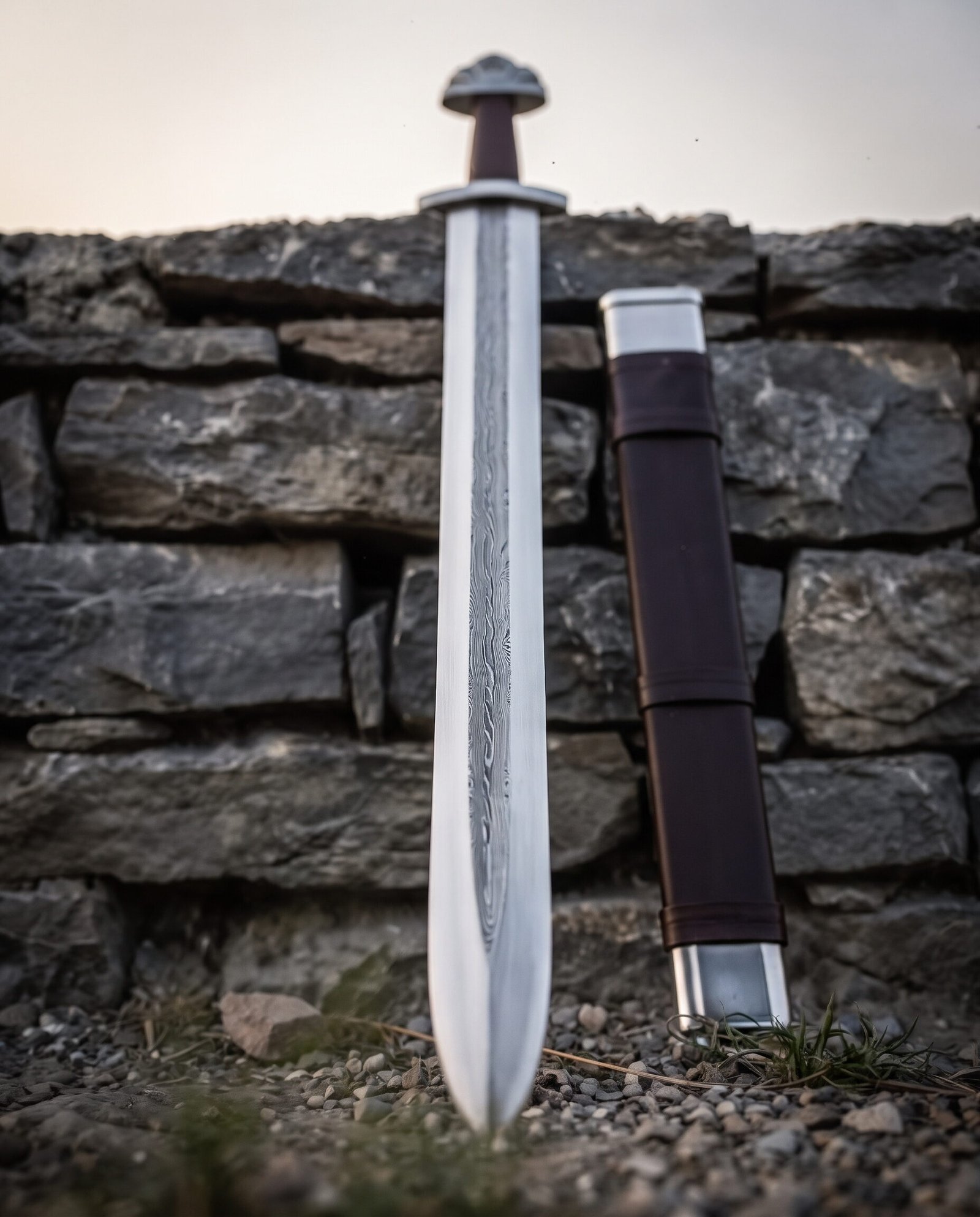
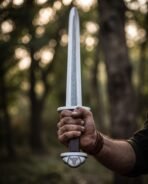
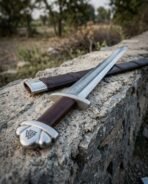
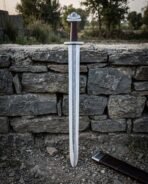
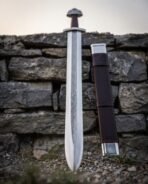
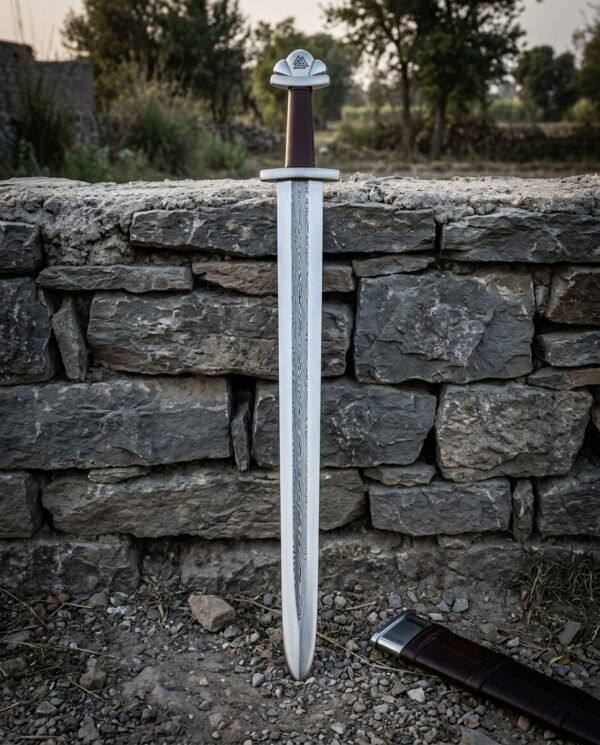
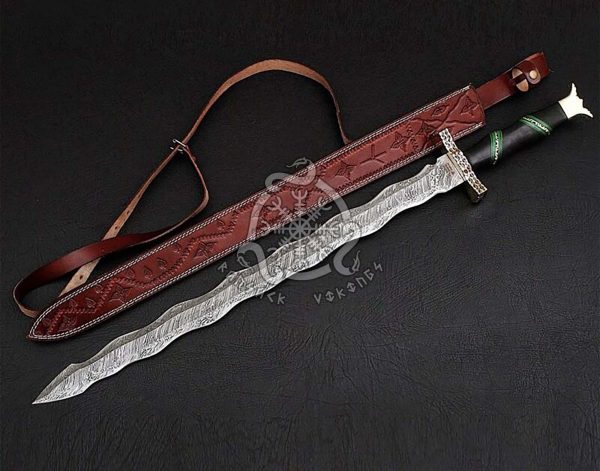
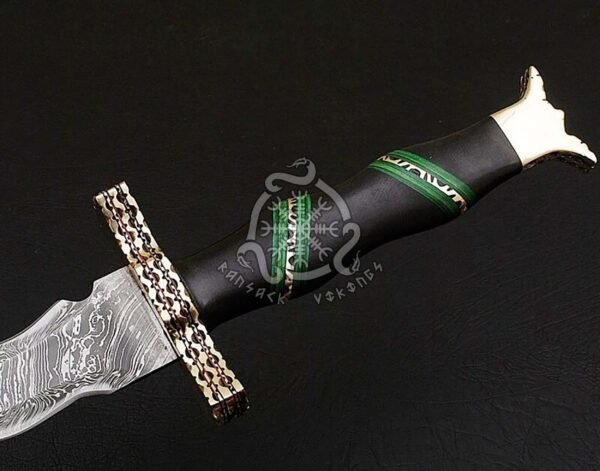
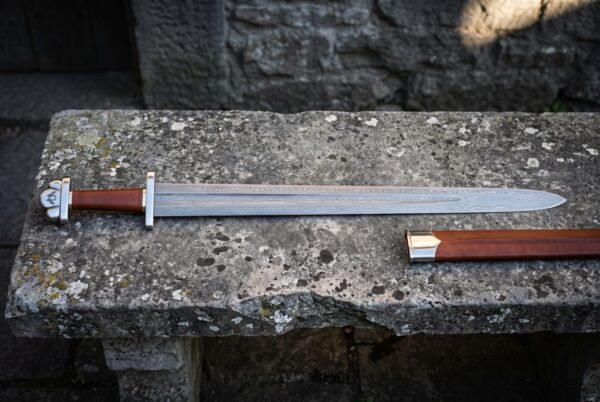
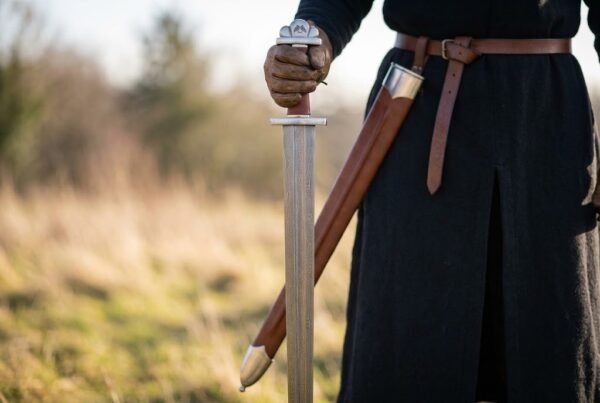
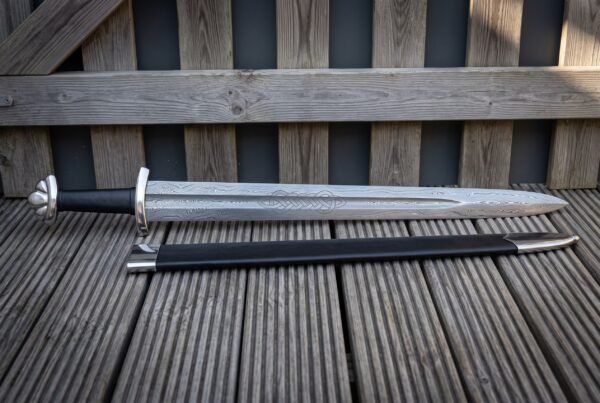
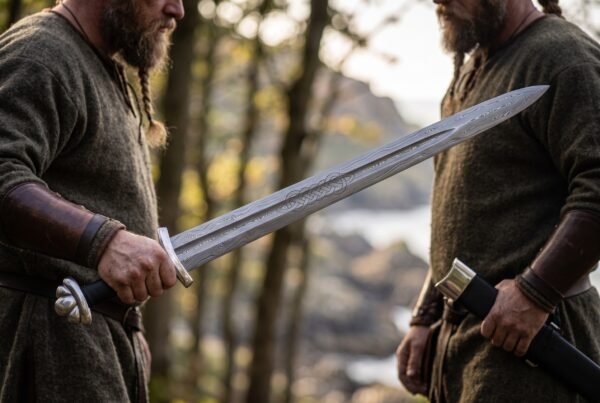
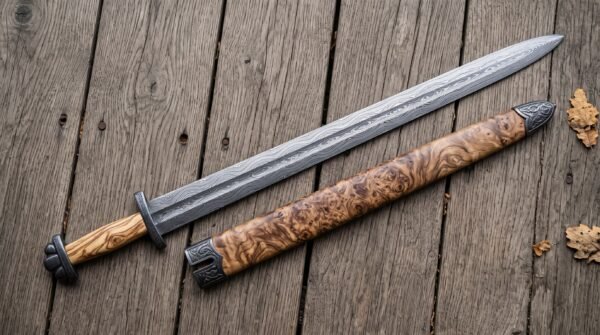
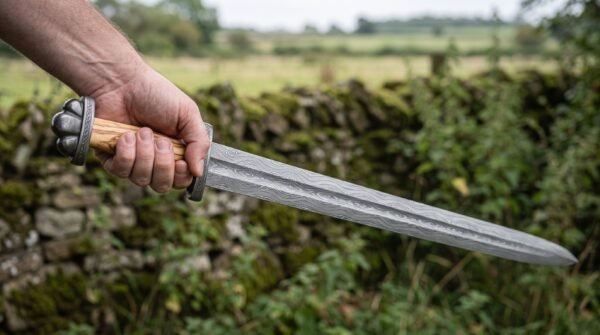
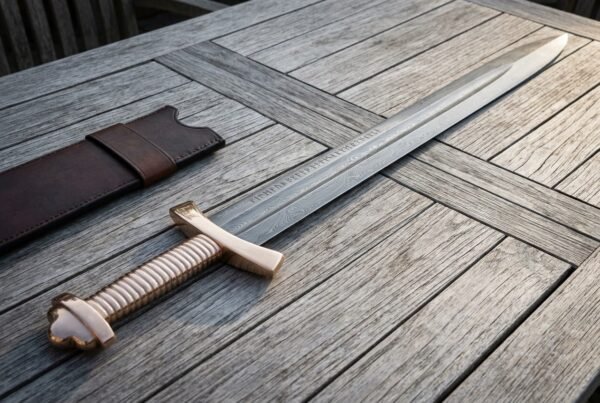
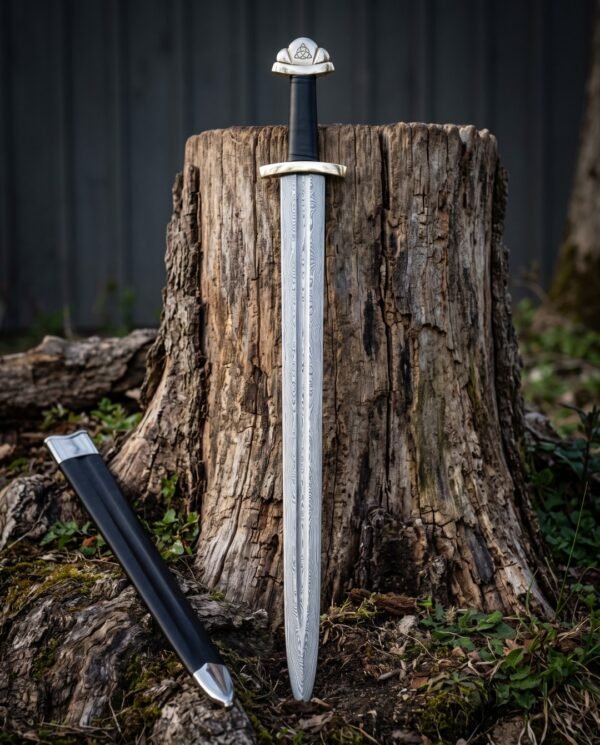
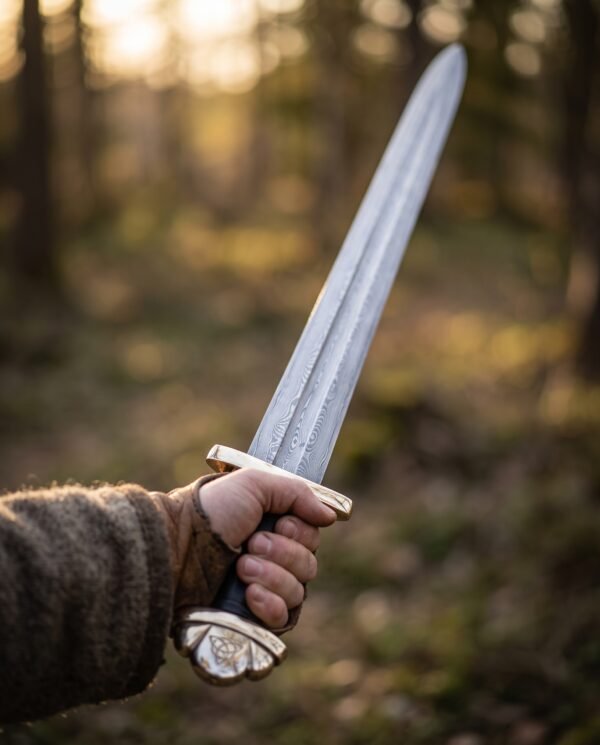
The Wyrmfall is a hand forged damascus viking sword with a serpentine pattern running the length of the blade core and plain polished edge bevels welded on either side of it. The pommel is a broad lobed cap with a Valknut set into the centre, the guard is short and straight, and the grip is wrapped in warm brown leather over a wooden core. It comes with a dark brown leather scabbard with a steel throat and chape.
The Norse had a word for exactly this blade. Old English and Old Norse poetry describe pattern welded swords as worm bright, or snake marked, because the twisted rods in the core surfaced as long writhing lines that look like adders under water. That was not a poetic flourish invented later, it was the plainest possible description of what a warrior saw when he tilted a blade towards the firelight. On the Wyrmfall the same effect comes from the same method, rods of two steels welded and twisted and then ground flat. It is forged, ground, hardened and assembled in the Czech Republic, and it ships in its scabbard with a care card. You will find it filed with the Damascus swords, along with the rest of the Viking swords.
Specifications
| Material | 1095 and 15N20 damascus steel, hardened to 58 to 60 HRC |
|---|
| Overall length | Approximately 37 inches |
|---|
| Blade length | Approximately 31 inches, double edged with a serpentine core panel |
|---|
| Grip | Approximately 4 inches, brown leather over a wooden core |
|---|
| Guard | Short straight polished steel guard |
|---|
| Pommel | Three lobed polished steel pommel with an inlaid Valknut |
|---|
| Finish | Etched damascus core with satin polished edge bevels |
|---|
| Scabbard | Dark brown leather over a wooden liner with raised bands, polished steel throat and chape |
|---|
| Weight | Approximately 2 lb 14 oz bare |
|---|
| Included | Sword, leather scabbard, care card |
|---|
| SKU | RK-1654 |
|---|
The Valknut and what it was actually used for
The Valknut is three triangles interlocked so that no one of them can be lifted free of the other two. It survives on the Stora Hammars picture stones on Gotland, on the Tangelgarda stone, and on the carved bed post from the Oseberg ship burial. What links those places is not battle. It is death and burial. On the Gotland stones it sits beside scenes that read as sacrifice and as passage from one world to the next, which is why most scholars connect it with Odin in his role as the god who receives the slain rather than with luck or protection in the modern sense.
Nobody knows what the Norse called it. Valknut is a modern Norwegian compound meaning knot of the slain, coined by antiquarians in the nineteenth century. Anyone who tells you it carried a specific documented meaning in the tenth century is telling you more than the evidence supports. What can be said honestly is that it belonged to the highest status objects of the period, which is exactly where it sits on this sword.
The steel and the weld
Two alloys go into the core, 1095 high carbon steel and 15N20 which carries nickel. They are stacked, forge welded at a bright orange heat, drawn out, twisted along the axis and welded up again, then ground flat so the twist is cut through at a shallow angle. The edge bevels are welded to either side of that core and the whole blade is normalised, hardened and tempered to 58 to 60 HRC. A ferric etch at the end darkens the 1095 and leaves the 15N20 bright.
The hardness range matters on a blade this long. Softer than 58 and the sword will take a permanent bend if it is levered sideways. Harder than 60 and a long thin section becomes brittle enough that a knock at the tip chips instead of flexing. The middle of that band gives a blade that holds an edge and still comes back straight.
Engraving, runes and your own design
Use the rune converter on this page to turn a name, a date or a short phrase into Elder Futhark and we will cut it into the steel, the leather or the wood. If you would rather have a Viking pattern than a rune line, choose your own design in the engraving option above the add to cart button and tell us where it goes. Where a piece already carries an engraved design, your chosen engraving replaces it rather than sitting alongside it. On the Wyrmfall the Valknut in the pommel is inlaid rather than surface cut, so most owners put their rune line on the flat of the blade near the guard or on the leather of the scabbard throat. Details are on the engraving page.
Handling and balance
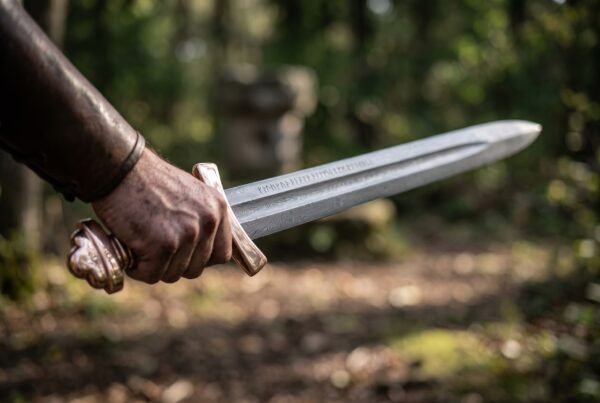
The balance point sits about five inches ahead of the guard. That is a touch further forward than the Runemarch and it gives this sword a heavier, more deliberate feel in the cut, which suits the wider blade. The grip is a single hand fit, snug between the guard and the pommel, and the pommel is meant to sit against the heel of the palm rather than floating behind it.
This is a sharpened hand forged sword sold as a collector and display piece and for careful solo handling. It is not for sparring, it is not for full contact work against another blade, and it should never be swung near other people. Store it out of reach of children.
Care
Damascus is high carbon steel and it will rust. Wipe the blade down after every handling session, because a fingerprint left overnight in a humid room will start etching itself into the surface, and lay a thin film of mineral oil on the steel before it goes back into the leather. Do not leave the sword sheathed for months in a damp room. A light non abrasive polish followed by fresh oil restores the contrast if the etch dulls. Feed the scabbard leather twice a year with a neutral cream. More detail is on steel care.
Made in the Czech Republic
This piece is made by hand in the Czech Republic, in a workshop that still works the old way. The steel is forged, ground, heat treated and finished by smiths who learned the trade from the people before them, and the wood, horn and leather are cut and fitted by hand rather than pressed out on a line. That is also why no two pieces come out exactly the same.
Ransack Viking is a United States company. We import these pieces ourselves, check every one when it lands and ship from our warehouse in Chicago, Illinois. Engraving is done here in the United States after the piece arrives, so your runes or your own design go on before it leaves for you.
A note on handmade variation
This sword is hand made, not machine made or bulk produced, so what arrives will not be a pixel for pixel copy of the photograph. The serpentine pattern comes from how that particular billet twisted under the hammer, so the waves will be wider or tighter and will break in different places. The leather takes dye differently from hide to hide. The lobes on the pommel are filed by hand and will not be identical to the millimetre. The length, the steel, the heat treat and the geometry are the same every time. The character is not. More on the Viking swords collectors go for elsewhere on the site, along with the arms in Vikings and The Last Kingdom.
Frequently asked questions
Is this sword sharp
Yes. Both edges are sharpened by hand before it leaves the shop. Open the box with that in mind and keep it out of reach of children.
What does the Valknut on the pommel mean
Three interlocked triangles associated with Odin and with the passage from life to death. The honest answer is that its exact tenth century meaning is not recorded.
Is the scabbard included
Yes. The brown leather scabbard with its wooden liner and steel chape is part of the price.
Can I display it on a wall
Yes. Use a bracket or horn mount rated for at least three pounds and set it where nobody can pull it down.
How is this different from a plain steel viking sword
The core is pattern welded rather than a single alloy, which is why it costs more and why the surface carries a pattern that runs through the thickness of the steel.
How long will I wait for it
One to two weeks of forging and finishing, then free shipping inside the United States.
What is in the box
- Wyrmfall damascus viking sword with an inlaid Valknut pommel
- Dark brown leather scabbard with a wooden liner, polished steel throat and chape
- Care card for high carbon damascus steel
- Leather feed note for the scabbard
- Lifetime warranty against defects, no receipt needed
- Forged and finished in the Czech Republic
Explore the range
Browse the other damascus swords, the rest of the viking swords, everything under swords, and the guides for what pattern welding does to a blade.
Other pieces in this group
For a straight comparison, see the Valkbraid Viking sword, pattern welded Damascus. Worth putting side by side with this is the Trinefold Viking sword, pattern welded Damascus. In the same category sits the Staveholm Viking sword, 35 inches overall.
From the same corner of the shop, there is the Shellcrown longsword. Nothing here exactly right, build one to your own spec on the custom Viking sword page.

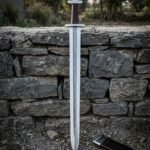
Incredible craftsmanship on this one. The wood handle feels amazing and the balance is perfect. This will be a family heirloom for sure.