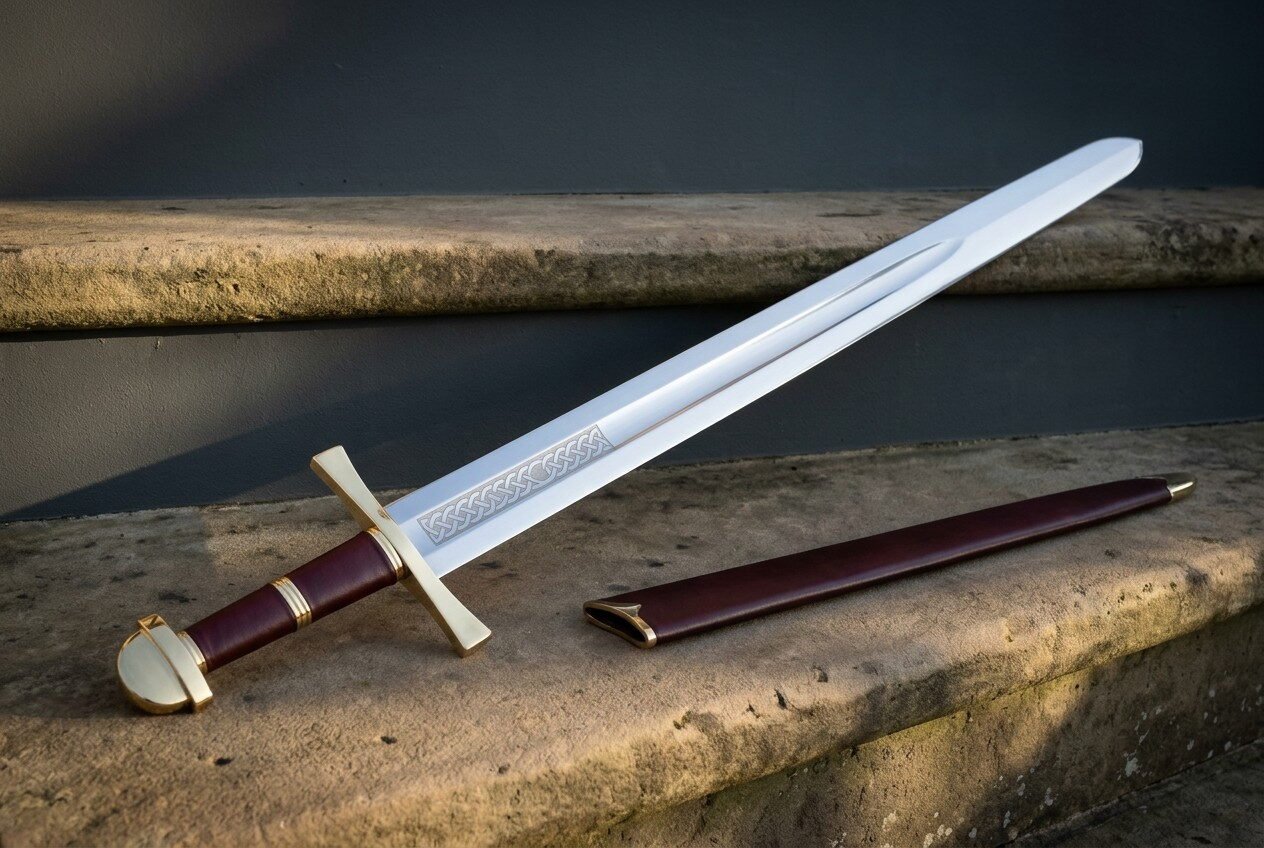
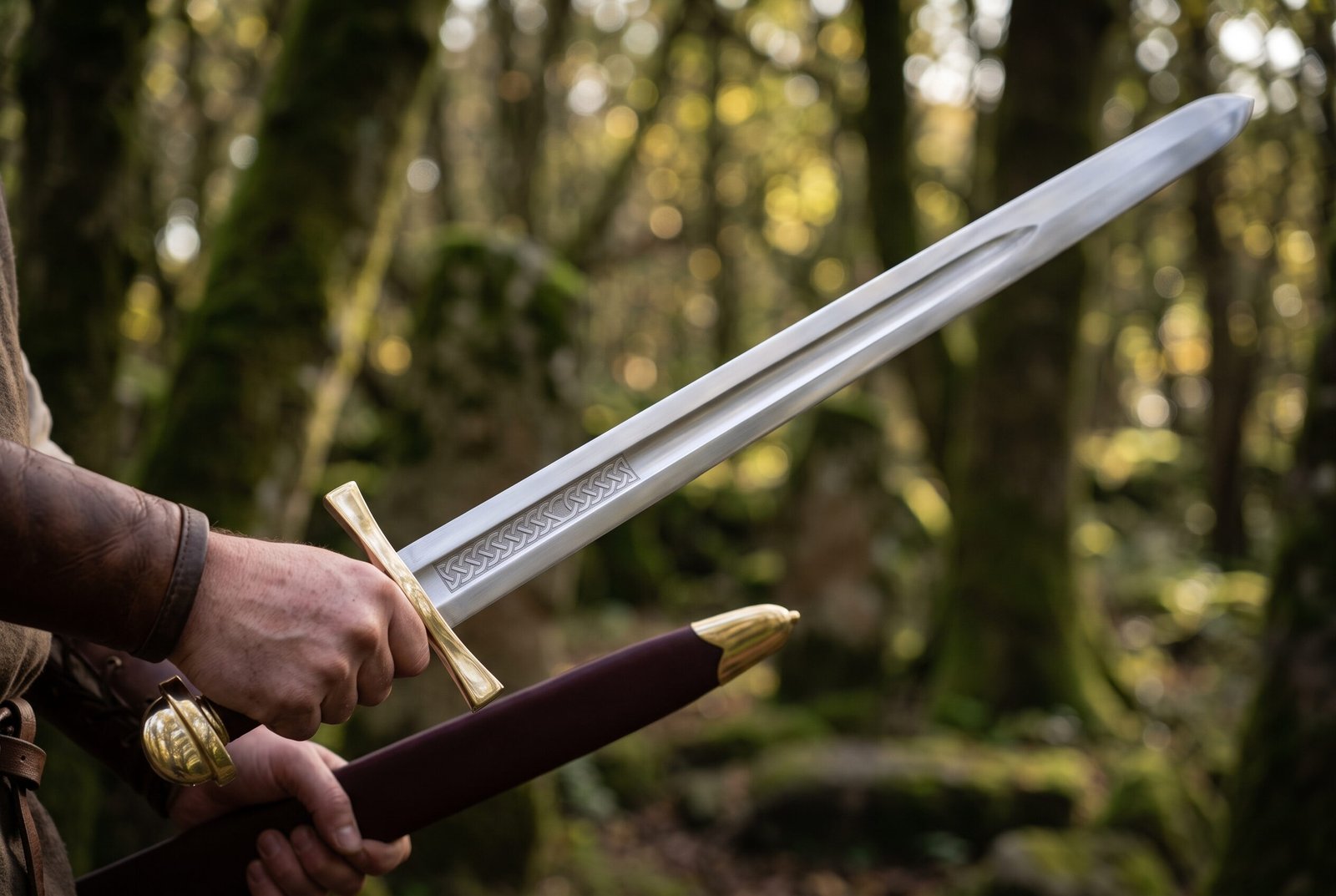
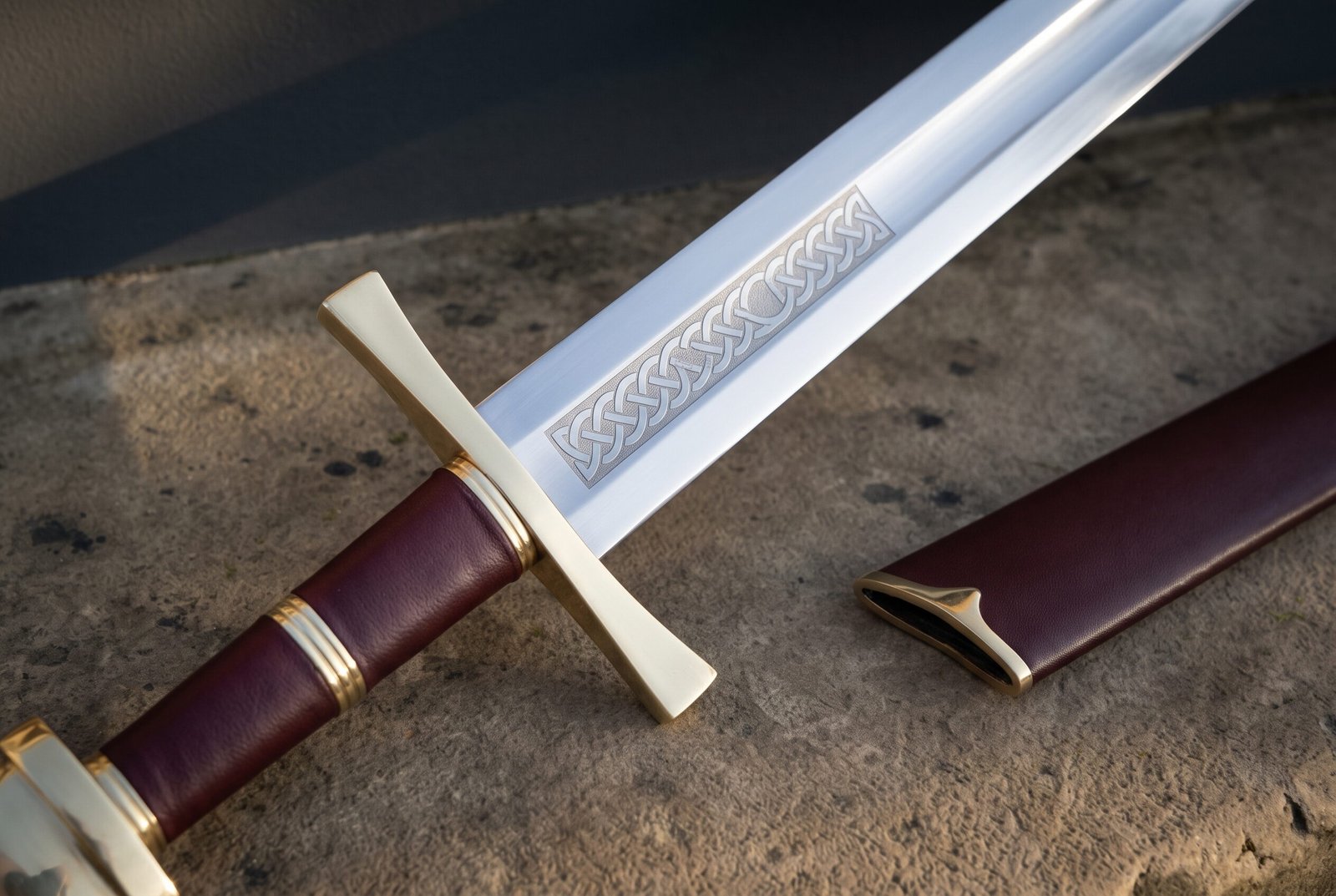
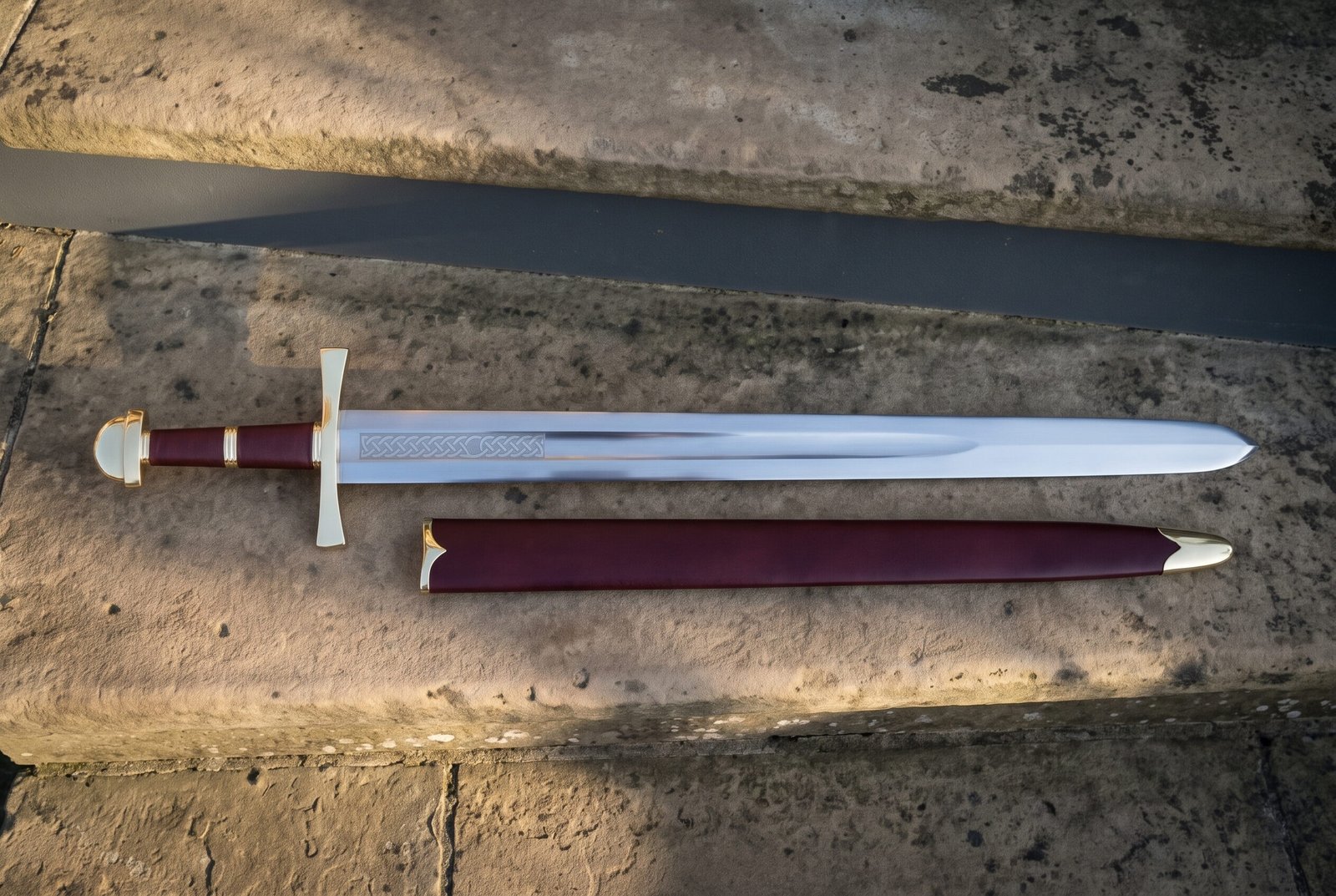
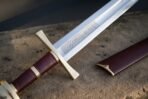
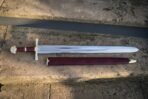
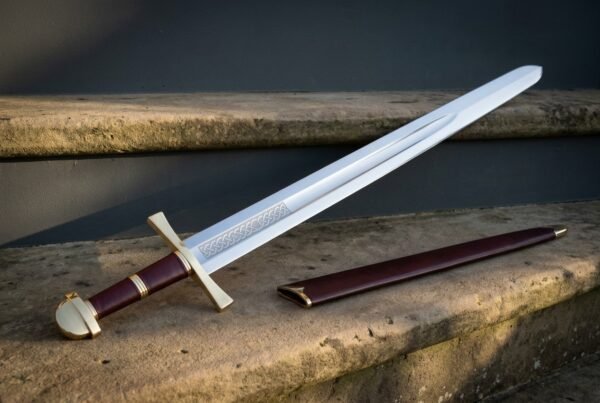
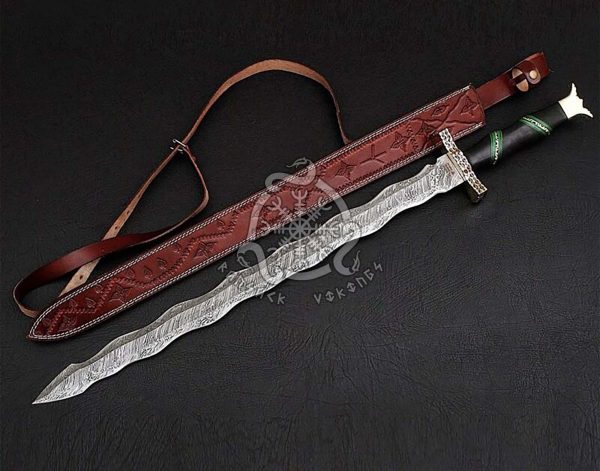
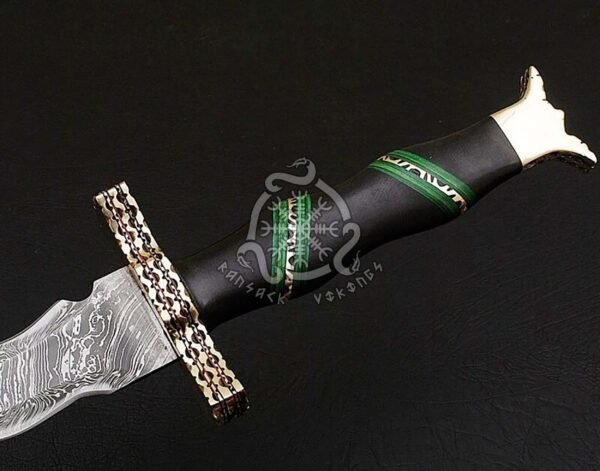
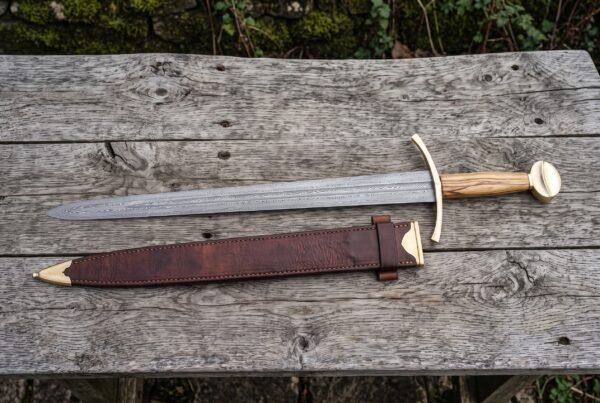
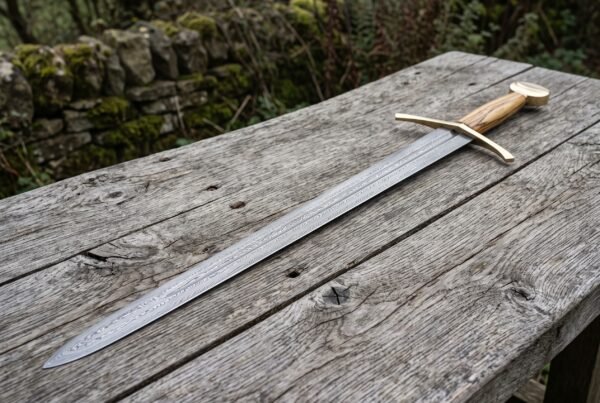
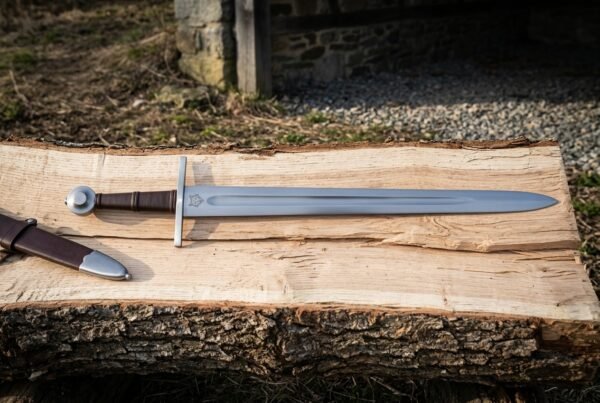
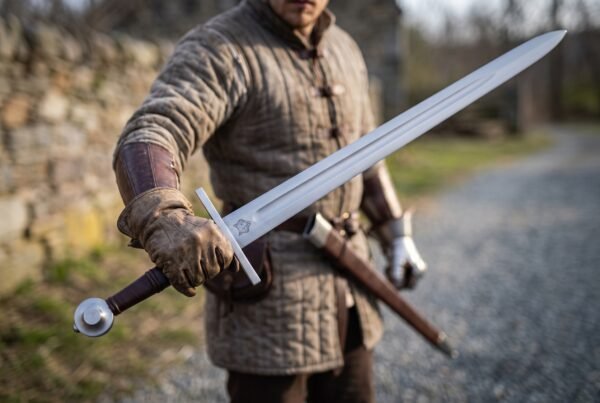
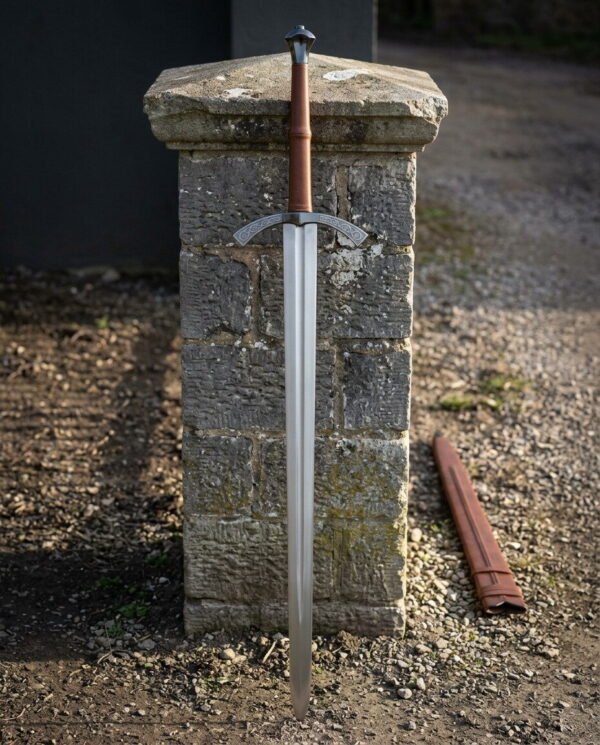
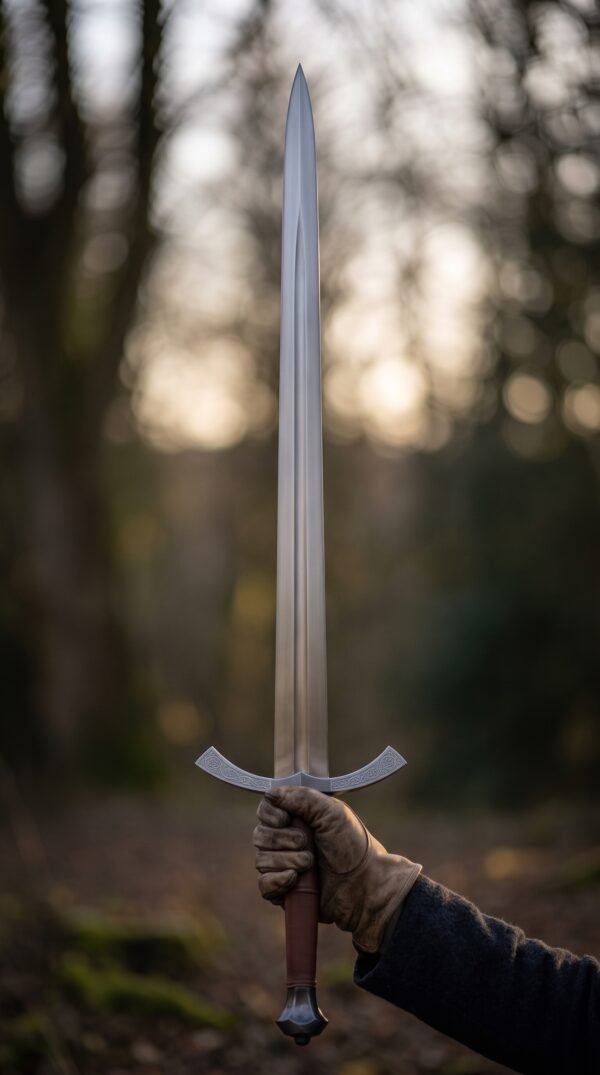
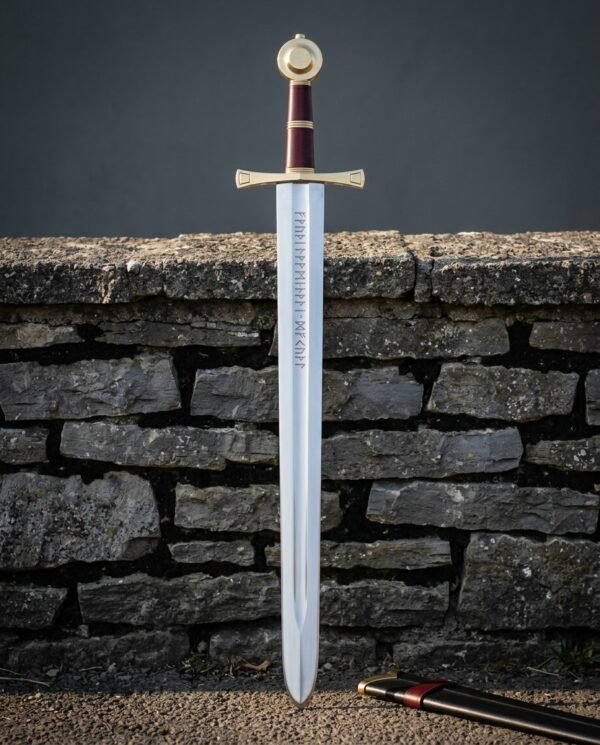
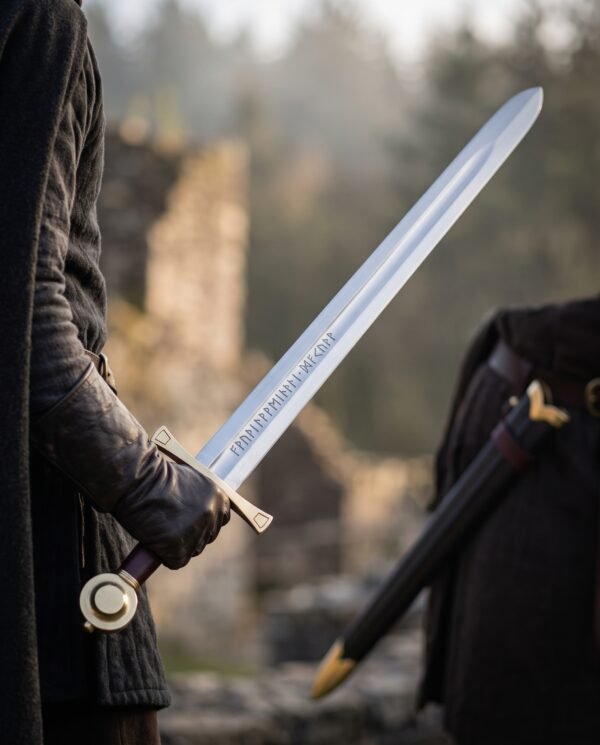
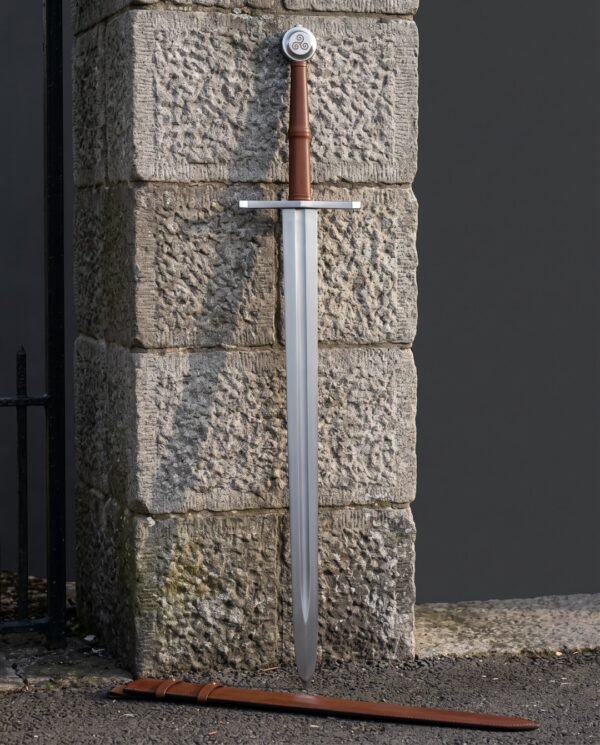
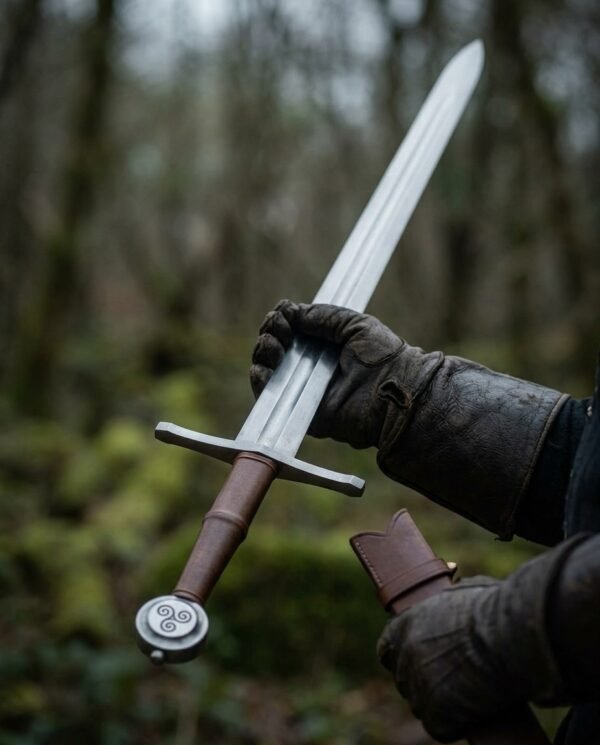
This is a knightly arming sword dressed in brass. The blade is a long, gently tapering double edged cutter with a narrow fuller running from the ricasso toward the tip, satin polished, and carrying a panel of engraved knotwork on the flat just below the guard. The crossguard is a solid brass bar with flared ends, the grip is bound in oxblood leather over a wooden core and ringed with two brass bands, and the pommel is a brass half disc peened over the tang. It ships with a matching oxblood leather scabbard with a brass throat and chape.
Brass on a sword was never only about looks. Medieval fittings in copper alloy were common because brass is dense, does not rust, and can be cast to a finished shape rather than forged and filed. A cast brass pommel of a given size weighs noticeably more than a steel one of the same dimensions, which means a smith could buy back balance without making the pommel comically large. That is why so many surviving swords with slim, elegant pommels turn out to have them in copper alloy rather than iron.
Forged, ground, heat treated, fitted and finished by hand in the Czech Republic, and shipped with its scabbard. It is catalogued with the arming swords, and the short swords sit one click away.
Specifications
| Blade steel | 1095 high carbon, hardened to 54 to 58 HRC |
|---|
| Overall length | 37 inches nominal |
|---|
| Blade length | 31 inches nominal, double edged |
|---|
| Blade profile | Tapering cutter with a central fuller and an engraved knotwork panel at the ricasso |
|---|
| Guard | Solid brass crossguard with flared terminals |
|---|
| Grip | Oxblood leather over a wooden core, banded with two brass rings |
|---|
| Pommel | Cast brass half disc, peened over the tang |
|---|
| Finish | Satin polished blade, polished brass fittings |
|---|
| Scabbard | Oxblood leather with brass throat and chape |
|---|
| SKU | RK-1774 |
|---|
How a sword is actually held together
Almost everything people worry about with a sword comes down to one detail they cannot see. The blade does not stop at the guard. It continues as a narrower bar of the same piece of steel, called the tang, all the way through the guard, through the grip core, and out of the top of the pommel. Blade and tang are one piece. There is no joint anywhere along the length.
At the top, the last quarter inch of tang is heated and hammered outward over the pommel until it spreads into a rivet head that cannot pull back through. That is peening, and it is how swords have been assembled since the Bronze Age. A peened sword is under permanent compression. The guard, grip and pommel are squeezed together as one solid column, which is why a properly built sword rings when you tap it instead of buzzing.
The alternative is a threaded tang with a pommel nut. It is cheaper, and it works until vibration backs the nut off and the grip starts to rattle. This sword is peened. It cannot be taken apart afterwards, which is the whole point.
If you ever want to test a sword you are considering buying anywhere, hold it by the blade and tap the pommel firmly against the heel of your hand. A well built sword feels dead solid. A rattle or a click means the assembly is loose.
Steel, brass and the engraved panel
The blade is 1095 high carbon steel run between 54 and 58 HRC. On a blade this long the toughness matters more than the last increment of edge holding, because a sword is a lever and a lever must be allowed to flex. In that range the blade will take a bad angle, bend and return straight rather than take a set or crack.
The fittings are solid brass rather than plated steel. Brass will not rust, it takes a mirror polish, and it darkens slowly to a warm antique gold that most owners end up preferring to the bright finish. Because it is soft, it will also mark if you knock it against stone, and those marks are permanent. That is the trade.
The knotwork panel on the ricasso is engraved into the steel, not etched on with acid and not printed. Engraved lines have a V section with bright cut walls, so the pattern catches light from one direction and disappears from another. Acid etch is flat and grey by comparison. You can feel the difference with a fingernail.
Engraving, runes and your own design
Use the rune converter on this page to turn a name, a date or a short phrase into Elder Futhark and we will cut it into the steel, the leather or the wood. If you would rather have a Viking pattern than a rune line, choose your own design in the engraving option above the add to cart button and tell us where it goes. Where a piece already carries an engraved design, your chosen engraving replaces it rather than sitting alongside it.
This sword already carries knotwork at the ricasso, so if you order engraving there your line takes the place of that panel. The other good options are the flat of the fuller further down the blade, the face of the brass crossguard, or a blind stamped line into the leather of the scabbard. See the engraving page.
Handling and balance
The dense brass pommel does what a heavy pommel is supposed to do and pulls the point of balance back toward the guard. Held with the thumb and forefinger pinching the ricasso above the crossguard, the sword turns on very little effort, which is how a single hand sword was meant to be steered.
The blade arrives sharp. It is a real forged cutting sword, not a display replica with a rolled edge. We do not offer it for full contact sparring or reenactment combat, which need blunted and rebated blades, and edge to edge contact with another hardened blade will chip any sword. Use it for controlled cutting against soft targets with a clear space around you, for collecting, or for display.
Draw it from the scabbard with the scabbard turned edge outward and your thumb clear of the throat. Brass throats have square edges and a careless thumb finds them.
Care
Wipe the blade after every handling and keep a thin film of mineral, gun or camellia oil on it. 1095 has no chromium and will spot from a fingerprint left over a week. Our steel care notes cover the routine in full.
Brass needs no protection from rust but it does tarnish. Leave it and it goes to a soft antique gold. Polish it with any metal polish on a soft cloth and it comes back bright in minutes. Do not use an abrasive pad, because brass scratches easily and the scratches show.
The leather grip and scabbard want a conditioner once or twice a year. Do not store the sword in the scabbard long term. Leather holds damp and the tanning is mildly acidic, so a blade left sheathed for months in a humid room will come out spotted.
Made in the Czech Republic
This is a handmade piece from the Czech Republic, made in a workshop that still forges, grinds and finishes by hand instead of stamping parts out. The smiths there have kept the older way of working, and the wood, horn and leather are shaped and fitted by hand as well. Two pieces of the same design will never be identical, and that is part of what you are buying.
Ransack Viking is a United States company. We handle the import ourselves, look over every piece when it lands and ship from our warehouse in Chicago, Illinois. Engraving is done in the United States after the piece arrives, so your design goes on before we send it out.
A note on handmade variation
This sword is hand made rather than machine made or bulk produced, so what arrives will not be a pixel for pixel copy of the photograph. Brass castings finish slightly differently from one to the next, the depth and rhythm of the engraved knotwork are cut by a hand rather than a program, and leather takes dye unevenly by nature, so the oxblood on the grip and scabbard can run anywhere from a deep wine to a browner red.
The steel, the hardness, the dimensions and the build are the same every time. The character is not. If you want the longer version, look at how to hang a blade on a wall and then at why a full tang matters.
Frequently asked questions
Is the pommel screwed on or peened?
Peened. The tang is hammered over the top of the brass pommel into a solid rivet head, so the whole assembly is permanently under compression and cannot rattle loose.
Is the brass solid or plated?
Solid cast brass, not plated steel. That is why it is heavy in the hand and why it will tarnish gently rather than flaking.
Does the scabbard come with a belt?
No. The scabbard has a brass throat and chape and is shaped to the blade, but it ships without a suspension belt. We sell belts separately.
Will my sword have the same colour leather?
It will be the same oxblood dye, but the exact shade varies across a hide. Expect a deep red brown that is close to the photograph rather than identical to it.
Can you replace the knotwork with my own engraving?
Yes. Anything you order in that position replaces the existing panel rather than sitting beside it. Tell us what you want in the engraving option.
Can I display it on a wall?
Yes, and it is the most common thing owners do. Hang it on two hooks rather than one so the blade sits level, and keep it out of direct sunlight to protect the leather.
What is in the box
- Gildwarden knightly arming sword, 1095 high carbon, sharpened
- Oxblood leather scabbard with brass throat and chape
- Light protective oil coat on the blade
- Steel, brass and leather care card
- Forged and finished in the Czech Republic
Explore the range
Browse the arming swords, the longswords, the full swords range, and the guides.
Also in this part of the catalogue
A near match for this one is the Emberdisc arming sword, 36 inches overall. Closest to this in the range is the Ashenwheel arming sword, 36 inches overall. If this one is not quite right, there is the Wolfbrand arming sword, 36 inches overall.
The Chainfell short sword covers the other half of the same kit. Or start from a blank sheet on the custom Viking sword page.
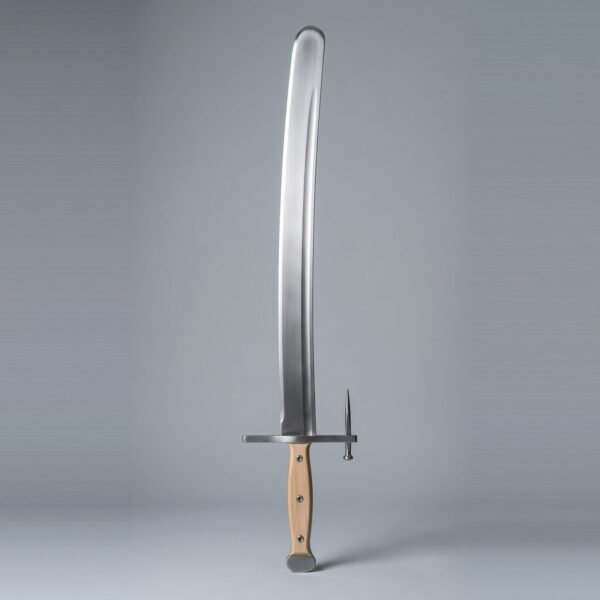
Collectors of this style may like the Jarnfeld langes messer, one of the four sharps in our HEMA line and not meant for sparring; our messer guide has more on it.

Nice piece for the price. Sheath is nice. Wish it had more padding but it does the job. Glad I made this purchase.